

Category: Art
“All art constantly aspires towards the condition of Pharoah Sanders”
Forward — Jacob Lawrence

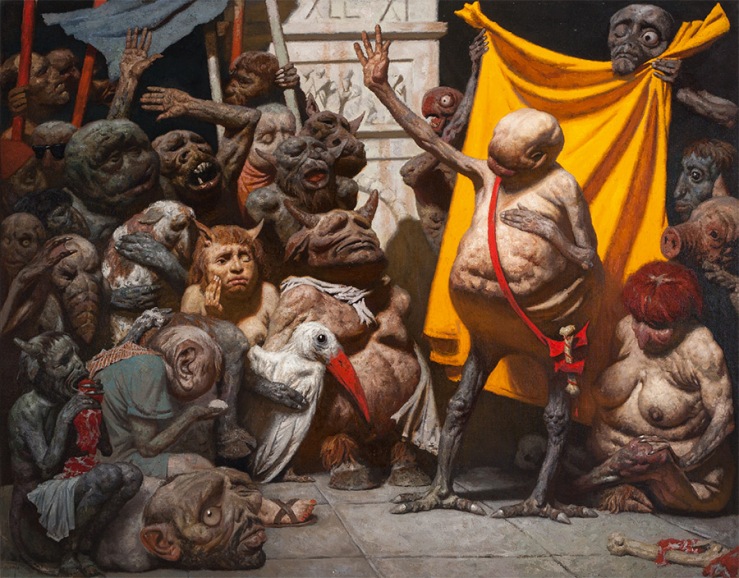
Mutants — Gely Korzhev
“Karintha” — Jean Toomer
“Karintha”
by
Jean Toomer
from Cane
Her skin is like dusk on the eastern horizon,
O can’t you see it,
O can’t you see it,
Her skin is like dusk on the eastern horizon
. . . When the sun goes down.
Men had always wanted her, this Karintha, even as a child, Karintha carrying beauty, perfect as dusk when the sun goes down. Old men rode her hobby-horse upon their knees. Young men danced with her at frolics when they should have been dancing with their grown-up girls. God grant us youth, secretly prayed the old men. The younger fellows counted the time to pass before she would be old enough to mate with them. This interest of the male, that wishes to ripen a growing thing too soon, could mean no good to her.
Karintha, at twelve, was a wild flash that told the other folks just what it was to live. At sunset, when there was no wind, and the pinesmoke from over by the saw-mill hugged the earth, and you couldn’t see more than a few feet in front, her sudden darting past you was a bit of vivid color, like a black bird that flashes in the light. With the other children one could hear, some distance away, their feet flopping in the two inch dust. Karintha’s running was a whir. It had the sound of the red dust that sometimes makes a spiral in the road. At dusk, during the hush just after the mill had closed down, and before any of the women had started their supper-getting-ready songs, her voice, Wgh-pitched, shrill, would put one’s ears to itching. But no one ever thought to make her stop because of it. She stoned the cows, and beat her dog, and fought the other children . . . Even the preacher, who caught her at mischief, told himself that she was as innocently lovely as a November cotton-flower. Already, rumors were out about her. Homes in Georgia are most often built on the two-room plan. In one, you cook and eat, in the other is where you sit and sleep, and where love goes on. Karintha had seen or heard, perhaps she had felt her parents loving. One could but imitate one’s parents, for to follow them was the way of God. She played home’ with a small boy who was not afraid to do her bidding. That started the whole thing. Old men could 110 longer ride her hobby-horse upon their knees. But young men counted faster.
Her skin is like dusk,
O can’t you see it,
Her skin is like dusk
When the sun goes down.
Karintha is a woman. She who carries beauty, perfect as dusk when the sun goes down. She has been married many times. Old men remind her that a few years back they rode her hobby-horse upon their knees. Karintha smiles, and indulges them when she is in the mood for it. She has contempt for them. Karintha is a woman. Young men run stills to make her money. Young men gamble to make her money. Young men go to the large cities and run on the road. Young men go away to college. They all want to bring her money. These are the young men who thought that all they had to do was to count time. But Karintha is a woman, and she has had a child. A child fell out of her womb onto a bed of pine-needles in the forest. Pine-needles are smooth and sweet. They are elastic to the feet of rabbits . . . A saw-mill was nearby. Its pyramidal saw-dust pile smouldered. It is a year before one completely burns. Meanwhile, the smoke curls up and hangs in odd wraiths about the forest, curls up, and spreads itself out over the valley. . . Weeks after Karintha returned home, the smoke was so heavy you tasted it in water. Someone made a song:
Smoke is on the hills. Rise up.
Smoke is on the hills, O rise
And take my soul away to Jesus
Karintha is a woman. Men do not know that the soul of her was a growing thing ripened too soon. They will bring their money; they will die not having found it out . . . Karintha at twenty, carrying beauty, perfect as dusk when the sun goes down. Karintha . . .
Her skin is like dusk on the eastern horizon,
O can’t you see it, O can’t you see it,
Her skin is like dusk on the eastern horizon
. . . When the sun goes down.
Goes down . . .
Signals — Edward Wadsworth

The Struggle — Purvis Young

Read Robert Louis Stevenson’s weird fable “The Yellow Paint”
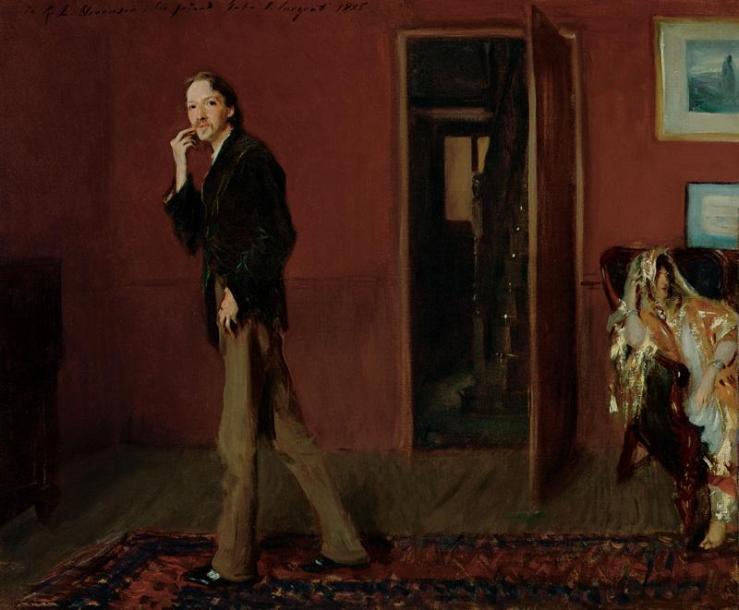
“The Yellow Paint”
by
Robert Louis Stevenson
In a certain city there lived a physician who sold yellow paint. This was of so singular a virtue that whoso was bedaubed with it from head to heel was set free from the dangers of life, and the bondage of sin, and the fear of death for ever. So the physician said in his prospectus; and so said all the citizens in the city; and there was nothing more urgent in men’s hearts than to be properly painted themselves, and nothing they took more delight in than to see others painted. There was in the same city a young man of a very good family but of a somewhat reckless life, who had reached the age of manhood, and would have nothing to say to the paint: “Tomorrow was soon enough,” said he; and when the morrow came he would still put it off. He could have continued to do until his death; only, he had a friend of about his own age and much of his own manners; and this youth, taking a walk in the public street, with not one fleck of paint upon his body, was suddenly run down by a water-cart and cut off in the heyday of his nakedness. This shook the other to the soul; so that I never beheld a man more earnest to be painted; and on the very same evening, in the presence of all his family, to appropriate music, and himself weeping aloud, he received three complete coats and a touch of varnish on the top. The physician (who was himself affected even to tears) protested he had never done a job so thorough.
Some two months afterwards, the young man was carried on a stretcher to the physician’s house.
“What is the meaning of this?” he cried, as soon as the door was opened. “I was to be set free from all the dangers of life; and here have I been run down by that self-same water-cart, and my leg is broken.”
“Dear me!” said the physician. “This is very sad. But I perceive I must explain to you the action of my paint. A broken bone is a mighty small affair at the worst of it; and it belongs to a class of accident to which my paint is quite inapplicable. Sin, my dear young friend, sin is the sole calamity that a wise man should apprehend; it is against sin that I have fitted you out; and when you come to be tempted, you will give me news of my paint.”
“Oh!” said the young man, “I did not understand that, and it seems rather disappointing. But I have no doubt all is for the best; and in the meanwhile, I shall be obliged to you if you will set my leg.”
“That is none of my business,” said the physician; “but if your bearers will carry you round the corner to the surgeon’s, I feel sure he will afford relief.”
Some three years later, the young man came running to the physician’s house in a great perturbation. “What is the meaning of this?” he cried. “Here was I to be set free from the bondage of sin; and I have just committed forgery, arson and murder.”
“Dear me,” said the physician. “This is very serious. Off with your clothes at once.” And as soon as the young man had stripped, he examined him from head to foot. “No,” he cried with great relief, “there is not a flake broken. Cheer up, my young friend, your paint is as good as new.”
“Good God!” cried the young man, “and what then can be the use of it?”
“Why,” said the physician, “I perceive I must explain to you the nature of the action of my paint. It does not exactly prevent sin; it extenuates instead the painful consequences. It is not so much for this world, as for the next; it is not against life; in short, it is against death that I have fitted you out. And when you come to die, you will give me news of my paint.”
“Oh!” cried the young man, “I had not understood that, and it seems a little disappointing. But there is no doubt all is for the best: and in the meanwhile, I shall be obliged if you will help me to undo the evil I have brought on innocent persons.”
“That is none of my business,” said the physician; “but if you will go round the corner to the police office, I feel sure it will afford you relief to give yourself up.”
Six weeks later, the physician was called to the town gaol.
“What is the meaning of this?” cried the young man. “Here am I literally crusted with your paint; and I have broken my leg, and committed all the crimes in the calendar, and must be hanged tomorrow; and am in the meanwhile in a fear so extreme that I lack words to picture it.”
“Dear me,” said the physician. “This is really amazing. Well, well; perhaps, if you had not been painted, you would have been more frightened still.”
Dream of December 21, 1929 (Self-Portrait) — Valentine Hugo

Saint Valentine — Jean Hugo

The Triumph of the Guillotine in Hell – Nicolas-Antoine Taunay

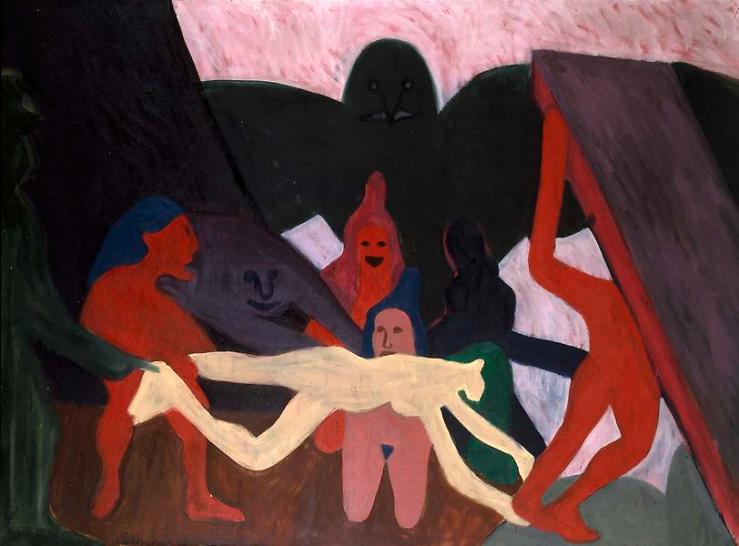
The Struggle — Bob Thompson
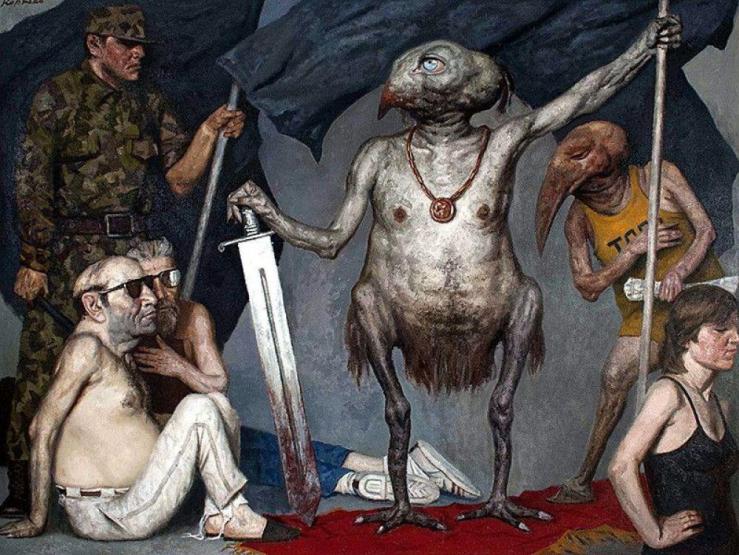
Triumfator — Geliy Korzhev
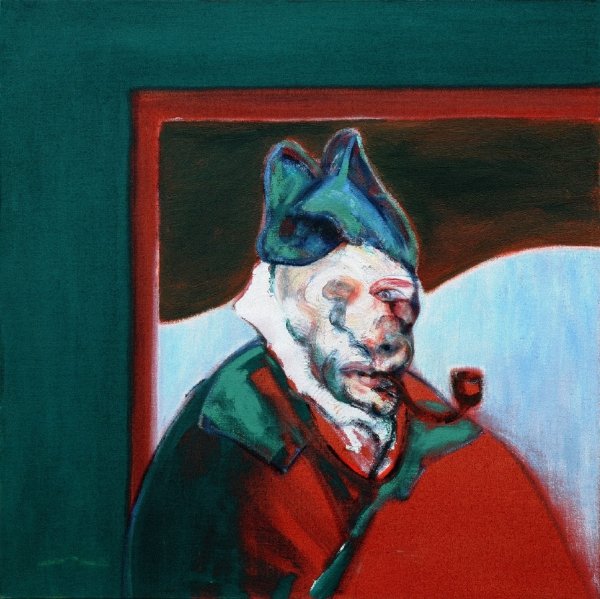
Homage to Van Gogh — Francis Bacon
Sunday Comics

A Krazy Kat strip by George Herriman. The scan is from Krazy Kat by George Herriman, Henry Holt and Company, 1946.
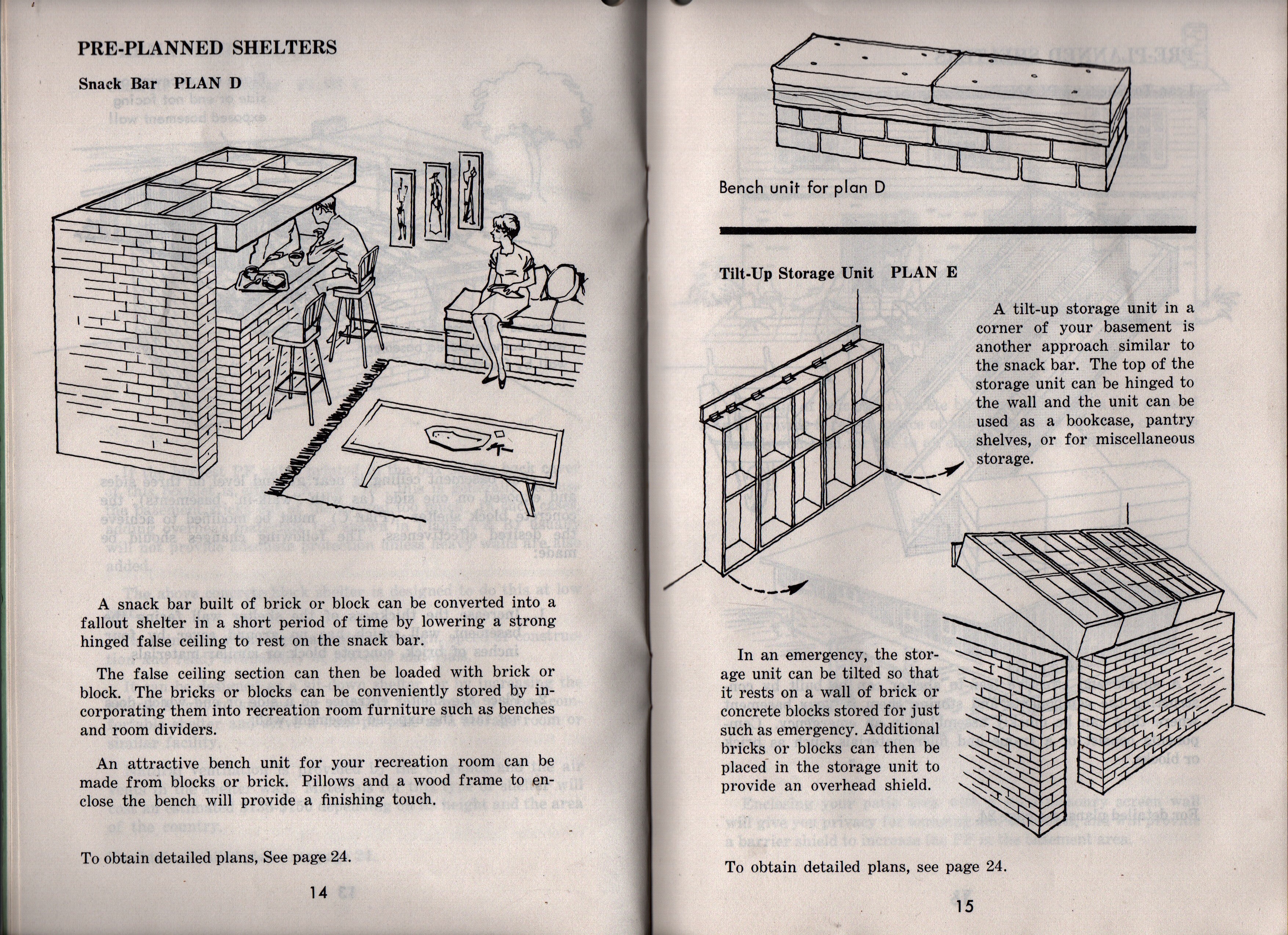
FALLOUT PROTECTION FOR…

My wife’s grandmother recently passed away and my wife took a bunch of her old photos and papers, including this DOD pamphlet from 1966. The scan above is the back cover/front cover. Here’s the first inside page, with a cheerful note from LBJ:

Here’s my favorite section:
 Biblioklept