“The Masters of Cubism” by César Vallejo (translated by Jason Weiss) is part of a forthcoming collection Selected Writings by César Vallejo, edited by Joseph Mulligan. You can read more selections translated by Weiss at Itineraries of a Hummingbird.
The Masters of Cubism
The Pythagoras of Painting
The greatest contemporary painter is a Spaniard from Málaga: Picasso. Next to Picasso and embracing a no less powerful artistic personality is another Spaniard from Madrid: Juan Gris. In Paris, the fame of both, at least among the elites of the vanguard, has helped in large part to impose the new painting which under the name of Cubism offers now figures so towering as Braque, Derain, Matisse, Marcoussis, whose works are being celebrated far and wide, that they can almost be considered classics already. I’ve just now finished reading an article by Sabord where he tells of his surprise on seeing how the cubist revolutionaries are starting to enjoy a popular and absolute consecration, as if they weren’t such revolutionaries. Every show of decorative models from Parisian shops is currently dominated by the motifs and drawings of Braque, Matisse, Gris, and naturally, Picasso himself. Generally, starting with the International Exposition of Decorative Arts in 1925, cubism has invaded the world of commerce to a resounding degree. Cubism has spread to furniture design, luxury goods, architecture, posters, the theater, etc. The famous and dazzling concert hall the Salle Pleyel has the most old-school polygons. The ads for the Cook Agency on locomotives haul along entire squads of geometry from les fauves. People get all caught up trying to locate the characters from Doctor Caligari among the truncated pyramids and the loony bin’s lack of perspective, etc, etc. The year 1923 marks the apex of Muscovite influence on decorative art in Paris. Upon this Russian prevalence of taste and heights followed the cubist prevalence of taste and depth, which has now reached its greatest scope. Okay, fine. To this irradiation of a new art, profoundly human and, above all, of its time, Picasso and Gris have contributed with ideas and works of the highest order. An overly patriotic Spaniard might claim that the current cubist prevalence in the Paris fashion industry is in the end a Spanish triumph, since cubism has Picasso and Gris for leaders.
But that’s not why one could think that cubism, on getting around and put within reach of commercial taste, is on the threshold of passing into the domain of the vulgar, that is, by that road it’s on the point of going up in smoke and disappearing, due to the superficiality and coarseness of its trajectory. The spread of cubism proves only that there breathes a broadly human content, a universal vitality. This spread is, at the same time, natural and logical. The great esthetic currents of history have had equal luck and the same consecration. The works of Picasso and his friends, like the marvels of the Renaissance, will pass into the category of celebrities, not for having descended to the majority of people but rather for having educated those people to the point of making them ascend toward the works and for enclosing there a cosmic rhythm. We must not forget that there is celebrity and celebrity. One thing is Paul de Kock and another is Victor Hugo.
Among the first creators of cubism, Gris has toiled away heroically. Hero against the recalcitrant public and hero against many sectarians of the school itself. Since his first paintings, Gris has shown a rigorous, mathematical sense of art, against the reigning celestinesque metaphysics. Gris paints in numbers. His canvases are real top-grade creations, brilliantly resolved. Beside other cubists more or less wavering from capitulation or disbelief, Gris preaches and carries out, from the dawn of the new esthetic, around 1908, an intransigent, red, vertical belief. Nothing of Bergsonism nor of empirical rationalism. Gris preaches and carries out a conscientious and scientific knowledge of painting. He wants the painter to know conscientiously what he is painting and to avail himself of a wise technique and vigilant practice, by which he may properly make use of his natural gifts. His work, in this way, is made of precision, of pure certainty, of Goethean infallibility. Without sinking in any narrow scholasticism. Gris always adjusts himself, like the sainted hermit Popes, to the severe and apostolic numbers. Because of that, the critics have called him the Pythagoras of painting and proclaimed him the initiator of what could be called “pure painting,” like the “pure poetry” of abbé Brémond. Such appreciations spring up of their own from the serene contemplation of his work, where he strictly practiced the doctrine upheld, shortly before his death, in his conference at the Sorbonne.
Gris has been perhaps the most rebellious painter in Paris. He was not the sort of artist who compromises out of hunger, or love of fame, or out of “lousy doubts,” as Apollinaire would say. Gris is always Gris, against aces and queens, even against time and against himself. And through this rigorous spirit of artistic austerity and through the scientific possession of his creative forces, without unconfessable fog or elaborate and complicit mysteries, Juan Gris will remain the most representative painter of our time.
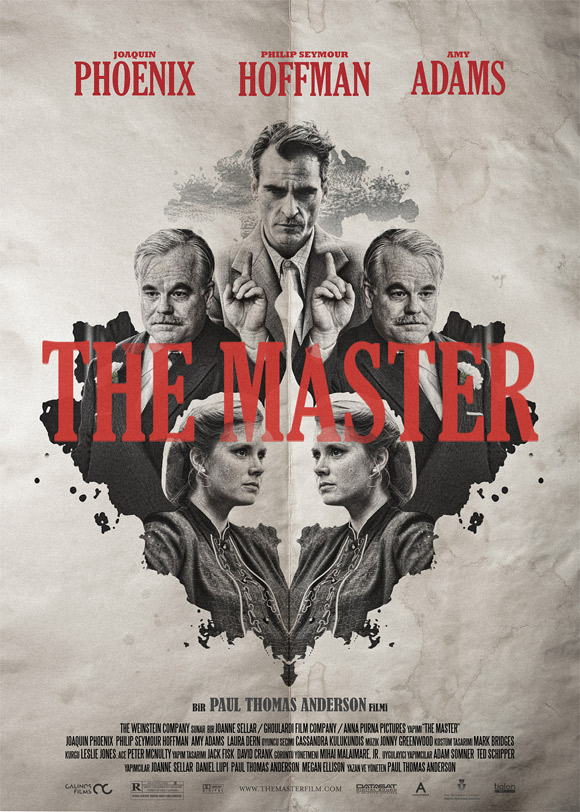
1. I finally saw Paul Thomas Anderson’s 2012 film The Master last night. I’m going to riff on the film. Fair warning:this riff will contain spoilers—I’ll talk about the film’s final scene, for instance (and if you just want to read about the ending, scroll down to point 23, after the embedded video).
2. The first hour of The Master is probably the best thing PTA has done.
3. The Master begins on a beach somewhere in the South Pacific. These are the final days of WWII. Navy boy Freddie Quell (portrayed by Joaquin Phoenix), solitary from his fellows, pours from a can of the mystic moonshine he brews into a coconut he’s hacked open with a machete. He then drinks the potion and mimes chopping off his hand with the machete. After this, he humps a woman made of sand and jerks off into the ocean.
4. The idyll of the Pacific beach contrasts strongly with Quell’s tortured psyche—it’s clear from the film’s first few moments that he’s borderline deranged, a sex-obsessed alcoholic who was damaged long before the war.
5. Quell is also a profoundly talented chemist (or alchemist) capable of brewing strange cocktails mixed from whatever’s at hand. These potions intrigue Lancaster Dodd (henceforth Master, played by Philip Seymour Hoffman), who samples a flask and asks Quell to brew more. Quell says he’ll make Master something different from that first batch, asking him, “How do you want to feel?”
6. “How do you want to feel?”
This question governs The Master, and the film is at its best when probing and plumbing these depths.
7. Back to my second statement: The first hour or so of The Master is probably the best thing PTA has done. Freddie Quell is an intriguing figure, a desperate madman who recapitulates the crimes of Oedipus where ever he goes.
He is The Misfit of Flannery O’Connor’s story “A Good Man Is Hard to Find,” trying to match faith to the phenomenal world.
He is Jonah, fleeing angry Yaweh, stowing away on a ship.
8. The first scenes of The Master borrow liberally from the Terrence Malick playbook:
The opening scene on the beach strongly recalls the opening of The Thin Red Line, and the subsequent scenes where Quell maybe murders a man and then must run feel like the opening minutes of Days of Heaven.
Like Malick, PTA lets the gorgeous cinematography convey meaning; dialog passes through the background of the film.
9. The dialog begins when Quell meets Master, charismatic leader of “The Cause.” You know of course that Master is based on L. Ron Hubbard, founder of Scientology. It’s worth pointing out that the film isn’t really about Scientology, or cults, or charlatans—although these points are explored, for sure—it’s really about the search for meaning, for stability. For some kind of peace.
10. The friendship—and friendship-as-dialog—between Master and Quell is by far the most compelling part of The Master, and the film’s best scene is a long episode where Master initiates “Processing” with Quell—delving into the man’s founding traumas to purify his spirit. I usually hate to laud actors, but Hoffman and Phoenix are sublime here, fully inhabiting the characters through the scenes deep emotional shifts.
The Master never surpasses this scene.
11. Indeed, the biggest failure of the film is that there’s no moment in its back half that can respond to the Processing scene. The film’s final scene attempts to mirror it in some ways, but the attempt lacks the weight. It’s off balance.
12. I feel the need to preface what I’m about to write by saying very clearly:
Paul Thomas Anderson is an extremely gifted auteur, a filmmaker who has, moreso than perhaps any of his contemporaries, continued in the (anti-)tradition of the New Hollywood films of the seventies. I would rather watch a PTA film than a film by just about anybody.
But:
The guy has a real problem sticking the ending. His films fail to cohere, to transcend the sum of their parts. This might be an editing issue or a plotting issue or something more commercially-driven, like running time. I don’t know.
13. Exceptions to PTA not sticking the ending:
Punch Drunk Love, easily his most concise and focused film, a long short story from a filmmaker who works in sprawling novels.
Possibly Boogie Nights, which sags in the final third but is nevertheless buoyed by an energetic scene featuring Alfred Molina, a mixtape, some cocaine, and fireworks. (This scene is lifted from Robert Downey Sr.’s Putney Swope, by the way).
14. For the most part though, PTA’s films swell outside of the margins that their own narratives establish in the beginning of each film (I’m not sure if this sentence makes sense—what I mean is that the films’ endings fall apart w/r/t the films’ beginnings).
In There Will Be Blood, PTA uses a stunning, violent, unforgettable final moment as a punchline to the film. It’s probably what most of us remember, and it’s certainly a great way to close the epic. Still: When I rewatch Blood, I start to become impatient with the film’s meandering after its thrilling opening hour. I start to anticipate the horrific punchline.
15. The easiest example to point to of PTA’s undisciplined sprawl is Magnolia. I can’t think of a film with a stronger opening that so quickly devolves into Altmanesque chaos. Which is the point, yes, I get—but Magnolia, again, is a PTA film which can’t live up to its first hour. (Again, PTA covers over the back end’s sloppiness with a marvelous final scene).
16. So, to return to The Master: I went into the film with high expectations—hoping that this would be the film by PTA that coheres, that is more than just a collection of fantastic performances and amazing scenes. And for the first hour, I was enthralled: I cared deeply about Freddie Quell, found his strange passions heartbreaking, was moved by his bizarre relationship with Master.
And the film is great—it really is—but it’s not as great as I wanted it to be. (Which, yes, I know, says nothing about the film and everything about me).
17. The film’s seams start to show after the magical sea voyage from California to New York. The first few scenes in New York are fascinating (especially when Master is confronted by a skeptic at a party), but as the The Cause moves back West over land, PTA increasingly relies on montages and shorter scenes that seem like placeholders to cobble together the film’s longer sections.
18. The last truly transcendent scene is where Master sings “I’ll Go No More A-Roving,” and it comes at almost exactly the half-way point of the film’s 138 minute running time.
19. All kinds of interesting stuff happens after the “Roving” scene—and PTA seems content to raise more mysteries than he resolves, which I’m fine with—but a long montage showcasing the different Processing techniques of The Cause sucks the energy right out of the film.
20. What follows is a lot of meandering, a lot of unexplained—or worse, unexplored—moments between characters that shift focus away from the relationship between Master and Quell.
21. Maybe I want a longer edit of The Master.
22. Here’s a 20 minute reel of cut footage:
23. And what about the ending of The Master? As I tried to convey in points 13-15, PTA usually closes with a very strong scene or image. With the exception of There Will Be Blood, I’d argue that the final moments of PTA’s films generally depict moments of love, redemption, or reconciliation. The Master fits into this trend. How so?
24. Okay: So The Master is in some ways formally Oedipal.
Quell’s crimes are two-fold: He kills a man who he says reminds him of his father and he has sex with his aunt. The film leaves open the possibility that both of these crimes—crimes he confesses to Master during Processing—are simply displacements for the more direct sins of killing his real father and fucking his real mother.
The Oedipal tensions that underwrite the film are strongly on display in the relationship between Master and Quell: Master is in love with Quell; Quell needs a father figure. All sorts of weird familial displacements ensue between Master’s family members and Quell.
The Oedipal theme also evinces in the film’s motif of breasts, bellies, and other pregnancy images. While not many of The Cause’s ideas are expressed clearly in The Master, the idea that all founding traumas are recorded in/on the soul is made plain several times. Put another way, all people are subjected to traumas that exist in pre-Oedipal, pre-lingual, pre-conscious states.
Quell wants to return to the womb to correct or ameliorate or avoid these traumas. The impossibility of achieving this desire drives him to self-medicate with his homemade brews and to see sex in everything.
The film ends with Quell having sex with a stranger he picks up in a bar. They laugh heartily—another of the film’s motifs—laughter as a measurement of joy, but also dejection, also hysteria, also fear, also irrationality, also no language, just laughter—they laugh heartily, and in a shot that foregrounds his sex partner’s large breasts, Quell begins Processing her.
25. We then get the film’s last line, delivered with laughter: “Stick it back in, it fell out.”
The referent of the “it” is, on the surface level, Quell’s penis, but it also serves as a substitution for Quell himself, who would like to return to a mother, to start again in a new life. (The scene, a riff on Quell’s first Processing with Master, can also be read as the displaced sexual consummation between the two men).
The film’s final image gives us Quell lying down next to the woman made of sand, her huge breasts erect, dominating the shot; he curls into her, peaceful, serene, fetal. The shot is deceptive: It suggests reconciliation or even redemption, but the memory of peace is just one fragment of Quell’s terribly fragmented life. Significantly, the moment comes from the beginning of the film. If Quell is to be reborn and live again—as Master believes all people are—it is clear that he has not transcended his base animal urges.
When Quell awakes, he awakes to trauma.
26. Having riffed on the film’s end, I think the film is probably better than I gave it credit for earlier. It’s a cold Sunday. I think I’ll watch The Master again.





 Biblioklept