Paul Kirchner’s Hieronymus & Bosch (Book acquired, 17 Oct. 2018)

img_1398

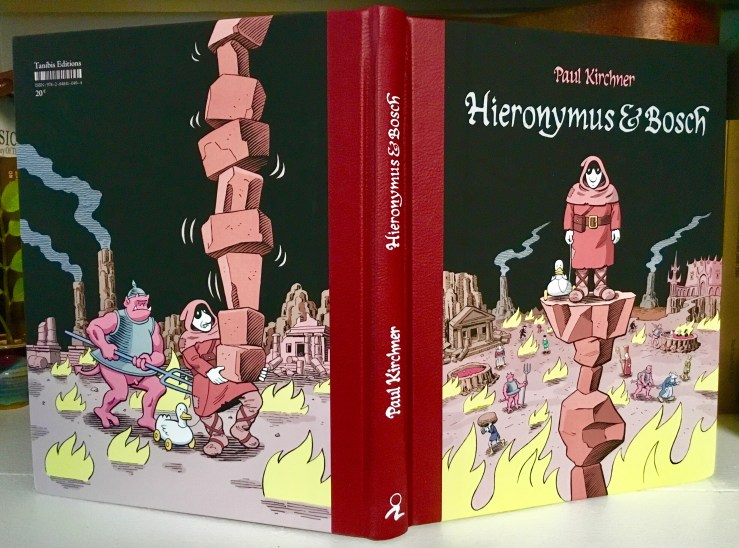
This afternoon, I started putting together a review of Biblioklept fave Paul Kirchner’s latest, Hieronymus & Bosch, and I realized that although I’d written a bit about it recently, I hadn’t put together one of these book acquired posts for it. So this is that post.

l

I really dig the book. It’s goofy and funny and has a lot of soul to it. Kirchner’s hapless hero Hieronymus seems like an extension—with difference—of the commuter, the hero of Kirchner’s bus strips. I hope to have a review up at The Comics Journal soon (where I reviewed Kirchner’s last collection, Awaiting the Collapse), but for now,  here’s publisher Tanibis’s blurb:

Meet the medieval miscreant Hieronymus and his wooden duck Bosch. When Hieronymus commits yet another petty crime, things go badly wrong and both are catapulted into a cartoonish version of Hell. There, lakes are made of lava (or, more often, poop) and an army of mischievous spiky-tailed devils bully the inmates and play impish pranks. Despite many gag-filled attempts at escaping this literal hell, Hieronymus and Bosch always end up being the butt of their trident-wielding guards’ most humiliating and painful jokes.

This book puts together about a hundred one-pagers filled with hilariously surrealistic and scatological gags by American comic book artist Paul Kirchner. Kirchner drew his inspiration from the medieval depictions of Hell by Dante and Hieronymus Bosch (duh!) as well as from the zany, almost sadistic humor of Warner Bros. cartoons like the Road Runner Show. Some of the stories published in this book originally appeared on the Adult Swim website.

Hieronymus & Bosch also evokes Kirchner’s famous comic strip series the bus. However, the bus‘ main character always got out from the practical jokes played on him unharmed, even if a bit confused. Hieronymus & Bosch‘s two heroes get burnt by lava, stabbed with tridents, used as a Q-tip by Satan himself, or just covered in a torrent of poop gushing down from above. Yet they carry on, finding fun where they can and refusing to abandon all hope.

Blog about Jindřich Štyrský’s Dreamverse

img_1161

I have to admit that I had never heard of the Czech artist Jindřich Štyrský (1899-1942) until a review copy of something called Dreamverse arrived at Biblioklept World Headquarters a week or so ago. I was excited when I saw the package though—the book is from Twisted Spoon Press, and their books are always gorgeous and strange and fascinating. Dreamverse is no exception, collecting Štyrský’s paintings, collages, sketches, poems, essays, and prose in a baffling (and yet simultaneously accessible) compendium translated by Jed Slast. Here is Twisted Spoon’s blurb:

Published posthumously in 1970 as Dreams, Štyrský’s dream journal spanning the interwar years comprises prose, sketches, collages, and paintings. The present volume includes the complete series of texts and full-color and halftone images based on Štyrský’s layout for its publication in the 1940s, his sole volume of poetry (also published posthumously), as well as a selection of his most important essays, articles, manifestos, and assorted other texts. This edition presents in English for the first time the broad range of Štyrský’s contribution to the interwar avant-garde and Surrealism.

Dreamverse begins with an (overly academic) introduction by the Czech avant garde artist Karel Teige dated from 1948, which argues that the Štyrský is deeply underappreciated. Teige describes Štyrský’s gradual artistic shift into surrealism, an excursion Štyrský shared with his partner Toyen.

Teige writes like an art historian, fussily constructing a place for a displaced artist. Dreamverse really takes off when we get to Štyrský’s prose. Dreams (1925-1940) comprises about half of the book, and begins with this lucidly surreal self-description:

Work birthed in the wellsprings of hypnagogic mental models, via faithful representations of dream objects and authentic dream records.

Štyrský then offers a brief introduction in which he dedicates the work to “my CHIMERA, my PHANTOM OBJECT.” This particular chimera is a Freudian’s fantasy: Štyrský begins by discussing his prepubescent infatuation with “the image of a woman’s head, exquisite with golden hair” which he sees in a cheap magazine. This image somehow transmogrifies into “the head of Medusa, the whole of it in a pool of blood,” its hair a “cluster of vipers, erect, ready to penetrate the woman through her mouth, nose, and ears.” Štyrský then tells us that this “ghastly horror,” this “alluring horror” haunts his dreams, and he tries to “place the head” on his mother and sister. The head fits his sister: “So I was madly in love with her.” Štyrský then details his sister’s death in strange, alarmingly sensual language. (She died in 1905 when he was a young boy). His muse then, his chimera, foregrounds the dreamverse he creates: we get a mass media image reconverted into a mythological figure, then reconverted again, through creative imagination, into a sister, who is in turn transformed again into a mythic trope of some kind—a figure like Eurydice for Štyrský to play Orpheus to. Štyrský’s dreamverse is a writhing collage of contradictions. Hope and despair, sex and death, the beautiful and the lurid are all collapsed into surrealist expression.

Take, for example, Dream XXXI:a
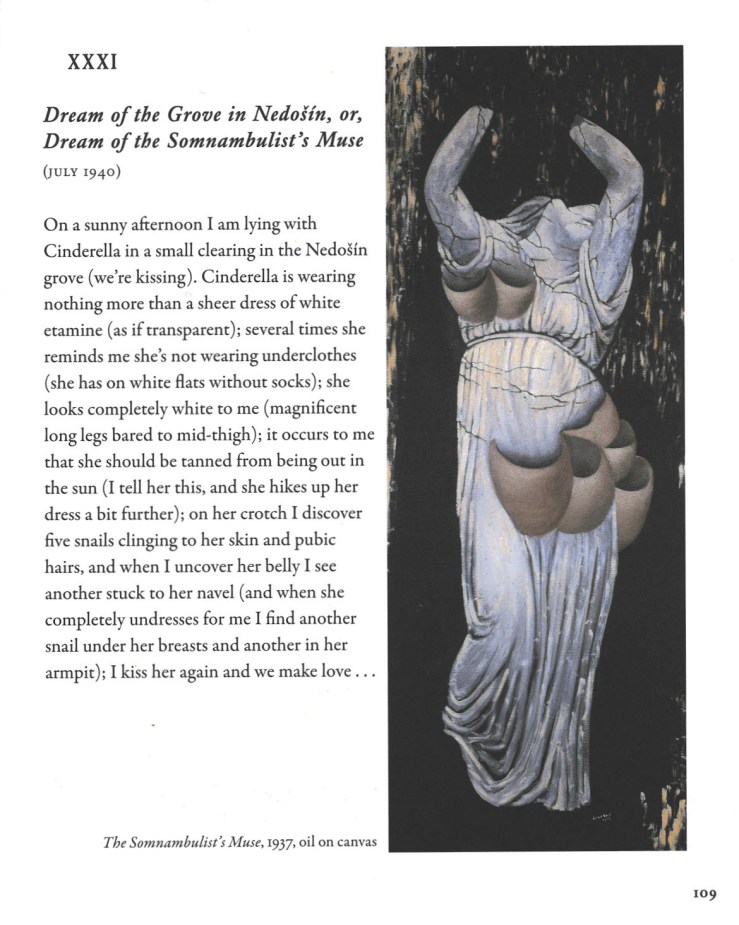
Štyrský’s dream—and its expression—excavates the sexuality suppressed just beneath the surface of our fairy tales. And while sexual abjection is typical in both Dreams (and in many of the poems collected in the Verse section of Dreamverse, sex is not always the dominant motif. Consider Dream VIII:
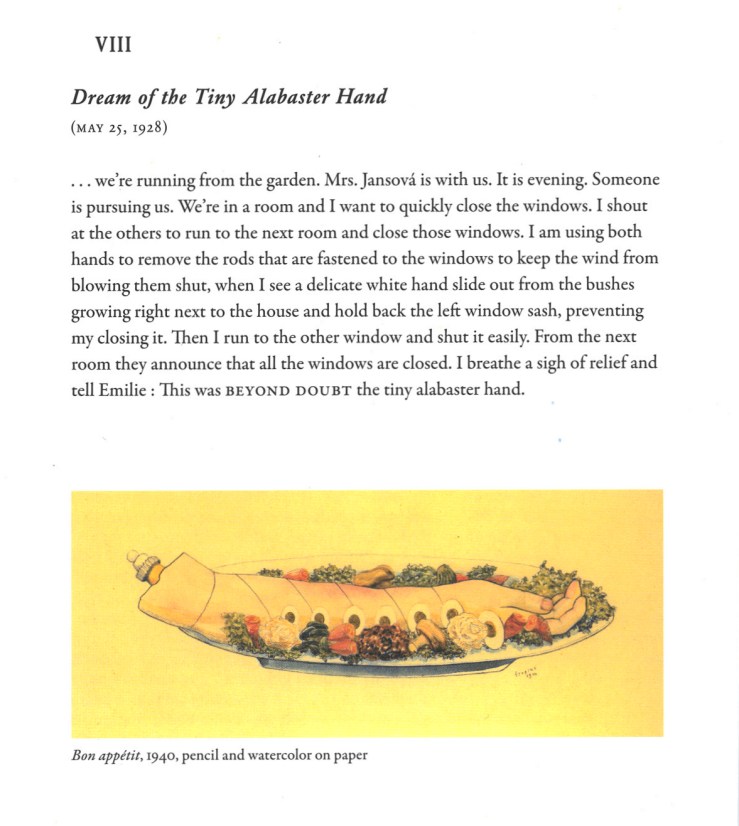
 

c

The vignette is a perfect slice of dread an horror, and the accompanying illustration—humorous and grotesque—is nightmare fuel.

I’ve been reading the Dreams somewhat slowly, a handful at a time, and then dipping deeper in the book, into the Verse, reading the Dreamverse as a sort of push-pull of image and word.

Štyrský’s writing is abject, evocative of a world that decays and regenerates at the same moment. A poem with the title “In the Swamps” of course stands out to me, a Florida boy always on the look out for abject images:

b

Štyrský’s imagery here is wonderful: The “fortune of blackcaps” pops out as an invented form of venery. Are the “blackcaps” actually little warblers—or just a surreal transformation of moorhens, the birds we would expect to find in the swamps? In either case, they are merely prey for “compassionate hunters,” susceptible to the arms of unseen brunettes and hunting dogs. The end of the poem is beautifully abject. The “horde of black swine” rumble in, neatly parallel to the “fortune of blackcaps” in the poems’s first line. These pigs slough through the swamp for “Sodden sacks of gold,” some kind of treasure there in the abject muck. Above it all is a speaker—a poet? Language hovers over the swamp.

Jed Slast deserves much praise for his translation, which seems tonally perfect and consistent over both the Dreams and the Verse sections. I’ll admit I haven’t gotten into any of the Writings at the end, which include lectures, essays, manifestos, and other fragments, but that gives me something to look forward to. So far though, Dreamverse has been an unexpected and strange joy, a dark and often perverse collection that plants its own dreamseeds in its reader.

Blog about some books and some book covers and acquiring some books and not acquiring some books

img_1179

I went to the book store this afternoon to pick up a copy of the latest graphic novel in by Kazu Kibuishi’s Amulet series for my kids, and of course I browsed a while. Looking for a copy of Anne Carson’s Plainwater, I ended up finding Angela Carter’s 1972 novel Infernal Desire Machines of Doctor Hoffman. It’s a British edition, 1985, Penguin, with a lovely Boschian cover by James Marsh. Here’s a detail from the cover:

img_1180

I’ve wanted to pick up Carter’s novel since I read about it on a silly good dystopian fiction list last year, and I’m thrilled that I was able to get one with a Marsh cover. This particular cover, along with Marsh’s cover for The Bloody Chamber, are included in Phil Baines lovely book Penguin by Design.

Baines’s book doesn’t include any of Marsh’s fantastic covers of J.G. Ballard novels, opting instead to include Dave Pelham’s versions. I love both Pelham and Marsh’s Ballard covers, and would love to get my mitts on one at some point. I always browse for old mass market paperbacks of sci-fi authors I like — Philip K. Dick, Ursula K. LeGuin, the Strugatsky Brothers, J.G. Ballard — hoping to find an interesting cover, something inventive and fun, something from before their works were, under the cloak of awful respectability, given safe, boring literary covers. I didn’t find any Ballard editions with Marsh or Pelham covers, but I did come across this lovely pair of mass market paperback:

img_1176

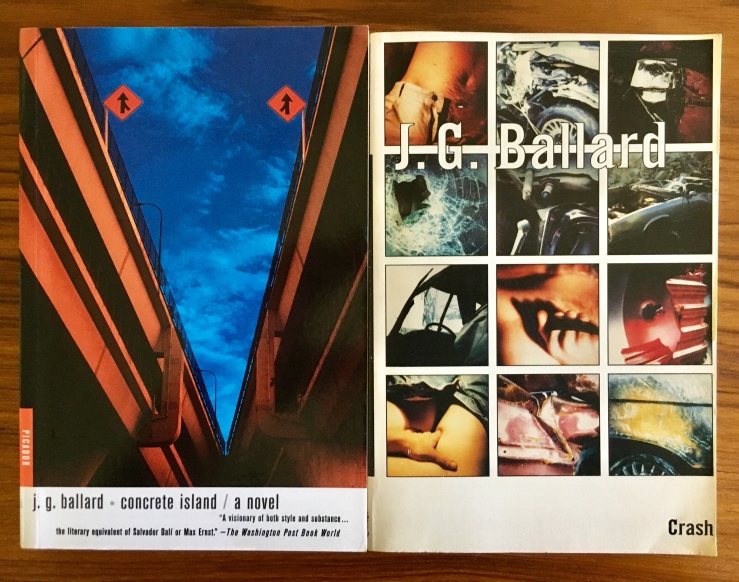
They’re US Vintage versions, 1985, with covers by Chris Moore. There’s like a proto-Cherry 2000 thing going on here that I kinda love, but I already own these novels, and I don’t love the covers quite enough. So instead, this post. Here are the covers of my copies of Crash and Concrete Island:

img_1181

While Henry Sene Yee’s cover design for my copy of Concrete Island (using a photograph by Kevin Laubacher) isn’t terrible, it is a good example of what I mean by boring respectable literary covers. Still, this trade edition (Picador, 2001) is really readable—I mean, it’s easy to read. The pages are nice, the typeset is great, etc. (And the book is killer). I actually like the cover of my copy of Crash, a lot (design by Michael Ian Kaye and Melissa Hayden), but it’s also trying just a little too hard. (Again—very readable version from FS&G’s Noonday Press imprint, 1994).

While I had to pass today on the mass market copies of Crash and Concrete Island today—not because they would have set me back five bucks in store credit, but because I don’t need them, because I hope some kid goes in there and picks them up—while I had to pass on those lurid beauties, I did pick up a mass market 1967 copy of The Crystal World. Publisher Berkley Medallion didn’t bother to name the cover designer/artist, and I haven’t been able to track it down, but it is, I admit, a bit disappointing—an early pulp bid for literary respectability. At least I can be on the look out for a weirder one in the future.

Luigi Pirandello’s One, No One, and One Hundred Thousand (Book acquired, 21 Sept. 2018)

img_1149

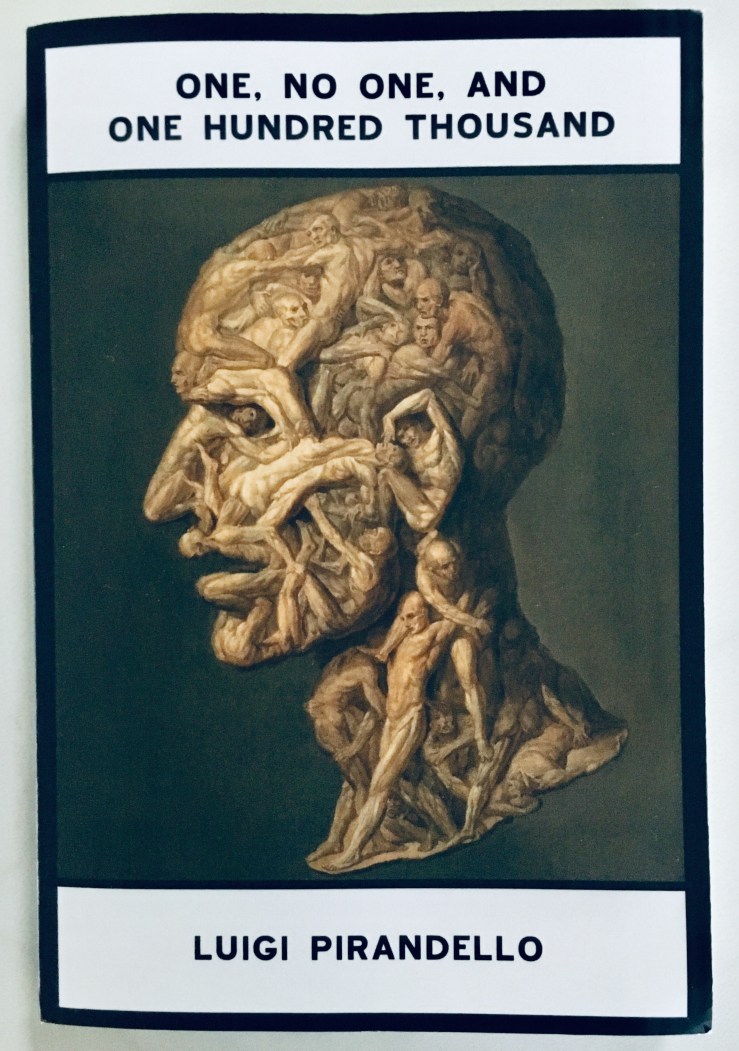
Luigi Pirandello’s One, No One, and One Hundred Thousand (English translation by William Weaver) is new in print again from Spurl Editions. Their blurb:

Translated from Italian by William Weaver, who wrote of One, No One, and One Hundred Thousand, “The definition of madness, the problem of identity, the impossibility of communicating with others and with being (or knowing) one’s self … Nowhere are these themes more intensely and wryly treated than in this spare, terse novel.”

Luigi Pirandello’s extraordinary final novel begins when Vitangelo Moscarda’s wife remarks that Vitangelo’s nose tilts to the right. This commonplace interaction spurs the novel’s unemployed, wealthy narrator to examine himself, the way he perceives others, and the ways that others perceive him. At first he only notices small differences in how he sees himself and how others do; but his self-examination quickly becomes relentless, dizzying, leading to often darkly comic results as Vitangelo decides that he must demolish that version of himself that others see.

Pirandello said of his 1926 novel that it “deals with the disintegration of the personality. It arrives at the most extreme conclusions, the farthest consequences.” Indeed, its unnerving humor and existential dissection of modern identity find counterparts in Samuel Beckett’s Molloy trilogy and the works of Thomas Bernhard and Vladimir Nabokov.

Conversations with Gordon Lish (Book acquired, 19 Sept. 2018)

dnei093vsaafypf

I’ve been reading somewhat at random the “interviews” with Gordon Lish collected in Conversations with Gordon Lish over the past two weeks and really enjoying them. The suspicious quotation marks around “interviews” are there to suggest that these pieces are often something closer to essays or post-fictions or metafictions—Lish extemporizing, lucidly ranting, self-interviewing himself, and just generally performing Gordon Lish. (I wasn’t at all surprised to learn that Lish briefly had a career as a radio personality in the early fifties on a show called “The Gordo Lochwood Show”).

More to come, but for now here’s the blurb for Conversations with Gordon Lish, which is edited by David Winters and Jason Lucarelli:

Known as “Captain Fiction,” Gordon Lish (b. 1934) is among the most influential–and controversial–figures in modern American letters. As an editor at Esquire (1969-1977), Alfred A. Knopf (1977-1994), and The Quarterly (1987-1995) and as a teacher both in and outside the university system, he has worked closely with many of the most pioneering writers of recent times, including Raymond Carver, Don DeLillo, Barry Hannah, Amy Hempel, Sam Lipsyte, and Ben Marcus. A prolific author of stories and novels, Lish has also won a cult following for his own fiction, earning comparisons with Gertrude Stein and Samuel Beckett.

Conversations with Gordon Lish collects all of Lish’s major interviews, covering the entire span of his extraordinary career. Ranging from 1965 to 2015, these interviews document his pivotal role in the period’s defining developments: the impact of the Californian counterculture, the rise and decline of so-called literary “minimalism,” dramatic transformations in book and magazine publishing, and the ongoing growth of creative writing instruction. Over time, Lish–a self-described “dynamic conversationalist”– forges an evolving conversation not only with his interviewers, but with the central trends of twentieth-century literary history.


Poe Poe Poe Poe Poe Poe Poe (Book acquired, 21 Sept. 2018)

img_1111

After flirting with the thing after first spying it a few weeks ago, I finally broke down and picked up Daniel Hoffman’s 1972 biography Poe Poe Poe Poe Poe Poe Poe. It is too weird not to be mine. Here is a good review of the book.

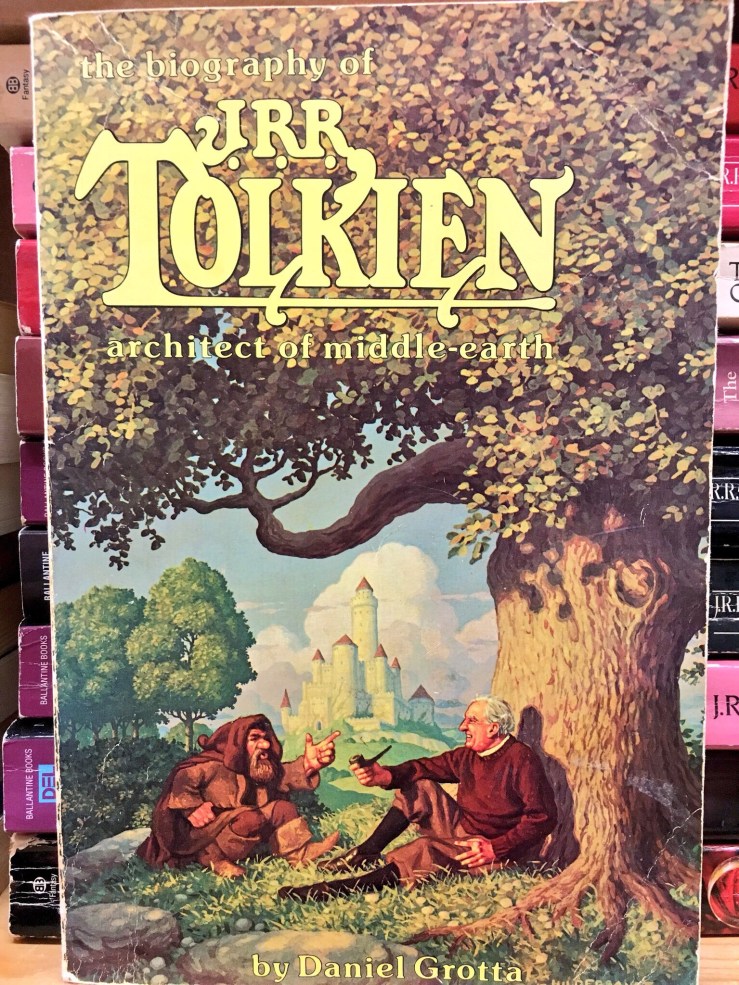
I spied but did not pick up this biography of JRR Tolkien, but its cover is utterly charming.

img_1101

David R. Bunch’s Moderan (Book acquired, 13 Sept. 2018)

img_1036

I’ve enjoyed dipping into the first few stories in NYRB’s collection of David R. Bunch’s Moderan stories over the past few days. Bunch’s weird world has meshed nicely with the Strugatsky’s The Snail on the Slope, which I finished today. More to come on Moderan, but here’s NRYB’s blurb for now:

Welcome to Moderan, world of the future. Here perpetual war is waged by furious masters fighting from Strongholds well stocked with “arsenals of fear” and everyone is enamored with hate. The devastated earth is coated by vast sheets of gray plastic, while humans vie to replace more and more of their own “soft parts” with steel. What need is there for nature when trees and flowers can be pushed up through holes in the plastic? Who requires human companionship when new-metal mistresses are waiting? But even a Stronghold master can doubt the catechism of Moderan. Wanderers, poets, and his own children pay visits, proving that another world is possible.

“As if Whitman and Nietzsche had collaborated,” wrote Brian Aldiss of David R. Bunch’s work. Originally published in science-fiction magazines in the 1960s and ’70s, these mordant stories, though passionately sought by collectors, have been unavailable in a single volume for close to half a century. Like Anthony Burgess in A Clockwork Orange, Bunch coined a mind-bending new vocabulary. He sought not to divert readers from the horror of modernity but to make us face it squarely.

This volume includes eleven previously uncollected Moderan stories.

Camus, Eliot, and Kuper’s Kafka (Books acquired, 31 Aug. 2018)

img_0894

I went to my favorite used bookshop on Friday afternoon to browse, order another Gerald Murnane novel, and pick up a copy of George Eliot’s Silas Marner.

I spied a late fifties mass market copy of Albert Camus’ novel Exile and the Kingdom from Vintage Books. I fell in love with the cover (by George Giusti) and ended up picking it up, although I’ll admit I haven’t read a Camus novel since college (it was The Plague if memory serves).

Browsing copies of Silas Marner, I found this monstrosity:

img_0892

I don’t even know where to start with this cover. I mean, even the colors seem to clash. It doesn’t really come across in the photo, but this hardback has a cheap greasy feel to it. I initially assumed that it was some kind of TV or film tie in, but as far as I can tell…no. Horrifying. I ended up going with the Oxford edition with Ferdinand Hodler’s painting Unemployed on the cover.

When I got home, the mail had come. It included a copy of Peter Kuper’s Kafkaesque, which collects 14 of Kuper’s illustrated Kafka translations. Publisher Norton’s blurb:

Award-winning graphic novelist Peter Kuper presents a mesmerizing interpretation of fourteen iconic Kafka short stories.

Long fascinated with the work of Franz Kafka, Peter Kuper began illustrating his stories in 1988. Initially drawn to the master’s dark humor, Kuper adapted the stories over the years to plumb their deeper truths. Kuper’s style deliberately evokes Lynd Ward and Frans Masereel, contemporaries of Kafka whose wordless novels captured much of the same claustrophobia and mania as Kafka’s tales. Working from new translations of the classic texts, Kuper has reimagined these iconic stories for the twenty-first century, using setting and perspective to comment on contemporary issues like civil rights and homelessness.

Longtime lovers of Kafka will appreciate Kuper’s innovative interpretations, while Kafka novices will discover a haunting introduction to some of the great writer’s most beguiling stories, including “A Hunger Artist,” “In The Penal Colony,” and “The Burrow.” Kafkaesque stands somewhere between adaptation and wholly original creation, going beyond a simple illustration of Kafka’s words to become a stunning work of art.

Tadao Tsuge’s Slum Wolf (Book acquired, 13 Aug. 2018)

img_0806


The New York Review of Books’ NYRC imprint has put together Slum Wolf, a collection of Tadao Tsuge’s stories new in English translation by Ryan Holmberg (who provides a long afterword to the volume).

Here’s NYRC’s blurb

Tadao Tsuge is one of the pioneers of alternative manga, and one of the world’s great artists of the down-and-out. Slum Wolf is a new selection of his stories from the late Sixties and Seventies, never before available in English: a vision of Japan as a world of bleary bars and rundown flophouses, vicious street fights and strange late-night visions. In assured, elegantly gritty art, Tsuge depicts a legendary, aging brawler, a slowly unraveling businessman, a group of damaged veterans uniting to form a shantytown, and an array of punks, pimps, and drunks, all struggling for freedom, meaning, or just survival.

I read “Bum Mutt” this afternoon and it was pretty weird and dark.

img_0828

Novels by Acker, Orlovitz, and Murnane (Books acquired 1 and 6 Aug. 2018)

img_0786-1

I went by my favorite used bookshop to purge a bunch of books I’ll never read again and order Gerald Murane’s 1982 novel The Plains. I had finished most of Murnane’s collection Stream System, leaving only the longest story in the collection (“Velvet Waters”) unread.

I browsed the store a bit too, of course, and found a used copy of Kathy Acker’s Great Expectations, which I’ve never read. Years ago, this particular book store had almost every Acker book used and I didn’t pick any up, which I’ve regretted for awhile. So.

I also picked up Gil Orlovitz’s 1967 novel Milkbottle H, which I’d never heard of until I saw @PierreMenard tweet about it last month—

The book is 500+ pages. I found the first 10 utterly bewildering. You can read more about Milkbottle H here.

My copy of The Plains came in a few days later so my son and I went and picked it up (he got an Asterix comic). I read Part I this week and really got a strange thrill out of it. The Plains is a kind of speculative fiction with mythological touches. The slim novel reimagines an Australia the plainsmen of the interior define themselves (aesthetically, above all else) against the coastal areas of “Outer Australia.” The narrator is a (would-be) film director who wants to a make a movie called The Interior that will capture the essence of the plains (a task that is plainly impossible). The Plains is a very strange and I’m really digging it so far.

Helen DeWitt’s Some Trick (Book acquired 27 July 2018)

img_0767

I spent a week in Charleston, SC at the end of July. The city’s veneer of “historical charm” doesn’t quite cover over a past that it recognizes but seems not wholly reconciled to, but the grits were very good.

img_0503-1

I visited Blue Bicycle Books while I was there, where I was allowed to fondle a signed Faulkner with my unwashed hands. I picked up Helen DeWitt’s Some Trick in hardback there, despite not really liking Lightning Rods. I would’ve picked up her cult novel The Last Samurai instead, but they didn’t have it—and anyway, I’ve been reading mostly short stories and short novels (Murnane, Volodine, Melville) since getting through Eliot’s big fat novel Middlemarch last month.

Here’s publisher New Direction’s blurb—

For sheer unpredictable brilliance, Gogol may come to mind, but no author alive today takes a reader as far as Helen DeWitt into the funniest, most yonder dimensions of possibility. Her jumping-off points might be statistics, romance, the art world’s piranha tank, games of chance and games of skill, the travails of publishing, or success. “Look,” a character begins to explain, laying out some gambit reasonably enough, even if facing a world of boomeranging counterfactuals, situations spinning out to their utmost logical extremes, and Rube Goldberg-like moving parts, where things prove “more complicated than they had first appeared” and “at 3 a.m. the circumstances seem to attenuate.” In various ways, each tale carries DeWitt’s signature poker-face lament regarding the near-impossibility of the life of the mind when one is made to pay to have the time for it, in a world so sadly “taken up with all sorts of paraphernalia superfluous, not to say impedimental, to ratiocination.”

Antoine Volodine’s Post-Exoticism in 10 Lessons, Lesson 11 (Book acquired in July, 2018)

img_0454

Even though I haven’t gotten to Minor Angels yet, I went ahead and picked up Antoine Volodine’s Post-Exoticism in Ten Lessons, Lesson Eleven. Publisher Open Letter’s blurb:

Like with Antoine Volodine’s other works (Minor AngelsWe Monks & Soldiers), Post-Exoticism in Ten Lessons, Lesson Eleven takes place in a corrupted future where a small group of radical writers—those who practice “post-exoticism”—have been jailed by those in power and are slowly dying off. But before Lutz Bassmann, the last post-exoticist writer, passes away, journalists will try and pry out all the secrets of this powerful literary movement.

With its explanations of several key “post-exoticist” terms that appear in Volodine’s other books, Lesson Eleven provides a crucial entryway into one of the most ambitious literary projects of recent times: a project exploring the revolutionary power of literature.

Translated from the French by J. T. Mahany

You can read an excerpt from the book here.

Denis Johnson’s The Largesse of the Sea Maiden (Book acquired, 27 June 2018)

img_0214

I had no intention of getting another book when I went to the bookstore yesterday. Swear. I had a few boxes of books my uncle gave me, and I was going to trade most of them in. Even this Carl Hiaasen novel that had a cool Charles Burns cover:

dguye4vuyaan9yq

Anyway, I browsed the store a bit, killing half an hour before I had to pick my kids up, and I was tempted by a Richard Hughes’ novel called In Hazard simply because of its magnificent cover (here, I put two copies together—the back is on the left, the front is on the right):

img_0205

As an afterthought, I went through the new fiction section—something I hardly ever do—looking for Helen DeWitt’s new collection Some Trick, just to thumb through it. They didn’t have it, but they did have Denis Johnson’s posthumous collection The Largesse of the Sea Maiden (in hardback and for half price). I ended up reading the first little vignette in the first story in the collection, and then remembered that I’d read the story (the title track) a few years ago in The New Yorker. In particular I remembered the vignette called “Accomplices,” a near-perfect two-paragraph punch that features a Mardsen Hartley painting and too much bourbon. Here it is:

“Accomplices”

by

Denis Johnson


Another silence comes to mind. A couple of years ago, Elaine and I had dinner at the home of Miller Thomas, formerly the head of my agency in Manhattan. Right—he and his wife, Francesca, ended up out here, too, but considerably later than Elaine and I—once my boss, now a San Diego retiree. We finished two bottles of wine with dinner, maybe three bottles. After dinner, we had brandy. Before dinner, we had cocktails. We didn’t know one another particularly well, and maybe we used the liquor to rush past that fact. After the brandy, I started drinking Scotch, and Miller drank bourbon, and, although the weather was warm enough that the central air-conditioner was running, he pronounced it a cold night and lit a fire in his fireplace. It took only a squirt of fluid and the pop of a match to get an armload of sticks crackling and blazing, and then he laid on a couple of large chunks that he said were good, seasoned oak. “The capitalist at his forge,” Francesca said.

At one point we were standing in the light of the flames, I and Miller Thomas, seeing how many books each man could balance on his out-flung arms, Elaine and Francesca loading them onto our hands in a test of equilibrium that both of us failed repeatedly. It became a test of strength. I don’t know who won. We called for more and more books, and our women piled them on until most of Miller’s library lay around us on the floor. He had a small Marsden Hartley canvas mounted above the mantel, a crazy, mostly blue landscape done in oil, and I said that perhaps that wasn’t the place for a painting like this one, so near the smoke and heat, such an expensive painting. And the painting was masterful, too, from what I could see of it by dim lamps and firelight, amid books scattered all over the floor. . . . Miller took offense. He said he’d paid for this masterpiece, he owned it, he could put it where it suited him. He moved very near the flames and took down the painting and turned to us, holding it before him, and declared that he could even, if he wanted, throw it in the fire and leave it there. “Is it art? Sure. But listen,” he said, “art doesn’t own it. My name ain’t Art.” He held the canvas flat like a tray, landscape up, and tempted the flames with it, thrusting it in and out. . . . And the strange thing is that I’d heard a nearly identical story about Miller Thomas and his beloved Hartley landscape some years before, about an evening very similar to this one, the drinks and wine and brandy and more drinks, the rowdy conversation, the scattering of books, and, finally, Miller thrusting this painting toward the flames and calling it his own property, and threatening to burn it. On that previous night, his guests had talked him down from the heights, and he’d hung the painting back in its place, but on our night—why?—none of us found a way to object as he added his property to the fuel and turned his back and walked away. A black spot appeared on the canvas and spread out in a sort of smoking puddle that gave rise to tiny flames. Miller sat in a chair across the living room, by the flickering window, and observed from that distance with a drink in his hand. Not a word, not a move, from any of us. The wooden frame popped marvellously in the silence while the great painting cooked away, first black and twisted, soon gray and fluttering, and then the fire had it all.

On Doing Nothing (Book acquired, 12 June 2018)

img_0051

Roman Muradov’s On Doing Nothing is new from Chronicle Books. Instead of the blurb, here’s the intro:

img_0071

Robert Coover/Barry Hannah/Antoine Volodine (Books acquired, 7 June 2018)

img_0040

I had ordered Antoine Volodine’s Minor Angels through my favorite bookstore, and it came in yesterday. It’s slim but expensive (ah! university presses!) and ate up all of my store credit, but still I picked up used copies of Robert Coover’s second novel The Universal Baseball Association, Inc., J. Henry Waugh, Prop. and Barry Hannah’s Boomerang b/w Never Die (some of the only Hannah I’ve yet to read). I was tempted also by the title and cover of Daniel Hoffman’s 1971 Poe Poe Poe Poe Poe Poe Poe—but I was not tempted enough to acquire it.

dfg3rjnwaaay2nl

Mario Benedetti’s The Truce (Book acquired, 2 June 2018)

img_9998

I’m excited about this one! I’ll admit I haven’t heard of Mario Benedetti before. The Truce: The Diary of Martín Santomé (first published in Uruguay 1960) is in English translation from Penguin by Harry Morales. More to come, but for now, Penguin’s blurb–

Forty-nine, with a kind face, no serious ailments (apart from varicose veins on his ankles), a good salary and three moody children, widowed accountant Martín Santomé is about to retire. He assumes he’ll take up gardening, or the guitar, or whatever retired people do. What he least expects is to fall passionately in love with his shy young employee Laura Avellaneda. As they embark upon an affair, happy and irresponsible, Martín begins to feel the weight of his quiet existence lift – until, out of nowhere, their joy is cut short.

The intimate, heartbreaking diary of an ordinary man who is reborn when he falls in love one final time, this beloved Latin American novel has been translated into twenty languages and sold millions of copies worldwide, and is now published in Penguin Classics for the first time.

Antoine Volodine’s Naming the Jungle (Book acquired 26 May 2018)

I keep meaning to write about the second half of Antoine Volodine’s Writers, which is the best contemporary book I’ve read this year. (I wrote about the first half though).

I had to use the internet to buy Naming the Jungle, and the cover is awful, but I’m eager to read more Volodine.

Publisher’s blurb:

Antoine Volodine has been hailed as one of the most innovative and accomplished writers in France today. Compared by critics to Franz Kafka and Lewis Carroll, Volodine weaves an unusual novel of political and psychological intrigue in a lush, exotic setting. The publication of Naming the Jungle marks his American debut and the first translation of his work into English.

Puesto Libertad could be any Latin American city torn by the strife of civil war. In this isolated capital buried in the jungle, the revolutionary secret police have started digging into Fabian Golpiez’s past. In order to avoid brutal torture and interrogation, he decides to feign madness. Led by a local shaman/psychiatrist in a bizarre talking cure, Golpiez must use indigenous names to prove both his innocence and his true Tupi Indian identity. To name is to conquer. He names the monkeys, the plants, and the insects all around him as he names his fear, his paranoia, and his pathologies.

A masterful storyteller, Volodine speaks to us about the slow and fatal agony of revolution in a haunting and intense novel, one of the most dazzling pieces of fiction to come out of France since the early novels of Robbe-Grillet and Duras.