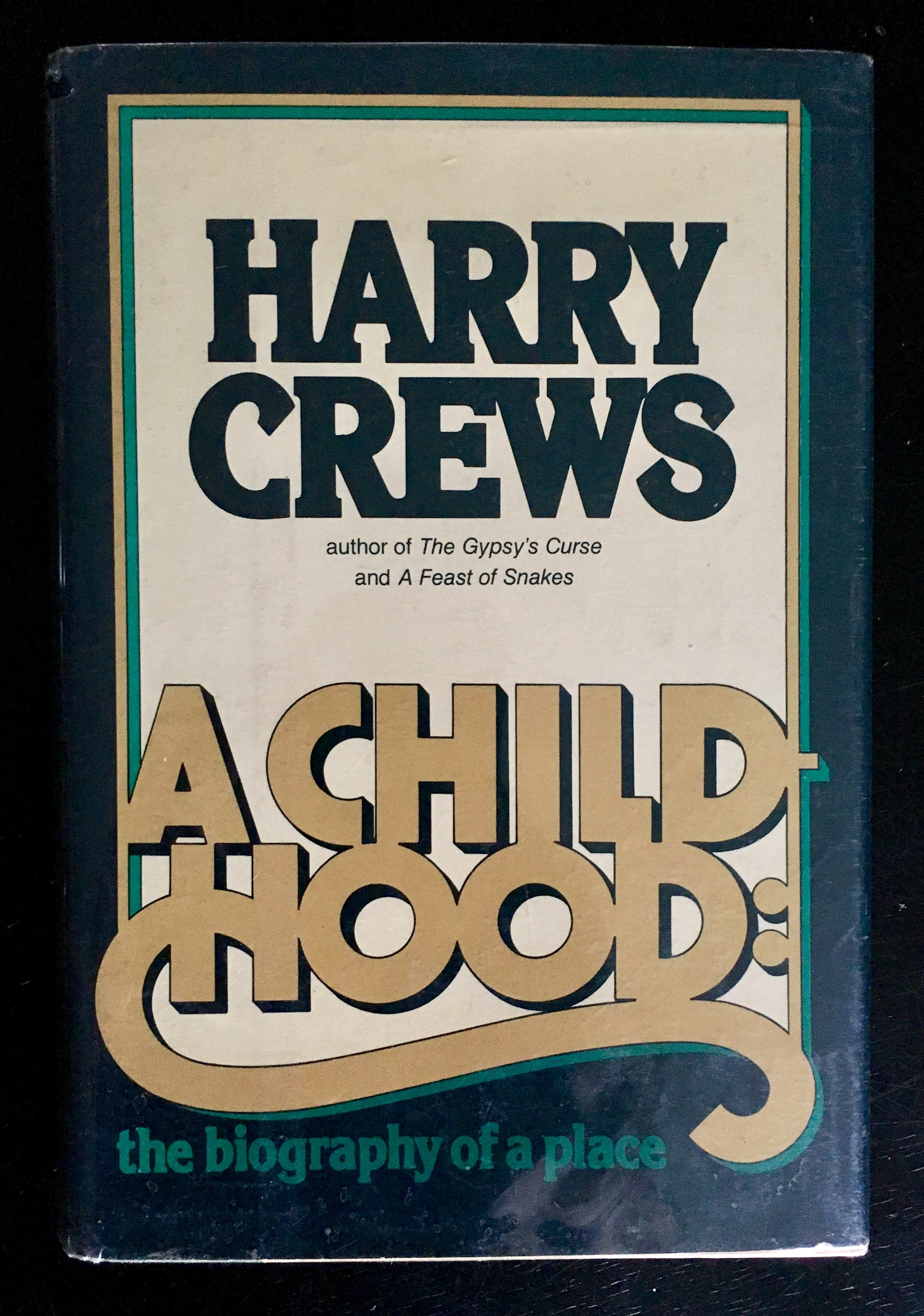
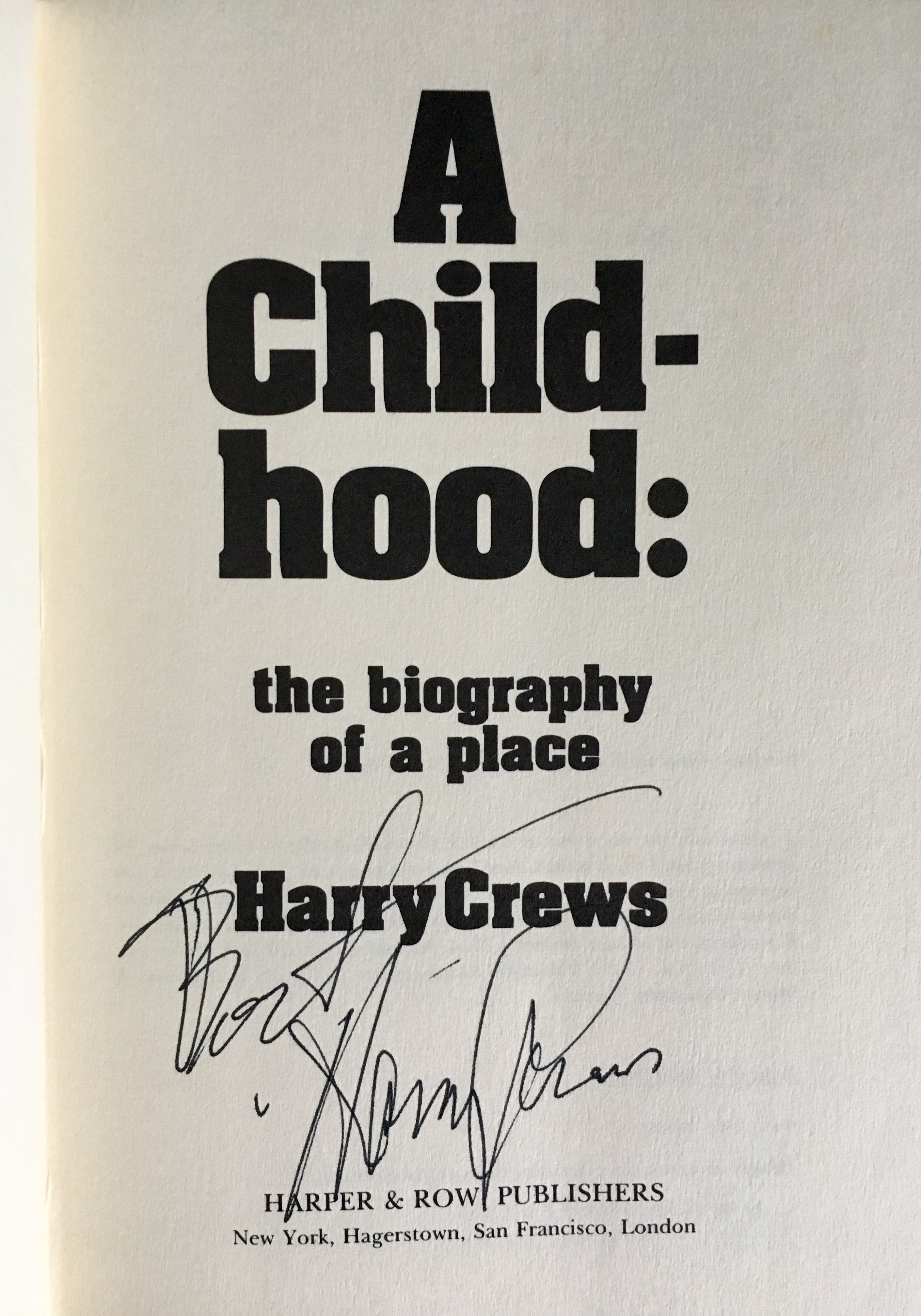
A couple of weeks back, I was looking for John Berryman’s biographical study of Stephen Crane. I did not find it, but I did find a signed hardback edition (not sure if it’s a first or second printing) of Harry Crews’s amazing memoir A Childhood.
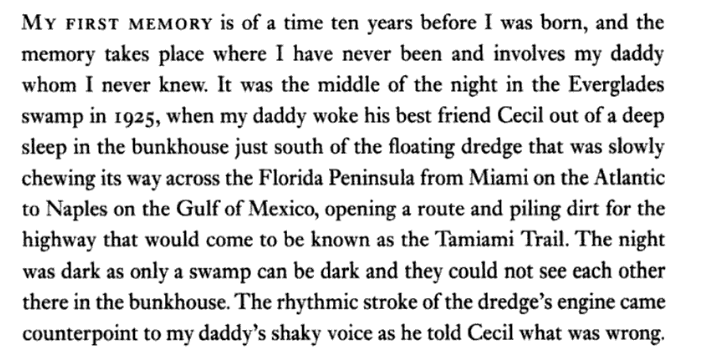
Here’s the opening paragraph:
I already have the book (it’s included in Classic Crews—the best starting place for Crews (you should start)), but I couldn’t pass up a signed copy. (It was like 8 bucks I think, and I have store credit out the wazoo).
Aaron R. Even’s novel He Comes in Fire is new from Atticus Books. Their blurb:
In the late 1990s a rash of mysterious arsons swept the Southern United States. For some months the fires (many striking African-American churches in rural communities) made the national news, raising fears of a racist criminal conspiracy. Then slowly they faded from the public eye, with no clear pattern, motive, or responsible group ever detected.
He Comes In Fire is a fictional, investigative composite of a country in flames, a dark and fast-paced crime drama that explores how the search for comprehensible answers and meaning can lead a people astray—into false assumptions, accusations, and terrible miscarriages of justice.
The setting is a semi-fictitious county (Zion) in central Virginia, a stark and fallen world of preachers, felons, and lost souls whose voices God no longer hears. When a misunderstood drifter (Lucas Sneed) tangles with a preacher struggling to lead a moral life (Jack Dixon), the two men collide in an unforgiving place teeming with sin, selfishness, and violence.
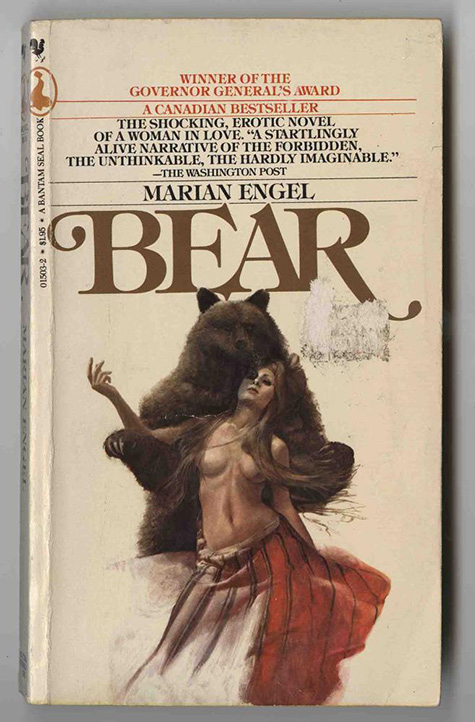
I can’t remember where or how I read about Marian Engel’s 1976 novel Bear, but I was intrigued. In lieu of the blurb, here’s Sara Bynoe at Hazlitt on Bear:
The first thing you need to know about Marian Engel’s 1976 novel Bear is that it is about a woman who has sex with a giant bear. Not a metaphorical, figurative, concept-within-a-creature bear: a real, furry, wild brown bear. There’s more to it than that, but why bury the lead?
The second thing you need to know, however, is that this is not some fringe underground chapbook: it won the Governor General’s award—the highest Canadian honour for the literary arts—in a year in which the jury included Mordecai Richler, Margaret Laurence, and Alice Munro.
We’re talking about Bear right now, though, because someone recently posted its cover and some particularly raunchy sections of the book to Imgur under the title, “WHATTHEACTUALFUCK, CANADA?” There was even a little boost in e-book sales after the book’s cover—an illustration of a lithe, topless woman with flowing brunette locks being embraced from behind by a bear standing on its hind legs—went viral. It looks like a Harlequin romance novel: ursine Fabio and his eager human companion, lost together, alone in a world that will never understand the depths of their potentially life-threatening interspecies love.
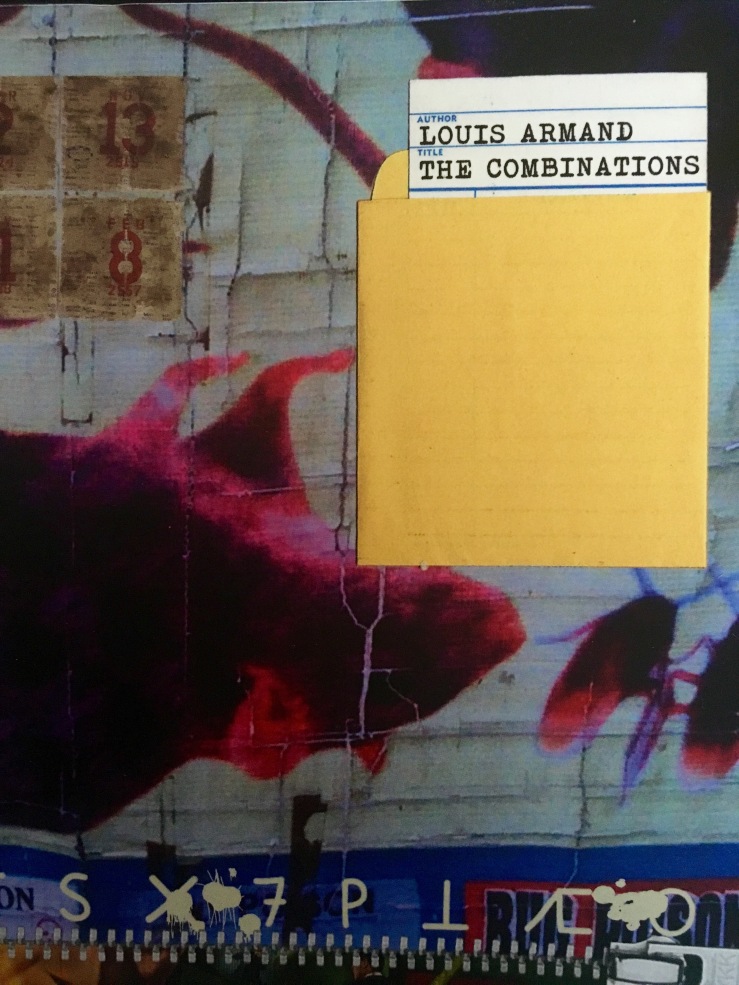
Louis Armand’s novel (or anti-novel, or whatever) is new from Equus Press.
It’s bigger than a brick.
Lots of footnotes, end notes, different fonts, maps, images, etc. The “text proper” (whatever that means) refuses to begin—epigraphs, notes, an “Overture,” etc.
Here’s the blurb from Equus:
Fiction. Drama. Art. The “European anti-novel” in all its unrepentant glory is here in THE COMBINATIONS, following in the tradition of Sterne, Rabelais, Cervantes, Joyce, Perec.
In 8 octaves, 64 chapters and 888 pages, Louis Armand’s THE COMBINATIONS is an unprecedented “work of attempted fiction” that combines the beauty & intellectual exertion that is chess with the panorama of futility & chaos that is Prague (a.k.a. “Golem City”), across the 20th-century and before/after. Golem City, the ship of fools boarded by the famed D’s (e.g. John) and K’s (e.g. Edward) of the 16th/17th centuries (who attempted and failed to turn lead into gold), and the infamous H’s (e.g. Adolf, e.g. Reinhard) of the 20th (who attempted and succeeded in turning flesh into soap). Armand’s prose weaves together the City’s thousand-and- one fascinating tales with a deeply personal account of one lost soul set adrift amid the early-90s’ awakening from the nightmare that was the previous half-century of communist Mitteleuropa. THE COMBINATIONS is a text whose 1) erudition dazzles, 2) structure humbles, 3) monotony never bores, 4) humour disarms, 5) relentlessness overwhelms, 6) storytelling captivates, 7) poignancy remains poignant, and 8) style simply never exhausts itself. Your move, Reader.
Here’s translator Fulya Peker’s introductory note to the volume:
Written between 1964 and 1974, between Paris and Hakkari, Ferit Edgü’s Noone approaches politics from a poetic standpoint and transforms a social-realist setting into a metaphor for a self that is in search of a subject for a sentence, or rather, that is subjected to a sentence.
As a record of history that is both personal and universal, Edgü depicts in Noone the severity of alienation, the difficulty of communication, the importance of memory, and the hidden rhyme of ‘existential’ and ‘survival,’ two grand words pronounced by pronouns suffering oppression and isolation. Noone compels us to consider the politically imposed idea of “the other” and how this “other” is not somewhere outside, external to us, but within. It prompts us to reflect on questions concerning the failure, or inability, to communicate, not only with others, but with one’s self due to man-made borders, whether lingual or geopolitical. Edgü’s acute and subtle observations about adverse living conditions that reduce humans to creatures of mere subsistence echo not only the current political climate in eastern Turkey, but also the general climate of despotism in many parts of the world.
While people are constantly forced to be ‘noone,’ the traces of history are buried (or frozen) under snow, and memory is dismantled, Noone reminds us of tomorrow, by re-momenting the past and keeping a record of the moment.
Picked up Samuel Delany’s famous/infamous novel Dhalgren today. I had an Audible credit and used it to get the audiobook (35 hours!), but as always, I need to do a tandem thing.
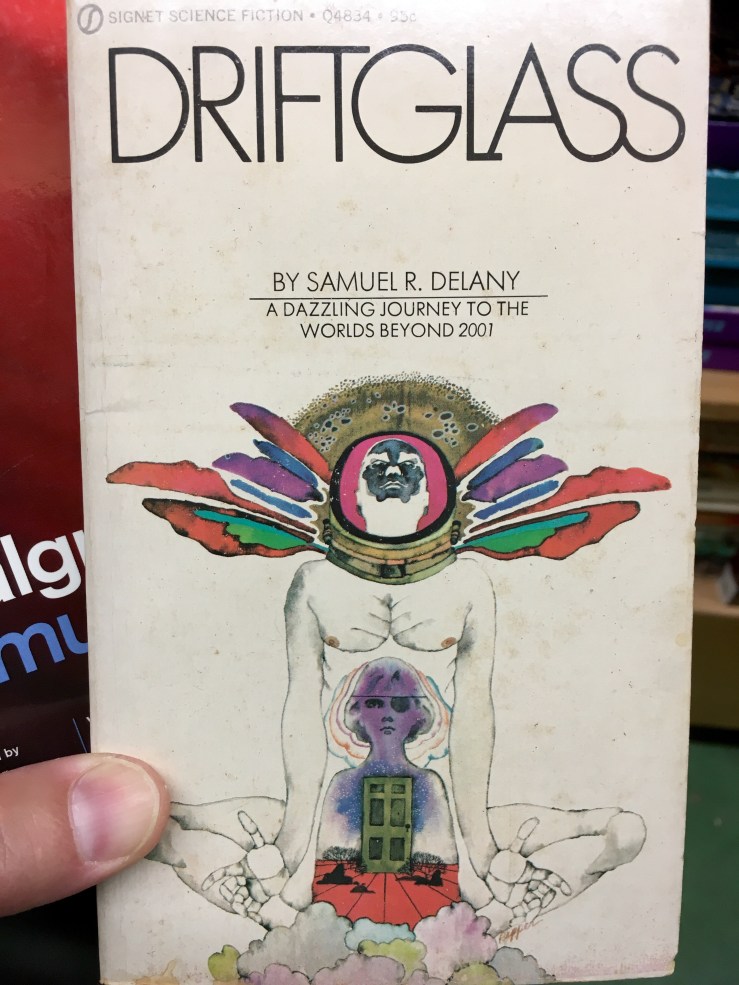
The book is enormous. I also hate the generic “prestige” cover (with a quote from Jonathan Lethem, of course). Okay, “hate” is a bit strong a verb, but c’mon—I mean look at this “genre” cover for Delany’s novel Driftglass that was right by the used copy of Dhalgren I picked up:
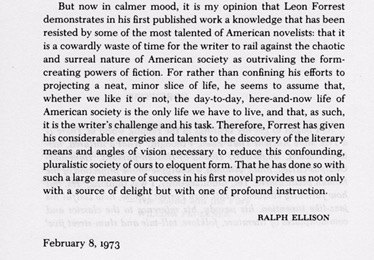
I also picked up Leon Forrest’s 1973 debut novel There Is a Tree More Ancient Than Eden on the recommendation of a dude I follow on Twitter who has the Good Taste. From Ralph Ellison’s introduction:
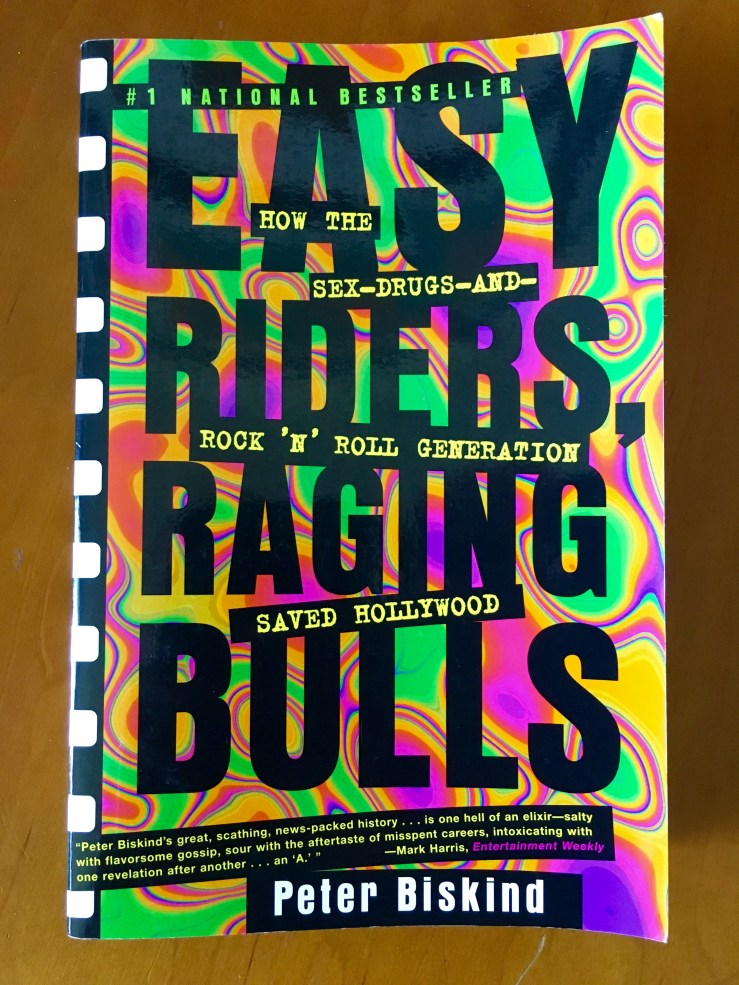
Peter Biskind’s Easy Riders, Raging Bulls has been on my radar forever (or at least since its publication in the late nineties), but I’d resisted picking it up until earlier this week—maybe because of its awful, awful cover (good lord), or maybe because of that off-putting subtitle, which just seems to scream, Boomer mythologies!
But after watching William Friedkin’s Sorcerer a third time, I wanted to read about the film, and Biskind’s book was easy to find used and so well hey. Of course I skipped to the index, and found enough pages on Sorcerer to take the book home. I read those pages at home, right away, with mounting disappointment, or frustration, rather. Biskind’s dishy, bitchy style is annoying, (although I assuaged the bad prose by reading the whole thing, as best as I could, in a Robert Evans accent) and beyond the bad prose is a paucity of information about, like, the actual filmmaking behind Sorcerer. It might be interesting to some people that Friedkin was a total asshole to his girlfriend, but I guess I wanted to know about the work, y’know? At least there’s a whole bunch of stuff on Heaven’s Gate too.
So well anyway, I read the introduction to the book and I can see how it does seem promising, but there’s also something deeply frustrating about Biskind’s approach (from the outset, anyway)—he seems to want to valorize the Baby Boomers at every turn. He introduces the first wave of the heroes of his book at “white men born in the mid- to late ’30s” without a hint of irony, noting that the “second wave was made up of the early boomers.” Of course it’s the names of the heroes that attract the reader: Bogdanovich, Coppola, Nichols, Scorsese, Malick, De Palma, etc. (It’s also sort of fascinating that even in the late ’90s, Biskind, a few paragraphs later, parses the “new group of actors” he lauds (Nicholson, De Niro, Keitel, et al) from “the women,” the “new faces.” Yeesh). My guess is that I’ll pick at this book as I watch and/or re-watch the films of the decade it valorizes—the films of the ’70s—the films that it so boomerishly insists were The Last Great Golden Age of Film Never to Be Replicated Again, Nope, That’s All Folks.
Here’s the trailer for Friedkin’s Sorcerer (the soundtrack is by Tangerine Dream, who also scored Michael Mann’s 1981 film Thief. Mann is not indexed in Easy Riders, Raging Bulls):
I Will Send Rain by Rae Meadows is new in hardback from Henry Holt & Co. Their blurb:
Annie Bell can’t escape the dust. It’s in her hair, covering the windowsills, coating the animals in the barn, in the corners of her children’s dry, cracked lips. It’s 1934 and the Bell farm in Mulehead, Oklahoma is struggling as the earliest storms of The Dust Bowl descend. All around them the wheat harvests are drying out and people are packing up their belongings as storms lay waste to the Great Plains. As the Bells wait for the rains to come, Annie and each member of her family are pulled in different directions. Annie’s fragile young son, Fred, suffers from dust pneumonia; her headstrong daughter, Birdie, flush with first love, is choosing a dangerous path out of Mulehead; and Samuel, her husband, is plagued by disturbing dreams of rain.
As Annie, desperate for an escape of her own, flirts with the affections of an unlikely admirer, she must choose who she is going to become. With her warm storytelling and beautiful prose, Rae Meadows brings to life an unforgettable family that faces hardship with rare grit and determination. Rich in detail and epic in scope, I Will Send Rain is a powerful novel of upheaval and resilience, filled with hope, morality, and love.
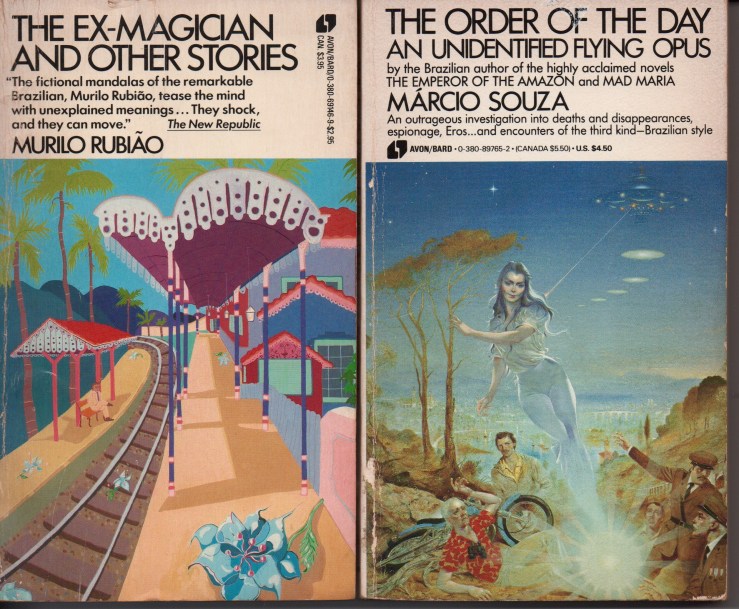
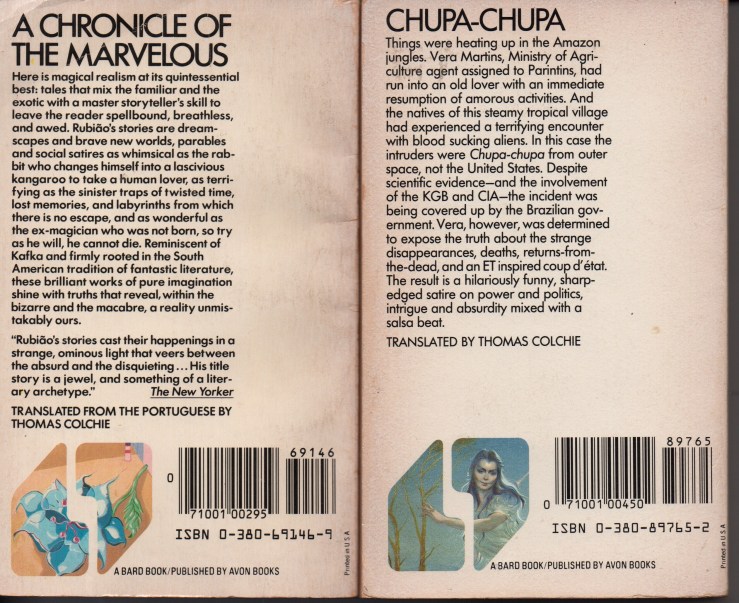
I couldn’t resist these two though, books by Brazilian authors I’d never heard of—The Order of the Day, a novel by Marcio Souza, and Murilo Rubiao’s collection The Ex-Magician and Other Stories.
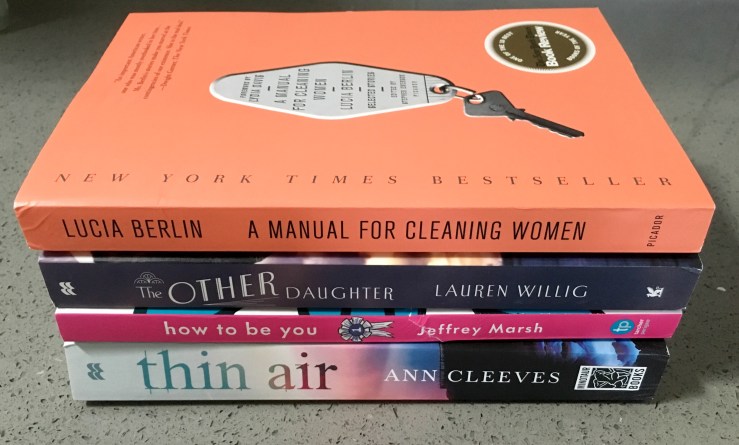
Four review copies in yesterday’s mail (solicited and unsolicited). I get behind on these books acquired posts, so I’ll lump the books in all at once and quickly.
First and foremost: Lucia Berlin’s collection A Manual for Cleaning Women is new in trade paperback from Picador. The book got a ton of buzz last year when it came out in hardback last year, and I didn’t read it then, but I did read the Black Sparrow-published collection Homesick. Many of the stories in Manual were first published in Homesick. They are very good stories—funny and gritty and elegant and sad and real. Full review forthcoming; in the meantime here’s Lydia Davis, who wrote the intro to Manual:
I have always had faith that the best writers will rise to the top, like cream, sooner or later, and will become exactly as well-known as they should be-their work talked about, quoted, taught, performed, filmed, set to music, anthologized. Perhaps, with the present collection, Lucia Berlin will begin to gain the attention she deserves.
The kind people at Nobrow sent along three gorgeous Hilda graphic novels by Luke Pearson ten days ago, and we’ve (my family, I mean) read each of them repeatedly since then—we’ve read them independently and to each other (my daughter started her own Hilda comic). I’ll have a proper essay-review thing up down the line, but for now, the short review: These are excellent, gorgeous books—funny, richly-detailed, sweet, and just a little scary (when they need to be).
W.D. Clarke’s White Mythology comprises two novellas, Skinner Boxed and Love’s Alchemy. The physical book itself is beautiful, filled with epigraphs and images, occasional font shifts, and intriguing chapter titles (“The Pynchon Method,” for example).
Here’s the blurb:
Dr. Ed’s head should be spinning: a long-lost ‘son’ has just been sent over to his office by the temp agency, his shopping-addicted wife seems to have disappeared, and the clinical trial that he is running for a revolutionary new anti-depressant might well be going off the rails. But Dr. Ed is in control of everything, including himself.
Thus begins “Skinner Boxed”, the first of two thematically linked novellas that comprise White Mythology. In the second piece, “Love’s Alchemy”, five narrators deliver stories of betrayal that are nested like Russian dolls, stories that span an attempted seduction in Tokyo in 1987 back to a brotherly schism that erupts during a bottle rocket game of “war” in 1970s Massachusetts. From boys who poison their teacher’s plants to men who compulsively urinate into rivers, these strange (and strangely connected) monologues drop the reader into the pitch-black dunk tank of the soul.
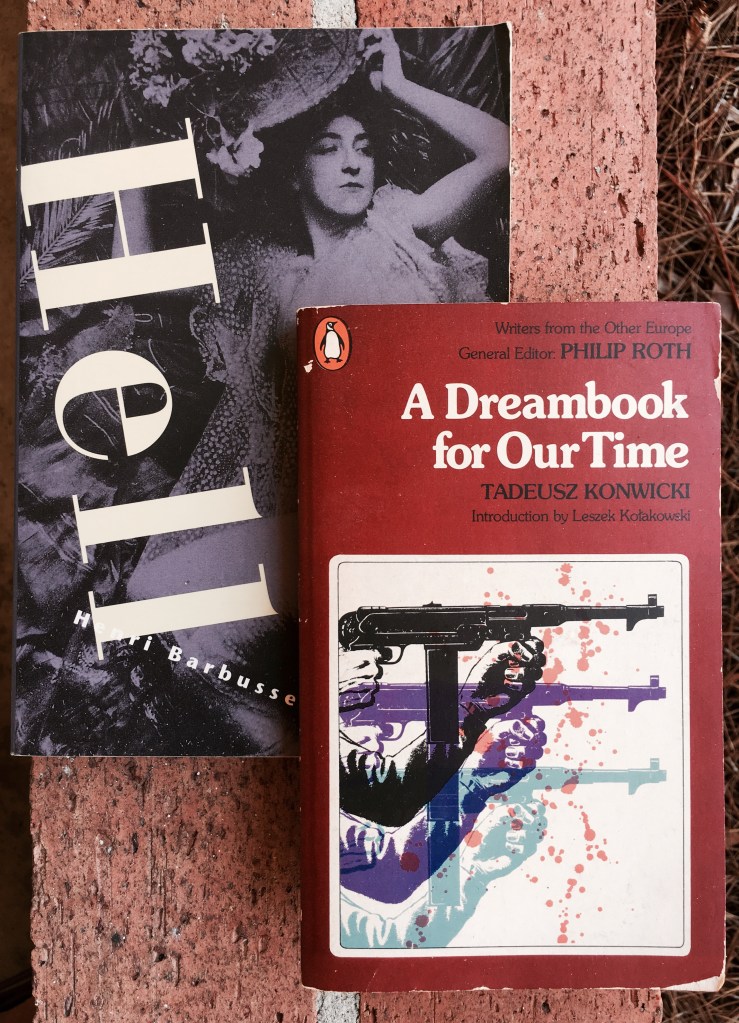
The Barbusse literally fell into my hands when I was pulling down a different book. I’d never heard of Hell until today but its title, cover, and blurb — “the most highly study of voyeurism” — sold me. Penguin’s Writers from Other Europe has always intrigued me and the cover alone on Tadeusz Konwicki’s A Dreambook for Our Time led to me picking it up.
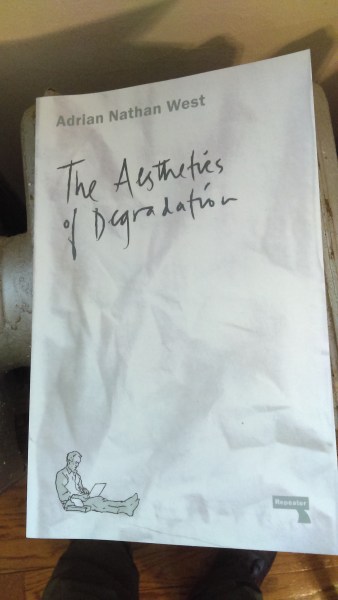
Publisher (Repeater Books) sent me this intriguing first novel, The Aesthetics of Degradation, from translator Adrian Nathan West (Franz Werfel, Josef Winkler) the other day. Working on a review of Han Kang’s Human Acts right now (which is good, uh, really good), which will be up here soon (I hope!), but looking forward to this one from Mr. West. From the back:
Pornography keeps getting more extreme. Manufacturers, defenders and consumers of porn rely on a mix of wilful [sic] ignorance and bad faith to avoid serious discussion. When we do talk about violence against women in the porn world, the debate all too often becomes technical, complicated by legalities and outrage.
[…]
Collapsing distinctions between novel, memoir, and essay, this book will not make for light reading. But at its core is an extraordinarily brave and honest concern for the women and men who have been hurt in the name of sexual gratification.
There’s a blurb by Edmund White that I won’t reproduce. Is that important? I don’t know. Trying to be thorough.
Juan Pablo Villalobos’s I’ll Sell You a Dog is forthcoming (this August) from And Other Books. English translation by Rosalind Harvey. Publisher’s blurb:
Long before he was the taco seller whose ‘Gringo Dog’ recipe made him famous throughout Mexico City, our hero was an aspiring artist: an artist, that is, till his would-be girlfriend was stolen by Diego Rivera, and his dreams snuffed out by his hypochondriac mother. Now our hero is resident in a retirement home, where fending off boredom is far more gruelling than making tacos. Plagued by the literary salon that bumps about his building’s lobby and haunted by the self-pitying ghost of a neglected artist, Villalobos’s old man can’t help but misbehave.
He antagonises his neighbours, tortures American missionaries with passages from Adorno, flirts with the revolutionary greengrocer, and in short does everything that can be done to fend off the boredom of retirement and old age . . . while still holding a beer.
A delicious take-down of pretensions to cultural posterity, I’ll Sell You a Dog is a comic novel whose absurd inventions, scurrilous antics and oddball characters are vintage Villalobos.
Brad Watson’s novel Miss Jane is forthcoming in hardback from W.W. Norton this July. Their blurb:
Astonishing prose brings to life a forgotten woman and a lost world in a strange and bittersweet Southern pastoral.
Since his award-winning debut collection of stories, Last Days of the Dog- Men, Brad Watson has been expanding the literary traditions of the South, in work as melancholy, witty, strange, and lovely as any in America. Inspired by the true story of his own great-aunt, he explores the life of Miss Jane Chisolm, born in rural, early-twentieth-century Mississippi with a genital birth defect that would stand in the way of the central “uses” for a woman in that time and place—namely, sex and marriage.
From the country doctor who adopts Jane to the hard tactile labor of farm life, from the highly erotic world of nature around her to the boy who loved but was forced to leave her, the world of Miss Jane Chisolm is anything but barren. Free to satisfy only herself, she mesmerizes those around her, exerting an unearthly fascination that lives beyond her still.