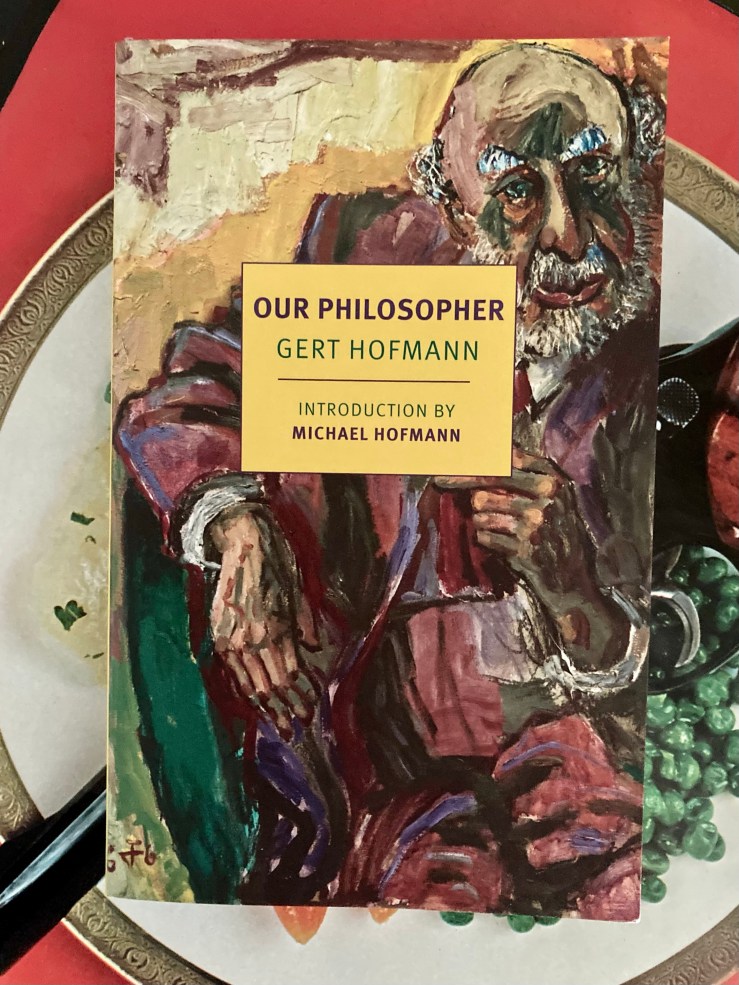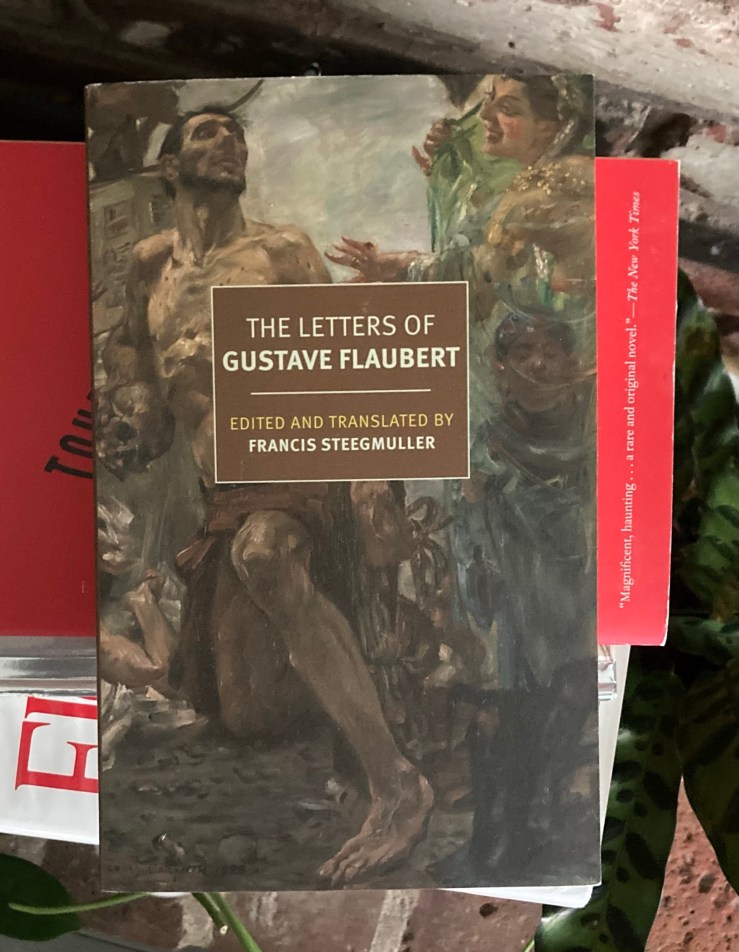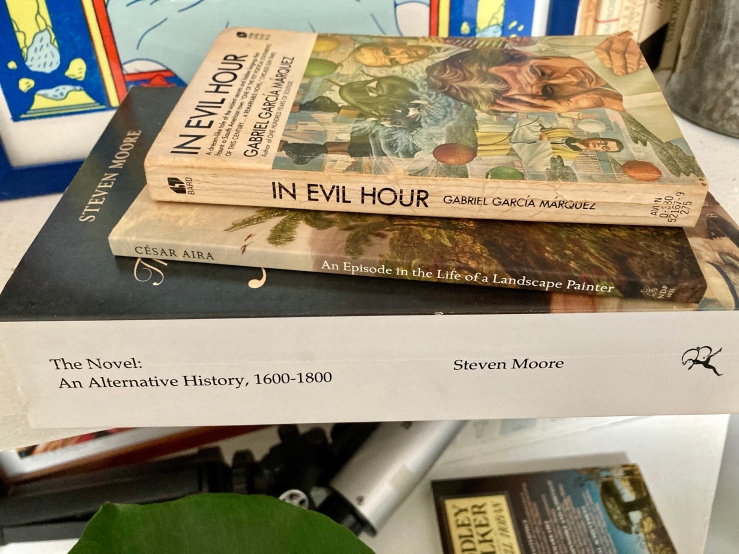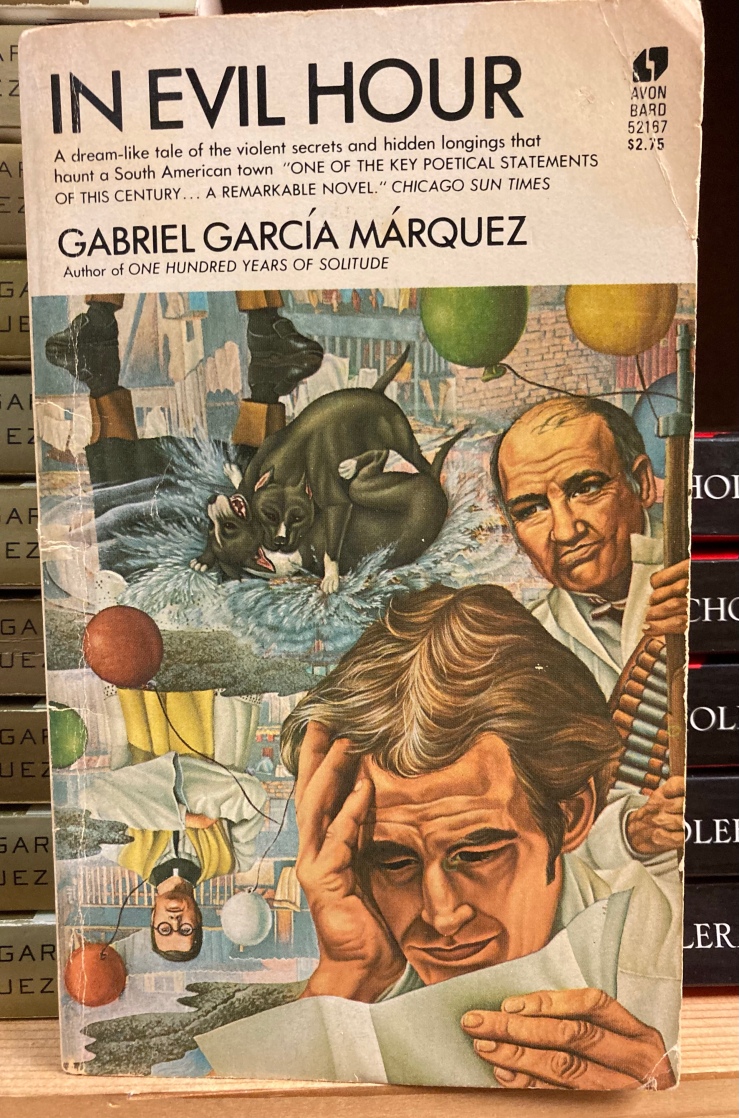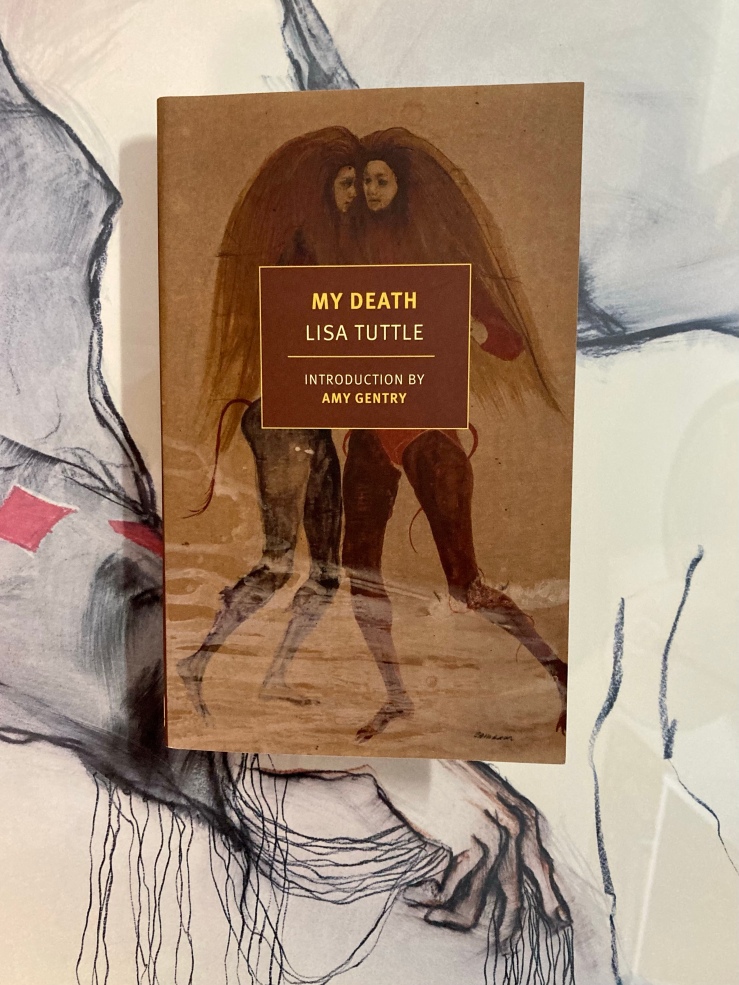
Mystery box (Books acquired, 17 May 2023)

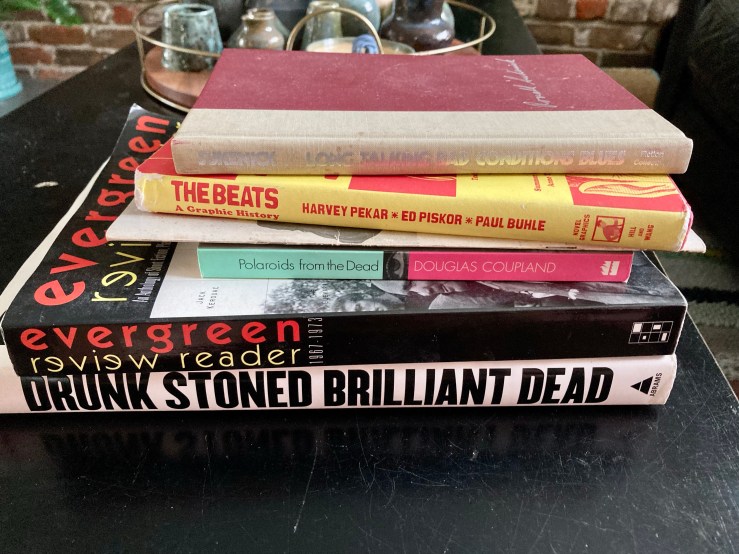
One of my oldest friends (by which I mean friend I’ve had for a long time, not, like, old, although we’re both getting up there, although by no means old, but I suppose certainly definitely no longer youngmiddleaged, I guess, although when we were young we would have thought ourselves now (middleaged) old)

—one of my oldest friends Patrick sent me a mystery box of books earlier this week. Highlights include The Evergreen Review Reader (begins with William S. Burroughs and ends with Kathy Acker, two writers Patrick introduced me to way back in seventh or eighth grade), a graphic history of the Beats by Harvey Pekar et al, and a signed copy of Ronald Sukenick’s Long Talking Bad Condition Blues. Thanks PT!

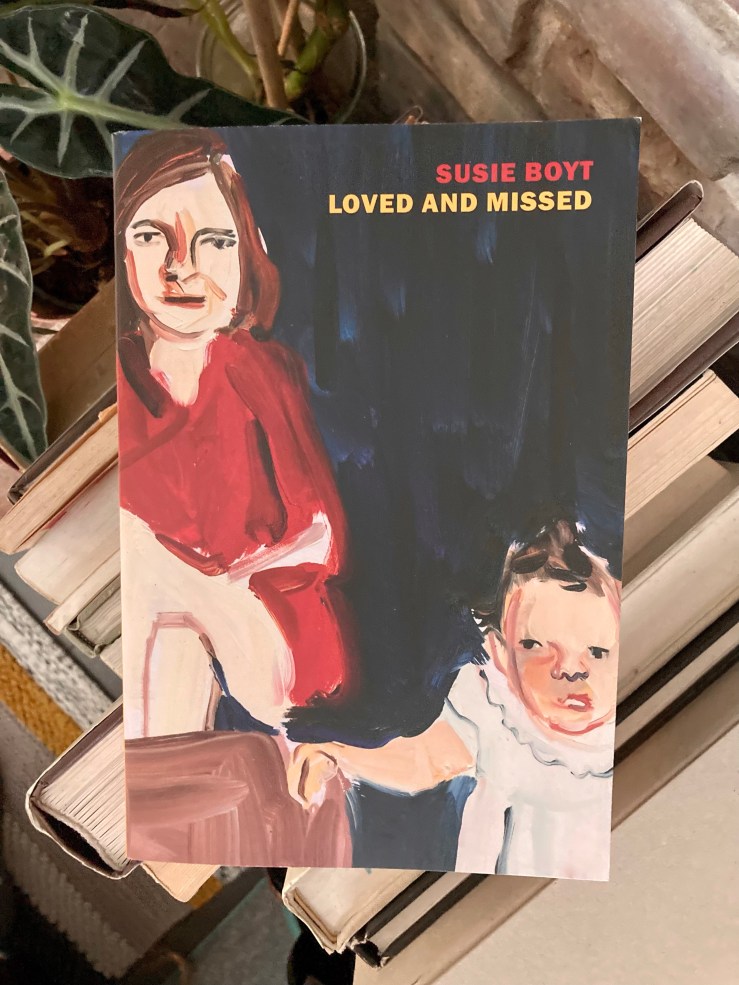
Gary Amdahl’s Across My Big Brass Bed (Book acquired, early May 2023)

Gary Amdahl’s 2014 novel Across My Big Brass Bed is getting a new printing from corona\samizdat. A review copy arrived at Biblioklept World Headquarters a day or two before a short vacation, and I almost tucked it into my backpack for the plane, but I knew that the novel’s paragraphless flow would not work for me if I were around other humans, let alone in a big metal plastic carbon fiber thing forty thousand feet in the etc.

So I set it aside, and then picked it up this afternoon.

The novel (subtitled “An Intellectual Autobiography in Twenty-four Hours”) begins: “I drove, aimlessly but alertly, fighting traffic.” It’s the early 1960s in the Twin Cities, and our narrator seems to be coming into consciousness, by which I might mean earliest memories, or really just new language-and-concept acquisition: “President John Fitzgerald Kennedy had just been—new word—assassinated.” A few sentences later, our narrator cracked me up with this mordant zinger:

“Whatever it meant to be human, President Kennedy could no longer manage it.”

Yikes! The first chapter ends with our hero successfully assisting a group of pedestrians in their crossing of the street in his new professional capacity of an elected Crossing Guard of Madison Elementary. I loved the pages I read today.

Books acquired (First week of May, 2023)

My wife and I spent a lovely few days in Sunny Manhattan last week in celebration of a recent anniversary. We stayed in the venerable Hotel Chelsea, where we were lucky enough to get a brief visit to room 629, the former residence of the artist Vali Myers. The current resident, photographer Tony Notarberardino was hosting a party later, and the theatrical currents outside of his door, accompanied by ethereal music, attracted us to peer in as we were looking around the hotel. Tony graciously invited us for a brief peek before his party, and the rooms are simply otherworldy, covered in murals by Myers along with beautiful paintings, furniture, and other sundries. Among other books, he recommended Sherill Tippins’ history of the hotel, Inside the Dream Palace. The short tour was a highlight of our visit.

I wasn’t able to find Tippins’ book at any of the four bookstores I visited in NYC, but I found it at my trusty enormous used bookstore when I got home. I’m enjoying it very much so far—it’s really almost like a history of 20th c. modernism focused around one locale. I’m not quite halfway through, around the early 1960s, in a chapter focusing on Harry Smith (he of the Anthology of American Folk Music, and many other things), who was a one-time resident of the Chelsea.

Admittedly, I didn’t scour the history books at The Strand’s main store too closely, spending most of my time browsing fiction. I ended up with László Krasznahorkai’s Spadework for a Palace (trans. by John Batki) and a hardback copy of Joy Williams’ HarrowHarrow was one of my favorite books of last year. I listened to the audiobook twice and have had an eye out for a physical copy since then. Something I wrote on it in a 2022 round up:

Williams takes the “post-apocalyptic” quite literally–Harrow is about post-revelation, an uncovering, a delayed judgment from an idiot savant. It’s one of those books you immediately start again and see that what appeared to be baggy riffing was knotting so tight you couldn’t recognize it the first time through — the appropriate style for a novel that dramatizes Nietzsche’s eternal return as a mediation of preapocalyptic consciousness in a post-apocalyptic world.

Drew Lerman’s Escape from the Great American Novel (Book acquired, end of April 2023)

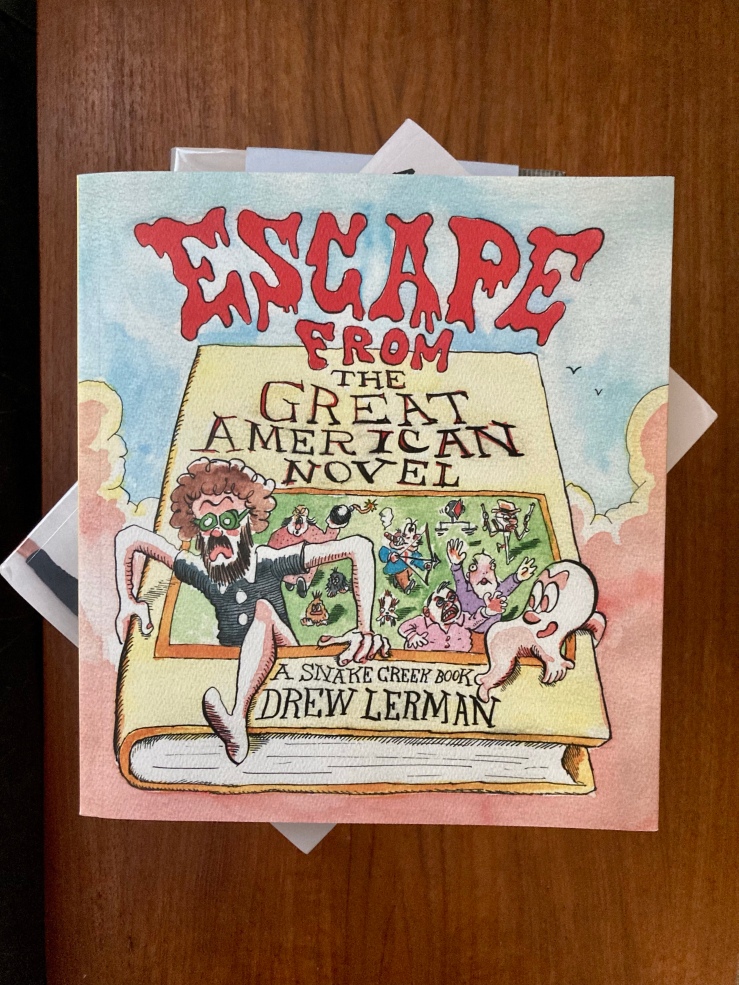
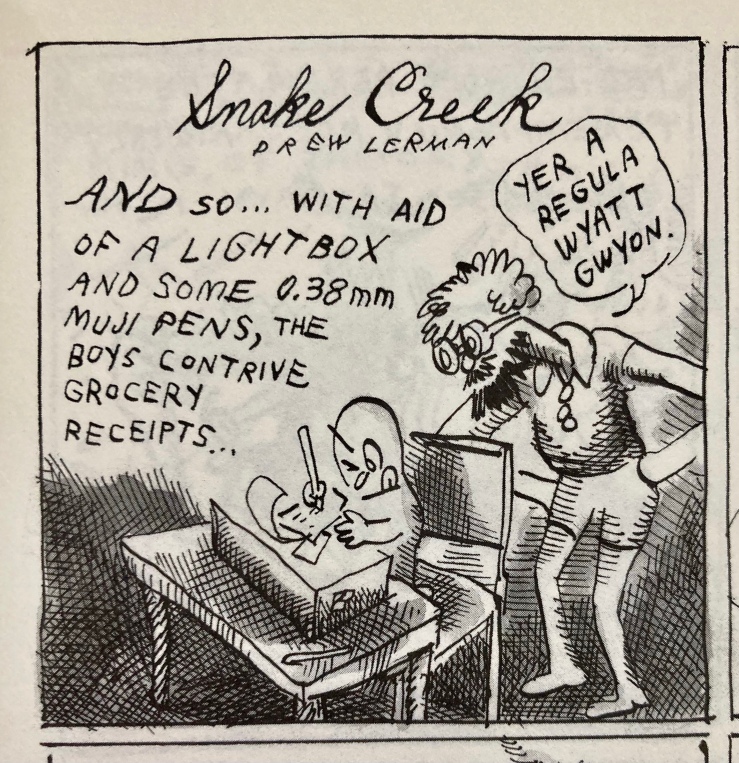
I’ve long been a fan of Drew Lerman’s Snake Creek strip, and eagerly look forward to each new collection. The latest is Escape from the Great American Novel, which I’ve tried not to read all at once. I should have a full review in the next few weeks, but so far, Great Stuff—Escape is funny, erudite without being precious, and soulful. It also shows an expansion of Lerman’s narrative development (without sacrificing the kind of gags and send ups that one wants out of a great strip).

Here’s publisher Radiator Comics’ description:

Escape from the Great American Novel by Drew Lerman follows best friends, Roy and Dav, as they find themselves on opposite sides of a battle between apocalyptic oil barons and bomb-chucking anarchists. But Dav just wants to write the Great American Novel, while Roy wonders what the big deal is—after all, their world is only another fiction.

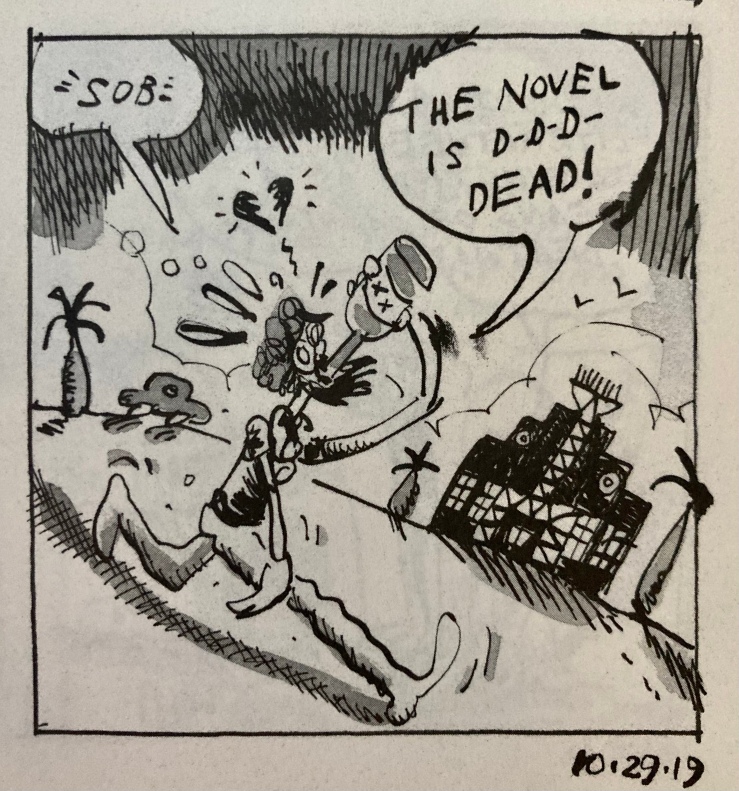
And here’s a nice little throwaway Gaddis gag:

Ballard/Colquhoun/Gray (Books acquired, 28 April 2023)

After an early spring purge n’ clean, I took a few boxes of books to my local used bookstore. I had intended to browse just a bit and not pick up anything (apart from a few Jeff VanderMeer novels my son had asked for), but I wound up getting three books: a pristine first U.S. edition of J.G. Ballard’s The Unlimited Dream Company, Alasdair Gray’s Unlikely Stories, Mostly, and surrealist artist Ithell Colquhoun’s ostensible biography of the occultist Samuel Liddell MacGregor Mathers (of the Golden Dawn).

I had never heard of Colquhoun’s book, but I’m a fan of her paintings and the cover struck me. The book seems to be a history of the occult organization the Golden Dawn, or, more to the point, the roots of that organization. It’s filled with photographs and diagrams and charts. Like this one:

Alasdair Gray’s collection Unlikely Stories, Mostly is also crammed with illustrations—Gray’s own, like this one:

Like Gray’s 1984 novel 1982, Janine, the collection is filled with typographic experiments, a kind of concrete poetry in prose I guess. The “About the Author” blurb on the flap is great stuff (still can’t top the blurb for 1982, Janine though):

Susan Taubes’ Lament for Julia (Book acquired, 18 April 2023)

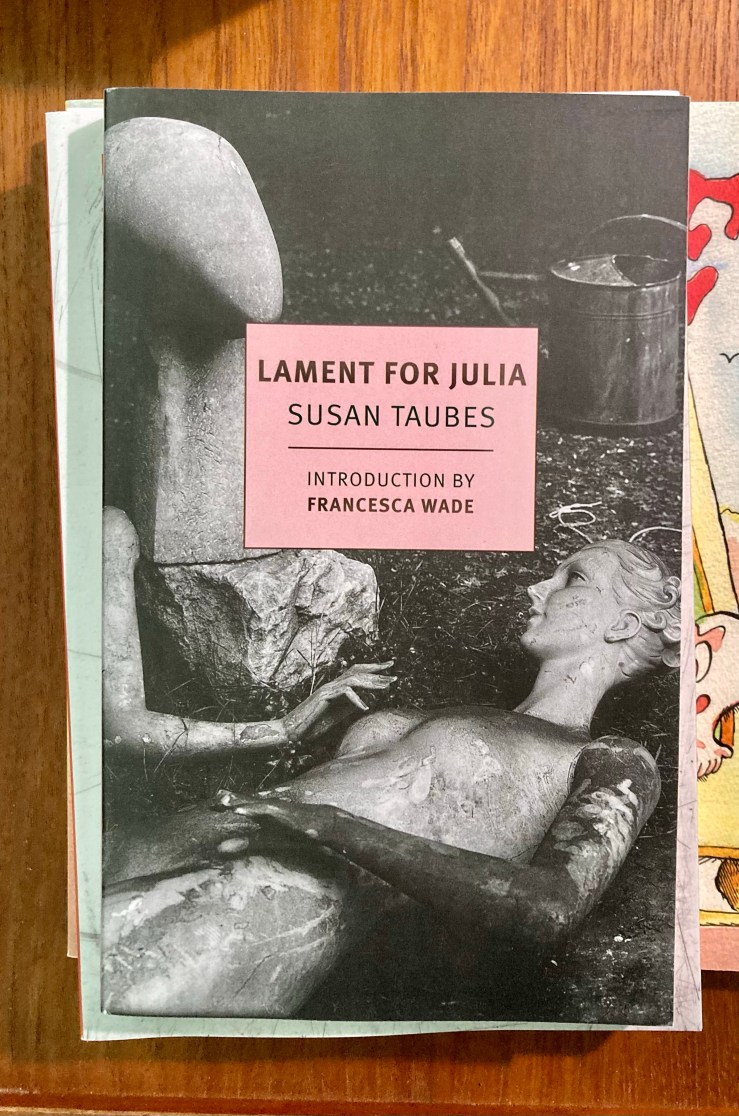
Susan Taubes’ Lament for Julia collects the eponymous posthumous novella with a handful of Taubes’ stories. The book is out this summer from NYRB. Their blurb–

Susan Taubes’s novella “Lament for Julia” is the story of a young woman coming of age in the twentieth century as seen through the eyes of a sexless spirit who supposes himself to be charged with her oversight.

What is this spirit? An operator from on high (though hardly holy), a narrative I, and a guiding presence that is more than a bit of a voyeur, who remains entirely unknown to Julia herself. About her, the spirit knows both a good deal and very little, since Julia’s emotional and physical and sexual being are all baffling, if also fascinating, to an entity that is pure mind.

The I and Julia are a mismatched couple, set up for failure from the start, it seems, even if they do somehow manage to deal in their different ways with childhood and Mother and Father Klopps and ugly pink outfits and dances and crushes for a while. After which come love and marriage, not necessarily in that order, at which point things really start to go wrong.

Unpublished during Taubes’s lifetime, “Lament for Julia” appears here with a selection of her stories. A brilliant metaphorical exploration of a woman’s double consciousness that is also a masterpiece of the grotesque, it is a novel like no other, a book, as Samuel Beckett wrote to his French publisher, “full of erotic touches of an emphatic sort [and] raw language,” the product of an “authentic talent,” adding, “I shall reread it.”

Eileen Chang’s Written on Water (Book acquired, 18 April 2023)

NYRB has a book of Eileen Chang’s essays out this summer. Titled Written on Water, the collection is translated and edited by Andrew F. Jones, with an afterword with Jones’s co-editor Nicole Huang. NYRB’s blurb:

Eileen Chang is one of the most celebrated and influential modern Chinese novelists and cultural critics of the twentieth century. First published in 1944, and just as beloved as her fiction in the Chinese-speaking world, Written on Water collects Chang’s reflections on art, literature, war, urban culture, and her own life as a writer and woman, set amid the sights and sounds of wartime Shanghai and Hong Kong. In a style at once meditative and vibrant, Chang writes of friends, colleagues, and teachers turned soldiers or wartime volunteers, and her own experiences as a part-time nurse. She also reflects on Chinese cinema, the aims of the writer, and the popularity of the Peking Opera. Chang engages the reader with her sly and sophisticated humor, conversational voice, and intense fascination with the subtleties of everyday life. In her examination of Shanghainese food, culture, and fashions, she not only reveals but also upends prevalent attitudes toward women, presenting a portrait of a daring and cosmopolitan woman bent on questioning pieties and enjoying the pleasures of modernity, even as the world convulses in war and a revolution looms.

James Grieve’s translation of Proust’s Swann’s Way (Book acquired, 19 March 2023)

This May, NYRB will publish a “new” translation of the first volume of Marcel Proust’s longassed novel In Search of Lost Time.

The translation, by James Grieve, is not actually new. It’s actually like half a century old.

The NYRB jacket copy states that “James Grieve began his career as a translator of Proust in the early 1970s, driven by his dismay at how many readers deemed In Search of Lost Time to be too difficult for them to take on. Grieve’s artful and celebrated version of Swann’s Way—only now available outside his native Australia—shows that this is hardly the case.” 

I was unfamiliar with Grieve’s translation. As I admitted on Twitter, I’m not really a Proust Guy. I read Lydia Davis’s translation of Swann’s Way a decade ago, and thought it was Okay and decided it was also Enough. Many, many people replied to my tweet that C.K. Scott Moncrieff’s translation was the way to go. Author and translator Daniel Mendelsohn told me that I’d “read the wrong translation!”  — but I’m okay with that.

Here is the I-guess famous opening line of Moncrieff’s 1922 translation:

For a long time I used to go to bed early.

Here is the Modern Library’s 1992 translation, crediting Moncrieff and Terence Kilmartin, revised by D.J. Enright:

For a long time I would go to bed early.

Here is Lydia Davis’s translation (2002) of the opening line:

For a long time, I went to bed early.

And here is James Grieve’s translation:

Time was when I always went to bed early.

There were a lot of opinions on Grieve’s rendering of this particular line floating around Twitter.

I have no dog in this race, but the voicing here strikes me as, I dunno, very, uh, colloquial? Almost like Huck Finn or something?

Proust’s original, by the way:

Longtemps, je me suis couché de bonne heure.

I muddled my way through a few years of college French, and have no real strong opinions here, but the phrase bonne heure is the most interesting to me. When I read it in French, I read it as something like, “a good hour,” or “the right time.”

Translation is about feeling and tone and vibe and mood as much it is about (the attempt for) precision, so I suppose each translator brings their own sense of the narrator’s voice to their translation, a voice that may or may not sync with what those other translators, the readers, hear in their mind’s ear.

Two from Dino Buzzati (Books acquired, last week of March 2023)

NYRB is issuing a new translation of Italian author Dino Buzzati’s 1940 novel Il deserto dei Tartari next month. In his afterword to this new edition, translator Lawrence Venuti points out that Buzzati’s original intended title, La fortezza, was rejected by the novel’s publisher Rizzoli, who expressed concerns that, with the outbreak of WW2, the title might be misunderstood by the reading public. The novel received an English translation by Stuart Hood twelve years later as The Tartar Steppe. Venuti restores Buzzati’s intended title in his new translation.

I started in on The Stronghold last night, just casually dipping into a few pages, as I try to do with all of these silly “book acquired” posts, and wound up reading the first fifty pages in one go, then picking it up again this morning. It quickly reminded me of Kafka’s The Castle and Ishiguro’s The Unconsoled—the kind of novel of endless deferrals, its alterity heightened by the concrete precision of the prose. Great stuff so far.

NYRB is also releasing an edition of Joseph Green’s translation of Buzzati’s later novel, A Love Affair. Their blurb:

Antonio Dorigi is a successful architect in Milan, nearing fifty, who has always been afraid of women. He has been a regular at an upscale brothel for years, even as he mourns the lack of close female companionship in his life.

One afternoon, the madam at the brothel introduces Tonio to “a new girl,” Laide (short for Adelaide). Tonio sees nothing especially remarkable about Laide, though it intrigues him that she dances at La Scala and also at a strip club, and yet in a very short time he becomes completely obssessed with her.

Laide draws Antonio on, confounds him, uses and humiliates him, treats him tenderly from time to time, lies to him, makes no apologies to him, and he loves her ever more. This helpless and hopeless love is what he is, he feels, even as it prevents him—we see—from ever seeing Laide for who she is. Because Who is she? is the question at the heart of Buzzati’s clear-eyed and often comic tale of infatuation.

Laide is a young woman who has never known the bourgeois prosperity Tonio takes for granted, someone in a pickle looking for a main chance. She is a storyteller and someone, too, who knows how stories tell on people and shape their desires and lives.

Is A Love Affair a love story or is it a story of anything but love? Buzzati’s novel, with its psychological subtleties, its vivid cityscapes, and its compassion, keeps the reader guessing till the end.

Under the Volcano and elsewhere (Books acquired, week of 10 March 2023)

My family and I had a wonderful time vacationing in Mexico City last week. We rented an apartment in Condesa, a friendly, walkable neighborhood marked by shade trees, lush gardens, and robust parks. And dogs. Lots of lovely dogs. Over eight days, we took in as much of the city as we could (as well as some excellent day trips to Grutas Tolantongo in Hidalgo and Teotihuacán in Edomex). The city is huge, with more than 150 museums, and the food is excellent. While the four members of our family share common interests (including a love of art), making sightseeing somewhat streamlined, I left Mexico City feeling like I had barely scratched the surface. It reminded me in disparate ways of New York City, Bangkok, and New Orleans. Like those cities, there’s not a single aspect that intrigues me, but rather a vibe. But this is not a travel blog, it is a book blog, so:

The first thing I noticed is that the selection of titles in the several bookstores I visited (a few just very briefly) was generally excellent. Shops tended to feature big-ell Literature titles in lieu of bestsellers and airport novels, with new releases like Mircea Cartarescu’s Solenoid and Yuri Herrera’s La estación del pantano getting prominent displays.

I visited both locations of Cafebrería El Péndulo, and picked up an inexpensive Debolsillo edition of Roberto Bolaño’s La literatura nazi en America, resisting the urge to grab one of the big novels. I’ve read Chris Andrews’ translation of Nazi Literature in the Americas a few times, and I figured that it would be better for me to attempt reading and comparing the shorter sketches here than to jump into 2666 in Spanish. Although I practiced my Spanish for a year in preparation for the trip (it helps to have a Spanish professor friend whose office is down the hall from mine), my vocabulary is still limited and my conjugations are a mess.

Also Bolaño-related: We lunched at Café la Habana, a charming restaurant boasting a history as a salon for poets, politicians, theorists and other bullshitters. In Bolaño’s Mexican opus The Savage Detectives, Café la Habana appears as Café Quito.

I also visited Under the Volcano, a tiny and charming bookstore in Condesa that carries English-language books–mostly literature. The store is named for Malcolm Lowry’s excellent novel, but there didn’t appear to be any of his books there the day I visited. There was a first-edition hardback copy of Robert Coover’s Pricksongs and Descants, but it was jacketless and out of my price range. There was also a standalone magazine-sized Dalkey Archive edition of William H. Gass’s story Willie Master’s Lonesome Wife, which, based on its price, the owner seemed to believe the most valuable item in the store. I also spied a copy of Jay McInerney’s 1984 novel Ransom, notable because it’s the first and so-far only hardcover of a Vintage Contemporaries edition I’ve ever seen.

I wound up with two books from Under the Volcano: a Europa Editions of Steven Erickson’s Zeroville and Vintage edition of Aldous Huxley’s Beyond the Mexique Bay. I listened to the audiobook of Zeroville a few years ago, loved it, and have kept an eye out for a reasonably-priced copy ever since. I admit that I picked up Huxley’s essay collection in large part because of its title and its cover design (by Bradbury Thompson). I only found it because I was looking for a copy of Huxley’s The Devils of Loudun. I’ve been falling asleep to an audiobook version of Devils for about three weeks now.

I stopped into a La Increíble Librería at random while walking through Condesa. It’s a charming store that specializes in art books and arty children’s books. They also sell a small but excellent selection of Latin American titles in English translation. I picked up a coffee table book there called 50 íconos de la Ciudad de México. The book is in both Spanish and English, and features lovely illustrations of iconic Mexico City locations by ten different artists. Here’s a detail from Diego Huacuja’s illustration of the Auditorio Nacional:

As we looked through this book this morning, my wife remarked on just how few of the fifty icons presented we missed seeing on this trip. And although we saw a lot that’s not in the book, it nevertheless confirmed my feeling that we need to visit Mexico City again.

The Letters of William Gaddis (Book acquired, 1 Feb. 2023)

Ten years ago, Dalkey Archive published The Letters of William Gaddis. Edited and introduced by Steven Moore, Letters functions as an ersatz autobiography or a one-sided epistolary autobiographical novel. As a public-facing author, Gaddis was hardly a Pynchon or Salinger, but, in a 1986 Paris Review interview, he did stick by the hero of his first novel The Recognitions, contending,

What’s any artist but the dregs of his work[?]: I gave that line to Wyatt thirty-odd years ago and as far as I’m concerned it’s still valid,

Wyatt, and Gaddis, wanted to know “what people want from the man they didn’t get from his work.” The Letters offers some answers—close to 700 pages of them in the new NYRB edition of the book that includes “over two dozen new letters and photographs.”

Portrait of William Gaddis, Julian Schnabel, 1987

I first read The Letters of William Gaddis slowly between 2014 and 2019 as an e-book (both legit and samizdat). Moore organized the collection around Gaddis’s five books, and I found myself often distracted, opening up the the volumes to find parallels between life and art (or moments where WG outright stole from reality). I’d never actually held the Dalkey edition, but I wanted to get a comparison, so I asked my librarian to engage in some hot library on library action, and I now have the University of Central Florida’s copy in my possession. The hardback volume is missing the jacket, which featured Julian Schnabel’s 1987 portrait of Gaddis on the cover.

The new NYRB edition, perhaps more appropriately, features Gaddis’s self-portrait as cover art. The black, gold, and red, as well as the extra-large dimensions (by NYRB standards) match the NYRB versions of The Recognitions and J.R. It’s longer and a bit smaller than the hardback Dalkey, but the print is about the same size.

I’ve decided to cover the book at my own pace; I’ve reread the first two sections, “Growing Up,” and “The Recognitions,” which covers 1930-1955. I remembered pretty much all of it, and my judgments remain the same: Gaddis is an unrepentant mama’s boy, his sweet ma Edith is the early hero of the book, quick to send money and books. Angry Young Man Gaddis is more Otto than Wyatt, but he can sling sentences with the best of them—and that’s the joy of The Letters: the writing is really, really good.

Like I said though, I’ll cover the volume at my own pace. I’ve got notes prepped for the first two sections, and I aim to get those blogs out sooner than later. In the meantime, here’s the publisher’s blurb, almost certainly Moore’s writing, updated just a tad from the Dalkey:

Now recognized as one of the giants of postwar American fiction, William Gaddis shunned the spotlight during his life, which makes this collection of his letters a revelation. Beginning in 1930 when Gaddis was at boarding school and ending in September 1998, a few months before his death, these letters function as a kind of autobiography, and also reveal the extent to which he drew upon events in his life for his fiction. Here we see him forging his first novel, The Recognitions (1955), while living in Mexico, fighting in a revolution in Costa Rica, and working in Spain, France, and North Africa. Over the next twenty years he struggles to find time to write the National Book Award–winning J R (1975) amid the complications of work and family; deals with divorce and disillusionment before reviving his career with Carpenter’s Gothic (1985); then teaches himself enough about the law to produce A Frolic of His Own(1994). Resuming his lifelong obsession with mechanization and the arts, he finishes a last novel, Agapē Agape (published in 2002), as he lies dying.

This newly revised edition includes clarifying notes by Gaddis scholar Steven Moore, as well as an afterword by the author’s daughter, Sarah Gaddis.


Márcia Barbieri’s The Whore (Book acquired, Feb. 2023)

In a long, delirious monologue driven by bile and cocaine, a prostitute named Anúncia recounts the story of her life, remembering and sometimes inhabiting the men and women who left the deepest scars on her psyche—her absent father, her mentally disturbed mother, the son she never wanted, the parade of lovers like the poet and the philosopher—all the while drawing grand conclusions about the nature of sex, life, and death from her own experiences. In a world ravaged by pollution and unceasing war, the narrator’s acid tongue condemns anyone who believes that filth and depravity have more to do with copulation than the misery inflicted by exploitation and inequality.

In acidic, relentless, and sometimes dream-like prose, Barbieri conjures a figure at once singularly human and divine, an androgynous, eternal being made of viscera and utterance. The Whore, more than anything, is an interrogation of interiority, and the ways in which the emotional and spiritual interior is not only inseparable from one’s physical form, but, in fact, strengthened by acknowledgement of the body.

Márcia Barbieri’s novel The Whore is forthcoming this spring from Sublunary Editions in translation by Adrian Minckley.

Camilo José Cela’s 1950 novel The Hive (Book acquired, 1 Feb. 2023)

Camilo José Cela’s 1950 novel The Hive is forthcoming from NYRB in translation by James Womack. NYRB’s blurb:

The translator Anthony Kerrigan compared Camilo José Cela, the 1989 winner of the Nobel Prize in Literature, to Louis-Ferdinand Céline and Curzio Malaparte—all “ferocious writers, truculent, badly spoken, even foulmouthed.” However provocative and disturbing, Cela’s novels are also flat-out dazzling, their sentences as rigorous as they are riotous, lodging like knives in the reader’s mind. Cela called himself a proponent of “uglyism,” of “nothingism.” But he has the knack, to quote another critic, Américo Castro, of deploying those “nothings and lacks” to construct beauty.

The Hive is set over the course of a few days in the Madrid of 1943, not long after the end of the Spanish Civil War, when the regime of General Francisco Franco was at its most oppressive. The book includes more than three hundred characters whose comings and goings it tracks to hypnotic effect. Scabrous, scandalous, and profane, The Hive is a virtuosic group portrait of a wounded and sick society.

Blog about some weekend book browsing and book buying, other stuff

I took a box of books to trade in at my local used bookstore on Saturday. I was hoping to find a short history of Mexico City, or maybe some travel writing about Mexico City, but I didn’t find anything like that, although I rarely look through the history section or travel writing section when I browse there so was perhaps a bit overwhelmed. .

did come across a book published by something called Rosicrucian Press in the 1930s–W.S. Cerve’s Lemuria: The Lost Continent of the Pacific. Lost Lemuria hangs over a few Pynchon novels (and is touched on in Charles Portis masterful and zany Masters of Atlantis)—so of course I picked up Cerve’s book. Chapters include “The First Races of Man in America,” “Mysterious Forces in the Universe,” and “Present Day Mystic Lemurians in California.” There are also diagrams, charts, and maps, like this one:

This bookstore, Chamblin’s Bookmine, also featured a display of books removed from classrooms and school libraries in our city as a result of the current Florida Governor’s efforts to suppress critical thinking, whitewash American history, and generally turn Florida’s soul into a puddle of tepid piss. University of North Florida English Professor Laura Heffernan documented the display in the following tweet (notice a common thread?):

Today I stopped by Chamblin’s second, downtown location, Chamblin’s Uptown, mostly because I was dropping my daughter off at a birthday party about five minutes away. I go there only a few times a year, so it was nice to browse for a spare hour.

I snapped up two Stanley Elkins, The Magic Kingdon and The Living End, in Janet Halverson-designed editions that match my copy of Elkin’s The Dick Gibson Show. I listened to an audiobook of The Living End this summer and loved it–it made me want to get into more Elkin.

Going from the Es to the Fs, I spotted a nice used copy of Ann Goldstein’s translation of The Lost Daughter. I’ve been wanting to read it for a while, but picked it out for my wife to read first (I don’t think she really likes reading Valeria Luiselli’s Lost Children Archive, which I gave her a few weeks ago. And now that I type this out, I see that I may have picked a weird substitute).

I also snagged a pristine used copy of Richard McGuire’s graphic novel Here. I checked it out from the library a few years ago when new copies seemed prohibitively expensive.

At the checkout I picked up a pamphlet describing strategies for undoing the book banning here in Jacksonville (and Florida in general). This whole fucking thing has had me so mad and sad, and I have friends who are checking out of Florida, but I feel like we shouldn’t have to cede territory to these dull monsters—and it feels good to see other people who feel the same.

A succinct summary from the pamphlet:


Aug Stone’s The Ballad of Buttery Cake Ass (Book acquired, January 2023)

Aug Stone’s novel The Ballad of Buttery Cake Ass publishes this week. Blurb form Stone’s website:

Two music obsessives embark on a hilarious quest to track down Buttery Cake Ass’ Live In Hungaria, an album as legendary as it is obscure. Their pursuit of one of the greatest bands ever unknown takes them down many a bizarre path teeming with grand ideas and grander egos in this ode to record shopping and what it’s like to be in your first band.

Martin Riker’s The Guest Lecture (Book acquired, early January 2023)

Martin Riker’s The Guest Lecture is out now from Grove Atlantic. Their blurb–

In a hotel room in the middle of the night, Abby, a young feminist economist, lies awake next to her sleeping husband and daughter. Anxious that she is grossly underprepared for a talk she is presenting tomorrow on optimism and John Maynard Keynes, she has resolved to practice by using an ancient rhetorical method of assigning parts of her speech to different rooms in her house and has brought along a comforting albeit imaginary companion to keep her on track—Keynes himself.

Yet as she wanders with increasing alarm through the rooms of her own consciousness, Abby finds herself straying from her prepared remarks on economic history, utopia, and Keynes’s pragmatic optimism. A lapsed optimist herself, she has been struggling under the burden of supporting a family in an increasingly hostile America after being denied tenure at the university where she teaches. Confronting her own future at a time of global darkness, Abby undertakes a quest through her memories to ideas hidden in the corners of her mind—a piecemeal intellectual history from Cicero to Lewis Carroll to Queen Latifah—as she asks what a better world would look like if we told our stories with more honest and more hopeful imaginations.

With warm intellect, playful curiosity, and an infectious voice, Martin Riker acutely animates the novel of ideas with a beating heart and turns one woman’s midnight crisis into the performance of a lifetime.

Beppe Fenoglio’s A Private Affair (Book acquired, 9 Jan. 2023)

Beppe Fenoglio’s A Private Affair is forthcoming this spring in translation by Howard Curtis from NYRB. Their blurb:

Milton—the name is a nom de guerre—is a member of a partisan band battling Italian Fascists and German forces in the chaotic last years of World War II. Before the war Milton was a student of English literature and a lover of poetry. He was in love with a girl, too, Fulvia, and from time to time she’d invite him over to her rich family’s fine house and have him read to her. Now, in the thick of war, he discovers that handsome Giorgio, his friend and fellow partisan, was sleeping with Fulvia at the time. Furious with jealousy, Milton hastens to have it out with Giorgio, but Giorgio has been captured by the Germans. A Private Affair tells the story of Milton’s mad quest—through mud and fog, rain and terror, while barely evading enemy patrols—to rescue his friend, the better to settle a grudge from a lost world of peace. Beppe Fenoglio’s masterpiece is a peerless story of the violent heart and world.