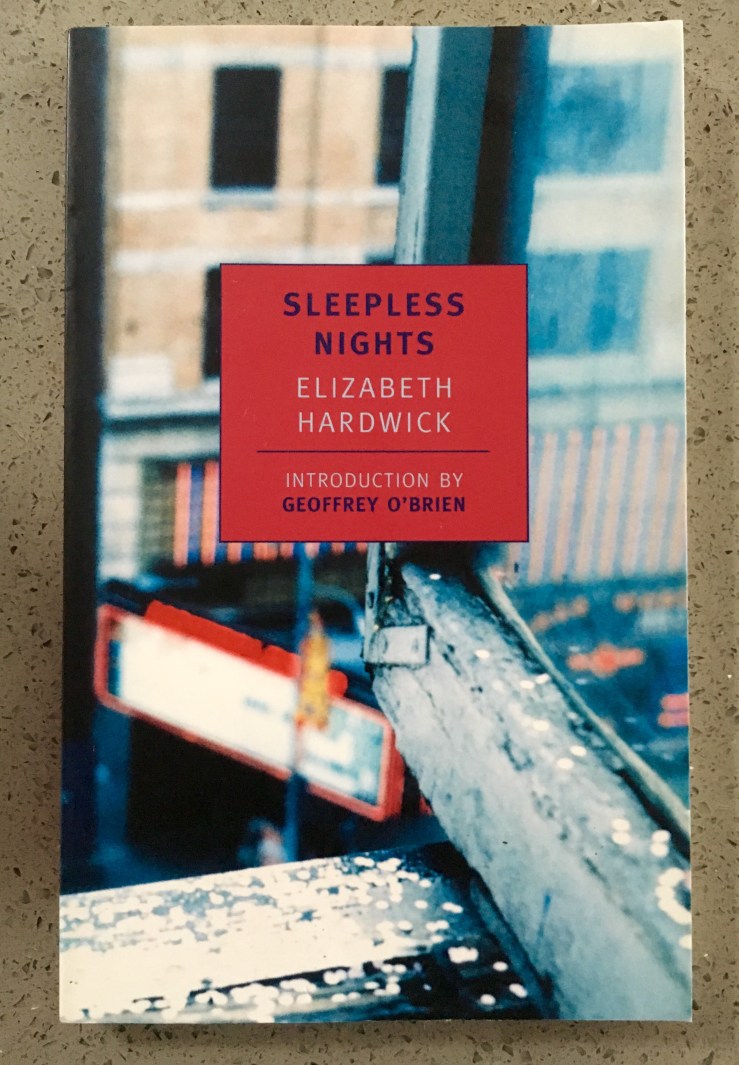
William Gaddis’s J R (A short riff on a long book)

img_1659

1.

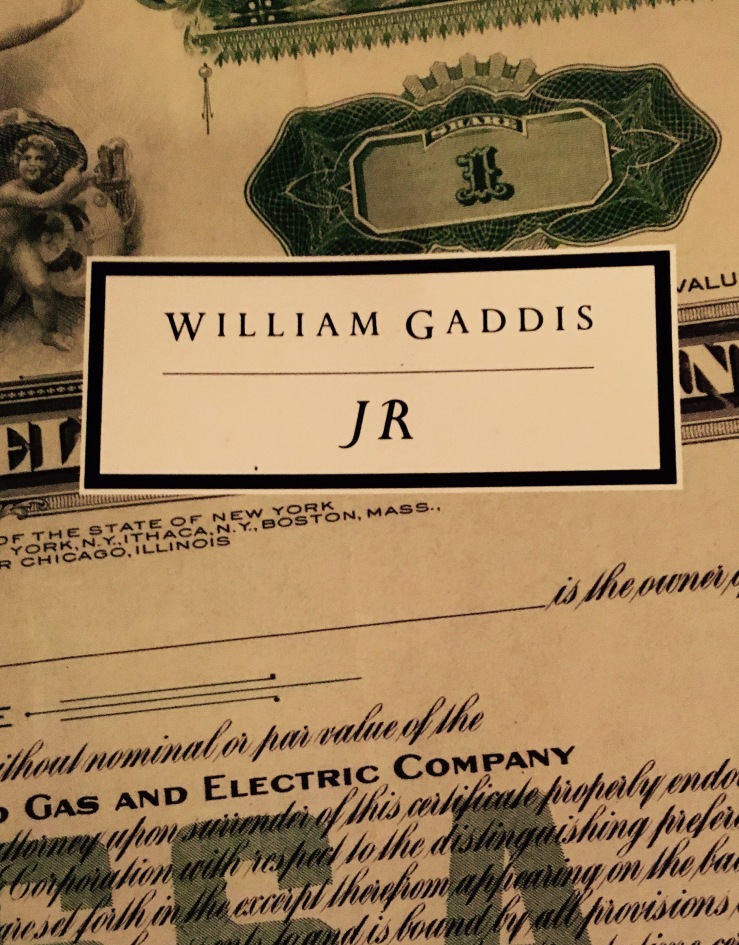
I reread William Gaddis’s 1975 novel J R this February and, as is usually the case with a reread, I was pleasantly unsurprised by all its unremembered surprises—the jokes and japes, riffs and routines that had oozed from my brain-sieve since that first read back in 2012.

How could I forget about a scheme to freeze sound, or an art theft subplot, or the Indian uprising? How could I forget that in J R, Gaddis anagrammatically parodies the critical rejections of his first novel The Recognitions? (I did remember the stuffed Eskimo).

2.

What I was surprised surprised surprised about in my rereading of J R was how much of the first reading had stuck. And stuck hard, soaked in, saturated—the sign of a great grand thing, the em-word thing, the masterpiece thing.

3.

Only a handful of novels are so perfectly simultaneously comic and tragic. Moby-Dick? Yes. Gravity’s Rainbow? Absolutely. (G R and J R, a duo published two years apart, spiritual twins, massive American novels that maybe America hardly deserves (or, rather: theses novels were/are totally the critique America deserves). I guess maybe what I’m saying is J  R is the Great American Novel to Come (The Recognitions is perhaps overpraised and certainly not Gaddis’s best novel; J R is. The zeitgeist has been caught up to J R, the culture should (will) catch up).

4.

So I already wrote on J R on this blog: A misfire of sorts from halfway through (in which I offer more description of the novel’s plot and form than I intend to here, maybe), and a thing I wrote after finishing it which (this thing I wrote before, I mean) might be better than anything I can muster here, in terms of analysis, of like, theme. I’ll limit myself to, I don’t know, eleven points in this riff, yes? (Why 11? Why not? Why not go to 11? 11 for Chapter 11, for bankruptcy, for the moral artistic intellectual bankruptcy that the novel J R skewers). So, having limited myself to eleven points, and having not gotten to the damn point yet, which is—

5.

J R is so good, y’all. The book is a performance, an opera, an essay on America, a howl, a condemnation, a farce, a romance, a tragedy. When I read it in 2012 I couldn’t believe how prescient it was, a feeling reconfirmed with force four years later. J R diagnoses and describes and ridicules American corporatism, the industrial-military-entertainment-banking-education-etc. -complex. And then it weeps.

6.

But wait—what I wanted to say is J R is so good—so, uh, entertaining. It’s fucking funny. And sweet.

7.

(And bitter).

8.

And J R’s not as hard a read as some dudes would have you believe. Sure, it’s composed almost entirely in unattributed dialogue—and that can be tough, to start, but you can learn to hear it very quickly.

In his essay “William Gaddis and His Goddamn Books,” William Gass writes that, “J R takes time. J R takes patience. J R takes faith.” But Gass also points out the payoff of J R “unlike other faiths…is immediately and continuously redeeming.”

It is redeeming (continuously), and I don’t just echo Gass here as some kind of rhetorical flourish—reading J R again was a reminder that the novel posits redemption through Bast’s call to action, to his resolve to, as the failed writer (or stymied writer) Eigen puts it, “go do what [he has] to do” to make real art—or, in our hero Bast’s own terms: “…until a performer hears what I hear and can make other people hear what hears it’s just trash isn’t it…”

9.

And in J R the reader becomes the performer, making the voices, singing the voices, (muttering the voices), navigating all the trash, the entropy—J R is a novel of unraveling, where art trips over commercial trash and literal trash–old ads, betting tickets, stock ticker tape, phone book pages, train tickets, scraps. Is there another American novel so aware of its own textuality, its own metatextuality—I mean one that doesn’t goddamn wink all the time at its readers like so much clever postmodern slop?

Gass again: “[J R] is written in speech scraps, confetti-like wiggles of brightly colored cliché. As a medium, it would appear to be as unpromising as might be imagined. And the reader has to ride in the parade and organize all that fluttering that’s come down from on high.” High and low.

10.

And all the heroes of J R—Bast and Gibbs and Amy Joubert, but also the titular J R his own goddamn self (and maybe, if we’re feeling charitable examining this novel of capitalism, Eigen)–they’re falling apart and trying to put themselves back together (even their clothes unraveling, their shoes falling apart). Chaos, entropy.

The whole deal is best summed up in an early episode in which Gibbs rants against the modern education system: “Order is simply a thin, perilous condition we try to impose on the basic reality of chaos…”

Or maybe it’s best summed up (not the right phrasal verb—maybe described by the chaos of, but gee-dee that’s clunky) in the scraps Gibbs keeps wadded in his pocket or in his folders, scraps toward something bigger

img_1658

Gibbs’s novel is Agapē Agape, which is also Gaddis’s last novel. And to go back to whatever thrust this riff had re: rereading—J R coheres, perhaps (it doesn’t have to cohere) after a reading of Agapē Agape (which also, Agapē Agape, works to dismantle coherence, or to emphasize the chaos of thought, or to highlight entropy, or to you know what goddamn it pick your own phrase). What I mean to say is I think it’s a good move to read Agapē Agape after J R.

(What I mean to say is that I care and cry for Jack Gibbs, and find in Agapē Agape for him a redemption and resurrection (and dissolution, of course…)).

11.

So I get to point 11 and fail to say so many things I intended to say—about the novel’s sexiness (it’s sexy!)—about its wit (goddamn!)—

——-about its repetition of phrases like god damn and its unrelenting use of forms of the verb threaten—and ——– and

—–and here I see/read/hear that I’ve been referring to the novel as its own agency, its own its, as if it were its own beast independent of its master Gaddis—

—-which I guess, like any Great Novel (American or otherwise), it is.

Independent, I mean.

And great, I mean.

And, <enthusiasm> You should read read it! </enthusiasm>.

I mean, I love it.
A conversation on Ursula K. Le Guin’s first novel, Rocannon’s World

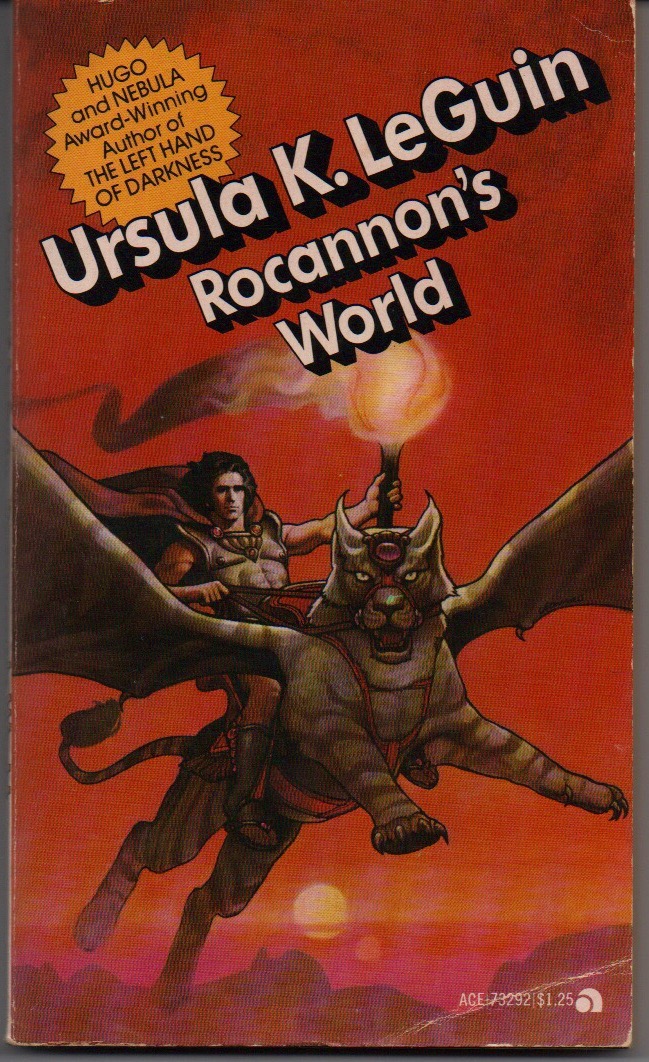
After I posted a review on this site of Ursula K. Le Guin’s novel The Lathe of Heaven, the novelist Adam Novy recommended that I check out her under-read first novel, Rocannon’s World. So I did. Our email exchanges about the book developed over a few weeks (during which time I ended up reading all of Le Guin’s so-called Hainish novels), and Adam’s analysis of the novel is, I think, especially perceptive. An edit of our conversation is below.

Adam Novy’s novel The Avian Gospels is fantastic. Buy it from Hobart.

img_1534

Edwin Turner: Thanks for suggesting Rocannon’s World, Adam. I’m not really sure how I missed it in my first few forays into Le Guin—when I was younger it might not have been in my school library—but I’m glad I read it. Very vivid stuff. You told me it was your favorite Le Guin. Why?

Adam Novy: There are many reasons why I love Rocannon’s World. The beautiful and exact descriptive writing, and the syntax. Le Guin can really sing. The sadness of the heroes for their vanished civilizations. The way so many passages evoke the feel of hiking. The flying cats. The incomparable ending.

But it’s the way Le Guin explores the idea of agency sets the book apart for me. The protagonists, Semley and Rocannon, take decisive action they believe in, which sets in motion plots that spiral out of control and annihilate their intentions. Rocannon and Semley end up being massive historical figures, yet also tiny cogs in galaxy-sized machines. This comparison of the massive and the tiny is not a calculated stalemate—not the cultivated balance I think a lot of writers feel we must produce these days, as if our calculations will be checked and we might get partial credit—but an ambivalence that’s immune to human desire or even narrative. It’s one of the things I love about Le Guin. Her idea of a human being’s influence in the world is like the ancients’.

This is fascinating to me in a lot of ways, first at the level of plot. How much should a character affect the world around her? Too much power can seem unserious and thrillery, like a fantasy, like competence porn. (A possible new definition of literary fiction is “incompetence porn.”)  Le Guin is just so elegant with this. Semley and Rocannon may be important figures in their communities—Semley is a kind of Duchess and Rocannon is a government anthropologist with administrative dominion over half the galaxy—and yet, by merely performing their own social roles, they ruin everything they care about, including the context in which their identities exist. Le Guin’s formula is magical: a central figure in a community commits a deliberate act, and the consequences are massive, unforeseen, accidental, and diminish this central figure to almost nothing. And yet, despite their total disempowerment, their influence endures in major ways. But even this is misconstrued by people in the future, who tell the history. There is no linear connection between intention and result. The reader feels the ages passing every time Rocannon takes a step.

This leads to the other aspect of the plot I really love, which is political. Rocannon is a bureaucrat in a colonial hegemony, and by honestly yet patronizingly trying to protect the subjects he administrates, he initiates a plot that will destroy them, and himself. He’s a kind of blinkered, well-meaning liberal who does not know what the hell he’s really doing, or how power works, since the force that does the destroying—an anti-government entity called “the enemy”—seems to emanate from the government Rocannon works for. In the end, his people simply don’t belong on the planet, which he only learns when he, too, is a refugee.

ET: But there’s also the sense that Rocannon integrates into the planet—he marries into the Angyar at the end, although we don’t really hear that story. It’s an epilogue that fulfills the legend-structure of the tale. So, on one hand Le Guin’s written this story that’s highly ironic—especially in the ironic title, Rocannon’s World—a title that points to the novel’s themes of colonialism. On the other hand, there’s a sense of discovery and exploration—a kind of High Adventure narrative à la Verne, where our viewpoint character ascends, peers down over the planet from his flying machine (in this case a winged cat).

And then Rocannon sort of achieves his Romantic quest of attaining Semley, or rather the idea of Semley—the exotic, the beautiful, the aristocratic—by marrying into her ancestral chain, and becoming a sort of Duke. This is all very much Fairy Tale stuff, Fantasy stuff. And Le Guin isn’t really synthesizing fantasy tropes with sci-fi in Rocannon’s World. It’s more like she’s tapping into a deeper, mythic vein—so on some level, I think that the novel is really about storytelling itself. There’s something oral and episodic about it, with its riffs on Eurydice and winged men and Valhalla. I reread The Dispossessed after Rocannon’s World. The Dispossessed strikes me as more deliberately structured than Rocannon’s World—more dialectical, more focused, but also centered much more on dialogue-monologue (similar to The Lathe of Heaven). Rocannon’s World is literally more fantastical than The Dispossessed. Do you think that Le Guin’s first novel has been overlooked as a book of ideas? Continue reading “A conversation on Ursula K. Le Guin’s first novel, Rocannon’s World”

A review of Paul Kirchner’s surreal sequel, The Bus 2

couv-1

Paul Kirchner’s cult classic comic strip The Bus originally ran in Heavy Metal from 1979-1985. The (anti-)story of “a hapless commuter and a demonic bus” (as Kichner put it himself in a recent memoir at The Boston Globe), The Bus, at its finest moments, transcends our expectations for what a comic strip can and should do. Sure, Kirchner delivers the set-ups, gags, japes, and jests we expect from a cartoon—but more often than not The Bus surpasses the confines of its form and medium. Its protagonist The Commuter is an allegorical everyman, a passenger tripping through an absurd world. Kirchner’s strip often shows us ways to see that absurd world—which is of course our own absurd world—with fresh eyes.

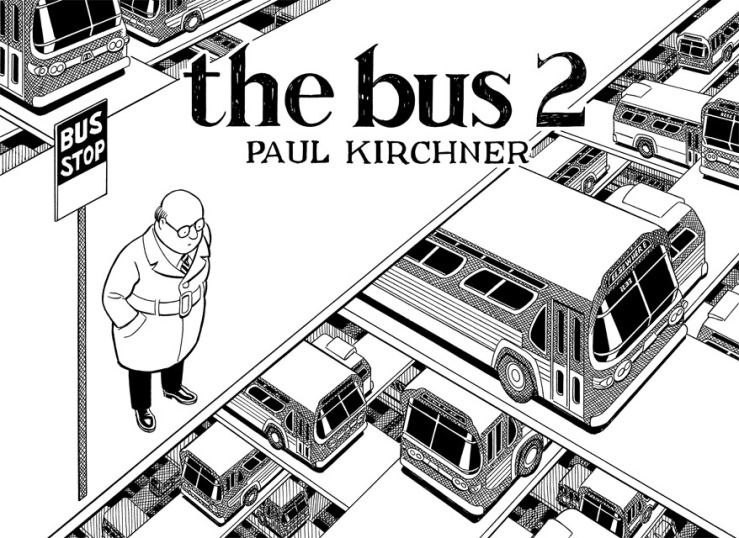
Thanks in part to the internet (and, in particular, an album of scans posted at Imgur), Kirchner’s comic has found a new audience. Over the past few years, Kirchner’s produced more than 40 new strips, which are now collected in one handsome volume as The Bus 2 (or the bus 2 if you like) from French publisher Tanibis EditionsTanibis also has collected the original run of The Bus in an edition that’s more complete (and polished) than the Imgur album. These books are fantastic stuff.

The Bus 2 picks up in full satirical mode with an intro that informs us that “the studio that produced ‘The Bus’ was forced to shut down” in 1985; “Its closing left over 70 talented employees jobless.” The intro unwinds over a few pages—we’re told the bus itself and the “commuter’s iconic overcoat” are now in museums, and that the role of the commuter in this sequel will be played by the son of the actor who played the original commuter. From the outset, Kirchner uses irony to draw our attention to the artificiality of his strip, highlighting The Bus as a performance, an entertainment focused on the utterly mundane topic of a daily commute. And even though the intro unfolds over four pages, Kirchner keeps it true to form—literally: Six equal black and white panels.

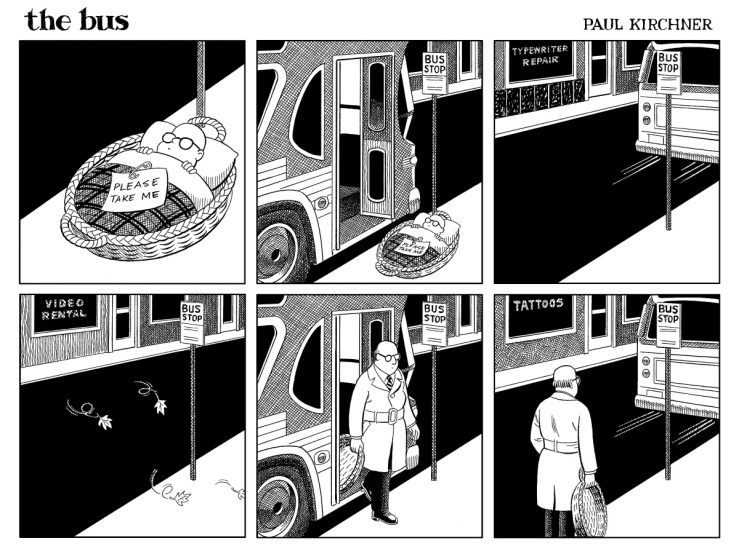
The first strip in the new collection positions The Commuter as an ironic hero, a foundling in a basket like Moses or Superman (note the signs that Kirchner employs to show the passage of time):

01 Continue reading “A review of Paul Kirchner’s surreal sequel, The Bus 2”

More Plant-like: Riffing on Han Kang’s The Vegetarian

We tend to pathologize the ultimate no—suicide—as a shameful failure, the worst kind of failure. The shame of not having assimilated into normative culture, of not bootstrapping the self into a legible narrative of success. Of being merely unable. Melville’s Bartleby teaches us this lesson all too well. Those around Bartleby can’t read his preference to merely not be as such. They want to know why he doesn’t want to be a good bureaucrat. And they string him up for it. But saying no can be an assertion of power, freedom and will, as Bartelby teaches us. The choice to merely not be is simply that. It frustrates everyone around it because it defies the most naturalized assumption in existence: that consciousness is a gift, a privilege, a precious unit of time not to be squandered or frivolously wasted. We are urged to make good with life.

But this attitude comes with the privilege of choices. One who can say that things can be different, that one only need to work a bit harder, shift her perception, to “be the change she wishes to see in the world” doesn’t wake up on Skid Row every morning, is not black in Baltimore or Ferguson, does not live in a body policed by the law and popular culture. Moreover, this attitude assumes that whatever prevents this different life, where one doesn’t have to say no, is conquerable, fixable. Often, the sensation that things cannot be different appears insurmountable. Whatever is assaulting you cannot be removed with a simple shift in perception and attitude.

Such is the dilemma of Yeong-hye in Han Kang’s The Vegetarian. The flap copy describes Yeong-hye’s turn towards vegetarianism as a decision, as does her tyrannical husband and everyone around her, but Yeong-hye’s plant-like turn is only a decision in the most technical sense. Yes, she does decide to become a vegetarian, but not because of preference, or political/ethical commitment. Yeong-hye’s vegetarianism is vital; for her, vegetarianism is her only out from the violent misogyny that she has been born into. But to also say that she wants death and, in turn, that Kang’s novel is a reconfiguration of the normative narrative of suicide would be a double injustice. I know nothing of South Korean culture, and I can only speak confidently of the misogyny that frames The Vegetarian because it is terrifyingly normal in the mouths of its narrators; the first injustice is that I only know this misogyny through western narratives. The second, to assert that Yeong-hye wants death, falls into the trap of romanticizing suicide. None of Yeong-hye’s life is decision, or choice, or freedom, except her desire to become more plant-like—even that is a stretch to say it is a desire. For Yeong-hye, a plant-like existence approaches a state of supreme serenity and disaffection from her world – a position where she cannot be read as a sexual being and, in turn, under the hands of a violent culture. Vegetarianism hangs the human body and self between what we understand and project onto the outside world as life and death. Vegetarianism asymptotically kisses death.

Continue reading “More Plant-like: Riffing on Han Kang’s The Vegetarian”

This Is Not A Review Of Thomas Bernhard’s The Lime Works

“Amazon, the so-called bookseller Amazon” makes a grave mistake.

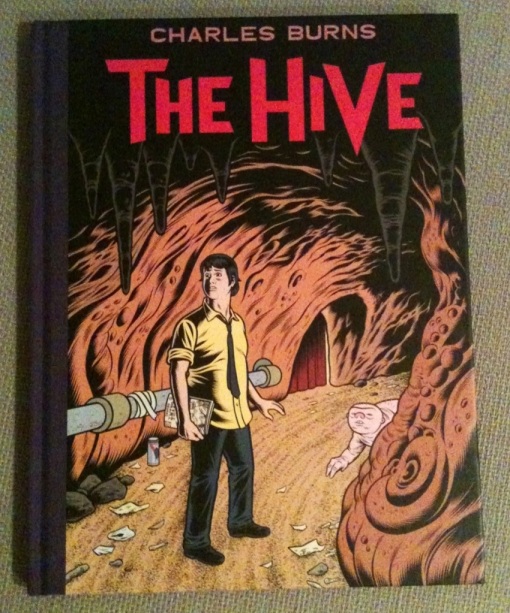
Charles Burns Enriches His Wonderfully Weird Trilogy with The Hive

20121104-183159.jpg

In X’ed Out, Charles Burns created a rich and strangely layered world focusing on Doug, a confused and injured young man. In his parents’ suburban basement, Doug parcels out the last of his late father’s painkillers, slipping from haunted memories of his relationship with Sarah into fevered nightmares of abject horror and then into a wholly other world, a realm that recalls William Burroughs’s Interzone. In this alien world, Doug takes on the features of Nitnit (an inversion of Tintin), the alter-ego he adopts when performing spoken word cut-ups as the opening act for local punk rock bands. What made X’ed Out so compelling (apart from Burns’s thick, precise illustration, of course), was the sense that this Interzone was a reality equal to Doug’s own “real world” — that it was somehow more real than Doug’s dreams.

20121104-165518.jpg

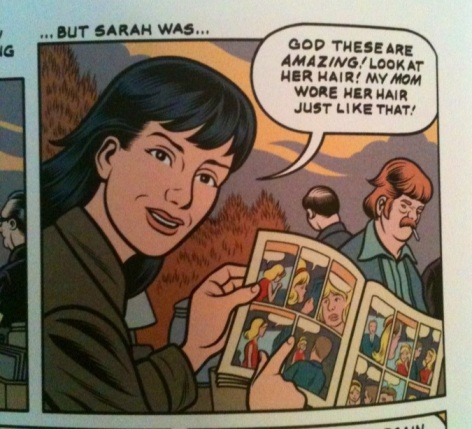
The Hive (part two of the proposed trilogy) deepens the richness and complexity of the world Burns has imagined. The title refers to a location in Interzone. Doug (or Nitnit) has found employment in The Hive as a kind of mail clerk or janitor. His primary role though is secret librarian, catering to the reading needs of the breeders of The Hive. One breeder seems to be a version of Doug’s ex-girlfriend; the other is a double of Sarah, who asks Doug/Nitnit to bring her romance comics—which he does—only he skips a few issues. These missing issues stand in for the information Doug (and Burns) withholds from the reader, the missing fragments that have been x’ed out.

20121104-165548.jpg

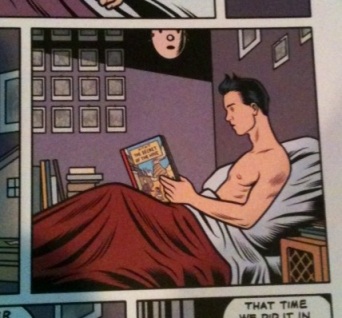
Burns uses romance comics as a framing or organizing device, a motif linking the disparate worlds of his narrative. In the “real world” — which is to say the world of Doug’s memory — we learn that he buys a stack of old romance comics for Sarah on their first date.

20121104-165537.jpg

Throughout the narrative, Burns plays his characters against the extreme, often hysterical dramas of 1950s and ’60s romance comics; his strong lines and heavy inks readily recall the early works of Simon and Kirby, but more precise and careful—something closer to Roy Lichtenstein, only more sincere, more emotional.

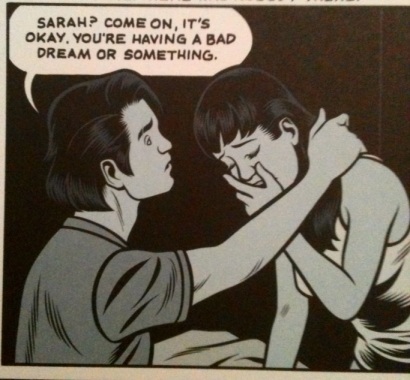
In The Hive, we learn more about Doug’s troubled relationship with Sarah, who has problems out the proverbial yingyang (not the least of which is a violent psychopathic ex-boyfriend).

20121104-165554.jpg

Burns weaves the story of Sarah and Doug’s relationship into the fallout of Doug’s father’s death—a death Doug was completely shuttered to, we realize. Doug’s drug-dreams dramatize the missing pieces of these narratives, and the Interzone set-pieces propel the mystery aspects of the narrative forward, as Doug’s alter-ego plumbs the detritus of his psychic fallout. Through the metatextual motif of reading-comic-books-as-detective-works, Burns explores themes of trauma, abjection, and distance. Images of pigs and cats, freaks and punks, portals and holes litter The Hive.

20121104-165603.jpg

Burns has always been a perfectionist of dark lines and strange visions, and his last full graphic novel Black Hole was a triumph of atmosphere and mood. With the first two entries of his trilogy, however, Burns has showed a significant maturation in storytelling, characterization, and dialogue. I often thought parts of Black Hole seemed forced or rushed (no doubt because Burns faced daunting production troubles during the decade he worked on the novel—including his original publisher Kitchen Sink folding). With X’ed Out and now The Hive we can see a more patient artist, working out an emotionally complex and compelling story in rich, symbolic layers.

I reread X’ed Out and then read The Hive in one greedy sitting; then I went through The Hive again, more slowly, more attendant to its details and nuances. We had to wait two years between X’ed Out and The Hive—and it was worth the two year wait. So if we must wait another two years—or more—for the final entry, Sugar Skull, so be it.

The Savage Detectives — Roberto Bolaño

savage

I give up. I don’t know how to review The Savage Detectives.

Everyone told me I was supposed to love this book, but I didn’t. There, that’s a review. Not a good review, but there. I can’t remember a book ever taking me so long to finish or a book that I put down so often. When I truly love a book, I am moved. Often physically. Sometimes I have to stand up to read a book, I’m so moved. That’s a good book. (I never had to stand up during The Savage Detectives, although I often had to force myself to read thoroughly and not just skim). When I truly love a book, I’m a little sad and deflated when it’s over. I know a book is great if I’m compelled to go back and immediately reread sections. (Again, with Detectives, this didn’t happen). But it looks like I’m trashing the book. I shouldn’t. It has a lot going for it.

I read the first 140 pages, the journal entries of young Garcia Madero, in a blur. Funny and passionate, Madero’s voice explodes with the immediacy and intensity of youth. He joins up with the visceral realists, a group of anti-establishment poets (who no one cares about). Led by two enigmatic outsiders, Ulises Lima and Arturo Belano, the visceral realists gripe about the state of Mexican and Latin American literature, screw around, and argue with each other (no one else will listen to them). Madero paints Mexico City in the mid-1970s as vibrant, a place full of poetry and art. He becomes a biblioklept, God bless him (yet he ethically agrees not to steal from a poor old blind bookseller). He writes poems. He has sex. He runs away from home, sort of. There’s a breathless energy to Madero’s narrative that makes the book hard to put down, and the first section of The Savage Detectives, “Mexicans Lost in Mexico” culminates in one of the book’s most exciting events. Madero, Lima, and Belano help a young girl named Lupe escape from her belligerent pimp. Then, that portion of the story unresolved, the narrative shifts dramatically.

In the second section, “The Savage Detectives,” we are treated to, or subjected to, or made to endure, or made to navigate–pick your verb, please–over 450 pages of (one-sided) interviews spanning 20 years. Some of the interviewees appear consistently throughout this section, like Amadeo Salvatierra, who helps Lima and Belano in their quest to find the lost original visceral realist, Cesárea Tinajero. Other voices only pop up once to tell a weird story about Lima or Belano–or more accurately, a weird story about themselves with Lima or Belano playing bit parts. Some of these stories, like Lima’s strange time in a Tel Aviv prison, or Belano’s tenure as a national park guard in France are great; other times they are painfully tedious or repetitive (you know, like real life).

Technically, The Savage Detectives is quite an achievement. The myriad stories in the book’s main section represent the fragmented narratives that might compose a person’s life–a series of perspectives that others have about us, views that can never add up to a unified truth. The bulk of these stories are very much about poetry, art, and travel. Like Joyce’s Ulysses, Detectives is a peripatetic novel, full of specific locations and very, very explicit directions (Joyce famously claimed that were Dublin destroyed in a catastrophe, it could be rebuilt based on his novel; the same seems true for Bolaño’s Mexico City). Also like Ulysses, Detectives is an epic about the banal, ordinary things that fill our lives: jobs and eating and getting to places and having one’s friendships sour and being disappointed and so on. Lots and lots of “and so on.” This isn’t to say that there aren’t moments of heroism and adventure–saving kids from satanic caves, stow-away sea voyages, and dodging bullets from Liberian rebels make for interesting narrative peaks. However, most of the novel remains rooted in a realism that is often dreadfully visceral in its painstaking replication of just how depressing a life could be. As the seventies and eighties turn into the nineties, things get more bleak and more depressing for Lima and Belano. And it all adds up to an incomplete picture (literally; check out the last page of the book if you don’t believe me).

o_roberto-bolano

By the time we return to Madero’s journals in the third and final part of the novel, “The Sonora Desert,” the sadness and deflation of the previous section infects and tints every aspect of the narrative. Lima and Belano, with Madero and Lupe in tow, search desperately for the forgotten poet Cesárea Tinajero. Their search works as a pitiful parallel to “The Savage Detectives” section, a comment on the elusive nature of identity, and the strange disappointments that punctuate our expectations. Even the novel’s climactic ending seems understated after the monolithic middle section. And while this deflationary technique is undoubtedly a carefully considered conceit on Bolaño’s part, the payoff for the reader–this reader anyway–did not merit the effort and concentration that the book required. Or, to put it another way, after hours of time invested, I was unmoved.

As rave reviews of the English translation of his last novel 2666 begin seeping out of the critical woodwork (this month’s Harper’s has devoted a full four pages to the book), it seems that Bolaño will top most critics’ lists again this year. At over 900 pages and reportedly full of grim, bleak violence, it’s hard to imagine 2666 will be any easier to get through, and as FS&G summarily ignored our requests for a review copy, there’s no pressing obligation, I suppose. The critical praise heaped on 2666 this year will surely lead interested readers to The Savage Detectives. I think Mark Twain’s infamous note at the beginning of The Adventures of Huckleberry Finn would provide the best warning to these potential readers: “Persons attempting to find a motive in this narrative will be prosecuted; persons attempting to find a moral in it will be banished; persons attempting to find a plot in it will be shot.” While no serious critic could dismiss Bolaño’s lyrical skill and complex control of the many voices that populate Detectives, I think a number of readers–serious readers–would not be wrong for considering the tome a bit overrated.

Down to a Sunless Sea

Mathias B. Freese’s slim collection of short stories, Down to a Sunless Sea, relays the weird, miserable, and even sometimes ghoulish existences of people you might pass on the street everyday. The stories read like psychological case studies, and there’s frequently a strange distance between the clinical detachment of the prose and the depressed or depraved sentiment expressed by the narrator. At times the effect is painful, as in “Herbie,” where the titular protagonist’s rage at his abusive father spills over into Oedipal violence. Elsewhere, the stories take on a wry surrealist humor. Freese’s knack for dissonance evinces in “Juan Peron’s Hands,” where a grave robber pines for a head but settles for hands. Far closer to home is “Young Man,” where Freese distills an entire life to a few bitter pages, exploring the modern disconnect between thought, action and identity.

I can’t be who I am in real life, so I can be who I am in thought, but who I am in thought is not who I am in deed, so I live between what is and what should be, and this serves to make sharper the cleavage–the crevices are clearly marked.

One of my favorites in the collection, “Arnold Schwarzenegger’s Father Was a Nazi,” disconcertingly (and humorously) condenses American obsession with celebrity into a fantasy ski trip, complete with the oddly sorta-prescient line: “I might even run for president if I can lose this accent” (the story was originally published in 1991). It is probably the deformed voyeur hero of “I’ll Make It, I Think” who delivers the closest thing to a mantra for these characters:

I’m not hurting anyone. So what if my morning shorts are sticky. I’m a good person. The outside, for sure, is a shambles–that’s not completely true, but I’ve made my point. Inside is fucked up some, but I’ll make it, I think.

Down to a Sunless Sea, for all its monsters and perverts and manic depressives, is never cruel in its darkness or unsympathetic in its distance. Freese creates real people here, and if we laugh at their pain, we’re laughing with them. Highly recommended.