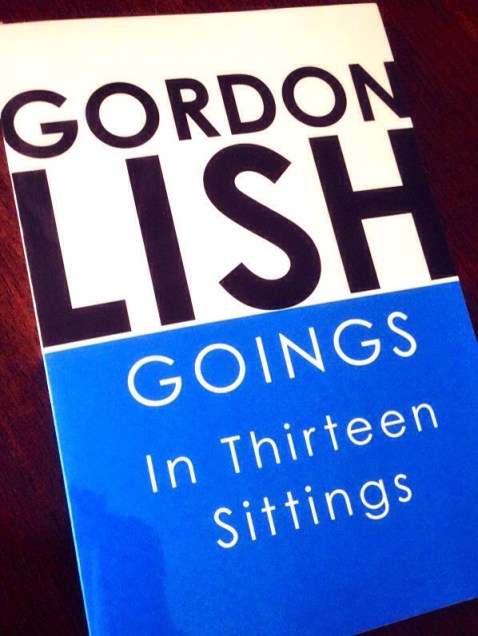
Ostensibly a collection of fictional short stories, Gordon Lish’s Goings reads more like a memoir-in-fragments. All thirteen stories are told by a first-person narrator named Gordon, who parenthetically appends an exclamatory repetition of his name (“I, Gordon (Gordon!)”) throughout the work, a verbal tic that registers the tension between the author and narrator, memory and truth. All these stories are in some way about memory and truth—and language, always language. Some of the tales are heavier on plot than others, although “heavier” is hardly the right modifier—let’s be honest—the plots here are thin, almost nonexistent: gestures, images, feelings—but that’s not why we read Gordon Lish, is it?
Opener “My Personal Memoir” sets the tone here, its title an honest ironic joke, I suppose. Old Gordon tells the story of young Gordon and his boyhood chums playing paddle-ball. A minor tragedy ensues. That’s pretty much the plot, but with Lish it’s really about the sentences, the memory behind the sentences, or maybe the inability of sentences to communicate the memories, or maybe just the failure of all of it—language, memory, truth—themes that carry through the collection in Lish’s (Lish’s!) often tortuous syntax.
In “Für Whom?”, Lish offers a sketch of his family, his boyhood piano lessons, his teacher, his competitive anxieties, his burgeoning lust:
Siblings, families—what else is there to say? Furthermore (I love that: the chance to flaunt it with echt balance), it was I whose fingers took up his arpeggios while his backside thrummed ever more thrummingly to a kind of low-register attunement to the propinquity of Miss Buggell’s same. Oh, the nearness of her ass (sirs, and madam, it was no rump, now was it?), all yearning angularities not infrequently settling itself within fractions of centimeters afar. I quote, of course. Yes, I, Gordon (Gordon!), aged seven, aged six, aged eight, hankered after that piano teacher as I have never since hankered after the person of a woman since.
In another strong story, “For My Mother, Reg, Dead in America,” Lish returns again to his parents, weaving them into a strange half-rant that moves from rutabagas to spelling to Kierkegaard to Grace Paley to lettuce. Like most of these stories, “For My Mother” is obsessed with its own telling (and the conditions that might authorize its telling). Its narrator tells us:
I don’t know. I don’t look anything up in any fucking dictionary. Who’s writing this? I’m writing this. The dictionary is not in any goddamn charge of this act of expression, or of this, if you please, scription. Even me, even I, even the author of this is barely in charge of it. Or of anything else. And you know why? Would you like to know fucking why? Because he does not fucking want to be—is that answership enough for you. Make sure you have mastered the spelling of your father’s name of of your mother’s name. Never refer to your mother as “Mom.” Never use the word “reference” as a verb. The same goes for “experience,” the word. Never start a sentence with the word “however.”
Lish’s narrator Gordon continues offering editorial advice, which I suppose we may take ironically or otherwise. In any case, the book is crammed with moments like these, little fits of our narrator’s (author’s?) doubt coupled with a commanding viewpoint on how language could, should, mean.
At least one (very funny) story, “Knowledge,” hangs entirely around Lish-as-editor—only this time, our Gordon isn’t cutting into Raymond Carver’s prose or tightening up some Barry Hannah. No, he’s tearing down a poorly-worded sign from a lamp post. Gordon (Gordon!), “for the decency of my community, for its bloody battered decency,” tears it down. The sign? — “WE ARE LOOKING FOR INFORMATION ABOUT THE MOTORCYCLE ACCIDENT THAT OCCURED THIS PAST SUNDAY IN THIS AREA. WE HIS FAMILY AND FRIENDS WANT TO FIND OUT WHAT HAPPENED.” There’s a story in there too, in that sign, but our narrator’s not interested in any human characters that the sign’s written characters, letters, might try to represent. The brilliance of the story: Lish leaves it to the reader to suss out the gap between the meaning of the sign—the information that it communicates—and the narrator’s critique of how that sign communicates.
“Avant La Lettre” offers another literary space for gaps to evince between reader, narrator, and author. Our narrator Gordon (Gordon!) tells us at the outset: “The title, pay it no mind. It does not apply. It does not appertain,” suggesting that he doesn’t even know what the phrase means, that it just came to him as he “sat down to tell you about a mystery (the vanishing of the man on the corner).” The immediate denial of a link between the meaning of the story’s title and the story’s content isutterly disingenuous, a clue really to the mystery here (more of a non-mystery, an anecdote at best). Lish pokes fun at the denial by repeatedly referencing literary theorists throughout the story: “(tell Barthes, tell Derrida, tell Badiou)” and then “Well name it and (tell Schopenhauer, tell Schelling, tell Spinoza or Freud) it dies.” The punch line to the story is too good to spoil here, but it can’t hurt to share part of the set-up. Lish writes (or Gordon (Gordon!) says):
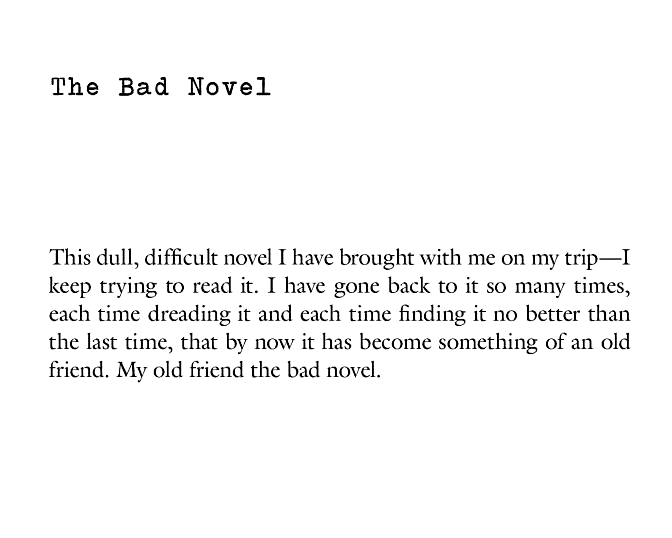
Where’s in me anymore (in Gordon, in Gordon!) the discipline for the creation of the succession of elaborations, for the concatenation of the falsifications, for the accruing of the exhausting collocations?
I’m sad….Writing’s not the god of me.
Is writing not the god of you, speaker? And what is “Avant La Lettre” but a succession of elaborations, a concatenation of falsifications, an accrual of collocations?
“Avant La Lettre” admittedly requires from its reader a certain comfort with (or at least understanding of) postmodern literary theory; this is a story that casually (and of course not casually) references Alphonso Lingis and Julia Kristeva.
Other material here is less obscure (and more subtle) in its treatment of theory. “In the District, Into the Bargain” uses a chance meeting between widower Gordon and a widowed acquaintance to restage the central paradox of Rene Magritte’s painting The Treachery of Images (you know: “This is not a pipe”). There’s also the oblique feminism of “Women Passing: O Mysterium!” and the semiotic play of “Troth.” This is all great stuff, or maybe not. I mean I loved it, lapped it up, but I’m the audience for this. I’m Lish’s (Gordon’s!) reader, the reader he addresses so directly in closer “Afterword.” Only I’m not—because “Afterword” is so clearly written to, spoken to Lish himself.
This literary solipsism, onanism, pick-your-ism is so not for everyone. Lish is a cult writer, and his performance here is appropriate to any aging (aged!) cult leader, one who’s painfully aware of how easy it is to point out a naked charlatan. The structure of Goings is something like I-see-you-seeing-me-seeing-myself-try-to-see-myself-etc. But the book is very funny, often painful, and downright moving at times, like in “Gnat,” where Lish shares a simple memory of trying on a new shirt for his wife, or the terror of “Speakage,” a two-page dialogue between young Gordon and his mother that begins “What is it, die?” The stories here are real—obscure, sure, difficult, yes, but also emotional, rewarding.
Goings In Thirteen Sittings is not the best starting place for anyone interested in Lish’s prose. This new book continues a project that will feel familiar to those who’ve read Self-Imitation of My Self, Epigraph, and My Romance, books that many critics felt were too insular, too inscrutable. New readers might do better to start with Mourner at the Door (although you can’t really lose in picking up Collected Fictions, which collects that book among others). I also highly recommend the Iambik recording of Lish reading selections from Collected Fictions. Hearing his intonation and rhythm totally changed how I read his prose, enriched my understanding of what he was doing and how he was doing it.
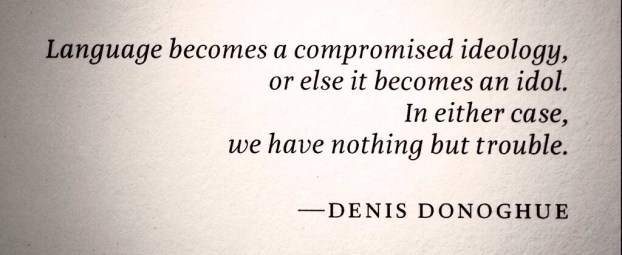
But the book accomplishes what it sets out to do, delivering on its two epigraphs. The second, ascribed to “Anon.” (another joke on Lish’s part, I think): “Mother! Father! Please!” The first is from a literary critic, but in its phrasing on the page it looks like a poem. In any case, it’s a fitting summary for Goings:
Goings In Thirteen Sittings is available now from OR Books.









 Biblioklept