“Poetry Is the Enchantment of Incest” — A Passage from Harold Bloom’s Manifesto for Antithetical Criticism

A passage from Harold Bloom’s “A Manifesto for Antithetical Criticism,” a chapter in his seminal study The Anxiety of Influence

 Every poem is a misinterpretation of a parent poem. A poem is not an overcoming of anxiety, but is that anxiety. Poets’ misinterpretations of poems are more drastic than critics’ misinterpretations or criticism, but this is only a difference in degree and not at all in kind. There are no interpretations but only misinterpretations, and so all criticism is prose poetry.

Critics are more or less valuable than other critics only (precisely) as poets are more or less valuable than other poets. For just as a poet must be found by the opening in a precursor poet, so must the critic. The difference is that a critic has more parents. His precursors are poets and critics. But – in truth – so are a poet’s precursors, often and more often as history lengthens.

Poetry is the anxiety of influence, is misprision, is a disciplined perverseness. Poetry is misunderstanding, misinterpretation, misalliance.

Poetry (Romance) is Family Romance. Poetry is the enchantment of incest, disciplined by resistance to that enchantment.

Influence is Influenza—an astral disease.

If influence were health, who could write a poem? Health is stasis.

Schizophrenia is bad poetry, for the schizophrenic has lost the strength of perverse, willful, misprision.

“Hemingway and Ourselves” — Italo Calvino

“Hemingway and Ourselves,” a 1954 essay by Italo Calvino, collected in Why Read the Classics?

Hemingway and Ourselves

There was a time when for me — and for many others, those who are more or less my contemporaries — Hemingway was a god. And they were good times, which I am happy to remember, without even a hint of that ironic indulgence with which we look back on youthful fashions and obsessions. They were serious times and we lived through them seriously and boldly and with purity of heart, and in Hemingway we could also have found pessimism, an individualistic detachment, a superficial involvement with extremely violent experiences: that was all there too in Hemingway, but either we could not see it in him or we had other things in our head, but the fact remains that the lesson we learnt from him was one of a capacity for openness and generosity, a practical commitment — as well as a technical and moral one – to the things that had to be done, a straightforward look, a rejection of self-contemplation or self-pity, a readiness to snatch a lesson for life, the worth of a person summed up in a brusque exchange, or a gesture. But soon we began to see his limitations, his flaws: his poetics, his style, to which I had been largely indebted in my first literary works, came to be seen as narrow, too prone to descending into mannerism. That life of his — and philosophy of life — of violent tourism began to fill me with distrust and even aversion and disgust. Today, however, ten years on, assessing the balance of my apprenticeship with Hemingway, I can close the account in the black. ‘You didn’t put one over on me, old man,’ I can say to him, indulging for the last time in his own style, ‘you did not make it, you never became a mauvais maitre.’ The aim of this discussion of Hemingway, in fact – now that he has won the Nobel Prize for Literature, a fact that means absolutely nothing, but which is as good an occasion as any other for putting down onpaper ideas that have been in my head for some time – is to try to define both what Hemingway meant for me, and what he is now, what moved me away from him and what I continue to find in his not others’ works.

Continue reading ““Hemingway and Ourselves” — Italo Calvino”

“She Was a Dynamite Girl and He Was an Aces Fellow” — A Passage from Renata Adler’s Speedboat

A passage from Renata Adler’s marvelous and strange novel Speedboat

She was a dynamite girl and he was an aces fellow. On the day he at last agreed by phone to marry her, the switchboard operators were overjoyed. For six months they had listened, in sympathy and indignation, to the tears, the threats, the partings and reconciliations. They were so unequivocally for the girl that only the purest professionalism kept them, at times, from breaking in. On the day Tim, after calls to his best friend, his firs wife, and his therapist, gave in at last, the oldest operator, who had been on the switchboard for twenty years, actually wept. The other two told the receptionist, at lunch. All four ladies had a drink, and then bought a card of slightly obscene felicitations. They had wavered toward the sentimental, but rejected it as basically unswinging. They did not sign the card. Tim and his girl, who had been breaking up once again on the day they received it (she was packing; they were in his apartment, were appalled. As a result of the card, and discussions of what to do about it—what it implied, who knew and who didn’t—they married.

“What’s the Matter, Don’t You Love Me Anymore?” — Raymond Carver’s Correspondence with Gordon Lish

Today is Raymond Carver’s birthday. Read excerpts of Carver’s letters to his editor Gordon Lish at The New Yorker. A few highlights (the letter from July 8, 1980 is fantastic and should be read in full, by the way)—

July 15, 1970

Hombre, thanks for the superb assist on the stories. No one has done that for me since I was 18, I mean it. High time I think, too. Feel the stories are first class now, but whatever the outcome there, I appreciate the fine eye you turned on them. Hang tough.

February 1, 1979

I’m going to Mardi Gras with Tess; and the Fords are coming down in March for spring break and we’re going into Mexico by train for a week. . . . I’m happy, and I’m sober. It’s aces right now, Gordon. I know better than anyone a fellow is never out of the woods, but right now it’s aces, and I’m enjoying it.

July 8, 1980, 8 a.m.

Dearest Gordon,

I’ve got to pull out of this one. Please hear me. I’ve been up all night thinking on this, and nothing but this, so help me. I’ve looked at it from every side, I’ve compared both versions of the edited mss—the first one is better, I truly believe, if some things are carried over from the second to the first—until my eyes are nearly to fall out of my head. You are a wonder, a genius, and there’s no doubt of that, better than any two of Max Perkins, etc., etc. And I’m not unmindful of the fact of my immense debt to you, a debt I can simply never, never repay. This whole new life I have, so many of the friends I now have, this job up here, everything, I owe to you for “Will You Please.” You’ve given me some degree of immortality already.

January 21, 1983

What’s the matter, don’t you love me anymore? I never hear from you. Have you forgotten me already? Well, I’m going back to the [Paris Review] interview and take out all the good things I said about you.

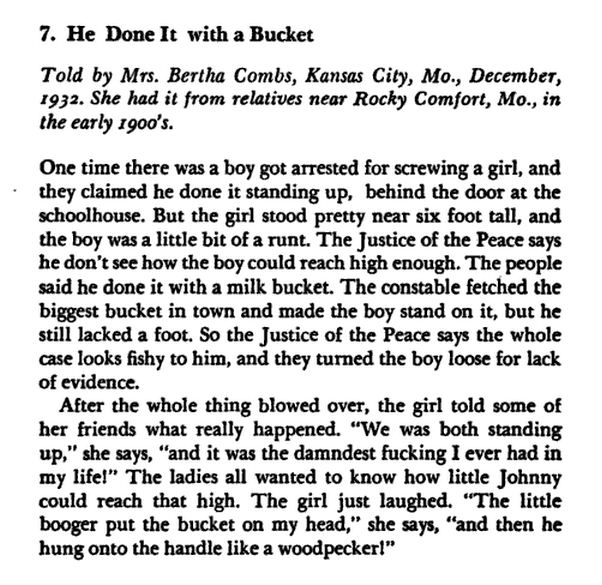
“He Done It with a Bucket” (An Ozark Folktale)

“He Done It with a Bucket,” an Ozark folktale from Vance Randolph’s indispensable collection, Pissing in the Snow & Other Ozark Folktales

The Old, Weird America — Greil Marcus on The World of Bob Dylan’s Basement Tapes

This month, to celebrate Bob Dylan’s 70th birthday (which is, um, today), Picador is reissuing Greil Marcus’s Invisible Republic under the name The Old, Weird America. Marcus uses Dylan and The Band’s recording sessions at Big Pink in 1967 as the ultimate synthesis of “the old, weird America.” From these legendary sessions Marcus unpacks Moby-Dick and William Burroughs, Ralph Waldo Emerson and Jerry Lee Lewis, Puritans and cowboys, utopias and ranches, Harry Smith and Dock Boggs, the Reverend J.M. Gates and Jonathan Edwards’s “Sinners in the Hands of Angry God,” murder ballads and the Beats, Clint Eastwood and Frank Hutchison, and more, more, more.

While Bob Dylan and the guys in the Band–Levon Helm, Robbie Robertson, Rick Danko, Richard Manuel, and Garth Hudson–are the protagonists of Marcus’s pop history, Harry Smith is perhaps its signal hero. Marcus finds in Smith’s seminal work Anthology of American Folk Music a history of democracy and America “made by willful, ornery, displaced, unsatisfied, ambitious individuals.” Marcus figures Anthology as the direct antecedent for The Basement Tapes. And yet as he moves backward in time he also moves forward, tracing the spirit of the old, weird America through to Bruce Springsteen and Nirvana.

Marcus’s mission isn’t so much a to tell Dylan’s history (yet again) as it is to contextualize Dylan and The Band’s project against the backdrop of the American folk past. As such, Dylanphiles won’t exactly find a new version here of the narrative that they’re undoubtedly so familiar with (cantankerous Dylan goes electric and “betrays” the folkies). Instead, what we find in The Old, Weird America is a verbal attempt to match the discursive, rambling, reference-hopping spirit of those sessions in ’67, and if Marcus at times rumbles and tumbles all over the place, we can forgive him—his weirdness is merely an attempt to match the verve, audacity, and strangeness of The Basement Tapes.

Herman Melville’s 1856 Passport Application

(More).

How to Enjoy the Apocalypse: A Post-Rapture Reading List

We published this list last year under the heading Ten Excellent Dystopian/Post-apocalyptic Novels That Aren’t Brave New World or 1984, but what with the Rapture going down and all, why not post it again, this time with links to pieces we’ve written on these novels—

1. Riddley Walker, Russell Hoban

2. Camp Concentration, Thomas Disch

3. A Clockwork Orange, Anthony Burgess

4. Oryx and Crake and The Year of the Flood, Margaret Atwood

5. The Hospital Ship, Martin Bax

6. Naked Lunch, William S. Burroughs

7. VALIS, Philip K. Dick

8. Ronin, Frank Miller

9. Ape and Essence, Aldous Huxley

10. The Road and Blood Meridian, Cormac McCarthy

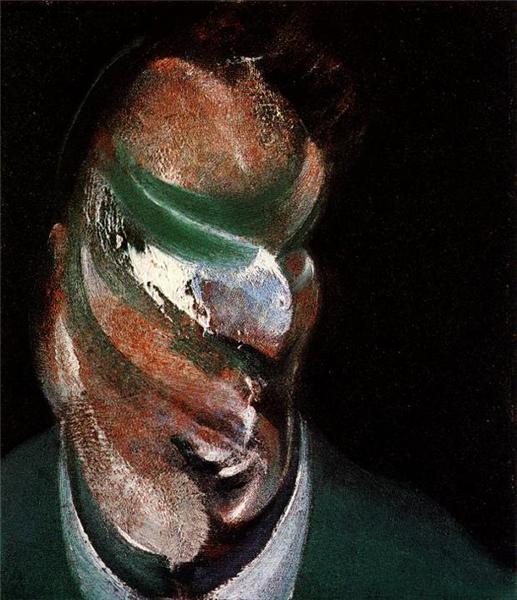
Study for Head of Lucian Freud — Francis Bacon

“The Flash” — Italo Calvino

“The Flash,” from Italo Calvino’s Numbers in the Dark

It happened one day, at a crossroads, in the middle of a crowd, people coming and going.
I stopped, blinked: suddently I understood nothing. Nothing, nothing about anything: I did not understand the reasons for things or for people, it was all senseless, absurd. I laughed.
What I found strange at the time was that I had never realized before; that up until then I had accepted everything: traffic lights, cars, posters, uniforms, monuments, things completely detached from any sense of the world, accepted them as if there were some necessity, some chain of cause and effect that bound them together.
Then my laugh died. I blushed, ashamed. I waved to get people’s attention. “Stop a moment!” I shouted, “there is something wrong! Everything is wrong! We are doing the absurdest things. This cannot be the right way. Where can it end?”
People stopped around me, sized me up, curious. I stood there in the middle of them, waving my arms, desparate to explain myself, to have them share the flash of insight that had suddenly enlightened me: and I said nothing. I said nothing because the moment I had raised my arms and opened my mouth, my great revelation had been as it were swallowed up again and the words had come out any old how, on impulse.
“So?” people asked, “what do you mean? Everything is in its place. All is as it should be. Everything is a result of something else. Everything fits in with everything else. We cannot see anything wrong or absurd.”
I stood there, lost, because as I saw it now everything had fallen into place again and everything seemed normal, traffic lights, monuments, uniforms, towerblocks, tramlines, begggards, processions; yet this did not calm me, it tormented me.
“I am sorry,” I said. “Perhaps it was I who was wrong. It seemd that way then. But everything is fine now. I am sorry.” And I made off amid their angry glares.
Yet, even now, every time (and it is often) that I find I do not understand something, then, instincitively, I am filled with the hope that perhaps this will be my moment again, perhaps once again I shall understand nothing, I shall grasp the other knowledge, found and lost in an instant.

On Bookstore Compulsions

I went to my favorite bookstore the other afternoon, a visit that I make at least once a week, usually when I’m bored, perhaps when I’ve had a bad day, or, often, when I can invent some reason to go, usually under the delusion that I “need” another book. I made this particular trip to replace Harold Brodkey’s First Love and Other Sorrows, which I’d given to a friend who was visiting from out of town. Not only did I feel compelled to replace this book, I also felt a strong desire to replace the exact edition, part of the Vintage Contemporaries mid-80s line, all featuring horrendous (and far-too literal) covers. And this is of course the first compulsion—the compulsion simply to go to the bookstore. Once in the bookstore I regularly experience a variety of other compulsions, which I’ll describe below.

But first, a little about this particular bookstore, which I will not name here because I am slightly ashamed of these compulsions, which are admittedly a little creepy. The store has two locations, one of which is a downtown café with a hip menu and the occasional art show. I rarely go to that one. The location I go to is a massive labyrinth, a twisty maze constructed out of books, sprawling out over a few connected buildings. To enter is to be immersed in that old book smell, that smell that makes me dizzy, that loads me with a strange anxiety. The staff seems to be in a constant state of reorganizing the flood of books that pours in each day. There are, quite literally, hundreds of thousands of books, from floor to ceiling. They take review copies off my hands for credit, so I haven’t had to pay cash for a book in years, which is, you know, nice. I also live 1.1 miles away. So, again, you can understand the repeated visits.

Anyway. Once compelled to the bookstore, I experience additional compulsions, such as

  • Offering unsolicited help to confused-looking customers: Most of the time these are high school or college students, searching for assigned reading, usually in the wrong section (Contemporary Authors when they should be in Classics). Not only do I feel compelled to point them to the opposite side of the store, I’ve even gone so far as to walk them over there, and then suggest particular editions of the book. I try to avoid a route that would put me in the direct scope of the legitimate employees as I perform this unwanted service.
  • Suggesting books to strangers: This compulsion is linked to another urge, the compulsion to look at what people are buying. If I see someone picking up a Philip K. Dick novel, I nosily ask about China Miéville, because I know that there’s a copy of Perdido Street Station that still hasn’t found a home. If some poor kid is in the Faulkner section to find As I Lay Dying for school, I become the creepy weirdo who suggests that she also read Go Down, Moses. On the “B” aisle once, my awareness of a used copy of 2666 became so distressing (why hadn’t someone already picked it up!) that I waited until someone else strolled down the aisle and tried to casually mention how awesome the book was, and that that person could not do wrong to buy it. Weird look ensues.
  • Desiring books I already own: The copy of 2666 (which disappeared by the next week, thankfully) highlights another strange compulsion. If I find a copy of, say, Tree of Smoke, I feel compelled to pick it up and give it to someone. I have to remind myself that giving someone a 700 page book that got incredibly mixed reviews is not really a gift; it’s a dare or burden.
  • Tracking books: So, yeah, I keep track of books. Why hasn’t anyone picked up Vollmann’s The Ice-Shirt in six months? Why is there still a used copy of Suttree? This is shamefully obsessive, but not as shamefully obsessive as—
  • Hiding books: I don’t even know how to begin to start to try to explain this. Let’s move on.
  • Buying books I’m pretty sure I’ll never read: I’m pretty sure that I’ll never get through all or even most of Roland McHugh’s Annotations to Finnegans Wake, but I had to buy the first edition. When will I have time to get through Malcolm Lowry’s Hear Us O Lord from Heaven Thy Dwelling Place? Why do I feel the need to pick up British Penguin editions of Aldous Huxley books that I already own (and have not read all of yet)?
  • Scouring for book marks: I don’t know why, but I like to find what people have used to mark their places in their books. I have, to my great shame, transferred, on occasion, a bookmark from a book that I’m not going to buy to one I am taking. This isn’t exactly theft, but it feels like a strange violation of sorts.

There are more compulsions of course, but this isn’t meant to be a case study of my illness, so I’ll spare you further details. So, did I get the Brodkey? No. They had about a dozen copies, but not that first Vintage Contemporaries edition with the ugly cover with sandcastles and butterflies that I wanted. So I picked up his later collection Stories in an Almost Classical Mode. I also picked up another book that I used to own but had given to a friend, James Weldon Johnson’s memoir Along This Way, and The Stories of Breece D’J Pancake by, uh, Breece D’J Pancake. Of course I won’t have time to read these before next week’s trip.

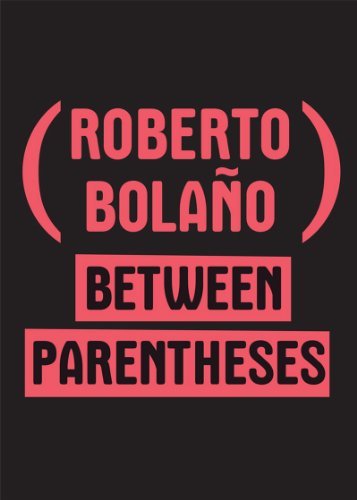
Between Parentheses — Roberto Bolaño

Between Parentheses (new from New Directions and deftly translated by Natasha Wimmer) collects over 400 pages of Roberto Bolaño’s essays, speeches, introductions, and newspaper columns, composed between 1998 and 2003, the year Bolaño died. The bulk of the book, as well as its title, comes from a column that Bolaño wrote for the Chilean newspaper Las Últimas Noticias. As one would expect, these pieces are relatively short, sometimes under 500 words, punctuated with a depth that belies their brevity. Bolaño writes about everything (or, everything worth writing about, I suppose), but, as those familiar will guess, literature is his main subject, whether he’s reviewing a Spanish-language translation of McCarthy’s Blood Meridian, comparing Kafka and Philip K. Dick, explaining his affection for William Burroughs, or discussing the merits of translating literature. If these samples tantalize you, let me go further: Bolaño writes about detective novels, Walter Mosley, Jonathan Swift, Jorge Luis Borges, magic, devils, memoirs, Gunter Grass, murder, troubadours, the Hell’s Angels, poetry, and more, more, more.

Despite its discursive topics, a unified tone inheres throughout Between Parentheses, a distinctly Bolañonian tone, at once grand and romantic (and Romantic) and profound and cynical and biting and flippant. In her blurb on the back of the book, Marcela Valdes (The Nation) declares that in Between Parentheses “we hear Bolaño’s real voice, the one he often disguised through the ventriloquism of his fiction.” This is perhaps a too-bold statement—I’m not sure if Bolaño can be said to have a “real voice”—instead, we find an author who’s constantly inventing and then reinventing, inflating and deflating, expanding and contracting.

And yet I think we’ll have to take Between Parentheses as Bolaño’s “real voice”—it’s perhaps the closest thing we’ll get to memoir or autobiography from the man (at least for now: his literary estate seems to be  in a constant state of excavation, so who knows). But Bolaño, ever the winking imp, is there to warn us against taking memoir at face value—

Of all books, memoirs are the most deceitful because the pretense in which they engage often goes undetected and their authors are usually only looking to justify themselves. Ostentation and memoirs tend to go together. Lies and memoirs get along swimmingly.

If Bolaño may occasionally employ invention in some of the passages here, it’s all to his credit, and all perhaps in the service of Higher Artistic Truth (whatever that means). He shares much of himself in Between Parentheses, especially in the book’s first section, “Three Insufferable Speeches,” (you may have already read “Literature and Exile”) and its second section, “Fragments of a Return to the Native Land,” detailing the writer’s return to Chile in 1998. These are indeed fragments, sketchy, pained moments where we glimpse Bolaño trying to process a difficult and emotional journey. The tone is at once comic, analytical, and depressive—familiar territory to Bolaño’s readers, I suppose. Besides its obvious appeal as a Bolaño memoir, “Fragments” is also fine travel literature, as is the later section “Scenes,” which comprises evocations of various locales, chief among them Bolaño’s adopted home Blanes. Several of the pieces in “Scenes” seem to extend into the realm of pure fiction; a few are narrated by speakers who are only partly-Bolaño (if such a construction can be said to exist). In any case, they are the book’s closest approximations of short fiction.

The book’s fifth section, “The Brave Librarian,” features one of the highlights (and longer pieces) of the volume, a preface for The Adventures of Huckleberry Finn called “Our Guide to the Abyss,” where Bolaño parses Twain and Melville, delving into American literature. I’m sure that for many this piece alone will be worth the price of admission. If you still need convincing, the book’s final section offers a treatise on book theft, advice on the art of writing short stories, a transcript of Bolaño’s last interview before his death, and more, more, more. “More, more, more” might be a simple way to summarize this book.

Between the Parentheses does little, ultimately, to explicate Roberto Bolaño. If anything, it helps to further confound those of us who’ve been puzzling out his fiction for the past few years. And thank God for that. I’ve written before about “the Bolañoverse,” about Bolaño’s labyrinthine genre-crossing intertextuality. Between Parentheses, despite its claims to reality or truth, is nevertheless a part of Bolaño’s maze, a maze by turns dark or illuminating, tragic or comic, and stark and enriching. Most of all, this maze is a strange joy to get lost in. Highly recommended.

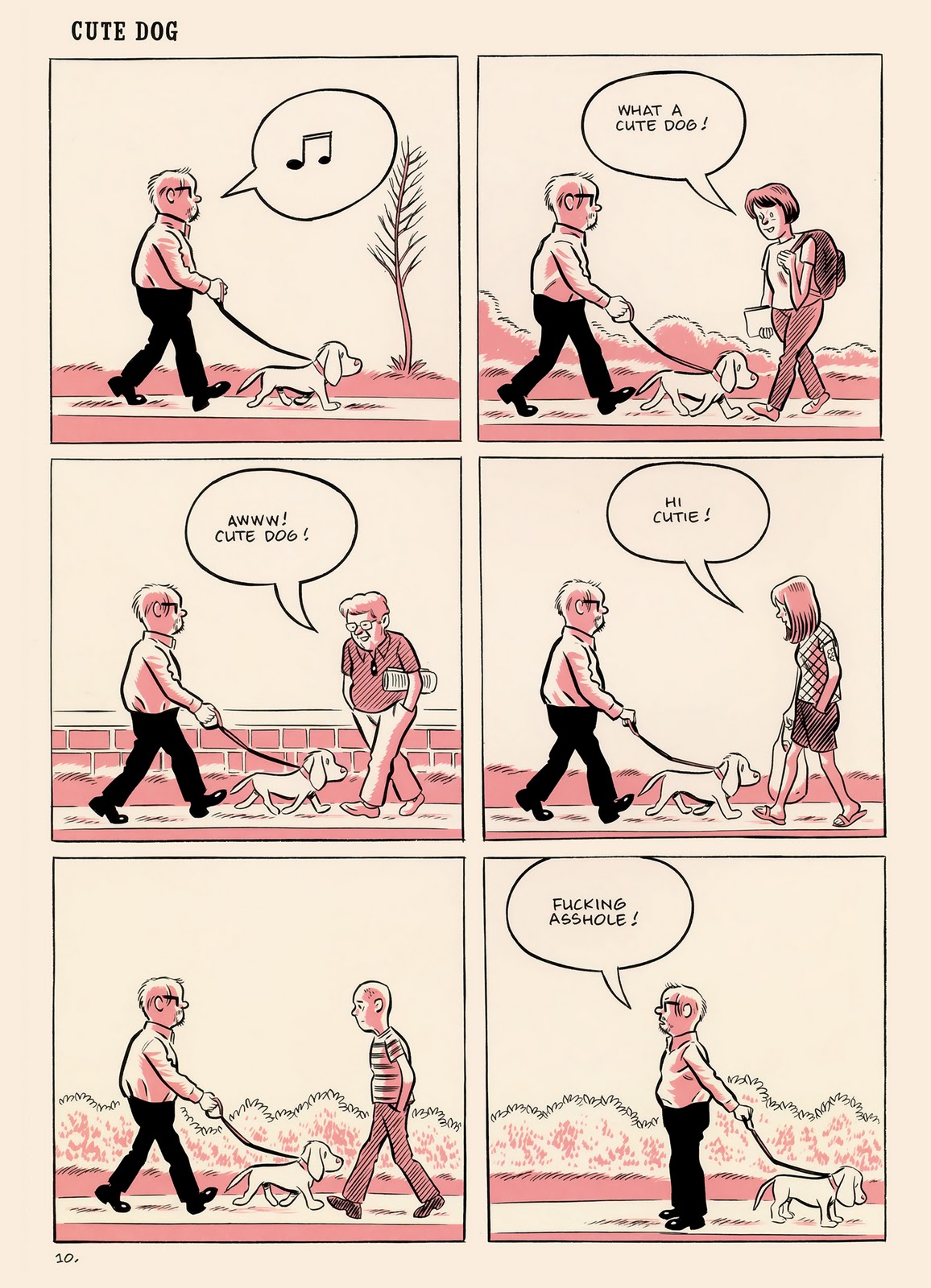
“Cute Dog” — Daniel Clowes

Read our review of Daniel Clowes’s Wilson, or buy the book from Drawn & Quarterly..

William Burroughs’s Advice to Young People

“Why Read the Classics?” — Italo Calvino

From Italo Calvino’s The Uses of Literature

  1. The classics are the books of which we usually hear people say, “I am rereading . . . ” and never “I am reading . . . “
  2. We use the words “classics” for books that are treasured by those who have read and loved them; but they are treasured no less by those who have the luck to read them for the first time in the best conditions to enjoy them
  3. The classics are books that exert a peculiar influence, both when they refuse to be eradicated from the mind and when they conceal themselves in the folds of memory, camouflaging themselves as the collective or individual unconscious.
  4. Every rereading of a classic is as much a voyage of discovery as the first reading.
  5. Every reading of a classic is in fact a rereading.
  6. A classic is a book that has never finished saying what it has to say.
  7. The classics are the books that come down to us bearing the traces of readings previous to ours, and bringing in their wake the traces they themselves have left on the culture or cultures they have passed through (or, more simply, on language and customs).
  8. A classic does not necessarily teach us anything we did not know before. In a classic we sometimes discover something we have always known (or thought we knew), but without knowing that this author said it first, or at least is associated with it in a special way. And this, too, is a surprise that gives much pleasure, such as we always gain from the discovery of an origin, a relationship, an affinity.
  9. The classics are books which, upon reading, we find even fresher, more unexpected, and more marvelous than we had thought from hearing about them.
  10. We use the word “classic” of a book that takes the form of an equivalent to the universe, on a level with the ancient talismans. With this definition we are approaching the idea of the “total book,” as Mallarmé conceived of it.
  11. Your classic author is the one you cannot feel indifferent to, who helps you to define yourself in relation to him, even in dispute with him.
  12. A classic is a book that comes before other classics; but anyone who has read the others first, and then reads this one, instantly recognizes its place in the family tree.
  13. A classic is something that tends to relegate the concerns of the moment to the status of background noise, but at the same time this background noise is something we cannot do without.
  14. A classic is something that persists as a background noise even when the most incompatible momentary concerns are in control of the situation.


Bill and Tony — A Short Film with William Burroughs

William Burroughs looks a little like Captain Picard in this one—

Will Ferrell on Raymond Carver

Will Ferrell talks to the AV Club about his new film, Everything Must Go, which is based on Raymond Carver’s short story “Why Don’t You Dance?” From the interview—

AVC: Your character in Everything Must Go is a persistent alcoholic who loses his job and his wife in one fell swoop, so the film could have been much darker than it is, especially considering the source. Raymond Carver isn’t known for being quirky and lighthearted.

WF: I probably shouldn’t admit, but I will, that I had never read Raymond Carver prior to this. When Dan gave me the short story, the collection it was in, I read it cover to cover, and I loved the starkness of his writing. But it’s true, it’s pretty dark and alcoholic. It just depends on your filter and where you’re coming from. You mentioned that it could be a lot darker. Other people have said to me, “Wow, this is really dark, especially for you to do.” I was fearful of the shot of the shaky hand reaching for the can, like, “That’s going to come off terrible.” A more skilled actor maybe could do it, but for me, and Dan agreed, we just made sure that everything was underplayed, if anything.

AVC: Actors often say that playing drunk is one of the hardest things to do, and the secret is acting like you’re trying not to look drunk. 

WF: Totally. I actually had a buddy of mine come over and film me getting drunk one night, just as an excuse to drink 18 beers, but also to see if there was anything I could glean from that.