“Without Any Jiggery-Pokery” — David Mitchell on Writing His Novel Black Swan Green

David Mitchell talks about writing his novel Black Swan Green in his 2010 Paris Review interview

MITCHELL

I’d actually started Black Swan Green years earlier. In 2003, while I was finishing Cloud Atlas, Granta asked for an unpublished story, and all I had were a few sketches about the world I grew up in. I didn’t want to be overly distracted from the end of Cloud Atlas, so I decided to knock one of the sketches into a publishable story. In doing so, I began my next novel.

INTERVIEWER

Did you, like Jason, write poetry under a pseudonym for the parish newsletter?

MITCHELL

I did.

INTERVIEWER

Was your pseudonym the same as Jason’s: Eliot Bolivar?

MITCHELL

James Bolivar—after a character created by an American science-fiction writer, Harry Harrison. I’ve never told anyone that before. You can see why.

INTERVIEWER

And, like Jason, did you go see a speech therapist?

MITCHELL

Just the same, aged about thirteen. Like Jason, I would go, and my stammer would vanish in the presence of the therapist, but come the next day, I’d be stammering again. One very pleasing result of Black Swan Green is that the book now appears on course syllabi for speech therapists in the UK. I hope that the book is useful for anyone wanting to understand an insider’s account of disfluency. For most of my life, the subject was a source of paralyzing shame, scrupulously avoided by family and friends. They were being kind, but to do something about a problem it must be named, discussed, and thought about. After writing the second chapter of Black Swan Green I realized, This is true, real, and liberating. I felt a little like how I imagine a gay man feels when he comes out. Thank God—well, thank me actually—that I don’t have to pretend anymore. Now I’m more able to feel that if people have a problem with my stammer, that problem is theirs and not mine. Almost a militancy. If Jason comes back in a future book, he’ll be an adult speech therapist.

INTERVIEWER

When you were creating Jason Taylor, did you ask yourself, What was David Mitchell like at that age?

MITCHELL

It was largely that, yes. Arguably, the act of memory is an act of fiction—and much in the act of fiction draws on acts of memory. Despite the fact that Jason’s and my pubescent voices are close, his wasn’t the easiest to crack because it had to be both plausible and interesting for adult readers.

INTERVIEWER

It was perverse of you to write a first novel after having written three others.

MITCHELL

When I started out on this head-banging vocation, my own background simply didn’t attract me enough to write about it. An island boy looking for his father in Tokyo; sarin-gas attackers; decayed future civilizations in the middle of the Pacific—these were what attracted me. It took me three books to realize that any subject under the sun is interesting, so long as the writing is good. Chekhov makes muddy, disappointed tedium utterly beguiling.

INTERVIEWER

Black Swan Green is very carefully structured.

MITCHELL

Get the structure wrong and you blow up shortly after takeoff. Get it right and you save yourself an aborted manuscript and months and months of wasted writing. Make your structure original and you may end up with a novel that looks unlike any other. So yes, Black Swan Green is carefully structured—like all halfway decent books—but simply structured too, with one story per month for thirteen months. After Cloud Atlas I wanted a holiday from complexity. I was reading Raymond Carver, John Cheever, and Alice Munro—all three great No Tricks merchants. After doing a half Chinese-box, half Russian-doll sort of a novel, I wanted to see if I could write a compelling book about an outwardly unremarkable boy stuck in an outwardly unremarkable time and place without any jiggery-pokery, without fireworks—just old-school.

CableKlept: Wild Times in the Caucasus

WikiLeaks’ recent infodump (available on a DNS mirror here) of over 250,000 US diplomatic cables has raised myriad questions about media responsibility, notably just how open America’s information-drunk society needs to be when private (but not really) communications between members of the intelligence community and governments are open to the public.

And regardless of whether you think the leak is embarrassing (to the US), strategic (for the US making a case against Iran) or triumphant (Assange as Martyr 2.0), the cables themselves actually make for some pretty great stories. Alexis Madrigal at the Atlantic has rounded up some of the more finely crafted transmissions, revealing an intelligence corps that often eschews dry, fact-based tones for rich and, in the case below, humorous detail.

This excerpt of a cable from Moscow to DC recounts an oligarch’s wedding in the Caucasus but reads like the plot summary from an episode of Eastbound and Down:

Gadzhi was locked into his role as host. He greeted every guest personally as they entered the hall — failure to do so would cause great insult — and later moved constantly from table to table drinking toasts with everyone. The 120 toasts he estimated he drank would have killed anyone, hardened drinker or not, but Gadzhi had his Afghan waiter Khan following him around to pour his drinks from a special vodka bottle containing water. Still, he was much the worse for wear by evening’s end. At one point we caught up with him dancing with two scantily clad Russian women who looked far from home. One, it turned out was a Moscow poet (later she recited an incomprehensible poem in Gadzhi’s honor) who MOSCOW 00009533 004 OF 005 was in town with a film director to write the screenplay for a film immortalizing Gadzhi’s defense of Dagestan against Shamil Basayev. By 6 p.m. most of the houseguests had returned to Gadzhi’s seaside home for more swimming and more jet-skiing-under-the-influence. But by 8 the summer house’s restaurant was full once more, the food and drink were flowing, the name performers were giving acoustic renditions of the songs they had sung at the reception, and some stupendously fat guests were displaying their lezginkas for the benefit of the two visiting Russian women, who had wandered over from the reception.

While the excerpted cable is 5 pages of hilarity, others leaked are sad accounts of Gitmo detainees starting new lives and judges seeking protection from the US against terrorist assassins. In all of them, we’re reminded us that diplomacy and intelligence activities are driven not by abstract political ideals, but by humans with feelings, desires and perspectives of their own. Cheers to the Atlantic for finding life (and the humor) within the debate.

Read more of Madrigal’s picks.

Heroes of 2010 — Those Guys Who Stole Jonathan Franzen’s Glasses

On October 4th of this year, right in the midst of Franzen-mania (and Franzenfreude), two ballsy Londoners jacked Jonathan Franzen’s signature spectacles during a Hyde Park bookstore launch party for Freedom. They left a ransom note asking for $100,000, but were eventually caught, and the glasses were returned. Now, if only someone could do him a favor and steal his silly leather jacket because, jeez, c’mon.

The Best Books We Read in 2010 That Were Published Before 2010

The best books that we read in 2010 that were published before 2010:

Nazi Literature in the Americas by Roberto Bolaño (2008, English translation) — Bolaño’s fake encyclopedia of right-wing writers is a tragicomic crash course in misanthropy, failure, and fated violence. Francisco Goldman’s blurb on the back of the book is spot on–the book is a “key cosmology to Bolaño’s literary universe.” Nazi Literature is like an index for the Bolañoverse–creepy, steeped in dread, deeply, caustically funny, and bitterly poignant.

Butterfly Stories by William T. Vollmann (1993) Adventures in the Southeast Asian sex trade. Bleakly funny, often depressing, and filled with erudite asides on Nobel prizewinners, transvestites, and the benefits of whiskey and benadryl. Plenty of grotesque sex. Not for everyone. In fact, not for most people.

The Friends of Eddie Coyle by George V. Higgins (1970) — Higgins throws his audience into the deep end of gritty urban Boston on the wrong side of the sixties in this crime noir classic. There’s little exposition to spell out Coyle’s intricate and fast-paced plot, but there is plenty of machine-gun dialogue, rendered very true and very raw. Higgins trusts the reader to sort out the complex relationships between hustlers and dupes, cops and finks from their conversations alone. The imagery is straight out of a Scorcese film, and like that director, Higgins has a wonderful gift for showing his audience action without getting in the way.

Home Land (2004) and Venus Drive (2000) by Sam Lipsyte — Is there a better stylist working today than Lipsyte? Does anyone write better sentences? Of course, sentences alone don’t matter much if you don’t have a story worth telling, and both Homeland and Venus Drive deliver. They are seething, funny, poignant books, with characters tipped toward some redemption, awful or otherwise, despite their myriad sins.

Steps by Jerzy Kosinski (1968) — One of the many small vignettes that comprise Steps begins with the narrator going to a zoo to see an octopus that is slowly killing itself by consuming its own tentacles. The piece ends with the same narrator discovering that a woman he’s picked up off the street is actually a man. In between, he experiences sexual frustration with a rich married woman. The piece is less than three pages long. You will either hate or love this book.

Cloud Atlas (2004) and Black Swan Green (2006) by David MitchellCloud Atlas is a postmodern puzzle piece of six nested narratives (each a smart take on some kind of genre fiction), informed by Nietzsche’s idea of eternal recurrence; Black Swan Green (which for some reason we forgot to review here) is a funny and heartwarming coming-of-age story of a boy who copes with his terrible stutter and his parents’ crumbling marriage in early 1980’s England. The books have little in common save their brilliance–which seems kinda sorta unfair. It also seems unfair that Mitchell put them out so quickly. Damn him.

Angels by Denis Johnson (1983) — Angels begins as a small book about not very much and ends as a small book about pretty much everything. Johnson has a keen eye and keener ear for the kinds of marginal characters many of us would rather overlook all together, people who live and sweat and suffer in the most wretched, unglamorous, and anti-heroic vistas of a decayed America. The great achievement of the novel (beyond Johnson’s artful sentences) is in staging redemption for a few–not all, but a few–of its hopeless anti-heroes.

Suttree by Cormac McCarthy (1979) — A beautiful, rambling riff on American literature — Suttree picks up on Emerson and Twain, Faulkner and Whitman, and flows into a new, wild territory that is pure McCarthy. Is it his best novel? Could be. Read it.

The Minimum Number of Books in Harvard’s Libraries That Are Bound in Human Flesh (and Other Fun Facts from Harper’s Index)

The following citations are culled from a search of Harper’s Index that used the term “literature.” (If it’s not obvious, the numbers before each datum are the month and year that Harper’s originally published the datum in its Index)–

5/84    Percentage of Americans who say they never read books: 45

Percentage of these who can’t read: 13

12/87  Number of direct-mail solicitations sent to Henry David Thoreau at Walden Pond this year: 90

4/87   Copies of Gabriel García Márquez’s new book burned by the Chilean government last November: 15,000

2/88   Exclamation points in Tom Wolfe’s The Bonfire of the Vanities: 2,343

10/90   Number of years George Bush has been citing Bonfire of the Vanities as an example of his pleasure reading: 2

11/90   Number of Georgia third-graders Representative Newt Gingrich paid $2 for every book they read last summer: 282

3/91   Percentage of American households in which no books were bought last year: 60

12/92   Chances that an attempt to ban or restrict access to school materials or books last’ year was successful: 2 in 5

6/94   Amount Random House lost on the 29 of its books included on the 1993 New York Times Notable Books list: $698,000

11/95   Estimated number of books banned since 1965 in Indonesia: 2,000

3/95   Amount for which a Mississippi man attempted to sue “the Bible” last year, citing it as “oppressive hearsay”: $45,000,000

5/95   Tons of remaindered books destroyed in the United States each year: 250,000

5/95   Number of Shakespeare’s thirty-seven plays quoted on the Senate floor last year by Robert Byrd: 37

9/95   Percentage of Americans who own at least five Bibles: 27

9/95   Number of California library books of modern American poetry from which pages have been reported stolen this year: 250

1/00   Estimated temperature of Hell, according to two Spanish physicists ‘ interpretation of the Bible: 832° F

Estimated temperature of Heaven: 448°F

3/00  Number of Playboy centerfold models since 1959 whose bios claimed their favorite book was by Ayn Rand: 12

9/00   Ratio of the number of copies of The Great Gatsby sold each month in the U.S. to the number sold in the author’s lifetime: 5:3

9/03   Estimated acres of forest Henry David Thoreau burned down in 1844 trying to cook fish he had caught for dinner: 300

6/04   Minimum number of the brand names mentioned in James Joyce’s Ulysses that are still extant: 28

Number of the brand holders that are sponsoring Dublin’s centennial Bloomsday celebration this month: 2

9/06   Minimum number of books in Harvard’s libraries that are bound in human flesh: 2

Books of 2010 — Noteworthy, Notorious, and Neglected

Biblioklept already busted out our Best Books of 2010 list, selecting ten of our favorite novels of the year. Such limitations help to generate lists, which internet folks love to circulate–you know the ritual–but those limitations can also prohibit a discussion of some of the other important books of 2010. So, without further ado–

Jonathan Franzen’s Freedom has, for some reason, topped all kinds of year-end lists already, and been hailed by writers, critics, and readers as book of the year, decade, and even century. We pretty much hated it, saying–

Franzen is deeply intelligent, even wise, and his analysis of the past decade is perhaps brilliant. It’s also incredibly easy to read, but this is mostly because it requires so little thought from the reader. Franzen has done all the thinking for you. The book has a clear vision, a mission even, but it lacks urgency and immediacy; it is flaccid, flabby, overlong. It moans where it should howl.

Still, we felt the need to defend Franzen when he caught flak for, gasp!, getting attention. Other writers had to work hard to get noticed, including Tao Lin, whose novel Richard Yates we found baffling. Lin smartly hijacked Franzen’s Time cover, parlaying it into the kind of media attention a young novelist needs in this decade to get noticed.

David Shields also garnered a lot of attention after publishing his ridiculous “manifesto” Reality Hunger, a book that cobbled together citations from superior writers to make a point that Henry Miller made over half a century ago and every novelist worth his salt has always known: great writers steal. Although Shields’s points about copyright laws and who can “own” stories are salient in world two point oh, his call for the death of the novel is absurd and offensive.

Lee Rourke’s brilliant début novel The Canal is as good an answer as any to Shields–The Canal is a thoroughly modern reconsideration of existentialism in the post-9/11 world, a new kind of novel in the nascent tradition of Tom McCarthy’s The Remainder (of course, as McCarthy–and David Shields–would point out, these novels are “plugging into” other novels). Similarly, Adam Langer’s witty novel The Thieves of Manhattan pointed to the ways that novels can still be meaningful; Thieves jauntily riffs on adventure and mystery genre fictions, squaring them against a parody of literary fiction and the hermetic world that produces it.

Langer’s novel tracks the quick rise and fall of more than one literary star; Yann Martel might have felt such a falling sensation in 2010–Beatrice and Virgil, his follow-up to the wildly successful book club classic Life of Pi, received mostly scathing reviews. He’ll have to console himself with the piles of money that Ang Lee’s film adaptation of Life of Pi will likely generate. In our review of Beatrice and Virgil we declared the book “a page turner, engaging, propulsive, and quite easy to read. It injects the philosophical and artistic concerns of literary fiction into the frame and pacing of a book designed for broader audiences.” We think too many folks mistook Martel’s aims for something higher.

Martel wasn’t the only big name writer whose 2010 novel found critical disfavor. Don DeLillo’s Point Omega was met with a mix of critical shrugs and outright dismissals, with very few champions. We seemed to like it better than most. In our review we said that “Point Omega takes an oblique, subtle, and unnerving tackle at themes of time, perception, family, and, ultimately, personal apocalypse. It’s not a particularly fun book nor does it yield any direct answers, but it’s also a rewarding, engaging, and often challenging read.”

DeLillo’s friend Paul Auster also received mixed reviews for his novel Sunset Park. We loved Auster’s winding syntax and his keen observations on high and middle culture, but found his take on twentysomethings in Brooklyn unrealistic and perhaps a bit pandering (Picador’s updated version of his Collected Prose that came out this year was a far more satisfying read).

The worst novel we read in 2010 though was quite easily Justin Cronin’s The Passage, a calculated attempt to make money, not literature. We have no problem with writers making money, of course–we don’t even mind writers ripping off other writers’ ideas to make money–but Cronin’s book is a shallow, sprawling laundry list of clichés and stolen-set pieces, a failed synthesis of post-apocalypse tropes, and a naked grab at commercial appeal. It seems to have been written expressly to be sold as a series of franchise movies. Because of Cronin’s earlier literary fictions, many critics mistook The Passage for a work of literature; indeed, many praised it. They were wrong.

Of course, our targeting of The Passage feels like backlash of some kind, common to both the internet and the book world. If we’re hating on Cronin for his overexposure, it might be because we feel that there are a host of neglected and overlooked books out there. We put two on our Best Books list: Imre Kertész’s The Union Jack and Nanni Balestrini’s Sandokan are both novellas in translation, not the sort of thing that usually tops critics’ year end lists (let alone get read by the public). We could add Yoko Ogawa’s bizarre, slim novel Hotel Iris to the list. Available for the first time in English this year, Ogawa’s novel is effectively a reverse-Lolita, a David Lynchian-riff on BDSM in a small Japanese coastal town. Not for everyone, but strange, disturbing stuff.

Critics also seemed to roundly ignore the full publication of Ralph Ellison’s second, unfinished novel, Three Days Before the Shooting . . . , which we wrote about twice (here and here) but never managed to finish, which doesn’t really matter because he didn’t finish it either. A much shortened version of the novel was published as Juneteenth in the ’90s to mixed reviews, but it seems strange that this version, collecting all of Ellison’s manuscripts and notes, should go so unremarked upon (still, it’s a big long sucker of a book; perhaps someone out there is still unpacking it all).

So what did we miss? What other books of 2010 remain thus-far neglected? What books did you love? Hate? Let us know.

The Best Books of 2010

Here are our favorite books published in 2010 (the ones that we read–we can’t read every book, you know).

Sandokan — Nanni Balestrini

A dark, elliptical treatise on the mundane and inescapable violence wrought by the Camorra crime syndicate in southern Italy.

Everything Ravaged, Everything Burned — Wells Tower (trade paperback)

Tower’s world is a neatly drawn parallel reality populated by down-on-their-luck protagonists who we always root for, despite our better judgment, even as they inadvertently destroy whatever vestiges of grace are bestowed upon them.

The Union Jack — Imre Kertész

Kertész’s slim novella explores a storyteller’s inability to accurately and properly communicate spirit and truth against the backdrop of an oppressive Stalinist regime.

BodyWorld — Dash Shaw

Shaw’s graphic novel is sardonically humorous in its psychoanalytic/post-apocalyptic visions. It’s a sweet and sour subversion of 1950’s comics and contemporary conformist groupthink politics. Witty and poignant, it advances its medium.

The Thousand Autumns of Jacob de Zoet — David Mitchell

An unexpected historical romance from postmodern poster boy David Mitchell. Thousand Autumns is a big fat riff on storytelling and history and adventure–but mostly, Mitchell’s Shogunate-era Japan is a place worth getting lost in.

C — Tom McCarthy

“I see what I’m doing as simply plugging literature into other literature,” McCarthy said in an interview this year. “For me, that’s what literature’s always done.” C, our favorite novel of 2010, seems plugged into the past and the present, pointing to the future.

Wolf Hall — Hilary Mantel (trade paperback)

Who knew that we needed to hear the Tudor saga again? Who knew that Thomas Cromwell could be a good guy?

The Ask — Sam Lipsyte

A mean, sad, hilarious novel that simultaneously eulogizes, valorizes, and mocks the American Dream.

X’ed Out — Charles Burns

Charles Burns does Tintin in William Burroughs’s Interzone. ‘Nuff said.

The Collected Stories of Lydia Davis — Lydia Davis

An epic compendium of, jeez, I don’t know, how do you define or explain what Davis does? Inspection, perception, mood, observation. Tales, fables, riffs, annotations, skits, jokes, japes, anecdotes, journals, thought experiments, epigrams, half-poems, and would-be aphorisms. Great stuff.

Biblioklept Interviews Mahendra Singh About Fitting Lewis Carroll into a Protosurrealist Straitjacket with Matching Dada Cufflinks

Mahendra Singh’s new book is a graphic-novelization of Lewis Carroll’s epic poem The Hunting of the Snark (read our review). Singh was kind enough to talk to us about his project over a series of emails. The Hunting of the Snark is available now in hardback from Melville House. You can read more about Singh’s work at his website.

Biblioklept: Where did your interest in Carroll originate?

Singh: I read the Alice books as a child and only read the Snark when I was a teenager. The Alice’s were fun, as was the Snark, but it also puzzled me at first. It was hard-core Nonsense and it took me a while to digest it, and half-way understand it. It was a great mental stretching exercise, still is. Kids need that sort of thing if they want their brains to grow up to be something besides consumer units.

Alice’s game of Nonsense is really a warm-up to the Snark’s. When Carroll got to the Snark, he’d had a bit of practice and was in top form. The Snark is really Alice 2.0, the more expensive professional upgrade to Nonsense Making.

When I was young, I had odd reading tastes. From 70s SF to Aristophanes to the Ramayana; I was a little piggy. What I usually liked was a complex, completely furnished fictional world, along with a nice musicality with words. What really turned me on was when that fictional world would be logically intertwined with the real world, past or present. In short, one world would be a sort of code for the other.

I think a lot of kids still like that, it’s really the basic premise of most storytelling, although nowadays it is often so deeply monetized and predigested that it’s hard to really enjoy or even benefit from.

In any case, everything Carroll wrote fit my tastes, but the Snark was extra-special, the difference being that this epic poem (the only genuine Victorian epic poem and I’ll defend that claim against all comers), this epic took the Alice premise of mismatching appearances and meaning and took it to its logical conclusion, which itself is another Nonsense paradox doubled upon itself — beware these Carrollian infinite regressions!

In the Snark, the story-telling code of Nonsense is perfected. Most of the elements are still drawn from the familiar, real world but they are so recombined that their appearances and meaning are impossible to decipher anymore. And yet the persistent, nagging feeling of a genuine logic behind it all still remains.

I think for most young people who are thinking things over, the above Snarkian description is a pretty accurate of their budding world view. And anyway, breaking world-codes was pure catnip for me, it’s the essence of reading, good reading anyway.

And I have to mention the poetry. I’ve always loved poetry and Carroll’s verse skills in the Snark are the perfect vehicle for what he’s doing. Their anapestic bounce, their goofy mouth feel (the mouthfeel of Old English poetry charms and chants) make a perfect vehicle for the code. It’s a bit of a music hall, Gilbert & Sullivan feel to what is technically a tragic verse epic.

I wouldn’t say I’m a full-bore Carrollian Obsessive, I’ve met plenty of them and they’re dangerous … quiet, nattily dressed librarians with bow ties and a deadpan penchant for puns and parody. Book editors concealing rural silos crammed full of  highly addictive Carrollian Nonsense. Carrollian Illuminatis cleverly disguised as entomologists hanging out at obscure Snarkian forestry associations.

I’m just a Carrollian Nutter, I’m harmless as long as I have access to drawing materials. And pictures of Snarks.

Biblioklept: You’ve described your work on Snark as “fitting Lewis Carroll into a protosurrealist straitjacket with matching Dada cufflinks.” Why do the techniques of surrealism and Dada lend themselves to Carroll?

Singh: Surrealism is one of those things that everyone can point at but few can define. It’s the idea of awakening the sleeper within us and letting them speak to us in their own dream language of pictures and words. Since dreams are a universal form of memory that draw upon every possible human experience, Surrealism is sort of the simultaneous dream-memory of everything.

Protosurrealism is what I call the comfy, cozy Carrollian straitjacket I’ve trapped my Snark in. Carroll was himself hailed as a protosurrealist by the founding fathers of this odd cult, Breton, Aragon, etc. His work, with its dreamlike logic and free associations entranced them and they regarded him as a unique trail-blazer in their explorations. And his verse, to me, is the epitome of the dream world; all poetry (Nonsense or otherwise) must surely be the natural, Adamic language of dreams!

The Surrealist Max Ernst was an enormous inspiration to me — his technique of using 19th-century engravings to illustrate dream stories is brilliant; the old-fashioned, realistic visual style gives them a jarring sense of authority. Realism is the optimal style of the determined dreamer! The urban dreamscapes and dream-eroded objects of Giorgio de Chirico and his brother, the unjustly neglected Alberto Savinio, were also part of my bag of tricks. And of course, references to Rene Magritte are scattered everywhere in this Snark. Magritte’s various techniques for undermining systems of linguistic and visual meaning are ideally suited to navigating the Carrollian Multiverse.
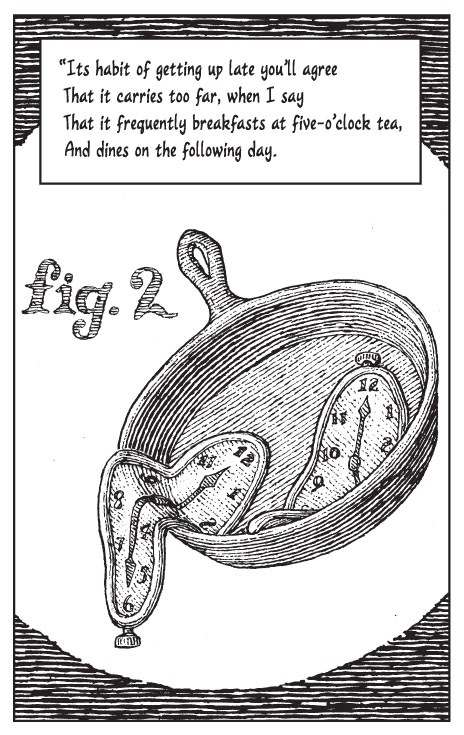
It’s hard to illustrate an idea and oddly enough, the Snark is really a poem of ideas, couched in the form of a tragic epic and then declaimed by a master comedian. One thing I wanted to avoid was doing literal drawings of the scenes in it; I wanted the Snark to constantly bring up a stream of associations, references, insinuations, all of them triggering more and faster allusions, what I call a gateway Surrealism that leaves readers hopelessly addicted and desperate for more! Don’t say no, kids!

I’ll add that protosurrealism is the 21st-century application of 19th-century answers to 20th-century problems. The application is this 21st century Snark, the answers are the Victorian rendering style I used and also Carroll’s entire invention of Victorian Nonsense, and the questions are the existential questions that 20th-century artists couched in the language of Surrealism.

Plus, let’s face it, Surrealism just looks cooler! Who wants a postmodernist or abstract expressionist Snark? And the smart kids love it, they’re still young enough to dare to question the sordid, official version of reality. Which is where Dada comes in — there’s a bit of it in my Snark and it’s there because Dada was the ultimate poke in Western Civ’s eye. If the idea of using a blank map isn’t pure Dada, what is it then?

It’s odd having to discuss this in words, proof positive that the Surrealist project remains unfinished. In a perfect Surrealist world, the meaning of my Snark would bleed out of the book and contaminate the reader’s world until they could not distinguish where the Snark began or reality left off. And that’s the essence of Carrollian Nonsense, fiddling with the logical doors of perception.

Biblioklept: Much of surrealist and Dadaist art seems to be an immediate response to mechanical reproduction. In Snark, you seem to at times be reconfiguring, recombining, recontextualizing otherwise familiar images. How do you work? How do you go about creating your art? Can you describe your process?

Singh: Mechanical reproduction can be a loaded phrase. Walter Benjamin gave it quite the kick in the pants, pointing out that it is a degradation of the cult object, a commodification, etc. But the problem is us, the public. A work of art has absolutely no meaning or value except what the viewer puts into it. This is a very important point. If art is degraded or degrades others, it is our choice.
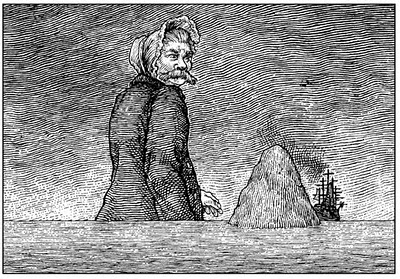
Poor Benjamin, a smart guy but always wriggling back into a Marxist strait-jacket just as useless as medieval Scholasticism or modern neoconservatism. At least Carrollian Nonsense makes the kiddies giggle! He never grasped that all philosophy is individual psychology (and wish-fulfilment) in essence. That’s why the Banker in my Snark is Karl Marx — revenge was sweet! I also included Nietzsche as the Bonnet-maker and Heidegger as the Barrister to round things off. I can assure you, several philosophers were injured in the course of this production. A broken ontology can be quite painful.

Nothing has meaning or value unless we decide it does. For years, readers have puzzled over the meaning behind the Snark. It’s another Carrolian Zen koan : the meaning is the meaning. It’s always been staring us in the face, the meaning of the Snark is a verb, it is to search for meaning and when doing so, one automatically generates a meaniningful purpose just as naturally as a spider ejects its web. Inside this silky web is the comfort of whatever logic you feel up to (and that is the secret pleasure of Carrollian Nonsense) and outside the web is just chaos, a Boojum!

In my Snark I’ve mashed up artists including Hieronymous Bosch, Grünewald, Titian, Théodore Géricault, David, Ingres, even George Herriman and also many Surrealists such as Man Ray, Dali, Magritte, etc. There are musicians and authors, the Beatles and Gilbert and Sullivan, Edgar Allan Poe, the Comte de Lautremont, even Victorian parlor games and optical illusions. The idea was to create a web, a labyrinth of allusions in which to hunt the Snark. Some of the references will be familiar but some will not and the reader, if so inclined, can hunt them down on their own. It’s a hunt within a hunt, another Carrollian regression.

The educational aspect is important to me. I really do hope some of the kids who read this will get curious and start off on their own, pillaging a library, ransacking a museum, sneaking into the opera, whatever turns them on. The smart kids are hungry for culture. We must get them thinking, to get them to manufacture and own their own meanings before a mass-marketing goon does it for them.
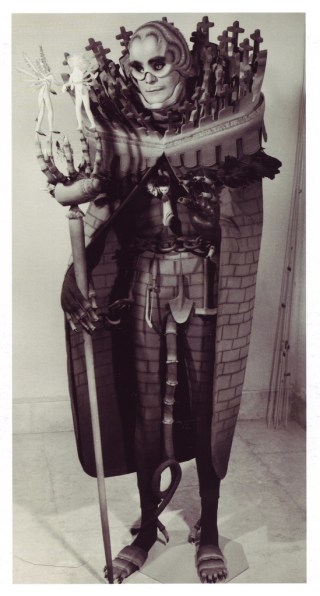
The actual process of creating the imagery was simple, it’s basically me lying on a sofa, maybe a quick snooze and then free-associating while pondering the text. The cover image is a good example, it’s also the illustration for the whiskered Snarks who scratch and the feathered Snarks who bite. This made me think of Old Scratch, the devil, AKA Lucifer, who was once an angel with feathered wings who also showed a nasty tendency to bite the hand that feeds. I had a vague visual memory of seeing a photo of a surrealist devil; I rummaged through some books until I found it — Denise Bellon’s photo of the Québécois Surrealist, Jean Benoit, at a costume party.

The slippers are what caught my eye, it made me think of Old Scratch lounging at home in Pandemonium, his day off, not bothering to shave, hence the whiskers that scratch. I made the toes unequal on a lark, it just seemed right to have Satan misshapen but afterwards I came up with a cabalistic explanation which I won’t bore you with for now.

I then did a pencil drawing on tissue paper, constantly refining and adding or deleting, this was the slowest part of the entire Snark, the pencils. Afterwards I did the pen and ink drawing atop the tissue, on Denril, a synthetic vellum. This is an old technical illustrator’s work habit, which is how I started out actually, in the 80s.

This business of free associating while simultaneously referring to one’s internal visual memory is only possible if one has spent many years romping though books and museums. You cannot be a serious illustrator if you don’t read and look voraciously, all the time. And above all, don’t look at too much rubbish or you will start drawing rubbish. Art students reading this, take heed! You are what you see.

Recombining Surrealism and other –isms, along with the free associations triggered by Carroll’s Nonsense verse, creates a matrix which allows the reader to move seamlessly back and forth between the worlds of dreams, culture, memory and emotion. Those readers who catch the references will enjoy the historical and even non-verbal logic binding them, the rest is up to you.

You are really bringing the meaning with you, and when confronted by my Snark I hope it triggers a cascade of free associations, a mental phenomenon which is the precursor to dreaming, the royal road of Surrealism and Carrollian Nonsense.

Biblioklept: How does your work respond to the nine illustrations by Henry Holiday that originally accompanied Carroll’s text?

Singh: Holiday’s illustrations are odd things, I’ve never been very keen on them. He was a graceful artist usually, very talented and yet these drawings are a bit grotesque, ugly perhaps. They just don’t look so appealing to me. The technique is flawless though, a very classic British style of line work that lasted well into the 1940s.

Some Snarkologists believe that Holiday worked with Carroll to hide a secret meaning in the art. Angles and distances have been measured, objects analysed,  hidden shapes discovered and reconfigured. Who knows? It’s unlikely but in any case, you can’t avoid Holiday if you’re doing the Snark.

I used some of his symbols, the bare-breasted woman and her anchor representing Hope, a very british motif which suits the nautical nature of much of the quest. His picture of the Beaver doing its math problem inspired me to treat that entire Fit the Fifth as a long variation upon the Temptation of St. Anthony, especially the version by Bosch. Holiday really nailed that one. I have to confess that Flaubert’s version is a favorite book of mine and I tried to give this part of the Snark the same baroque, over the top feeling of deranged pagan vs. Christian imagery.

Holiday also crammed a considerable number of small details in the Beaver illustration. It’s quite a contrast to the style of the other big Carroll illustrator, Sir John Tenniel, who favored a cleaner look. Nowadays this technique is called “chicken fat” and I used a lot of chicken fat in my Snark, more than Holiday. Of course, with only 9 drawings, he had to keep to a slower visual tempo. That was another reason I did it as a graphic novel — I could vary the tempo quite a bit and really overwhelm the reader with chicken fat when the verses demanded it.

On the other hand, doing it as a graphic novel required creating a narrative visual thread through the whole thing, something which Holiday really didn’t need. In this case, my idea was to make it a theatrical presentation, each Fit a new set change until the end, when Carroll is revealed as the spectator in the empty hall. Carroll was fond of theatricals and the Snark does have a stagey feel to it anyway.

Biblioklept: Have you ever stolen a book?

Singh: Yes, Aces High, a lavishly illustrated book about British fighter pilot aces of WWI. It once graced the shelves of the high school I once attended in a desultory manner (myself, not the book). I was, and still am, fascinated by all things aviation and I could not bear the sight of that wonderful book languishing there, unremarked, unappreciated. I still know the difference between a Sopwith Pup and a Sopwith Camel and I love a well-executed Immelman at the crack of dawn. It was wrong to do and I can only plead callow youth in my defence. Don’t do it, kids! It isn’t worth it! Gosh, I hope Mrs. Merrill isn’t reading this . .  .

“Furniture” — Jonathan Lethem

In The Novelist’s Lexicon (new from Columbia University Press), over 70 prominent writers (including Rick Moody, A. S. Byatt, Etgar Keret, Annie Proulx, Elif Shafak, Colum McCann, and Tariq Ali) choose a single word as an inroad to discuss their work. Here’s Jonathan Lethem on furniture–

However appalling to consider, however tedious to enact, every novel requires furniture, whether it is to be named or unnamed, for the characters will be unable to remain in standing positions for the duration of the story. For that matter, when night falls—whether it is depicted or occurs between chapters—characters must be permitted to sleep in beds, to rinse their faces in sinks, to glance into mirrors, and so on. (It is widely believed that after Borges, mirrors are forbidden as symbols in novels. However, it is cruel to deny the characters in a novel sight of their own faces; hence mirrors must be provided.) These rules apply no matter how tangential the novel’s commitment to so-called realism, no matter how avant-garde or capricious, no matter how revolutionary or bourgeois. Furniture may be explicit or implicit, visible or invisible; may bear the duty of conveying social and economic detail or be merely cursorily functional; may be stolen or purchased, borrowed, destroyed, replaced; may be sprinkled with crumbs of food or splashed with drink; may remain immaculate; may be transformed into artworks by aspiring bohemians; may be inherited by characters from uncles who die before the action of the novel begins; may reward careful inspection of the cushions and seams for loose change that has fallen from pockets; may be collapsible, portable; may even be dragged into the house from the beach where it properly belongs—but, in any event, it must absolutely exist. Anything less is cruelty.


“Crash of ’69” — David Foster Wallace

“Crash of ’69” is a short story by David Foster Wallace. It was originally published in the New York-based literary quarterly Between C & D in winter of 1989. Between C & D published their journal on dot matrix paper and distributed it in plastic bags–not exactly the best way to preserve something.

CRASH OF ‘69 by David Foster Wallace

KARRIER

It’s great. I’m always wrong. It’s great.
Ask anybody except my agent if it’s great. He’ll be in checks and Weejuns, pointing binoculars at narrow horses hung with satin as they’re led toward their boxes. Mr. Diggs will say it’s great. He holds his racing form a certain way. He folds both sides together, to compare possibilities.
He’ll say So what about Rusty Hull in the Fourth, kid.
And I’ll say A winner, so sure a thing it’s almost boring, money in the account of our choice, Mr. Diggs.
He’ll put the forms side by side and feel the square of hair on his chin and say So then what about Siberian Saber-Toothed Crotch-Cricket, Karrier? Does Siberian Saber-Toothed Crotch- Cricket have a chance here in the Fourth?
I’ll say Mr. Diggs sir, no way. As in no chance. As in I feel in my chest, bowels the absence of even one slim snowball’s chance for Siberian Saber-Toothed Crotch-Cricket.
The form trembles a certain way in his hands as he trains the glasses on a certain horse, from here a tiny hull atop legs.
But are you sure Karrier.
I feel it, Mr. D. It’s that feeling, with the tight hide and velvet lips. That no-way certainty.

THE WOMAN WHO’S GOING TO BE HIS LOVER

I’ll take Father’s arm and we’ll take our constitutional together through the dawning halls of the Federal Reserve, to the sound of the click of my heels and the squeak of his chair, as the fire in the East window yellows. He says We can’t live like this, child. A whole nation has lost the cool side of the pillow. First thing every morning I taste in my mouth the human potential for evil.

His neck’s slow tic sends his head around over his shoulder. It has ceased to be great. The only brilliance he sees is over his shoulder, now.

Continue reading ““Crash of ’69” — David Foster Wallace”

“Searching for Suttree” — Wes Morgan Photographs Cormac McCarthy’s Knoxville

University of Tennessee professor Wes Morgan has documented some of the key locations in Cormac McCarthy’s novel Suttree. A few samples, but check out his website for more–

"Suttree's Home" (#1 on the map) -- This photograph is taken looking east from the Henley Street Bridge. It shows the Gay Street Bridge in the background with Volunteer Landing at the center. It is on this left bank of the Tennessee River, about where Volunteer Landing is located, that Suttree docked his houseboat. The suicide (p. 9) jumped from the Gay Street Bridge and the "...edge of the railroad" (p. 10) mentioned can be seen to the left of the parking lot. First Creek (p. 115) enters the Tennessee River on the left just above the docked riverboat.
The Huddle -- "They came down the steep street and turned in two by two." (p. 72) The Huddle, now vacant, was located at 219 Cumberland Avenue just a few yards east of Gay Street. The location had previously been occupied by a cab company before The Huddle opened in 1952 or 1953. Its mention in the text in 1951 is an anachronism
Ragpicker's Home -- The ragpicker's "...dark cavern beneath the vaulted concrete...." (p. 11) where "Water ran from a clay drain tile and went down a stone gully" (p. 421). The ragpicker's home under the south end of the Henley Street Bridge

Suttree — Cormac McCarthy

In his 1992 interview with The New York TimesCormac McCarthy said, “The ugly fact is books are made out of books. The novel depends for its life on the novels that have been written.” McCarthy’s fourth novel, 1979’s Suttree is such a book, a masterful synthesis of the great literature — particularly American literature — that came before it. And like any masterful synthesis, Suttree points to something new, even as it borrows, lifts, and outright steals from the past. But before we plumb its allusions and tropes and patterns, perhaps we should overview the plot, no?

The novel rambles over several years in the life of Cornelius Suttree. It is the early 1950s in Knoxville, Tennessee, and Suttree ekes out a mean existence on the Tennessee River as a fisherman, living in a ramshackle houseboat on the edge of a shantytown. This indigent life is in fact a choice: Suttree is the college-educated son of an established, wealthy family. His choice is a choice for freedom and self-reliance, those virtues we like to think of, in our prejudicial manner, as wholly and intrinsically American. Suttree then is both Emersonian and Huck Finnian, a reflective and insightful man who finds his soul via a claim to agency over his own individuality, an individuality poised in quiet, defiant rebellion against the conforming forces of civilization. These forces manifest most pointedly in the Knoxville police, a brutal, racist organization, but we also see social constraint in the form of familial duty. One thinks of the final lines of Huckleberry Finn: “I reckon I got to light out for the Territory ahead of the rest, because Aunt Sally she’s going to adopt me and sivilize me and I can’t stand it. I been there before.”

Like Huck, Suttree aims to resist all forces that would “sivilize” him. His time on the river and in the low haunts of Tennessee (particularly the vice-ridden borough of McAnally) brings him into close contact with plenty of other outcasts, but also his conscience, which routinely mulls over its place in the world. Suttree is punctuated by–perhaps even organized by–several scenes of hallucination. Some of these psychotrips result from drunkeness, one comes from accidentally ingesting the wrong kind of mushrooms (or, the right kind, if that’s your thing), and the final one, late in the novel, sets in as Suttree suffers from a terrible illness. In his fever dream, a small nun–surely a manifestation of the guilt that would civilize us–accuses him–

Mr. Suttree it is our understanding that at curfew rightly decreed by law in that hour wherein night draws to its proper close and the new day commences and contrary to conduct befitting a person of your station you betook yourself to various low places within the shire of McAnally and there did squander several ensuing years in the company of thieves, derelicts, miscreants, pariahs, poltroons, spalpeens, curmudgeons, clotpolls, murderers, gamblers, bawds, whores, trulls, brigands, topers, tosspots, sots and archsots, lobcocks, smellsmocks, runagates, rakes, and other assorted and felonious debauchees.

The passage is a marvelous example of McCarthy’s stream-of-consciousness technique in Suttree, moving through the various voices that would ventriloquize Suttree, into the edges of madness, strangeness, and the sublimity of language. The tone moves from somber and portentous into bizarre imagery that blends humor and pathos. This is the tone of Suttree, a language that gives voice to transients and miscreants, affirming the dignity of their humanity even as it details the squalor of their circumstance.

It is among these criminals and whores, transvestites and gamblers that Suttree affirms his own freedom and humanity, a process aided by his comic foil, Gene Harrogate. Suttree meets Harrogate on a work farm; the young hillbilly is sent there for screwing watermelons. After his release, Harrogate moves to a shantytown in Knoxville. He’s the country mouse determined to become the city rat, the would-be Tom Sawyer to Suttree’s older and wiser Huck Finn. Through Harrogate’s endless get-rich-quick schemes, McCarthy parodies that most-American of tales, the Horatio Alger story. Simply put, the boy is doomed, on his  “way up to the penitentiary” as Suttree constantly admonishes. In one episode, Harrogate tries to buy arsenic from “a grayhaired and avuncular apothecary” to poison bats he hopes to sell to a hospital (don’t ask)–

May I help you? said the scientist, his hands holding each other.

I need me some strychnine, said Harrogate.

You need some what?

Strychnine. You know what it is dont ye?

Yes, said the chemist.

I need me about a good cupful I reckon.

Are you going to drink it here or take it with you?

Shit fire I aint goin to drink it. It’s poisoner’n hell.

It’s for your grandmother.

No, said Harrogate, craning his neck suspectly. She’s done dead

Suttree, unwilling father-figure, eventually buys the arsenic for the boy against his better judgment. The scene plays out as a wonderful comic inversion of William Faulkner’s “A Rose for Emily,” from which it is so transparently lifted. McCarthy borrows liberally from Faulkner here, of course, most notably in the language and style of the novel, but also in scenes like this one, or a later episode that plays off Faulkner’s comic-romantic story of a man and a woman navigating the aftermath of a flood, “Old Man.” Unpacking the allusions in Suttree surpasses my literary knowledge or skill, but McCarthy is generous, if oblique, with his breadcrumb trail. Take, for example, the following sentence: “Suttree with his miles to go kept his eyes to the ground, maudlin and muttersome in the bitter chill, under the lonely lamplight.” The forced phrase “miles to go” does not immediately present itself as a reference to Robert Frost’s famous poem, yet the direction of the sentence retreats into the history of American poetry; with its dense alliteration and haunted vowels, it leads us into Edgar Allan Poe territory. Only a few dozen pages later, McCarthy boldly begins a chapter with theft: “In just spring the goatman came over the bridge . . .” The reference to e.e. cummings explicitly signifies McCarthy’s intentions to play with literature. Later in the book, while tripping on mushrooms in the mountains, Suttree is haunted by “elves,” the would-be culprits in Frost’s poem “Mending Wall.” The callback is purposeful, but tellingly, McCarthy’s allusions are not nearly as fanciful as their surface rhetoric might suggest: the goatman does not belong in Knoxville–he’s an archaic relic, forced out of town by the police; the elves are not playful spirits but dark manifestations of a tortured psyche.

Once one spots the line-lifting in Suttree it’s hard to not see it. What’s marvelous is McCarthy’s power to convert these lines, these riffs, these stories, into his own tragicomic beast. An early brawl at a roadhouse recalls the “Golden Day” episode of Ralph Ellison’s Invisible Man; a rape victim’s plight echoes Hubert Selby’s “Tralala”; we find the comic hobos of John Steinbeck’s Cannery Row–we even get the road-crossing turtle from The Grapes of Wrath. A later roadhouse chapter replays the “Circe/Nighttown” nightmare in James Joyce’s Ulysses. Ulysses is an easy point of comparison for Suttree, which does for Knoxville what Joyce did for Dublin. Suttree echoes Ulysses’s language, both in its musicality and appropriation of varied voices, as well as its ambulatory structure, its stream-of-consciousness technique, its rude earthiness, and its size (nearly 600 pages). But, as I argued earlier, there’s something uniquely American about Suttree, and its literary appropriations tend to reflect that. Hence, we find Mark Twain, Herman Melville, Ernest Hemingway, Walt Whitman, Emerson and Thoreau, Emily Dickinson, and William Carlos Williams, to name just a few writers whose blood courses through this novel (even elegant F. Scott Fitzgerald is here, in an unexpected Gatsbyish episode late in the novel).

Making a laundry list of writers is weak criticism though, and these sources–all guilty of their own proud plagiarisms–are mentioned only as a means to an end, to an argument that what McCarthy does in Suttree is to synthesize the American literary tradition with grace and humor, while never glossing over its inherent dangers and violence. So, while it appropriates and plays with the tropes of the past, Suttree is still pure McCarthy. Consider the following passage, which arrives at the end of a drunken, awful spree, Suttree locked up for the night–

He closed his eyes. The gray water that dripped from him was rank with caustic. By the side of a dark dream road he’d seen a hawk nailed to a barn door. But what loomed was a flayed man with his brisket tacked open like a cooling beef and his skull peeled, blue and bulbous and palely luminescent, black grots his eyeholes and bloody mouth gaped tonguless. The traveler had seized his fingers in his jaws, but it was not alone this horror that he cried. Beyond the flayed man dimly adumbrate another figure paled, for his surgeons move about the world even as you and I.

Suttree’s dark vision points directly toward the language of McCarthy’s next novel, 1985’s Blood Meridian, roundly considered his masterpiece. Critics who disagree tend to point to Suttree as the pinnacle of McCarthy’s writing. I have no interest at this time in weighing the books against each other, nor do I think that doing so would be especially enlightening. For all of their sameness, they are very different animals: Suttree provides us intense access to its hero’s consciousness, where Blood Meridian always keeps the reader on the outside of its principals’ souls (if those grotesques could be said to have souls). And while Blood Meridian does display some humor, it is the blackest and driest humor I’ve ever read. Suttree is broader and more compassionate; it even has a fart joke. Blood Meridian, at least in my estimation (and many critics will contend this notion) has no flawed episodes; much of this results from the book’s own internal program–it resists love, compassion, and even human dignity. In contrast, Suttree is punctuated by two deaths the audience is meant to read as tragic, yet I found it impossible to do so. The first is the death of Suttree’s child, whom he has abandoned, along with its mother. As such, he is not permitted to take part in the funeral, observing the process rather from its edges. The second tragedy is the death of Suttree’s young lover in a landslide. The book begs us to empathize with Suttree, just as he often empathizes with the marginal figures in the novel, but ultimately these tragedies are a failed ploy. They underwrite a sublime encounter with death for Suttree, an encounter that deepens and enriches his character while paradoxically freeing him from the burdens of social duty and familial order. McCarthy is hardly alone in such a move; indeed, it seems like the signature trope of American masculine literature to me. It’s the move that Huck Finn wishes to make when he promises to light out for the Territory to escape the civilizing body of Aunt Sally; it’s the ending that Hemingway was compelled to give to Frederic Henry at the end of A Farewell to Arms; it’s all of Faulkner, with his mortification of fatherhood and the dramatic responsibility fatherhood entails. It is a cost analysis that neglects any potential benefits.

But these are small criticisms of a large, beautiful, benevolent novel, a book that begs to be reread, a rambling picaresque of comic and tragic proportions. “I learned that there is one Suttree and one Suttree only,” our hero realizes, but this epiphany is set against a larger claim. Near the end of the novel, Suttree goes to check on an old ragman who he keeps a watchful eye on. He finds the man dead, his shack robbed, his body looted. Despairing over the spectacle’s abject lack of humanity, Suttree cries, “You have no right to represent people this way,” for “A man is all men. You have no right to your wretchedness.” Here, Suttree’s painful epiphany is real and true, an Emersonian insight coded in the darkest of Whitman’s language. If there is one Suttree and one Suttree only, he is still beholden to all men; to be anti-social or an outcast is not to be anti-human. Self-hood is ultimately conditional on others and otherness. To experience the other’s wretchedness is harrowing; to understand the other’s wretchedness and thus convert it to dignity is life-affirming and glorious. Suttree is a brilliant, bold, marvelous book. Very highly recommended.