Beckett directs Beckett

Extinction, Gilgamesh, Miyazaki’s Wolfchild, etc. (A Riff)

img_1916

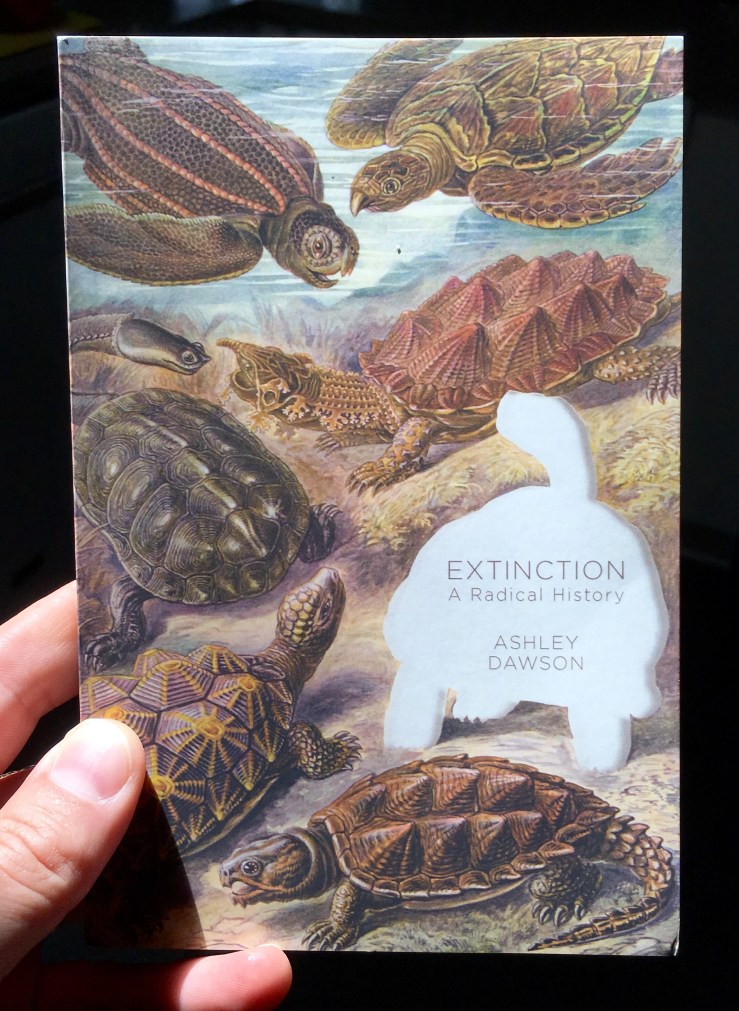
Reading the introduction to Ashley Dawson’s Extinction: A Radical History this afternoon (forthcoming from OR Books), I felt a surreal yet nevertheless familiar twinge of apocalypse anxiety creeping into my right eye, where it tussled around. Is unnerved the metaphor I look for, here? Or is my response more literal? “Extinction is the product of a global attack on the commons, the great trove of air, water, plants and creatures, as well as collectively created cultural forms such as language, that have been regarded traditionally as the inheritance of humanity as a whole,” writes Dawson, and I nod my head. Dawson continues: “capital of course depends on continuous commodification of this environment to sustain its growth.” I nod some more. “Indeed, there is no clearer example of the tendency of capital accumulation to destroy its own conditions of reproduction than the sixth extinction.” More nodding, more anxiety.

Chapter 2 of Extinction, “An Etiology of the Present Catastrophe,” assuages (not its intent, thank gawd) some of my anxiety by beginning with a passage from old ancient historical literature. Dawson gives us a passage from The Epic of Gilgamesh; we get Gilgamesh and his homeboy Enkidu killing the forest guardian spirit Humbaba. I’m more at home in literature, in history, outside of the awful present (I’m thinking that later in the book, in chapters titled “Anti-Extinction” and “Radical Conservation,” that Dawson might like call on me to do something other than to extol the virtues of Thoreau and Emerson to college sophomores. (And nod in agreement with him)).

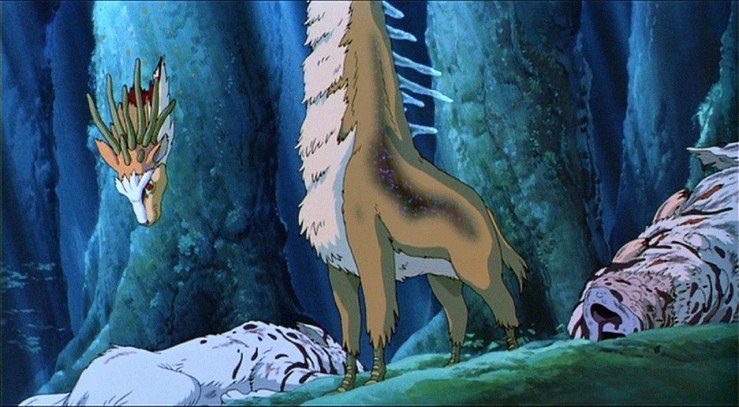
But so and anyway, reading this prefatory paragraph from Gilgamesh, I made the immediate imaginative leap that literature licenses me: the episode that Dawson has invoked, this city-statesman vs. nature narrative featuring Gilgamesh straight up beheading the forest protector—well, that’s the central conflict/plot in Hayao Miyazki’s 1997 film Mononoke-hime (rendered in English as Princess Mononoke, but I think better translated as Spirit-Monster Wolfchild or something like that, although no one asked me).

More on that in a second, but first, Dawson again, from the middle of “An Etiology of the Present Catastrophe,” wherein we move from literature to history to the present:

The violence generated by what geologists call the Holocene epoch was directed not just at other human beings but also at nature. Indeed what is perhaps humanity’s first work of literature, the Epic of Gilgamesh (1800 BCE), hinges on a mythic battle with natural forces. In the epic, the protagonist Gilgamesh, not content with having built the walls of his city-state, seeks immortality by fighting and beheading Humbaba, a giant spirit who protects the sacred cedar groves of Lebanon. Gilgamesh’s victory over Humbaba is a pyrrhic one, for it causes the god of wind and storm to curse Gilgamesh. We know from written records of the period that Gilgamesh’s defeat of the tree god reflects real ecological pressures on the Sumerian empire of the time. As the empire expanded, it exhausted its early sources of timber. Sumerian warriors were consequently forced to travel to the distant mountains to the north in order to harvest cedar and pine trees, which they then ferried down the river to Sumer. These journeys were perilous since tribes who populated the mountains resisted the Sumerians’ deforestation of their land.

Dawson goes on to to detail how the Sumerians’ short-sighted, expansion-oriented agricultural methods led to the downfall of their empire: A scarcity of timber and farming practices that led to a “salt-soaked earth” led to Iraq’s modern deserts.

Before my eye starts twitching again let me return (retreat) to Miyazaki—
111

—well, I watched Princess Mononoke just this Saturday, the Saturday before Easter—for like the first time in a decade. (We watch his films all the time with our kids (PonyoTotoro, and Spirited Away especially), but not Mononoke, which is too abject and violent yet for their tender years. And not Porco Rosso, which isn’t really for kids. Or The Wind Rises).

Anyway: So: Mononoke, I was thinking, rewatching it, was/is this wonderfully, beautiful, aesthetically astonishing take on the beginning of industrialization, and the weaponization of industry, and, like man vs nature, in a primordial sense. It’s also a Japanese Western, a meditation on purity and defilement, and a study of sorts on a feral child. Not having seen it in some time, I was perhaps most struck by how complex, brave, and intriguing I found the industrialist arms-designer/manufacturer Lady Eboshi (voiced by Minnie Driver). She fights against the forest gods, she destroys and pollutes nature, she creates new weapons capable of killing people with a proficiency not yet seen on this earth. And yet at the same time, she finds a home for lepers and prostitutes—and not just a home, but a reason to be, an agency, an existential calling outside of the feudal system that would otherwise reject them. She’s the most human character in the film, perhaps. Miyazaki’s villains are rarely absolute. They are gray, human. And in their complicated, seemingly realistic humanity, I find the consolation of fantasy, yes?

So in viewing Mononoke this Easter eve—well maybe it was the wine I drank transubstantiating (or do I mean consubstantiating?) my blurred vision toward something more (an aesthetic illusion)—

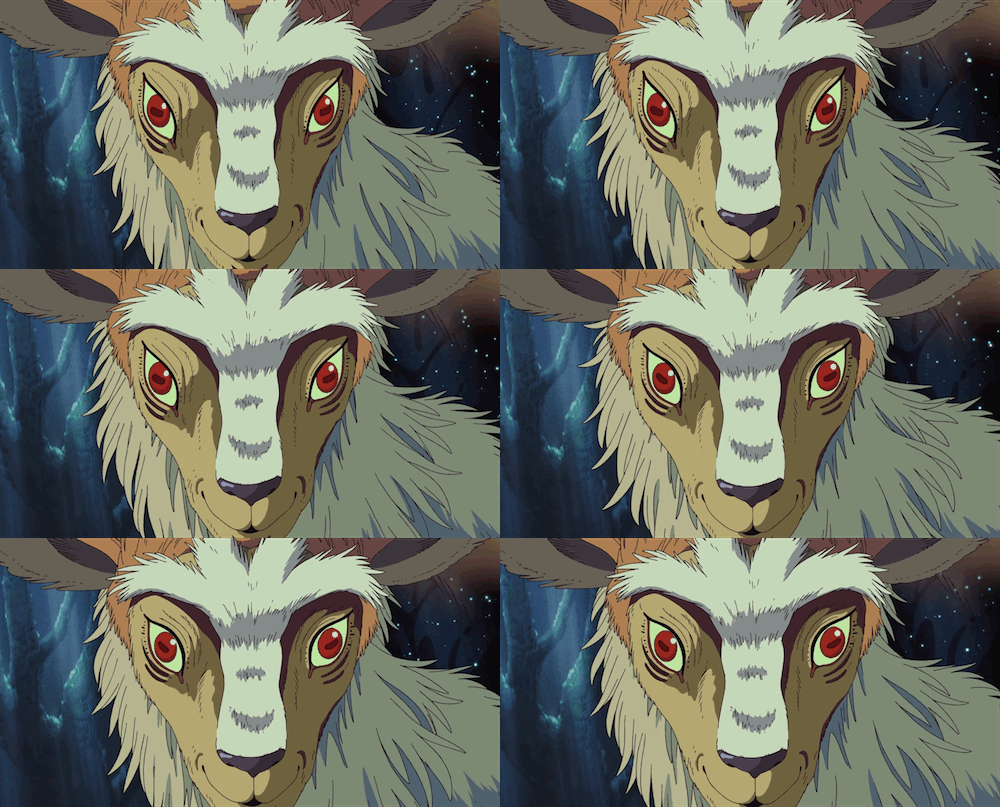
—or and but anyway, so in Mononoke, I found some kind of synthesis, some kind of reconciliation between the wolfchild (Princess Mononoke, human-divine emissary of the old gods, the human not in nature but of and for nature) and the film’s protagonist (the self-exiled marked man Ashitaka—a cursed wanderer like Cain).
tumblr_inline_o1qoyqk5ln1t6t6sv_500

But no redemption. Or maybe only aesthetic redemption—which is ultimately anaesthetic, no? The rebirth in Mononoke—spoilers, maybe sorry—well the rebirth is predicated on the same sacrifices (same same but different) detailed in the Easter story.  Self-sacrifice: Obliteration of self. The tree-god-guardian—as in Gilgamesh—is beheaded. But Miyazaki contrives a heroic restoration of the godhead, one that turns the literal megafauna creature into a metaphor, an idea—a concept of nature to be attended to—stewarded by—humankind. This is wish-fulfillment, of course.

But hey and so: that fantastic wonderful megafauna, eh? They range and lumber and speak and act and assert agency throughout Mononoke. Boars, wolves, elk. A kirin. Hell, apes. In Extinction, Dawson takes us through the mass extinction of the megafauna that once trudged and bounded over the earth, detailing the “Pleistocene wave of megadeath.” (Should I note that saber tooth tigers and giant sloths and wooly mammoths populated my childhood fantasies more than any T-rex or triceratops?). We—that is humans—we are the big animals now, elephants be damned! (Dawson opens his book with the shocking line “His face was hacked off.” This, in reference to the elephant Satao, felled by poachers). Is it my dreams and fantasies that I find consolation in? In aesthetics? In the crusty rime of religion that sticks to my consciousness?

Extinction frightens me—wait, I said that already, forgive me, I’ve been applying anaesthetics, okay—Dawson’s take is realurgentvital. It makes me face that I prefer my ecological criticism couched in the fantasy of the fantasy-past (Mononoke) or the doomed-but-hey-maybe-not-so-doomed-future (I’ll call here on Mononoke’s twin, Miyazaki’s 1984 epic Nausicaä of the Valley of the Windas an example). But prefer is not the right mode/verb here (and neither is the spirit of this riff, a solipsistic navel-gazing blog of myself). This failure is my failure.

Maybe skip ahead, eh?— “The struggle to preserve global biodiversity must be seen as an integral part of a broader fight to challenge an economic and social system based on feckless, suicidal, expansion,” Dawson writes later. And skimming ahead more, I see notes on regenesis, ideas toward rewilding. Dawson’s last paragraphs—damn me, I skipped way ahead, looking for rhetorical solace—point toward “a human capacity to dream and to build a more just, more biologically diverse world.” A rhetorical flourish is easy but Dawson’s claim here is real—a future requires imagination, but an imagination beyond solace, beyond consolation. Miyazaki’s ecoverses perhaps point toward an imaginative collective future—or perhaps don’t. I don’t have a rhetorical flourish to finish off this riff.
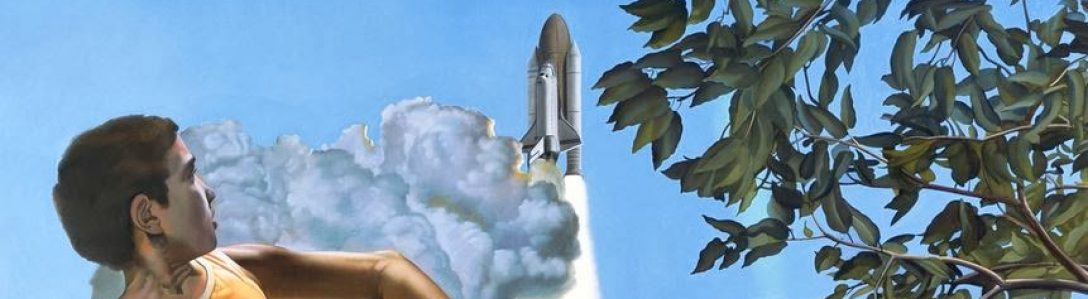
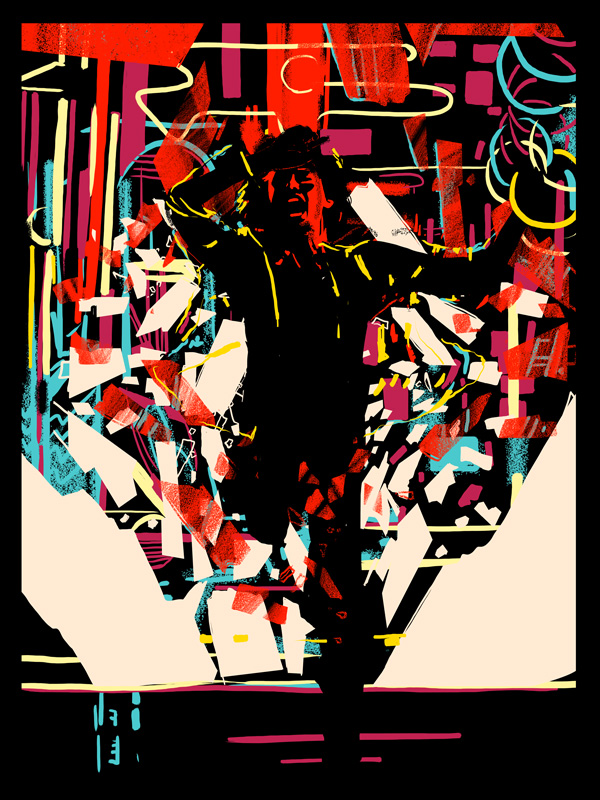
The Death of Zhora — Chris Thornley

tumblr_nfalzjd8l01qer2oto1_1280

Subject 41 — Chris Thornley

tumblr_n7m5d4wvkk1qer2oto1_1280


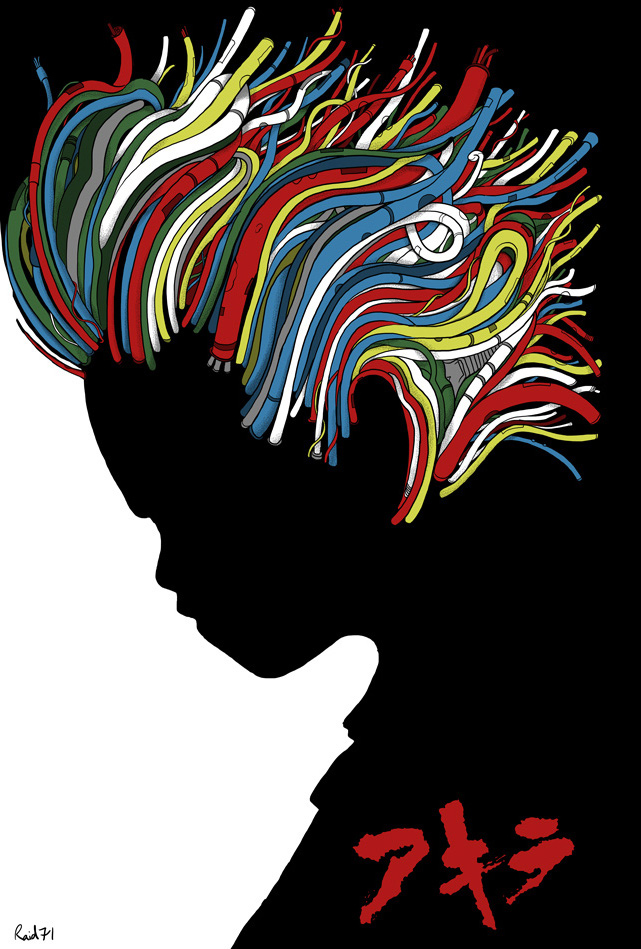
Chris Thornley (aka Raid 71) channeling Milton Glaser’s iconic Dylan poster in this illustration of Tetsuo of Katsuhiro Otomo’s Akira.

A short film adaptation of Zora Neale Hurston’s “The Gilded Six-Bits”

Booker T. Mattison’s 2001 short film adaptation of Zora Neale Hurston’s short story “The Gilded Six-Bits” features Wendell Pierce (of The Wire and Treme), Chad Coleman (The WireThe Walking Dead) and T’Keyah Crystal Keymáh (In Living ColorJackie Brown,

The Coen Brothers’ film Hail, Caesar! adds up to less than the sum of its parts


download (2)
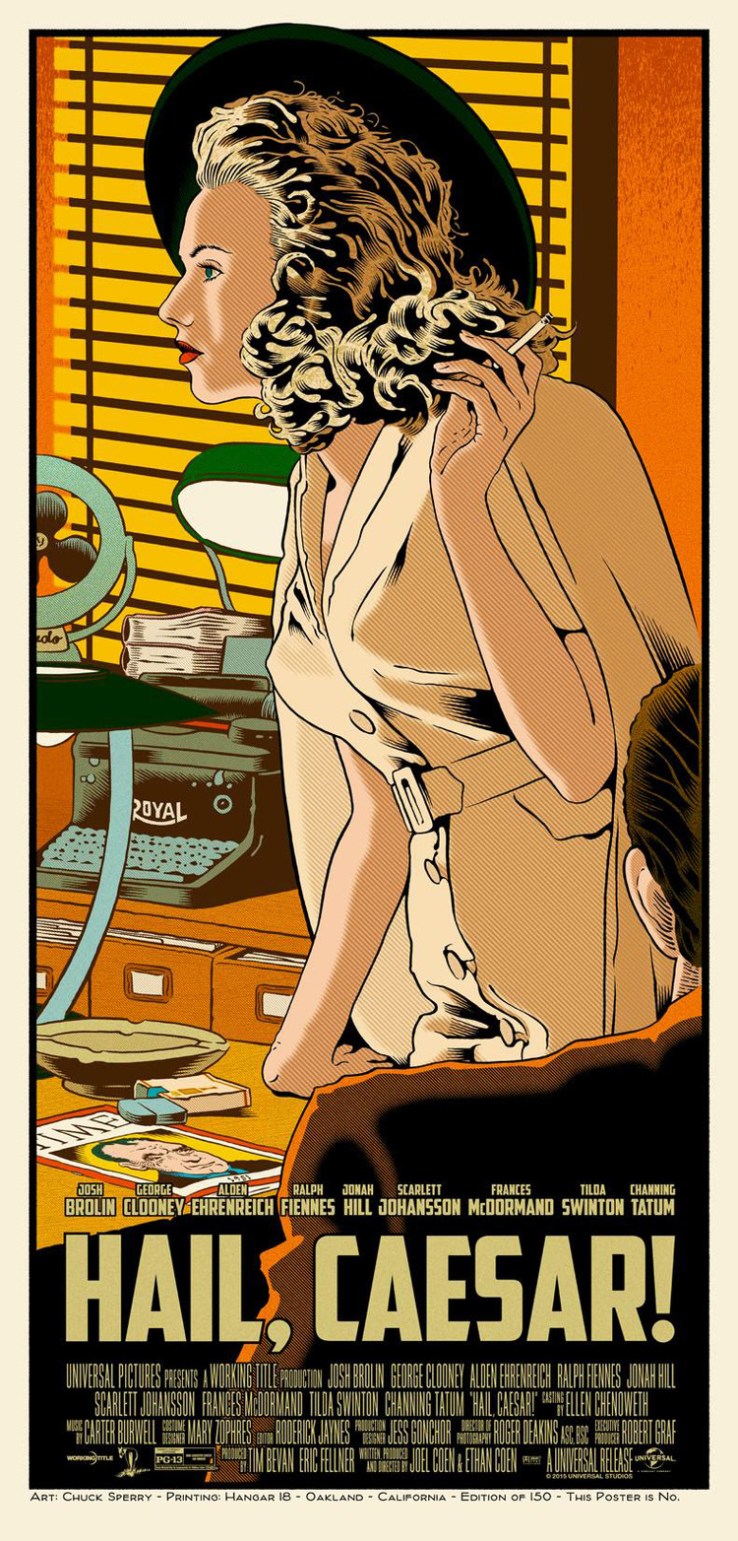
Hail, Caesar! film poster by Chuck Sperry
In her cameo in the Coen brothers’ newest film, Hail, Caesar!,  Frances McDormand gets her scarf stuck in her editing machine. It nearly chokes her (or, I should write, her character, film editor C.C. Calhoun) before Josh Brolin’s studio head/fixer Eddie Mannix hits “Reverse,” saving her life.

Like so many of the scenes in Hail, Caesar!, the editing scene is funny, well-acted, impeccably filmed, and ultimately superfluous. It’s a throwaway, a wonderful scrap, one of many scraps that the Coens seem to toss to their audience, goading, Hey, you put all of this together.

The McDormand scene is ultimately just another way for the Coens to highlight the artificiality of their medium. Hail, Caesar! is of course a film about film, a film that aims to satirize how the metaphorical sausage is made. As such, Hail, Caesar! is self-satirizing, meta-metaphorical. It’s the Coens pointing out the flawed seams or imperfect varnish before the product is even finished. McDormand’s editor getting caught in the machine is some kind of clumsy synecdoche then.

These metatextual gestures only helped to heighten my own awareness of Hail, Caesar’s! flawed seams. This is a film brimming with wonderful, energetic set pieces—synchronized swimming with Scarlett Johannsson! — Channing Tatum tap-dancing on a bar! — Alden Ehrenreich (not so famous, yet) stunting on horses!—that add up to almost nothing. The end result would almost be fascinating were it not so dull.

Alden Ehrenreich’s singing cowboy Hobie Doyle is not dull, and every time he’s on the screen Hail, Caesarthreatens to become interesting. “Called up” to be in more, eh, prestigious fare than the cowboy pictures he’s been doing so well in, young Hobie’s plot has the slightest (just the slightest) tinge of Mulholland Drive — “This is the girl.” (Or, eh, “This is the boy. The cowboy”).

Hail, Caesar! can’t commit fully to Hobie for its hero, alas. Instead the film, after an initial bout of goodwill-building (including an especially funny early scene in which religious leaders are invited to critique Hail, Caesar!, the film-within-a-film here)—instead the film (the Coens’ Hail, Casear!, that is) plods along a few not-quite-intersecting tracks, introducing the occasional grotesque for a cameo that serves no real plot point.

Look, I get it. Having a character’s fate expositioned away via clumsy dialogue at the end of the film is like, meta, right? It’s the Coens way of grinning at the corny clumsy past of their chosen medium, hey? It’s like, purposefully, self-reflexively bad, a piss-take on an audience’s willed suspension of disbelief, hm?

Suspension of disbelief—faith. Does Hail, Caser! aim to take on faith? It certainly dabbles, exploring (“exploring” is not the right verb—but I already used “dabbles”) political faith, economic faith, religious faith. Faith in the aesthetic power of film, which again and again Hail, Caesar! attempts to embody via kinetic spectacle before puncturing said aesthetic transcendence with ironc winking (or technical failure).

The signal moment in the film’s ironic treatment of faith is delivered in its penultimate scene. George Clooney’s character Baird Whitlock’s character (a Roman soldier whose name I can’t recall, but, hey, note the layering, man) deilvers a monologue. The speech is meant to be this kinda sorta Road-to-Damascus epiphanic transcendence deaile, and the aesthetic power of Clooney’s Whitlock’s delivery is confirmed internally on set by the various film people  (grips and script folk, etc.) offering up admiring Brady nods—only Whitlock stumbles over the last word of the speech—which last word, of course, was faith.  Charlie Kaufman did the same thing much better in the funeral monologue near the end of his film Synecdoche, New York. In Hail, Caesar!, the moment feels like a glib trick played on the audience

It’s entirely likely that there’s a much finer design to Hail, Caesar! than I’ve credited the Coens here. Maybe on a second viewing, I won’t be bogged down so hard looking for a thread to follow. (Shagginess is hardly a sin though, yes Lebowski?). And I’ve failed to point out some of the fine performances here—Josh Brolin anchors the film admirably (although half the time he was on the screen, I kept hoping the film would turn into Inherent Vice). Hail, Caesar! has plenty of great moments, and those moments, like I said, might cohere into something sharper upon a second screening. But right now there’s nothing that compels me toward a second screening any time soon.

Another trailer for that High-Rise film

Not sure about this one…but I love the Ballard novel, so…

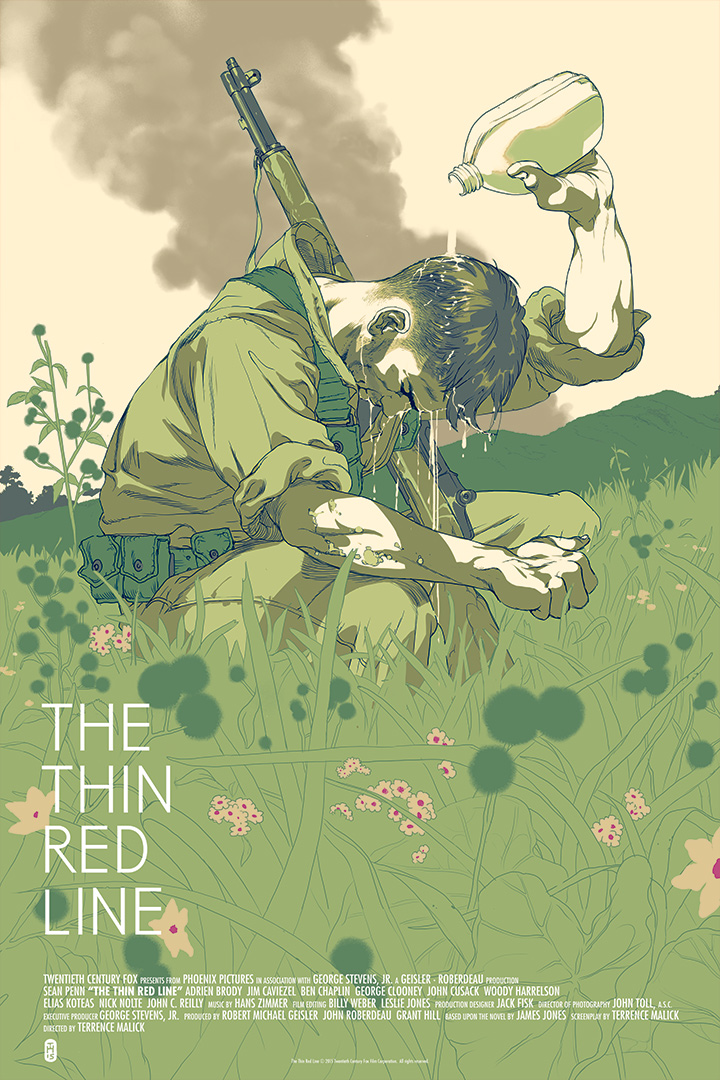
Film poster for Malick’s The Thin Red Line — Tomer Hanuka

trl

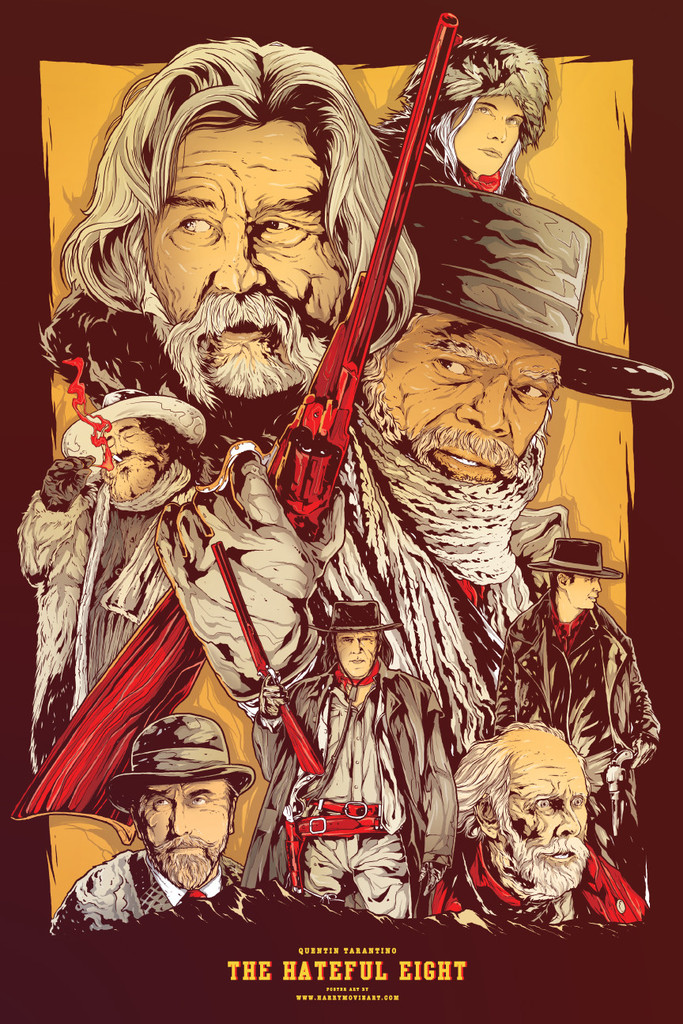
Does anything good happen in The Hateful Eight?

Hateful-eight-12x18_1024x1024

I don’t like films where nothing good happens, my wife told me years ago. I can’t remember the film that occasioned this remark, and I don’t find myself beholden to her rubric, but I still find myself applying it to films now and then. Especially after watching Quentin Tarantino’s The Hateful Eight.

Does anything good happen in The Hateful Eight?

(This is not the right question to ask about a film, but—).

This question isn’t the same as, say, Is any part of The Hateful Eight good?—because so many of the elements are good—excellent even—Ennio Morricone’s score, Robert Richardson’s cinematography, Yohei Taneda’s set design.

And the acting is great, or sorta great, or it’s hard to tell, maybe. Let’s say the performances are great. I mean, it’s Tarantino, so the acting is always at least one level removed from reality—even in Sam Jackson, the realest dude, the dude who carries the film as former Union officer, Major Marquis Warren. Sam Jackson is Tarantino’s main man, his star of hyperreality, and his performance is electric here.

But for hyperreality, it’s Jennifer Jason Leigh who stands out in The Hateful Eight. Her portrayal of prisoner Daisy Domergue is refined Looney Tunes slapstick. Cartoon soul. Watching Walton Goggins (vile racist ex-Confederate marauder Chris Mannix) or Kurt Russell (bounty hunter John Ruth)—both of whom get lots and lots of lines and screen time—one can’t help but realize one is seeing an actor acting—or, more Tarantinoesque—a character acting.

But Jennifer Jason Leigh, remanded to a punching bag for much of the film—or even stranger, a chained work-wife to Kurt Russell’s John Wayne parody (via Kurt Russell’s John Wayne parody as Jack Burton in Big Trouble in Little Trouble)—JJL imbues her Daisy Domergue with a wily pathos that surpasses both the script she’s made to read and her Seussian name.

Not that JJL’s Daisy Domergue’s isn’t vile, nasty, deeply racist, and hateful…but her hatefulness points towards something, I dunno, complex. Real. True. (I should mention now Laura Bogart’s essay “Hipster Misogyny: The Betrayal of The Hateful Eight,” which I think offers an intriguing read on the film. Bogart seems to argue that JJL’s DD is not complex enough, or not given enough complexity, which, hey, okay, fair enough—but I think also that Bogart was disturbed by the film’s conclusion—which I was too, disturbed). 

But: Does anything good happen in The Hateful Eight?

What do I mean here by good? Should I just admit I don’t know “good,” but rather feel “good”? Okay. I don’t know good through definition, but rather by example. Fuzzy precis. Good: Perhaps a moment of redemption, but like, say, an earned one, a real one, one not forced through a Hollywood formula. Good might be kernel of hope—a real moment of hope, not just an up established for a foreshadowed down. Or maybe by good I just mean something aesthetically true.

Tarantino’s best films—the Kill Bill films, Pulp FictionJackie Brown, and Reservoir Dogs—point to something good in their conclusions—and by conclusions I mean both literal endings and thesis statements. I’m not sure if I find this same “goodness” evident in the conclusion of The Hateful Eight, or, if it is there, it’s awfully ambiguous.

The conclusion of The Hateful Eight is the not-exact opposite of the end of my favorite Tarantino conclusion, the end of Kill Bill 2:

img_0370

And The Hateful Eight’s conclusion is the not-exact opposite of the ending of Jackie Brown’s bittersweet take on redemption, loss, and escape—American lives that earn second acts.

And The Hateful Eight’s conclusion is the not-exact opposite of the ending Pulp Fiction, a film that resurrects Vincent Vega and sees Sam Jackson’s Jules Winnfield suspend wrathful violence and judgment on Tim Roth’s Ringo (or Pumpkin. Or whatever his name was).

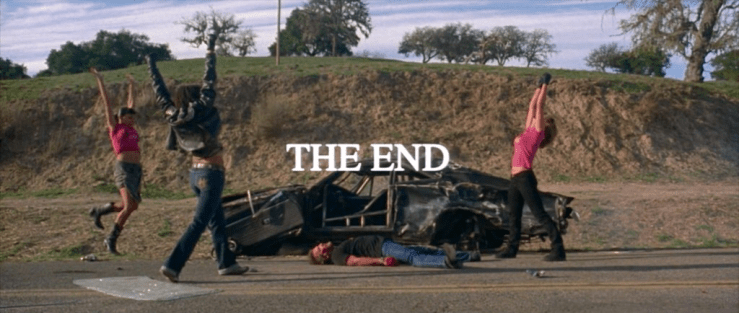
And what about those films that didn’t make my silly little list of “Best Tarantino” — Inglorious Basterds (which is one of my faves, actually, just to watch for like, pure entertainment), Django Unchained, and Death Proof (which actually belongs on that best-of list, maybe, or at least the final sequence)? Shoshanna Dreyfus using film as weapon to end the Nazis? Django’s righteous rampage against slavery? Or the ecstatic violence of “the girls” destroying serial killer Stuntman Mike?

img_0372

What most of QT’s conclusions share in common is that they somehow mediate the relationship between revenge and justice, and do so in a way that’s aesthetically convincing. The Hateful Eight also seeks to be a film about the relationship between revenge and justice. Its final moments attempt to aesthetically recapitulate much of American history into a morbid sequence of violence.

[Fair warning: There’s a discussion of the conclusion of The Hateful Eight coming up, including what some folks might call spoilers].

Continue reading “Does anything good happen in The Hateful Eight?”

The Coen Brothers talk with Guillermo del Toro about Inside Llewyn Davis

A beautiful/bloody scene from Lady Snowblood: Love Song of Vengeance

The obligatory 2015 year-end list

img_1228

Favorite Reading Experiences

I finally read Thomas Pynchon’s novel Gravity’s Rainbow in full in 2015. Then I immediately read it again (which is sort of like really reading it), occasionally dipping into Steven Weisenburger’s A Gravity’s Rainbow Companion. Rewarding, hilarious, challenging, perplexing, Gravity’s Rainbow is too brilliant to look at directly, and is perhaps best approached slantwise, as one Ms. Dickinson of Amherst has advised.

On page 588 of Gravity’s Rainbow, the narrator (?!) suggests that we “Check out Ishmael Reed.” So I did. His novel Mumbo Jumbo is like nothing I’ve ever read before—the reviewer’s crutch “dazzling performance” comes to mind, because Mumbo Jumbo is a performance (jazz, bebop, soft shoe, vaudeville, a hoodoo magic show, an exorcism: performance art), and it does dazzle, overwhelm, energize, haunt, titillate, reverberate, howl…and there are pictures! Reed uses photos in a way that Sebald would a few decades later—documentary evidence of a sort. I don’t know. I just don’t know.

Like Reed’s novel, Anne Carson’s novel-poem-myth-book Autobiography of Red is impossible to categorize and extremely difficult to describe. I tried to write about it a few times on this site and failed, which is fine. What matters here is the reading experience: Carson’s book zapped me, gave me tingles, reminded me that what I want to think and feel when I read is, How is this possible? How is this allowed? (Another huge thank you to BLCKDGRD for sending me Autobiography of Red and its sorta-sequel Red Doc>).

Also: Nabokov’s Pale FireTwo Serious Ladies by Jane BowlesHomesick by Lucia Berlin and Evan Dara’s novel Fleewhich I loved reading with Biblioklept contributor Ryan Chang .

And finally, Ursula K. Le Guin, whose so-called Hainish Cycle I read most of this year. I still have to read The Telling, but great stuff, and a full write-up early in the new year.

Favorite Books I Read in 2015 That Were Actually Published in 2015

Signs Preceding the End of the World, Yuri Herrera

Cess, Gordon Lish

The Bus 2, Paul Kirchner

Mislaid, Nell Zink (although I liked The Wallcreeper better, but hey, it was published last year)

Favorite Indie Presses of 2015

You can’t beat Nobrow, Dorothy, OR, and/or And Other Stories.

Favorite Films I Saw in 2015 That Came Out in 2015

IMG_0340

I had a relatively contrarian opinion of Fury Road, but I enjoyed it overall, I suppose. The Force Awakens was a better spectacle for my money/nostalgia. Overall, 2015 was kind of a weak year for movies, filled with overrated indies, comic book schlock, and self-serious entertainments that Tried Too Hard. Hard to Be a God was the only thing that really zapped me, although a quick google shows that it was actually released in 2014.

You know, Inherent Vice was released in late 2014 too, but I saw it and loved it and obsessed over it in 2015…so, Inherent Vice, yeah…

I also liked that Scientology documentary, which was full-on Pynchon.

Favorite Television Shows of 2015

I thought the second season of Fargo was near-perfect and found the tawdry spectacle of The Jinx thrilling, but there was no show I enjoyed watching and reading about more than the second season of True Detective

Favorite Albums of 2015

The albums I listened to the most this year were soundtracks that came out before 2015: Inherent Vice and The Good, The Bad, and The Ugly. But I did like a number of new albums this year, including Joanna Newsom’s Divers, Jim O’Rourke’s Simple Songs, and Destroyer’s Poison Season.

Favorite Books I Didn’t Finish in 2015

I’ve been crawling my way through a full read of Leslie Fiedler’s Love and Death in the American Novel, but: No end in sight. I also read most of the essays in William T. Vollmann: A Critical Companion (check out my interview with the editors). I also read a hefty chunk of the Ben Marcus-edited collection New American Stories. My favorite discursive reading though was dipping into William H. Gass’s nonfiction.

Favorite Rereads

…speaking of Gass—well, I read his essay “Even If, by All the Oxen in the World” in conjunction with a reread of David Foster Wallace’s Infinite Jest, which turned out to be most rewarding—both the rereading and the reading-in-conjunction. Reading Infinite Jest for the first time since 2001 ended up being a deflating, even depressing experience, but I wouldn’t trade it. I also reread against the second reading of Gravity’s Rainbow. Other rereading highlights included Pynchon, Ursula K. Le Guin, High Rise by J.G. Ballard, and Blood Meridian by Cormac McCarthy (which I’ve reread every year since I first read it). But it was McCarthy’s Suttree that I got the most out of rereading this year.

2016

I’ll finish out Le Guin’s Hainish books with The Telling, and then probably crack into William H. Gass’s Eyes. In between I might read Marianne Fritz’s novel The Weight of Things. More Lucia Berlin for sure. Thomas Bernhard if it ever cools down again. (End of December 2015 and it feels like early summer here in Florida). I’d also love to take a shot at William T. Vollmann’s The Dying Grass, but who knows…there are always more pages than hours.

Haskell Wexler talks about shooting Medium Cool

RIP Haskell Wexler, 1922-2015

Thirty-point riff on Star Wars: The Force Awakens

Rey-Star-Wars-Episode-7-Force-Awakens

  1. Star Wars: The Force Awakens is a fun entertainment that achieves its goals, one of which is not to transcend the confines of its brand-mythos.
  2. SW: TFA takes Star Wars itself (as brand-mythos) as its central subject. The film is “about” Star Wars.
  3. To this end, SW: TFA is basically a remake of A New Hope. My saying this is not insightful and cannot be insightful.
  4. In the first Star Wars film, A New Hope (aka Episode IV, aka simply Star Wars), George Lucas synthesized Flash Gordon and Kurosawa, Joseph Campbell and WWII serials into a cultural product that was simultaneously new and old, hokey and profound, campy and heroic.
  5. SW: TFA is not a synthesis (and does not seek to be a synthesis); rather it is a transcription, repetition, and  replication of the previous Star Wars films—particularly the so-called “original trilogy” (Episodes IV, V, and VI).
  6. Hence, SW: TFA often feels like a greatest hits collection, its sequences and visuals (engaging and visually spectacular) cribbed from the previous films. I could spend the rest of the riff outlining the correspondences—major and minor—but why? The correspondences are intentionally obvious to anyone who has seen the film; furthermore, they are not allusions, but the formal structure of the film.
  7. And this formal technique, this replication—it’s all very enjoyable and often warm and unexpectedly humorous and at times awfully sad even.
  8. And I liked the new characters very much, which I was of course supposed to. They are all in some ways replications of previously existing characters, just as the set pieces and sequences they act in/out/upon are replications.
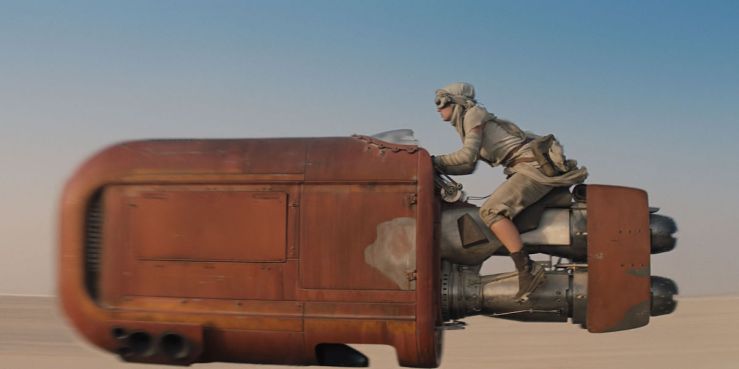
  9. Let’s consider Rey, the heroine of The Force Awakens really quickly: She is, in some ways, a synthesis, but only a synthesis of the principals of the Star Wars brand-mythos: She is at once Han, Luke, and Leia: A figuration in the foreground: A childhood fantasy.
  10. A childhood fantasy: Watching SW: TFA feels like watching a Star Wars film—which is the film’s intention, obviously.
  11. But not obviously and really quickly and not a gripe: Isn’t there a part of us, by which us I mean me, that wants something more than the feeling of (the feeling of) a Star Wars film? That wants something transcendent—something beyond that which we have felt and can name? Something that we don’t know that we want because we haven’t felt it before?
  12. Re: Point 11: I already made an (awfully) oblique argument at some length almost three years ago about franchise films in general and Star Wars films in particular, arguing (maybe arguing) for, say, Wong Kar Wai to direct the next Star Wars film.
  13. In that riff I wrote that, “J.J. Abrams is a safe bet. I can more or less already imagine the movie he’ll make.” That prediction was incorrect only in that I enjoyed the product that he made more than I thought I would. That prediction was wholly correct in that I could imagine the product Abrams made. It was easy to imagine. I’d already seen the film dozens of times before he even made it.
  14. So, to return to point 11, the “not a gripe” point: Is the argument then that film as an art form allows us (the illusion of) a transcendent perspective? That film at its best, at its strongest and strangest, offers us a new way of seeing?
  15. (Yes).
  16. The Force Awakens is strong but not strange. Its major advancement (by which I mean break from previous films) evinces in its casting choices—but these reflect the progress of our own era, not the brand-mythos of Star Wars itself, which was of course always diverse.
  17. The Force Awakens is fun. Entertaining. Like I wrote in point 1.
  18. And, to repeat point 2 after repeating point 1: SW: TFA is “about” Star Wars.
  19. So what do I mean by this? Consider for a minute what the other Star Wars films are “about.”
  20. A New Hope is about escape and rescue, both in the literal, romantic, and metatextual sense.
  21. The Empire Strikes Back is about Oedipal anxieties and Oedipal violence, family entanglements, friendships and loyalties.
  22. Return of the Jedi is about restoration and redemption, a film about the genius of ecology over mechanization.
  23. And while the (so-called) prequels are generally reviled, I like them: They are “about” something.
  24. For example, Revenge of the Sith is about democracy and fascism, community and ego—and more of that Oedipal violence.
  25. Indeed the entire series is Oedipally structured—which The Force Awakens replicates and continues.
  26. Yet Abrams’s reverence for Star Wars bears no clear trace (at least on my first viewing) of Oedipal anxiety towards Lucas. No attempt to transcend or surpass—as such a move would entail a kind of critical (if metaphorical) violence directed at Lucas’s vision. (Notably, many of the criticisms of the so-called prequels rest on the way those films look beyond their predecessors (in a way that Abrams’s film doesn’t)).
  27. “In order to criticize a movie, you have to make another movie,” said Jean-Luc Goddard.
  28. And Harold Bloom: “Every poem is a misinterpretation of a parent poem. A poem is not an overcoming of anxiety, but is that anxiety…There are no interpretations but only misinterpretations, and so all criticism is prose poetry.”
  29. Abrams’s goal was not to criticize Star Wars or poetically engage it; his goal was to praise it—to praise it as stasis, to replicate its comforts, to avow and vindicate its forms and tropes. And he succeeded.
  30. And of course the biggest success of the film: I want to watch it again.

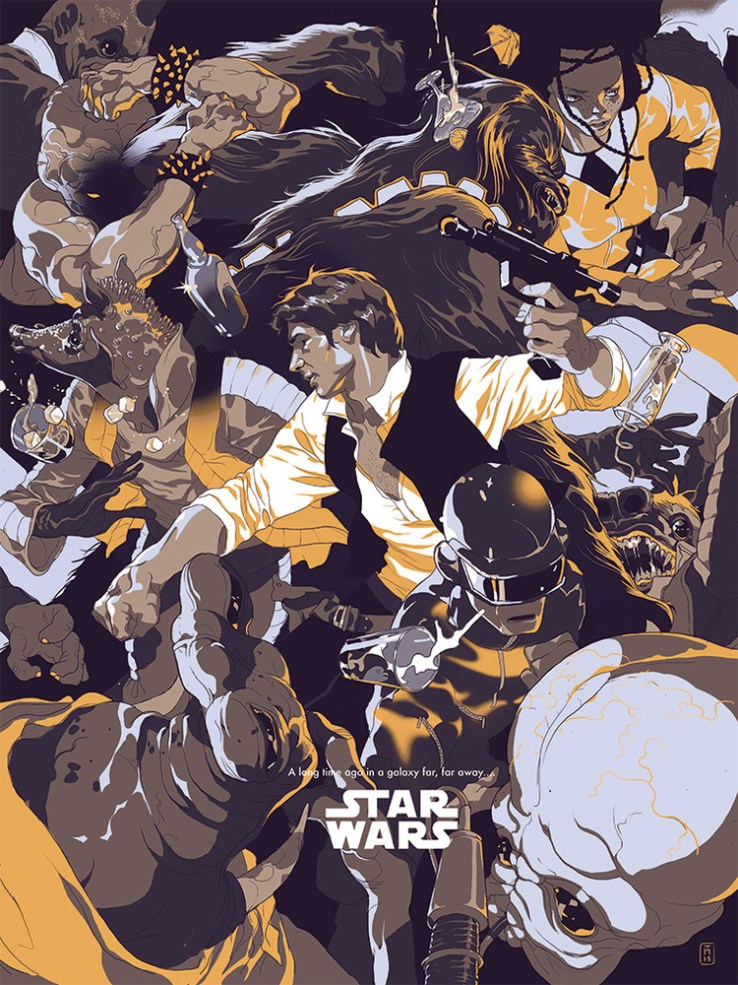
Goldie Han, a Star Wars illustration by Tomer Hanuka

Goldie_Han_72

William S. Burroughs and his friends

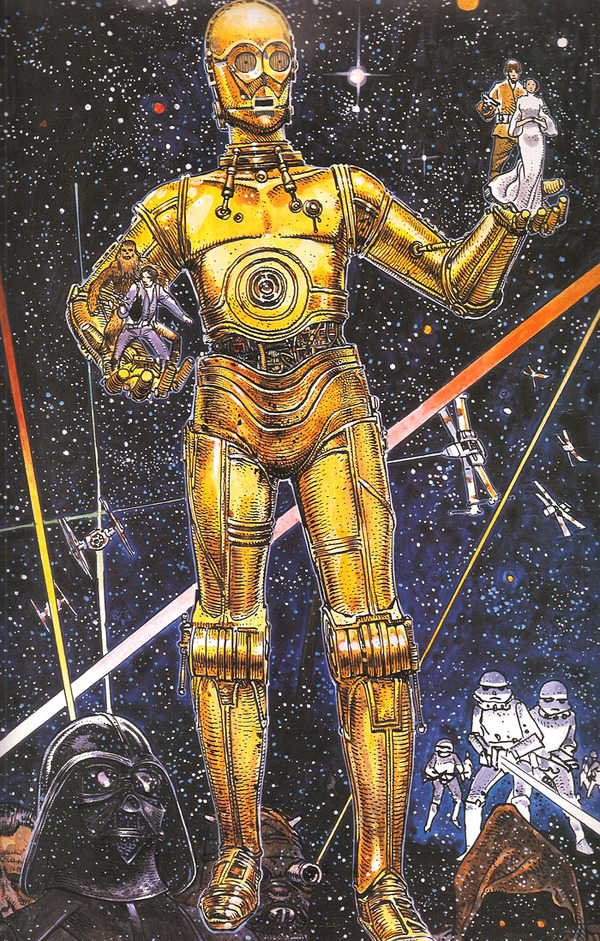
A Star Wars illustration by Moebius

(Via).