“There’s a purity of intent and a lack of self-consciousness that I wish I could achieve when I was experiencing pleasure” (David Foster Wallace)

Let’s put it this way. Say you’ve got really serious art, and it takes really hard work, whether it’s painting or music or literature. That stuff’s not fun in the way commercial entertainment is fun. I mean fun — like eating a Twinkie. It’s like slipping into a warm bath after a hard day. It’s an escape. It’s a relaxation. And that’s fine, and that’s entirely appropriate. The danger comes when the escape becomes the overriding purpose. And one of the ways it seems that television has affected me is that my expectation for the amount of fun and pleasure to work — that ratio is very different than they are for my parents. I think my pain threshold is lower. My expectations are higher. My level of resentment at having to do anything I don’t particularly want to do that isn’t pleasurable is higher. I think a certain amount of that comes from the fact that for six hours a day I receive certain messages — you know, ‘relax, we’re going to give to you, you don’t have to give anything back, all you need to do is every so often go and buy this product.’ But animals have fun. My dogs play. And watching them play — there’s a purity of intent and a lack of self-consciousness that I wish I could achieve when I was experiencing pleasure. But Plato and John Stuart Mill both take books to talk about different types of pleasure. In my own personal life, I like really arty stuff a lot of the time. But there’s also times I watch an enormous amount of TV, and I’ve read probably 70 percent of Stephen King’s books. And I’ve read them basically because for a little while I want to forget that my name is David Wallace, you know, and that I have limitations, and that I’m sad that my girlfriend yelled at me. I think serious art is supposed to make us confront things that are difficult in ourselves and in the world. And one of the dangers is if we get conditioned to confront less and less and experience more and more pleasure, the commercial stuff’s gonna win out.

From a 1997 interview with David Foster Wallace by David Wiley, originally published in The Minnesota Daily, and archived here.

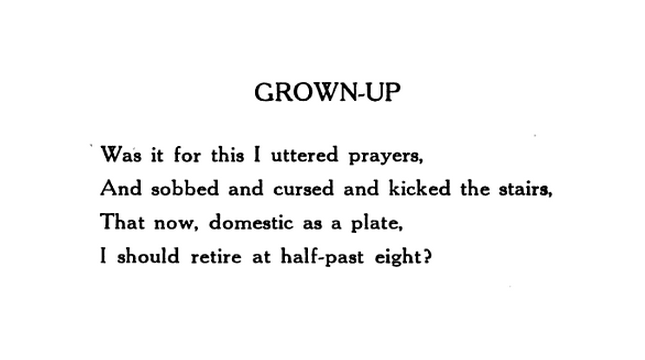
“Grown-Up” — Edna St. Vincent Millay

grown up

William S. Burroughs looking serious, sad lover’s eyes, afternoon light in window (Photo by Ginsberg)

“Authors” — Voltaire

“Authors” — Voltaire

(From Philosophical Dictionary)

Author is a generic name which can, like the name of all other professions, signify good or bad, worthy of respect or ridicule, useful and agreeable, or trash for the wastepaper-basket.


We think that the author of a good work should refrain from three things—from putting his name, save very modestly, from the epistle dedicatory, and from the preface. Others should refrain from a fourth—that is, from writing.


Prefaces are another stumbling-block. “The ‘I,'” said Pascal, “is hateful.” Speak as little of yourself as possible; for you must know that the reader’s self-esteem is as great as yours. He will never forgive you for wanting to condemn him to have a good opinion of you. It is for your book to speak for you, if it comes to be read by the crowd.


If you want to be an author, if you want to write a book; reflect that it must be useful and new, or at least infinitely agreeable.


If an ignoramus, a pamphleteer, presumes to criticize without discrimination, you can confound him; but make rare mention of him, for fear of sullying your writings.


If you are attacked as regards your style, never reply; it is for your work alone to make answer.


Someone says you are ill, be content that you are well, without wanting to prove to the public that you are in perfect health. And above all remember that the public cares precious little whether you are well or ill.


A hundred authors make compilations in order to have bread, and twenty pamphleteers make excerpts from these compilations, or apology for them, or criticism and satire of them, also with the idea of having bread, because they have no other trade. All these persons go on Friday to the police lieutenant of Paris to ask permission to sell their rubbish. They have audience immediately after the strumpets who do not look at them because they know that these are underhand dealings.


Real authors are those who have succeeded in one of the real arts, in epic poetry, in tragedy or comedy, in history or philosophy, who have taught men or charmed them. The others of whom we have spoken are, among men of letters, what wasps are among birds.

An Interview with Jason Schwartz

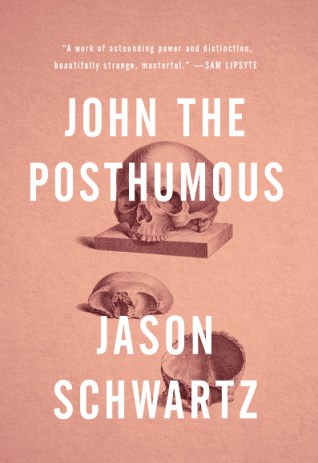
Jason Schwartz’s novel John the Posthumous was published last year to wide acclaim, despite—or maybe because of—its challenging, disruptive qualities. With blurbs from Gordon Lish, Ben Marcus, and Sam Lipsyte, John the Posthumous had “cult novel” written all over it from the outset. It was a 2013 highlight for many critics, including K. Thomas Khan, who called it “a dizzyingly delightful and hypnotically haunting book that resists easy classification,” and David C. Winters, who described it as a “Fractal baroque: an unfurling art that enfolds us in incomprehension, in fear, but also in irreducible beauty.” In my review, I  wrote that John the Posthumous is “strong, strange literature, a terrifying prose-poem that seizes history and folklore, science and myth . . . and distills it to a sustained, engrossing nightmare.”

Schwartz is the author of another book, A German Picturesque (1998). He lives and works in Florida. Schwartz kindly consented to an interview with me via email; his answers here approach the same oblique verbal dexterity that we see in his fiction. Get John the Posthumous from OR Books or your local bookstore.

SchwartzBiblioklept: Your book John the Posthumous is a challenge to describe, let alone summarize. How do you describe the book to those who haven’t read it?

Jason Schwartz: I lie–it seems the only decent way to proceed.  Why dwell upon unpleasant things?

Biblioklept: In a recent interview with 3:AM Magazine, you said that one of the first things you tried to write—in high school—was “a very long espionage novel.” You mentioned charts and appendices—lots of plots. In the same interview, you also say that you “favor format as someone else might favor plot,” which I think evinces in John the Posthumous and A German Picturesque. I’m curious what experiences—particularly what reading experiences—may have motivated a shift from an initial interest in writing plot-driven genre fiction to the stuff you write now.

JS: I’m sure I was abandoning other things too.  I seem to recall something about a war.  A catalog of imaginary battles, land and air–that would have been a handy enough project for a kid.  Remember Little Wars?  I don’t, but I like the idea of H.G. Wells and company concealed behind end tables, orchestrating cavalry raids.  Unless the tactician was free to explore the drawing room, inspecting positions and so on, enumerating the wounded, admiring an especially fine artillery barrage.  That seems more likely.  But the would-be novel, espionage–I started that on a lark.  I’d found an old Olivetti somewhere in the house–in the attic, I’d like to say, but we didn’t have an attic–and one thing led to another, et cetera, et cetera.  A turn may or may not have occurred at that same moment, give or take, with all those devices, the appendices, the charts and annotated maps, captions for photographs that didn’t exist.  Hard to say, exactly, going back now to the tenth grade.  But they began to overtake the plot, such as it was.  I liked some of the Bond books, and Graham Greene–still do–but I also liked The Encyclopedia of Espionage and that kind of thing, compendiums of jargon, biographies of Bulgarian spies.  So maybe it was more the subject than the genre.

Biblioklept: Do you think about a particular audience when you compose?

JS: A young family, stranded on a mountain pass, killing time until help arrives.  They take turns reading aloud–the text in question having been purchased by mistake and packed by accident, and later discovered in the luggage as potential kindling.  The father shields the first child from those passages displaying traces of grotesquerie.  The mother corrects the second child’s pronunciation or praises his elocution–as the case may be–on the occasion of the most ostentatious phrases.  The third child, meanwhile, has wandered off into the woods.  Ah!–it’s beginning to rain.

Biblioklept: Did John the Posthumous start as something smaller, like the pieces that make up A German Picturesque? Did you have the theme of adultery in mind from the outset?

jtpJS: Yes, it was there from the outset, adultery, running through a number of things–directly and otherwise–and many of these appeared in magazines as individual pieces, beginning in 2003 or so.  The “Corinthians” section, for instance, was once called “Breviary.”  The final section in “Hornbook” was “Notation on Hidden Children.”  Another one in that little series–a section in “Adulterium”–was “Notation on the Principal Graves.”  There were changes in every case–all this happened over a very long period of time, obviously.  “Housepost,” on the other hand, was done more or less at once, mostly in sequence.  I published certain parts of this–“The Mary Casket” is an example–in various combinations, dismantling the house a few different ways.

Biblioklept: Your sentences are precise and concrete, but they also often refuse to give the reader something definite to grip on to. There’s a lot of power—and, I’d argue horror—in this restraint. How much of this technique is attributable to editing? How do you edit your work?

JS: As to the second question: it varies.  No set method.  And as to the first:  I’m not really editing in that direction, no.  I see this more as a simple matter of description.  So–for instance–the schoolmarm in the museum, a wax form, with pins for eyes.  A person of reputation in her hometown, I take it, and–it turns out–a distant relation of mine.  I don’t wish to be flippant–or to sunder a cousin without good reason, here on the spur of the moment–but she seems easy enough to grasp in one’s hands, or at least as easy as any other set of letters.  And she was, she certainly was, when they cut her in two, at the waist, and then into several smaller portions–her coat and purse set off to one side, forgotten there (the former eaten by moths, I’d guess, the remnants used to stuff the dummies on the second floor; the latter left on a shelf and, later on, mistaken for something foreign and important, given its own display)–in order to get her out the door.  She’d have used, by the way, back at the schoolhouse, a razor blade and a ruler, according to a practice now out of fashion.  “Children, let’s remove all your objectionable words and phrases, replacing them with more companionable ones.”  And in the evening, the janitor and janitress would sweep up the scraps, and then use them to write ransom notes.

Biblioklept: Have you ever stolen a book?

JS: Sure.  Including one from my grandparents’ bookcase, I’m ashamed to say.  The book was The Deer Park.  I was three, I believe, or four, or five.  I was not, at the time, a fan of Norman Mailer.  I must have mistaken it for something else–or maybe I had plans for it in the construction of a fort or what have you, some structure already underway, or only in the earliest planning stages, back home, down in the basement, off in a corner reserved for projects of just that sort.  I suppose it could have been the jacket art, an attraction to that, but I can’t recall what was depicted on the cover, or even the colors on display.  It’s unfair to speculate in this way, I know, but–to be on the safe side, and to put the matter out of mind, once and for all–let’s just assume it was a stick-figure deer, in black, on a field of red.  Very much, in other words, the kind of stick figure–and field–I’d have quite disliked as a child.  Anyway, my grandmother gave chase.  She shouted in a language manufactured on the spot, and composed wholly of bedbugs and regret, dozens of variations on these words, accompanied by near-simultaneous translations, bent by the effect of her breathlessness, and taking curious shapes, in formation, at my back and overhead–or so it all seemed to me.  And then?  I was caught, of course.

James Joyce’s Death Mask

The Complete Short Stories of J.G. Ballard (Eighth Riff: Closing Out the Sixties)

jgb_complete_ss40031

PREVIOUSLY:

Introductions + stories 1956-1959

Stories of 1960

Stories of 1961

Stories of 1962

“The Subliminal Man,” Black Friday, and Consumerism

Stories of 1963-1964

Stories of 1966

IN THIS RIFF:

“Cry Hope, Cry Fury!” (1967)

“The Recognition” (1967)

“The Cloud–Sculptors of Coral D” (1967)

“Why I Want to Fuck Ronald Reagan” (1968)

“The Dead Astronaut” (1968)

“The Comsat Angels” (1968)

“The Killing Ground” (1969)

“A Place and a Time to Die” (1969)

“Say Goodbye to the Wind” (1970)

1. “Cry Hope, Cry Fury!” (1967) / “The Cloud-Sculptors of Coral D” (1967) / “Say Goodbye to the Wind” (1970)

Ballard’s Vermilion Sands stories, collected and published together (under the title Vermilion Sands in 1971), are generally my least favorite selections in The Complete Short Stories of J.G. Ballard. The stories, composed over a decade, share a unified tone and a consistent (first-person) point of view to match their unified setting, and that setting is interesting enough—Ballardian enough—but each story is essentially just a delivery mechanism for a Cool Idea that Ballard has about art.

In “Cry Hope, Cry Fury!”, Ballard’s Cool Idea is a light-responsive painting technique:

Like all paintings produced at Vermilion Sands at that time, it would not actually need the exercise of the painter’s hand. Once the pigments had been selected, the photosensitive paint would produce an image of whatever still life or landscape it was exposed to. Although a lengthy process, requiring an exposure of at least four or five days, it had the immense advantage that there was no need for the subject’s continuous presence. Given a few hours each day, the photosensitive pigments would anneal themselves into the contours of a likeness.

This discontinuity was responsible for the entire charm and magic of these paintings. Instead of a mere photographic replica, the movements of the sitter produced a series of multiple projections, perhaps with the analytic forms of cubism, or, less severely, a pleasant impressionistic blurring.

The idea is interesting in and of itself, calling back to the central conceit of another VS story, “Studio 5, The Stars.” In that tale, poetry is the automated product of programmed machines. The concept of programmed art is fascinating, and clearly Ballard’s fiction tracks a predictive curve, but like most Vermilion Sands stories, “Cry Hope, Cry Fury!” is clumsily executed pulp fiction. “The Cloud-Sculptors of Coral D” is no different (the Cool Idea is cloud-sculpting, which allows Ballard to riff on one of his central motifs, airplanes). “Say Goodbye to the Wind” features living, responsive clothing. It also features another stereotypical Ballardian (pseudo)ingénue (the man really had a difficult time coming up with complex female characters). However, with its notes on “the teenage cult” and its obsession with plastic surgery, the story points to the more compelling territory Ballard was exploring.

2. “The Recognition” (1967)

A doomed circus, another (pseudo)ingénue, another dwarf, another morality fable, another stab at magical realism—far less successful than “The Drowned Giant” though.

3. “Why I Want to Fuck Ronald Reagan” (1968)

This is one you might as well just read: I mean, an attempt to describe it here will fail. But I’ll fail anyway.

“Reagan” was first published when the former actor and then-Governor of California was positioned as a write-in candidate for the ’68 election—the Gipper was the conservative alternative to Nixon. Written in the style of an academic psychology paper, the piece isn’t so much satire as something else entirely. I’m not sure exactly what that “something else” is, but it’s probably best signaled in Ballard’s own prose:

Sexual fantasies in connection with Ronald Reagan. The genitalia of the Presidential contender exercised a continuing fascination. A series of imaginary genitalia were constructed using (a) the mouth–parts of Jacqueline Kennedy, (b) a Cadillac rear–exhaust vent, (c) the assembly kit prepuce of President Johnson, (d) a child–victim of sexual assault. In 89 per cent of cases, the constructed genitalia generated a high incidence of self–induced orgasm. Tests indicate the masturbatory nature of the Presidential contender’s posture. Dolls consisting of plastic models of Reagan’s alternate genitalia were found to have a disturbing effect on deprived children.

According to a number of sources, including Ballard himself, the story was disseminated at the 1980 Republican National Convention in Detroit. VICE reports:

. . . a number of still-unknown former Situationists got hold of letterhead stamped with the seal of the Republican National Committee, upon which they printed Ballard’s Reagan text, replaced his offending title with the innocuous, “Official Republican 1980 Presidential Survey,” and managed to distribute copies to delegates on the convention floor in Detroit, one of the most audacious acts of political theater in our time.

“Reagan” is one of only three sections of The Atrocity Exhibition collected in The Complete Stories. It also clearly belongs in The Essential Short Stories of J.G. Ballard, an ideal collection that does not yet exist.

4. “The Dead Astronaut”

Betrayal, unfaithful wives, the fall-out of the space race against the backdrop of the Cold War, paranoia, radiation, etc.

5. “The Comsat Angels”

Ballard’s best stories, like “The Index,” “Why I Want to Fuck Ronald Reagan,” “The Beach Murders,” or “Answers to a Questionnaire” all succeed because their form is indivisible from their content—the idea that Ballard delivers is inseparable from the method of delivery. Most of Ballard’s stories are beholden to genre conventions though, and while Ballard’s treatment of these conventions are often excellent (and sometimes not-so-excellent), against the backdrop of his best stuff, the conventional exercises are always a little disappointing, or at least frustrating. Often clunky and heavy-handed, his stories for sci-fi mags are often the worst offenders.

However, when Ballard works through the conventions of detective fiction, he usually has stronger results. Edgar Allan Poe is surely Ballard’s foremost literary ancestor, a comparison that finds illustration in “The Comsat Angels,” a detective piece with a nimble streak of sci-fi running through it for flavor. Cloning, conspiracy, and paranoia done right. Great stuff.

6. “The Killing Ground” (1969) / “A Place and a Time to Die” (1969)

These stories are basically thought exercises where Ballard takes on the Vietnam War and its simultaneous culture war. “The Killing Ground” foregrounds the Vietnam War, but still displaces it, extrapolating a future where “Thirty years after the original conflict in south–east Asia, the globe was now a huge insurrectionary torch, a world Vietnam,” with Imperial America dominating the globe with its war machine. (Thank goodness nothing like that really happened!).  “A Place and a Time to Die” is more oblique, a tale of fear of invading otherness. “A Place and a Time to Die” could resonate just as strongly today in contemporary America, with its exurbs and gated communities and Stand Your Ground laws.

7. On the horizon:

Some of Ballard’s best, including “The Index” and another (oblique) Vietnam story, “Theatre of War.” I’ll also riff on Ballard’s pseudo-but-not-so-pseudo-autobiographical story, “Notes Toward a Mental Breakdown.”

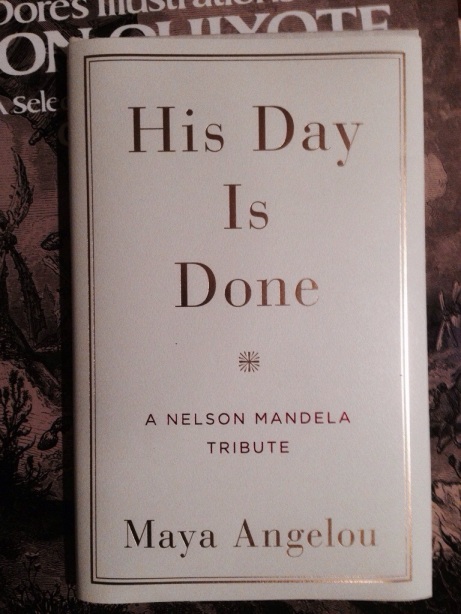
His Day Is Done (Book Acquired, 1.07.2014)

20140111-180541.jpg

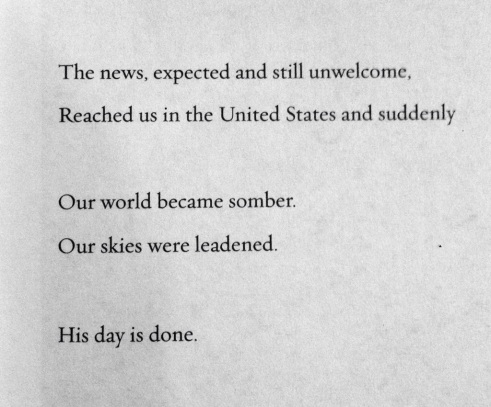
His Day Is Done: A Nelson Mandela Tribute is a slim hardback book of a poem that takes fewer than five minutes to recite.

Here are the opening lines:

20140111-180612.jpg

I’m restraining myself here but oh dear lord this is pretty bad poetry and there’s something that strikes me as utterly crass about the whole business of this little book, although I have no doubt that Angelou’s intentions are the purest (and even publisher Random House’s)—but yeesh.

“Resolutions” — Franz Kafka

“Resolutions”

by Franz Kafka

(Trans. by W. & E. Muir)

To LIFT YOURSELF out of a miserable mood, even if you have to do it by strength of will, should be easy. I force myself out of my chair, stride around the table, exercise
my head and neck, make my eyes sparkle, tighten the muscles around them. Defy my own feelings, welcome A. enthusiastically supposing he comes to see me, amiably tolerate B. in my room, swallow all that is said at C.’s, whatever pain and trouble it may cost me, in long draughts.

Yet even if I manage that, one single slip, and a slip cannot be avoided, will stop the whole process, easy and painful alike, and I will have to shrink back into my own circle again.

So perhaps the best resource is to meet everything passively, to make yourself an inert mass, and, if you feel that you are being carried away, not to let yourself be lured into taking a single unnecessary step, to stare at others with the eyes of an animal, to feel no compunction, in short, with your own hand to throttle down whatever ghostly life remains in you, that is, to enlarge the final peace of the graveyard and let nothing survive save that.

A characteristic movement in such a condition is to run your little finger along your eyebrows.

“Storm” — H.D.

storm

“The Index” — J.G. Ballard

“The Index”

by J.G. Ballard

EDITOR’S NOTE. From abundant internal evidence it seems clear that the text printed below is the index to the unpublished and perhaps suppressed autobiography of a man who may well have been one of the most remarkable figures of the twentieth century. Yet of his existence nothing is publicly known, although his life and work appear to have exerted a profound influence on the events of the past fifty years. Physician and philosopher, man of action and patron of the arts, sometime claimant to the English throne and founder of a new religion, Henry Rhodes Hamilton was evidently the intimate of the greatest men and women of our age. After World War II he founded a new movement of spiritual regener­ation, but private scandal and public concern at his grow­ing megalomania, culminating in his proclamation of himself as a new divinity, seem to have led to his down­fall. Incarcerated within an unspecified government insti­tution, he presumably spent his last years writing his autobiography of which this index is the only surviving fragment.

A substantial mystery still remains. Is it conceivable that all traces of his activities could be erased from our records of the period? Is the suppressed autobiography itself a disguised roman à clef, in which the fictional hero exposes the secret identities of his historical contempo­raries? And what is the true role of the indexer himself, clearly a close friend of the writer, who first suggested that he embark on his autobiography? This ambiguous and shadowy figure has taken the unusual step of index­ing himself into his own index. Perhaps the entire compi­lation is nothing more than a figment of the over­wrought imagination of some deranged lexicographer. Alternatively, the index may be wholly genuine, and the only glimpse we have into a world hidden from us by a gigantic conspiracy, of which Henry Rhodes Hamilton is the greatest victim.

A

Acapulco, 143

Acton, Harold, 142–7, 213

Alcazar, Siege of, 221–5

Alimony, HRH pays, 172, 247, 367, 453

Anaxagoras, 35, 67, 69–78, 481

Apollinaire, 98

Arden, Elizabeth, 189, 194, 376–84

Autobiography of Alice B. Toklas, The (Stein), 112

Avignon, birthplace of HRH, 9–13; childhood holidays, 27; research at Pasteur Institute of Ophthalmology, 101; attempts to restore anti-Papacy, 420–35

B

Bal Musette, Paris, 98

Balliol College, Oxford, 69–75, 231

Beach, Sylvia, 94–7

Berenson, Bernard, conversations with HRH, 134; offer of adoption, 145; loan of Dürer etching, 146; law-suits against HRH, 173–85

Bergman, Ingrid, 197, 134, 267

Biarritz, 123

Blixen, Karen von (Isak Dinesen), letters to HRH, declines marriage proposal, 197

Byron, Lord, 28, 76, 98, 543 Continue reading ““The Index” — J.G. Ballard”

“A Respectable Woman” — Kate Chopin

“A Respectable Woman”

by Kate Chopin

Mrs. Baroda was a little provoked to learn that her husband expected his friend, Gouvernail, up to spend a week or two on the plantation.

They had entertained a good deal during the winter; much of the time had also been passed in New Orleans in various forms of mild dissipation. She was looking forward to a period of unbroken rest, now, and undisturbed tete-a-tete with her husband, when he informed her that Gouvernail was coming up to stay a week or two.

This was a man she had heard much of but never seen. He had been her husband’s college friend; was now a journalist, and in no sense a society man or “a man about town,” which were, perhaps, some of the reasons she had never met him. But she had unconsciously formed an image of him in her mind. She pictured him tall, slim, cynical; with eye-glasses, and his hands in his pockets; and she did not like him. Gouvernail was slim enough, but he wasn’t very tall nor very cynical; neither did he wear eyeglasses nor carry his hands in his pockets. And she rather liked him when he first presented himself.

But why she liked him she could not explain satisfactorily to herself when she partly attempted to do so. She could discover in him none of those brilliant and promising traits which Gaston, her husband, had often assured her that he possessed. On the contrary, he sat rather mute and receptive before her chatty eagerness to make him feel at home and in face of Gaston’s frank and wordy hospitality. His manner was as courteous toward her as the most exacting woman could require; but he made no direct appeal to her approval or even esteem.

Once settled at the plantation he seemed to like to sit upon the wide portico in the shade of one of the big Corinthian pillars, smoking his cigar lazily and listening attentively to Gaston’s experience as a sugar planter.

“This is what I call living,” he would utter with deep satisfaction, as the air that swept across the sugar field caressed him with its warm and scented velvety touch. It pleased him also to get on familiar terms with the big dogs that came about him, rubbing themselves sociably against his legs. He did not care to fish, and displayed no eagerness to go out and kill grosbecs when Gaston proposed doing so. Continue reading ““A Respectable Woman” — Kate Chopin”

“The main difficulty with the book business” (Donald Barthelme)

The main difficulty with the book business is that a book is two kinds of objects. You have, on the one hand, a thing that a reasonable and prudent man might decide is a book. You have on the other hand an object which looks very much like a book, feels very much like a book, but is in actuality a bucket of peanut butter covered with a thin layer of chocolate sauce. These things are sold in the same way. The latter seems to sell better, for some mysterious reason, than the former. A good example of this that I ran into recently is a book called The First Time, which apparently has to do with accounts of initial sexual experiences of either eminent or reasonably well-known people. This, I would say, is a bucket of peanut butter. Actually, they missed. They should have done a book called The Last Time, which would not only be funnier but more poignant. The idea is copyrighted, by the way. Take notes.

From remarks Donald Barthelme delivered at a 1975 conference at the Library of Congress. Published in Tracy Daugherty’s book Hiding Man: A Biography of Donald Barthelme.

RIP Amiri Baraka

RIP Amiri Baraka, 1934-2014

“An archeological slice. Not much glitter.” (Donald Barthelme)

INTERVIEWER

Which reminds me: Some of your detractors say that you’re merely fashionable.

BARTHELME

Well, the mere has always been a useful category.

INTERVIEWER

That you’re a jackdaw, and your principle of selection is whatever glitters most.

BARTHELME

I weep and tear my hair. And disagree.

INTERVIEWER

Let’s look at a specific jackdaw’s nest, the barricade in “The Indian Uprising.”

BARTHELME

I don’t see anything particularly fashionable. The table made from a hollow-core door may be a 1960s reference but aren’t people still making them?

INTERVIEWER

But your barricade is not intended as straightforward realism; these things are artifacts of a certain culture.

BARTHELME

An archeological slice. Not much glitter.

INTERVIEWER

Won’t it require scholarly annotation in the future?

BARTHELME

I’d say no. If you read The Swiss Family Robinson and you’re reading about what they unpack from the pinnace as they shuttle from ship to shore you don’t need any footnotes, even though there may be four hundred pounds of tallow in the cargo. You have a vague recollection that it’s used to make candles.

Actually I think the jackdaw business is a function of appearing in the New Yorker with some frequency. People read the fiction with after images of Rolls Royces and Rolexes still sizzling in their eyes. Rare is the reviewer who can resist mentioning the magazine’s ads when talking about the fiction. One is gilded by association.

INTERVIEWER

Suppose we turn things around. Suppose I say that when I read that story I’m not at all concerned about whether people made tables from hollow-core doors in the 1960s. Rather, I’m interested in the speaker, who in the metaphorical context of the story is besieged by Comanches.

BARTHELME

Is besieged by very much more than Comanches, but also by Comanches. He’s not meant to be a walking-around person so much as a target, a butt. The arrows of the Comanches but also sensory insult, political insult, there are references to the war there, to race, to torture, jingoism . . . But none of the references in the story were picked at random, and none are used simply as decor. If they seem random it’s probably because the range of reference is rather wide for a short piece—you have Patton and Frank Wedekind and the seventh cavalry coexisting on the same plane—but the crowding is part of the design, is the design.

From Donald Barthelme’s The Paris Review interview.

“Samuel” — Grace Paley

“Samuel”

by Grace Paley

Some boys are very tough. They’re afraid of nothing. They are the ones who climb a wall and take a bow at the top. Not only are they brave on the roof, but they make a lot of noise in the darkest part of the cellar where even the super hates to go. They also jiggle and hop on the platform between the locked doors of the subway cars.

Four boys are jiggling on the swaying platform. Their names are Alfred, Calvin, Samuel, and Tom. The men and women in the cars on either side watch them. They don’t like them to jiggle or jump but don’t want to interfere. Of course some of the men in the cars were once brave boys like these. One of them had ridden the tail of a speeding truck from New York to Rockaway Beach without getting off, without his sore fingers losing hold. Nothing happened to him then or later. He had made a compact with other boys who preferred to watch: starting at Eighth Avenue and Fifteenth Street, he would get to some specified place, maybe Twenty-third and the river, by hopping the tops of the moving trucks. This was hard to do when one truck turned a corner in the wrong direction and the nearest truck was a couple of feet too high. He made three or four starts before succeeding. He had gotten this idea from a film at school called The Romance of Logging. He had finished high school, married a good friend, was in a responsible job, and going to night school.

These two men and others looked at the four boys jumping and jiggling on the platform and thought. It must be fun to ride that way, especially now the weather is nice and we’re out of the tunnel and way high over the Bronx. Then they thought. These kids do seem to be acting sort of stupid. They are little. Then they thought of some of the brave things they had done when they were boys and jiggling didn’t seem so risky.

The ladies in the car became very angry when they looked at the four boys. Most of them brought their brows together and hoped the boys could see their extreme disapproval. One of the ladies wanted to get up and say, be careful you dumb kids, get off that platform or I’ll call a cop. But three of the boys were Negroes and the fourth was something else she couldn’t tell for sure. She was afraid they’d be fresh and laugh at her and embarrass her. She wasn’t afraid they’d hit her, but she was afraid of embarrassment. Another lady thought, their mothers never know where they are. It wasn’t true in this particular case. Their mothers all knew that they had gone to see the missile exhibit on Fourteenth Street.

Out on the platform, whenever the train accelerated, the boys would raise their hands and point them up to the sky to act like rockets going off, then they rat-tat-tatted the shatterproof glass pane like machine guns, although no machine guns had been exhibited.

For some reason known only to the motorman, the train began a sudden slowdown. The lady who was afraid of embarrassment saw the boys jerk forward and backward and grab the swinging guard chains. She had her own boy at home. She stood up with determination and went to the door. She slid it open and said, “You boys will be hurt. You’ll be killed. I’m going to call the conductor if you don’t just go into the next car and sit down and be quiet.”

Two of the boys said, “Yes’m,” and acted as though they were about to go. Two of them blinked their eyes a couple of times and pressed their lips together. The train resumed its speed. The door slid shut, parting the lady and the boys. She leaned against the side door because she had to get off at the next stop.

The boys opened their eyes wide at each other and laughed. The lady  blushed. The boys looked at her and laughed harder. They began to pound each other’s back. Samuel laughed the hardest and pounded Alfred’s back until Alfred coughed and the tears came. Alfred held tight to the chain hook. Samuel pounded him even harder when he saw the tears. He said, “Why you bawling? You a baby, huh?” and laughed. One of the men whose boyhood had been more watchful than brave became angry. He stood up straight and looked at the boys for a couple of seconds. Then he walked in a citizenly way to the end of the car, where he pulled the emergency cord. Almost at once, with a terrible hiss, the pressure of air abandoned the brakes and the wheels were caught and held.

People standing in the most secure places fell forward, then backward. Samuel had let go of his hold on the chain so he could pound Tom as well as Alfred. All the passengers in the cars whipped back and forth, but he pitched only forward and fell head first to be crushed and killed between the cars.

The train had stopped hard, halfway into the station, and the conductor called at once for the trainmen who knew about this kind of death and how to take the body from the wheels and brakes. There was silence except for passengers from the other cars who asked, What happened! What happened! The ladies waited around wondering if he might be an only child. The men recalled other afternoons with very bad endings. The little boys stayed close to each other, leaning and touching shoulders and arms and legs.

When the policeman knocked at the door and told her about it, Samuel’s mother began to scream. She screamed all day and moaned all night, though the doctors tried to quiet her with pills.

Oh, oh, she hopelessly cried. She did not know how she could ever find another boy like that one. However, she was a young woman and she became pregnant. Then for a few months she was hopeful. The child born to her was a boy. They brought him to be seen and nursed. She smiled. But immediately she saw that this baby wasn’t Samuel. She and her husband together have had other children, but never again will a boy exactly like Samuel be known.

“The Unexplorer” — Edna St. Vincent Millay

esvm