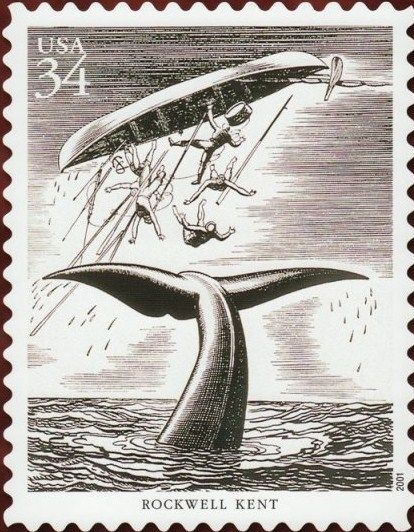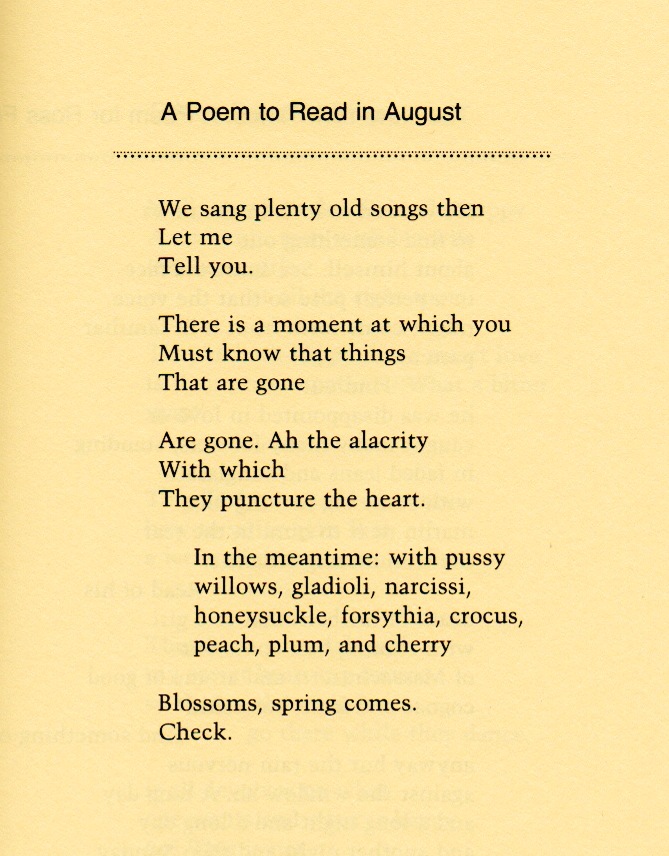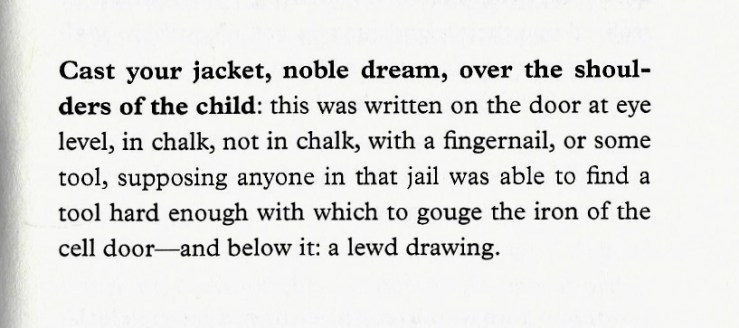
From Studies of Silhouettes by Pierre Senges. English translation by Jacob Siefring. Get it from Sublunary Editions.
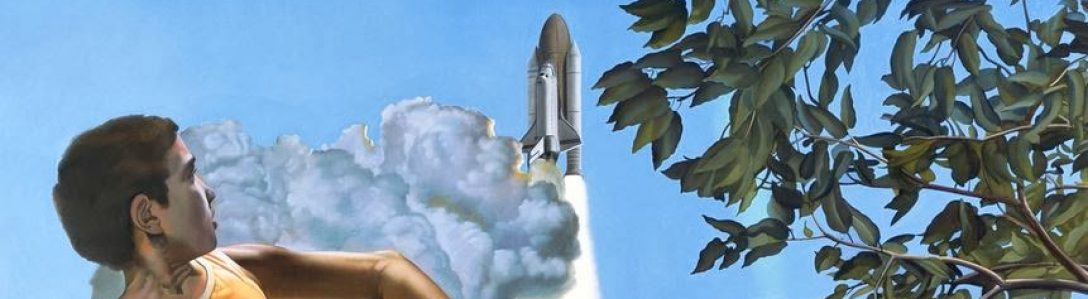
From Studies of Silhouettes by Pierre Senges. English translation by Jacob Siefring. Get it from Sublunary Editions.
Marc Chénetier: Wouldn’t you say that one of the reasons why the writer is of necessity very skeptical is that his or her trade consists of knowing how the idea of a truth can be built into a sentence? Therefore, the skepticism would derive from the awareness of the manipulations that are at work—
William Gass: The writer really doesn’t build the truth into the sentence, the reader does, especially if the sentence is well constructed. That was one of the things that Plato was worried about, because the poets were so persuasive, whereas the sentences of science, expressed in highly mathematical terms, are not the kind of soft bed that one wants to lie in. Rhetorical constructions have enormous seduction, but the writer doesn’t build the belief in it. What you build is something that has unity and emotional power that the reader, then, is liable to latch onto. A good writer should be able to make any point of view sound terrific. Shakespeare could do it, of course. Then that terrificness has nothing to do with the truth, it has to do with being terrific.
From a discussion on William Gaddis’s speech/essay “Old Foes with New Faces.”
Gaddis delivered the speech at the International Writers Center as part The Writer and Religion Conference at Washington University in St. Louis, Missouri, 23-26 Oct. 1994. The discussion held afterwards was moderated by Marc Chénetier and the panelists were Wayne Fields, William Gass, and Heide Ziegle (and Gaddis, of course).
The essay, discussion, as well as other essays and discussions are collected in The Writer and Religion, ed. by William H. Gass and Lorin Cuoco.
The New York Times published “Authors’ Authors” on 5 Dec. 1976. The piece “asked a number of authors, ranging from Vladimir Nabokov to John Dean, to tell us the three books they most enjoyed this year and to say, in a sentence or two, why.”
There’s of course something silly and even gossipy about such articles, which fall far from literary criticism, of course. But, simultaneously, these kinds not-really-lists are fun. I came across the article looking for something else, and ended up reading it all. There are plenty of my favorite authors as well as notable authors who contributed to the piece: Ishmael Reed, William H. Gass, Eudora Welty, Maurice Sendak, Henry Miller, Joan Didion, and loads more. What’s most interesting to me are the “new” books many books include—I mean books published in (or around) 1976. Some I’ve never heard of, others are classics (of one fashion or another) and many are long long forgotten.
John Cheever’s answer opens the list with an appropriate warning:
I’ve always thought the response to these questionnaires cranky and pretentious and associated them with the darkest hours of Sunday. I mention this only to make it clear that you are free to throw my reply away.
He selects the only book by John Updike I’ve retained, Picked-Up Pieces, cites Richard Condon’s The Manchurian Candidate as an airplane read, and reflects on Daniel Deronda:
It may be a reflection on George Eliot’s refinement or my grossness but my most vivid recollection of this estimable classic is a scene where Deronda enthusiastically seizes the oar of a wherry. It seemed the only robust gesture in the book.
(I had to look up the word wherry.)
Cheever’s pick Updike is on the list, providing a bit of satire on the whole business:

I also found some of Nabokov’s response amusing, although I don’t think it was his intention. He gives us “the three books I read during the three summer months of 1976 while hospitalized in Lausanne”: Dante’s Inferno (“in Singleton’s splendid translation”, The Butterflies of North America by William H. Howe (natch), and his own book, The Original of Laura. Nabokov describes it as
The not quite finished manuscript of a novel which I had begun writing and reworking before my illness and which was completed in my mind: I must have gone through it some 50 times and in my diurnal delirium kept reading it aloud to a small dream audience in a walled garden. My audience consisted of peacocks, pigeons, my long dead parents, two cypresses, several young nurses crouching around, and a family doctor so old as to be almost invisible. Perhaps because of my stumblings and fits of coughing the story of my poor Laura had less success with my listeners than it will have, I hope, with intelligent reviewers when properly published.
Nabokov never finished The Original of Laura. A version of it was published in 2009.
Conservative commentator William F. Buckley picked books by John McPhee, Hugh Kenner, and Malcolm Muggeridge. Joyce Carol Oates liked Ted Hughes’s Season Songs. Despite having “has no taste for contemporary fiction,” Maurice Sendak recommends Leonard Michaels’ collection I Would Have Saved Them If I Could. Maxine Hong Kingston breaks the rule of three, adding Nabokov’s Ada to her trio. Philip Roth includes Bruno Schulz’s The Street of Crocodiles, which was part of a series of translations Roth “edited.” Robert Coles liked Walker Percy’s The Message in the Bottle. Lois Gould lists Anne Rice’s Interview with the Vampire, possibly one of the most enduringly popular books of 1976. Saul Bellow enjoyed Richard Yates’s The Easter Parade. Richard Yates enjoyed Larry McMurty’s Terms of Endearment. Nora Ephron loved Joan Didion’s A Book of Common Prayer. Joan Didion loved Renata Adler’s Speedboat. Cynthia Ozick gives only one title, Leon Edel’s biography of Henry James.
Henry Miller kept it short and sweet:

James Dickey loved something called Dreamthorp by Alexander Smith:
A book of gentle meditations on death in the remote English village: the quietest book of essays I know. To read it is like sinking under the leaves and views and grass of a gentle and caring cemetery and being profoundly glad to be there.
Eudora Welty sticks mostly to Virginia Woolf, recommending the second volume of Woolf’s letters (“Nothing in this book to get between the reader and the writer: Virginia Woolf in her own words, her own mind, speaking for herself”) as well as Mrs Dalloway’s Party. Welty also references Brewer’s Dictionary of Phrase and Fable, which I now must track down.
William H. Gass cites two bona fide postmodern classics and an oddity I’ve never heard of:
J R by William Gaddis. Perhaps the supreme masterpiece of acoustical collage. A real contribution to the art of fiction.
The Geek by Craig Nova. A hard, brilliantly visual novel which is equal in quality to early Hawkes. Few American writers have such a sensuous yet masterfully controlled style.
The Franchiser by Stanley Elkin. Elkin is a genius. I am happy he is also a friend. There are paragraphs in this book in which the language leaps from the page and flies away. The critics owe Elkin much bowing and scraping.
Ishmael Reed describes a book called Dangerous Music by by Jessica Tarahata Hagedorn, a writer I’d never heard of until now:
While the boys were drawing graffiti what were the girls doing? They were writing “Ditty Bop” books, black and white speckled composition books usually, full of gossip, desire, fashion, recipes, proverbs and boyfriends. Written in fire-engine red lipstick “Ditty Bop” books spell “cause” c-u‐z. Nikki Giovanni (“Gemini”) and Alison Mills (“Francisco”) have written classics of the genre. Now Jessica Hagedorn, who makes the S.F. rounds with her West Coast Gangster Choir, has penned the Latino‐Filipino version of the “Ditty Bop.” Reviewers describe “Ditty Bop” books as “sultry”; this one is that. It is a joyous, mean, mambo book blessed by the patron Saint of Latino‐Filipino Ditty Bops, Carmen Miranda.
He also recommends Shouting by by Joyce Carol Thomas, who, thankfully, is not Joyce Carol Oates.
Two authors picked up John Updike’s Picked-Up Pieces (Joyce Carol Oates and John Cheever).
Gabriel Garcia Marquez is cited three times on the list: twice for Autumn of the Patriarch (Lewis Thomas and Bernard Malamud) and once for One Hundred Years of Solitude (John Dean).
John Dean’s Blind Ambition shows up three times (Ishmael Reed, Bob Woodward, and Nikki Giovanni).
Somehow, Nikki Giovanni is the only writer to include Alex Haley’s Roots in a list.
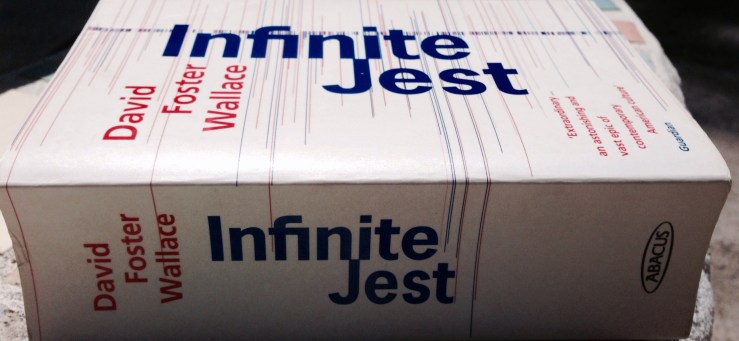
A note to readers new to Infinite Jest
David Foster Wallace’s 1996 novel Infinite Jest poses rhetorical, formal, and verbal challenges that will confound many readers new to the text. The abundance of (or excess of) guides and commentaries on the novel can perhaps have the adverse and unintentional consequence of making readers new to Infinite Jest believe that they can’t “get it” without help. Many of the online analyses and resources for Infinite Jest are created by and targeted to readers who have finished the novel or are rereading the novel. While I’ve read many insightful and enlightening commentaries on the novel over the years, my intuition remains that the superabundance of analysis may have the paradoxical effect of actually impeding readers new to the text. With this in mind, I’d suggest that first-time readers need only a dictionary and some patience.
Infinite Jest is very long but it’s not nearly as difficult as its reputation suggests. There is a compelling plot behind the erudite essaying and sesquipedalian vocabulary. That plot develops around three major strands which the reader must tie together, with both the aid of—and the challenge of—the novel’s discursive style. Those three major plot strands are the tragic saga of the Incandenzas (familial); the redemptive narrative of Ennet House Drug and Alcohol Recovery House, with Don Gately as the primary hero (socicultural); and the the schemes of the Québécois separatists (national/international/political). An addictive and thus deadly film called Infinite Jest links these three plots (through discursive and byzantine subplots).
Wallace often obscures the links between these plot strands, and many of the major plot connections have to be intuited or outright guessed. Furthermore, while there are clear, explicit connections between the plot strands made for the reader, Wallace seems to withhold explicating these connections until after the 200-page mark. Arguably, the real contours of the Big Plot come into (incomplete) focus in a discussion between Hal Incandenza and his brother Orin in pages 242-58. Getting to this scene is perhaps a demand on the patience of many readers. And, while the scene by no means telegraphs what happens in IJ, it nonetheless offers some promise that the set pieces, riffs, scenes, lists, and vignettes shall add up to Something Bigger.
Some of those earliest set pieces, riffs, scenes, lists, and vignettes function almost as rhetorical obstacles for a first-time reader. The novel’s opening scene, Hal Incandenza’s interview with the deans at the University of Arizona, is chronologically the last event in the narrative, and it dumps a lot of expository info on the reader. It also poses a number of questions or riddles about the plot to come, questions and riddles that frankly run the risk of the first-time reader’s forgetting through no fault of his own.
The second chapter of IJ is relatively short—just 10 pages—but it seems interminable, and it’s my guess that Wallace wanted to make his reader endure it the same way that the chapter’s protagonist–Erdedy, an ultimately very minor character—must endure the agonizing wait for a marijuana delivery. The chapter delivers the novel’s themes of ambivalence, desire, addiction, shame, entertainment, “fun,” and secrecy, both in its content and form. My guess is that this where a lot of new readers abandon the novel.
The reader who continues must then work through 30 more pages until meeting the novel’s heart, Don Gately, but by the time we’ve met him we might not trust just how much attention we need to pay him, because Wallace has shifted through so many other characters already. And then Gately doesn’t really show up again until like, 200 pages later.
In Infinite Jest, Wallace seems to suspend or delay introducing the reading rules that we’ve been trained to look for in contemporary novels. While I imagine this technique could frustrate first-time readers, I want to reiterate that this suspension or delay or digression is indeed a technique, a rhetorical tool Wallace employs to perform the novel’s themes about addiction and relief, patience and plateaus, gratitude and forgiveness.
Where is a fair place to abandon Infinite Jest?
I would urge first-time readers to stick with the novel at least until page 64, where they will be directed to end note 24, the filmography of J.O. Incandenza (I will not even discuss the idea of not reading the end notes. They are essential). Incandenza’s filmography helps to outline the plot’s themes and the themes’ plots—albeit obliquely. And readers who make it to the filmography and find nothing to compel them further into the text should feel okay about abandoning the book at that point.
What about a guide?
There are many, many guides and discussions to IJ online and elsewhere, as I noted above. Do you really need them? I don’t know—but my intuition is that you’d probably do fine without them. Maybe reread Hamlet’s monologue from the beginning of Act V, but don’t dwell too much on the relationship between entertainment and death. All you really need is a good dictionary. (And, by the way, IJ is an ideal read for an electronic device—the end notes are hyperlinked, and you can easily look up words as you read).
Still: Two online resources that might be useful are “Several More and Less Helpful Things for the Person Reading Infinite Jest,” which offers a glossary and a few other unobtrusive documents, and “Infinite Jest: A Scene-by-Scene Guide,” which is not a guide at all, but rather a brief series of synopses of each scene in the novel, organized by page number and year; my sense is that this guide would be helpful to readers attempting to delineate the novel’s nonlinear chronology—however, I’d advise against peeking ahead. After you read you may wish to search for a plot diagram of the novel, of which there are several. But I’d wait until after.
An incomplete list of motifs readers new to Infinite Jest may wish to attend to
The big advantage (and pleasure) of rereading Infinite Jest is that the rereader may come to understand the plot anew; IJ is richer and denser the second go around, its themes showing brighter as its formal construction clarifies. The rereader is free to attend to the imagery and motifs of the novel more intensely than a first-time reader, who must suss out a byzantine plot propelled by a plethora of characters.
Therefore, readers new to IJ may find it helpful to attend from the outset to some of the novel’s repeated images, words, and phrases. Tracking motifs will help to clarify not only the novel’s themes and “messages,” but also its plot. I’ve listed just a few of these motifs below, leaving out the obvious ones like entertainment, drugs, tennis (and, more generally, sports and games), and death. The list is in no way definitive or analytic, nor do I present it as an expert; rather, it’s my hope that this short list might help a reader or two get more out of a first reading.
Heads
Cages
Faces
Masks
Teeth
Cycles
Maps
Waste
Infants
Pain
Deformities
Subjects
Objects
One final note
Infinite Jest is a rhetorical/aesthetic experience, not a plot.
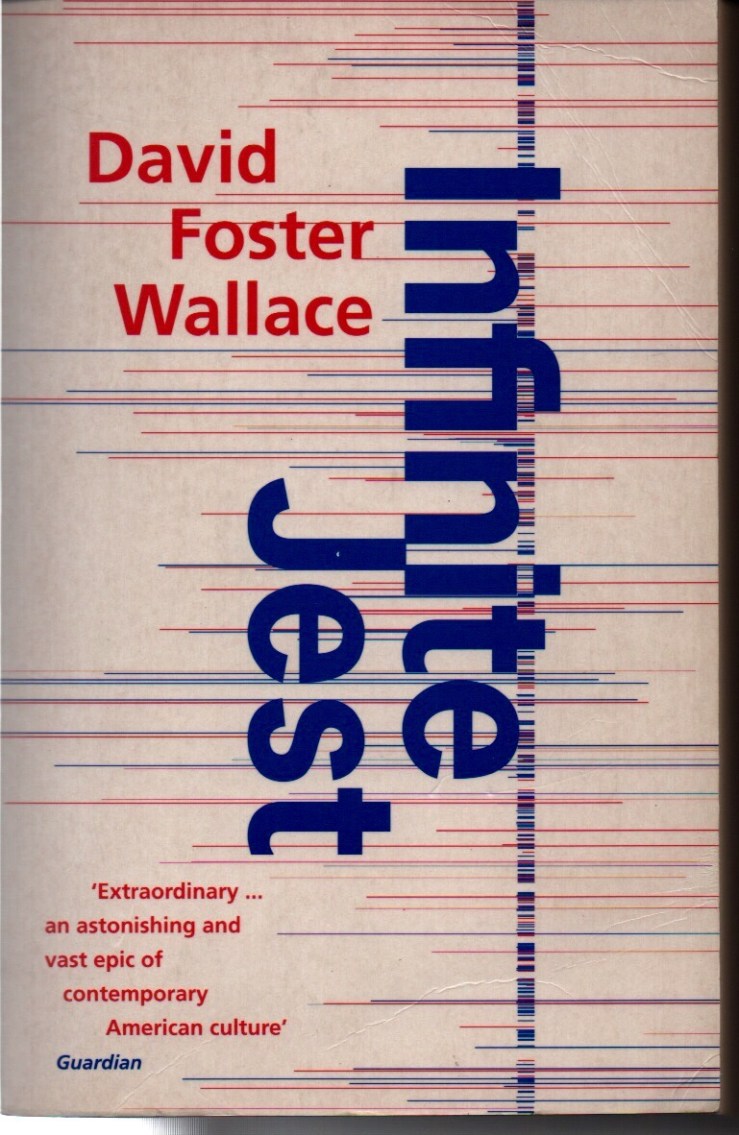
[Ed. note: Biblioklept first posted a version of this note in the summer of 2015. Infinite Jest remains underread by overtalkers].

The above ad was published in The New York Times, 16 March 1955. Blurbs, bigger (Sterling North’s is my fave):
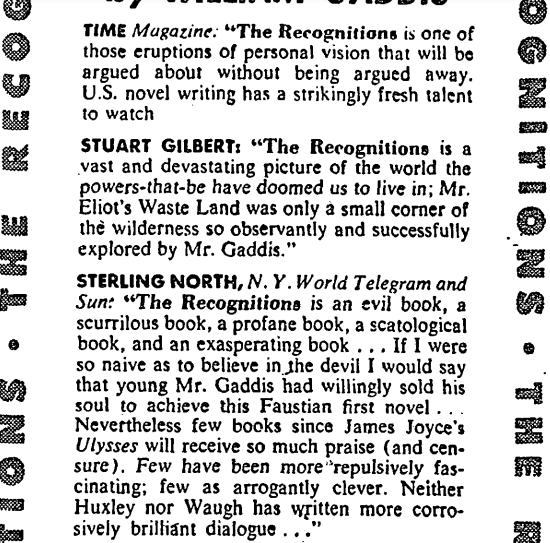

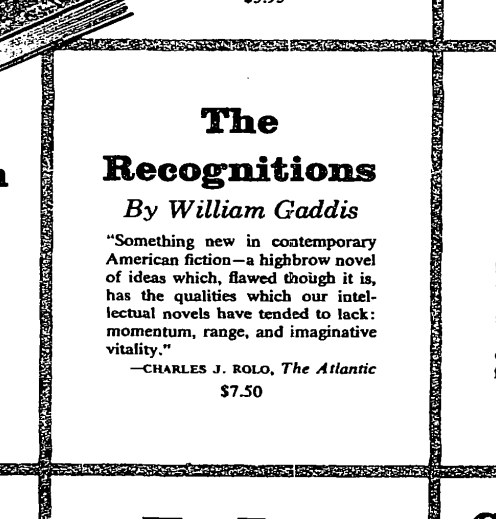
The second ad is from 1 May 1955, also in The New York Times:

I first came to know William Gaddis at a writers’ conference in the Soviet Union in 1985. I had heard that he was shy and averse to publicity, but I found that this reputation was based only on his belief that a writer’s life and personality should be as little as possible associated with his work. As a conferee, he was both eloquent and precise.
Perhaps the most amusing contrast in our group was between him and Allen Ginsberg. Allen, shaggy and bearded, chanted his verse in loud, emotional tones as he pounded a species of accordion that he always carried with him. Will, on the other hand, reserved and quiet, impeccably clad, with the patient composure of a man of the world and the piercing eye of a wit, spoke in measured tones of the small sales that the serious novelist might expect.
If Danielle Steele counted her sales in the millions while he had to make do with a few thousands, he said, it was because she wrote books and he wrote ‘”literature.” Asked for pointers as to future conferences, he glanced obliquely down the table at Allen and suggested that the novelists and poets be separated, so that the accordion would be heard only “down a long corridor, through a closed door.”
Gaddis, who is considered by some critics to be the nearest thing to Herman Melville that our century has produced, who is almost a cult figure among students of English, is nonetheless not well-known to the wider reading public. His first two novels, The Recognitions and JR, published 20 years apart, in 1955 and 1975, frightened off many readers by their length, erudition and supposed ”difficulty.” But this difficulty is much exaggerated by symbol and ambiguity hunters (“What can I do if people insist I’m cleverer than I think I am?” Gaddis asks with a shrug), and length and erudition become virtues when the stories are as interesting as his.
Gaddis has more to say to American readers today than any other novelist I can think of. Take just three fields in which his knowledge is significant: theology, painting and corporate finance. Then consider the space devoted by the press in the 1980’s to religious strife and revivalism, to art sales and art frauds, to stock-market chicanery and insider trading. Some critics have credited me as a novelist with a degree of familiarity in the last-named field, but I have treated it only in broad outlines and with a minimum of legal details. Gaddis could almost qualify as an expert witness in the trial of a malefactor.
From “Recognizing Gaddis,” a longish profile of William Gaddis by novelist (and lawyer) Louis Auchincloss. “Recognizing Gaddis” was published in the 15 Nov. 1987 issue of The New York Times.
Harold Bloom. Is he the one who wrote about the schools? The point is that there are two Blooms, and one of them is dead. [He is told he is confusing Harold with Allan.] Good—if he were the other one, I would like to flee. He’s very welcome to his opinion, especially this one; it sounds like very good company to be in. You can say I’m embarrassed not to know his work. And that I’m glad he’s not Allan Bloom.
From a sidebar in “The Next Big Lit-Crit Snit” by Rebecca Mead in New York Magazine (15 Aug. 1994). The article is about the publication of Harold Bloom’s The Western Canon. Bloom included Gaddis in his silly canon for The Recognitions.
I would worry about being on such a list, because I like to write uncanonical things, things that oppose the general flow of the culture. I would certainly be happy to believe that I could share the same halls or bookcase or something with some of the writers whom I admire so much, but I would feel very insecure about my place there…I”m not sure that I want my books to be patted on the back by lots of scholars in the academy and told, “There, there, these are okay.” …My feelings about things like this are more the sort of thing I have about my children: I would be a little disturbed if everybody loved them.
From a sidebar in “The Next Big Lit-Crit Snit” by Rebecca Mead in New York Magazine (15 Aug. 1994). The article is about the publication of Harold Bloom’s The Western Canon. The sidebar quotes a number of authors who were included and omitted. William H. Gass was included in Bloom’s canon for both his first novel, Omensetter’s Luck, and his follow-up of long short stories, In the Heart of the Heart of the Country. In the New York article, Bloom, says that he was encouraged to make the list by his editor, wavering “I’m not so sure it was a good idea.” He was more forceful in a 2008 interview in Vice, claiming that,
The list was not my idea. It was the idea of the publisher, the editor, and my agents. I fought it. I finally gave up. I hated it. I did it off the top of my head. I left out a lot of things that should be there and I probably put in a couple of things that I now would like to kick out.
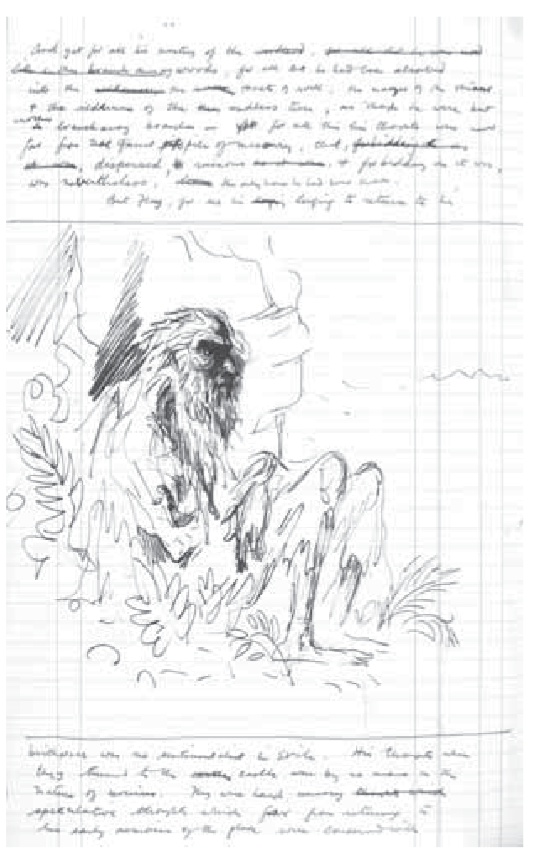
Who should be the next American Nobel Prize winner?
CORMAC McCARTHY: Would you wish the Nobel Prize off on a friend or an enemy?
What would you have done, do you think, if it hadn’t been for writing?
CORMAC McCARTHY: I think I can say that if I hadn’t been a writer I’d have been what I have been all my life anyway: one more unemployed person of dubious character.
The “article” consists of a ten-question questionnaire Esquire fiction editor Rust Hills sent to around fifty American writers. These are the only two answers from Cormac McCarthy.
“Parable of Cervantes and the Quixote”
by
Jorge Luis Borges
Translated by Andrew Hurley
Weary of his land of Spain, an old soldier of the king’s army sought solace in the vast
geographies of Ariosto, in that valley of the moon in which one finds the time that is squandered by dreams, and in the golden idol of Muhammad stolen by Montalbán.
In gentle self-mockery, this old soldier conceived a credulous man—his mind unsettled by the reading of all those wonders—who took it into his head to ride out in search of adventures and enchantments in prosaic places with names such as El Toboso and Montici.
Defeated by reality, by Spain, don Quixote died in 1614 in the town of his birth. He was survived only a short time by Miguel de Cervantes.
For both the dreamer and the dreamed, that entire adventure had been the clash of two worlds; the unreal world of romances and the common everyday world of the seventeenth century.
They never suspected that the years would at last smooth away the discord, never suspected that in the eyes of the future, La Mancha and Montici and the lean figure of the Knight of Mournful Countenance would be no less poetic than the adventures of Sindbad or the vast geographies of Ariosto.
For in the beginning of literature there is myth, as there is also in the end of it.
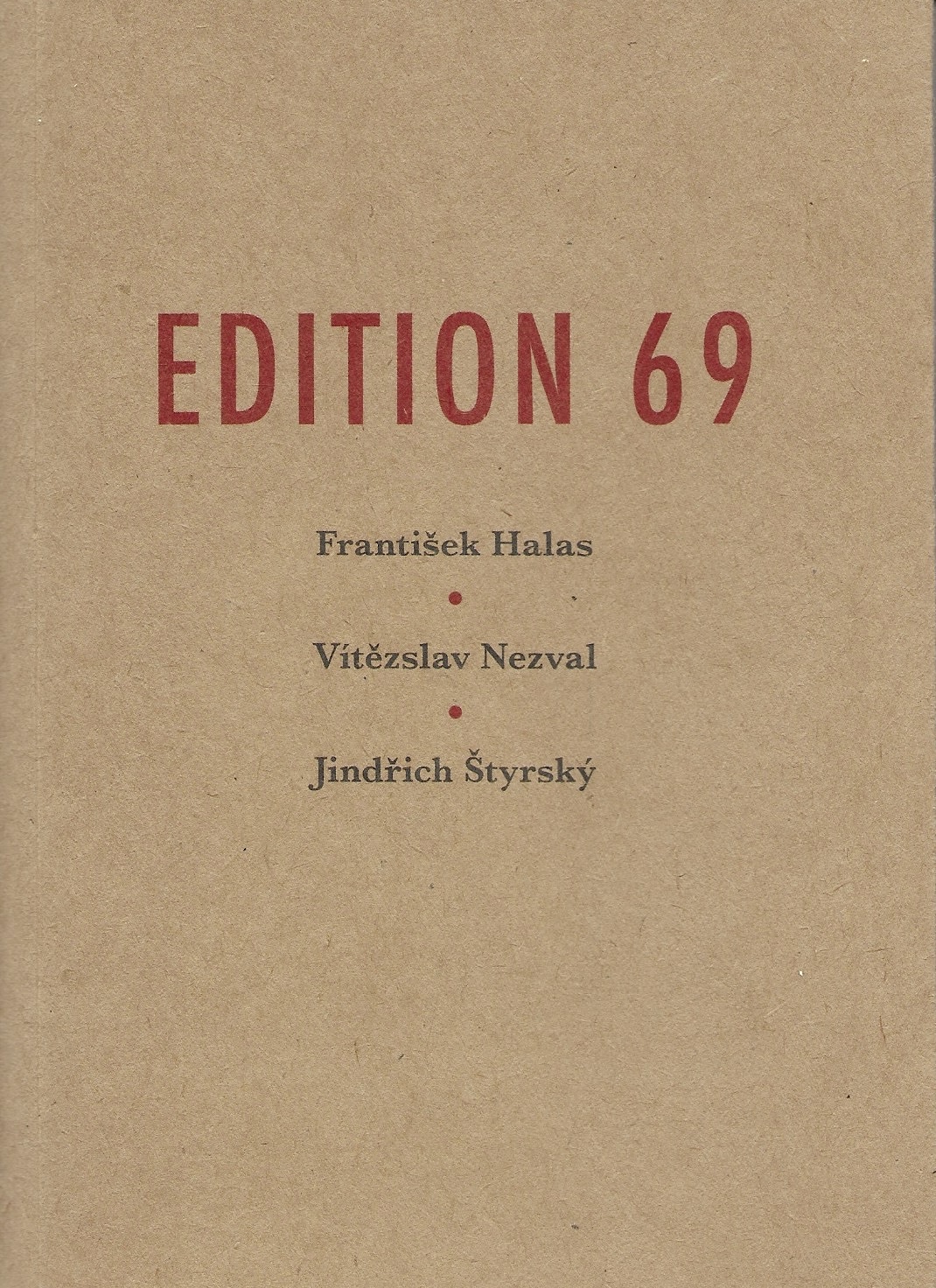
New from Twisted Spoon Press, Edition 69 collects three previously-untranslated volumes of Czech artist and writer Jindřich Štyrský’s private-press books of the same name. Beginning in 1931, Štyrský published six volumes of Edition 69. The series was devoted to outré erotic writing and art — “pornophilia,” as the biologist/poet/philosopher Bohuslav Brouk puts it in an essay accompanying the sixth and final volume of Edition 69.
Because of Czech censorship laws, Štyrský’s project was limited to subscribers and friends, with each volume running under 200 editions (the final volume was limited to 69 copies). Undoubtedly, the material in Edition 69 would present an affront—indeed an intentional affront—to the “supercilious psyches of the ruling peacocks,” to again borrow from Brouk (rendered wonderfully here in Jed Slast’s estimable English translation—I should’ve mentioned Slast earlier!). Much of the material in Twisted Spoon’s new collection of Edition 69 still provokes and disturbs nearly a century after their original publication.
Three of the original volumes of Edition 69 presented Czech translations–in some cases the first—of writers like the Marquis de Sade, along with accompanying illustrations by Toyen and Rudolf Krajc. Following its mission of bringing Czech literature to an English-reading audience, Twisted Spoon’s Edition 69 collects the three volumes by Czech artists in translation by Jed Slast: Vítězslav Nezval’s Sexual Nocturne (1931), František Halas’s Thyrsos (1932), and Štyrský’s own Emilie Comes to Me in a Dream (1933). (Štyrský designed and illustrated each of these volumes.)
Nezval’s fragmentary surrealist dream-memoir Sexual Nocturne is the strongest of the three pieces in Edition 69. Nezval gives us an abject, dissolving reminiscence of an unnamed narrator’s boarding school days, centering on a trip to the local bordello and culminating in a return visit years later, one soaked in alcohol and despair. It’s a creepy and decidedly unsexy story, directly referencing Poe’s “The Raven” and Whitman’s “The City Dead-House” (and cribbing more Gothic gloom from a handful of penny dreadfuls).
Sexual Nocturne is a Freudian ramble into adolescent sexual frustration, voyeurism, and ultimately loss, loneliness, and insanity. It’s also a wonderful exploration of the connection between taboo bodily functions and taboo words. In one notable scene, our narrator sends a missive to a crush containing an obscenity, only to be discovered by the bourgeois landlord of his boarding house:
His views reflected those of society. How ridiculous. A writer is expected to make a fool of himself by employing periphrastic expressions while the word ‘fuck’ is nonpareil for conveying sexual intercourse. Fortunately there are old dictionaries where this world has its monument. How I sought it out! When the kiss of lovers pronounces it during coitus it is infused with a sudden vertigo. I have little tolerance for its disgraceful and comic synonyms. They convey nothing, just mealy-mouthed puffballs that make me want to retch when I encounter them.
The word FUCK is diamond-hard, translucent, a classic. As if adopting the appearance of a gem from a noble Alexandrine, it has, since it is forbidden, a magical power. It is one of the Kabbalistic abbreviations for the erotic aura, and I love it.
I love it! I love that second paragraph so much. It’s one of the best paragraphs I’ve read all year.
The collages by Štyrský that accompany Sexual Nocturne are reminiscent of Max Ernst’s work in A Week of Sundays, but less frenetic. At times they sync with the tale’s dream logic, and when they don’t, fine. It’s interwar surrealism, baby!

František Halas’s Thyrsos is far less successful. Halas’s poems can’t quite live up to their namesake, let alone the Sophocles’ quote that precedes them (“Not to be born is, beyond all estimation, best; but when a man has seen the light of day, this is next best by far, that with utmost speed he should go back from where he came”).
The opener, “Leda’s Sorrow,” isn’t particularly bad, but it’s nothing special either:

Other poems celebrate incest, arcadian bacchanalia, and old-man boners. Halas’s poem about cunnilingus (“The Taste of Love”) is particularly bad. Outlier “In the Field” connects the collection’s larger themes of sex-as-death’s-twin, evoking a scene of what might be a battle field, with trenches and barbed wire, a solitary man jerking off “like a demon” over what I take to be a foxhole. For the most part though, Thyrsos is a strange mix of ribald and whimsical with occasional sex tips thrown in. It’s weak stuff. In his translator’s note, Slast admits that “perhaps it’s understandable that Halas considered this thin collection of poems juvenile and much inferior to his other work.” Štyrský’s pen-and-ink illustrations are simple and charming though, even if their simple charm seems to point to the fact that Halas’s ditties are out of place in the queasy surrealism of the rest of the collection.

Štyrský’s Emilie Comes to Me in a Dream reads like a mix of dream writing and automatic writing. It’s stranger and more poetic than the prose in Nezval’s Nocturne, but neither as funny nor as profound. And yet it has its moments, as it shifts from sensuality to pornography to death obsession. “I came to love the fragrance of her crotch,” our narrator declares, and then appends his description: “a mix of laundry room and mouse hole, a pincushion forgotten in a bed of lilies of the valley.” He tells us he “was prone to seeing in dissolve,” and the prose bears it out later, in a linguistic episode that mirrors Štyrský’s surrealist collage techniques:
Later I placed an aquarium in the window. In it I cultivated a golden-haired vulva and a magnificent penis specimen and delicate veins on its temples. Yet in time I threw in everything I had ever loved: shards of broken teacups, hairpins, Barbora’s slipper, light bulbs, shadows, cigarette butts, sardine tins, my entire correspondence, and used condoms. Many strange creatures were born in this world. I considered myself a creator, and with justification.
After the dream writing, Štyrský delivers a sexually-explicit photomontage that’s simultaneously frank and ambiguous, ironic and sincere, sensual and abject. The photographic collages wed sex and death, desire and repulsion.

Štyrský’s Emilie includes a (previously-mentioned) postscript by Bohuslav Brouk, which, while at times academic and philosophical, plainly spells out that the mission of the so-called “pornophiles” is to give a big FUCK YOU to the repressed and repressive bourgeoisie. Brouk intellectualizes pornophilia, arguing against the conservative mindset that strives for immortal purity. He argues in favor of embracing corporeal animality: “The body will continue to demonstrate mortality as the fate of all humans, and for this reason any reference to human animality so gravely offends those who dream of its antithesis.” Hence, sex and death—blood, sweat, tears, semen—are the abject markers of the fucking circle of life, right? Our dude continues:
The body is the last argument of those who have been unjustly marginalized and ignored, because it demonstrates beyond question the groundlessness of all social distinctions in comparison to the might of nature.
I’ll give Brouk the last quote here because I think what he wrote resonates still in These Stupid Times.
Edition 69 has its highs and its lows, but I think it’s another important document of Czech surrealism from Twisted Spoon, and in its finest moments it reminds us that we are bodies pulling a psyche around, no matter how much we fool ourselves. Nice.
August 24th.–I left home at five o’clock this morning to catch some fish for breakfast. I shook our summer apple-tree, and ate the golden apple which fell from it. Methinks these early apples, which come as a golden promise before the treasures of autumnal fruit, are almost more delicious than anything that comes afterwards. We have but one such tree in our orchard; but it supplies us with a daily abundance, and probably will do so for at least a week to come. Meantime other trees begin to cast their ripening windfalls upon the grass; and when I taste them, and perceive their mellowed flavor and blackening seeds, I feel somewhat overwhelmed with the impending bounties of Providence. I suppose Adam, in Paradise, did not like to see his fruits decaying on the ground, after he had watched them through the sunny days of the world’s first summer. However, insects, at the worst, will hold a festival upon them, so that they will not be thrown away, in the great scheme of Nature. Moreover, I have one advantage over the primeval Adam, inasmuch as there is a chance of disposing of my superfluous fruits among people who inhabit no Paradise of their own.
Passing a little way down along the river-side, I threw in my line, and soon drew out one of the smallest possible of fishes. It seemed to be a pretty good morning for the angler,–an autumnal coolness in the air, a clear sky, but with a fog across the lowlands and on the surface of the river, which a gentle breeze sometimes condensed into wreaths. At first, I could barely discern the opposite shore of the river; but, as the sun arose, the vapors gradually dispersed, till only a warm, smoky tint was left along the water’s surface. The farm-houses across the river made their appearance out of the dusky cloud; the voices of boys were heard, shouting to the cattle as they drove them to the pastures; a man whetted his scythe, and set to work in a neighboring meadow. Meantime, I continued to stand on the oozy margin of the stream, beguiling the little fish; and though the scaly inhabitants of our river partake somewhat of the character of their native element, and are but sluggish biters, still I contrived to pull out not far from two dozen. They were all bream, a broad, flat, almost circular fish, shaped a good deal like a flounder, but swimming on their edges, instead of on their sides. As far as mere pleasure is concerned, it is hardly worth while to fish in our river, it is so much like angling in a mud-puddle; and one does not attach the idea of freshness and purity to the fishes, as we do to those which inhabit swift, transparent streams, or haunt the shores of the great briny deep. Standing on the weedy margin, and throwing the line over the elder-bushes that dip into the water, it seems as if we could catch nothing but frogs and mud-turtles, or reptiles akin to them. And even when a fish of reputable aspect is drawn out, one feels a shyness about touching him. As to our river, its character was admirably expressed last night by some one who said “it was too lazy to keep itself clean.” I might write pages and pages, and only obscure the impression which this brief sentence conveys. Nevertheless, we made bold to eat some of my fish for breakfast, and found them very savory; and the rest shall meet with due entertainment at dinner, together with some shell-beans, green corn, and cucumbers from our garden; so this day’s food comes directly and entirely from beneficent Nature, without the intervention of any third person between her and us.
Nathaniel Hawthorne’s journal entry, 24 August 1842. From American Note-Books.