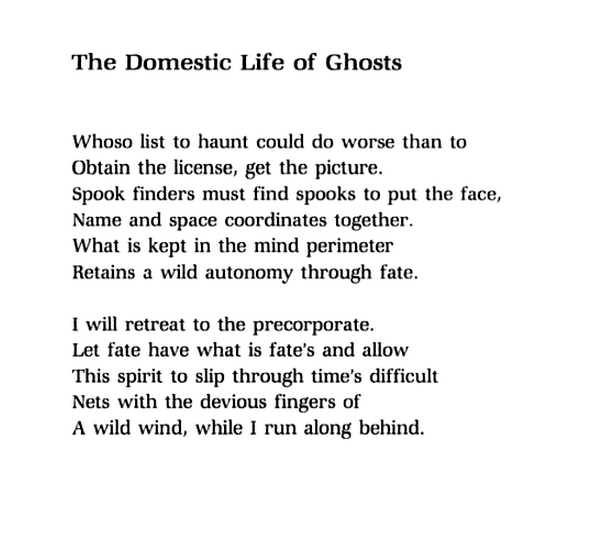
Topless Ezra Pound

ep

Alice Munro Wins the 2013 Nobel Prize in Literature

410519_alice_munro_555x203

Canadian writer Alice Munro has won the 2013 Nobel Prize in Literature.

Munro, 82, has written over a dozen short story collections in her career. Most of her stories–composed in a mode of psychological realism reminiscent of 19th-century modernism—focus on the lives of people in a small rural pocket of Canada. Munro’s stories appear with an almost-alarming ubiquity, popping up every year in the big anthologies and the best magazines (Jonathan Franzen’s 2004 claim that “outside of Canada, where her books are No. 1 best sellers, she has never had a large readership” strikes me as odd).

For an appreciative and comprehensive look at her work, take a look at this guide at The Millions. For a contrarian take on Munro, read Christian Lorentzen’s essay in The LRB.

Or, better yet, make your own informed opinion by reading some of her stories:

“Boys and Girls”

“Gravel”

“The Bear Came Over the Mountain”

“Fiction”

“Bach,” An Anecdote by Heinrich von Kleist

Bach, when his wife died, had to arrange for the funeral. The poor man, however, was in the habit of leaving all practical matters to his wife, with the result that when when an old servant appeared, asking him for money to buy mourning crepe, Bach, weeping quietly, his head resting on the table, said, “Ask my wife.”

–Heinrich von Kleist

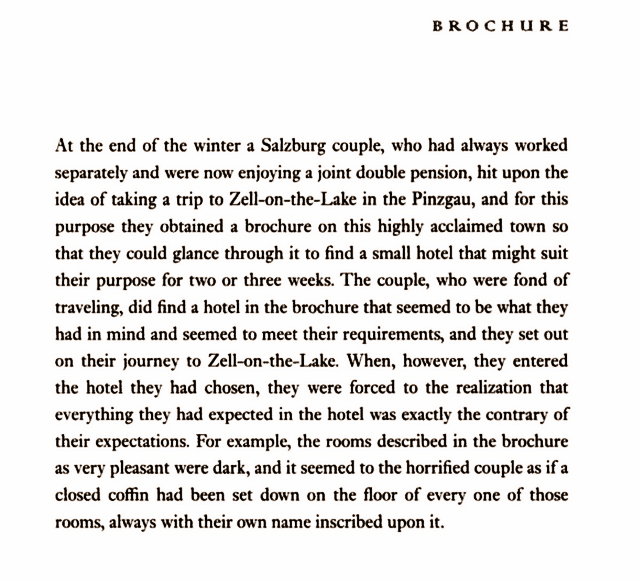
“Brochure” — Thomas Bernhard

brochure

“The Already Wildly Implausible Real We’re All Struggling to Absorb” | Carl Shuker Talks to Biblioklept About His Novel Anti Lebanon

New Zealand writer Carl Shuker is the author of four novels, including Three Novellas for a Novel, cult novel The Lazy Boys, and The Method Actors. His latest novel is Anti Lebanon (Counterpoint Press) is a strange work of surreal horror, set primary in Lebanon in the immediate fallout of the Arab Spring.  In my review, I wrote that Anti Lebanon’s “trajectory repeatedly escapes the reader’s expectations, driving into increasingly alien terrain.”

Carl was kind enough to talk about his work over a series of emails. He was especially kind in letting Biblioklept publish the short story “Fiction” which he mentions in the first part of this interview.

Carl Shuker Author Photo B&W

Biblioklept: How did Anti Lebanon begin? Did you set out to write about a Lebanese Christian? Tell us about the genesis of the novel and your research process.

Carl Shuker: Anti Lebanon started with the words, and the disjunction between my sense memories of the words, the place names and the language, and the atrocity exhibition of the Lebanese civil war of ‘75-’90 (which we are reliving now in the Syrian civil war).

I was brought up moderately conservative Anglican, which early on involved a lot of Bible stories and Sunday school. I had a very deep and powerful connection with the vocabulary. I remember tasting the words in a totally engrossing synesthesia: lying in bed in a small town in the South Island of New Zealand, ten years old and waiting for sleep and saying the words to myself.

Lebanon, for example, was thick milk and Alpine honey (as Nabokov once described his life). You can taste it in those pregnant Bs, those labile Ls and sonorous Os and Ns. And Syria and Damascus—with the latter I had generated some fertile misprision, I think, because into it I had somehow conflated “alabaster.” So the city had the word within it, and these cool and chalky white walls I felt up under my fingernails were as real to me as the blanket at my cheek. Jounieh, Jtaoui, and Bsharre; Ehden, and Zghorta.

Sometime in late 2006 I lost my agent (of only two years), via a one-paragraph email entitled, chillingly, “Cutting back.” He was a bit older and I hadn’t made him any money so it was understandable.

I saw, after eight years of trying to get it published, that although it did well critically and got a very cult following of some very cool and interesting people (a lot of eastern European teenage girls, pleasingly), that The Lazy Boys (2006) was not going to be any kind of breakthrough. There would be no musical. That book does sometimes feel to me like a cursed chalice. Another two years of querying agents for my Three Novellas for a Novel project had not gotten me representation again. I had no publisher for it. A long-gestating film project with a director and producer finally fell through due to funding and all the difficulties surrounding that. (The screenplay for The Lazy Boys is sitting humming in my drawer.)  I was running out of money I had from a prize and I felt after nearly ten years of work I was back almost at square one. Currently I have no agent and I think I’m fortunate to have gotten through the current convulsions in publishing under my own steam. I don’t know what I’d advise a young writer right now, about getting represented.

With writing and publishing, which is a tough and demanding ambient, the cliché is very useful: you get bitter or you get better. Working on a new thing is the best and only antidote to publishing an old thing. It’s always and only the writing that saves you. I started looking around for a new project. Though I don’t write short stories I wrote a suicide note for the lit-fict writer of the time and of the writer I’d almost become, a short story called “Fiction” that started to encompass elements of this new obsession with Lebanon, and to extend it to the consequences of that obsession.

I’m intuitive and a weird hybrid of deeply elemental and playful and airy fairy when I look around for a new project. But I’ve learned to identify and focus in on my obsessions, which is an important skill for a novelist. And usually it is what is troubling me; what I can’t figure out.

Etienne Sakr, a Christian militia leader in the civil war, who has been subsequently exiled and tarred as a rightist and racist and has not emerged from the post-war period at all well, wrote, “Politics is not the art of the possible. Politics, like all great art forms, is the art of the impossible. Otherwise there is no problem to resolve.”

Like all great art forms. This was a conception of the novel as well. The writing is a resolving of unresolved and seemingly irresolvable elements—it’s a tension, also, that can sustain you through the long period of composing something as big and demanding as a novel. Solving some problem you couldn’t any other way.

And the solution was the mode I think I am refining, that I work in by default anyhow. Freud in The Interpretation of Dreams: “Contradictory thoughts do not try to eliminate one another, but continue side by side, and often combine to form condensation products, as though no contradiction existed.”

In Anti Lebanon it was: how to resolve and express this deep but wordless feeling I have for the words of this country, the bloody holy dirt of this country, and the tropes and gestures of the vampire, the monster?

I prepped and read as much as I could on the civil war, and went to Beirut in May 2008 to taste the dirt. This was the same month I published the Three Novellas in serial online for a limited time for free or more, a la Radiohead’s In Rainbows, clearing the decks for something new (These were rereleased with a new introduction, for all ebook formats, in 2011: http://www.threenovellasforanovel.com).

And while I was there Hezbollah invaded Beirut, and I was given my novel to the sound of gunfire in the west, to the sight of an old Christian making fun of the Ashura and of the Shi’a who now owned his city and his country, wearing a comedy fez and mock self-flagellating with a plastic whip.

Biblioklept: Was it always in your head to introduce the vampire element into the plot? How did that come about?

CS: Well, when I started Anti Lebanon I started with the scene in the amusement park with my protagonist Leon, a security guard there who’s fallen asleep and wakes up to “a dead and freakish still.” I had all these materials in my head for the book:

I had the country, my obsession with it. I had the this amazing historical moment when Hezbollah took over, in response to the Sunni-heavy government under Saad Hariri trying to control them, to shut down their illegal communications network. The revenge of the Shia in Lebanon against the Sunni who have always looked down upon them. And the first time the seemingly untouchable Hezbollah turned their guns against fellow Lebanese. It was a complex contemporary political and military moment that I think novels have a particular genius in showing us, if novelists would only look at them.

I had Christians in Lebanon after the civil war. All the tragedy and the bloodthirstiness of Lebanese Christianity. The decline of things, which I’m very attracted to: pride in decline. And I had this character of Leon’s father very powerfully in mind: a big Christian, both physically and in personality; a security guard, a burly, charismatic, working man and leader and a civil war veteran. A man I became friendly with in east Beirut. One of those powerful male figures in our lives we feel are untouchable and always right. (“Three times jujitsu champion of Lebanon during the civil war; when? who remembers; who knows now.”) I had the contradictions creeping into his life, as the Hezbollah he has to support, because the Christian party he supports has aligned with them, do something very ambiguous and worrying.

But there was something missing, some binding element, or catalyst, some next level shit that could help the novel embody the whole messy idea. Somehow represent the addiction to violence, the ancestral handing-down of this kind of obligation to violence, and the sense of the blood in the soil always under your feet in Beirut. Walking a particular corner, looking at the men outside Phalange headquarters, and knowing Black Saturday started here where you stand. I had always wanted to write a vampire, one day. It was right in front of me, begging me to see it.

When I finally realised it, that was when the problems started.

Biblioklept: Okay—you can’t just stop there. Tell us about those problems.

CS: Oh my God. It would seem so silly and all writers’ problems when it comes to actually writing are the same or similar. Not finding a voice. Doubting your own voice. Time. Jobs. Debt. Money. Doubt, principally. The only mentionable and salvageable things, because they are, in retrospect, possibly funny, are the symptoms: I became convinced I was losing my hair. I went to an ER one day and had to abashedly (I was then a 36-year-old heavy smoker) tell the doctor (kind of leaning into him, and making an “I know this sounds stupid” face) that I thought I might be having a heart attack.

You don’t want to go into the emotions you feel when you enter a hospital ER thinking you’re having a heart attack and leave with some over-the-counter Gaviscon and one rogue ECG electrode still stuck to your ribs.

There were pressures. The worst were probably internal. But when my daughter was born she slept a lot of the time and I had a sudden superhuman burst of clarity and focus and went through the entire manuscript again stem to stern, took two weeks off work to rewrite one of the Japan sequences where Beirut and Lebanon had slipped off the page and the book had gotten floaty and lost, and then almost immediately I submitted it to Jack Shoemaker.

Anti_lebanon_CAT

Biblioklept: The final third of the book, those Japan sequences and the Israel bit, those are some of my favorites. I think there’s a lot of picaresque energy there. Was Jack Shoemaker your editor as well as publisher?

CS: Jack is my first reader, then there’s a second, but he’s never edited me as a copy editor edits. He’s always been my greatest advocate and is an amazing reader (and his list speaks for itself) but I don’t even know if he edits anyone any more. My editor on the first two books was the incomparable Trish Hoard, who was then one half of Shoemaker and Hoard before Jack got Counterpoint back.

Biblioklept: Were you ever pressured or tempted to play up the vampire aspect of the novel as a means to, I don’t know, bolster its commercial appeal?

CS: Well I started the book in 2008 and very soon after Twilight hunched and slouched and pouted into my awareness and after about six seconds of thinking “oh cool, trickledown” I realised it was an unmitigated disaster for me. Not only was my vampirism in Anti Lebanon supposed to be truly terrifying – and geopolitical, and religious – plus it had to do with sex but was also kind of unsexy in the easier ways (in that the sex in the book is constrained by religion, and is difficult and a bit sad and more about relief and frustration), but it was also the kind of vampirism I actually believed in: a nearly physical manifestation of a metaphor that is so persistent and pervasive and persuasive: a shade.

So I asked myself would the audience of Twilight and True Blood really want to broaden their fun base into a novel about Beirut, Hezbollah, the Lebanese civil war and the Christian exodus, and I decided probably not. So I thought so I’m writing the wrong kind of vampirism to speak to these people, and too much vampirism to speak to everybody else who’s thoroughly sick of it, and I’m screwed when it comes to publication.

But the metaphor was so true and so right and the novel started to click “like a fucking Geiger counter” as dfw would have it, so I really had no choice. I stuck by the kind of vampire the book was into and the kind of questions the book was asking: is he or is he not a vampire? What is a vampire really? If the historical record clearly demonstrates so many acts that are far, far worse and the cause of so much more blood spilled than any act of vampirism, then what kind of creature is a vampire? Is he mourning?

Late in the war a Christian priest was quoted as saying, “For a long time it was fun. Playing in our own blood.”  I put alongside this a Patrick Chauvel photograph of a priest in robes standing in a pile of shells firing a 50-cal. machine gun in south Lebanon in 1985. The glee on his face. A soldier beside him with his face in his hand. The material in the “pyr” chapter, about PLO soldiers ransacking the the Christian mausoleums in Damour: it was all true. What more evidence did I need? All good lit, music, film goes against what prevailing fashions, even if they’re dealing in the same ostensible material.

And here we recognize conclusive evidence of pyr: The process of exection extended to the dead. The Damour cemetery was invaded and it was a rout. They rooted out the corpsesnipers from the mausoleums, dragged the skeletonsoldiers from their elaborate Christian coffins, stripped them of their mortuary best, murdered their cadavers, pulling rib from rib, penetrating the vacant insides to locate and despoil and exect the very Christian soul.

Anti Lebanon – 150

Plus, in terms of “commercial appeal”, Etienne Sakr said another smart thing:

“When you are fighting you either follow the cause and don’t get the money, or you follow the money and lose the cause.”

Biblioklept: There’s a lot in the book that makes the reader go, “Wait, what?” Is this real? Is this really happening to Leon? Is this in his head?” The section in Israel for example . . .

CS: The idea became for me the discipline of this particular novel, which was to attempt to analogise contemporary Christian Lebanon while invoking and revitalising the vampire genre. [Note: some spoilers follow in this response only]

Leon is a young Christian in a very precarious situation. Yet paradoxically he and his father are security guards. (The novel is riddled with them – and Leon kills one later.) With some fellow Christians he commits, through a fin de siècle hedonism, accident and the absence of inhibition bred of desperation and overfamiliarity, a violent crime against, not a rival sect, but a fellow Christian. This is the vulnerable, damaged Armenian jeweller Frederick Zakarian. And, believing him dead, as they try to dispose of his body Zakarian, tied up but seemingly still alive, bites him. With the only weapon Zakarian has any longer. Teeth.

It is here (though for close readers the inevitability is triggered at the threshold to Zakarian’s workshop) that the narrative attempts to successfully double or mirror Leon – as vampire, as criminal, as victim, failed son, inheritor of paternal sin and a psychology overdetermined by violence, and simply as mourning brother. To me, being undead and mourning share a lot of the same qualities.

There was a wonderful 1984 Playboy interview with the Druze leader Walid Jumblatt (despite the blood and compromise on his hands a very interesting polymath and political genius, who showed William Dalrymple the rooms of priceless religious artifacts he’d saved from the war – see Dalrymple’s excellent From the Holy Mountain). I had it as an epigraph for a time:

Q: How do you deal with those feelings on a personal level? How does it feel not to know if you or your family will live through another day?

A: We become inhuman. We no longer respond to normal human feelings.

—interview with Walid Jumblatt, Playboy 1984

Leon flees Lebanon when it becomes clear the Armenians, missing their man and the jewels he was working on (destined for Iranians), are talking to the Christians of Beirut who have decades-old scores to settle against Leon’s father for his alliances in the civil war. The factions begin to align around money. Leon’s flight from Lebanon also simply mirrors in a particular sense the horrible inevitability of the more general Christian flight after 1400 continuous years of settlement in that one place.

The scenes in Israel you mention, that feature a psychic during immigration questioning at the Allenby Bridge border: these are simply in-context extrapolations of the already wildly implausible real we’re all struggling to absorb.

Biblioklept: Can you tell us what you’re working on now? I know you’ve been working on something new…

CS: [sotto voce] Right now I’m writer in residence at Victoria University of Wellington’s International Institute of Modern Letters, and the generosity and good company of students and staff here have allowed me to get 60,000 words into a new novel set in a medical journal in London. It’s a social comedy in the world of work, with a Straw Dogs strand and a healthy skepticism for the whole project of “a social comedy in the world of work” driving the plot—like Saki meeting Julio Cortazar in an argument over grammar and style in a London pub full of eccentric, driven healthcare professionals.

Biblioklept: Have you ever stolen a book?

CS: I once rescued Burroughs’ Cities of the Red Night (in English) from a trashcan in Tokyo (and stole a great nickname for one of my dark drinking lazy boys: “Pazuzu, of the rotting genitals’). I was also prohibited from graduating from Victoria due to more than $1000 in overdue fees from the library. One of the books was David Bergamini’s astonishing Japan’s Imperial Conspiracy. So I have no regrets.

“The Great Hug” — Donald Barthelme

“The Great Hug” by Donald Barthelme

At the last breakfast after I told her, we had steak and eggs. Bloody Marys. Three pieces of toast. She couldn’t cry she tried. Balloon Man came. He photographed the event. He created the Balloon of the Last Breakfast After I Told Her — a butter- colored balloon. “This is the kind of thing I do so well,” he said. Balloon Man is not modest. No one has ever suggested that. “This balloon is going to be extra-famous and acceptable, a documentation of raw human riches, the plain canvas gravy of the thing. The Pin Lady will never be able to bust this balloon, never, not even if she hugs me for a hundred years.” We were happy to have pleased him, to have contributed to his career.

The Balloon Man won’t sell to kids. Kids will come up to the Balloon Man and say, “Give us a blue balloon, Balloon Man,” and the Balloon Man will say, “Get outa here kids, these balloons are adults-only.” And the kids will say, “C’mon, Balloon Man, give us a red balloon and a green balloon and a white balloon, we got the money.” “Don’t want any kid-money,” the Balloon Man will say, “kid-money is wet and nasty and makes your hands wet and nasty and then you wipe ’em on your pants and your pants get all wet and nasty and you sit down to eat and the chair gets all wet and nasty, let that man in the brown hat draw near, he wants a balloon.” And the kids will say, “Oh please Balloon Man, we want five yellow balloons that never pop, we want to make us a smithereen.” “Ain’t gonna make no smithereen outa my fine yellow balloons,” says the Balloon Man, “your red balloon will pop sooner and your green balloon will pop later but your yellow balloon will never pop no matter how you stomp on it or stick it and besides the Balloon Man don’t sell to kids, it’s against his principles.”

The Balloon Man won’t let you take his picture. He has something to hide. He’s a superheavy Balloon Man, doesn’t want the others to steal his moves. It’s all in the gesture — the precise, reunpremeditated right move. Continue reading ““The Great Hug” — Donald Barthelme”

Read “Fiction,” a Short Story by Carl Shuker

“Fiction” by Carl Shuker

So there was a US novelist, permanently relocated to the UK some years back for an MFA, now mid-list, mid-career and “between books”, thirty-mid-something, author of two well-received novels and a less-well-received book of short stories, product of a labor of ten years on and off, and thus at the quintessential time and place to stall, creatively, who was that kind of writer who worked from emotion thence into intellect and, if he was successful, back once again into emotion, “evoked.“

And he came to the Lebanon looking to be bitten by the dragonfly.

Emotion > intellect > emotion. From the dream to the text to the dream. In practice this meant the not-so-youngish writer knew his subject when it hurt his heart, when it obsessed him and seemed too painful and the hardest thing at which to look. Then the writer knew he would have the dark, acidic energy it took to compose, edit, destroy, recompose, re-edit, polish and eventually finish, after years, a novel something like the kind of novels he loved and aspired to create, the books that made him want to become a writer in the first place. This method, which he fell into rather than chose, in the messy process of finding one’s way as a writer in his twenties, meant that by his early thirties the writer had published first one deliberately thinly veiled book of first-person late-adolescent horror, which counted, for its relative success, on the frisson of a patchwork of à clef-ish links with his own life and on making his own weaknesses—inexperience and naiveté—part of the material, and had published second one semi-immense “follow-up” or “sophomore effort”, as critics who hadn’t read the first book always wrote, a terrific shambling thing that during the long three years of its composition veered in his imagination from being a bloated, confused, constant evasion of a real book, a shadow of the kind of book it aspired to be, to being sometimes briefly the most amazing thing he’d ever read, like, ever; structured, strong, urgent, inevitable; the writer being thrilled and dazzled it’d come out of himself, then brutally depressed and miserable at its derivativeness and the puniness of his talent and by extension his soul, his self. And so how he’d done it (coming back to the MO thing), how he’d surmounted the hugeness and endlessness of the task and this bipolar crippling self-doubt and corresponding occasional massively inflated sense of self-importance was with the choice of a subject so tough, so big and hard, so new, that he had a kind of duty to it; a duty that transcended his own comfort and his own ego. A duty to the world. A subject that humbled and steeled. The second book was published to polite notices but bigger papers and a year or so of peace for the writer, and then the award of a one-year fellowship slash residency at a red-brick university like the one he’d graduated from (in crea writ, natch; the MFA) wherein the writer was immediately expected to write again. Having drawn on his childhood and his adolescence, having spent most of his twenties writing or thinking about writing while not publishing anything, the writer was immediately wary of being seen, by imagined peers, by his remembered brutal adolescent reading self with its impossible but definitive demands, of having sold out or trying to be commercially big, not cool or hard or true or essential, so he carved out a book of singular and odd semifuturistic short stories and a novella that linked them all, in a hazy darkness of second-novel-hangover and fellowship-paid-for Scotch, a clutch of one-night-stands compared to the love affairs of the first books, and worked really hard while never really, really loving these new small strange things, never adoring them like he did the books he’d had to summon forth forces for that were old and presymbolic and frightening. He had an office and stuff, and people knew he was a writer. This hadn’t happened before.

And then he got a job teaching creative writing.

Continue reading “Read “Fiction,” a Short Story by Carl Shuker”

Three Books with Stickers on Them (Books Acquired, Sometime Last Month)

My daughter, six, brought home some books from the library a few weeks ago. “These are good,” she reported, showing them to me. “They have medals on them.”

In the last weeks of last month, I got behind three bemedaled or bestickered books (okay, these aren’t really stickers anymore, but I don’t know what to call the stickers—blazons? Emblems? Medals?)—here they are:

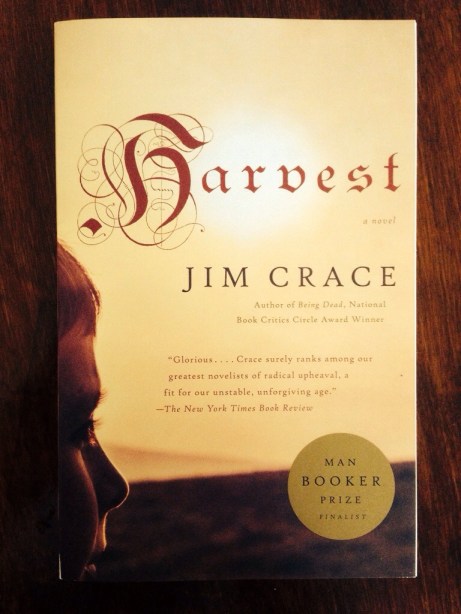
20131006-154010.jpg

Jim Crace’s Harvest, beblazoned with a Man Booker Finalist blazon. From The New York Times’s review earlier this year:

In its poetry of the precarious hereafter, “Harvest” calls to mind J. M. Coetzee’s finest and most allegorical novel, “Waiting for the Barbarians.” Like Coetzee, Crace asks large questions: How will ordinary people behave when ripped from their mundane routines, cut adrift from comforting old verities? What suppressed capacity for cruelty may surface? What untested gift for improvised survival?

20131006-154019.jpg

Next: Ayana Mathis’s The Twelve Tribes of Hattie, bemedaled with an Oprah’s Book Club 2.0 medal. I don’t know what 2.0 means here, but the sticker I’ll admit is immediately off-putting. I also originally read the title as The Twelve Tribes of Hottie, also off-putting. The actual premise of the book seems really good though. From The New York Times again:

When the country was too distracted to notice, caught up as it was with two world wars and the Depression, a great movement of people, of some six million African-Americans fleeing the Jim Crow South, was upending the social geography of the country itself. The Great Migration would figure into much of the literature and music of 20th-century urban life — Wright, Ellison, Baldwin and Coltrane — and, decades after it ended, it still lives in myth and shadow, casting a spell upon race relations to this day and captivating the lives and imaginations of its descendants.

Still, there has been no novel like “The Grapes of Wrath” that looks squarely at this migration, which might have been the promise and yet not the purpose of so raw and intimate a book as “The Twelve Tribes of Hattie,” the debut novel of ­Ayana Mathis. The story it tells works at the rough edges of history, residing not so much within the migration itself as within a brutal and poetic allegory of a family beset by tribulations. The narrative opens in 1925, as Hattie Shepherd, a 17-year-old wife and mother newly ­arrived in Philadelphia from Georgia, ­administers mustard poultices and droplets of ipecac to save her infant twins from the pneumonia that has crept into their limp bodies. Because of her desperate circumstances in the cold of the North, she loses her twins “in the order in which they were born.”

20131006-154027.jpg

Finally, Olen Steinhauer’s An American Spy, bestickered with A New York Times Notable Book sticker. You know what? Im just gonna go ahead and borrow from The New York Times review again:

Not since John le Carré has a writer so vividly evoked the multilayered, multifaceted, deeply paranoid world of espionage, in which identities and allegiances are malleable and ever shifting, the mirrors of loyalty and betrayal reflecting one another to infinity. In this intensely clever, sometimes baffling book, it’s never quite clear who is manipulating whom, and which side is up.

So three books, all from major houses, all garnering accolades (in the form of stickers!), and all prominently and favorably reviewed by The New York Times. I’m sure there’s nothing troubling in this at all.


William Burroughs’s Writing Bunker

burroughs desk writing room

“Disagreement” — Lydia Davis

disagreement

The Complete Short Stories of J.G. Ballard (Second Riff: Stories of 1960)

jgb_complete_ss400 PREVIOUSLY:

Introductions + stories 1956-1959

IN THIS RIFF:

Stories published in 1960:

“The Sound-Sweep”

“Zone of Terror”

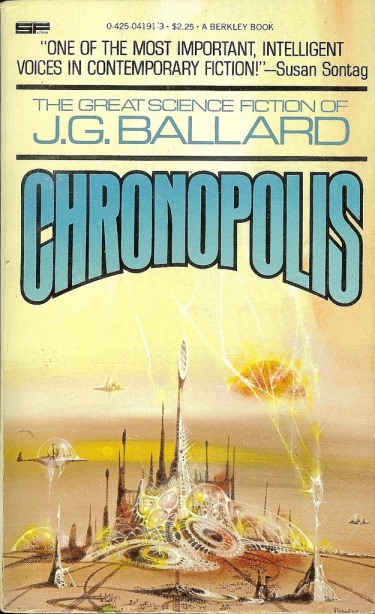
“Chronopolis”

“The Voices of Time”

“The Last World of Mr. Goddard”

1. “The Sound-Sweep” (1960)

Ballard’s strong suit isn’t characterization. In his later writing, he transcends this apparent weakness, employing a style and rhetoric that dispenses with—or nakedly accepts, in some cases—the flatness of his characters. Ballard works in types: the scientist, the madman, the artist, the detective, the ingenue, the explorer, the has-been. Most of his characters are driven by very basic desires—curiosity, madness, revenge. There’s a thin line though between archetypal placeholders and hackneyed stereotypes, and Ballard occasionally stumbles over it in some of these early stories. “The Sound-Sweep” is one such story, plodding along over too many pages, asking its readers to care about characters that lack emotional or psychological depth. And while I don’t think we read Ballard for emotional depth, necessarily, we do read Ballard’s best work because it plumbs the contours of human psychology colliding into nascent technological changes that affect the most basic human senses.

As its title suggests, “The Sound-Sweep” is another early Ballard tale that takes on the sense of sound. The short version: This is a story about noise pollution, and also about how we might sacrifice an artistic way of listening in favor of apparent convenience. As is often the case in these early stories, Ballard constructs the tale to explore the fallout of one particular idea. In this case, that’s “ultrasonic music”:

Ultrasonic music, employing a vastly greater range of octaves, chords and chromatic scales than are audible by the human ear, provided a direct neural link between the sound stream and the auditory lobes, generating an apparently sourceless sensation of harmony, rhythm, cadence and melody uncontaminated by the noise and vibration of audible music. The re–scoring of the classical repertoire allowed the ultrasonic audience the best of both worlds. The majestic rhythms of Beethoven, the popular melodies of Tchaikovsky, the complex fugal elaborations of Bach, the abstract images of Schoenberg – all these were raised in frequency above the threshold of conscious audibility. Not only did they become inaudible, but the original works were re–scored for the much wider range of the ultrasonic orchestra, became richer in texture, more profound in theme, more sensitive, tender or lyrical as the ultrasonic arranger chose.

To tease out this idea, Ballard employs a washed-up opera singer, Madame Giaconda (a heavy base of Sunset Boulevard’s Norma Desmond with a heavy dash of Miss Havisham and cocaine), and Mangon, a mute orphan, the titular sound-sweep (should I wax on the Blakean undertones here? No? Okay).

“The Sound-Sweep” plods along over far too many pages, even divvying up the plot into chapters, asking us to care about the relationship between Giaconda and Mangon. The story would probably have made an excellent episode of The Twilight Zone, where performers might give life to some of the flat dialogue here and the constraints of television might compress the plot. The most interesting thing about “The Sound-Sweep”: The tale in some ways anticipates the mp3 and the ways in which music will be consumed:

But the final triumph of ultrasonic music had come with a second development – the short–playing record, spinning at 900 r.p.m., which condensed the 45 minutes of a Beethoven symphony to 20 seconds of playing time, the three hours of a Wagner opera to little more than two minutes. Compact and cheap, SP records sacrificed nothing to brevity. One 30–second SP record delivered as much neurophonic pleasure as a natural length recording, but with deeper penetration, greater total impact.

2. “Zone of Terror” (1960)

Edgar Allan Poe’s “William Wilson” is a much better doppelganger story. “Zone of Terror” reads like a very rough sketch for some of the stuff Ballard will do in his 1962 novel The Drowned World. (Both “Chronopolis” and “The Voices of Time” also clearly anticipate The Drowned World, each with much stronger results).

chronopolis

3. “Chronopolis” (1960)

“Chronopolis” offers an interesting central shtick: Clocks and other means of measuring and standardizing time have been banned. But this isn’t what makes the story stick. No, Ballard apparently tips his hand early, revealing why measuring time has been banned—it allows management to control labor:

‘Isn’t it obvious? You can time him, know exactly how long it takes him to do something.’ ‘Well?’ ‘Then you can make him do it faster.’

But our intrepid young protagonist (Conrad, his loaded name is), hardly satisfied with this answer, sneaks off to the city of the past, the titular chronopolis, where he works to restore the timepieces of the past. “Chronopolis” depicts a technologically-regressive world that Ballard will  explore in greater depth with his novel The Drowned World, but the details here are precise and fascinating (if perhaps ultimately unconvincing if we try to apply them as any kind of diagnosis for our own metered age). Ending on a perfect paranoid note, Ballard borrows just a dab of Poe here, synthesizing his influence into something far more original, far more Ballardian. Let’s include it in something I’m calling The Essential Short Stories of J.G. Ballard.

4.  “The Voices of Time” (1960)

“The Voices of Time” is easily the best of the early stories in the collection. Ballard allows himself to dispense almost entirely with plot, or at least the kind of plot he’s been thus-far constrained by. Instead of the neat concision of his nineteenth century forebears (Chekhov and Poe), Ballard moves to something far more Ballardian (excuse the repetition), opening his text to a range of images and phrases that will repeat throughout his career—the word terminal, drained vessels, cryptic designs and sequences, a kind of psychic detritus the reader is left to account for and monitor. The loose threads in “The Voices of Time” are too many to enumerate. There’s a mutant armadillo and a girl named Coma. Mass narcolepsy and cacti that absorb gold from the earth as a shield against radiation. And sleep. And de-evolution:

…thirty years ago people did indeed sleep eight hours, and a century before that they slept six or seven. In Vasari’s Lives one reads of Michelangelo sleeping for only four or five hours, painting all day at the age of eighty and then working through the night over his anatomy table with a candle strapped to his forehead. Now he’s regarded as a prodigy, but it was unremarkable then. How do you think the ancients, from Plato to Shakespeare, Aristotle to Aquinas, were able to cram so much work into their lives? Simply because they had an extra six or seven hours every day. Of course, a second disadvantage under which we labour is a lowered basal metabolic rate – another factor no one will explain. …

… It’s time to re–tool. Just as an individual organism’s life span is finite, or the life of a yeast colony or a given species, so the life of an entire biological kingdom is of fixed duration. It’s always been assumed that the evolutionary slope reaches forever upwards, but in fact the peak has already been reached, and the pathway now leads downward to the common biological grave. It’s a despairing and at present unacceptable vision of the future, but it’s the only one. Five thousand centuries from now our descendants, instead of being multi–brained star–men, will probably be naked prognathous idiots with hair on their foreheads, grunting their way through the remains of this Clinic like Neolithic men caught in a macabre inversion of time. Believe me, I pity them, as I pity myself. My total failure, my absolute lack of any moral or biological right to existence, is implicit in every cell of my body…

I harped on Ballard’s lack of characterization earlier, and “The Voices of Time” makes no strong case for its author’s ability to create deep, full characters. What Ballard does very very well though is harness, express, and communicate the intellect of his smart, smart characters—something many if not most other writers (contemporary or otherwise) can’t do, despite any technical prowess they may possess. “The Voices of Time” doesn’t just tell you that its heroes and antiheroes are brilliant (and/or mad)—it shows you.

Marvelous stuff. Include it in The Essential Short Stories of J.G. Ballard

5. “The Last World of Mr. Goddard” (1960)

More Twilight Zone stuff. God-dard. Lilliput, sort of. Doll’s house. Etc. A one-note exercise that I doubt is worth your time. Skip it.

6. On the horizon:

Ballard anticipates how hollow and stale contemporary writing will become in “Studio Five, The Stars.”

“A Lesson for This Sunday” — Derek Walcott

“A Lesson for This Sunday” by Derek Walcott

The growing idleness of summer grass
With its frail kites of furious butterflies
Requests the lemonade of simple praise
In scansion gentler than my hammock swings
And rituals no more upsetting than a
Black maid shaking linen as she sings
The plain notes of some Protestant hosanna—
Since I lie idling from the thought in things—

Or so they should, until I hear the cries
Of two small children hunting yellow wings,
Who break my Sabbath with the thought of sin.
Brother and sister, with a common pin,
Frowning like serious lepidopterists.
The little surgeon pierces the thin eyes.
Crouched on plump haunches, as a mantis prays
She shrieks to eviscerate its abdomen.
The lesson is the same. The maid removes
Both prodigies from their interest in science.
The girl, in lemon frock, begins to scream
As the maimed, teetering thing attempts its flight.
She is herself a thing of summery light,
Frail as a flower in this blue August air,
Not marked for some late grief that cannot speak.

The mind swings inward on itself in fear
Swayed towards nausea from each normal sign.
Heredity of cruelty everywhere,
And everywhere the frocks of summer torn,
The long look back to see where choice is born,
As summer grass sways to the scythe’s design.

“The Domestic Life of Ghosts” — Tom Clark

tc

Ten Notes from Nathaniel Hawthorne’s Note-Books

  1. Anciently, when long-buried bodies were found undecayed in the grave, a species of sanctity was attributed to them.
  2. Some chimneys of ancient halls used to be swept by having a culverin fired up them.
  3. At Leith, in 1711, a glass bottle was blown of the capacity of two English bushels.
  4. The buff and blue of the Union were adopted by Fox and the Whig party in England. The Prince of Wales wore them.
  5. In 1621, a Mr. Copinger left a certain charity, an almhouse, of which four poor persons were to partake, after the death of his eldest son and his wife. It was a tenement and yard. The parson, headboroughs, and his five other sons were to appoint the persons. At the time specified, however, all but one of his sons were dead; and he was in such poor circumstances that he obtained the benefit of the charity for himself, as one of the four.
  6. A town clerk arranges the publishments that are given in, according to his own judgment.
  7. To make a story from Robert Raikes seeing dirty children at play, in the streets of London, and inquiring of a woman about them. She tells him that on Sundays, when they were not employed, they were a great deal worse, making the streets like hell; playing at church, etc. He was therefore induced to employ women at a shilling to teach them on Sundays, and thus Sunday-schools were established.
  8. To represent the different departments of the United States government by village functionaries. The War Department by watchmen, the law by constables, the merchants by a variety store, etc.
  9. At the accession of Bloody Mary, a man, coming into a house, sounded three times with his mouth, as with a trumpet, and then made proclamation to the family. A bonfire was built, and little children were made to carry wood to it, that they might remember the circumstance in old age. Meat and drink were provided at the bonfires.
  10. To describe a boyish combat with snowballs, and the victorious leader to have a statue of snow erected to him. A satire on ambition and fame to be made out of this idea. It might be a child’s story.

Notations from Nathaniel Hawthorne’s American Note-Books


“Lead us into temptation, and deliver us from no evil” (Thomas Bernhard)

“I used to take sleeping pills,” he said, “and slowly boosted the number of pills I took. In the end, they had absolutely no effect on me, and I could have gulped any number of them, and still not have got to sleep. I repeatedly took such high dosages, I should have died. But I only ever vomited them up. Then I would be unable for days to pursue the least thought, and it was precisely this inability to think that got me through long periods of complete horror … You have to be careful you don’t end up living for longer than your natural lifespan,” he said. “Life is a court case which you lose, whoever you are, and whatever you do. That was decided before any human being was even born. The first man fared no differently from us. Rebellion against this only leads to deeper despair,” he said. “And no more distraction. From the age of thirteen, no more distraction. After the first sexual experience, no distraction. Do you understand?” The only variety was thunderstorms, “and lightning the only poetry.” He said: “Seeing as you’re locked up, locked up in solitary confinement, you’re increasingly thrown back upon yourself.” The questions one asked oneself slowly became one’s death. “But you know, we’re all dead anyway from the outset.” There were simply “no more forms of assistance.” One lay on the floor of one’s cell, along with the shattered limbs of past millennia. “Deceits and subterfuges,” he said. Just as the handling of facts injected insignificance into the brain, whatever question one asked oneself. “Every question is a defeat.” Every question wrought devastation. Disinclination. With questions, the time passed, and the questions passed in time, “so meaningless that everything is just ruins … There, you see,” said the painter, “it’s quite black down there. Last night, I dreamed the workers climbed up the mountain, and flooded the village and the inn and everything. In their thousands and tens of thousands, they swarmed up here, and whatever didn’t belong to them, they trampled underfoot, or it was suffocated in their blackness. How calm it is now! Listen!” The butcher greeted us, and we greeted him back. The houses of Weng seemed jumbled together, as though crushed at the foot of the cliff. “Earlier,” said the painter, “I used to have no pity for human frailty. Any pain seemed to me unnatural! Suddenly I saw myself confronted with an abundance of frailty.” He said: “Will you be playing cards tonight? The knacker is a good cardplayer. The engineer as well. They’re all of them good cardplayers. I don’t know why I’ve always had such an aversion to cardplayers.” He muttered something about cretinism in the mountain valleys, in the high Alps. And then: “Our Father, who art in Hell, unhallowed be Thy name. No Kingdom come. Thy will not be done. On earth, as it is in Hell. Deny us this day our daily bread. And forgive us no trespasses. As we forgive none of those that trespass against us. Lead us into temptation, and deliver us from no evil. Amen. That one works just as well,” he said.

From Thomas Bernhard’s novel Frost.


Biblioklept’s Dictionary of Literary Terms

ALLEGORY

Didactic extended metaphor, best enjoyed amorally.

BIOGRAPHY

The sordid and lurid details of an author’s life; use as a critical rubric if the author’s work seems beyond comprehension.

CATACHRESIS

Mixed or imprecise metaphor. When an author stretches her words like taffy across the loom of meaning.

DEATH OF THE NOVEL

Declare the novel dead every few weeks. Resuscitate as necessary.

EPIC

Originally used to denote lengthy narrative works concerning serious subjects, this term may now be applied freely to modify failure, coffee, tacos, kittens, etc.

FANTASY

An inventive and imaginative style of fiction eschewed and denigrated by serious readers and writers.

GNOMIC POETRY

Poetry composed in the secret language of garden gnomes, inaudible to mortal ears.

HUBRIS

Defining common characteristic of all politicians.

IRONY

Dominant mode of much of 21st century communication (including, lamentably, this list).

JOYCEAN

Hyperbole used to describe lengthy works of contemporary authors. Use to disappoint potential readers.

KENNING

Circumlocution of meaning. E.g. “feed the eagle” for “kill,” “battle-sweat” for “blood,” “tube of garbage” for “internet.”

LEONINE VERSE

Poetry about lions.

MORAL

Each reader’s personal misunderstanding of the meaning of a work of literature.

NONFICTION

What your father reads.

OPEN LETTER

A solipsistic bid for attention delivered under the pretense of reaching out to another entity.

PASTORAL

Use to describe any work of literature set outside of a city.

QUATRAIN

A stanza

or poem

composed of

four lines.

RED HERRING

A false clue employed by an author to distract the reader. A novel where all points of evidence are red herrings (preferable) is a shaggy dog story.

STRUCTURALISM

Grab bag of theories you learned in college.

TRILOGY

Elevate any degraded work of pop culture by repeating it twice. Reboot as necessary.

UNRELIABLE NARRATOR

This narrator cannot be depended upon to pick you up from the airport, water your plants while you’re away, meet you on time for a beer or coffee, return small loans, etc.

VICTORIANISM

Indicative of literature of the prudish, uptight Victorian Era. Famous Victorian works include Venus in FursThe Pearl, and The Lustful Turk.

WITTGENSTEIN

Twentieth-century philosopher. Quote the first and last lines of his book Tractatus Logico-Philosophicus frequently (don’t worry about reading anything in between).

XENOPHOBIA

Fear of warrior princesses.

YELP

The pinnacle of contemporary criticism.

ZEUGMA

The list ended with zeugma and disappointment.

(Previous entries here and here).

Susan Sontag on W.G. Sebald

Susan Sontag on W.G. Sebald:

IS LITERARY GREATNESS still possible? Given the implacable devolution of literary ambition, and the concurrent ascendancy of the tepid, the glib, and the senselessly cruel as normative fictional subjects, what would a noble literary enterprise look like now? One of the few answers available to English-language readers is the work of W. G. Sebald.

Vertigo, the third of Sebald’s books to be translated into English, is how he began. It appeared in German in 1990, when its author was forty-six; three years later came The Emigrants; and two years after that, The Rings of Saturn. When The Emigrants appeared in English in 1996, the acclaim bordered on awe. Here was a masterly writer, mature, autumnal even, in his persona and themes, who had delivered a book as exotic as it was irrefutable. The language was a wonder—delicate, dense, steeped in thinghood; but there were ample precedents for that in English. What seemed foreign as well as most persuasive was the preternatural authority of Sebald’s voice: its gravity, its sinuosity, its precision, its freedom from all-undermining or undignified self-consciousness or irony.

In W. G. Sebald’s books, a narrator who, we are reminded oc­casionally, bears the name W. G. Sebald, travels about registering evidence of the mortality of nature, recoiling from the ravages of modernity, musing over the secrets of obscure lives. On some mission of investigation, triggered by a memory or news from a world irretriev­ably lost, he remembers, evokes, hallucinates, grieves.

Is the narrator Sebald? Or a fictional character to whom the author has lent his name, and selected elements of his biography? Born in 1944, in a village in Germany he calls “W.” in his books (and the dust jacket identifies for us as Wertach im Allgau), settled in England in his early twenties, and a career academic currently teaching modern German literature at the University of East Anglia, the author in­cludes a scattering of allusions to these bare facts and a few others, as well as, among other self-referring documents reproduced in his books, a grainy picture of himself posed in front of a massive Lebanese cedar in The Rings of Saturn and the photo on his new passport in Vertigo. Continue reading “Susan Sontag on W.G. Sebald”