“The Alcotts” — Charles Ives

“The Alcotts” by Charles Ives

If the dictagraph had been perfected in Bronson Alcott’s time, he might now be a great writer. As it is, he goes down as Concord’s greatest talker. “Great expecter,” says Thoreau; “great feller,” says Sam Staples, “for talkin’ big … but his daughters is the gals though—always DOIN’ somethin’.” Old Man Alcott, however, was usually “doin’ somethin'” within. An internal grandiloquence made him melodious without; an exuberant, irrepressible, visionary absorbed with philosophy AS such; to him it was a kind of transcendental business, the profits of which supported his inner man rather than his family. Apparently his deep interest in spiritual physics, rather than metaphysics, gave a kind of hypnotic mellifluous effect to his voice when he sang his oracles; a manner something of a cross between an inside pompous self-assertion and an outside serious benevolence. But he was sincere and kindly intentioned in his eagerness to extend what he could of the better influence of the philosophic world as he saw it. In fact, there is a strong didactic streak in both father and daughter. Louisa May seldom misses a chance to bring out the moral of a homely virtue. The power of repetition was to them a natural means of illustration. It is said that the elder Alcott, while teaching school, would frequently whip himself when the scholars misbehaved, to show that the Divine Teacher-God-was pained when his children of the earth were bad. Quite often the boy next to the bad boy was punished, to show how sin involved the guiltless. And Miss Alcott is fond of working her story around, so that she can better rub in a moral precept—and the moral sometimes browbeats the story. But with all the elder Alcott’s vehement, impracticable, visionary qualities, there was a sturdiness and a courage—at least, we like to think so. A Yankee boy who would cheerfully travel in those days, when distances were long and unmotored, as far from Connecticut as the Carolinas, earning his way by peddling, laying down his pack to teach school when opportunity offered, must possess a basic sturdiness. This was apparently not very evident when he got to preaching his idealism. An incident in Alcott’s life helps confirm a theory—not a popular one—that men accustomed to wander around in the visionary unknown are the quickest and strongest when occasion requires ready action of the lower virtues. It often appears that a contemplative mind is more capable of action than an actively objective one. Dr. Emerson says: “It is good to know that it has been recorded of Alcott, the benign idealist, that when the Rev. Thomas Wentworth Higginson, heading the rush on the U.S. Court House in Boston, to rescue a fugitive slave, looked back for his following at the court-room door, only the apostolic philosopher was there cane in hand.” So it seems that his idealism had some substantial virtues, even if he couldn’t make a living.

The daughter does not accept the father as a prototype—she seems to have but few of her father’s qualities “in female.” She supported the family and at the same time enriched the lives of a large part of young America, starting off many little minds with wholesome thoughts and many little hearts with wholesome emotions. She leaves memory-word-pictures of healthy, New England childhood days,—pictures which are turned to with affection by middle-aged children,—pictures, that bear a sentiment, a leaven, that middle-aged America needs nowadays more than we care to admit.

Concord village, itself, reminds one of that common virtue lying at the height and root of all the Concord divinities. As one walks down the broad-arched street, passing the white house of Emerson—ascetic guard of a former prophetic beauty—he comes presently beneath the old elms overspreading the Alcott house. It seems to stand as a kind of homely but beautiful witness of Concord’s common virtue—it seems to bear a consciousness that its past is LIVING, that the “mosses of the Old Manse” and the hickories of Walden are not far away. Here is the home of the “Marches”—all pervaded with the trials and happiness of the family and telling, in a simple way, the story of “the richness of not having.” Within the house, on every side, lie remembrances of what imagination can do for the better amusement of fortunate children who have to do for themselves-much-needed lessons in these days of automatic, ready-made, easy entertainment which deaden rather than stimulate the creative faculty. And there sits the little old spinet-piano Sophia Thoreau gave to the Alcott children, on which Beth played the old Scotch airs, and played at the Fifth Symphony.

There is a commonplace beauty about “Orchard House”—a kind of spiritual sturdiness underlying its quaint picturesqueness—a kind of common triad of the New England homestead, whose overtones tell us that there must have been something aesthetic fibered in the Puritan severity—the self-sacrificing part of the ideal—a value that seems to stir a deeper feeling, a stronger sense of being nearer some perfect truth than a Gothic cathedral or an Etruscan villa. All around you, under the Concord sky, there still floats the influence of that human faith melody, transcendent and sentimental enough for the enthusiast or the cynic respectively, reflecting an innate hope—a common interest in common things and common men—a tune the Concord bards are ever playing, while they pound away at the immensities with a Beethovenlike sublimity, and with, may we say, a vehemence and perseverance—for that part of greatness is not so difficult to emulate.

We dare not attempt to follow the philosophic raptures of Bronson Alcott—unless you will assume that his apotheosis will show how “practical” his vision in this world would be in the next. And so we won’t try to reconcile the music sketch of the Alcotts with much besides the memory of that home under the elms—the Scotch songs and the family hymns that were sung at the end of each day—though there may be an attempt to catch something of that common sentiment (which we have tried to suggest above)-a strength of hope that never gives way to despair—a conviction in the power of the common soul which, when all is said and done, may be as typical as any theme of Concord and its transcendentalists.

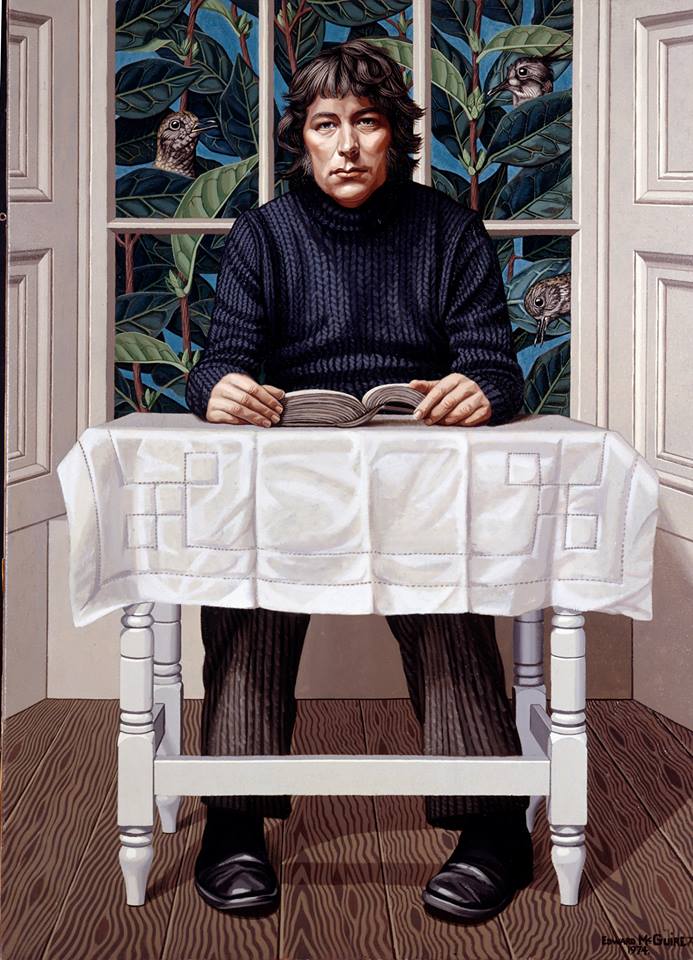


Portrait of Seamus Heaney — Edward McGuire

w285UbI

A gathering impossible/General merriment (From Pynchon’s Against the Day)

A DAY OR TWO LATER, Lew went up to Carefree Court. The hour was advanced, the light failing, the air heated by the Santa Ana wind. Palm trees rattled briskly, and the rats in their nests up there hung on for dear life. Lew approached through a twilit courtyard lined with tileroofed bungalows, stucco archways, and the green of shrubbery deepening as the light went. He could hear sounds of glassware and conversation.

From the swimming pool came sounds of liquid recreation—feminine squeals, deep singlereed utterances from high and low divingboards. The festivities here this evening were not limited to any one bungalow. Lew chose the nearest, went through the formality of ringing the doorbell, but after waiting a while just walked in, and nobody noticed.

It was a gathering impossible at first to read, even for an old L.A. hand like Lew—society ladies in flapper-rejected outfits from Hamburger’s basement, real flappers in extras’ costumes—Hebrew headdresses, belly-dancing outfits, bare feet and sandals—in from shooting some biblical extravaganza, sugar daddies tattered and unshaven as street beggars, freeloaders in bespoke suits and sunglasses though the sun had set, Negroes and Filipinos, Mexicans and hillbillies, faces Lew recognized from mug shots, faces that might also have recognized him from tickets long cold he didn’t want to be reminded of, and here they were eating enchiladas and hot dogs, drinking orange juice and tequila, smoking cork-tip cigarettes, screaming in each others’ faces, displaying scars and tattoos, recalling aloud felonies imagined or planned but seldom committed, cursing Republicans, cursing police federal state and local, cursing the larger corporate trusts, and Lew slowly began to get a handle, for weren’t these just the folks that once long ago he’d spent his life chasing, them and their cousins city and country? through brush and up creek-beds and down frozen slaughterhouse alleyways caked with the fat and blood of generations of cattle, worn out his shoes pair after pair until finally seeing the great point, and recognizing in the same instant the ongoing crime that had been his own life—and for achieving this self-clarity, at that time and place a mortal sin, got himself just as unambiguously dynamited.

He gradually understood that what everybody here had in common was having survived some cataclysm none of them spoke about directly—a bombing, a massacre perhaps at the behest of the U.S. government. . . .

“No it wasn’t Haymarket.”

“It wasn’t Ludlow. It wasn’t the Palmer raids.”

“It was and it wasn’t.” General merriment.

—Thomas Pynchon’s novel Against the Day.


Salem, August 31, 1836 — Nathaniel Hawthorne

Salem, August 31, 1836.–A walk, yesterday, down to the shore, near the hospital. Standing on the old grassy battery, that forms a semicircle, and looking seaward. The sun not a great way above the horizon, yet so far as to give a very golden brightness, when it shone out. Clouds in the vicinity of the sun, and nearly all the rest of the sky covered with clouds in masses, not a gray uniformity of cloud. A fresh breeze blowing from land seaward. If it had been blowing from the sea, it would have raised it in heavy billows, and caused it to dash high against the rocks. But now its surface was not all commoved with billows; there was only roughness enough to take off the gleam, and give it the aspect of iron after cooling. The clouds above added to the black appearance. A few sea-birds were flitting over the water, only visible at moments, when they turned their white bosoms towards me,–as if they were then first created. The sunshine had a singular effect. The clouds would interpose in such a manner that some objects were shaded from it, while others were strongly illuminated. Some of the islands lay in the shade, dark and gloomy, while others were bright and favored spots. The white light-house was sometimes very cheerfully marked. There was a schooner about a mile from the shore, at anchor, laden apparently with lumber. The sea all about her had the black, iron aspect which I have described; but the vessel herself was alight. Hull, masts, and spars were all gilded, and the rigging was made of golden threads. A small white streak of foam breaking around the bows, which ware towards the wind. The shadowiness of the clouds overhead made the effect of the sunlight strange, where it fell.

From Nathaniel Hawthorne’s American Note-Books.


The Chums of Chance Meet the Wandering Sisterhood of the Sodality of Ætheronauts (Pynchon’s Against the Day)

CROSSING THE ROCKIES, they found aloft an invisible repetition of the material terrain beneath them. Three-dimensional flows of cold air followed the flow of rivers far below. Air currents ascended sunny sides of mountains at the same steep angles as colder air drained down the shady sides. Sometimes they would be caught in this cycling, and hung over the ridge-line repeating great vertical circles until Randolph ordered the engines engaged.

It proved a struggle after that, for the wind desired them to go south, and numberless standard cubic feet of engine propellant were wasted against the northerly imperative before Randolph, calculating that they had exceeded their energy allotment, gave up the ship’s immediate future to the wind, and they drifted thus over the Rio Bravo, and into the skies of Old Mexico. So they were borne onward, before winds of obscure sorrow, their clarity of will fitful as the nightly heat-lightning at their horizon.

It was just at that moment of spiritual perplexity that they would be rescued, with no advance annunciation, here, “South of the Border,” by the Sodality of Ætheronauts.

How could they have ever crossed trajectories? Afterward none of the boys could remember where it happened, during which toxic ascent, amid what clamor of bickering by now grown routine, they had blundered into this flying-formation of girls, dressed like religious novices in tones of dusk, sent whirling, scattering before the airship’s star-blotting mass, their metallic wings earnestly rhythmic, buffeting, some passing close enough for the boys to count the bolts on gear-housings, hear the rotary whining of nitro-naphthol auxiliary power-units, grow rigidly attentive to glimpses of bared athletic girl-flesh. Not that these wings, with their thousands of perfectly-machined elliptical “feathers,” even in this failing, grime-filtered light, could ever have been mistaken for angels’ wings. The serious girls, each harnessed in black kidskin and nickel-plating beneath the inescapable burdens of flight, each bearing on her brow a tiny electric lamp to view her control panel by, regrouped and wheeled away into the coming night. Were glances, even then, cast back at the lumbering, engine-driven skycraft? frowns, coquetries, indistinct foreknowledge that it was to be among themselves, these sombre young women, that the Chums were destined after all to seek wives, to marry and have children and become grandparents—precisely among this wandering sisterhood, who by the terms of their dark indenture must never descend to Earth, each nightfall nesting together on city rooftops like a flock of February chaffinch, having learned to find, in all that roofs keep out, a domesticity of escape and rejection, beneath storm, assaults of moonlight, some darker vertical predation, never entirely dreamed, from other worlds.

Their names were Heartsease and Primula, Glee, Blaze, and Viridian, each had found her way to this Ætherist sorority through the mysteries of inconvenience—a train arriving late, a love-letter mistimed, a hallucinating police witness, and so forth.

—Another passage from Thomas Pynchon’s novel Against the Day.


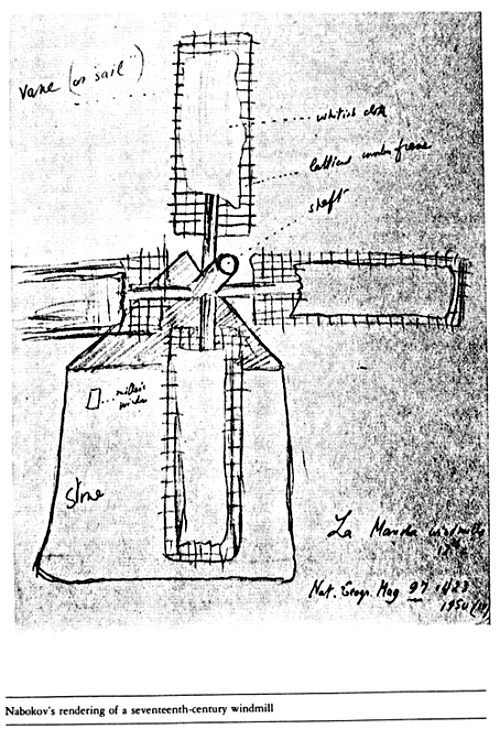
Windmill Drawing — Vladimir Nabokov

Capture

(From Vladimir Nabokov’s Lectures on Don Quixote).

I Hate Everybody (Calvin & Hobbes)

ch

The Conium Review, Vol. 2, No. 2 (Book Acquired, 8,19.2013)

20130824-102848.jpg

This came in the mail a few weeks ago; I read a few of the poems and flash fictions, but haven’t had made time for the stories or the novella. From the The Conium Review’s website:

This issue of The Conium Review contains seventeen poems, five pieces of flash fiction, four short stories, and one novella. The contributing poets and writers are Elena Botts, Valentina Cano, Paola Capó-García, Patrick Cole, Darren C. Demaree, Thomas Dodson, Edward A. Dougherty, Ginger Graziano, Alamgir Hashmi, Kyle Hemmings, Nicholas Kriefall, Connie A. Lopez-Hood, Carlo Matos, Gretchen McGill, Robert McGuill, Thomas Mundt, Catherine Owen, Natalie Peeterse, Richard King Perkins II, Octavio Quintanilla, Charles Rafferty, Scott Ragland, Jonathan H. Roberts, M. A. Schaffner, Jacob Schepers, Claude Clayton Smith, and Emily Strauss. The cover art is courtesy of Loren Kantor.


RIP Seamus Heaney

gm655_01

RIP Seamus Heaney, 1939-2013

“Funeral Rites”

I shouldered a kind of manhood
stepping in to lift the coffins
of dead relations.
They had been laid out

in tainted rooms,
their eyelids glistening,
their dough-white hands
shackled in rosary beads.

Their puffed knuckles
had unwrinkled, the nails
were darkened, the wrists
obediently sloped.

The dulse-brown shroud,
the quilted satin cribs:
I knelt courteously
admiting it all

as wax melted down
and veined the candles,
the flames hovering
to the women hovering
behind me.
And always, in a corner,
the coffin lid,
its nail-heads dressed

with little gleaming crosses.
Dear soapstone masks,
kissing their igloo brows
had to suffice

before the nails were sunk
and the black glacier
of each funeral
pushed away.

II

Now as news comes in
of each neighbourly murder
we pine for ceremony,
customary rhythms:

the temperate footsteps
of a cortège, winding past
each blinded home.
I would restore

the great chambers of Boyne,
prepare a sepulchre
under the cupmarked stones.
Out of side-streets and bye-roads

purring family cars
nose into line,
the whole country tunes
to the muffled drumming

of ten thousand engines.
Somnambulant women,
left behind, move
through emptied kitchens

imagining our slow triumph
towards the mounds.
Quiet as a serpent
in its grassy boulevard

the procession drags its tail
out of the Gap of the North
as its head already enters
the megalithic doorway.

III

When they have put the stone
back in its mouth
we will drive north again
past Strang and Carling fjords

the cud of memory
allayed for once, arbitration
of the feud placated,
imagining those under the hill

disposed like Gunnar
who lay beautiful
inside his burial mound,
though dead by violence

and unavenged.
men said that he was chanting
verses about honour
and that four lights burned

in corners of the chamber:
which opened then, as he turned
with a joyful face
to look at the moon.

“…in the direction of increasing entropy” (Another Riff on Pynchon’s Novel Against the Day)

1. So in the final pages of Against the Day, Thomas Pynchon takes us back to those heroes of the ether who initiated the book, the Chums of Chance. They’ve been absent for a long stretch, with only the occasional mention here or there to assure us that yes, they are still in the narrative, but under its surface, or, rather—invisible (this, in a novel full of invisibility).

2. Example: in a maddening moment, we learn that, via Pugnax’s girlfriend, a dog named Ksenija, “the Chums of Chance had been invisibly but attentively keeping an eye on the progress of Reef’s family exfiltration from the Balkan Peninsula.”

3. Several chapters later, Pynchon makes our sky-heroes visible again; they’ve dramatically expanded the size of their ship Inconvenience and have essentially declared independence from Chums headquarters.

They learn of a strange “updraft” over the Sahara desert that spells new adventure—

Tonight’s meeting was about whether or not to take the Inconvenience into the great updraft over the Sahara without somebody paying for it in advance. Miles called the session to order by bashing upon a Chinese gong acquired years before from an assassination cult active in that country, during the boys’ unheralded but decisive activities in the Boxer Rebellion (see The Chums of Chance and the Wrath of the Yellow Fang), and wheeled around a refrigerated Champagne cart, refilling everyone’s glass from a Balthazar of ’03 Verzenay.

4. And so of course they go, and we get this remarkable passage:

 And as they entered and were taken, Chick Counterfly thought back to his first days aboard the Inconvenience, and Randolph’s dark admonition that going up would be like going north, and his own surmise that one could climb high enough to descend to the surface of another planet. Or, as the commander had put it then, “Another ‘surface,’ but an earthly one . . . all too earthly.”

—and jeez I hate to break in, but I just have to point out that Pynchon is citing himself here, that the lines that Chick Counterfly recollects go all the way back to page nine, to the first chapter of the book.

5. Continuing:

The corollary, Chick had worked out long ago, being that each star and planet we can see in the Sky is but the reflection of our single Earth along a different Minkowskian spacetime track. Travel to other worlds is therefore travel to alternate versions of the same Earth. And if going up is like going north, with the common variable being cold, the analogous direction in Time, by the Second Law of Thermodynamics, ought to be from past to future, in the direction of increasing entropy.

So the great grand theme of bilocation gets tied in here to the novel’s hard sci-fi tropes, all pointing to “increasing entropy.” There are other Chums on other Earths, bilocating into other systems that are breaking “in the direction of increasing entropy.”

6. Which is a fairly accurate description of both the plot and the structure of Against the Day. The novel is shaggy and seemingly fails to cohere because it is a stylistic approximation of entropy.

7. And a few paragraphs later, we get a demonstration of this program. Miles Blundell, the most mystical and reflective Chum, is able to perceive the violence and terror of The Great War that rages below the Chums—who, bilocated, displaced cannot see it—it’s invisible. 

Blundell:

“Those poor innocents,” he exclaimed in a stricken whisper, as if some blindness had abruptly healed itself, allowing him at last to see the horror transpiring on the ground. “Back at the beginning of this . . . they must have been boys, so much like us. . . . They knew they were standing before a great chasm none could see to the bottom of. But they launched themselves into it anyway. Cheering and laughing. It was their own grand ‘Adventure.’ They were juvenile heroes of a World-Narrative—unreflective and free, they went on hurling themselves into those depths by tens of thousands until one day they awoke, those who were still alive, and instead of finding themselves posed nobly against some dramatic moral geography, they were down cringing in a mud trench swarming with rats and smelling of shit and death.”

“Miles,” said Randolph in some concern. “What is it? What do you see down there?”

Miles points out that the “boys” fighting in the war are “so much like” the Chums — “juvenile heroes of a World-Narrative” on their “own grand ‘Adventure'” and then punctures the high heroic rhetoric that marked the Chums episode up until this point, his analysis culminating in the abject image of “a mud trench swarming with rats and smelling of shit and death.” The language and sentiment of the Chums is bilocated, unraveling in the direction of increasing entropy.

Teaser Trailer for James Franco’s Film Adaptation of Cormac McCarthy’s Novel Child of God

So James Franco has taken a stab at Faulkner and one of Faulkner’s literary descendants, Cormac McCarthy—in the same year no less. Franco has adapted McCarthy’s 1973 novel Child of God; the film will play this weekend at the Toronto Film Festival.

Here is my review of McCarthy’s novel Child of God.

“The Bet” — Anton Chekhov

“The Bet” by Anton Chekhov

I

It was a dark autumn night. The old banker was pacing from corner to corner of his study, recalling to his mind the party he gave in the autumn fifteen years before. There were many clever people at the party and much interesting conversation. They talked among other things of capital punishment. The guests, among them not a few scholars and journalists, for the most part disapproved of capital punishment. They found it obsolete as a means of punishment, unfitted to a Christian State and immoral. Some of them thought that capital punishment should be replaced universally by life-imprisonment.

“I don’t agree with you,” said the host. “I myself have experienced neither capital punishment nor life-imprisonment, but if one may judge a priori, then in my opinion capital punishment is more moral and more humane than imprisonment. Execution kills instantly, life-imprisonment kills by degrees. Who is the more humane executioner, one who kills you in a few seconds or one who draws the life out of you incessantly, for years?”

“They’re both equally immoral,” remarked one of the guests, “because their purpose is the same, to take away life. The State is not God. It has no right to take away that which it cannot give back, if it should so desire.”

Among the company was a lawyer, a young man of about twenty-five. On being asked his opinion, he said:

“Capital punishment and life-imprisonment are equally immoral; but if I were offered the choice between them, I would certainly choose the second. It’s better to live somehow than not to live at all.”

There ensued a lively discussion. The banker who was then younger and more nervous suddenly lost his temper, banged his fist on the table, and turning to the young lawyer, cried out:

“It’s a lie. I bet you two millions you wouldn’t stick in a cell even for five years.”

“If you mean it seriously,” replied the lawyer, “then I bet I’ll stay not five but fifteen.”

“Fifteen! Done!” cried the banker. “Gentlemen, I stake two millions.”

“Agreed. You stake two millions, I my freedom,” said the lawyer.

So this wild, ridiculous bet came to pass. The banker, who at that time had too many millions to count, spoiled and capricious, was beside himself with rapture. During supper he said to the lawyer jokingly:

“Come to your senses, young roan, before it’s too late. Two millions are nothing to me, but you stand to lose three or four of the best years of your life. I say three or four, because you’ll never stick it out any longer. Don’t forget either, you unhappy man, that voluntary is much heavier than enforced imprisonment. The idea that you have the right to free yourself at any moment will poison the whole of your life in the cell. I pity you.”

And now the banker, pacing from corner to corner, recalled all this and asked himself:

“Why did I make this bet? What’s the good? The lawyer loses fifteen years of his life and I throw away two millions. Will it convince people that capital punishment is worse or better than imprisonment for life? No, no! all stuff and rubbish. On my part, it was the caprice of a well-fed man; on the lawyer’s pure greed of gold.” Continue reading ““The Bet” — Anton Chekhov”

W.G. Sebald Poem-Fragment

Capture

Don Quixote — Ub Iwerks

Teju Cole’s Dictionary of Received Ideas

Yesterday on Twitter, Teju Cole shared a series of definitions—some ironic, some hilarious funny, all perceptive.

The series of definitions immediately reminded me of Ambrose Bierce’s sardonic work The Devil’s Dictionary, but Cole later tweeted that he had Gustave Flaubert’s Le Dictionnaire des Idées Reçues (The Dictionary of Received Ideas) in mind as a model.

Cole reiterated Flaubert’s influence again when he published the tweets today at The New Yorker under the title “In Place of Thought“—a little sample:

AMERICAN. With the prefix “all,” a blonde.

CHILDREN. The only justification for policy. Always say “our children.” The childless have no interest in improving society.

HILARIOUS. Never simply say “funny.”

HIP HOP. Old-school hip hop, i.e., whatever was popular when you were nineteen, is great. Everything since then is intolerable.

HIPSTER. One who has an irrational hatred of hipsters.

INTERNET. A waste of time. Have a long online argument with anyone who disagrees.

JAZZ. America’s classical music. The last album was released in 1965.

LITERALLY. Swear you’d rather die than use “literally” as an intensifier.

POET. Always preceded by “published.” Function unknown.

Bonus—from Flaubert’s Dictionnaire:

BLACK – Always preceded by “pitch”.

CHILDREN – Affect a lyric tenderness towards  them, when people are about.

INTRODUCTION — Obscene word.

LITERATURE — Idle pastime.

METAPHORS — Always too many in poems. Always too many in anybody’s writing.

OPTIMIST — Synonym for imbecile.

POETRY — Entirely useless; out of date.

THINK (TO) — Painful. Things that compel us to think are generally neglected.

Fascination and Voyeuristic Attraction (Notes from Susan Sontag’s Notebook, 8/28/65)

My fascination with:

Disembowellment [sic]

Stripping down

Minimum conditions (from Robinson Crusoe to concentration camps)

Silences, muteness

My voyeuristic attraction to:

Cripples (Trip to Lourdes—they arrive from Germany in sealed trains)

Freaks

Mutants

—Notes from Susan Sontag’s notebook dated 8/28/65 Marseilles; published as part of the collection As Consciousness Is Harnessed to Flesh.


Proust Penchant (Glen Baxter)

Rumours of my penchant