“Lines” — John Keats

Capture

“The two basic stories of all times are Cinderella and Jack the Giant Killer” and other notes from F. Scott Fitzgerald

  1. Art invariably grows out of a period when in general the artist admires his own nation and wants to win its approval. This fact is not altered by the circumstances that his work may take the form of satire for satire is the subtle flattery of a certain minority in a nation. The greatest artists grow out of these periods as the tall head of the crop. They may seem not to be affected but they are.
  2. Great art is the contempt of a great man for small art.
  3. The queer slanting effect of the substantive, the future imperfect, a matter of intuition or ear to O’Hara, is unknown to careful writers like Bunny and John.
  4. When the first rate author wants an exquisite heroine or a lovely morning, he finds that all the superlatives have been worn shoddy by his inferiors. It should be a rule that bad writers must start with plain heroines and ordinary mornings, and, if they are able, work up to something better.
  5. Man reads good reviews of his book so many times that he begins finally to remodel his style on them and use their rhythms.
  6. Realistic details like Dostoiefski glasses
  7. The two basic stories of all times are Cinderella and Jack the Giant Killer—the charm of women and the courage of men. The 19th century glorified the merchant’s cowardly son. Now a reaction.
  8. The Steinbeck scene. Out of touch with that life. The exact observation there.
  9. The episodic book, (Dos P. + Romaine etc.) may be wonderful, but the fact remains that it is episodic, and and such definition implies a limitation. You are with the character until the author gets tired of him—then you leave him for a while. In the true novel, you have to stay with the character all the time, and you acquire a sort of second wind about him, a depth of realization.
  10. In a short story, you have only so much money to buy just one costume. Not the parts of many. One mistake in the shoes or tie, and you’re gone.
  11. Play—For Act II. Something happens that to audience, changes entire situation, such as significant suitcase to country, or old terror apparently buried in Act I.

—From F. Scott Fitzgerald’s The Notebooks.

The Chums of Chance Reading List (Thomas Pynchon’s Against the Day)

hgdTitles of The Chums of Chance books mentioned in Thomas Pynchon’s Against the Day:

  • The Chums of Chance and the Evil Halfwit
  • The Chums of Chance and the Curse of the Great Kahuna
  • The Chums of Chance and the Ice Pirates
  • The Chums of Chance Nearly Crash into the Kremlin
  • The Chums of Chance and the Caged Women of Yokohama
  • The Chums of Chance and the Wrath of the Yellow Fang
  • The Chums of Chance at Krakatoa
  • The Chums of Chance Search for Atlantis
  • The Chums of Chance in Old Mexico
  • The Chums of Chance in the Bowels of the Earth
  • The Chums of Chance at the Ends of the Earth

The Chums of Chance bits have been some of my favorites in Pynchon’s Against the Day, and have given me more than one occasion to riff. There’s something wonderfully generative (and even generous) about these pulpy, romantic titles—an invitation to daydream, to fly with the boys a bit.

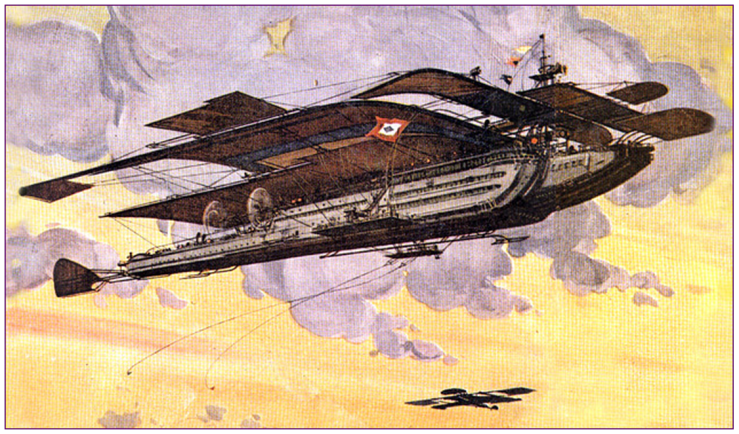
The painting of the airship at the top is by Harry Grant Dart, whose comic strip The Explorigator undoubtedly influenced Pynchon’s vision of The Chums of Chance. You can perhaps glean some of that inspiration in this 1908 broadside:

Explorigator19080503Intro


“So of course we use them” / Scarsdale Vibe’s Last Evil Monologue (Pynchon’s Against the Day)

Scarsdale Vibe was addressing the Las Animas-Huerfano Delegation of the Industrial Defense Alliance (L.A.H.D.I.D.A~) gathered in the casino of an exclusive hot-springs resort up near the Continental Divide. Enormous windows revealed and framed mountain scenery like picture postcards hand-tinted by a crew brought in from across the sea and all slightly colorblind. The clientele looked to be mostly U.S. white folks, pretty well-off in a flash sort of way—vacationers from back east and beyond, though an observer might be forgiven if he thought he recognized faces from the big hotel bars in Denver, with a few that might’ve fit in on upper Arapahoe as well.

The evening was advanced, the ladies had long since retired, and with them any need for euphemism.

“So of course we use them,” Scarsdale well into what by now was his customary stemwinder, “we harness and sodomize them, photograph their degradation, send them up onto the high iron and down into mines and sewers and killing floors, we set them beneath inhuman loads, we harvest from them their muscle and eyesight and health, leaving them in our kindness a few miserable years of broken gleanings. Of course we do. Why not? They are good for little else. How likely are they to grow to their full manhood, become educated, engender families, further the culture or the race? We take what we can while we may. Look at them—they carry the mark of their absurd fate in plain sight. Their foolish music is about to stop, and it is they who will be caught out, awkwardly, most of them tonedeaf and never to be fully aware, few if any with the sense to leave the game early and seek refuge before it is too late. Perhaps there will not, even by then, be refuge.

“We will buy it all up,” making the expected arm gesture, “all this country. Money speaks, the land listens, where the Anarchist skulked, where the horsethief plied his trade, we fishers of Americans will cast our nets of perfect ten-acre mesh, leveled and varmint-proofed, ready to build on. Where alien muckers and jackers went creeping after their miserable communistic dreams, the good lowland townsfolk will come up by the netful into these hills, clean, industrious, Christian, while we, gazing out over their little vacation bungalows, will dwell in top-dollar palazzos befitting our station, which their mortgage money will be paying to build for us. When the scars of these battles have long faded, and the tailings are covered in bunch-grass and wildflowers, and the coming of the snows is no longer the year’s curse but its promise, awaited eagerly for its influx of moneyed seekers after wintertime recreation, when the shining strands of telpherage have subdued every mountainside, and all is festival and wholesome sport and eugenically-chosen stock, who will be left anymore to remember the jabbering Union scum, the frozen corpses whose names, false in any case, have gone forever unrecorded? who will care that once men fought as if an eight-hour day, a few coins more at the end of the week, were everything, were worth the merciless wind beneath the shabby roof, the tears freezing on a woman’s face worn to dark Indian stupor before its time, the whining of children whose maws were never satisfied, whose future, those who survived, was always to toil for us, to fetch and feed and nurse, to ride the far fences of our properties, to stand watch between us and those who would intrude or question?” He might usefully have taken a look at Foley, attentive back in the shadows. But Scarsdale did not seek out the eyes of his old faithful sidekick. He seldom did anymore. “Anarchism will pass, its race will degenerate into silence, but money will beget money, grow like the bluebells in the meadow, spread and brighten and gather force, and bring low all before it. It is simple. It is inevitable. It has begun.”

—Nearing the end of Thomas Pynchon’s novel Against the Day, we get this (final—sorry if that’s a spoiler, but this mutherfucker needed to get got!) monologue from mustache-twirling super-capitalist arch-villain Scarsdale Vibe. His speech here (to the L.A.H.D.I.D.A., another wonderful throwaway gag) recalls an earlier bit of the book that I riffed on at some length—it almost feels as if Pynchon, at the end of Against the Day is going through the motions of checking in on everyone and reminding the readers, Hey, look, this guy is downright dastardly. Also: Manifest Destiny, exploitation, environmental degradation, etc. And again—not trying to set up any spoilers, but I could totally see not just this guy’s demise on the radar, but also the means of his demise. And despite that, it was very, very satisfying.

“Nights were populated by light-bearing women, who found their way through the forest as if it were day” (Thomas Pynchon’s Against the Day)

FOR THIS PARTICULAR STRETCH of Pacific slope, Tapachula was town— you wanted to relax or raise hell or both at the same time, you went in to Tapachula. Frank tended to spend time at a cantina called El Quetzal Dormido, drinking either maguey brandy from Comitán or the at first horrible but after a while sort of interesting local moonshine known as pox, and dancing with or lighting panatelas for a girl named Melpomene who’d drifted down from the ruins and fireflies of Palenque, first to Tuxtla Gutiérrez and then, with that boomtown certitude some young folks possess of knowing where the money is being spent least reflectively at any given season, to Tapachula, where there were cacao, coffee, rubber, and banana plantations all within an easy radius, so the town was always jumping with pickers, tree shakers, nurserymen, beanpolishers, guayuleros, and centrifuge operators, none in a mood for moderation of any kind.

Melpomene told Frank about the giant luminous beetles known as cucuji. Each night in the country around Palenque, illuminating the miles of ruins hidden among the jungle trees, you could see them by the millions, shining all over their bodies, so brightly that by the light of even one of them you could read the newspaper, and six would light up a city block. “Or so a tinterillo told me once,” grinning through the smoke of a Sin Rival. “I never learned to read, but I have a tree full of cucuji in my yard. Come on,” and she led him out the back and down a cobbled alley and into a dirt lane. All at once, ahead of them, above the tops of the trees, shone a greenish yellow light, pulsing off and on. “They feel me coming,” she said. They rounded a corner and there was a fig tree, with near as Frank could tell thousands of these big luminous beetles, flashing brightly and then going dark, over and over, all in perfect unison. He found if he stared too long into the tree, he tended to lose his sense of scale and it became almost like looking into a vast city, like Denver or the Mexican capital, at night. Shadows, depths . . .

Melpomene told him how the Indian women of Palenque captured the beetles and tamed them, giving them names which they learned to answer to, putting them into little cages to carry like lamps at night, or wearing them in their hair beneath transparent veils. Nights were populated by light-bearing women, who found their way through the forest as if it were day.

“Do all these critters here have names?”

“Most of them,” giving him a look of warning not to make fun of this. “Even one named after you, if you’d like to meet him. Pancho!”

One of the fragments of light detached itself from the tree and flew down and landed on the girl’s wrist, like a falcon. When the tree went dark, so did Pancho. “Bueno, “she whispered to it, “pay no attention to the others. I want you to light up only when I tell you. Now.” The bug, obligingly, lit up. “Ahora, apágate,” and again Pancho complied.

Frank looked at Pancho. Pancho looked back at Frank, though what he was seeing was anybody’s guess.

He couldn’t say when exactly, but at some point Frank came to understand that this bearer of light was his soul, and that all the fireflies in the tree were the souls of everyone who had ever passed through his life, even at a distance, even for a heartbeat and a half, that there existed such a tree for each person in Chiapas, and though this suggested that the same soul must live on a number of trees, they all went to make up a single soul, really, in the same way that light was indivisible. “In the same way,” amplified Günther, “that our Savior could inform his disciples with a straight face that bread and wine were indistinguishable from his body and blood. Light, in any case, among these Indians of Chiapas, occupies an analogous position to flesh among Christian peoples. It is living tissue. As the brain is the outward and visible expression of the Mind.”

–From Thomas Pynchon’s novel Against the Day.

This passage illustrates some of the novel’s grand themes—the visible and invisible worlds; the tangible, the real and the metaphysical something that might be behind it—and light, of course. I don’t know if I can muster anything else to say about it right now—I’ve enjoyed Against the Day—it’s funny, erudite, sprawling, etc.—but it’s very very long (part of the pleasure too, no doubt). Happy to be in the homestretch.


Ten Inspiring Quotes from Ten Inspirational Writers

dfw

guy-debord

as

wb

sp

eh

Hart-Crane1

HST-1

jberr

virginia-woolf

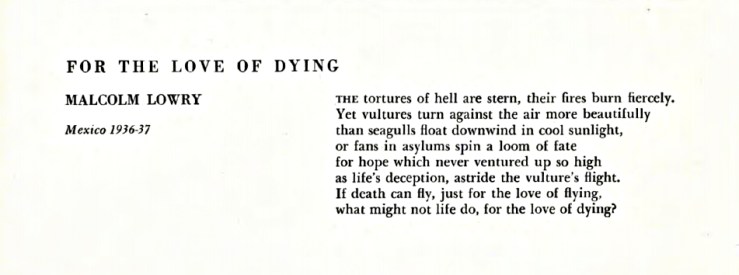
“For the Love of Dying” — Malcolm Lowry

ml

Borges Riff/Borges Anxiety

borgesscan
Art by Roman Muradov

1. Jorge Luis Borges is 115 today.

2. I’ve shared clips from my scattered readings of Borges on this blog (receiving the occasional takedown notice as well)—but I’ve never mustered the energy to try to say anything about him or describe his writing or try to situate it or analyze it or anything—

3. Because that’s what Borges does: He situates, analyzes, condenses, clarifies, expands, complicates, archives, curates, cultivates, teaches, improves literature.

4. And he does it in a way that makes following him with my own mealy mottled words seem superfluous (or maybe futile is the word I want—although I think Borges is unrelentingly positive and futile is such an ugly word).

5. I read a book of Borges’ essays this summer, a collection entitled Other Inquisitions. I read most of it in the Great Smoky Mountains, where the crisp morning air was perfect for Borges. Or for me to read Borges. It was lovely.

6. I wanted to write about Borges’ book—or, rather, and more exactly, I wanted to have written Borges’ book.

7. In one essay—I’ve put the book aside for now and can’t recall exactly which essay (maybe on FitzGerald and Omar Khayyam?); nor will I go look; if I had it out I’d only cite it, recycle it here; the book would kill this riff immediately, put a stake through its heart—Borges suggests that “A great writer creates his precursors.” — This, years, decades before Harold Bloom makes a career out of the same notion.

8. And Borges’ essays are a canon-making: His own canon–the formation and creation of his own precursors: Whitman, Kafka, DeQuincey, Carlyle, Becher, Valery, Wilde, Poe, Hawthorne…

9. The shock I experienced reading Borges’ essay on Nathaniel Hawthorne. That Borges had set about to riff on Hawthorne’s Note-Books, the same note-books I’d been reading since the early spring, the same note-books that seemed and still seem so generative to me, so full of entire worlds, so rich, so much fuller and richer than Hawthorne’s novels or his stories, so full in their singularity and off-focus, these notes, these Borgesian notes. Oh and that Borges had written the essay that I wished I could write!

10. Borges, who never wrote a novel, whose entire work might be some kind of postmodern novel.

11. Borges, whose short stories often seem like pretexts to an essay he’d like to write—and here pretext is not the right word, again—-so maybe the short stories, so many of them so brilliant, act as some kind of surface text that illuminates and yet simultaneously hides an essay underneath.

12. The great joy of reading Borges: We read through Borges: Borges the librarian grants us access to so many minds. We get to share his perceptions, read over his shoulder, or maybe through his glasses—we get to glance over his annotations, his notes. But that’s not accurate—he’s so much more lucid than that scatter-shot image suggests, even when he’s at his most Borgesian, which is to say his most labyrinthine, mirrored, winding, forking, decentering and recentering, deferring, echoing, prefiguring…

13. I’ve written more than I intended to and have yet barely edged into all the thicket of anxieties that guard Borges’ oeuvre from poseurs like myself. It’s enough to know that his works exist, will exist.

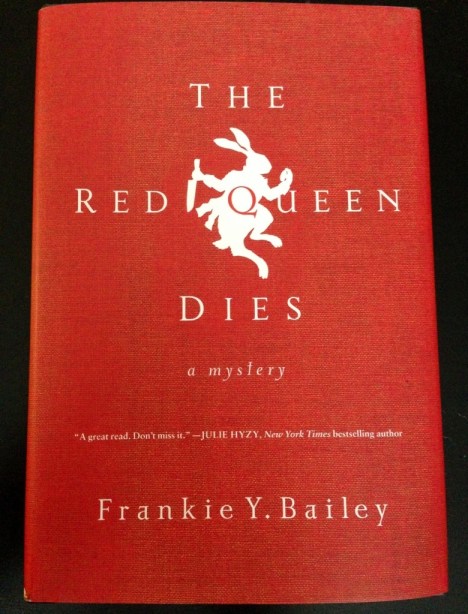
The Red Queen Dies (Book Acquired, 8.22.2013)

20130824-102919.jpg

Great cover design for Frankie Y. Bailey’s new set-in-the-future-kinda-sci-fi-definitely-mystery The Red Queen Dies: elegant, minimal, and very striking. Wish there was more of this in genre fiction. Publisher Macmillan/Minotaur’s blurb:

Frankie Bailey introduces readers to a fabulous new protagonist and an Alice in Wonderland-infused crime in this stunning mystery, which kicks off an exciting new series set in the near future.

The year is 2019, and a drug used to treat soldiers for post-traumatic stress disorder, nicknamed “Lullaby,” has hit the streets. Swallowing a little pill erases traumatic memories, but what happens to a criminal trial when the star witness takes a pill and can’t remember the crime? When two women are murdered in quick succession, biracial police detective Hannah McCabe is charged with solving the case. In spite of the advanced technology, including a city-wide surveillance program, a third woman is soon killed, and the police begin to suspect that a serial killer is on the loose. But the third victim, a Broadway actress known as “The Red Queen,” doesn’t fit the pattern set by the first two murders.

With the late September heat sizzling, Detective Hannah McCabe and her colleagues on the police force have to race to find the killer in a tangled web of clues that involve Alice in Wonderland, The Wizard of Oz, and Abraham Lincoln’s assassination. Fast-paced and original, this is a one-of-a-kind mystery from an extremely talented crime writer.

“Four Beasts in One—The Homo-Cameleopard” by Edgar Allan Poe

“Four Beasts in One—The Homo-Cameleopard” by Edgar Allan Poe

                     Chacun a ses vertus.
                        —Crebillon's Xerxes.

ANTIOCHUS EPIPHANES is very generally looked upon as the Gog of the prophet Ezekiel. This honor is, however, more properly attributable to Cambyses, the son of Cyrus. And, indeed, the character of the Syrian monarch does by no means stand in need of any adventitious embellishment. His accession to the throne, or rather his usurpation of the sovereignty, a hundred and seventy-one years before the coming of Christ; his attempt to plunder the temple of Diana at Ephesus; his implacable hostility to the Jews; his pollution of the Holy of Holies; and his miserable death at Taba, after a tumultuous reign of eleven years, are circumstances of a prominent kind, and therefore more generally noticed by the historians of his time than the impious, dastardly, cruel, silly, and whimsical achievements which make up the sum total of his private life and reputation.

Let us suppose, gentle reader, that it is now the year of the world three thousand eight hundred and thirty, and let us, for a few minutes, imagine ourselves at that most grotesque habitation of man, the remarkable city of Antioch. To be sure there were, in Syria and other countries, sixteen cities of that appellation, besides the one to which I more particularly allude. But ours is that which went by the name of Antiochia Epidaphne, from its vicinity to the little village of Daphne, where stood a temple to that divinity. It was built (although about this matter there is some dispute) by Seleucus Nicanor, the first king of the country after Alexander the Great, in memory of his father Antiochus, and became immediately the residence of the Syrian monarchy. In the flourishing times of the Roman Empire, it was the ordinary station of the prefect of the eastern provinces; and many of the emperors of the queen city (among whom may be mentioned, especially, Verus and Valens) spent here the greater part of their time. But I perceive we have arrived at the city itself. Let us ascend this battlement, and throw our eyes upon the town and neighboring country.

“What broad and rapid river is that which forces its way, with innumerable falls, through the mountainous wilderness, and finally through the wilderness of buildings?”

That is the Orontes, and it is the only water in sight, with the exception of the Mediterranean, which stretches, like a broad mirror, about twelve miles off to the southward. Every one has seen the Mediterranean; but let me tell you, there are few who have had a peep at Antioch. By few, I mean, few who, like you and me, have had, at the same time, the advantages of a modern education. Therefore cease to regard that sea, and give your whole attention to the mass of houses that lie beneath us. You will remember that it is now the year of the world three thousand eight hundred and thirty. Were it later—for example, were it the year of our Lord eighteen hundred and forty-five, we should be deprived of this extraordinary spectacle. In the nineteenth century Antioch is—that is to say, Antioch will be—in a lamentable state of decay. It will have been, by that time, totally destroyed, at three different periods, by three successive earthquakes. Indeed, to say the truth, what little of its former self may then remain, will be found in so desolate and ruinous a state that the patriarch shall have removed his residence to Damascus. This is well. I see you profit by my advice, and are making the most of your time in inspecting the premises—in

-satisfying your eyes

With the memorials and the things of fame

That most renown this city.—

I beg pardon; I had forgotten that Shakespeare will not flourish for seventeen hundred and fifty years to come. But does not the appearance of Epidaphne justify me in calling it grotesque?

“It is well fortified; and in this respect is as much indebted to nature as to art.”

Very true.

“There are a prodigious number of stately palaces.”

There are.

“And the numerous temples, sumptuous and magnificent, may bear comparison with the most lauded of antiquity.”

All this I must acknowledge. Still there is an infinity of mud huts, and abominable hovels. We cannot help perceiving abundance of filth in every kennel, and, were it not for the over-powering fumes of idolatrous incense, I have no doubt we should find a most intolerable stench. Did you ever behold streets so insufferably narrow, or houses so miraculously tall? What gloom their shadows cast upon the ground! It is well the swinging lamps in those endless colonnades are kept burning throughout the day; we should otherwise have the darkness of Egypt in the time of her desolation.

“It is certainly a strange place! What is the meaning of yonder singular building? See! it towers above all others, and lies to the eastward of what I take to be the royal palace.”

Continue reading ““Four Beasts in One—The Homo-Cameleopard” by Edgar Allan Poe”

“Best films (not in order)” — Susan Sontag

Best films (not in order)

  1. Bresson, Pickpocket
  2. Kubrick, 2001
  3. Vidor, The Big Parade
  4. Visconti, Ossessione
  5. Kurosawa, High and Low
  6. Syberberg, Hitler
  7. Godard, 2 ou 3 Choses . . .
  8. Rossellini, Louis XIV
  9. Renoir, La Regle du Jeu
  10. Ozu, Tokyo Story
  11. Dreyer, Gertrud
  12. Eisenstein, Potemkin
  13. Von Sternberg, The Blue Angel
  14. Lang, Dr. Mabuse
  15. Anonioni, L’Eclisse
  16. Bresson, Un Condamne a Mort . . . 
  17. Grance, Napoleon
  18. Vertov, The Man with the Movie Camera
  19. Feuillade, Judex
  20. Anger, Inauguration of the Pleasure Dome
  21. Godard, Vivre Sa Vie
  22. Bellocchio, Pugni in Tasca
  23. Carne, Les Enfants du Pradis
  24. Kurosawa, The Seven Samurai
  25. Tati, Playtime
  26. Truffaut, L’Enfant Savage
  27. Rivette, L’Amour Fou
  28. Eisenstein, Strike
  29. Von Stroheim, Greed
  30. Straub, . . . Anna Magadalena Bach
  31. Taviani bros, Padre Padrone
  32. Renais, Muriel
  33. Becker, Le Trou
  34. Cocteau, La Belle et la Bete
  35. Bergman, Persona
  36. Fassbinder, . . . Petra von Kant
  37. Griffith, Intolerance
  38. Godard, Contempt
  39. Marker, La Jete
  40. Conner, Crossroads
  41. Fassbinder, Chinese Rouleette
  42. Renoir, La Grande Illusion
  43. Opuls, The Earrings of Madame de . . .
  44. Kheifits, The Lady with the Little Dog
  45. Godard, Les Carabiners
  46. Bresson, Lancelot du Lac
  47. Ford, The Searchers
  48. Bertolucci, Prima della Rivoluzione
  49. Pasolini, Teorema
  50. Sagan, Madchen in Uniform

[The list continues up to number 228, where SS abandons it].

—From a 1977 entry in one of Susan Sontag’s notebooks. The list is published as part of As Consciousness Is Harnessed to Flesh: Journals & Notebooks, 1964-1980.

Cocktail Recipe: The Crocodile, a Traditional Anarchist Favorite (Thomas Pynchon’s Against the Day)

“I’ll be in the bar,” said Reef. Yzles-Bains was in fact one of the few places on the continent of Europe where a sober Anarchist could find a decent Crocodile—equal amounts of rum, absinthe, and the grape spirits known as trois-six—a traditional Anarchist favorite, which Loïc the bartender, a veteran of the Paris Commune, claimed to have been present at the invention of.

A cocktail recipe from Thomas Pynchon’s novel Against the Day. (More on trois-six here; good luck finding real absinthe).

Bonus recipe: Kit Traverse’s drink invention:

“‘Love in the Shadows of Pera,’ ” Kit said. “It’s just Creme de Menthe and beer.”

Anarchists’ Golf (Maybe a Synecdoche of Thomas Pynchon’s Novel Against the Day)

THE NEXT DAY Reef, Cyprian, and Ratty were out on the Anarchists’ golf course, during a round of Anarchists’ Golf, a craze currently sweeping the civilized world, in which there was no fixed sequence—in fact, no fixed number—of holes, with distances flexible as well, some holes being only putter-distance apart, others uncounted hundreds of yards and requiring a map and compass to locate. Many players had been known to come there at night and dig new ones. Parties were likely to ask, “Do you mind if we don’t play through?” then just go and whack balls at any time and in any direction they liked. Folks were constantly being beaned by approach shots barreling in from unexpected quarters. “This is kind of fun,” Reef said, as an ancient brambled guttie went whizzing by, centimeters from his ear.

From Thomas Pynchon’s ginormous novel Against the Day, which I am almost finished with.

I won’t riff on this (very short) Anarchists’ Golf scene, other than to suggest that it perhaps functions as a condensation or synecdoche of the novel proper: the joy, the optimism, the phallic aggression, the disruption of order, the social angle, the nose-thumbing, the creativity, the synthesis—the anarchy.


“He reportedly owns many guns and a flame-thrower” and Other Extracts from William Vollmann’s FBI File

William T. Vollmann has an essay in the newest issue of Harper’s called “Life as a Terrorist.” In the essay, Vollmann details what he finds in his FBI files (after filing a Freedom of Information Act request, an appeal, and a lawsuit to actually get a hold of the thing). He finds out that he was one of the Unabomber suspects:

When I finally received my FBI file, such as it was — namely, two higgledy-piggledy batches of papers, out of order, padded with duplicates, some of which they had forgotten to redact — I learned that I had been Unabomber Suspect Number S-2047:

S-2047 William T. Vollman. Predicated on a referral from a citizen. Investigation has determined that Vollman, a professional author, is widely travelled, however, existing travel records for him do not eliminate him as a viable suspect.

A few more extracts from Vollmann’s FBI file:

  • While VOLLMANN’s appearance varies over the years, New Haven notes strong physical resemblance to UNABOMBER composites. New Haven provided color video prints of book jackets to Sacramento via referenced airtel.
  • UNABOMBER’s moniker FC may correlate with title of VOLLMANN’s largest work, novel Fathers and Crows. That novel reportedly best exemplifies VOLLMANN’s anti-progress, anti-industrialist theme/beliefs/value systems and VOLLMANN, himself, has described it as his most difficult work.
  • [An informant] suggests VOLLMANN has a death wish . . . Reportedly, at age 9, VOLLMANN’s younger sister (age 6) drowned in a backyard pond in New Hampshire while he was supposed to be watching over her. Guilt from that situation may have had a profound effect on VOLLMANN.
  • VOLLMANN’s meticulous nature, as described above, is consistent with manufacture of and presentation on UNABOM devices. Several witnesses have commented that UNABOM packages appeared “seamless” and “too pretty to open.”
  • By all accounts VOLLMANN is exceedingly intelligent and possessed with an enormous ego.
  • He revels in immersing himself in the seamy underside of life. He reportedly has used drugs (crack cocaine) extensively. He reportedly owns many guns and a flame-thrower.

“I would love to own a flamethrower,” Vollmann wryly adds to this last entry. And thus, new entries for the ongoing chronicles of The Myth of the Vollmann!

Vollmann discussed the article on NPR’s NPR’s Morning Edition with David Greene this morning.


Four Notes on the World from Samuel Butler’s Note-Books

  1. The world is a gambling-table so arranged that all who enter the casino must play and all must lose more or less heavily in the long run, though they win occasionally by the way.
  2. We play out our days as we play out cards, taking them as they come, not knowing what they will be, hoping for a lucky card and sometimes getting one, often getting just the wrong one.
  3. The world may not be particularly wise – still, we know of nothing wiser.
  4. The world will always be governed by self-interest.  We should not try to stop this, we should try to make the self-interest of cads a little more coincident with that of decent people.

—From Samuel Butler’s Note-Books.


Map of American Folklore

map of folklore

(Via).

“Just Once” — Anne Sexton

as