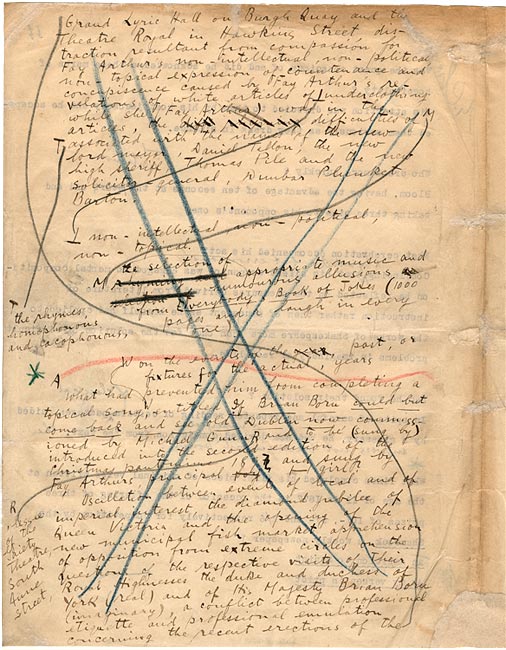
Manuscript Fragment from James Joyce’s Ulysses

joyce_ulysses-p2

(Via/about/zoom in!).

“The Story of the Ram” — Mark Twain

“The Story of the Old Ram” by Mark Twain

Every now and then, in these days, the boys used to tell me I ought to get one Jim Blaine to tell me the stirring story of his grandfather’s old ram but they always added that I must not mention the matter unless Jim was drunk at the time just comfortably and sociably drunk. They kept this up until my curiosity was on the rack to hear the story. I got to haunting Blaine; but it was of no use, the boys always found fault with his condition; he was often moderately but never satisfactorily drunk. I never watched a man’s condition with such absorbing interest, such anxious solicitude; I never so pined to see a man uncompromisingly drunk before. At last, one evening I hurried to his cabin, for I learned that this time his situation was such that even the most fastidious could find no fault with it he was tranquilly, serenely, symmetrically drunk not a hiccup to mar his voice, not a cloud upon his brain thick enough to obscure his memory. As I entered, he was sitting upon an empty powder-keg, with a clay pipe in one hand and the other raised to command silence. His face was round, red, and very serious; his throat was bare and his hair tumbled; in general appearance and costume he was a stalwart miner of the period. On the pine table stood a candle, ar~d its dim light revealed “the boys” sitting here and there on bunks, candle-boxes, powder-kegs, etc. They said:

“Sh ! Don’t speak he’s going to commence.”

THE STORY OF THE OLD RAM

I found a seat at once, and Blaine said:

“I don’t reckon them times will ever come again. There never was a more burlier old ram than what he was. Grandfather fetched him from Illinois got him of a man by the name of Yates Bill Yates maybe you might have heard of him; his father was a deacon Baptist and he was a rustler, too; a man had to get up rusher early to get the start of old Thankful Yates; it was him that put the Greens up to jining teams with my grandfather when he moved West. Seth Green was prob’ly the pick of the flock; he married a Wilkerson Sarah Wilkerson good cretur, she was one of the likeliest heifers that was ever raised in old Stoddard, everybody said that knowed her. She could heft a bar’l of flour as easy as I can flirt a flapjack. And spin? Don’t mention it! Independent? Humph! When Sile Hawkins come abrowsing around her, she let him know that for all his tin he couldn’t trot in harness alongside of her. You see, Sile Hawkins was no, it warn’s Sile Hawkins, after all it was a galoot by the name of Filkins I disremember his first name; but he was a stump come into pra’r meeting drunk, one night, hooraying for Nixon, becuz he thought it was a primary; and old deacon Ferguson up and scooted him through the window and he lit on old Miss Jefferson’s head, poor old filly. She was a good soul had a glass eye and used to lend it to old Miss Wagner, that hadn’t any, to receive company in; it warn’s big enough, and when Miss Wagner warn’s noticing, it would get twisted around in the socket, and look up, maybe, or out to one side, and every which way, while t’other one was looking as straight ahead as a spyglass. Grown people didn’t mind it, but it most always made the children cry, it was so sort of scary. She tried packing it in raw cotton, but it wouldn’t work, somehow the cotton would get loose and stick out and look so kind of awful that the children couldn’t stand it no way. She was always dropping it out, and turning up her old dead-light on the company empty, and making them oncomfortable, becuz she never could tell when it hopped out, being blind on that side, you see. So somebody would have to hunch her and say, ‘Your game eye has fetched loose, Miss Wagner dear’ and then all of them would have to sit and wait till she jammed it in again wrong side before, as a general thing, and green as a bird’s egg, being a bashful cretur and easy sot back before company. But being wrong side before warn’s much fetched him from Illinois got him of a man by the name of Yates Bill Yates maybe you might have heard of him; his father was a deacon Baptist and he was a rustler, too; a man had to get up rusher early to get the start of old Thankful Yates; it was him that put the Greens up to jining teams with my grandfather when he moved West. Seth Green was prob’ly the pick of the flock; he married a Wilkerson Sarah Wilkerson good cretur, she was one of the likeliest heifers that was ever raised in old Stoddard, everybody said that knowed her. She could heft a bar’l of flour as easy as I can flirt a flapjack. And spin? Don’t mention it! Independent? Humph! When Sile Hawkins come a- browsing around her, she let him know that for all his tin he couldn’t trot in harness alongside of her. You see, Sile Hawkins was no, it warn’s Sile Hawkins, after all it was a galoot by the name of Filkins I disremember his first name; but he was a stump come into pra’r meeting drunk, one night, hooraying for Nixon, becuz he thought it was a primary; and old deacon Ferguson up and scooted him through the window and he lit on old Miss Jefferson’s head, poor old filly. She was a good soul had a glass eye and used to lend it to old Miss Wagner, that hadn’t any, to receive company in; it warn’s big enough, and when Miss Wagner warn’s noticing, it would get twisted around in the socket, and look up, maybe, or out to one side, and every which way, while t’other one was looking as straight ahead as a spyglass. Grown people didn’t mind it, but it most always made the children cry, it was so sort of scary. She tried packing it in raw cotton, but it wouldn’t work, somehow the cotton would get loose and stick out and look so kind of awful that the children couldn’t stand it no way. She was always dropping it out, and turning up her old dead-light on the company empty, and making them oncomfortable, becuz she never could tell when it hopped out, being blind on that side, you see. So somebody would have to hunch her and say, ‘Your game eye has fetched loose, Miss Wagner dear’ and then all of them would have to sit and wait till she jammed it in again wrong side before, as a general thing, and green as a bird’s egg, being a bashful cretur and easy sot back before company. But being wrong side before warn’s much difference, anyway, becuz her own eye was sky-blue and the glass one was yeller on the front side, so whichever way she turned it it didn’t match nohow. Old Miss Wagner was considerable on the borrow, she was. When she had a quilting, or Dorcas S’iety at her house she gen’ally borrowed Miss Higgins’s wooden leg to stump around on, it was considerable shorter than her other pin, but much she minded that. She said she couldn’t abide crutches when she had company, becuz they were so slow; said when she had company and things had to be done, she wanted to get up and hump herself. She was as bald as a jug, and so she used to borrow Miss Jacops’s wig Miss Jacops was the coffin-peddler’s wife a ratty old buzzard, he was, that used to go roosting around where people was sick, waiting for ’em; and there that old rip would sit all day, in the shade, on a coffin that he judged would fit the can’idate; and if it was a slow customer and kind of uncertain, he’d fetch his rations and a blanket along and sleep in the coffin nights. He was anchored out that way, in frosty weather, for about three weeks, once, before old Robbins’s place, waiting for him; and after that, for as much as two years, Jacops was not on speaking terms with the old man, on account of his disapp’inting him. He got one of his feet froze, and lost money, too, becuz old Robbins took a favorable turn and got well. The next time Robbins got sick, Jacops tried to make up with him, and varnished up the same old coffin and fetched it along; but old Robbins was too many for him; he had him in, and ‘pe…red to be powerful weak; he bought the coffin for ten dollars and Jacops was to pay it back and twenty-five more besides if Robbins didn’t like the coffin after he’d tried it. And then Robbins died, and at the funeral he bursted off the lid and riz up in his shroud and told the parson to let up on the performances, becuz he could not stand such a coffin as that. You see he had been in a trance once before, when he was young, and he took the chances on another, cal’lating that if he made the trip it was money in his pocket, and if he missed fire he couldn’t lose a cent. And by George he sued Jacops for the rhino and got jedgment; and he set up the coffin in his back parlor and said he ‘lowed to take his time, now. It was always an aggravation to Jacops, the way that miserable old thing acted. He moved back to Indiany pretty soon went to Wellsville Wellsville was the place the Hogadorns was from. Mighty fine family. Old Maryland stock. Old Squire Hogadorn could carry around more mixed licker, and cuss better than most any man I ever see. His second wife was the widder Billings she that was Becky Martin; her dam was deacon Dunlap’s first wife. Her oldest child, Maria, married a missionary and died in grace et up by the savages. They et him, too, poor feller biled him. It warn’s the custom, so they say, but they explained to friends of his’n that went down there to bring away his things, that they’d tried missionaries every other way and never could get any good out of ’em and so it annoyed all his relations to find out that that man’s life was fooled away just out of a dern’d experiment, so to speak. But mind you, there ain’t anything ever reely lost; everything that people can’t understand and don’t see the reason of does good if you only hold on and give it a fair shake; Prov’dence don’t fire no blank ca’tridges, boys. That there missionary’s substance, unbeknowns to himself, actu’ly converted every last one of them heathens that took a chance at the barbecue. Nothing ever fetched them but that. Don’t tell me it was an accident that he was biled. There ain’t no such a thing as an accident. When my uncle Lem was leaning up agin a scaffolding once, sick, or drunk, or suthin, an Irishman with a hod full of bricks fell on him out of the third story and broke the old man’s back in two places. People said ir was an accident. Much accident there was about that. He didn’t know what he was there for, but he was there for a good object. If he hadn’t been there the Irishman would have been killed. Nobody can ever make me believe anything different from that. Uncle Lem’s dog was there. Why didn’t the Irishman fall on the dog? Becuz the dog would a seen him a-coming and stood from under. That’s the reason the dog warn’s appinted. A dog can’t be depended on to carry out a special providence. Mark my words it was a put-up thing. Accidents don’t happen, boys. Uncle Lem’s dog I wish you could a seen that dog. He was a reglar shepherd or rusher he was part bull and part shepherd splendid animal; belonged to parson Hagar before Uncle Lem got him. Parson Hagar belonged to the Western Reserve Hagars; prime family; his mother was a Watson; one of his sisters married a Wheeler; they settled in Morgan County, and hŠ got nipped by the machinery in a carpet factory and went through in less than a quarter of a minute; his widder bought the piece of carpet that had his remains wove in, and people come a hundred mile to ‘tend the funeral. There was fourteen yards in the piece. She wouldn’t let them roll him up, but planted him just so full length. The church was middling small where they preached the funeral, and they had to let one end of the coffin stick out of the window. They didn’t bury him they planted one end, and let him stand up, same as a monument. And they nailed a sign on it and put put on put on it sacred to the m-e-m-o-r-y of fourteen y-a-r-d-s of three-ply car – – – pet containing all that was m-o-r-t-a-l of of W-i-l-l-i-a-m W-h-e ”

Jim Blaine had been growing gradually drowsy and drowsier his head nodded, once, twice, three times dropped peacefully upon his breast, and he fell tranquilly asleep. The tears were running down the boys’ cheeks they were suffocating with suppressed laughter and had been from the start, though I had never noticed it. I perceived that I was “sold.” I learned then that Jim Blaine’s peculiarity was that whenever he reached a certain stage of intoxication, no human power could keep him from setting out, with impressive unction, to tell about a wonderful adventure which he had once had with his grandfather’s old ram and the mention of the ram in the first sentence was as far as any man had ever heard him get, concerning it. He always maundered off, interminably, from one thing to another, till his whisky got the best of him and he fell asleep. What the thing was that happened to him and his grandfather’s old ram is a dark mystery to this day, for nobody has ever yet found out.

Read an Excerpt from Cormac McCarthy’s Script for The Counselor

The New Yorker has published an excerpt of Cormac McCarthy’s script for The Counselor, a film directed by Ridley Scott that will come out this fall.

An excerpt of the excerpt:

the kid rakes an object from under the paper into his helmet and puts down the paper and stands and puts the helmet under his arm and crosses the plaza to his bike and puts his foot over the bike and starts it and pulls his gloves from the helmet and lays them on the tank in front of him and pulls on the helmet and fastens the strap and then pulls on the gloves and kicks back the stand and pulls away into the traffic.

night. two-lane blacktop road through the high desert. A car passes and the lights recede down the long straight and fade out. A man walks out from the scrub cedars that line the road and stands in the middle of the road and lights a cigarette. He is carrying a roll of thin braided wire over one shoulder. He continues across the road to the fence. A tall metal pipe is mounted to one of the fence posts and at the top—some twenty feet off the ground—is a floodlight. The man pushes the button on a small plastic sending unit and the light comes on, flooding the road and the man’s face. He turns it off and walks down the fence line a good hundred yards to the corner of the fence and here he drops the coil of wire to the ground and takes a flashlight from his back pocket and puts it in his teeth and takes a pair of leather gloves from his belt and puts them on. Then he loops the wire around the corner post and pulls the end of the wire through the loop and wraps it about six times around the wire itself and tucks the end several times inside the loop and then takes the wire in both hands and hauls it as tight as he can get it. Then he takes the coil of wire and crosses the road, letting out the wire behind him. In the cedars on the far side, a flatbed truck is parked with the bed of the truck facing the road. There is an iron pipe at the right rear of the truck bed mounted vertically in a pair of collars so that it can slide up and down and the man threads the wire through a hole in the pipe and pulls it taut and stops it from sliding back by clamping the wire with a pair of vise grips. Then he walks back out to the road and takes a tape measure from his belt and measures the height of the wire from the road surface. He goes back to the truck and lowers the iron pipe in its collars and clamps it in place again with a threaded lever that he turns by hand against the vertical rod. He goes out to the road and measures the wire again and comes back and wraps the end of the wire through a heavy three-inch iron ring and walks to the front of the truck, where he pulls the wire taut and wraps it around itself to secure the ring at the end of the wire and then pulls the ring over a hook mounted in the side rail of the truck bed. He stands looking at it. He strums the wire with his fingers. It gives off a deep resonant note. He unhooks the ring and walks the wire to the rear of the truck until it lies slack on the ground and in the road. He lays the ring on the truck bed and goes around and takes a walkie-talkie from a work bag in the cab of the truck and stands in the open door of the truck, listening. He checks his watch by the dome light in the cab.

“Old Red” by Caroline Gordon

“Old Red” by Caroline Gordon

I

WHEN THE DOOR HAD closed behind his daughter, Mr. Maury went to the window and stood a few moments looking out. The roses that had grown in a riot all along that side of the fence had died or been cleared away, but the sun lay across the garden in the same level lances of light that the remembered. He turned back into the room. The shadows had gathered until it was nearly all in gloom. The top of his minnow bucket just emerging from his duffel bag glinted in the last rays of the sun. He stood looking down at his traps all gathered neatly in a heap at the foot of the bed. He would leave them like that. Even if they came in here sweeping and cleaning up — it was only in hotels that a man was master of his own room — even if they came in here cleaning up he would tell them to leave all his things exactly as they were. It was reassuring to see them all there together, ready to be taken up in the hand to be carried down and put into a car, to be driven off to some railroad station at a moment’s notice.

As he moved toward the door he spoke aloud, a habit that was growing on him:

“Anyhow I won’t stay but a week…. I ain’t going to stay but a week, no matter what they say….”

Downstairs in the dining room they were already gathered at the supper table: his white-haired, shrunken mother in-law; his tall sister-in-law who had the proud carriage of the head, the aquiline nose, but not the spirit of his dead wife; his lean, blond, new son-in-law; his black eyed daughter who, but that she was thin, looked so much like him, all of them gathered there waiting for him, Alexander Maury. It occurred to him that this was the first time he had sat down in the bosom of the family for some years. They were always writing saying that he must make a visit this summer or certainly next summer — “. . . all had a happy Christmas together, but missed you….” They had even made the pretext that he ought to come up to inspect his new son-in-law. As if he hadn’t always known exactly the kind of young man Sarah would marry! What was the boy’s name? Stephen, yes, Stephen. He must be sure and remember that.

He sat down and, shaking out his napkin, spread it over his capacious paunch and tucked it well up under his chin in the way his wife had never allowed him to do. He let his eyes rove over the table and released a long sigh.

“Hot batter bread,” he said, “and ham. Merry Point ham. I sure am glad to taste them one more time before I die.”

The old lady was sending the little Negro girl scurrying back to the kitchen for a hot plate of batter bread. He pushed aside the cold plate and waited. She had bundled when he spoke of the batter bread and a faint flush had dawned on her withered cheeks. Vain she had always been as a peacock, of her housekeeping, her children, anything that belonged to her. She went on now, even at her advanced age, making her batter bread, smoking her hams according to that old recipe she was so proud of, but who came here now to this old house to eat or to praise?

He helped himself to a generous slice of batter bread, buttered it, took the first mouthful and chewed it slowly. He shook his head.

“There ain’t anything like it,” he said. “There ain’t anything else like it in the world. ”

His dark eye roving over the table fell on his son-in-law. “You like batter bread?” he inquired. Continue reading ““Old Red” by Caroline Gordon”

The Chums of Chance vs The Legion of Gnomes (Citation from + Riff on Thomas Pynchon’s Against the Day)

At first the “noise” seemed no more than the ensemble of magnetoatmospheric disturbances which the boys had long grown used to, perhaps here intensified by the vastly resonant space into which they were moving ever deeper. But presently the emission began to coalesce into human timbres and rhythms—not speech so much as music, as if the twilit leagues passing below were linked by means of song.

Lindsay, who was Communications Officer, had his ear close to the Tesla device, squinting attentively, but at last withdrew, shaking his head. “Gibberish.”

“They are calling for help,” ~delared Miles, “clear as day and quite desperately, too. They claim to be under attack by a horde of hostile gnomes, and have set out red signal lamps, arranged in concentric circles.”

“There they are!” called Chick Counterfly, pointing over the starboard quarter.

“Then there is nothing to discuss,” declared Randolph St. Cosmo. “We must put down and render aid.”

They descended over a battlefield swarming with diminutive combatants wearing pointed hats and carrying what proved to be electric crossbows, from which they periodically discharged bolts of intense greenish light, intermittently revealing the scene with a morbidity like that of a guttering star.

“We cannot attack these fellows,” protested Lindsay, “for they are shorter than we, and the Rules of Engagement clearly state—”

“In an emergency, that choice lies at the Commander’s discretion,” replied Randolph.

They were soaring now close above the metallic turrets and parapets of a sort of castle, where burned the crimson lights of distress. Figures could be discerned below gazing up at the Inconvenience. Peering at them through a nightglass, Miles stood at the conning station, transfixed by the sight of a woman poised upon a high balcony. “My word, she’s lovely!” he exclaimed at last.

Their fateful decision to land would immediately embroil them in the byzantine politics of the region, and eventually they would find themselves creeping perilously close to outright violation of the Directives relating to Noninterference and Height Discrepancy, which might easily have brought an official hearing, and perhaps even disfellowshipment from the National Organization. For a detailed account of their subsequent narrow escapes from the increasingly deranged attentions of the Legion of Gnomes, the unconscionable connivings of a certain international mining cartel, the sensual wickedness pervading the royal court of Chthonica, Princess of Plutonia, and the all-but-irresistible fascination that subterranean monarch would come to exert, Circelike, upon the minds of the crew of Inconvenience (Miles, as we have seen, in particular), readers are referred to The Chums of Chance in the Bowels of the Earth—for some reason one of the less appealing of this series, letters having come in from as far away as Tunbridge Wells, England, expressing displeasure, often quite intense, with my harmless little intraterrestrial scherzo.

After their precipitate escape from the ill-disposed hordes of thickset indigenous, over another night and day, as time is reckoned on the surface, the Chums swept through the interior of the Earth and at last out her Northern portal, which they beheld as a tiny circle of brightness far ahead. As before, all remarked the diminished size of the planetary exit. It was a tricky bit of steering, as they emerged, to locate the exact spot, on the swiftly dilating luminous circumference, where they might with least expenditure of time find themselves in the vicinity of the schooner Etienne-Louis Malus, carrying the Vormance Expedition toward a fate few of its members would willingly have chosen.

1.The above citation comprises the final paragraphs of The Light Over the Ranges, the first book in Thomas Pynchon’s massive, byzantine novel Against the Day, which is perhaps too massive and too byzantine for me to approach in any way other way than the occasional riff and citation as I read it.

2. The Light Over the Ranges both begins and ends by focusing on The Chums of Chance, an intrepid band of adventurers who sail their skyship Inconvenience into every manner of trouble. The passage above—which, hey, don’t worry, there are no real spoilers there—-the passage above showcases a jocular, jaunty voice that Pynchon employs frequently throughout the book, a voice appropriate to pulp fiction, to serialized “boy’s novels,” to speculative fiction narratives, etc. The voice is somehow simultaneously engaged and detached, urging its listener to care about the heroes in peril, but also acknowledging its own formal artificiality, the flatness of its characters, their position as placeholders or checkerboard pieces in Pynchon’s big project.

3. The voice that relates the Chums of Chance episodes is wonderfully didactic, its earnest, moral tone buoying the narrative into adventure (and fun!); at the same time, everything else in the novel—its violence, its class warfare, its analysis of exploitation—-ensures that this voice is to be read and interpreted with dark irony.

4. And yet the spirit of adventure, of fun—of imagination—inheres (and not just in the episodes with the Chums).

5. The Chums of Chance: Miles Blundell, Chick Counterfly, Lindsay Noseworth,  Darby Suckling, and commander Randolph St. Cosmo. The names are Pynchonian, tautologies be damned! (They also remind me of porn aliases). I am remiss: Let me include Pugnax, a dog of discerning literary taste, his ability to read just one of many seemingly-metaphysical powers Pynchon grants his characters in Against the Day.

6. My favorite paragraph in the above citation is the penultimate one, where we find our heroes “creeping perilously close to outright violation of the Directives relating to Noninterference and Height Discrepancy” by diving into a strange underworld adventure and battling The Legion of Gnomes. Pynchon (or Pynchon’s adventure-voice, if’n ya’ll permit me) offers us a too-brief peek at “the royal court of Chthonica, Princess of Plutonia, and the all-but-irresistible fascination that subterranean monarch would come to exert, Circelike, upon the minds of the crew of Inconvenience” and then refers us to The Chums of Chance in the Bowels of the Earth, a book we cannot read because it doesn’t exist.

7. But what am I saying? Of course The Chums of Chance in the Bowels of the Earth exists!—we just have to imagine it.

“Was” by William Faulkner

“Was” by William Faulkner

Isaac McCaslin, ‘Uncle Ike’, past seventy and nearer eighty than he ever corroborated any more, a widower now and uncle to half a county and father to no one

this was not something participated in or even seen by himself, but by his elder cousin, McCaslin Edmonds, grandson of Isaac’s father’s sister and so descended by the distaff, yet notwithstanding the inheritor, and in his time the bequestor, of that which some had thought then and some still thought should have been Isaac’s, since his was the name in which the title to the land had first been granted from the Indian patent and which some of the descendants of his father’s slaves still bore in the land. But Isaac was not one of these:-a widower these twenty years, who in all his life had owned but one object more than he could wear and carry in his pockets and his hands at one time, and this was the narrow iron cot and the stained lean mattress which he used camping in the woods for deer and bear or for fishing or simply because he loved the woods; who owned no property and never desired te since the earth was no man’s but all men’s, as light and air and weather were; who lived still in the cheap frame bungalow in Jefferson which his wife’s father gave them on their marriage and which his wife had willed to him at her death and which he had pretended to accept, acquiesce to, to humor her, ease her going but which was not his, will or not, chancery dying wishes mortmain possession or whatever, himself merely holding it for his wife’s sister and her children who had lived in it with him since his wife’s death, holding himself welcome to live in one room of it as he had during his wife’s time or she during her time or the sister-in-law and her children during the rest of his and after not something he had participated in or even remembered except from the hearing, the listening, come to him through and from his cousin McCaslin born in 1850 and sixteen years his senior and hence, his own father being near seventy when Isaac, an only child, was born. rather his brother than cousin and rather his father than either, out of the old time, the old days.

When he and Uncle Buck ran back to the house from discovering that Tomey’s Turl had run again, they heard Uncle Buddy cursing and bellowing in the kitchen, then the fox and the dogs came out of the kitchen and crossed the hall into the dogs’ room and they heard them run through the dogs’ room into his and Uncle Buck’s room then they saw them cross the hall again into Uncle Buddy’s room and heard them run through Uncle Buddy’s room into the kitchen. Where Uncle Buddy was picking the breakfast up out of the ashes and wiping it off with his apron. “What in damn’s hell do you mean,” he said “turning that damn fox out with the dogs all loose in the house?”

“Damn the fox” Uncle Buck said. “Tomey’s Turl has broke out again. Give me and Cass some breakfast quick we might just barely catch him before he gets there.” Continue reading ““Was” by William Faulkner”

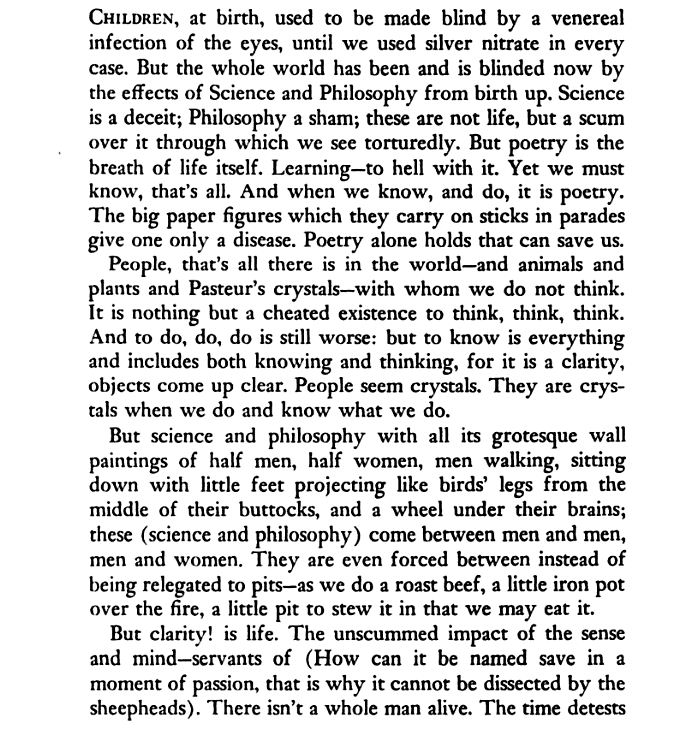
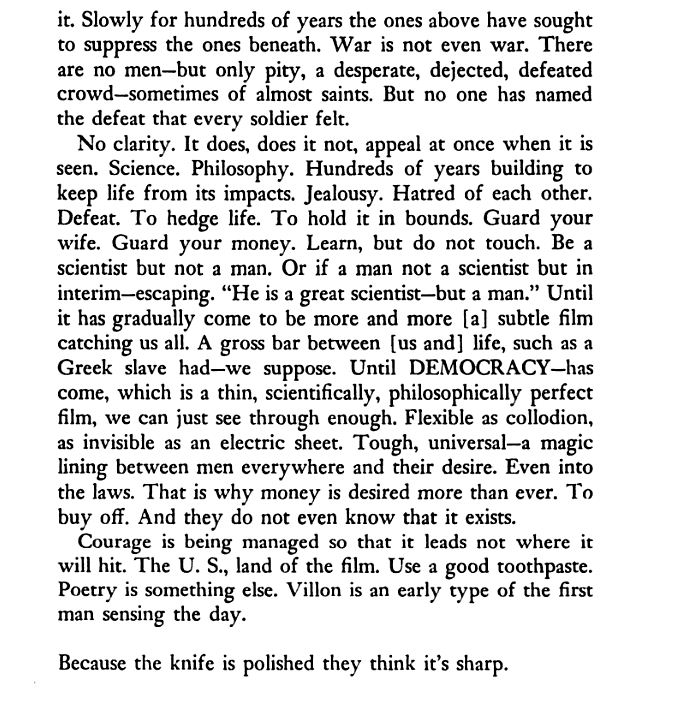
“Science and Philosophy” — William Carlos Williams

1

            2

“Science and Philosophy” by William Carlos Williams is collected in The Embodiment of Knowledge (New Directions).

Huxley vs. Orwell: The Webcomic

Stuart McMillen’s webcomic adapts (and updates) Postman’s famous book-length essay, Amusing Ourselves to Death, which argues that Aldous Huxley’s vision of the future in Brave New World was ultimately more accurate than the one proposed by George Orwell in 1984. (Via).

“The Bible as Poetry” — Walt Whitman

“The Bible as Poetry” by Walt Whitman

I suppose one cannot at this day say anything new, from a literary point of view, about those autochthonic bequests of Asia—the Hebrew Bible, the mighty Hindu epics, and a hundred lesser but typical works; (not now definitely including the Iliad—though that work was certainly of Asiatic genesis, as Homer himself was—considerations which seem curiously ignored.) But will there ever be a time or place—ever a student, however modern, of the grand art, to whom those compositions will not afford profounder lessons than all else of their kind in the garnerage of the past? Could there be any more opportune suggestion, to the current popular writer and reader of verse, what the office of poet was in primeval times—and is yet capable of being, anew, adjusted entirely to the modern?

All the poems of Orientalism, with the Old and New Testaments at the centre, tend to deep and wide, (I don’t know but the deepest and widest,) psychological development—with little, or nothing at all, of the mere esthetic, the principal verse-requirement of our day. Very late, but unerringly, comes to every capable student the perception that it is not in beauty, it is not in art, it is not even in science, that the profoundest laws of the case have their eternal sway and outcropping.

In his discourse on “Hebrew Poets” De Sola Mendes said: “The fundamental feature of Judaism, of the Hebrew nationality, was religion; its poetry was naturally religious. Its subjects, God and Providence, the covenants with Israel, God in Nature, and as reveal’d, God the Creator and Governor, Nature in her majesty and beauty, inspired hymns and odes to Nature’s God. And then the checker’d history of the nation furnish’d allusions, illustrations, and subjects for epic display—the glory of the sanctuary, the offerings, the splendid ritual, the Holy City, and lov’d Palestine with its pleasant valleys and wild tracts.” Dr. Mendes said “that rhyming was not a characteristic of Hebrew poetry at all. Metre was not a necessary mark of poetry. Great poets discarded it; the early Jewish poets knew it not.” Compared with the famed epics of Greece, and lesser ones since, the spinal supports of the Bible are simple and meagre. All its history, biography, narratives, &c., are as beads, strung on and indicating the eternal thread of the Deific purpose and power. Yet with only deepest faith for impetus, and such Deific purpose for palpable or impalpable theme, it often transcends the masterpieces of Hellas, and all masterpieces.

The metaphors daring beyond account, the lawless soul, extravagant by our standards, the glow of love and friendship, the fervent kiss—nothing in argument or logic, but unsurpass’d in proverbs, in religious ecstasy, in suggestions of common mortality and death, man’s great equalizers—the spirit everything, the ceremonies and forms of the churches nothing, faith limitless, its immense sensuousness immensely spiritual—an incredible, all-inclusive non-worldliness and dew-scented illiteracy (the antipodes of our Nineteenth Century business absorption and morbid refinement)—no hair-splitting doubts, no sickly sulking and sniffling, no “Hamlet,” no “Adonais,” no “Thanatopsis,” no “In Memoriam.”

The culminated proof of the poetry of a country is the quality of its personnel, which, in any race, can never be really superior without superior poems. The finest blending of individuality with universality (in my opinion nothing out of the galaxies of the “Iliad,” or Shakspere’s heroes, or from the Tennysonian “Idylls,” so lofty, devoted and starlike,) typified in the songs of those old Asiatic lands. Men and women as great columnar trees. Nowhere else the abnegation of self towering in such quaint sublimity; nowhere else the simplest human emotions conquering the gods of heaven, and fate itself. (The episode, for instance, toward the close of the “Mahabharata”—the journey of the wife Savitri with the god of death, Yama,

“One terrible to see—blood-red his garb,

His body huge and dark, bloodshot his eyes,

Which flamed like suns beneath his turban cloth,

Arm’d was he with a noose,”

who carries off the soul of the dead husband, the wife tenaciously following, and—by the resistless charm of perfect poetic recitation!—eventually redeeming her captive mate.)

I remember how enthusiastically William H. Seward, in his last days, once expatiated on these themes, from his travels in Turkey, Egypt, and Asia Minor, finding the oldest Biblical narratives exactly illustrated there to-day with apparently no break or change along three thousand years—the veil’d women, the costumes, the gravity and simplicity, all the manners just the same. The veteran Trelawney said he found the only real nobleman of the world in a good average specimen of the mid-aged or elderly Oriental. In the East the grand figure, always leading, is the old man, majestic, with flowing beard, paternal, &c. In Europe and America, it is, as we know, the young fellow—in novels, a handsome and interesting hero, more or less juvenile—in operas, a tenor with blooming cheeks, black mustache, superficial animation, and perhaps good lungs, but no more depth than skim-milk. But reading folks probably get their information of those Bible areas and current peoples, as depicted in print by English and French cads, the most shallow, impudent, supercilious brood on earth.

I have said nothing yet of the cumulus of associations (perfectly legitimate parts of its influence, and finally in many respects the dominant parts,) of the Bible as a poetic entity, and of every portion of it. Not the old edifice only—the congeries also of events and struggles and surroundings, of which it has been the scene and motive—even the horrors, dreads, deaths. How many ages and generations have brooded and wept and agonized over this book! What untellable joys and ecstasies—what support to martyrs at the stake—from it. (No really great song can ever attain full purport till long after the death of its singer—till it has accrued and incorporated the many passions, many joys and sorrows, it has itself arous’d.) To what myriads has it been the shore and rock of safety—the refuge from driving tempest and wreck! Translated in all languages, how it has united this diverse world! Of civilized lands to-day, whose of our retrospects has it not interwoven and link’d and permeated? Not only does it bring us what is clasp’d within its covers; nay, that is the least of what it brings. Of its thousands, there is not a verse, not a word, but is thick-studded with human emotions, successions of fathers and sons, mothers and daughters, of our own antecedents, inseparable from that background of us, on which, phantasmal as it is, all that we are to-day inevitably depends—our ancestry, our past.

Strange, but true, that the principal factor in cohering the nations, eras and paradoxes of the globe, by giving them a common platform of two or three great ideas, a commonalty of origin, and projecting kosmic brotherhood, the dream of all hope, all time—that the long trains gestations, attempts and failures, resulting in the New World, and in modern solidarity and politics—are to be identified and resolv’d back into a collection of old poetic lore, which, more than any one thing else, has been the axis of civilization and history through thousands of years—and except for which this America of ours, with its polity and essentials, could not now be existing.

No true bard will ever contravene the Bible. If the time ever comes when iconoclasm does its extremest in one direction against the Books of the Bible in its present form, the collection must still survive in another, and dominate just as much as hitherto, or more than hitherto, through its divine and primal poetic structure. To me, that is the living and definite element-principle of the work, evolving everything else. Then the continuity; the oldest and newest Asiatic utterance and character, and all between, holding together, like the apparition of the sky, and coming to us the same. Even to our Nineteenth Century here are the fountain heads of song.
 

The Resurrectionist (Book Acquired, 6.04.2013)

20130607-155808.jpg

20130607-155816.jpg

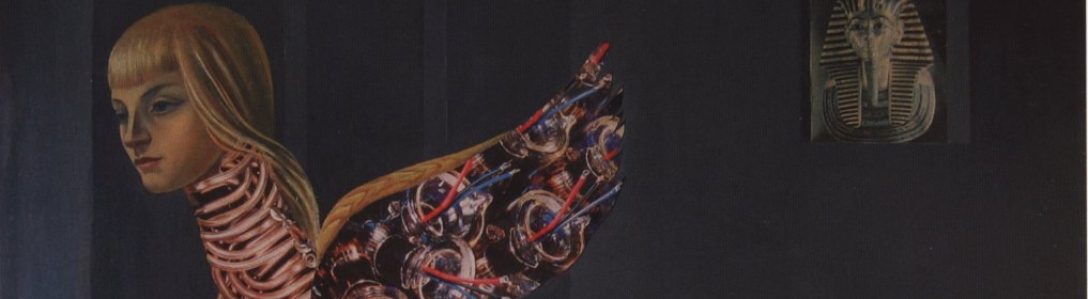
Matthew Guinn’s The Resurrectionist showed up in the mail a few days ago. Haven’t really had time to get into it, but the premise seems promising, and Guinn’s Southern lit bona fides also intrigue me.

Publisher W.W. Norton’s blurb:

A young doctor wrestles with the legacy of a slave “resurrectionist” owned by his South Carolina medical school.

“Dog days and the fresh bodies are arriving once again.” So begins the fall term at South Carolina Medical College, where Dr. Jacob Thacker is on probation for Xanax abuse. His interim career—working public relations for the dean—takes an unnerving detour into the past when the bones of African American slaves, over a century old, are unearthed on campus. Out of the college’s dark past, these bones threaten to rise and condemn the present.

In the middle of the nineteenth century, Dr. Frederick Augustus Johnston, one of the school’s founders, had purchased a slave for his unusual knife skills. This slave, Nemo (“no man”) would become an unacknowledged member of the surgical faculty by day—and by night, a “resurrectionist,” responsible for procuring bodies for medical study. An unforgettable character, by turns apparently insouciant, tormented, and brilliant, and seen by some as almost supernatural, Nemo will seize his self-respect in ways no reader can anticipate.

With exceptional storytelling pacing and skill, Matthew Guinn weaves together past and present to relate a Southern Gothic tale of shocking crimes and exquisite revenge, a riveting and satisfying moral parable of the South.


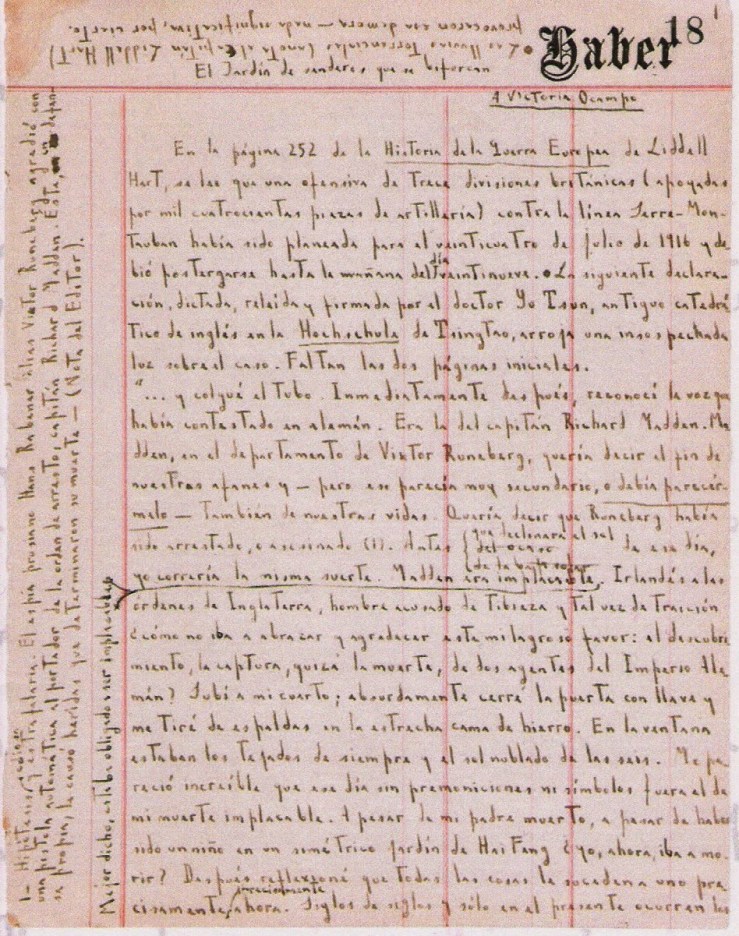
Handwritten Manuscript Page for Jorge Luis Borges’s “The Garden of Forking Paths”

borges manuscript

(Via).

Read an Excerpt from Adam Novy’s Work in Progress, The Gore and the Splatter

Hobart has published an excerpt of Adam Novy’s work in progress, The Gore and Splatter. I was a big fan of Adam’s last novel, The Avian Gospels, a dystopian take on terror and gypsies and birds. When I interviewed Adam a few years ago, he told me he was “writing a novel about the life and times of Medusa. It’s called The Gore and the Splatter. Ryan Chang got a bit more info about the novel in his interview with Adam, posted yesterday at Electric Literature:

I’m working on a novel about Perseus and Medusa before they get discovered. The early days of Perseus and Medusa. It takes place partially in mythic Greece and partially the suburb I grew up in. The characters are in the middle of mythic history. One thing about mythology I’ve always been really interested is what the characters know about their place and time in history. There’s this idea that the world is new and folks are creating meaning as they go along. Do they know they’re creating meaning? And what would it be like to be a teenager under those circumstances? Or a parent raising those teenagers, what would it be like?

I’m looking forward to this one. Until then we have the excerpt. Here is an excerpt of the excerpt:

Pentheus’s bedroom: hardly large enough to fit his mattress, a modest trunk of clothes, a wooden torso on a stick that wore his armor while he slept, and an altar to Athena. The floorplanks creaked, the roof leaked water, porous walls keened in wind. He’d let his mother and his nephews have the bedrooms with the windows. The den was also small, and too close to the kitchen for these rooms to be considered separate entities, and this house, such as it was, sat unevenly on pylons of old concrete, for the ground was a decline of dirt and sand on a rambling scrappy hillside, where any rugged vegetables that flourished in the desperate little gardens were scavengered immediately by rabbits.

The bungalow wasn’t quite dysfunctional, merely ugly, small, grotty, and way beyond the prospect of improvement. Still, the sneaky sisters Casey and Arden enjoyed their lives in an unfairly lavish home, and the house where the miraculous atrocity had happened, with the river and the tree, was nigh short of a mansion, if an ugly, nouveau, tasteless one. Perhaps whoever’d lived there had been killed for being vulgar. Pentheus had been working in a lumber yard adjacent to The Turnbull Farm—a huge, efficient version of the farm where Casey and Arden lived—when Mister Reddy heard that he was tall and took him on as his assistant. Your feet are very big, he’d said, you’ll leave a large carbon footprint. Pentheus thought he’d caught his golden opportunity, but all he got to do was walk beside the boss in heavy armor, sweat until he felt that he would rot, follow incoherent orders and let teenage girls humiliate him. And the pay was just as crappy as the lumber yard. Agave, his own mother, was a maid for Mister Turnbull. She was sixty-eight years old, but still she cooked, scrubbed the floor, washed stains from the clothes of messy children whose privilege didn’t exactly translate into manners. Pentheus and Agave paid their rent to Mister Reddy, who was Mister Turnbull’s partner, though Mister Reddy and Mister Turnbull also paid their salaries. Pentheus and his mother were little more than conduits for money as it looped its way inexorably back to whence it came. Jayden, Pentheus’s nephew, had said they were a kind of large intestine, where food was turned to shit and got excreted without their being able to enjoy it. Pentheus sometimes wished the boy was less articulate.

“The Seven Vagabonds” — Nathaniel Hawthorne

“The Seven Vagabonds” — Nathaniel Hawthorne

Rambling on foot in the spring of my life and the summer of the year, I came one afternoon to a point which gave me the choice of three directions. Straight before me the main road extended its dusty length to Boston; on the left a branch went toward the sea, and would have lengthened my journey a trifle of twenty or thirty miles, while by the right-hand path I might have gone over hills and lakes to Canada, visiting in my way the celebrated town of Stamford. On a level spot of grass at the foot of the guide-post appeared an object which, though locomotive on a different principle, reminded me of Gulliver’s portable mansion among the Brobdignags. It was a huge covered wagon—or, more properly, a small house on wheels—with a door on one side and a window shaded by green blinds on the other. Two horses munching provender out of the baskets which muzzled them were fastened near the vehicle. A delectable sound of music proceeded from the interior, and I immediately conjectured that this was some itinerant show halting at the confluence of the roads to intercept such idle travellers as myself. A shower had long been climbing up the western sky, and now hung so blackly over my onward path that it was a point of wisdom to seek shelter here.

“Halloo! Who stands guard here? Is the doorkeeper asleep?” cried I, approaching a ladder of two or three steps which was let down from the wagon.

The music ceased at my summons, and there appeared at the door, not the sort of figure that I had mentally assigned to the wandering showman, but a most respectable old personage whom I was sorry to have addressed in so free a style. He wore a snuff-colored coat and small-clothes, with white top-boots, and exhibited the mild dignity of aspect and manner which may often be noticed in aged schoolmasters, and sometimes in deacons, selectmen or other potentates of that kind. A small piece of silver was my passport within his premises, where I found only one other person, hereafter to be described.

“This is a dull day for business,” said the old gentleman as he ushered me in; “but I merely tarry here to refresh the cattle, being bound for the camp-meeting at Stamford.” Continue reading ““The Seven Vagabonds” — Nathaniel Hawthorne”

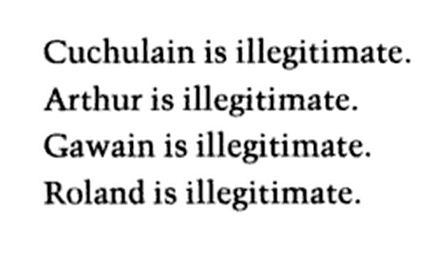
Illegitimate (David Markson)

Capture

“…the amazing, world-reversing night of Fourth of July Eve 1899” (Pynchon’s Against the Day)

For years after, there were tales told in Colorado of the amazing, world-reversing night of Fourth of July Eve 1899. Next day’d be full of rodeos, marching bands, and dynamite explosions—but that night there was man-made lightning, horses gone crazy for miles out into the prairie, electricity flooding up through the iron of their shoes, shoes that when they finally came off and got saved to use for cowboy quoits, including important picnic tourneys from Fruita to Cheyenne Wells, why they would fly directly and stick on to the spike in the ground, or to anything else nearby made of iron or steel, that’s when they weren’t collecting souvenirs on their way through the air—gunmen’s guns came right up out of their holsters and buck knives out from under pants legs, keys to traveling ladies’ hotel rooms and office safes, miners’ tags, fencenails, hairpins, all seeking the magnetic memory of that long-ago visit. Veterans of the Rebellion fixing to march in parades were unable to get to sleep, metallic elements had so got to humming through their bloodmaps. Children who drank the milk from the dairy cows who grazed nearby were found leaning against telegraph poles listening to the traffic speeding by through the wires above their heads, or going off to work in stockbrokers’ offices where, unsymmetrically intimate with the daily flow of prices, they were able to amass fortunes before anyone noticed. .

A passage from Thomas Pynchon’s novel Against the Day.


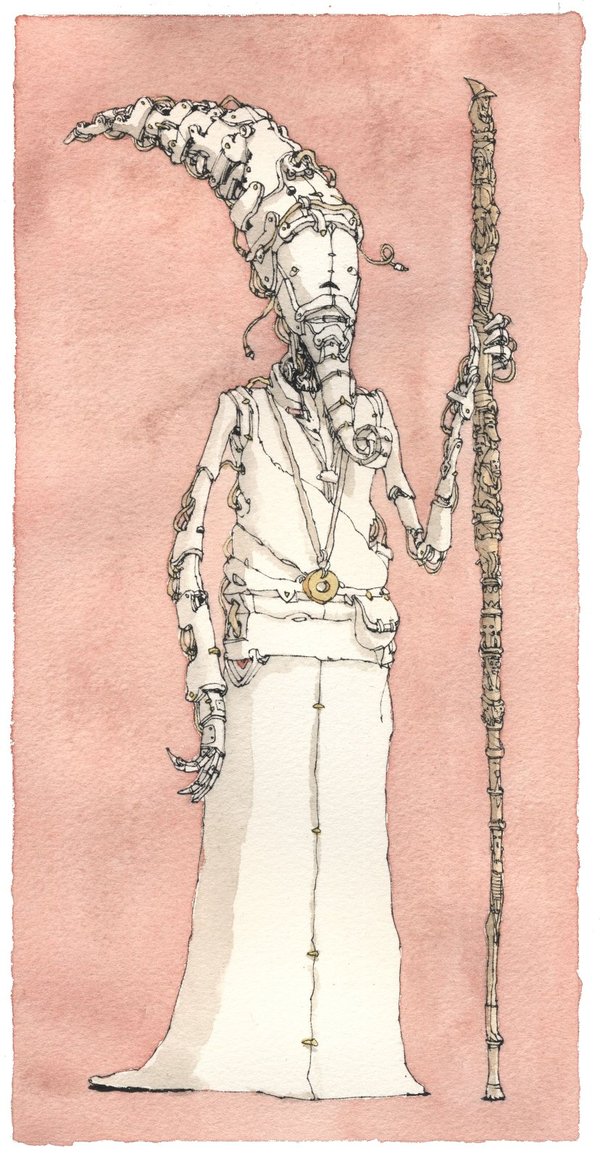
Gandalf Bot — Mattias Adolfsson

gandalf

(More/via).

“The Singing Lesson” — Katherine Mansfield

“The Singing Lesson” — Katherine Mansfield

With despair—cold, sharp despair—buried deep in her heart like a wicked knife, Miss Meadows, in cap and gown and carrying a little baton, trod the cold corridors that led to the music hall. Girls of all ages, rosy from the air, and bubbling over with that gleeful excitement that comes from running to school on a fine autumn morning, hurried, skipped, fluttered by; from the hollow class-rooms came a quick drumming of voices; a bell rang; a voice like a bird cried, “Muriel.” And then there came from the staircase a tremendous knock-knock-knocking. Some one had dropped her dumbbells.

The Science Mistress stopped Miss Meadows.

“Good mor-ning,” she cried, in her sweet, affected drawl. “Isn’t it cold? It might be win-ter.”

Miss Meadows, hugging the knife, stared in hatred at the Science Mistress. Everything about her was sweet, pale, like honey. You wold not have been surprised to see a bee caught in the tangles of that yellow hair.

“It is rather sharp,” said Miss Meadows, grimly.

The other smiled her sugary smile.

“You look fro-zen,” said she. Her blue eyes opened wide; there came a mocking light in them. (Had she noticed anything?)

“Oh, not quite as bad as that,” said Miss Meadows, and she gave the Science Mistress, in exchange for her smile, a quick grimace and passed on…

Forms Four, Five, and Six were assembled in the music hall. The noise was deafening. On the platform, by the piano, stood Mary Beazley, Miss Meadows’ favourite, who played accompaniments. She was turning the music stool. When she saw Miss Meadows she gave a loud, warning “Sh-sh! girls!” and Miss Meadows, her hands thrust in her sleeves, the baton under her arm, strode down the centre aisle, mounted the steps, turned sharply, seized the brass music stand, planted it in front of her, and gave two sharp taps with her baton for silence. Continue reading ““The Singing Lesson” — Katherine Mansfield”