Something on Georges Perec’s La Boutique Obscure

georges-perec-la-boutique-obscure-124-dreams

1. Listening to someone’s dreams is usually pretty boring. Reading about someone’s dreams is even worse.

Except when it’s not, of course.

2. Perec, describing his dream journal La Boutique Obscure:

I thought I was recording the dreams
I was having; I have realized that it was
not long before I began having dreams
only in order to write them.

These dreams—overdreamed, overworked,
overwritten—what could I then
expect of them, if not to make them into
texts, a bundle of texts left as an o)ering
at the gates of that “royal road” I still
must travel with my eyes open?

3. La Boutique Obscure is new in English translation by Daniel Levin Becker, published by the good people at Melville House.

4. The dreams in La Boutique Obscure, rendered in fairly concrete prose (Perec avoids analysis), were recorded between 1968-1972.

5. I’ve been slowly reading the essays and riffs and lists collected in Perec’s Species of Spaces and Other Pieces over the past few years. There’s something wonderful about picking the book up at random and finding some little quip or note (or entire essay) that illuminates some fascinating aspect of what we might initially take to be a dull topic.

La Boutique Obscure works the same way.

6. Sample:

Capture

7. Many of the elements that we see in Dream No. 24 / “Cats” run throughout the collection: Friends, doors, streets, houses, apartments, disasters, performances, lists, etc. etc. Note also Perec’s refusal to analyze or contextualize or otherwise attempt to make meaning out of the dream.

8. My favorite pieces in the collection are the ones that convey more plot—adventures, chases, fragments of films and plays—but there’s also pleasure in Perec’s shortest pieces, which often resemble imagist poems—like “The stone bridge”:

Capture

9. A good review, a responsible review, might try to situate Perec’s dream journal against his role as Oulipo gamesmaster, or set the entries against Perec’s biography, or maybe compare it to other dream journals. Or maybe even try to tackle it as a novel, or a novelish book.

10. But I’m more interested in the aesthetic experience of reading La Boutique Obscure. The book is fun, distracting, and divergent. Perec’s refusal to interpret his dreams leaves plenty of space for the reader to make his own connection—and if need be, interpretations—but to be clear, the same banal anxieties that inform our own dreams are what Perec traces the contours of in La Boutique Obscure. The book’s greatest strength is its imagery, its evocation of place, space, movement. To fault it for lacking depth would be to entirely miss the point.

11. Reading La Boutique Obscure provides another nagging reminder that I have yet to read Life A User’s Manual.

12. Finally: Roman Muradov’s response to the book is better than any review:

tumblr_mkghmeCTMk1qzxelgo1_1280

“On the Weather” — Jerome K. Jerome

“On the Weather” by Jerome K. Jerome

Things do go so contrary-like with me. I wanted to hit upon an especially novel, out-of-the-way subject for one of these articles. “I will write one paper about something altogether new,” I said to myself; “something that nobody else has ever written or talked about before; and then I can have it all my own way.” And I went about for days, trying to think of something of this kind; and I couldn’t. And Mrs. Cutting, our charwoman, came yesterday—I don’t mind mentioning her name, because I know she will not see this book. She would not look at such a frivolous publication. She never reads anything but the Bible and Lloyd’s Weekly News. All other literature she considers unnecessary and sinful.

She said: “Lor’, sir, you do look worried.”

I said: “Mrs. Cutting, I am trying to think of a subject the discussion of which will come upon the world in the nature of a startler—some subject upon which no previous human being has ever said a word—some subject that will attract by its novelty, invigorate by its surprising freshness.”

She laughed and said I was a funny gentleman.

That’s my luck again. When I make serious observations people chuckle; when I attempt a joke nobody sees it. I had a beautiful one last week. I thought it so good, and I worked it up and brought it in artfully at a dinner-party. I forget how exactly, but we had been talking about the attitude of Shakespeare toward the Reformation, and I said something and immediately added, “Ah, that reminds me; such a funny thing happened the other day in Whitechapel.” “Oh,” said they, “what was that?” “Oh, ’twas awfully funny,” I replied, beginning to giggle myself; “it will make you roar;” and I told it them.

There was dead silence when I finished—it was one of those long jokes, too—and then, at last, somebody said: “And that was the joke?”

I assured them that it was, and they were very polite and took my word for it. All but one old gentleman at the other end of the table, who wanted to know which was the joke—what he said to her or what she said to him; and we argued it out. Continue reading ““On the Weather” — Jerome K. Jerome”

Willa Cather on Mark Twain

If there is anything which should make an American sick and disgusted at the literary taste of his country, and almost swerve his allegiance to his flag it is that controversy between Mark Twain and Max O’Rell, in which the Frenchman proves himself a wit and a gentleman and the American shows himself little short of a clown and an all around tough. The squabble arose apropos of Paul Bourget’s new book on America, “Outre Mer,” a book which deals more fairly and generously with this country than any book yet written in a foreign tongue. Mr. Clemens did not like the book, and like all men of his class, and limited mentality, he cannot criticise without becoming personal and insulting. He cannot be scathing without being a blackguard. He tried to demolish a serious and well considered work by publishing a scurrilous, slangy and loosely written article about it. In this article Mr. Clemens proves very little against Mr. Bourget and a very great deal against himself. He demonstrates clearly that he is neither a scholar, a reader or a man of letters and very little of a gentleman. His ignorance of French literature is something appalling. Why, in these days it is as necessary for a literary man to have a wide knowledge of the French masterpieces as it is for him to have read Shakespeare or the Bible. What man who pretends to be an author can afford to neglect those models of style and composition. George Meredith, Thomas Hardy and Henry James excepted, the great living novelists are Frenchmen.

Mr. Clemens asks what the French sensualists can possibly teach the great American people about novel writing or morality? Well, it would not seriously hurt the art of the classic author of “Puddin’ Head Wilson” to study Daudet, De Maupassant, Hugo and George Sand, whatever it might do to his morals. Mark Twain is a humorist of a kind. His humor is always rather broad, so broad that the polite world can justly call it coarse. He is not a reader nor a thinker nor a man who loves art of any kind. He is a clever Yankee who has made a “good thing” out of writing. He has been published in the North American Review and in the Century, but he is not and never will be a part of literature. The association and companionship of cultured men has given Mark Twain a sort of professional veneer, but it could not give him fine instincts or nice discriminations or elevated tastes. His works are pure and suitable for children, just as the work of most shallow and mediocre fellows. House dogs and donkeys make the most harmless and chaste companions for young innocence in the world. Mark Twain’s humor is of the kind that teamsters use in bantering with each other, and his laugh is the gruff “haw-haw” of the backwoodsman. He is still the rough, awkward, good-natured boy who swore at the deck hands on the river steamer and chewed uncured tobacco when he was three years old. Thoroughly likeable as a good fellow, but impossible as a man of letters. It is an unfortunate feature of American literature that a hostler with some natural cleverness and a great deal of assertion receives the same recognition as a standard American author that a man like Lowell does. The French academy is a good thing after all. It at least divides the sheep from the goats and gives a sheep the consolation of knowing that he is a sheep.

It is rather a pity that Paul Bourget should have written “Outre Mer,” thoroughly creditable book though it is. Mr. Bourget is a novelist, and he should not content himself with being an essayist, there are far too many of them in the world already. He can develop strong characters, invent strong situations, he can write the truth and he should not drift into penning opinions and platitudes. When God has made a man a creator, it is a great mistake for him to turn critic. It is rather an insult to God and certainly a very great wrong to man.

Willa Cather on Mark Twain. Originally published in Nebraska State Journal, May 5, 1895


Sappho (Raphael + David Markson)

raphael sappho(2)


Capture


“Poker!” — A Short Play by Zora Neale Hurston

POKER! by Zora Neale Hurston

Time—Present

Place—New York

Cast of characters—
Nunkie
Too-Sweet
Peckerwood
Black Baby
Sack Daddy
Tush Hawg
Aunt Dilsey

SCENE—

A shabby front room in a shotgun house.

A door covered by dingy portieres upstage C. Small panel window in side Wall L. Plain centre table with chairs drawn up about it. Gaudy calendars on wall. Battered piano against wall R. Kerosene lamp with reflector against wall on either side of room.

At rise of curtain NUNKIE is at piano playing…. Others at table with small stacks of chips before each man. TUSH HAWG is seated at table so that he faces audience. He is expertly riffing the cards … looks over his shoulder and speaks to NUNKIE.

TUSH HAWG Come on here, Nunkie—and take a hand! You’re holding up the game. You been woofin’ round here about the poker you can play—now do it!

NUNKIE
Yeah, I plays poker. I plays the piano and Gawd knows I plays the devil.
I’m Uncle Bob with a wooden leg!*[Handwritten: Last sentence crossed out
in pencil in manuscript.]

BLACK BABY Aw, you can be had! Come on and get in the game! My britches is cryin’ for your money! Come on, don’t give the healer no trouble!*[Handwritten: last sentence crossed out in pencil]

NUNKIE Soon as I play the deck I’m comin’ and take you alls money! Don’ rush me.

 Ace means the first time that I met you
Duece means there was nobody there but us two
Trey means the third party—Charlie was his name
Four spot means the fourth time you tried that same old game—
Five spot means five years you played me for a clown
Six spot means six feet of earth when the deal goes down
Now I’m holding the seven spot for each day of the week
Eight means eight hours that she Sheba-ed with your Sheik—
Nine spot means nine hours that I work hard every day—
Ten spot means tenth of every month I brought you home my pay—
The Jack is three-card Charlie who played me for a goat
The Queen, that’s my pretty Mama, also trying to cut my throat—
The King stands for Sweet Papa Nunkie and he’s goin’ to wear the crown,
So be careful you all ain’t broke when the deal goes down!
(He laughs—X’es to table, bringing
piano stool for seat)

TUSH HAWG Aw now, brother, two dollars for your seat before you try to sit in this game.

NUNKIE
(Laughs sheepishly—puts money
down—TUSH HAWG pushes stack of chips
toward him. Bus.)
I didn’t put it down because I knew you all goin’ to be puttin’ it right
back in my pocket.

BECKERWOOD
Aw, Y’all go ahead and play.
(to TUSH HAWG)
Deal!
(TUSH HAWG begins to deal for draw
poker. The game gets tense. SACK
DADDY is first man at TUSH’s left—he
throws back three cards and is dealt
three more)

SACK DADDY My luck sure is rotten! My gal must be cheatin’ on me. I ain’t had a pair since John Henry had a hammer!

BLACK BABY
(Drawing three new cards)
You might be fooling the rest with the cryin’ you’re doin’ but I’m
squattin’ for you! You’re cryin’ worse than cryin’ Emma!

TOO-SWEET
(Studying his three new cards)
(Sings)
When yo’ cards gets lucky, oh Partner, you oughter be in a rollin’ game.
*[Handwritten: get you foot offa my chair etc]

AUNT DILSEY (Enters through portieres—stands and looks disapprovingly) You all oughter be ashamed of yourself, gamblin’ and carryin’ on like this!

BLACK BABY Aw, this ain’t no harm, Aunt Dilsey! You go on back to bed and git your night’s rest.

AUNT DILSEY
No harm! I know all about these no-harm sins! If you don’t stop this
card playin’, all of you all goin’ to die and go to Hell.
(Shakes warning finger—exits through
portieres—while she is talking the
men have been hiding cards out of
their hands and pulling aces out of
sleeves and vest pockets and
shoes—it is done quickly, one does
not see the other do it)

NUNKIE
(Shoving a chip forward)
A dollar!

SACK DADDY
Raise you two!

BLACK BABY I don’t like to strain with nobody but it’s goin’ to cost you five. Come on, you shag-nags! This hand I got is enough to pull a country man into town. *[Handwritten: Last sentence crossed through in pencil.]

TOO-SWEET You all act like you’re spuddin’! Bet some money! Put your money where your mouth is *[Handwritten: els my fist where yo mouf is.]

TUSH HAWG Twenty-five dollars to keep my company! Dog-gone, I’m spreadin’ my knots!

SACK DADDY
And I bet you a fat man I’ll take your money—I call you.
(Turns up his cards—he has four aces
and king)

TUSH HAWG (showing his cards) Youse a liar! I ain’t dealt you no aces. Don’t try to carry the Pam-Pam to me ’cause I’ll gently chain-gang for you!

SACK DADDY Oh yeah! I ain’t goin’ to fit no jail for you and nobody else. I’m to get me a green club and season it over your head. Then I’ll give my case to Miss Bush and let Mother Green stand my bond! I got deal them aces!

NUNKIE
That’s a lie! Both of you is lyin’! Lyin’ like the cross-ties from New
York to Key West! How can you all hold aces when I got four? Somebody is
goin’ to West hell before midnight!

BECKERWOOD Don’t you woof at Tush Hawg. If you do I’m goin’ to bust hell wide open with a man!

BLACK BABY
(Pulls out razor—Bus.)
My chop-axe tells me I got the only clean aces they is on this table!
Before I’ll leave you all rob me outa my money, I’m goin’ to die it off!

TOO-SWEET
I promised the devil one man and I’m goin’ to give him five!
(Draws gun)

TUSH HAWG
Don’t draw your bosom on me! God sent me a pistol and I’m goin’ to send
him a man!
(FIRES. Bus. for all)

AUNT DILSEY
(Enters after shooting bus. Stands.
Bus. drops to chair)
They wouldn’t lissen—
(Looks men over—Bus.)
It sure is goin’ to be a whole lot tougher in hell now!

CURTAIN


I Riff on the Cloud Atlas Movie

Cloud-Atlas-Poster

1. Cloud Atlas is neither the bizarre trainwreck I thought it might be, nor is it a disastrously wrong-headed reinterpretation of David Mitchell’s novel.

2. It’s actually about as faithful an adaptation as one could expect.

3. A major deviation from the novel:

The filmmakers (the Wachowskis and Tom Tykwer) of Cloud Atlas chop up and rearrange the novel’s six sections such that each section’s individual arc (e.g. exposition, climax, dénouement, etc.) runs concurrently with the other narrative arcs—like braided strands—whereas the novel nests them—like matryoskha dolls.

It’s very clear why the filmmakers would wish to use a more traditional grammar, but the effect is often more taxing than rewarding—the work’s themes of eternal recurrence are overstated (yet somehow underdeveloped), pressed repeatedly on the viewer. There’s little breathing room.

4. Another (possible) deviation from Mitchell’s novel:

The filmmakers cast their company (including Tom Hanks, Halle Berry, Jim Broadbent, and Hugo Weaving) in multiple roles, so that each actor portrays a new character in each section. Mitchell’s novel played with the idea of eternal recurrence subtly, using a comet-shaped birthmark as a linking signifier. The film adaptation overloads the theme, creating the impression of a system that simply doesn’t inhere through the plot unless the viewer chooses to impose it (granted, certain actors tend to be cast in villainous roles or heroic roles—but there isn’t a coherent system of correspondences between the actors and the characters, despite what snippets of dialog would wish the viewer to believer).

5. The biggest problem with casting actors across a variety of roles:

The effect is extremely distracting—especially when actors are playing characters across gender or across race (especially the film’s notorious use of “yellow face,” which is problematic on many levels, not the least of which is that the make-up and prosthetics just look awful—and the part of the yellow face that’s worst to me (and perhaps the least-remarked-upon) is the awful fake “Asian” accents that the white actors use, with mangled intonations, etc. Disastrous).

The gambit may have worked (only may) if the filmmakers had cast actors who could actually pull it off. Denis Lavant, Tilda Swinton, and Gary Oldman all come to mind as actors who inhabit their roles to such a degree that the character transcends them (in plainer language: Gary Oldman is excellent at not looking like Gary Oldman). Tom Hanks—well, Hanks is wonderful at balancing charm with profound gazes—but he looks just like Tom Hanks in every damn scene he’s in, whether he’s playing a contemporary British gangster (maybe the low point of the film) or a post-apocalyptic tribesman (which, let me just shoehorn this in here real quickly—I imagined the Zachry of the novel to be like, much, much younger than mid-fifties). Halle Berry looks like Halle Berry, even in white face. And Hugo Weaving doing his Nurse Ratchet impression…well, leave it alone, leave it alone.

6. One thing the film does very well:

Stylized action sequences. We might expect this—the Wachowskis gave us The Matrix trilogy—but I was surprised at how well these moments fit into the film. There must have been a temptation to wedge shootouts and battles and cool cityscape sequences into the film, but these pockets of action are used sparingly, effectively buoying the film.

7. Another thing the film does well:

Explore the themes of slavery (and slave-master dynamics) that are central to Mitchell’s text.

8. The biggest thematic short-coming of the Cloud Atlas film:

Its muddled handling of eternal recurrence. In my review of Mitchell’s novel, I suggested that the book was overtly investigating the relationship between Nietzsche’s concept of eternal recurrence and his infamous and often misunderstood übermensch. Granted, the film does posit history as a cycle of domination and submission, and also suggests that figures who wish to break or disrupt or upset this cycle will be assassinated or martyred—but the film elides the novel’s Nietzschean impulses in favor of New Age contours. There’s a broad, hippy-dippy streak of faux-spiritualism to the film that’s too syrupy to swallow. (In full disclosure, dear reader—I prefer a healthy dose of bitter with any sweets).

9. Another problem:

The music. It’s not that the score by director Tom Tykwer and two collaborators is bad—it’s fine, I suppose—it’s that the filmmakers rely too heavily on music to stitch their story strands together. The effect is at times simultaneously dulling and claustrophobic.

10. An extension of the previous point:

This is perhaps the biggest shortcoming of Cloud Atlas: Its compression. The film runs to an epic three hours, but somehow feels rushed.

There’s not enough space for characters to develop, and because the film has created a system through which characters are essentially reiterations of previous “selves,” the changes that the characters do undergo seem like fore drawn conclusions. Perhaps the most drastic example comes in the fabricant Sonmi-451. She’s an emblematic character to the narrative, a messianic figure, and her catechism provides the novel’s perhaps strongest exploration of what it means to be human and free. While the film hardly botches the Sonmi-451 segment, it doesn’t devote enough time to showing her revolutionary arc.

11. I know, I know—the film is already three hours, and here I am asking for more.

Suggestion: Cloud Atlas might have been much stronger as a twelve part miniseries, giving its characters and themes room to breathe and grow.

Another suggestion: Cloud Atlas as a one-man theatrical show starring, I don’t know, Gary Oldman (?). 75 minutes tops.

12. My criticisms might seem overly nitpicky, and to be clear, they are from the perspective of someone who read and enjoyed the book first. Still, I hate to fault the Wachowskis and Tykwer for their ambition, scope, technical prowess, and, oddly, their restraint. The film is far more focused and coherent than it has any right to be and its themes come through clearly. The filmmakers show a deep respect for Mitchell’s novel as well as the film’s audience while at the same time offering their own personal interpretation of the source material. When Cloud Atlas stumbles or outright fails, it does so on its own terms—which is why I think the film ultimately succeeds.

What if a demon (Nietzsche)

The greatest weight.— What, if some day or night a demon were to steal after you into your loneliest loneliness and say to you: “This life as you now live it and have lived it, you will have to live once more and innumerable times more; and there will be nothing new in it, but every pain and every joy and every thought and sigh and everything unutterably small or great in your life will have to return to you, all in the same succession and sequence – even this spider and this moonlight between the trees, and even this moment and I myself. The eternal hourglass of existence is turned upside down again and again, and you with it, speck of dust!”
Would you not throw yourself down and gnash your teeth and curse the demon who spoke thus?… Or how well disposed would you have to become to yourself and to life to crave nothing more fervently than this ultimate eternal confirmation and seal?

–From Nietzsche’s The Gay Science.


“Miss Brill” — Katherine Mansfield

“Miss Brill” by Katherine Mansfield

Although it was so brilliantly fine—the blue sky powdered with gold and great spots of light like white wine splashed over the Jardins Publiques—Miss Brill was glad that she had decided on her fur. The air was motionless, but when you opened your mouth there was just a faint chill, like a chill from a glass of iced water before you sip, and now and again a leaf came drifting—from nowhere, from the sky. Miss Brill put up her hand and touched her fur. Dear little thing! It was nice to feel it again. She had taken it out of its box that afternoon, shaken out the moth-powder, given it a good brush, and rubbed the life back into the dim little eyes. “What has been happening to me?” said the sad little eyes. Oh, how sweet it was to see them snap at her again from the red eiderdown!… But the nose, which was of some black composition, wasn’t at all firm. It must have had a knock, somehow. Never mind—a little dab of black sealing-wax when the time came—when it was absolutely necessary… Little rogue! Yes, she really felt like that about it. Little rogue biting its tail just by her left ear. She could have taken it off and laid it on her lap and stroked it. She felt a tingling in her hands and arms, but that came from walking, she supposed. And when she breathed, something light and sad—no, not sad, exactly—something gentle seemed to move in her bosom.

There were a number of people out this afternoon, far more than last Sunday. And the band sounded louder and gayer. That was because the Season had begun. For although the band played all the year round on Sundays, out of season it was never the same. It was like some one playing with only the family to listen; it didn’t care how it played if there weren’t any strangers present. Wasn’t the conductor wearing a new coat, too? She was sure it was new. He scraped with his foot and flapped his arms like a rooster about to crow, and the bandsmen sitting in the green rotunda blew out their cheeks and glared at the music. Now there came a little “flutey” bit—very pretty!—a little chain of bright drops. She was sure it would be repeated. It was; she lifted her head and smiled.

Only two people shared her “special” seat: a fine old man in a velvet coat, his hands clasped over a huge carved walking-stick, and a big old woman, sitting upright, with a roll of knitting on her embroidered apron. They did not speak. This was disappointing, for Miss Brill always looked forward to the conversation. She had become really quite expert, she thought, at listening as though she didn’t listen, at sitting in other people’s lives just for a minute while they talked round her.

She glanced, sideways, at the old couple. Perhaps they would go soon. Last Sunday, too, hadn’t been as interesting as usual. An Englishman and his wife, he wearing a dreadful Panama hat and she button boots. And she’d gone on the whole time about how she ought to wear spectacles; she knew she needed them; but that it was no good getting any; they’d be sure to break and they’d never keep on. And he’d been so patient. He’d suggested everything—gold rims, the kind that curved round your ears, little pads inside the bridge. No, nothing would please her. “They’ll always be sliding down my nose!” Miss Brill had wanted to shake her.

The old people sat on the bench, still as statues. Never mind, there was always the crowd to watch. To and fro, in front of the flower-beds and the band rotunda, the couples and groups paraded, stopped to talk, to greet, to buy a handful of flowers from the old beggar who had his tray fixed to the railings. Little children ran among them, swooping and laughing; little boys with big white silk bows under their chins, little girls, little French dolls, dressed up in velvet and lace. And sometimes a tiny staggerer came suddenly rocking into the open from under the trees, stopped, stared, as suddenly sat down “flop,” until its small high-stepping mother, like a young hen, rushed scolding to its rescue. Other people sat on the benches and green chairs, but they were nearly always the same, Sunday after Sunday, and—Miss Brill had often noticed—there was something funny about nearly all of them. They were odd, silent, nearly all old, and from the way they stared they looked as though they’d just come from dark little rooms or even—even cupboards!

Behind the rotunda the slender trees with yellow leaves down drooping, and through them just a line of sea, and beyond the blue sky with gold-veined clouds.

Tum-tum-tum tiddle-um! tiddle-um! tum tiddley-um tum ta! blew the band.

Two young girls in red came by and two young soldiers in blue met them, and they laughed and paired and went off arm-in-arm. Two peasant women with funny straw hats passed, gravely, leading beautiful smoke-coloured donkeys. A cold, pale nun hurried by. A beautiful woman came along and dropped her bunch of violets, and a little boy ran after to hand them to her, and she took them and threw them away as if they’d been poisoned. Dear me! Miss Brill didn’t know whether to admire that or not! And now an ermine toque and a gentleman in grey met just in front of her. He was tall, stiff, dignified, and she was wearing the ermine toque she’d bought when her hair was yellow. Now everything, her hair, her face, even her eyes, was the same colour as the shabby ermine, and her hand, in its cleaned glove, lifted to dab her lips, was a tiny yellowish paw. Oh, she was so pleased to see him—delighted! She rather thought they were going to meet that afternoon. She described where she’d been—everywhere, here, there, along by the sea. The day was so charming—didn’t he agree? And wouldn’t he, perhaps?… But he shook his head, lighted a cigarette, slowly breathed a great deep puff into her face, and even while she was still talking and laughing, flicked the match away and walked on. The ermine toque was alone; she smiled more brightly than ever. But even the band seemed to know what she was feeling and played more softly, played tenderly, and the drum beat, “The Brute! The Brute!” over and over. What would she do? What was going to happen now? But as Miss Brill wondered, the ermine toque turned, raised her hand as though she’d seen some one else, much nicer, just over there, and pattered away. And the band changed again and played more quickly, more gayly than ever, and the old couple on Miss Brill’s seat got up and marched away, and such a funny old man with long whiskers hobbled along in time to the music and was nearly knocked over by four girls walking abreast.

Oh, how fascinating it was! How she enjoyed it! How she loved sitting here, watching it all! It was like a play. It was exactly like a play. Who could believe the sky at the back wasn’t painted? But it wasn’t till a little brown dog trotted on solemn and then slowly trotted off, like a little “theatre” dog, a little dog that had been drugged, that Miss Brill discovered what it was that made it so exciting. They were all on the stage. They weren’t only the audience, not only looking on; they were acting. Even she had a part and came every Sunday. No doubt somebody would have noticed if she hadn’t been there; she was part of the performance after all. How strange she’d never thought of it like that before! And yet it explained why she made such a point of starting from home at just the same time each week—so as not to be late for the performance—and it also explained why she had quite a queer, shy feeling at telling her English pupils how she spent her Sunday afternoons. No wonder! Miss Brill nearly laughed out loud. She was on the stage. She thought of the old invalid gentleman to whom she read the newspaper four afternoons a week while he slept in the garden. She had got quite used to the frail head on the cotton pillow, the hollowed eyes, the open mouth and the high pinched nose. If he’d been dead she mightn’t have noticed for weeks; she wouldn’t have minded. But suddenly he knew he was having the paper read to him by an actress! “An actress!” The old head lifted; two points of light quivered in the old eyes. “An actress—are ye?” And Miss Brill smoothed the newspaper as though it were the manuscript of her part and said gently; “Yes, I have been an actress for a long time.”

The band had been having a rest. Now they started again. And what they played was warm, sunny, yet there was just a faint chill—a something, what was it?—not sadness—no, not sadness—a something that made you want to sing. The tune lifted, lifted, the light shone; and it seemed to Miss Brill that in another moment all of them, all the whole company, would begin singing. The young ones, the laughing ones who were moving together, they would begin, and the men’s voices, very resolute and brave, would join them. And then she too, she too, and the others on the benches—they would come in with a kind of accompaniment—something low, that scarcely rose or fell, something so beautiful—moving… And Miss Brill’s eyes filled with tears and she looked smiling at all the other members of the company. Yes, we understand, we understand, she thought—though what they understood she didn’t know.

Just at that moment a boy and girl came and sat down where the old couple had been. They were beautifully dressed; they were in love. The hero and heroine, of course, just arrived from his father’s yacht. And still soundlessly singing, still with that trembling smile, Miss Brill prepared to listen.

“No, not now,” said the girl. “Not here, I can’t.”

“But why? Because of that stupid old thing at the end there?” asked the boy. “Why does she come here at all—who wants her? Why doesn’t she keep her silly old mug at home?”

“It’s her fu-ur which is so funny,” giggled the girl. “It’s exactly like a fried whiting.”

“Ah, be off with you!” said the boy in an angry whisper. Then: “Tell me, ma petite chere—”

“No, not here,” said the girl. “Not yet.”


On her way home she usually bought a slice of honey-cake at the baker’s. It was her Sunday treat. Sometimes there was an almond in her slice, sometimes not. It made a great difference. If there was an almond it was like carrying home a tiny present—a surprise—something that might very well not have been there. She hurried on the almond Sundays and struck the match for the kettle in quite a dashing way.

But to-day she passed the baker’s by, climbed the stairs, went into the little dark room—her room like a cupboard—and sat down on the red eiderdown. She sat there for a long time. The box that the fur came out of was on the bed. She unclasped the necklet quickly; quickly, without looking, laid it inside. But when she put the lid on she thought she heard something crying.


Portrait of Anton Chekhov — Isaac Levitan

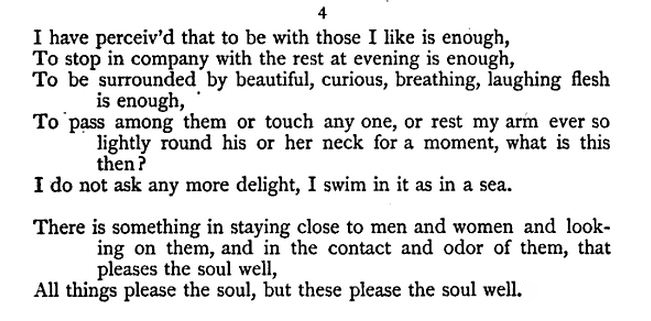
“I do not ask any more delight” (Walt Whitman)

Capture

“Walt Whitman” — Willa Cather

“Walt Whitman” by Willa Cather

Speaking of monuments reminds one that there is more talk about a monument to Walt Whitman, “the good, gray poet.” Just why the adjective good is always applied to Whitman it is difficult to discover, probably because people who could not understand him at all took it for granted that he meant well. If ever there was a poet who had no literary ethics at all beyond those of nature, it was he. He was neither good nor bad, any more than are the animals he continually admired and envied. He was a poet without an exclusive sense of the poetic, a man without the finer discriminations, enjoying everything with the unreasoning enthusiasm of a boy. He was the poet of the dung hill as well as of the mountains, which is admirable in theory but excruciating in verse. In the same paragraph he informs you that, “The pure contralto sings in the organ loft,” and that “The malformed limbs are tied to the table, what is removed drop horribly into a pail.” No branch of surgery is poetic, and that hopelessly prosaic word “pail” would kill a whole volume of sonnets. Whitman’s poems are reckless rhapsodies over creation in general, some times sublime, some times ridiculous. He declares that the ocean with its “imperious waves, commanding” is beautiful, and that the fly-specks on the walls are also beautiful. Such catholic taste may go in science, but in poetry their results are sad. The poet’s task is usually to select the poetic. Whitman never bothers to do that, he takes everything in the universe from fly-specks to the fixed stars. His “Leaves of Grass” is a sort of dictionary of the English language, and in it is the name of everything in creation set down with great reverence but without any particular connection.

But however ridiculous Whitman may be there is a primitive elemental force about him. He is so full of hardiness and of the joy of life. He looks at all nature in the delighted, admiring way in which the old Greeks and the primitive poets did. He exults so in the red blood in his body and the strength in his arms. He has such a passion for the warmth and dignity of all that is natural. He has no code but to be  natural, a code that this complex world has so long outgrown. He is sensual, not after the manner of Swinbourne and Gautier, who are always seeking for perverted and bizarre effects on the senses, but in the frank fashion of the old barbarians who ate and slept and married and smacked their lips over the mead horn. He is rigidly limited to the physical, things that quicken his pulses, please his eyes or delight his nostrils. There is an element of poetry in all this, but it is by no means the highest. If a joyous elephant should break forth into song, his lay would probably be very much like Whitman’s famous “song of myself.” It would have just about as much delicacy and deftness and discriminations. He says:

“I think I could turn and live with the animals. They are so placid and self-contained, I stand and look at them long and long. They do not sweat and whine about their condition. They do not lie awake in the dark and weep for their sins. They do not make me sick discussing their duty to God. Not one is dissatisfied nor not one is demented with the mania of many things. Not one kneels to another nor to his kind that lived thousands of years ago. Not one is respectable or unhappy, over the whole earth.” And that is not irony on nature, he means just that, life meant no more to him. He accepted the world just as it is and glorified it, the seemly and unseemly, the good and the bad. He had no conception of a difference in people or in things. All men had bodies and were alike to him, one about as good as another. To live was to fulfil all natural laws and impulses. To be comfortable was to be happy. To be happy was the ultimatum. He did not realize the existence of a conscience or a responsibility. He had no more thought of good or evil than the folks in Kipling’s Jungle book.

And yet there is an undeniable charm about this optimistic vagabond who is made so happy by the warm sunshine and the smell of spring fields. A sort of good fellowship and whole-heartedness in every line he wrote. His veneration for things physical and material, for all that is in water or air or land, is so real that as you read him you think for the moment that you would rather like to live so if you could. For the time you half believe that a sound body and a strong arm are the greatest things in the world. Perhaps no book shows so much  as “Leaves of Grass” that keen senses do not make a poet. When you read it you realize how spirited a thing poetry really is and how great a part spiritual perceptions play in apparently sensuous verse, if only to select the beautiful from the gross.

Nebraska State Journal, January 19, 1896


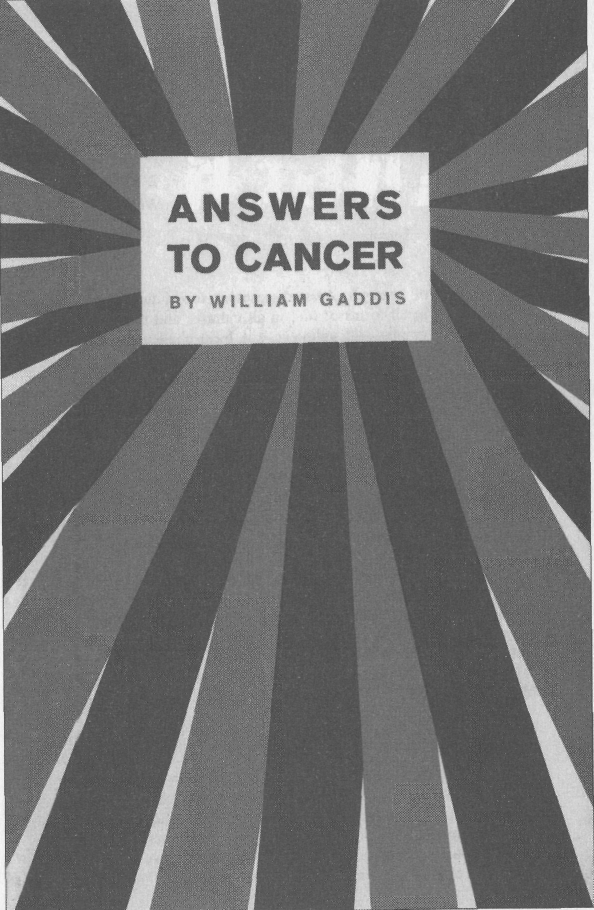
Answers to Cancer by William Gaddis

cancer

(This is the cover to one of William Gaddis’s corporate writings; the image comes from the collection The Rush for Second Place).

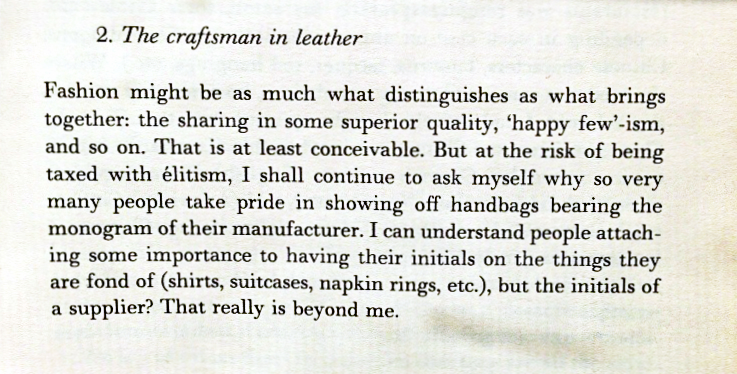
Georges Perec on Designer Handbags

gp

“Of Death” — Francis Bacon

“Of Death” — Francis Bacon

MEN fear death, as children fear to go in the dark; and as that natural fear in children, is increased with tales, so is the other. Certainly, the contemplation of death, as the wages of sin, and passage to another world, is holy and religious; but the fear of it, as a tribute due unto nature, is weak. Yet in religious meditations, there is sometimes mixture of vanity, and of superstition. You shall read, in some of the friars’ books of mortification, that a man should think with himself, what the pain is, if he have but his finger’s end pressed, or tortured, and thereby imagine, what the pains of death are, when the whole body is corrupted, and dissolved; when many times death passeth, with less pain than the torture of a limb; for the most vital parts, are not the quickest of sense. And by him that spake only as a philosopher, and natural man, it was well said, Pompa mortis magis terret, quam mors ipsa. Groans, and convulsions, and a discolored face, and friends weeping, and blacks, and obsequies, and the like, show death terrible. It is worthy the observing, that there is no passion in the mind of man, so weak, but it mates, and masters, the fear of death; and therefore, death is no such terrible enemy, when a man hath so many attendants about him, that can win the combat of him. Revenge triumphs over death; love slights it; honor aspireth to it; grief flieth to it; fear preoccupateth it; nay, we read, after Otho the emperor had slain himself, pity (which is the tenderest of affections) provoked many to die, out of mere compassion to their sovereign, and as the truest sort of followers. Nay, Seneca adds niceness and satiety: Cogita quamdiu eadem feceris; mori velle, non tantum fortis aut miser, sed etiam fastidiosus potest. A man would die, though he were neither valiant, nor miserable, only upon a weariness to do the same thing so oft, over and over. It is no less worthy, to observe, how little alteration in good spirits, the approaches of death make; for they appear to be the same men, till the last instant. Augustus Caesar died in a compliment; Livia, conjugii nostri memor, vive et vale. Tiberius in dissimulation; as Tacitus saith of him, Jam Tiberium vires et corpus, non dissimulatio, deserebant. Vespasian in a jest, sitting upon the stool; Ut puto deus fio. Galba with a sentence; Feri, si ex re sit populi Romani; holding forth his neck. Septimius Severus in despatch; Adeste si quid mihi restat agendum. And the like. Certainly the Stoics bestowed too much cost upon death, and by their great preparations, made it appear more fearful. Better saith he, qui finem vitae extremum inter munera ponat naturae. It is as natural to die, as to be born; and to a little infant, perhaps, the one is as painful, as the other. He that dies in an earnest pursuit, is like one that is wounded in hot blood; who, for the time, scarce feels the hurt; and therefore a mind fixed, and bent upon somewhat that is good, doth avert the dolors of death. But, above all, believe it, the sweetest canticle is’, Nunc dimittis; when a man hath obtained worthy ends, and expectations. Death hath this also; that it openeth the gate to good fame, and extinguisheth envy.—Extinctus amabitur idem.


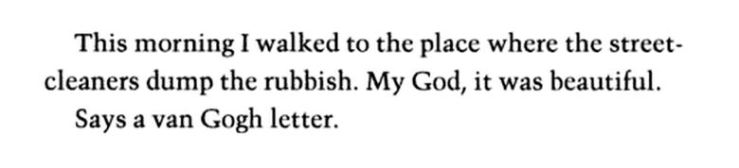
Van Gogh Anecdote (David Markson)

Capture

“A Little Cloud” — James Joyce

“A Little Cloud” by James Joyce

EIGHT years before he had seen his friend off at the North Wall and wished him godspeed. Gallaher had got on. You could tell that at once by his travelled air, his well-cut tweed suit, and fearless accent. Few fellows had talents like his and fewer still could remain unspoiled by such success. Gallaher’s heart was in the right place and he had deserved to win. It was something to have a friend like that.

Little Chandler’s thoughts ever since lunch-time had been of his meeting with Gallaher, of Gallaher’s invitation and of the great city London where Gallaher lived. He was called Little Chandler because, though he was but slightly under the average stature, he gave one the idea of being a little man. His hands were white and small, his frame was fragile, his voice was quiet and his manners were refined. He took the greatest care of his fair silken hair and moustache and used perfume discreetly on his handkerchief. The half-moons of his nails were perfect and when he smiled you caught a glimpse of a row of childish white teeth.

As he sat at his desk in the King’s Inns he thought what changes those eight years had brought. The friend whom he had known under a shabby and necessitous guise had become a brilliant figure on the London Press. He turned often from his tiresome writing to gaze out of the office window. The glow of a late autumn sunset covered the grass plots and walks. It cast a shower of kindly golden dust on the untidy nurses and decrepit old men who drowsed on the benches; it flickered upon all the moving figures—on the children who ran screaming along the gravel paths and on everyone who passed through the gardens. He watched the scene and thought of life; and (as always happened when he thought of life) he became sad. A gentle melancholy took possession of him. He felt how useless it was to struggle against fortune, this being the burden of wisdom which the ages had bequeathed to him. Continue reading ““A Little Cloud” — James Joyce”

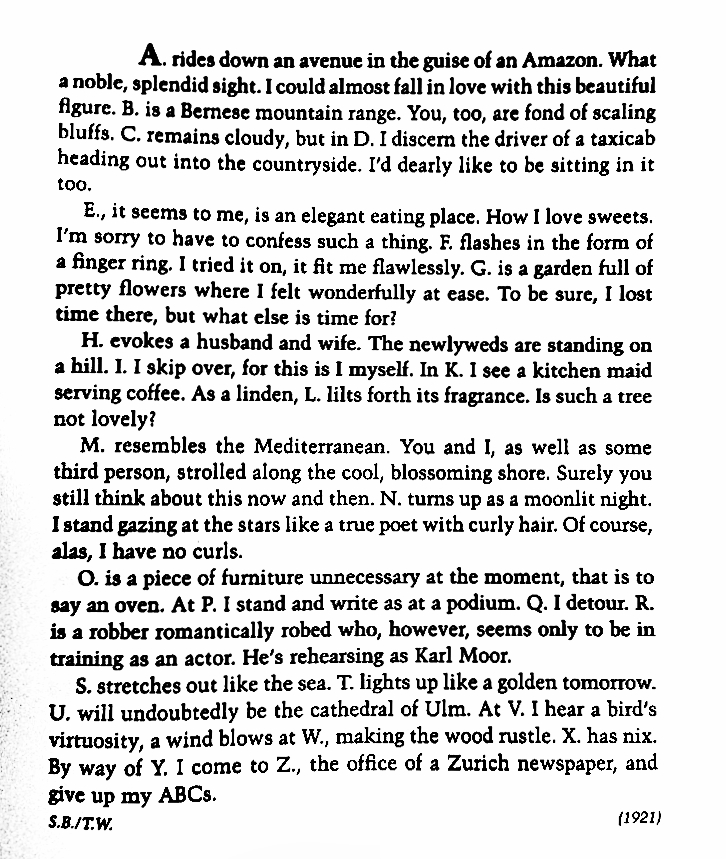
“The Alphabet” — Robert Walser

rw