The Hobbit Reconsidered as a Picaresque Novel

Making a weekend trip from the east coast of Florida to its Gulf shores, my family and I listened to Nicol Williamson’s early 1970s recording of J.R.R. Tolkien’s The Hobbit. Williamson’s recording is rich and expressive, his command of each voice bringing Tolkien’s characters to life.

I first heard Williamson’s recording over twenty years ago on a series of LPs that I checked out from the library. I had probably already read The Hobbit half a dozen times by then, but Williamson’s sonorous voice—along with the music and audio production effects—added another layer to Middle Earth.

My daughter, five, already familiar with the 1977 Rankin-Bass film, had no problem keeping pace with the story (although she occasionally asked me to pause for clarification on a few finer points, such as the delicate distinctions between goblins and trolls, or just who exactly is this guy Bard who shows up all of a sudden?) My favorite part of the entire weekend was my two year old imitating Gollum, sniveling a sinister, “My precious!” while squinting gleefully.

There are few books I’ve read as many times as Tolkien’s The Lord of the Rings trilogy: I read it countless times between the ages of 11 and 15, read it again as an undergrad, then read it again–twice, I’m not ashamed to admit—when Peter Jackson’s adaptations came out. However, despite reading The Hobbit repeatedly as a kid, I’ve never really gone back to it. It traffics in a gentle folklore that seems out of square with the epic mythmaking in The Lord of the Rings, and I think that I was always unsettled by a certain discontinuity between the two books that was easier to ignore if I never went back to The Hobbit.

Memory has a way of eliding details, and books are especially susceptible to this wearing down and smoothing out. So, I remembered The Hobbit as a quest, a miniature epic with Bilbo Baggins leaving the comforts of home to find treasure guarded by the dragon Smaug. I remembered Gandalf and the thirteen dwarves invading Bilbo’s tidy hobbit hole; I remembered trolls who turn to stone; I remembered riddles with Gollum and a ring that turns its wearer invisible; I remembered Mirkwood and barrels and the mountain lair of a dragon. I vaguely remembered the Battle of Five Armies, where the enormous eagles literally swoop in and save the day, deus ex machina style.

Listening to the unabridged audio, I was struck by just how much had escaped my memory: I barely recalled the spiders of Mirkwood or the talking ravens or the part where the wargs tree the dwarves. I had completely forgotten the shapeshifter Beorn, a creature straight out of Scandinavian myth.

One of Tolkien’s original illustrations for The Hobbit

What I found most strange in revisiting The Hobbit though was its radical compression, its tendency and willingness to pivot sharply, to cast its characters about or trample them under (metaphorical and sometimes literal) foot, or throw them in dungeons or barrels or some other danger.

Whereas The Lord of the Rings progresses from the folkloric feel of The Shire through to the high-adventure sweep of Icelandic saga and ultimately to a King Jamesish condensation of near-pure archetypery (and back again, of course), The Hobbit showcases a rambling, flowing, discursive, “out of the frying pan, into the fire” rhythm.

In short, The Hobbit, as it turns out, is a picaresque novel.

And just what is a picaresque novel, and why is The Hobbit one?, you may or may not ask.

Michael Seidel offers a clear definition in his introduction to Daniel Defoe’s Moll Flanders (an excellent picaresque, by the way):

. . . the tradition of Continental picaresque, or rogue, literature . . .  became popular throughout Europe with the publication of Lazarillo de Tormes (1554) in Spain. Picarós and picarás are orphans, vagabonds, desperadoes, and reprobates trying to manipulate the conventions of a world largely determined by established family and class connections. . . . Picaresque fiction is the story of outsiders trying to get in, and the fortunes of the protagonist often depend on adaptable, protean, and duplicitous behavior as picaresque characters become who they need to be to survive.

The Hobbit is very much the story of the topsy-turvy turns of Bilbo Baggins’s identity. At the adventure’s outset, he’s a respectable—comfortable—Baggins of Bag End. Not the sort of fellow who goes on adventures. And yet he’s enlisted by Gandalf to serve as burglar for the expedition, a picaró in the making who steals a purse from a troll and never looks back.

It’s not just Bilbo’s various thefts, but also his “adaptable, protean, and duplicitous behavior” that marks him as a picaró. His scheming is evident repeatedly in the novel, whether he’s riddling with Gollum or Smaug, devising a breakout from the Elf King of Mirkwood’s dungeon, or playing the long con against the parties involved in the Battle of Five Armies. He echoes Gandalf in this way, whose talents seem to veer more toward trickery and cunning than dazzling spells or marvelous magic.

Bilbo’s picaresque turns of fortune and turns of identity are neatly summarized in a late exchange with yon dragon Smaug, who immediately calls him out as a picaró:

“You have nice manners for a thief and a liar,” said the dragon. “You seem familiar with my name, but I don’t seem to remember smelling you before. Who are you and where do you come from, may I ask?”

“You may indeed! I come from under the hill, and under hills and over the hills my paths led. And through the air, I am he that walks unseen.”

“So I can well believe,” said Smaug, “but that is hardly our usual name.”

“I am the clue-finder, the web-cutter, the stinging fly. I am chosen for the lucky number.”

“Lovely titles!” sneered the dragon. “But lucky numbers don’t always come off.”

“I am he that buries his friends alive and drowns them and draws them alive again from the water. I came from the end of a bag, but no bag went over me.”

“These don’t sound so creditable,” scoffed Smaug.

“I am the friend of bears and the guest of eagles. I am Ringwinner and Luckwearer; and I am Barrel-rider,” went on Bilbo beginning to be pleased with his riddling.

“That’s better!” said Smaug. “But don’t let your imagination run away with you!”

But imagination is of course the primary tool of the picaró, and Bilbo is no slouch: The Hobbit condemns evil, greedy Smaug when it shows the rewards of letting “your imagination run away with you.” Indeed, the entire novel is a running away, a constant deflection of stable identity, as Bilbo twists and turns his way back to The Shire.

And what happens to Bilbo? What happens to that once-stable, once-comfortable identity? We learn at the novel’s end about the queering of his identity—

. . . he had lost his reputation. It is true that for ever after he remained an elf-friend, and had the honour of dwarves, wizards, and all such folk as ever passed that way; but he was no longer quite respectable. He was in fact held by all the hobbits of the neighbourhood to be ‘queer’—except by his nephews and nieces on the Took side, but even they were not encouraged in their friendship by their elders. I am sorry to say he did not mind.

So! Queer, strange Baggins the  picaró embraces his “Took side,” his disreputable adventuring side. And still the narrative comes to a lovely cozy warm respectable ending, Bilbo’s identity transformed, sullied, illuminated, and enlarged by his picaresque adventure.

And the picaresque? Well, maybe I’ve stretched its definition a bit simply because I’m so fond of picaresque narratives these days. Maybe I’ve simply revisited a childhood classic and imposed a new viewpoint upon it. (And maybe years and years from now I’ll revisit it again with grandchildren, and find something new and different there as well. I hope).

I think what I enjoyed most about The Hobbit this time was hearing the rambling discursiveness of it all—here we have a narrative that understands the perilous and precarious position of the storyteller, he or she who might lose the thread—or worse, lose the audience!—at any damn time. So keep the story sailing, shifting, rambling out into new moods, modes, movements.

Seidel gives us a lovely definition of picaresque above, but can’t do better than Ralph Ellison who, in describing his modernist classic Invisible Man, offers us a description of the picaresque as “one of those pieces of writing which consists mainly of one damned thing after another sheerly happening.”

And this is the power of The Hobbit—which is to say the staying power of The Hobbit—its ability to evoke the imaginative force of one damned thing after another sheerly happening for generation after generation.
The First Sentences of Thomas Bernhard’s Novel Correction

After a mild pulmonary infection, tended too little and too late, had suddenly turned into a severe pneumonia that took its toll of my entire body and laid me up for at least three months at nearby Wels, which has a hospital renowned in the field of so-called internal medicine, I accepted an invitation from Hoeller, a so-called taxidermist in the Aurach valley, not for the end of October, as the doctors urged, but for early in October, as I insisted, and then went on my own so-called responsibility straight to the Aurach valley and to Hoeller’s house, without even a detour to visit my parents in Stocket, straight into the so-called Hoeller garret, to begin sifting and perhaps even arranging the literary remains of my friend, who was also a friend of the taxidermist Hoeller, Roithamer, after Roithamer’s suicide, I went to work sifting and sorting the papers he had willed to me, consisting of thousands of slips covered with Roithamer’s handwriting plus a bulky manuscript entitled “About Altensam and everything connected with Altensam, with special attention to the Cone.” The atmosphere in Hoeller’s house was still heavy, most of all with the circumstances of Roithamer’s suicide, and seemed from the moment of my arrival favorable to my plan of working on Roithamer’s papers there, specifically in Hoeller’s garret, sifting and sorting Roithamer’s papers and even, as I suddenly decided, simultaneously writing my own account of my work on these papers, as I have here begun to do, aided by having been able to move straight into Hoeller s garret without any reservations on Hoeller’s part, even though the house had other suitable accommodations, I deliberately moved into that four-by-five-meter garret Roithamer was always so fond of, which was so ideal, especially in his last years, for his purposes, where I could stay as long as I liked, it was all the same to Hoeller, in this house built by the headstrong Hoeller in defiance of every rule of reason and architecture right here in the Aurach gorge, in the garret which Hoeller had designed and built as if for Roithamer’s purposes, where Roithamer, after sixteen years in England with me, had spent the final years of his life almost continuously, and even prior to that he had found it convenient to spend at least his nights in the garret, especially while he was building the Cone for his sister in the Kobernausser forest, all the time the Cone was under construction he no longer slept at home in Altensam but always and only in Hoeller’s garret, it was simply in every respect the ideal place for him during those last years when he, Roithamer, never went straight home to Altensam from England, but instead went every time to Hoeller’s garret, to fortify himself in its simplicity (Hoeller house) for the complexity ahead (Cone), it would not do to go straight to Altensam from England, where each of us, working separately in his own scientific field, had been living in Cambridge all those years, he had to go straight to Hoeller’s garret, if he did not follow this rule which had become a cherished habit, the visit to Altensam was a disaster from the start, so he simply could not let himself go directly from England to Altensam and everything connected with Altensam, whenever he had not made the detour via Hoeller’s house, to save time, as he himself admitted, it had been a mistake, so he no longer made the experiment of going to Altensam without first stopping at Hoeller’s house, in those last years, he never again went home without first visiting Hoeller and Hoeller’s family and Hoeller’s house, without first moving into Hoeller’s garret, to devote himself for two or three days to such reading as he could do only in Hoeller s garret, of subject matter that was not harmful but helpful o him, books and articles he could read neither in Altensam or in England, and to thinking and writing what he found possible to think and write neither in England nor in Altensam, here I discovered Hegel, he always said, over and over again, it was here that I really delved into Schopenhauer for the first time, here that I could read, for the first time, Goethe’s Elective Affinities and The Sentimental Journey, without distraction and with a clear head, it was here, in Hoeller’s garret, that I suddenly gained access to ideas to which my mind had been sealed for decades before I came to this garret, access, he wrote, to the most essential ideas, the most important for me, the most necessary to my life, here in Hoeller’s garret, he wrote, everything became possible for me, everything that had always been impossible for me outside Hoeller’s garret, such as letting myself be guided by my intellectual inclinations and to develop my natural aptitudes accordingly, and to get on with my work, everywhere else I had always been hindered in developing my aptitudes but in Hoeller’s garret I could always develop them most consistently, here everything was congenial to my way of thinking, here I could always indulge myself in exploring all my intellectual possibilities, here my intellectual possibilities, here in Hoeller’s garret my head, my mind, my whole constitution were suddenly relieved from all the outside world’s oppression, the most incredible things were suddenly no longer incredible, the most impossible (thinking!) no longer impossible. It was in Hoeller’s garret that he found the conditions necessary and most favorable to thought, for getting the mechanism of his thought going in the most natural, most undistracted way, all he had to do was to come to Hoeller’s garret from wherever he might be, and the mechanism worked.

—The first sentences of Thomas Bernhard’s novel Correction.

The Hobbit (1977 Rankin/Bass, Full Film)

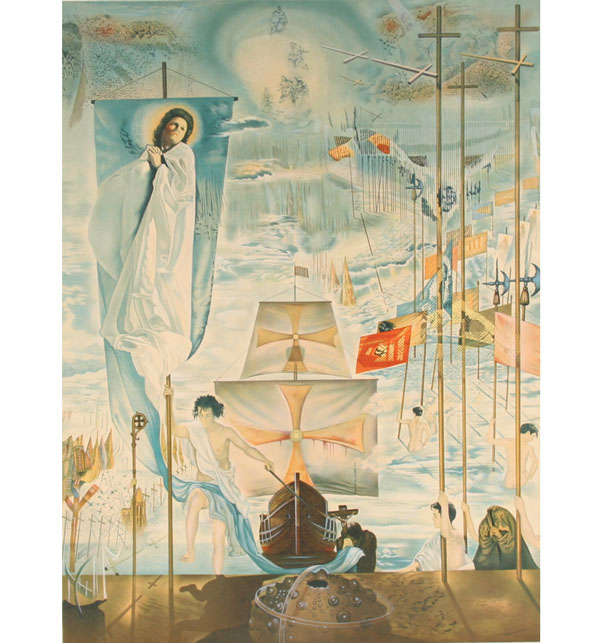
Anthems in New Tongues I Hear Saluting Me (Whitman/Dali)


Salvador Dali Museum.
Salvador Dalí, The Discovery of America by Christopher Columbus

“Prayer of Columbus” by Walt Whitman

A batter’d, wreck’d old man,
Thrown on this savage shore, far, far from home,
Pent by the sea and dark rebellious brows, twelve dreary months,
Sore, stiff with many toils, sicken’d and nigh to death,
I take my way along the island’s edge,
Venting a heavy heart.
I am too full of woe!
Haply I may not live another day;
I cannot rest O God, I cannot eat or drink or sleep,
Till I put forth myself, my prayer, once more to Thee,
Breathe, bathe myself once more in Thee, commune with Thee,
Report myself once more to Thee.
Thou knowest my years entire, my life,
My long and crowded life of active work, not adoration merely;
Thou knowest the prayers and vigils of my youth,
Thou knowest my manhood’s solemn and visionary meditations,
Thou knowest how before I commenced I devoted all to come to Thee,
Thou knowest I have in age ratified all those vows and strictly kept them,
Thou knowest I have not once lost nor faith nor ecstasy in Thee,
In shackles, prison’d, in disgrace, repining not,
Accepting all from Thee, as duly come from Thee.
All my emprises have been fill’d with Thee,
My speculations, plans, begun and carried on in thoughts of Thee,
Sailing the deep or journeying the land for Thee;
Intentions, purports, aspirations mine, leaving results to Thee.
O I am sure they really came from Thee,
The urge, the ardor, the unconquerable will,

The potent, felt, interior command, stronger than words,

A message from the Heavens whispering to me even in sleep,
These sped me on.
By me and these the work so far accomplish’d,
By me earth’s elder cloy’d and stifled lands uncloy’d, unloos’d,
By me the hemispheres rounded and tied, the unknown to the known.
The end I know not, it is all in Thee,
Or small or great I know not–haply what broad fields, what lands,
Haply the brutish measureless human undergrowth I know,
Transplanted there may rise to stature, knowledge worthy Thee,
Haply the swords I know may there indeed be turn’d to reaping-tools,
Haply the lifeless cross I know, Europe’s dead cross, may bud and
blossom there.
One effort more, my altar this bleak sand;
That Thou O God my life hast lighted,
With ray of light, steady, ineffable, vouchsafed of Thee,
Light rare untellable, lighting the very light,
Beyond all signs, descriptions, languages;
For that O God, be it my latest word, here on my knees,
Old, poor, and paralyzed, I thank Thee.
My terminus near,
The clouds already closing in upon me,
The voyage balk’d, the course disputed, lost,
I yield my ships to Thee.
My hands, my limbs grow nerveless,
My brain feels rack’d, bewilder’d,
Let the old timbers part, I will not part,
I will cling fast to Thee, O God, though the waves buffet me,
Thee, Thee at least I know.
Is it the prophet’s thought I speak, or am I raving?
What do I know of life? what of myself?
I know not even my own work past or present,
Dim ever-shifting guesses of it spread before me,
Of newer better worlds, their mighty parturition,
Mocking, perplexing me.
And these things I see suddenly, what mean they?
As if some miracle, some hand divine unseal’d my eyes,
Shadowy vast shapes smile through the air and sky,
And on the distant waves sail countless ships,
And anthems in new tongues I hear saluting me.


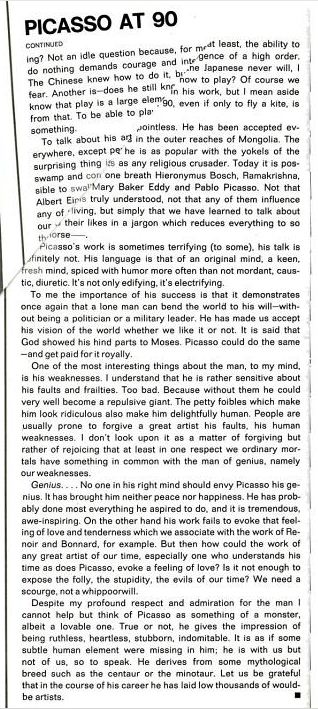
“Picasso at 90” — Henry Miller (1971 LIFE Magazine Profile)

“Picasso at 90” is an October, 1971 profile on the artist by Henry Miller, presented here via Google Books. In a felicitous cubist twist, the second page of the article (featuring the full portrait of Picasso and, on its back, the column of text) seems to have been cut (or ripped) and then repaired.

An Evening with Edgar Allan Poe — Vincent Price Recites Four Poe Classics

Alexander Alexeieff Illustrates Poe’s Story “The Fall of the House of Usher”

(More/via/about).

Read Edgar Allan Poe’s Story “A Descent into the Maelström”


“A Descent into the Maelström” by Edgar Allan Poe—

The ways of God in Nature, as in Providence, are not as our ways; nor are the models that we frame any way commensurate to the vastness, profundity, and unsearchableness of His works, which have a depth in them greater than the well of Democritus.
Joseph Glanville.

WE had now reached the summit of the loftiest crag. For some minutes the old man seemed too much exhausted to speak.

“Not long ago,” said he at length, “and I could have guided you on this route as well as the youngest of my sons; but, about three years past, there happened to me an event such as never happened before to mortal man –or at least such as no man ever survived to tell of –and the six hours of deadly terror which I then endured have broken me up body and soul. You suppose me a very old man –but I am not. It took less than a single day to change these hairs from a jetty black to white, to weaken my limbs, and to unstring my nerves, so that I tremble at the least exertion, and am frightened at a shadow. Do you know I can scarcely look over this little cliff without getting giddy?”

The “little cliff,” upon whose edge he had so carelessly thrown himself down to rest that the weightier portion of his body hung over it, while he was only kept from falling by the tenure of his elbow on its extreme and slippery edge –this “little cliff” arose, a sheer unobstructed precipice of black shining rock, some fifteen or sixteen hundred feet from the world of crags beneath us. Nothing would have tempted me to within half a dozen yards of its brink. In truth so deeply was I excited by the perilous position of my companion, that I fell at full length upon the ground, clung to the shrubs around me, and dared not even glance upward at the sky –while I struggled in vain to divest myself of the idea that the very foundations of the mountain were in danger from the fury of the winds. It was long before I could reason myself into sufficient courage to sit up and look out into the distance.

“You must get over these fancies,” said the guide, “for I have brought you here that you might have the best possible view of the scene of that event I mentioned –and to tell you the whole story with the spot just under your eye.”

“We are now,” he continued, in that particularizing manner which distinguished him –“we are now close upon the Norwegian coast –in the sixty-eighth degree of latitude –in the great province of Nordland –and in the dreary district of Lofoden. The mountain upon whose top we sit is Helseggen, the Cloudy. Now raise yourself up a little higher –hold on to the grass if you feel giddy –so –and look out beyond the belt of vapor beneath us, into the sea.” Continue reading “Read Edgar Allan Poe’s Story “A Descent into the Maelström””

The Fall of the House of Usher — Edgar Allan Poe’s Tale Comes to Life in a Creepy Stop-Motion Film by Jan Svankmajer

Book Shelves #41, 10.07.2012


20121001-205929.jpg

Book shelves series #41, forty-first Sunday of 2012

Lots of lovely books and mags with pictures.

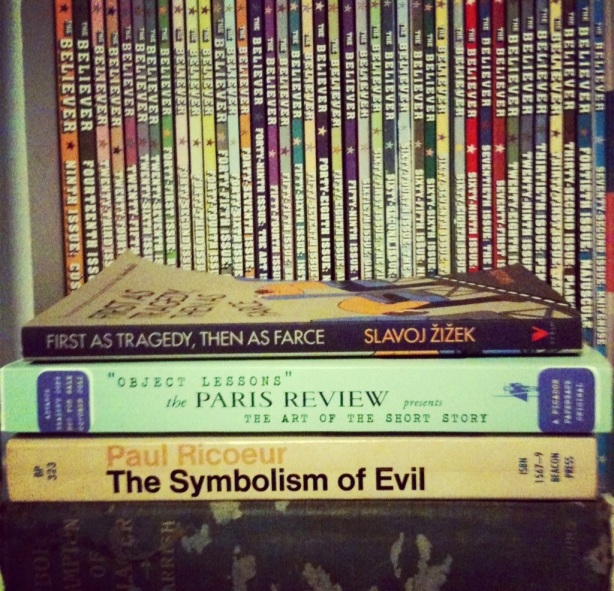
Several years worth of subscription to The Believer, with an unsorted stack setting up front:

20121001-200254.jpg

I suppose I could write a whole post about The Believer, which I think is an excellent mag but no longer subscribe to, but instead, here’s a cover from Charles Burns:

20121001-200318.jpg

Charles Burns also shows up in this section, which includes stuff by R. Crumb, Daniel Clowes, Art Spiegelman, and more:

20121001-200329.jpg

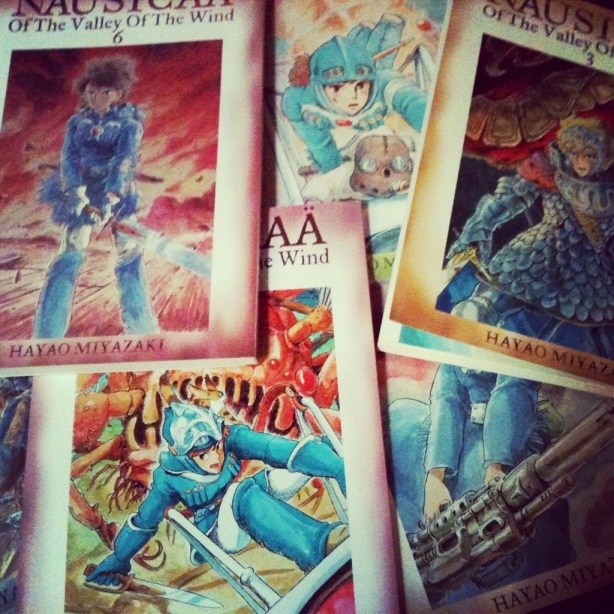
The wife got me a subscription to The Paris Review last year; then, some unsorted books, and then the Nausicaä collection (also courtesy the wife):

20121001-200342.jpg

Nausicaä spread out on my couch. (My son and I ended up looking through them for an hour):

20121001-200353.jpg


“Life in the jungle” (Kafka)

(From Kafka’s Diaries).

“Evil does not exist” (Kafka)

(From Kafka’s Diaries).

New in Trade Paperback from Picador (Books Acquired Some Time Last Month)

20120923-131033.jpg

Amitav Ghosh’s River of Smoke is the second entry in a proposed trilogy about the opium trade. (The first was 2008’s Sea of Poppies). Here’s Picador’s blurb:

In Amitav Ghosh’s Sea of Poppies, the Ibis began its treacherous journey across the Indian Ocean, bound for the cane fields of Mauritius with a cargo of indentured servants. Now, in River of Smoke, the former slave ship flounders in the Bay of Bengal, caught in the midst of a deadly cyclone.  The storm also threatens the clipper ship Anahita, groaning with the largest consignment of opium ever to leave India for Canton. Meanwhile, the Redruth, a nursery ship, carries horticulturists determined to track down the priceless botanical treasures of China. All will converge in Canton’s Fanqui-town, or Foreign Enclave, a powder keg awaiting a spark to ignite the Opium Wars. A spectacular adventure, but also a bold indictment of global avarice, River of Smoke is a consuming historical novel with powerful contemporary resonance.

20120923-131043.jpg

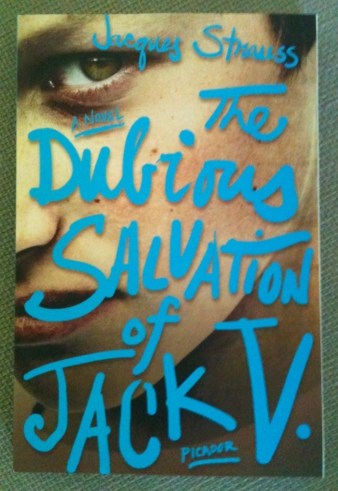
Jacques Strauss’s debut novel The Dubious Salvation of Jack V. got a good review from John Self, which is worth a read—Self does a marvelous job expressing the trepidation and wariness—and yes, prejudice—that some of us might have toward contemporary novels.

Here’s Picador’s blurb:

Above all, The Dubious Salvation of Jack V. is funny; both witty and ironic. Jack hates to be reminded that Susie “didn’t stay with us because she loved me … She stayed with us because it was her job.” The irony is that to stop her being their servant, to give her her freedom, he may end up having to do something terrible to her. Around all this cultural specificity, more general principles are touched on (“one could only conclude that humanity, rather than a ballast against the arbitrary, was … its very agent”) which feed back into the story.

20120923-131049.jpg

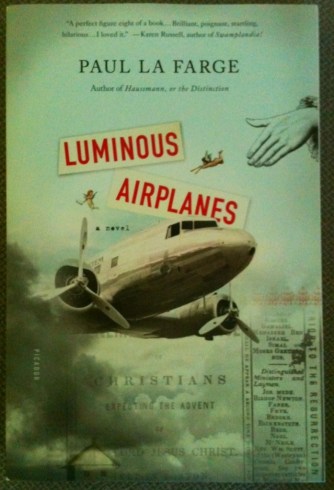
Here are the epigraphs to Paul La Farge’s novel Luminous Airplanes, via the book’s site, which is worth checking out:

We hope it will not be unconsidered, that we find no open tract, or constant manduction in this Labyrinth; but are oft-times fain to wander in the America and untravelled parts of Truth.

— Thomas Browne

Nothing odd will do long.

— Samuel Johnson

Ein schönes Protokoll. Ein nie bevor gesehenes Protokoll.

— Werner Herzog

…but the path of what happened is so brightly lit that it places everything else more deeply in shadow.

— The 9/11 Commission Report

The truth, fellow UFOlogists, is that I have known precisely what I was doing all along. It is just that very few other people knew what I was doing.

— William L. Moore

Run!

— Hal Hartley

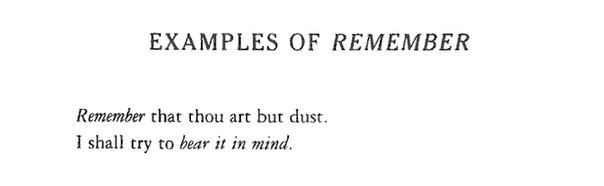
“Examples of Remember” — Lydia Davis

“Lobster,” a Poem by Anne Sexton


“Lobster” by Anne Sexton:

A shoe with legs,
a stone dropped from heaven,
he does his mournful work alone,
he is the old prospector for golf,
with secret dreams of God-heads and fish heads.
Until suddenly a cradle fastens round him
and his is trapped as the U.S.A. sleeps.
Somewhere far off a woman lights a cigarette;
somewhere far off a car goes over a bridge;
somewhere far off a bank is held up.
This is the world the lobster knows not of.
He is the old hunting dog of the sea
who in the morning will rise from it
and be undrowned
and they will take his perfect green body
and paint it red

(Thanks Jescie).


The sound of pommelling on a sofa in Ulysses by James Joyce

From Wye’s Dictionary of Improbably Words.

“Goethe probably retards the development of the German language by the force of his writing” (Kafka)


Goethe probably retards the development of the German language by the force of his writing.  Even though prose style has often traveled away from him in the interim, still, in the end, as at present, it returns to him with strengthened yearning and even adopts obsolete idioms found in Goethe but otherwise without any particular connection with him, in order to rejoice in the completeness of its unlimited dependence.

From Kafka’s Diaries.