The Medusa v. The Odalisque (Infinite Jest)

But this one other short high-tech one was called ‘The Medusa v. The Odalisque’ and was a film of a fake stage-production at Ford’s Theater in the nation’s capital of Wash. DC that, like all his audience-obsessed pieces, had cost Incandenza a real bundle in terms of human extras. The extras in this one are a well-dressed audience of guys in muttonchops and ladies with paper fans who fill the place from first row to the rear of the balcony’s boxes, and they’re watching an incredibly violent little involuted playlet called ‘The Medusa v. The Odalisque,’ the relatively plotless plot of which is just that the mythic Medusa, snake-haired and armed with a sword and well-polished shield, is fighting to the death or petrification against L’Odalisque de Ste. Thérèse, a character out of old Québecois mythology who was supposedly so inhumanly gorgeous that anyone who looked at her turned instantly into a human-sized precious gem, from admiration. A pretty natural foil for the Medusa, obviously, the Odalisque has only a nail-file instead of a sword, but also has a well-wielded hand-held makeup mirror, and she and the Medusa are basically rumbling for like twenty minutes, leaping around the ornate stage trying to de-map each other with blades and/or de-animate each other with their respective reflectors, which each leaps around trying to position just right so that the other gets a glimpse of its own full-frontal reflection and gets instantly petrified or gemified or whatever. In the cartridge it’s pretty clear from their milky-pixeled translucence and insubstantiality that they’re holograms, but it’s not clear what they’re supposed to be on the level of the playlet, whether the audience is supposed to see/(not)see them as ghosts or wraiths or ‘real’ mythic entities or what. But it’s a ballsy fight-scene up there on the stage — having been intricately choreographed by an Oriental guy Himself rented from some commercial studio and put up in the HmH, who ate like a bird and smiled very politely all the time and didn’t have even a word to say to anybody, it seemed, except Avril, to whom the Oriental choreographer had cottoned right off — balletic and full of compelling little cornerings and near-misses and reversals, and the theater’s audience is rapt and clearly entertained to the gills, because they keep spontaneously applauding, as much maybe for the film’s play’s choreography as anything else — which would make it more like spontaneously meta-applauding, Hal supposes — because the whole fight-scene has to be ingeniously choreographed so that both combatants have their respectively scaly and cream-complected backs 155. to the audience, for obvious reasons… except as the shield and little mirror get whipped martially around and brandished at various strategic angles, certain members of the playlet’s well-dressed audience eventually start catching disastrous glimpses of the combatants’ fatal full-frontal reflections, and instantly get transformed into like ruby statues in their front-row seats, or get petrified and fall like embolized bats from the balcony’s boxes, etc. The cartridge goes on like this until there’s nobody left in the Ford’s Theater seats animate enough to applaud the nested narrative of the fight-scene play, and it ends with the two aesthetic foils still rumbling like mad before an audience of varicolored stone. ‘The Medusa v. The Odalisque’ ’s own audiences didn’t think too much of the thing, because the film audience never does get much of a decent full-frontal look at what it is about the combatants that supposedly has such a melodramatic effect on the rumble’s live audience, and so the film’s audience ends up feeling teased and vaguely cheated, and the thing had only a regional release, and the cartridge rented like yesterday’s newspapers, and it’s now next to impossible to find.

155. The Medusa wears a kind of chain-mail backless evening gown and Hellenic sandals, the Odalisque a Merry Widow.

From David Foster Wallace’s novel Infinite Jest.

Bloomsday blog

Portrait of James Joyce by Djuna Barnes

How to read Ulysses

Ulysses art by Roman Muradov

Selections from one-star Amazon reviews of Ulysses

joyce_ulysses-p2
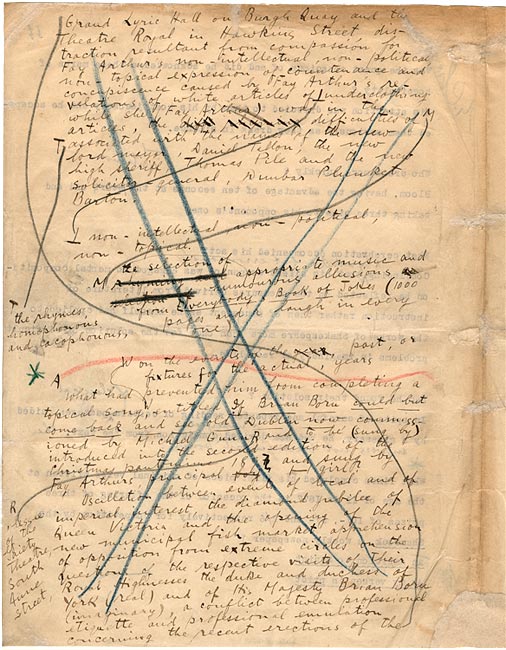
Ulysses manuscript page

A list of Irish heroes (from “The Cyclops” episode of Ulysses)

“Words,” a page from one of Joyce’s notebooks for Ulysses

Another page of Joyce’s notes, plus links to more

James Joyce talks dirty

Filming Finnegans

James Joyce’s eye glasses prescription

William Faulkner’s Joyce anxiety

Ezra Pound on James Joyce

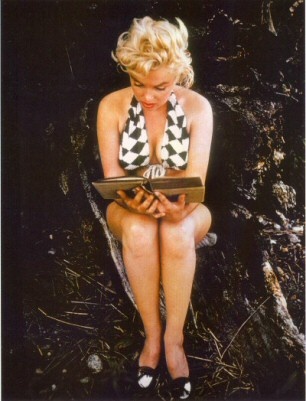
Marilyn Monroe reads Molly 

Biblioklept’s lousy review (the review is lousy, not the book) of Dubliners

Joyce’s entry on the 1901 Irish Census

Joyce’s caricature of Leopold Bloom

Biblioklept’s review (not so lousy, the review) of a superior full-cast audio recording of Ulysses

James Joyce explains why Odysseus is the most “complete man’ in literature

James Joyce’s passport

Leopold’s Bloom’s recipe for burnt kidney breakfast

“What in water did Bloom, waterlover, drawer of water, watercarrier, returning to the range, admire?”

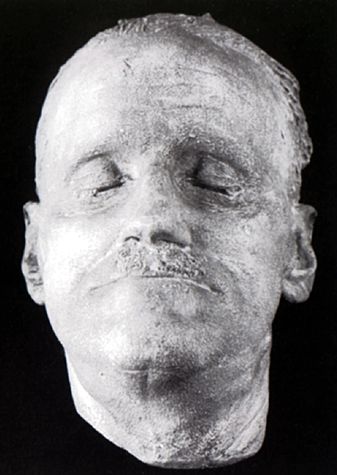
James Joyce’s death mask


Film Footage of the First Bloomsday Celebration in 1954

Film footage of the first Bloomsday celebration (June 16, 1954)–a great find by Antoine Malette, who posted the video along with an account of the journey as told in Flann O’Brien: An Illustrated Biography. The film was shot by John Ryan, and shows an extremely inebriated Brian O’Nolan (aka Flann O’Brien) having to be helped around by pals Anthony Cronin and Patrick Kavanagh. We’re also treated to a scene of Kavanagh taking a piss with Joyce’s cousin Tom Joyce, a dentist who joined the merry band. (The scene will undoubtedly recall to you that marvelous moment in Ulysses when “first Stephen, then Bloom, in penumbra urinated“). The troupe didn’t quite finish their mission, getting sidetracked by booze and quarrels. Read the full account at Malette’s site.

“Sentence” — Donald Barthelme

“Sentence”
by
Donald Barthelme

Or a long sentence moving at a certain pace down the page aiming for the bottom-if not the bottom of this page then some other page-where it can rest, or stop for a moment to think out the questions raised by its own (temporary) existence, which ends when the page is turned, or the sentence falls out of the mind that holds it (temporarily) in some kind of embrace, not necessarily an ardent one, but more perhaps the kind of embrace enjoyed (or endured), by a wife who has just waked up and is on her way to the bathroom in the morning to wash her hair, and is bumped into by her husband, who has been lounging at the breakfast table reading the newspaper, and doesn’t see her coming out of the bedroom, but, when he bumps into her, or is bumped into by her, raises his hands to embrace her lightly, transiently, because he knows that if he gives her a real embrace so early in the morning, before she has properly shaken the dreams out of her head, and got her duds on, she won’t respond, and may even become slightly angry, and say something wounding, and so the husband invests in this embrace not so much physical or emotional pressure as he might, because he doesn’t want to waste anything-with this sort of feeling, then, the sentence passes through the mind more or less, and there is another way of describing the situation too, which is to say that the sentence crawls through the mind like something someone says to you while you are listening very hard to the FM radio, some rock group there, with its thrilling sound, and so, with your attention or the major part of it at least already rewarded, there is not much mind room you can give to the remark, especially considering that you have probably just quarreled with that person, the maker of the remark, over the radio being too loud, or something like that, and the view you take, of the remark, is that you’d really rather not hear it, but if you have to hear it, you want to listen to it for the smallest possible length of time, and during a commercial, because immediately after the commercial they’re going to play a new rock song by your favorite group, a cut that has never been aired before, and you want to hear it and respond to it in a new way, a way that accords with whatever you’re feeling at the moment, or might feel, if the threat of new experience could be (temporarily) overbalanced by the promise of possible positive benefits, or what the mind construes as such, remembering that these are often, really, disguised defeats (not that such defeats are not, at times, good for your character, teaching you that it is not by success alone that one surmounts life, but that setbacks, too, contribute to that roughening of the personality that, by providing a textured surface to place against that of life, enables you to leave slight traces, or smudges, on the face of human history-your mark) and after all, benefit-seeking always has something of the smell of raw vanity about it, as if you wished to decorate your own brow with laurel, or wear your medals to a cookout, when the invitation had said nothing about them, and although the ego is always hungry (we are told) it is well to remember that ongoing success is nearly as meaningless as ongoing lack of success, which can make you sick, and that it is good to leave a few crumbs on the table for the rest of your brethren, not to sweep it all into the little beaded purse of your soul but to allow others, too, part of the gratification, and if you share in this way you will find the clouds smiling on you, and the postman bringing you letters, and bicycles available when you want to rent them, and many other signs, however guarded and limited, of the community’s (temporary) approval of you, or at least of it’s willingness to let you believe (temporarily) that it finds you not so lacking in commendable virtues as it had previously allowed you to think, from its scorn of your merits, as it might be put, or anyway its consistent refusal to recognize your basic humanness and its secret blackball of the project of your remaining alive, made in executive session by its ruling bodies, which, as everyone knows, carry out concealed programs of reward and punishment, under the rose, causing faint alterations of the status quo, behind your back, at various points along the periphery of community life, together with other enterprises not dissimilar in tone, such as producing films that have special qualities, or attributes, such as a film where the second half of it is a holy mystery, and girls and women are not permitted to see it, or writing novels in which the final chapter is a plastic bag filled with water, which you can touch, but not drink: in this way, or ways, the underground mental life of the collectivity is botched, or denied, or turned into something else never imagined by the planners, who, returning from the latest seminar in crisis management and being asked what they have learned, say they have learned how to throw up their hands; the sentence meanwhile, although not insensible of these considerations, has a festering conscience of its own, which persuades it to follow its star, and to move with all deliberate speed from one place to another, without losing any of the “riders” it may have picked up just being there, on the page, and turning this way and that, to see what is over there, under that oddly-shaped tree, or over there, reflected in the rain barrel of the imagination, even though it is true that in our young manhood we were taught that short, punchy sentences were best (but what did he mean? doesn’t “punchy” mean punch-drunk? I think he probably intended to say “short, punching sentences,” meaning sentences that lashed out at you, bloodying your brain if possible, and looking up the word just now I came across the nearby “punkah,” which is a large fan suspended from the ceiling in India, operated by an attendant pulling a rope-that is what I want for my sentence, to keep it cool!) we are mature enough now to stand the shock of learning that much of what we were taught in our youth was wrong, or improperly understood by those who were teaching it, or perhaps shaded a bit, the shading resulting from the personal needs of the teachers, who as human beings had a tendency to introduce some of their heart’s blood into their work, and sometimes this may not have been of the first water, this heart’s blood, and even if they thought they were moving the “knowledge” out, as the Board of Education had mandated, they could have noticed that their sentences weren’t having the knockdown power of the new weapons whose bullets tumble end-over-end (but it is true that we didn’t have these weapons at that time) and they might have taken into account the fundamental dubiousness of their project (but all the intelligently conceived projects have been eaten up already, like the moon and the stars) leaving us, in our best clothes, with only things to do like conducting vigorous wars of attrition against our wives, who have now thoroughly come awake, and slipped into their striped bells, and pulled sweaters over their torsi, and adamantly refused to wear any bras under the sweaters, carefully explaining the political significance of this refusal to anyone who will listen, or look, but not touch, because that has nothing to do with it, so they say; leaving us, as it were, with only things to do like floating sheets of Reynolds Wrap around the room, trying to find out how many we can keep in the air at the same time, which at least gives us a sense of participation, as though we were Buddha, looking down at the mystery of your smile, which needs to be investigated, and I think I’ll do that right now, while there’s still enough light, if you’ll sit down over there, in the best chair, and take off all your clothes, and put your feet in that electric toe caddy (which prevents pneumonia) and slip into this permanent press hospital gown, to cover your nakedness-why, if you do all that, we’ll be ready to begin! after I wash my hands, because you pick up an amazing amount of exuviae in this city, just by walking around in the open air, and nodding to acquaintances, and speaking to friends, and copulating with lovers, in the ordinary course (and death to our enemies! by and by)-but I’m getting a little uptight, just about washing my hands, because I can’t find the soap, which somebody has used and not put back in the soap dish, all of which is extremely irritating, if you have a beautiful patient sitting in the examining room, naked inside her gown, and peering at her moles in the mirror, with her immense brown eyes following your every movement (when they are not watching the moles, expecting them, as in a Disney nature film, to exfoliate) and her immense brown head wondering what you’re going to do to her, the pierced places in the head letting that question leak out, while the therapist decides just to wash his hands in plain water, and hang the soap! and does so, and then looks around for a towel, but all the towels have been collected by the towel service, and are not there, so he wipes his hands on his pants, in the back (so as to avoid suspicious stains on the front) thinking: what must she think of me? and, all this is very unprofessional and at-sea looking! trying to visualize the contretemps from her point of view, if she has one (but how can she? she is not in the washroom) and then stopping, because it is finally his own point of view that he cares about and not hers, and with this firmly in mind, and a light, confident step, such as you might find in the works of Bulwer-Lytton, he enters the space she occupies so prettily and, taking her by the hand, proceeds to tear off the stiff white hospital gown (but no, we cannot have that kind of pornographic merde in this majestic and high-minded sentence, which will probably end up in the Library of Congress) (that was just something that took place inside his consciousness, as he looked at her, and since we know that consciousness is always consciousness of something, she is not entirely without responsibility in the matter) so, then, taking her by the hand, he falls into the stupendous white puree of her abyss, no, I mean rather that he asks her how long it has been since her last visit, and she says a fortnight, and he shudders, and tells her that with a condition like hers (she is an immensely popular soldier, and her troops win all their battles by pretending to be forests, the enemy discovering, at the last moment, that those trees they have eaten their lunch under have eyes and swords) (which reminds me of the performance, in 1845, of Robert-Houdin, called The Fantastic Orange Tree, wherein Robert-Houdin borrowed a lady’s handkerchief, rubbed it between his hands and passed it into the center of an egg, after which he passed the egg into the center of a lemon, after which he passed the lemon into the center of an orange, then pressed the orange between his hands, making it smaller and smaller, until only a powder remained, whereupon he asked for a small potted orange tree and sprinkled the powder thereupon, upon which the tree burst into blossom, the blossoms turning into oranges, the oranges turning into butterflies, and the butterflies turning into beautiful young ladies, who then married members of the audience), a condition so damaging to real-time social intercourse of any kind, the best thing she can do is give up, and lay down her arms, and he will lie down in them, and together they will permit themselves a bit of the old slap and tickle, she wearing only her Mr. Christopher medal, on its silver chain, and he (for such is the latitude granted the professional classes) worrying about the sentence, about its thin wires of dramatic tension, which have been omitted, about whether we should write down some natural events occurring in the sky (birds, lightning bolts), and about a possible coup d’etat within the sentence, whereby its chief verb would be-but at this moment a messenger rushes into the sentence, bleeding from a hat of thorns he’s wearing, and cries out: “You don’t know what you’re doing! Stop making this sentence, and begin instead to make Moholy-Nagy cocktails, for those are what we really need, on the frontiers of bad behavior!” and then he falls to the floor, and a trap door opens under him, and he falls through that, into a damp pit where a blue narwhal waits, its horn poised (but maybe the weight of the messenger, falling from such a height, will break off the horn)-thus, considering everything very carefully, in the sweet light of the ceremonial axes, in the run-mad skimble-skamble of information sickness, we must make a decision as to whether we should proceed, or go back, in the latter case enjoying the pathos of eradication, in which the former case reading an erotic advertisement which begins, How to Make Your Mouth a Blowtorch of Excitement (but wouldn’t that overtax our mouthwashes?) attempting, during the pause, while our burned mouths are being smeared with fat, to imagine a better sentence, worthier, more meaningful, like those in the Declaration of Independence, or a bank statement showing that you have seven thousand kroner more than you thought you had-a statement summing up the unreasonable demands that you make on life, and one that also asks the question, if you can imagine these demands, why are they not routinely met, tall fool? but of course it is not that query that this infected sentence has set out to answer (and hello! to our girl friend, Rosetta Stone, who has stuck by us through thick and thin) but some other query that we shall some day discover the nature of, and here comes Ludwig, the expert on sentence construction we have borrowed from the Bauhaus, who will-“Guten Tag, Ludwig!”-probably find a way to cure the sentence’s sprawl, by using the improved way of thinking developed in Weimer-“I am sorry to inform you that the Bauhaus no longer exists, that all of the great masters who formerly thought there are either dead or retired, and that I myself have been reduced to constructing books on how to pass the examination for police sergeant”-and Ludwig falls through the Tugendhat House into the history of man-made objects; a disappointment, to be sure, but it reminds us that the sentence itself is a man-made object, not the one we wanted of course, but still a construction of man, a structure to be treasured for its weakness, as opposed to the strength of stones

(via).

Irony-free zone (Infinite Jest)

The thing is it has to be the truth to really go over, here. It can’t be a calculated crowd-pleaser, and it has to be the truth unslanted, unfortified. And maximally unironic. An ironist in a Boston AA meeting is a witch in church. Irony-free zone. Same with sly disingenuous manipulative pseudo-sincerity. Sincerity with an ulterior motive is something these tough ravaged people know and fear, all of them trained to remember the coyly sincere, ironic, self-presenting fortifications they’d had to construct in order to carry on Out There, under the ceaseless neon bottle.


From David Foster Wallace’s novel Infinite Jest

A U.S.A. that would die for the so-called perfect Entertainment (Infinite Jest)


The sky of U.S.A.’s desert was clotted with blue stars. Now it was deep at night. Only above the U.S.A. city was the sky blank of stars; its color was pearly and blank. Marathe shrugged. ‘Perhaps in you is the sense that citizens of Canada are not involved in the real root of the threat.’

Steeply shook the head in seeming annoyance. ‘What’s that supposed to mean?’ he said. The lurid wig of him slipped when he moved the head with any abrupt force.

The first way Marathe betrayed anything of emotion was to smooth rather too fussily at the blanket on his lap. ‘It is meaning that it will not of finality be Québecers making this kick to l’aine des Etats Unis. Look: the facts of the situation speak loudly. What is known. This is a U.S.A. production, this Entertainment cartridge. Made by an American man in the U.S.A. The appetite for the appeal of it: this also is U.S.A. The U.S.A. drive for spectation, which your culture teaches. This I was saying: this is why choosing is everything. When I say to you choose with great care in loving and you make ridicule it is why I look and say: can I believe this man is saying this thing of ridicule?’ Marathe leaned slightly forward on his stumps, leaving the machine pistol to use both his hands in saying. Steeply could tell this was important to Marathe; he really believed it.

Marathe made small emphatic circles and cuts in the air while he spoke: ‘These facts of situation, which speak so loudly of your Bureau’s fear of this samizdat: now is what has happened when a people choose nothing over themselves to love, each one. A U.S.A. that would die — and let its children die, each one — for the so-called perfect Entertainment, this film. Who would die for this chance to be fed this death of pleasure with spoons, in their warm homes, alone, unmoving: Hugh Steeply, in complete seriousness as a citizen of your neighbor I say to you: forget for a moment the Entertainment, and think instead about a U.S.A. where such a thing could be possible enough for your Office to fear: can such a U.S.A. hope to survive for a much longer time? To survive as a nation of peoples? To much less exercise dominion over other nations of other peoples? If these are other peoples who still know what it is to choose? who will die for something larger? who will sacrifice the warm home, the loved woman at home, their legs, their life even, for something more than their own wishes of sentiment? who would choose not to die for pleasure, alone?’

From David Foster Wallace’s novel Infinite Jest.


The Pool of Tears — Arthur Rackham

Some notes from 299 pages into a rereading of Infinite Jest

IMG_6547

A note on the context of the first reading, subsequent ventures, and this rereading

I bought David Foster Wallace’s novel Infinite Jest in 1997 when I was a freshman in college, as required by law. I attempted reading it a few times without really getting to page 100. (I did read and reread the short stories and the essays and Wallace’s first novel in that time though. None were assigned readings. The DFW Academic Industry was not a Thing yet).

The first time I read the book the whole way through was in the weird fall of 2001, the first fall I hadn’t returned to school because I had graduated from school, the fall of 9/11, the fall I moved to Tokyo the week after 9/11, packing the book in a smallish suitcase that the airport security guy had to take everything out of with his latex-gloved hands, removing every item, all the clothes and books, because I was traveling on a one-way ticket to a foreign land. It was in that weird fall that I finally read the book, reading mostly in the very very early a.m., sometimes reading for hours, reading too late, becoming addicted.

In years since, I’ve poked at rereadings, often looking for very specific passages/sections, and always meaning to do a full reread, but there are all those other big books that need to get read (and then reread).

Well so and anyway: This reread has been prompted by back-to-back readings of Gravity’s Rainbow, which I take to be the most obvious precursor text for Infinite Jest (and likely the greatest source of Wallace’s Oedipal anxiety if we want to get all Bloomian). I thought about Infinite Jest a lot while reading GR.

So far, like any rereading of a big encyclopedic novelInfinite Jest seems much, much easier than my initial go through (although coming off GR almost anything would probably seem much, much easier). With the contours of the “big plot” in place (and the rhetorical dazzle of some of Wallace’s embedded-essays not as blinding as before), focusing on details, patterns, and motifs becomes simply more possible. (I don’t think I connected Hal’s clipping his toenails in Ch. 18 to the toenails Gately finds in Ennet House in Ch. 19 before, f’r’instance). (There are no actual chapter numbers in IJ, although there are circles separating chapters which can be counted).

A note to readers new to Infinite Jest

Infinite Jest is very long but it’s not nearly as difficult as its reputation suggests. There is a compelling plot behind the erudite essaying and sesquipedalian vocabulary. That plot develops around three major strands which the reader must tie together, with both the aid of—and the challenge of—the novel’s discursive style. Those three major plot strands are the tragic saga of the Incandenzas (familial); the redemptive narrative of Ennet House Drug and Alcohol Recovery House, with Don Gately as the primary hero (socicultural); and the the schemes of the Québécois separatists (national/international/political). An addictive and thus deadly film called Infinite Jest links these three plots (through discursive and byzantine subplots).

Wallace often obscures the links between these plot strands, and many of the major plot connections have to be intuited or outright guessed. Furthermore, while there are clear, explicit connections between the plot strands made for the reader, Wallace seems to withhold explicating these connections until after the 200-page mark. Arguably, the real contours of the Big Plot come into (incomplete) focus in a discussion between Hal Incandenza and his brother Orin in pages 242-58. While that scene by no means telegraphs what happens in IJ, it nonetheless offers some promise that the set pieces, riffs, scenes, lists, and vignettes shall add up to Something Bigger.  Continue reading “Some notes from 299 pages into a rereading of Infinite Jest”

Watch Guilty as Charged, a documentary about Harry Crews

Nathaniel Hawthorne’s journal entry, June 6th, 1844

Concord, June 6th.–. . . Mr. F—- arrived yesterday, and appeared to be in most excellent health, and as happy as the sunshine. About the first thing he did was to wash the dishes; and he is really indefatigable in the kitchen, so that I am quite a gentleman of leisure. Previous to his arrival, I had kindled no fire for four entire days, and had lived all that time on the corned beef, except one day, when Ellery and I went down the river on a fishing excursion. Yesterday, we boiled some lamb, which we shall have cold for dinner to-day. This morning, Mr. F—- fried a sumptuous dish of eels for breakfast. Mrs. P. —- continues to be the instrument of Providence, and yesterday sent us a very nice plum-pudding.

I have told Mr. F—- that I shall be engaged in the forenoons, and he is to manage his own occupations and amusements during that time, . . .

Leo, I regret to say, has fallen under suspicion of a very great crime,–nothing less than murder,–a fowl crime it may well be called, for it is the slaughter of one of Mr. Hayward’s hens. He has been seen to chase the hens, several times, and the other day one of them was found dead. Possibly he may be innocent, and, as there is nothing but circumstantial evidence, it must be left with his own conscience.

Meantime, Mr. Hayward, or somebody else, seems to have given him such a whipping that he is absolutely stiff, and walks about like a rheumatic old gentleman. I am afraid, too, that he is an incorrigible thief. Ellery says he has seen him coming up the avenue with a calf’s whole head in his mouth. How he came by it is best known to Leo himself. If he were a dog of fair character, it would be no more than charity to conclude that he had either bought it, or had it given to him; but with the other charges against him, it inclines me to great distrust of his moral principles. Be that as it may, he managed his stock of provisions very thriftily, burying it in the earth, and eating a portion of it whenever he felt an appetite. If he insists upon living by highway robbery, it would be well to make him share his booty with us. . . .

From Nathaniel Hawthorne’s American Note-Books.

Lydia Davis on using found materials in her stories

INTERVIEWER

More and more you seem to use found materials in your stories.

DAVIS

Back in the early eighties, I realized that you could write a story that was really just a narration of something that had happened to you, and change it slightly, without having really to fictionalize it. In a way, that’s found ­material. I think it’s hard to draw the line and say that something isn’t found material. Because if a friend of mine tells me a story or a dream, I guess that’s found material. If I get an e-mail that lends itself to a good story, that’s found material. But then if I notice the cornmeal making little condensations, is that found material? It’s my own, I’m not using text, but I am using a situation that exists. I’m not making it up. I find what happens in reality very interesting and I don’t find a great need to make up things, but I do like retelling stories that are told to me.

INTERVIEWER

The last time I was here you mentioned that you jot things down on scraps of paper. What happens to those scraps?

DAVIS

They pile up in my study. And then I use them. Sometimes when I’m just sort of tidying up, I go through them and type them onto the computer and then either do something with them right away or else I just leave them there for later. When I travel, I carry around a notebook with me. I use notebooks a lot because my brain tends to live in the moment. I’m always afraid of forgetting something.

From the Spring 2015 issue of Paris Review. Lydia Davis’s full interview is now online. She discusses her fiction and translation, recalls taking Grace Paley’s writing class when she was 19, and trying to run away from school after reading Walden.

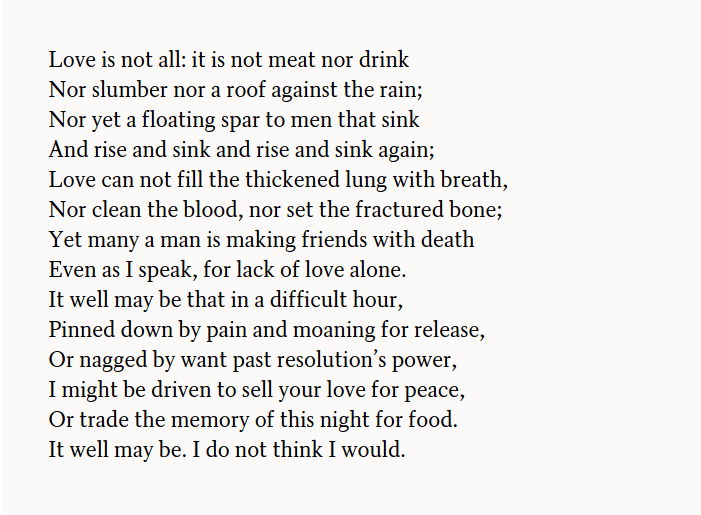
“Love is not all” — Edna St. Vincent Millay

Screenshot 2015-05-04 at 7.33.58 PM

An Interview with Christopher K. Coffman and Daniel Lukes, Editors of William T. Vollmann: A Critical Companion (Part 2)

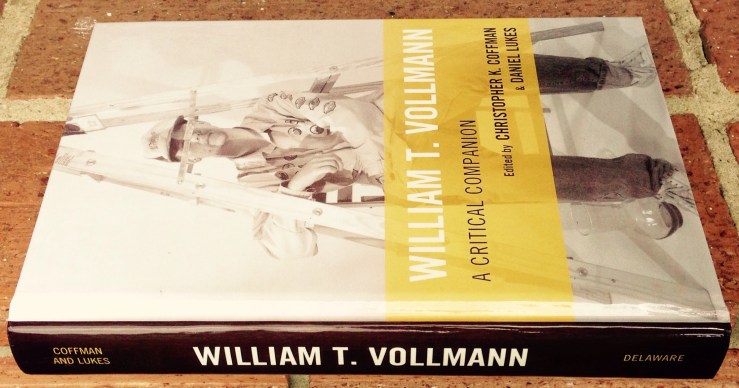
William T. Vollmann: A Critical Companion, newish from University of Delaware Press, collects academic essays and memoir-vignettes by a range of critics and authors to make the case that Vollmann is, as the blurb claims, the “most ambitious, productive, and important living author in the US.” I interviewed the book’s editors, Christopher K. Coffman and Daniel Lukes, over a series of emails in a two-part interview. You can read the first part here. A few days after the first part of the interview posted, Lukes and Coffman hosted a book launch party in NYC for WTV: ACC; the pics in this interview are from that event (check out the Facebook page for more, including Jonathan Franzen reading from his piece on Vollmann).

IMG_6524


Biblioklept: Let’s talk about the formal elements of William T. Vollmann: A Critical Companion. The collection seems to balance essays of a more academic flavor with memoir-vignettes, personal accounts, and riffs.

Christopher K. Coffman: We decided early on to intersperse among the academic essays pieces by non-scholars, or by scholars writing in a non-scholarly mode. The goal here was at least two-fold. We wanted to offer something a bit more accessible to WTV readers who were not in academia (although I think the average WTV fan can follow scholarly arguments as well as many of us in academia can). Also, we realized that some people with a privileged view on WTV’s work–such as those of WTV’s book designers who contributed (Bolte and Speaker Austin)–could add something of interest and great value to audiences in and out of academia, and we wanted to make space for that. I would have to look back through the e-mail log to be sure, but I think Daniel first came up with the idea of soliciting shorter pieces from non-scholars, and that I then conceived the structural component. I am a huge fan of Hemingway’s In Our Time, and the contrapuntal play between the stories and the very short inter-chapters in that book served for me as a paradigm of what Daniel and I have tried to do in this regard. Of course, as soon as we brought up the example of Hemingway, we recalled that WTV does something similar in Thirteen Stories and Thirteen Epitaphs, so he beat us to the punch even there. At any rate, my hope is that our readers find in the short chapterlets material that serves as a response to or as an extension of ideas presented in the more properly scholarly readings that surround those shorter pieces.

The second question of arrangement was the placement of essays and interchapters, and we here grouped according to subject matter as well as we could, without merely replicating what McCaffery and Hemmingson had done for Expelled from Eden. We also, obviously, made space for both Larry and Michael as the authors of the Preface and Afterword. Our intention there, insofar as I can speak for both of us, is to make it clear that we are trying to situate our contribution to scholarship on WTV in relation to the work that Larry and Michael have already done. Finally, I wrote the Introduction not only because one of us had to, but also because Daniel was spoken for in the sense that he already had material that formed the basis for the really great chapter that he contributed. Also, I found the chance to frame the book’s material via an introduction that dealt with WTV’s place in the landscape of post-1945 American fiction appealing. That said, while the introduction bears my byline, my ongoing conversation with Daniel during the past few years shaped my thinking about WTV as much as any original ideas of my own, so he deserves a lot of credit for the introduction as well.

Daniel Lukes: I’ve been going back over the timeline to see if Samuel Cohen and Lee Konstantinou’s edited volume The Legacy of David Foster Wallace, which also features some shorter pieces, was an influence on that, but it looks like we took our approach independently. Though I will say their book did serve as a model in some ways of what ours could be. Dealing with the “non-scholarly” pieces has been for me one of the most exciting parts of putting this book together (the distinction between “scholarlies” and “non-scholarlies” itself being one of the various amusing frameworks that Chris and I have been carrying around throughout the process). From the beginning I thought it would be very helpful to have some of Vollmann’s literary peers chime in: you just don’t hear too much from them about him. So we reached out to writers we thought might be Vollmann readers: some just weren’t (I’d love to know if Cormac McCarthy reads Vollmann: the letter I mailed to a presumed representative of his returned unopened). Some were Vollmann fans/friends, but couldn’t make it for another reason; when Jonathan Franzen came through and expressed his enthusiasm for the project and willingness to contribute a piece, I felt some relief. And James Franco was a pleasure to work with. That said I think the primary value of the non-scholarlies is in the insights they offer into Vollmann’s world and writing practices, from those who have worked closely with him, in particular Carla Bolte, Mary Austin Speaker, and Mariya Gusev’s excellent and vivid pieces. Continue reading “An Interview with Christopher K. Coffman and Daniel Lukes, Editors of William T. Vollmann: A Critical Companion (Part 2)”

Read “Gandalf Goes West,” a short story by Chris Power

“Gandalf Goes West”

by

Chris Power


HAL STANDS IN FRONT OF THE SCREEN. On the screen the words GANDALF GOES EAST.


GO EAST, types Hal.


The cursor flashes.


BILBO GOES EAST, the screen says.


The cursor flashes.


Another line of text appears: GANDALF GOES WEST, it says.


Hal clenches his hands once, twice. He cannot progress in the game without Gandalf. GO WEST, he types.


The cursor flashes.


BILBO GOES WEST, the screen says.


Ben comes into the room and walks over to Hal. He reads the words on the screen from top to bottom:


GANDALF GOES EAST


GO EAST


BILBO GOES EAST


GANDALF GOES WEST


GO WEST


BILBO GOES WEST


GANDALF GOES EAST


Hal turns to Ben. How are you? Hal says.


Ben stares at the screen.


Stay, says Ben.

Read the rest of Chris Power’s short story “Gandalf Goes West” at The White Review.

No Zen-type One, always rather Two (Infinite Jest)

How many sub-rosa twins are there, out there, really? What if heredity, instead of linear, is branching? What if it’s not arousal that’s so finitely circumscribed? What if in fact there were ever only like two really distinct individual people walking around back there in history’s mist? That all difference descends from this difference? The whole and the partial. The damaged and the intact. The deformed and the paralyzingly beautiful. The insane and the attendant. The hidden and the blindingly open. The performer and the audience. No Zen-type One, always rather Two, one upside-down in a convex lens.

A passage from David Foster Wallace’s novel Infinite Jest. Thoughts are Joelle Van Dyne’s for those keeping score. The riff reminds me of all the binaries in Gravity’s Rainbow, but maybe only because I just read Gravity’s Rainbow.

Antaeus Setting Down Dante and Virgil in the Last Circle of Hell — William Blake

514484

Madame Psychosis’ Downer-Lit Hour Reading List (Infinite Jest)

Like for months in the spring semester of Y.D.P.A.H. she referred to her own program as ‘Madame’s Downer-Lit Hour’ and read depressing book after depressing book — Good Morning, Midnight and Maggie: A Girl of the Streets and Giovanni’s Roomand Under the Volcanoplus a truly ghastly Bret Ellis period during Lent — in a monotone, really slowly, night after night.

From David Foster Wallace’s Infinite Jest (hyperlinks are my attempt at oblique (non)annotation and obviously not part of the original text).