The Mother Conspiracy (Gravity’s Rainbow)

Otto is earnestly explaining his views on the Mother Conspiracy. It’s not often a sympathetic girl will listen. The Mothers get together once a year, in secret, at these giant conventions, and exchange information. Recipes, games, key phrases to use on their children. “What did yours use to say when she wanted to make you feel guilty?”

“‘I’ve worked my fingers to the bone!’” sez the girl.

“Right! And she used to cook those horrible casseroles, w-with the potatoes, and onions—”

“And ham! Little pieces of ham—”

“You see, you see? That can’t be accidental! They have a contest, for Mother of the Year, breast-feeding, diaper-changing, they time them, casserole competitions, ja—then, toward the end, they actually begin to use the children. The State Prosecutor comes out on stage. ‘In a moment, Albrecht, we are going to bring your mother on. Here is a Luger, fully loaded. The State will guarantee you absolute immunity from prosecution. Do whatever you wish to do—anything at all. Good luck, my boy.’ The pistols are loaded with blanks, natürlich, but the unfortunate child does not know this. Only the mothers who get shot at qualify for the finals.

Here they bring in psychiatrists, and judges sit with stopwatches to see how quickly the children will crack. ‘Now then, Olga, wasn’t it nice of Mutti to break up your affair with that long-haired poet?’ ‘We understand your mother and you are, ah, quite close, Hermann. Remember the time she caught you masturbating into her glove? Eh?’ Hospital attendants stand by to drag the children off, drooling, screaming, having clonic convulsions. Finally there is only one Mother left on stage. They put the traditional flowered hat on her head, and hand her the orb and scepter, which in this case are a gilded pot roast and a whip, and the orchestra plays Tristan und Isolde.

From Thomas Pynchon’s novel Gravity’s Rainbow.

“Mothers” — William Gaddis

“Mothers” by William Gaddis

When Ralph Waldo Emerson informed—or rather, perhaps, warned us—that we are what our mothers made us, we might dismiss it as received opinion and let it go at that, like the broken clock which is right twice a day, like the self-evident answer contained in Freud’s oft-quoted query “What do women want?” when, as nature’s handmaid, she must want what nature wants which is, quite simply, More. But which woman? Whose mother, Emerson’s? A woman so in thrall to religion that we confront another dead end; or Freud’s? or even one’s own, even mine, offering an opportune bit of wisdom to those of us engaged in the creative arts, where paranoia is almost an occupational hazard: “Bill, just try to remember,” she said, “there is much more stupidity than there is malice in the world,” an observation lavish with possibilities recalling Anatole France finding the fool more dangerous than the rogue because “the rogue does at least take a rest sometimes, the fool never.”

This is hardly to see stupidity and malice as mutually exclusive: look at your morning paper, where their combined forces explode exponentially (women and children first) from Bosnia to Belfast, unlike the international “intelligence community” so self-contained in its malice-free exercises that it generally ensnares only its own dubious cast of players. Of further importance is the distinction between stupidity and ignorance, since ignorance is educable, while stupidity’s self-serving mission is the cultivation and exploitation of ignorance, as politicians are keenly aware.

How, then, might Emerson’s mother have seen herself stumbling upon Thomas Carlyle’s vision of her son as a “hoary-headed and toothless baboon”? Or Freud’s, in the gross unlikelihood of her reading the Catholic World’s review of her son’s book Moses and Monotheism as “poorly written, full of repetitions . . . and spoiled by the author’s atheistic bias and his flimsy psychoanalytic fancies”? Goethe’s Wilhelm Meister dismissed as “sheer nonsense” by the Edinburgh Review and, a good century later, the hero of Saul Bellow’s Dangling Man ridiculed as a “pharisaical stinker” in Time magazine, John Barth’s The End of the Road recommended by Kirkus Reviews “for those schooled in the waste matter of the body and the mind,” and William Faulkner’s Absalom, Absalom! shrugged off as the “final blowup of what was once a remarkable, if minor, talent” by The New Yorker magazine where, just forty years later, “a group of avant-garde critics has put forward the idea that books should be made unreadable. This movement has manifest advantages. Being unreadable, the text repels reviewers, critics, anthologists, academic literati, and other parasitical forms of life,” indicting the author of the novel J R wherein “to produce an unreadable text, to sustain this foxy purpose over 726 pages, demands rare powers. Mr. Gaddis has them.” “You’re a fool, a fool!” the distraught mother of Dostoevski’s ill-fated hero Nikolay Stavrogin cries out at the “parasitical forms of life” surrounding her. “You’re all ungrateful fools. Give me my umbrella!”

(“Mothers” is collected in The Rush to Second Place).

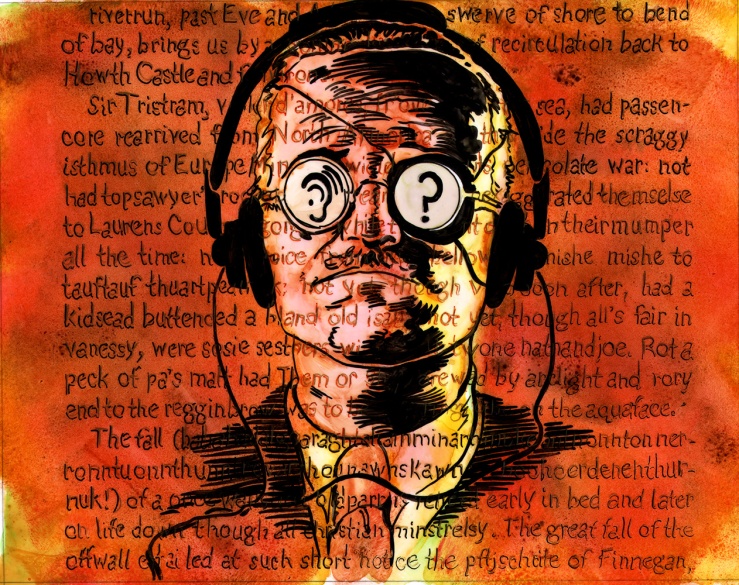
Watch a film about Thomas Pynchon, A Journey into the Mind of P


This 2002 documentary by Donatello Dubini and Fosco Dubini is kind of a mess, but it’s a fun mess. Interviews with old friends, like Jules Siegel, superfans and webdudes, and critics (George Plimpton shows up a few times), are interspliced with a lot of stock footage. The Residents’ fantastic pop appropriations from The Third Reich Rock n’ Roll help to stitch the movie together. The film occasionally indulges in a kind of obvious paranoid rambling, and the last section, detailing an attempt to photograph Thomas Pynchon (you remember that silly CNN report?) is not nearly as interesting as Allen Rush or other Pynchonians analyses…. Sort of a for completists only deal.

What the hell is Pynchon in Public Day?

image

Pynchon in Public Day is tomorrow, May 8th–that’s Pynchon’s birthday if you’re keeping score. (He’ll be 78 tomorrow. Last year I put together links for his auspicious 77th birthday).

For the past couple of years, I’ve seen the phrase Pynchon in Public pop up in my Twitter timeline, often as a hashtag. I had a (willfully) vague idea about what Pynchon in Public was all about–like, reading Pynchon publicly, posting the W.A.S.T.E. horn in public places, leaving books about. Making the secret sign. Etc.

But so and anyway: I’ve been reading or re-reading Pynchon more or less non-stop for the past two years, after diving for reasons I can’t recall into Against the Day, following that up with Mason & Dixon, and then going through The Crying of Lot 49 and Inherent Vice again. (In the deepest and most sincere spirit of my Pynchon-reading-experience, I abandoned Bleeding Edge twice during this time). I’m rereading Gravity’s Rainbow now after just having finished it (after years of false starts). Reading it again is like reading it for the first time, and as I progress (and sometimes retreat) through the Zone, I experience a sympathetic fragmentation, a scattering, a sense that the novel is consuming me. Another way of saying this is that Gravity’s Rainbow is a scary book, and all of Pynchon is scary in the sense that it’s all just one big book. It kinda sorta worms its way into the ear of one’s consciousness, wriggles (Ruggles?) behind the old brainpan, performs a paranoid song and dance routine. Other fun and games too.

Wait, what? Continue reading “What the hell is Pynchon in Public Day?”

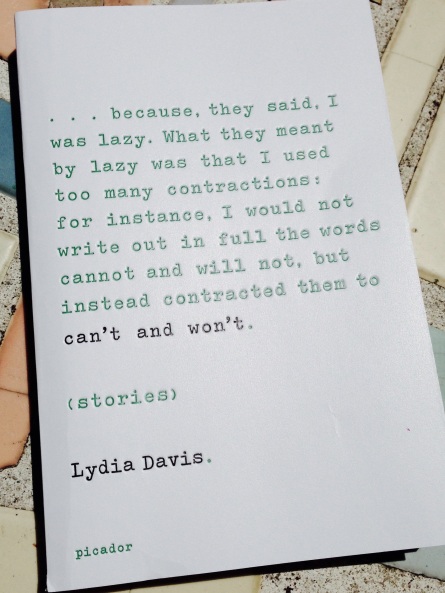
This is not a review of Lydia Davis’s Can’t and Won’t

This is the part of the not-review where I include a picture I took of the book to accompany the not-review:

image

This is the part of the not-review where I briefly restage Lydia Davis’s publishing history to provide some context for readers new to her work.

This is the part of the not-review where I submit that anyone already familiar with Lydia Davis’s short fiction is likely to already hold an opinion on it that won’t (but could) be changed by Can’t and Won’t.

This is the part of the not-review where I dither pointlessly over whether or not the stories in Can’t and Won’t are actually stories or something other than stories.

This is the part of the not-review where I state that I don’t care if the stories in Can’t and Won’t are actually stories or something other than stories.

This is the part of the not-review where I explain that I have found a certain precise aesthetic pleasure in most of Can’t and Won’t that radiates from the savory contradictory poles of identification and alienation.

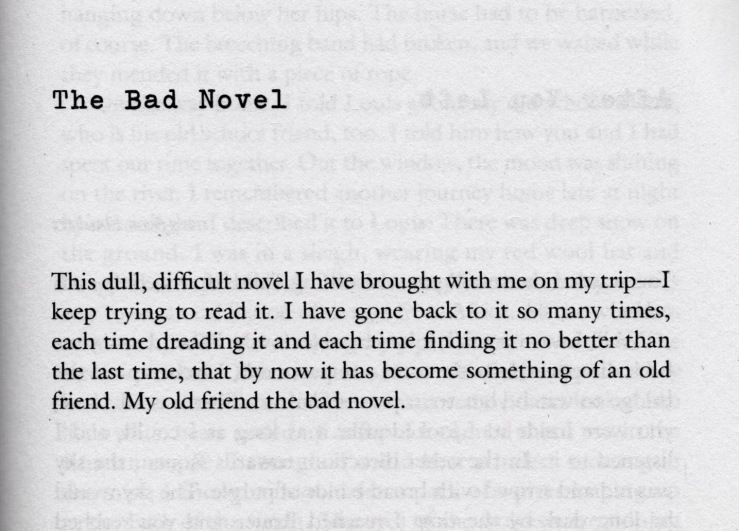
This is the part of the not-review where I cite an example of identification with Davis’s narrator-persona-speaker:

IMG_6074

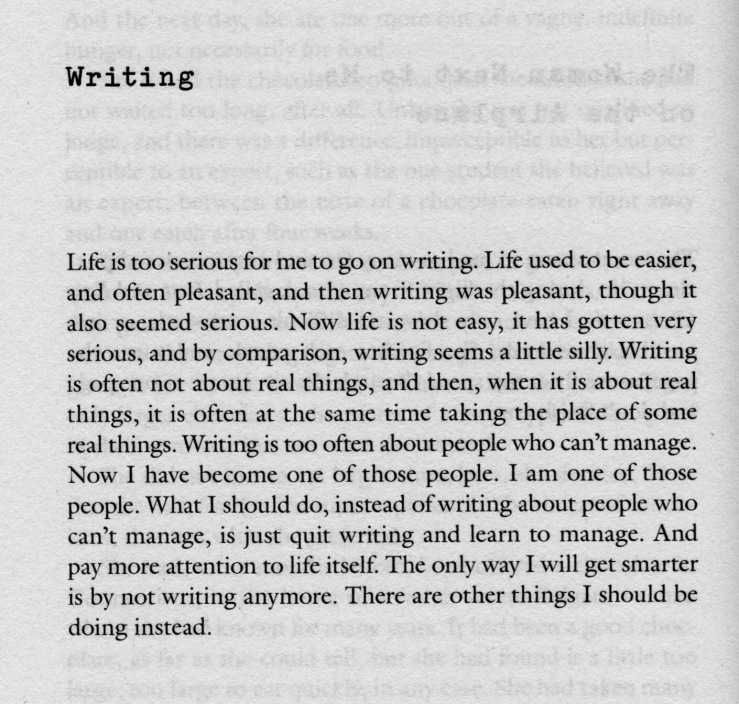
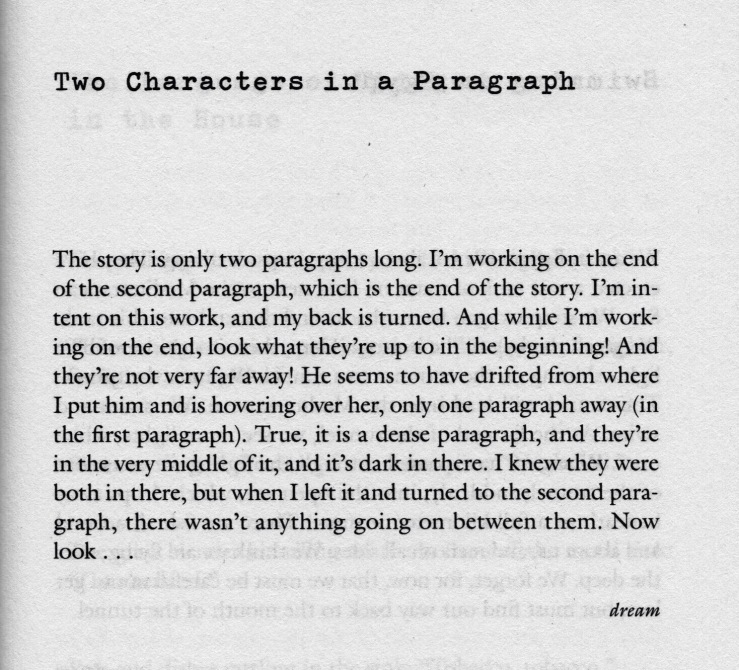
This is the part of the not-review where I claim that I used scans of the text to preserve the look and feel of Lydia Davis’s prose on the page.

This is the part of the not-review where I say that some of my favorite moments in Can’t and Won’t are Davis’s expressions of frustrated boredom with literature (or do I mean publishing?), like in the longer piece “Not Interested.”

This is the part of the not-review where I point out that Davis’s speaker-narrator-persona expresses frustration with the act of writing itself:

IMG_6072

This is the part of the not-review where I dither pointlessly over distinctions between Davis the author and Davis the persona-speaker-narrator.

This is the part of the not-review where I point out that (previous dithering and frustration-with-writing aside) writing itself is a major concern of Can’t and Won’t:

IMG_6070

This is the part of the not-review where I say that many of the stories in Can’t and Won’t are labeled dream, and I often found myself not really caring for these dreams (although I like the one above), but maybe I didn’t really care for the dreams because of their being tagged as dreams. (This is the part of the not-review where I point out that our eyes glaze over when anyone tells us their literal dreams).

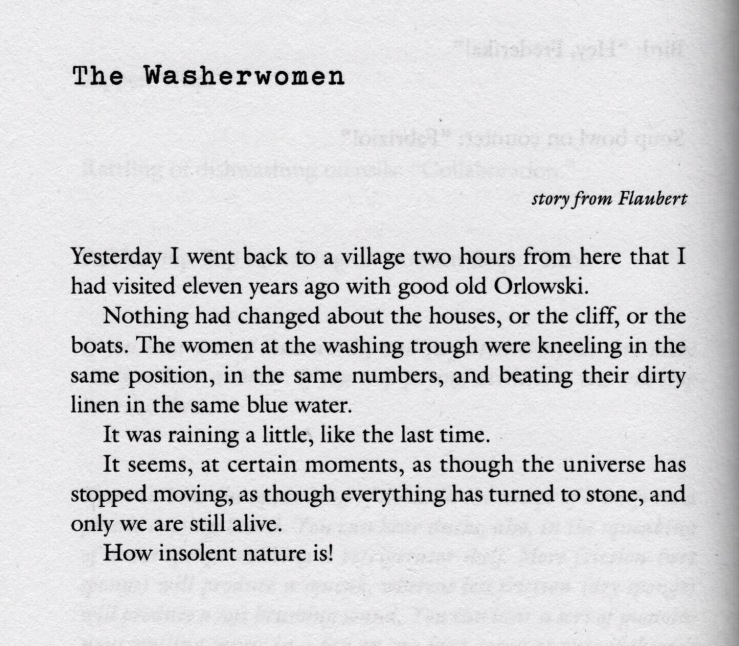
This is the part of the not-review where I transition from stories tagged dream to stories tagged story from Flaubert, like this one:

IMG_6076

This is the part of the not-review where I say how much I liked the stories from Flaubert stories in Can’t and Won’t.

This is the part of the not-review where I mention Davis’s translation work, but don’t admit that I didn’t make it past the first thirty pages of her Madame Bovary. 

This is the part of the not-review where I needlessly reference my review of The Collected Stories of Lydia Davis and point out that that collection is not so collected now.

This is the part of the not-review where I pointlessly dither over post-modernism, post-postmodernism, and Davis’s place in contemporary fiction. (This is the part of the not-review where I needlessly cram in the names of other authors, like Kafka and Walser and Bernhard and Markson and Adler and Miller &c.).

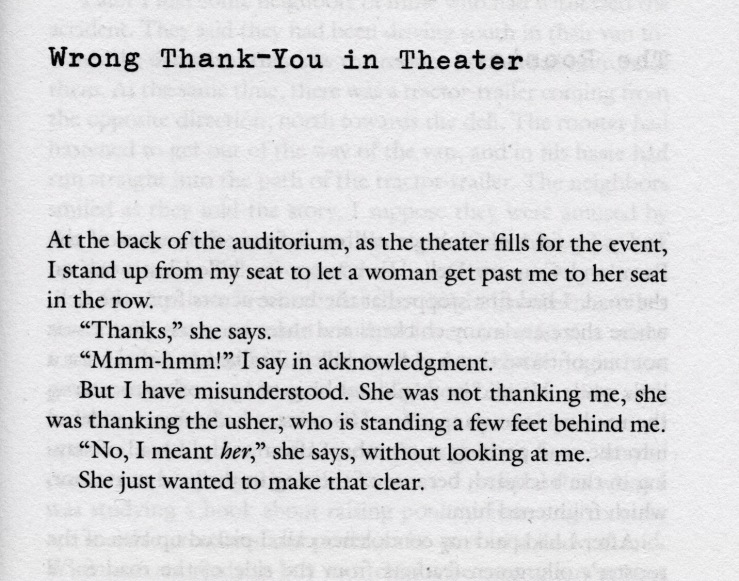
This is the part of the not-review where I claim that nothing I’ve written matters because Davis makes me laugh (this is also the part of the not-review where I use the adverb “ultimately,” a favorite crutch):

IMG_6077

This is the part of the not-review where I point out that Can’t and Won’t is not for everybody, but I very much enjoyed it.

This is the part of the not-review where I mention that the publisher is FS&G/Picador, and that the book is available in the usual formats.

“Population Explosion” — Archibald MacLeish

Screenshot 2015-05-07 at 8

Orson Welles on making fun of Ernest Hemingway

“The Hunter Gracchus,” a short tale by Franz Kafka

“The Hunter Gracchus”

by

Franz Kafka

Two boys were sitting on the wall by the jetty playing dice. A man was reading a newspaper on the steps of a monument in the shadow of a hero wielding a sabre. A young girl was filling her tub with water at a fountain. A fruit seller was lying close to his produce and looking out to sea. Through the empty openings of the door and window of a bar two men could be seen drinking wine in the back. The landlord was sitting at a table in the front dozing. A small boat glided lightly into the small harbour, as if it were being carried over the water. A man in a blue jacket climbed out onto land and pulled the ropes through the rings. Behind the man from the boat, two other men in dark coats with silver buttons carried a bier, on which, under a large silk scarf with a floral pattern and fringe, a man was obviously lying.

No one bothered with the newcomers on the jetty, even when they set the bier down to wait for their helmsman, who was still working with the ropes. No one came up to them, no one asked them any questions, no one took a closer look at them.

The helmsman was further held up a little by a woman with disheveled hair, who now appeared on deck with a child at her breast. Then he came on, pointing to a yellowish two-story house which rose close by, directly on the left near the water. The bearers took up their load and carried it through the low door furnished with slender columns. A small boy opened a window, noticed immediately how the group was disappearing into the house, and quickly shut the window again. The door closed. It had been fashioned with care out of black oak wood. A flock of doves, which up to this point had been flying around the bell tower, came down in front of the house. The doves gathered before the door, as if their food was stored inside the house. One flew right up to the first floor and pecked at the window pane. They were brightly coloured, well cared for, lively animals. With a large sweep of her hand the woman on the boat threw some seeds towards them. They ate them up and then flew over to the woman. Continue reading ““The Hunter Gracchus,” a short tale by Franz Kafka”

Don’t Try This at Home (Book acquired, 4.30.2015)

IMG_6010

Angela Readman’s short story collection Don’t Try This at Home is new from And Other Stories. Their blurb:

A girl repeatedly chops her boyfriend in half but, while her ‘other half’ multiplies, she is still not satisfied. Love transforms a mother working down the chippie – into Elvis! An old witch takes in a young one and, despite her best, magical powers, can’t help revealing something of the real world to her apprentice. Beautiful, sharp and fearless, these stories breathe. Do Try This at Home.

In Angela Readman’s debut collection, each story packs its share of explosive material.  In every one, quirky new strategies for surviving troubled lives are revealed, often through a transformative touch of contemporary magic.

If Angela Carter were Readman’s fairy godmother, would that make David Lynch her wicked stepbrother? Don’t say you weren’t warned!


Moby Dick — Hieronimus Fromm

“I think I could turn and live with animals” — Walt Whitman

Section 32 of Walt Whitman’s “Song of Myself”

***

I think I could turn and live with animals, they are so placid and self-contain’d;
I stand and look at them long and long.

They do not sweat and whine about their condition;
They do not lie awake in the dark and weep for their sins;
They do not make me sick discussing their duty to God;
Not one is dissatisfied—not one is demented with the mania of owning things;
Not one kneels to another, nor to his kind that lived thousands of years ago;
Not one is respectable or industrious over the whole earth.

So they show their relations to me, and I accept them;
They bring me tokens of myself—they evince them plainly in their possession.

I wonder where they get those tokens:
Did I pass that way huge times ago, and negligently drop them?
Myself moving forward then and now and forever,
Gathering and showing more always and with velocity,
Infinite and omnigenous, and the like of these among them;
Not too exclusive toward the reachers of my remembrancers;
Picking out here one that I love, and now go with him on brotherly terms.

A gigantic beauty of a stallion, fresh and responsive to my caresses,
Head high in the forehead, wide between the ears,
Limbs glossy and supple, tail dusting the ground,
Eyes full of sparkling wickedness—ears finely cut, flexibly moving.

His nostrils dilate, as my heels embrace him;
His well-built limbs tremble with pleasure, as we race around and return.

I but use you a moment, then I resign you, stallion;
Why do I need your paces, when I myself out-gallop them?
Even, as I stand or sit, passing faster than you.

Check out Waywords and Meansigns, a musical adaptation of James Joyce’s Finnegans Wake

Robert Berry copyWaywords and Meansigns, a musical adaptation of James Joyce’s Finnegans Wake, is now available for free download.

I interviewed the project’s director (and contributor) Derek Pyle a few weeks back, and he explained the idea:

Biblioklept: What is Waywords and Meansigns?

Derek Pyle: Waywords and Meansigns is a collaborative music project recreating James Joyce’s Finnegans Wake. Seventeen different musicians from all around world have each taken a chapter of Finnegans Wake and set it to music, thereby creating an unabridged audio version of Finnegans Wake.

Finnegans Wake is an incredible book, but it’s notoriously difficult to read. One hope of the project is to create a version of the Wake that is accessible to newcomers — people can just listen to and enjoy the music. To maximize accessibility, we are distributing all the audio freely via our website. But the project does not only appeal to Wake newcomers — as we’ve seen so far, a lot of scholars and devoted readers are also finding Waywords and Meansigns an exciting way of interpreting and engaging with Joyce’s text.

“If I should learn, in some quite casual way” — Edna St. Vincent Millay

Screenshot 2015-05-04 at 7

“Snips of the Tongue” — Harry Mathews

“Snips of the Tongue”

by

Harry Mathews

from Selected Declarations of Independence

Once burned, twice snide

+

Every drug has its day

+

The road to help is paved with good intentions

+

Never pull of tomorrow what you can do today

+

When in Rome, do as the Trojans do

+

Half a loan is better than no bread

+

Every crowd has a silver lining

+

One man’s meat is another man’s person

+

Look before you leave

+

A snitch in time saves nine

+

In the kingdom of the blind, the one-eyed man is kinky

+

Too many cooks spoil the dwarf

“Three Sundays in a Week” — Edgar Allan Poe

“Three Sundays in a Week”

by

Edgar Allan Poe

“YOU hard-headed, dunder-headed, obstinate, rusty, crusty, musty, fusty, old savage!” said I, in fancy, one afternoon, to my grand uncle Rumgudgeon—shaking my fist at him in imagination.

Only in imagination. The fact is, some trivial discrepancy did exist, just then, between what I said and what I had not the courage to say—between what I did and what I had half a mind to do.

The old porpoise, as I opened the drawing-room door, was sitting with his feet upon the mantel-piece, and a bumper of port in his paw, making strenuous efforts to accomplish the ditty.

Remplis ton verre vide!

Vide ton verre plein!

“My dear uncle,” said I, closing the door gently, and approaching him with the blandest of smiles, “you are always so very kind and considerate, and have evinced your benevolence in so many—so very many ways—that—that I feel I have only to suggest this little point to you once more to make sure of your full acquiescence.”

“Hem!” said he, “good boy! go on!” Continue reading ““Three Sundays in a Week” — Edgar Allan Poe”

The Great Serpent holding its own tail in its mouth (Gravity’s Rainbow)

Kekulé dreams the Great Serpent holding its own tail in its mouth, the dreaming Serpent which surrounds the World. But the meanness, the cynicism with which this dream is to be used. The Serpent that announces, “The World is a closed thing, cyclical, resonant, eternally-returning,” is to be delivered into a system whose only aim is to violate the Cycle. Taking and not giving back, demanding that “productivity” and “earnings” keep on increasing with time, the System removing from the rest of the World these vast quantities of energy to keep its own tiny desperate fraction showing a profit: and not only most of humanity—most of the World, animal, vegetable and mineral, is laid waste in the process. The System may or may not understand that it’s only buying time. And that time is an artificial resource to begin with, of no value to anyone or anything but the System, which sooner or later must crash to its death, when its addiction to energy has become more than the rest of the World can supply, dragging with it innocent souls all along the chain of life. Living inside the System is like riding across the country in a bus driven by a maniac bent on suicide… though he’s amiable enough, keeps cracking jokes back through the loudspeaker, “Good morning folks, this is Heidelberg here we’re coming into now, you know the old refrain, ‘I lost my heart in Heidelberg,’ well I have a friend who lost both his ears here! Don’t get me wrong, it’s really a nice town, the people are warm and wonderful—when they’re not dueling. Seriously though, they treat you just fine, they don’t just give you the key to the city, they give you the bung-starter!” u.s.w. On you roll, across a countryside whose light is forever changing—castles, heaps of rock, moons of different shapes and colors come and go. There are stops at odd hours of the mornings, for reasons that are not announced: you get out to stretch in lime-lit courtyards where the old men sit around the table under enormous eucalyptus trees you can smell in the night, shuffling the ancient decks oily and worn, throwing down swords and cups and trumps major in the tremor of light while behind them the bus is idling, waiting—passengers will now reclaim their seats and much as you’d like to stay, right here, learn the game, find your old age around this quiet table, it’s no use: he is waiting beside the door of the bus in his pressed uniform, Lord of the Night he is checking your tickets, your ID and travel papers, and it’s the wands of enterprise that dominate tonight… as he nods you by, you catch a glimpse of his face, his insane, committed eyes, and you remember then, for a terrible few heartbeats, that of course it will end for you all in blood, in shock, without dignity—but there is meanwhile this trip to be on… over your own seat, where there ought to be an advertising plaque, is instead a quote from Rilke: “Once, only once…” One of Their favorite slogans. No return, no salvation, no Cycle—that’s not what They, nor Their brilliant employee Kekulé, have taken the Serpent to mean. No: what the Serpent means is—how’s this—that the six carbon atoms of benzene are in fact curled around into a closed ring, just like that snake with its tail in its mouth, GET IT?

From pages 412-13 of Thomas Pynchon’s novel Gravity’s Rainbow.

“The Banjo Player” — Fenton Johnson

Screenshot 2015-05-02 at 8.59.16 AM