Watch The Danish Poet, an Animated Short by Torill Kove (Narrated by Liv Ullmann)

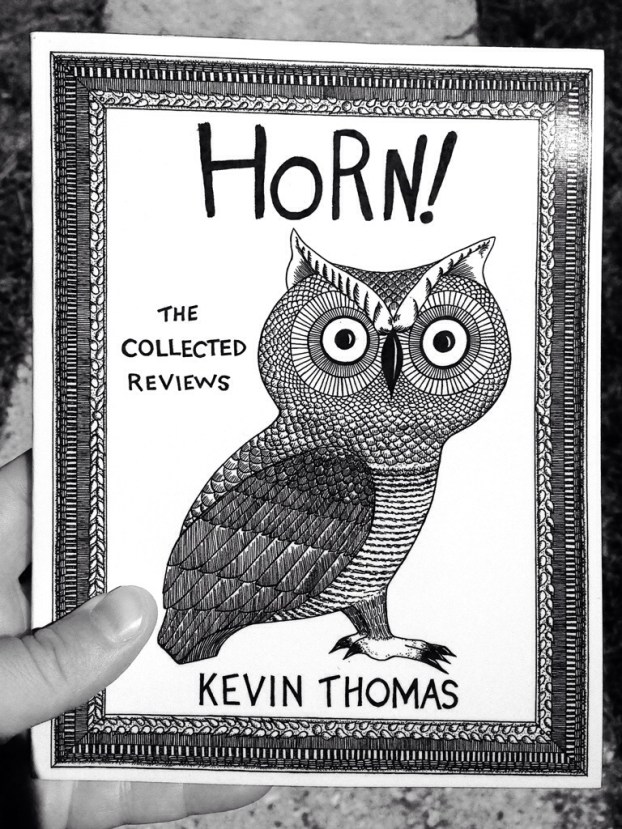
Horn! — Kevin Thomas’s Collected Reviews (Book Acquired, 6.14.2014)

20140618-113731-41851102.jpg

Kevin Thomas has been doing illustrated reviews of contemporary books for The Rumpus for a few years now. Now, the good people of OR Books have published the reviews in one volume—HORN! The Collected Reviews.

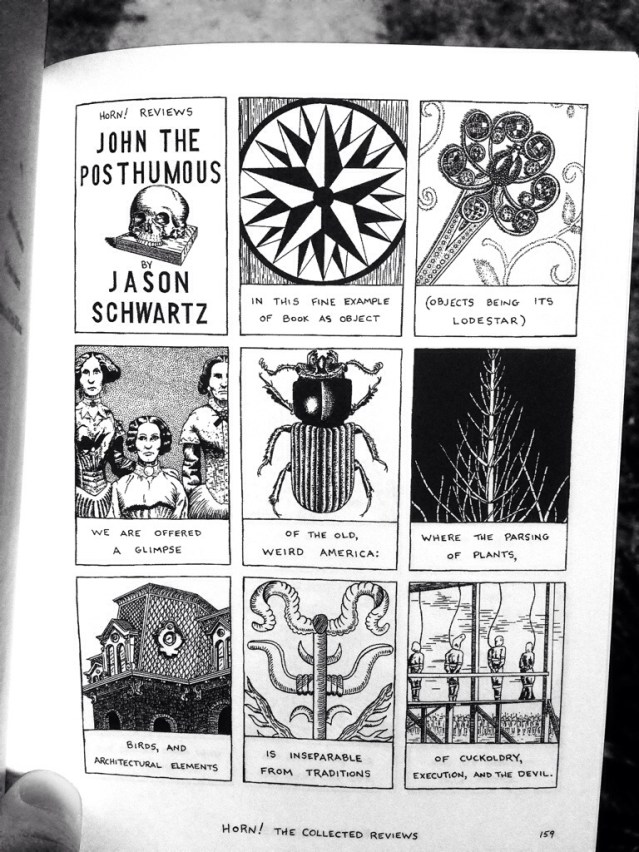
I’d read a few of Thomas’s reviews in the past and always been a bit jealous at his control of his medium—of his ability to go past or through or beyond the language under discussion to provoke with a sequence of images. Reviews is maybe not the right term—commentaries seems more fitting. Take his review of George Saunders’s Tenth of December for example, which manages to condense an overview of the collection’s themes along with a viewpoint on those themes into nine small panels. (I needed over 2000 words for my own review of the Saunders book).

Thomas’s technique works especially well with novels that are very difficult to write about/after, like one of my favorite recent titles, Jason Schwartz’s John the Posthumous. I stammered and hiccuped through my essay; Thomas explicates, illustrates, and piques reader interest—again, in just nine panels.

20140618-113733-41853283.jpg

I’ve been trying to limit myself to just a few strips a day from the collection, but more often than not I’ve failed, curious to see Thomas’s takes on Levin’s The Instructions (a novel I couldn’t finish), Peter Hook’s memoir, Renata Adler’s Speedboat (yes!) and more. Great stuff.

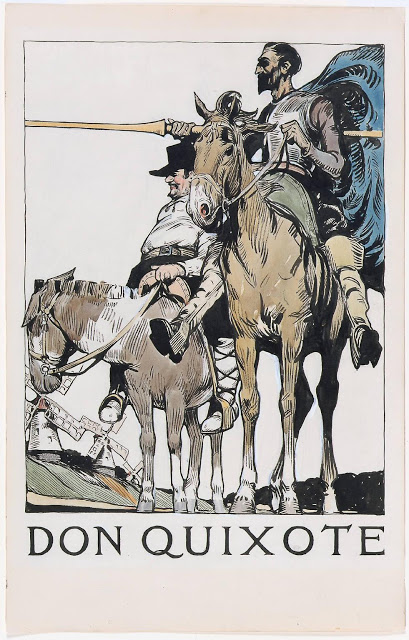
Don Quixote (Illustration) — Edward Hopper

hopper quixote

“The Royal Command,” A Surreal Short Story by Leonora Carrington

“The Royal Command”

by

Leonora Carrington

I had received a royal command to visit the rulers of my country.

The invitation, in gold letters in relief and adorned with roses and swallows, was bordered in lace.

I went to look for my car, but the chauffeur, who lacks practical sense, had buried it.

“It’s to grow mushrooms,” he told me. “Nothing better for mushrooms.”

“Brady,” I said to him, “you are an imbecile of the first degree. You have ruined my car.”

Actually, since the car was completely ruined, I had to rent a horse-pulled buggy.

Upon reaching the palace, an impossible servant, dressed in red and gold, said to me: “The queen went crazy yesterday; she is in her bathtub.”

“How unfortunate!” I exclaimed. “How did that happen?”

“It’s the heat.”

“Can I see her in any event?” (I hoped I hadn’t made the long voyage for nothing.)
Continue reading ““The Royal Command,” A Surreal Short Story by Leonora Carrington”

Selections from One-Star Amazon Reviews of Joyce’s Ulysses

[Ed. note: The following citations come from one-star Amazon reviews of James Joyce’s Ulysses. To be clear, I think Ulysses is a marvelous, rewarding read. While one or two of the reviews are tongue-in-cheek, most one-star reviews of the book are from very, very angry readers who feel duped]

I can sum this book up in two words: “Ass Beating”.

What an awful book this is?

I bought this having been a huge fan of the cartoon series, but Mr Joyce has taken a winning formula and produced a prize turkey. After 20 pages not only had Ulysses failed to even board his spaceship, but I had no idea at all what on earth was going on. Verdict: Rubbish.

When an English/American writer try to explain his/her ideas about life(I mention ideas about meaning,purpose and philosophy of life)and when he/she try to do this with complicated ideas and long sentences(or like very short ones especially in this particular book);what his/her work become to is:A tremendous nonsense!!!

Thi’ got to be the worst, I- I – I mean the worst ever written book ever. Know why? ‘Cause he’ such a showoff, know what I MEAN? He’s ingenious I’ll giv’ ’em that, but ingenuity my friends tire and enervate. Get to the point and stick to it ‘s my motto.

This is one of those books that “smart” people like to “read.”

The grammar is so disjointed as to make it nearly impossible to read.

Ulysses is basically an unbridled attack on the very ideas of heroism, romantic love and sexual fulfillment, and objective literary expression.

What’s with all the foreign languages?

It has no real meaning.

It is a blasphemy that it ever was published.

Anyone who tells you they’ve read this so-called book all the way through is probably lying through their teeth.It is impossible to endure this torture.

A babbling, senseless tome upheld by “literary luminaries” who fear being cast into the tasteless bourgeois darkness for dissent? Yes, that’s the gist.

I discovered that the novel was not what I though it would be.

Joyce is an aesthetic bother of Marcel Duchamp (known for The Fountain, a urinal, now a museum piece) and John Cage (the composer of pieces for prepared piano, where the piano’s strings are mangled with trash.

Two positive things I can say about James Joyce is that he has a great sounding name and he gives wonderful titles to his works.

Ask yourself – are you going to enjoy a book that neccesitates your literature teacher lie next to you and explain its ‘sophistication’ to you ?

It’s the worst book which has ever been written.

Unless you really hate yourself, do not attempt to read this book.

The truth is this book stinks. For one thing it is vulgar, which, I hate to disappoint anyone, requires no talent at all. This is a talent any six year-old boy possesses.

The book is not so good, it is boring, it is a colection of words and a continuous experimentation of styles that, unhappily, do not mean anything to the meaning of the story; that is, the book’s language is snobbish and useless. Those who say that “love” such a writing are to be thought about as non-readers or as victims of a literary abnormality.

…the single most destructive piece of Literature ever written…

I’m all for challenging reads, but not for gibberish which academics persist in labeling erudition.

This book is extremely dull!!! My book club decided to read this book after one of the members visited the James Joyce tower in Ireland, which the author supposedly wrote part of the book in.

Ulysses is a failed novel because Joyce was a bad writer (shown by his other works).

In conclusion, Don’t read the book. Burn it hard. Do not let your children read the book—it will mutilate their brain cells.

Film Footage of the First Bloomsday Celebration in 1954

Film footage of the first Bloomsday celebration (June 16, 1954)–a great find by Antoine Malette, who posted the video along with an account of the journey as told in Flann O’Brien: An Illustrated Biography. The film was shot by John Ryan, and shows an extremely inebriated Brian O’Nolan (aka Flann O’Brien) having to be helped around by pals Anthony Cronin and Patrick Kavanagh. We’re also treated to a scene of Kavanagh taking a piss with Joyce’s cousin Tom Joyce, a dentist who joined the merry band. (The scene will undoubtedly recall to you that marvelous moment in Ulysses when “first Stephen, then Bloom, in penumbra urinated“). The troupe didn’t quite finish their mission, getting sidetracked by booze and quarrels. Read the full account at Malette’s site.

Summary of Bloom’s Day in Ulysses — Evan Lavender-Smith (From Old Notebooks)

Makes breakfast for his wife. Goes to the butcher. Goes to the post office. Goes to church. Goes to a chemist. Goes to a public bath. Goes to a funeral. Goes to a newspaper press. Goes to a locksmith to canvass an ad. Feeds some seagulls. Goes to a bar. Helps a blind man cross the street. Goes to the museum. Goes to to the library. Visits a bookseller. Window-shops. Goes to a restaurant. Listens to some live music. Writes a love letter. Goes to another bar. Nearly gets in a fight. Masturbates to a beautiful eighteen-year-old exhibitionist giving him a private show. Takes an alfresco nap. Takes up a collection for a widow. Goes to a hospital to visit a pregnant woman. Flirts with a nurse. Feeds a stray dog. Goes to a whorehouse. Helps avert a row with the police. Goes to a cabman’s shelter and listens to a sailor tell stories. Breaks into his own house. Urinates under the stars with another man. Watches the sunrise. Kisses his wife on her arse.

It would have been the single busiest, most adventurous day of my life.

From Evan Lavender-Smith’s From Old Notebooks.


“Patricide: Patricide is a bad idea” (Donald Barthelme)

Patricide: Patricide is a bad idea, first because it is contrary to law and custom and second because it proves, beyond a doubt, that the father’s every fluted accusation against you was correct: you are a thoroughly bad individual, a patricide! — member of a class of persons universally ill-regarded. It is all right to feel this hot emotion, but not to act upon it. And it is not necessary. It is not necessary to slay your father, time will slay him, that is a virtual certainty. Your true task lies elsewhere. Your true task, as a son, is to reproduce every one of the enormities touched upon in this manual, but in attenuated form. You must become your father, but a paler, weaker version of him. The enormities go with the job, but close study will allow you to perform the job less well than it has previously been done, thus moving toward a golden age of decency, quiet, and calmed fevers. Your contribution will not be a small one, but “small” is one of the concepts that you should shoot for. If your father was a captain in Battery D, then content yourself with a corporalship in the same battery. Do not attend the annual reunions. Do not drink beer or sing songs at the reunions. Begin by whispering, in front of a mirror, for thirty minutes a day. Then tie your hands behind your back for thirty minutes a day, or get someone else to do this for you. Then, choose one of your most deeply held beliefs, such as the belief that your honors and awards have something to do with you, and abjure it. Friends will help you abjure it, and can be telephoned if you begin to backslide. You see the pattern, put it into practice. Fatherhood can be, if not conquered, at least “turned down” in this generation — by the combined efforts of all of us together.

From Donald Barthelme’s novel The Dead Father.

A father is a necessary evil (Ulysses)

—A father, Stephen said, battling against hopelessness, is a necessary evil. He wrote the play in the months that followed his father’s death. If you hold that he, a greying man with two marriageable daughters, with thirtyfive years of life, nel mezzo del cammin di nostra vita, with fifty of experience, is the beardless undergraduate from Wittenberg then you must hold that his seventyyear old mother is the lustful queen. No. The corpse of John Shakespeare does not walk the night. From hour to hour it rots and rots. He rests, disarmed of fatherhood, having devised that mystical estate upon his son. Boccaccio’s Calandrino was the first and last man who felt himself with child. Fatherhood, in the sense of conscious begetting, is unknown to man. It is a mystical estate, an apostolic succession, from only begetter to only begotten. On that mystery and not on the madonna which the cunning Italian intellect flung to the mob of Europe the church is founded and founded irremovably because founded, like the world, macro and microcosm, upon the void. Upon incertitude, upon unlikelihood. Amor matris, subjective and objective genitive, may be the only true thing in life. Paternity may be a legal fiction. Who is the father of any son that any son should love him or he any son?

What the hell are you driving at?

I know. Shut up. Blast you. I have reasons.

Amplius. Adhuc. Iterum. Postea.

Are you condemned to do this?

—They are sundered by a bodily shame so steadfast that the criminal annals of the world, stained with all other incests and bestialities, hardly record its breach. Sons with mothers, sires with daughters, lesbic sisters, loves that dare not speak their name, nephews with grandmothers, jailbirds with keyholes, queens with prize bulls. The son unborn mars beauty: born, he brings pain, divides affection, increases care. He is a new male: his growth is his father’s decline, his youth his father’s envy, his friend his father’s enemy.

In rue Monsieur-le-Prince I thought it.

—What links them in nature? An instant of blind rut.

Am I a father? If I were?

Shrunken uncertain hand.

—Sabellius, the African, subtlest heresiarch of all the beasts of the field, held that the Father was Himself His Own Son. The bulldog of Aquin, with whom no word shall be impossible, refutes him. Well: if the father who has not a son be not a father can the son who has not a father be a son? When Rutlandbaconsouthamptonshakespeare or another poet of the same name in the comedy of errors wrote Hamlet he was not the father of his own son merely but, being no more a son, he was and felt himself the father of all his race, the father of his own grandfather, the father of his unborn grandson who, by the same token, never was born, for nature, as Mr Magee understands her, abhors perfection.

Stephen Dedalus, holding forth in Ulysses. (Context, if necessary: The referent of He in the second paragraph is William Shakespeare; the play is of course Hamlet).

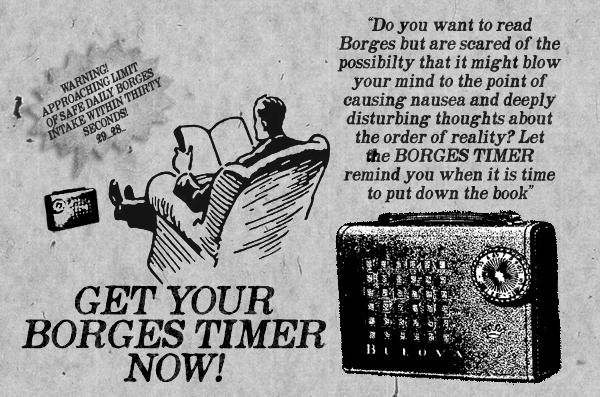
Get Your Borges Timer Now!

borges_timer

“Over an Absinthe Bottle” — W.C. Morrow


“Over an Absinthe Bottle”

by

W.C. Morrow

Arthur Kimberlin, a young man of very high spirit, found himself a total stranger in San Francisco one rainy evening, at a time when his heart was breaking; for his hunger was of that most poignant kind in which physical suffering is forced to the highest point without impairment of the mental functions. There remained in his possession not a thing that he might have pawned for a morsel to eat; and even as it was, he had stripped his body of all articles of clothing except those which a remaining sense of decency compelled him to retain. Hence it was that cold assailed him and conspired with hunger to complete his misery. Having been brought into the world and reared a gentleman, he lacked the courage to beg and the skill to steal. Had not an extraordinary thing occurred to him, he either would have drowned himself in the bay within twenty-four hours or died of pneumonia in the street. He had been seventy hours without food, and his mental desperation had driven him far in its race with his physical needs to consume the strength within him; so that now, pale, weak, and tottering, he took what comfort he could find in the savory odors which came steaming up from the basement kitchens of the restaurants in Market Street, caring more to gain them than to avoid the rain. His teeth chattered; he shambled, stooped, and gasped. He was too desperate to curse his fate—he could only long for food. He could not reason; he could not understand that ten thousand hands might gladly have fed him; he could think only of the hunger which consumed him, and of food that could give him warmth and happiness. Continue reading ““Over an Absinthe Bottle” — W.C. Morrow”

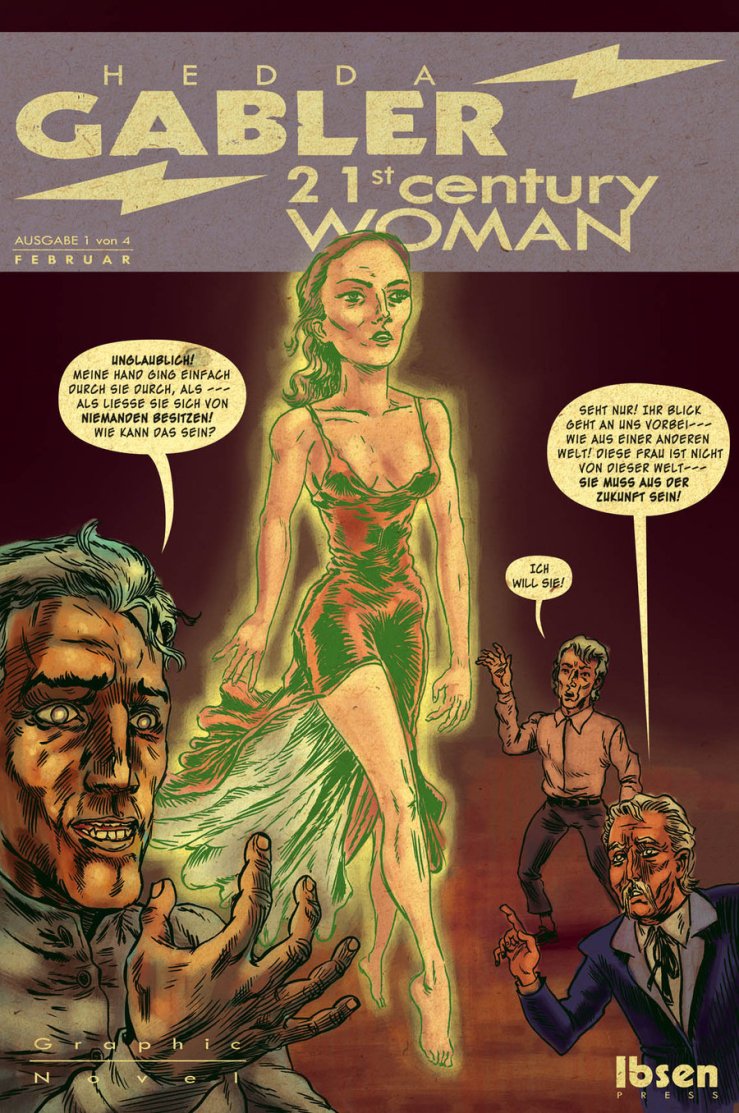
Hedda Gabler, 21st Century Woman — Ralph Niese

hedda_21st_century_woman_by_bruno83

“The Forgetful Ghost,” A Supernatural Tale by William T. Vollmann

After my father died, I began to wonder whether my turn might come sooner rather than later. What a pity! Later would have been so much more convenient! And what if my time might be even sooner than soon? Before I knew it, I would recognize death by its cold shining as of brass. Hence in those days, I do confess, I felt sometimes angry that the treasures of sunlight escaped my hands no matter how tightly I clenched them. I loved life so perfectly, at least in my own estimation, that it seemed I deserved to live forever, or at least until later rather than sooner. But just in case death disregarded my all-important judgments, I decided to seek out a ghost, in order to gain expert advice about being dead. The living learn to weigh the merits of preparation against those of spontaneity, which is why they hire investment counselors and other fortune-tellers. And since I had been born an American, I naturally believed myself entitled to any destiny I could pay for. Why shouldn’t my postmortem years stretch on like a lovely procession of stone lamps?

If you believe, as H.P. Lovecraft asserted, that all cemeteries are subterraneously connected, then it scarcely matters which one you visit; so I put one foot before the other, and within a half-hour found myself allured by the bright green moss on the pointed tops of those ancient stone columns of the third Shogun’s loyally suicided retainers. Next I found, glowing brighter than the daylight, more green moss upon the stone railings and torii enclosing these square plots whose tombstones strained upward like trees, each stone engraved with its undertenant’s postmortem Buddhist name.

The smell of moss consists of new and old together. Dead matter having decayed into clean dirt, the dirt now freshens into green. It is this becoming-alive that one smells. I remember how when my parents got old, they used to like to walk with me in a certain quiet marsh. The mud there smelled clean and chocolate-bitter. I now stood breathing this same mossy odor, and fallen cryptomeria-needles darkened their shades of green and orange while a cloud slid over the sun. Have you ever seen a lizard’s eyelid close over his yellow orb? If so, then you have entered ghostly regions, which is where I found myself upon the sun’s darkening. All the same, I had not gone perilously far: On the other side of the wall, tiny cars buzzed sweetly, bearing living skeletons to any number of premortem destinations. Reassured by the shallowness of my commitment, I approached the nearest grave. 

The instant I touched the wet moss on the railing, I fell into communication with the stern occupant, upon whose wet dark hearthstone lay so many dead cryptomeria-tips. To say he declined to come out would be less than an understatement. It was enough to make a fellow spurn the afterlife! I experienced his anger as an electric shock. To him I was nothing, a rootless alien who lacked a lord to die for. Why should he teach me?

Humiliated, I turned away, and let myself into the lower courtyard behind the temple. Here grew the more diminutive ovoid and phallic tombs of priests. Some were incised with lotus wave-patterns. One resembled a mirror or hairbrush stood on end. I considered inviting myself in, but then I thought: If that lord up there was so cross, wouldn’t a priest have even less use for me? 

So I pulled myself up to the temple’s narrow porch and sat there with my feet dangling over, watching cherry blossoms raining down on the tombs. The gnarled arms of that tree pointed toward every grave, and afternoon fell almost into dusk. 

A single white blossom sped down like a spider parachuting down his newest thread. Then my ears began to ring—death’s call. 

So I ran away. I sat down in my room and hid. Looking out my window, I spied death up boards and pouring vinegar on nails. Death killed a dog. What if I were next?

Read the rest of “The Forgetful Ghost” at VICE.

The tale is collected in Vollmann’s forthcoming book, Last Stories and Other Stories.

“Food” — Donald Barthelme

I was preparing a meal for Celeste-a meal of a certain elegance, as when arrivals or other rites of passage are to be celebrated.

First off there were Saltines of the very best quality and of a special crispness, squareness, and flatness, obtained at great personal sacrifice by making representations to the National Biscuit Company through its authorized nuncios in my vicinity. Upon these was spread with a hand lavish and not sitting Todd’s Liver Pate, the same having been robbed from geese and other famous animals and properly adulterated with cereals and other well-chosen extenders and the whole delicately spiced with calcium propionate to retard spoilage. Next there were rare cheese products from Wisconsin wrapped in gold foil in exquisite tints with interesting printings thereon, including some very artful representations of cows, the same being clearly in the best of health and good humor. Next there were dips of all kinds including clam, bacon with horseradish, onion soup with sour cream, and the like, which only my long acquaintance with some very high-up members of the Borden company allowed to grace my table. Next there were Fritos curved and golden to the number of 224 (approx.), or the full contents of the bursting 53c bag. Next there were Frozen Assorted Hors d’Oeuvres of a richness beyond description, these wrested away from an establishment catering only to the nobility, the higher clergy, and certain selected commoners generally agreed to be comers in their particular areas of commonality, calcium propionate added to retard spoilage. In addition there were Mixed Nuts assembled at great expense by the Planters concern from divers strange climes and hanging gardens, each nut delicately dusted with a salt that has no peer. Furthermore there were cough drops of the manufacture of the firm of Smith Fils, brown and savory and served in a bowl once the property of Brann the Iconoclast. Next there were young tender green olives into which ripe red pimentos had been cunningly thrust by underpaid Portuguese, real and true handwork every step of the way. In addition there were pearl onions meticulously separated from their nonstandard fellows by a machine that had caused the Board of Directors of the S&W concern endless sleepless nights and had passed its field trails just in time to contribute to the repast I am describing. Additionally there were gherkins whose just fame needs no further words from me. Following these appeared certain cream cheeses of Philadelphia origin wrapped in costly silver foil, the like of which a pasha could not have afforded in the dear dead days. Following were Mock Ortolans Manques made of the very best soybean aggregate, the like of which could not be found on the most sophisticated tables of Paris, London and Rome. The whole washed down with generous amounts of Tab, a fiery liquor brewed under license by the Coca-Cola Company which will not divulge the age-old secret recipe no matter how one begs and pleads with them but yearly allows a small quantity to circulate to certain connoisseurs and bibbers whose credentials meet the very rigid requirements of the Cellarmaster. All of this stupendous feed being a mere scherzo before the announcement of the main theme, chilidogs.
“What is all this?” asked sweet Celeste, waving her hands in the air. “Where is the food?”
“You do not recognize a meal spiritually prepared,” I said, hurt in the self-love.
“We will be very happy together,” she said. “I cook.”

From Donald Barthelme’s short story “Daumier.”

Read Barry Hannah’s Short Story “The Spy of Loog Root”

THE OUTCAST NEPHEW was farhearinged. That is a difficult word and concept, but as with farsighted, his ear could not participate with sounds up close, only those far away, up to a quarter mile, a distance of course at which the rest of us townsmen can hear little at all except explosions and aircraft. It seemed to work that if voices were soft enough, faint enough, they could penetrate his tympana. One thought of the sound waves, but how, in his case? I don’t know, but imagine the tenderness of his ears, bent by the incredible bawling of noise he must have sensed up close, so that he ran away, holding both ears in agony, dispossessed of normal human intercourse.

He was one of those exceptional children, ghostly with long blond hair, to whom none of his family out at Loog Root Pass felt kin, except the mother. We never got, because of his affliction, a definite reckoning on his intelligence before he ran off, alone, into the hills.

Read the rest of Barry Hannah’s short story “The Spy of Loog Root” at The Oxford American.

“Go to hell, Roberto” | Roberto Bolaño’s The Unknown University

The Unknown University, Roberto Bolaño’s poetry collection—his complete poems, a bilingual edition, lovely, beautiful, over 800 pages—has been shifted all over my messy house this past month, wedged into ad hoc shelves, even conspicuously, for a time, fatly weighing down another Bolaño text, The Insufferable Gaucho (which I’ve been reading in tandem with/against The Unknown University), swollen and warped with saltwater from the gray Atlantic ocean.

I pecked at The Unknown University discursively, avoiding end notes, taking the rest of the Bolañoverse as my guide or frame or map or background for these poems. I read randomly, trying one poem at a time in no special order, taking crude stabs at the Spanish text on the left hand pages, clumsily matching them against Laura Healy’s fine translation, a poetics that matches the tone and rhythm and cadence and vibe of Bolaño’s other translators, Natasha Wimmer and Chris Andrews.

Then last night, a tale from The Insufferable Gaucho compelled me to read from The Unknown University straightwise, linear, 1-2-3, non-discursively, to take a stab at an orderly trajectory, reading it like a novel in fragments, perhaps.

The book is divided into three parts, each comprised of their own chapters or individual books. Last night I read, or reread, the first half of the first part: The Snow-NovelGuirat de BornelhStreets of BarcelonaIn the Reading Room of Hell.

The examples and citations in this riff come from those books, but I’d suggest that the images, motifs, and themes of these early poems—switchblades, hell, abysses, poets, girls, detectives, assassins, hunchbacks, genitals, sex, madness, blood—resonate throughout the entire volume (and throughout Bolaño’s oeuvre).

Perhaps the most central theme is Bolaño himself; The Unknown University often reads like a diffuse autobiography, with Bolaño’s concern for his own place in literature at the fore.

We see that anxiety in the first poem shared by the editors, a piece from 1990 included in the book’s intro:

Even a decade earlier, Bolaño prophesied that he would be carried to hell, a primal setting of the Bolañoverse. Bolaño’s romantic ancestor Jorge Luis Borges famously imagined Paradise as a kind of library. Bolaño inverts that image:

20140609-152831-55711939.jpgIn another poem, Bolaño seems to obliquely address Borges again (“Dear, this isn’t Paradise”), while also name-checking the heroes of that “club / for science-fiction fans” (including some perhaps-unlikely figures):

20140609-152831-55711467.jpg“A long, slow University.” Yes.

But how could Bolaño leave his hero Edgar Allan Poe from the curriculum? Oh, never mind. Here he is: 

20140609-152830-55710956.jpg

The vase—Pandora’s box, Keats’s urn?—is a central image in these early poems. Dark, beautiful, and transformative, Bolaño seems to posit the vase—an object rendered somewhat mundane in its traditional place as an aesthetic object—as a portal to the abyss:

20140609-152830-55710494.jpg

Elsewhere our poet warns/invites us: “The nightmare begins over there, right there. / Further up, down, everything’s part of the / nightmare. Don’t stick your hand in that urn. Don’t / stick your hand in that hellish vase.” Reading the poem forces us to stick our hand in the vase.

If Bolaño seems occasionally melodramatic in his poems, a thrall to Baudelaire, he’s also keenly aware of it, even this early in his career. A twinning of irony and earnestness characterizes Bolaño’s writing, a savage self-reflexive humor that doesn’t necessarily reveal itself on first reading. When he begins a poem about a lost love, “Go to hell, Roberto, and remember you’ll never stick it in again,” the sentiment is simultaneously tragic and comic, the kind of personal confession that connects to the reader’s own experiences. “To be honest I don’t remember much now,” our narrator confides near the end, before the devastating conclusion, “She loved me forever / She crushed me.”

For Bolaño though, what’s perhaps most crushing is the loss of literature:

20140609-161756-58676319.jpg

And yet Bolaño sticks his arm into the vase, walks out over the chasm, dares for his poems to perhaps earn the right to be one of those “loose sentences, traces . . . fragments” that may survive.

In the very early poem “Work,” Bolaño romanticizes his own literary posterity:

Poetry that might champion my shadow in days to come

when I’ll be just a name not the man who wandered

with empty pockets, worked in slaughterhouses

on the old and on the new continent.

I seek credibility not durability for the ballads

I composed in honor of very real girls.

And mercy for my years before 26.

Seems like a reasonable request.

I don’t know if these poems are good or bad or excellent or what. I do know that I loved reading them and that they are of a piece with everything else I’ve read by Bolaño. The best moments recall his best writing, that strange mix of plain, even understated language, set against romantic violence and terrible madness. The poems here don’t distill the best of Bolaño into burning kernels of visceral realism; rather, they feel like the liquid filament of the Bolañoverse. Fantastic.

More to come.

The Unknown University is available now from New Directions.

Capitalism arose and took off its pajamas (Donald Barthelme)

Capitalism arose and took off its pajamas. Another day, another dollar. Each man is valued at what he will bring in the marketplace. Meaning has been drained from work and assigned instead to remuneration. Unemployment obliterates the world of the unemployed individual. Cultural underdevelopment of the worker, as a technique of domination, is found everywhere under late capitalism. Authentic self-domination by individuals is thwarted. The false consciousness created and catered to by mass culture perpetuates ignorance and powerlessness. Strands of raven hair floating on the surface of the Ganges . . . Why can’t they clean up the Ganges? If the wealthy capitalists who operate the Ganges wig factories could be forced to install sieves, at the mouths of their plants . . . And now the sacred Ganges is choked with hair, and the river no longer knows where to put its flow, and the moonlight on the Ganges is swallowed by the hair, and the water darkens. By Vishnu! This is an intolerable situation! Shouldn’t something be done about it?

From Donald Barthelme’s short story “The Rise of Capitalism.”