“I can’t write incorrectly” | Lydia Davis Interview

Salon has posted a new interview with Lydia Davis. From the interview:

I can’t write incorrectly. I find it very difficult to just relax and have spelling mistakes and grammar mistakes and punctuation – I cannot do that. But I can’t do that even if I write a shopping list, so that’s not surprising. I can’t be casual, so it’s more correct. Sometimes I have fun writing it nicely – doing parallel constructions or, you know – but of course it’s more relaxed than a formal story, but it’s still a piece of writing that has an effect whether it’s a really good friend or a business email so I’m still quite conscious. It’s amazing how you can write something quickly and when I reread it – I always reread my emails – I make mistakes and I’m confusing and you’d think after all this time I could write a quick email that would be absolutely perfect, but I can’t.

No literary quality can be attained by reading writers who possess it (Schopenhauer)

No literary quality can be attained by reading writers who possess it: be it, for example, persuasiveness, imagination, the gift of drawing comparisons, boldness or bitterness, brevity or grace, facility of expression or wit, unexpected contrasts, a laconic manner, naïveté, and the like. But if we are already gifted with these qualities—that is to say, if we possess them potentia—we can call them forth and bring them to consciousness; we can discern to what uses they are to be put; we can be strengthened in our inclination, nay, may have courage, to use them; we can judge by examples the effect of their application and so learn the correct use of them; and it is only after we have accomplished all this that we actu possess these qualities. This is the only way in which reading can form writing, since it teaches us the use to which we can put our own natural gifts; and in order to do this it must be taken for granted that these qualities are in us. Without them we learn nothing from reading but cold, dead mannerisms, and we become mere imitators.

From Arthur Schopenhauer’s essay “On Reading and Books.”

Reconstruction of the Machine from Franz Kafka’s In the Penal Colony


 “However,” the Officer said, interrupting himself, “I’m chattering, and his apparatus stands here in front of us. As you see, it consists of three parts. With the passage of time certain popular names have been developed for each of these parts. The one underneath is called the Bed, the upper one is called the Inscriber, and here in the middle, this moving part is called the Harrow.” “The Harrow?” the Traveller asked. He had not been listening with full attention.

“In the Penal Colony,” Franz Kafka.

With the assurance of a sleepwalker (William T. Vollmann)

Their slave-sister Guthrún, marriage-chained to Huns on the other side of the dark wood, sent Gunnar and Hogni a ring wound around with wolf’s hair to warn them not to come; but such devices cannot be guaranteed even in dreams. As the two brothers gazed across the hall-fire at the emissary who sat expectantly or ironically silent in the high-seat, Hogni murmured: Our way’d be fairly fanged, if we rode to claim the gifts he promises us! . . .—And then, raising golden mead-horns in the toasts which kingship requires, they accepted the Hunnish invitation. They could do nothing else, being trapped, as I said, in a fatal dream. While their vassals wept, they sleepwalked down the wooden hall, helmed themselves, mounted horses, and galloped through Myrkvith Forest to their foemen’s castle where Guthrún likewise wept to see them, crying: Betrayed!—Gunnar replied: Too late, sister . . .—for when dreams become nightmares it is ever too late.

When on Z-Day 1936 the Chancellor of Germany, a certain Adolf Hitler, orders twenty-five thousand soldiers across six bridges into the Rhineland Zone, he too fears the future. Unlike Gunnar, he appears pale. Frowning, he grips his left wrist in his right. He’s forsworn mead. He eats only fruits, vegetables and little Viennese cakes. Clenching his teeth, he strides anxiously to and fro. But slowly his voice deepens, becomes a snarling shout. He swallows. His voice sinks. In a monotone he announces: At this moment, German troops are on the march.

What will the English answer? Nothing, for it’s Saturday, when every lord sits on his country estate, counting money, drinking champagne with Jews. The French are more inclined than they to prove his banesmen . . .

Here comes an ultimatum! His head twitches like a gun recoiling on its carriage. He grips the limp forelock which perpetually falls across his face. But then the English tell the French: The Germans, after all, are only going into their own back garden.—By then it’s too late, too late.

I know what I should have done, if I’d been the French, laughs Hitler. I should have struck! And I should not have allowed a single German soldier to cross the Rhine!

To his vassals and henchmen in Munich he chants: I go the way that Providence dictates, with the assurance of a sleepwalker.—They applaud him. The white-armed Hunnish maidens scream with joy.

From William Vollmann’s Europe Central. 

For the past 100 pages or so, Vollmann has referred to Hitler as the sleepwalker (I’m almost positive that the word Hitler hasn’t been used in the text up until now), and while context has made it clear that this sleepwalker is Hitler, the source of the moniker is only clarified at this point.

“The Grave” — Katherine Anne Porter

“The Grave” by Katherine Anne Porter

The grandfather, dead for more than thirty years, had been twice disturbed in his long repose by the constancy and possessiveness of his widow. She removed his bones first to Louisiana and then to Texas, as if she had set out to find her own burial place, knowing well she would never return to the places she had left. In Texas she set up a small cemetery in a corner of her first farm, and as the family connection grew, and oddments of relations came over from Kentucky to settle, it contained at last about twenty graves. After the grandmother’s death, part of her land was to be sold for the benefit of certain of her children, and the cemetery happened to lie in the part set aside for sale. It was necessary to take up the bodies and bury them again in the family plot in the big new public cemetery, where Grandmother had been recently buried. At long last her husband was to lie beside her for eternity, as she had planned.

The family cemetery had been a pleasant small neglected garden of tangled rose bushes and ragged cedar trees and cypress, the simple flat stones rising out of uncropped sweet-smelling wild grass. The graves were lying open and empty one burning day when Miranda and her brother Paul, who often went together to hunt rabbits and doves, propped their twenty-two Winchester rifles carefully against the rail fence, climbed over and explored among the graves. She was nine years old and he was twelve.

They peered into the pits all shaped alike with such purposeful accuracy, and looking at each other with pleased adventurous eyes, they said in solemn tones: “These were graves!” trying by words to shape a special, suitable emotion in their minds, but they felt nothing except an agreeable thrill of wonder: they were seeing a new sight, doing something they had not done before. In them both there was also a small disappointment at the entire commonplaceness of the actual spectacle. Even if it had once contained a coffin for years upon years, when the coffin was gone a grave was just a hole in the ground. Miranda leaped into the pit that had held her grandfather’s bones. Scratching around aimlessly and pleasurably, as any young animal, she scooped up a lump of earth and weighed it in her palm. It had a pleasantly sweet, corrupt smell, being mixed with cedar needles and small leaves, and as the crumbs fell apart, she saw a silver dove no larger than a hazel nut, with spread wings and a neat fan-shaped tail. The breast had a deep round hollow in it. Turning it up to the fierce sunlight, she saw that the inside of the hollow was cut in little whorls. She scrambled out, over the pile of loose earth that had fallen back into one end of the grave, calling to Paul that she had found something, he must guess what. . . . His head appeared smiling over the rim of another grave. He waved a closed hand at her: “I’ve got something too!” They ran to compare treasures, making a game of it, so many guesses each, all wrong, and a final show-down with opened palms. Paul had found a thin wide gold ring carved with intricate flowers and leaves. Miranda was smitten at sight of the ring and wished to have it. Paul seemed more impressed by the dove. They made a trade, with some little bickering. After he had got the dove in his hand, Paul said, “Don’t you know what this is? This is a screw head for a coffin! . . . I’ll bet nobody else in the world has one like this!” Continue reading ““The Grave” — Katherine Anne Porter”

Anna Akhmatova, née Gorenko, is best known for two poems (William T. Vollmann)

Anna Akhmatova, née Gorenko, is best known for two poems, first and foremost the nasty “Requiem,” which attacks the “organs” of state security, and incidentally slanders our prison system. Shostakovich was among that literary effort’s admirers; I wish I had enough space to tell you a few things about that cocksucker. (On the other hand, he did make us laugh from time to time; I don’t mind telling you that my job has its compensations. In 1953 Akhmatova was trying to impress him with some drivel she’d written about his Seventh Symphony, and he thanked her in his usual insincere fashion, then went to the Hotel Sovietskaya and said to his then mistress, G. I. Ustvolskaya, ingenuously assuming the walls don’t have ears: Basically, I can’t bear having poetry written about my music.) Our line on that so-called “work of art” was this: Since she had the good sense not to make a cause out of it, why not let her live out her pathetic little life? We’d already isolated her. Shooting her might have lost us hard currency in the West. Since “Requiem” accuses us, and we already know ourselves, it’s of zero investigative interest.

That leaves the “Poem Without a Hero,” whose publication I for my part have always welcomed. Do you remember when Hitler staged that exhibition of degenerate art? Don’t get me wrong; every time I see a German I want to string him up by the balls; nonetheless, I’m man enough to say this straight: Hitler wasn’t incorrect in that instance. Now, “Poem Without a Hero” is as degenerate as anything the Nazis banned. It portrays the so-called “life” of a clique of a parasites and intellectuals in Leningrad before our Revolution. This was the Symbolist epoch, whose atmosphere N. Berdayev aptly characterized as the putrefied air of a hothouse. My children even studied it in school (I had the teacher arrested). To me the main interest of the poem is this: All the characters are real, in which case have we identified all those bastards and sent them where they belong?

From William Vollmann’s novel Euorpe Central.

You can read “Requiem” here and “Poem without a Hero” here.

Orson Welles Is Falstaff in Chimes at Midnight (Full Film)

How can love be self-ironic? (William T. Vollmann)

I promise you that from the first time she took his hand—the very first time!—he actually believed; she was ready, lonely, beautiful; she wanted someone to love with all her heart and he was the man; she longed to take care of him, knowing even better than he how much he needed to be taken care of—he still couldn’t knot his necktie by himself, and, well, you know. He believed, because an artist must believe as easily and deeply as a child cries. What’s creation but self-enacted belief? —Now for a cautionary note from E. Mravinsky: Shostakovich’s music is self-ironic, which to me implies insincerity. This masquerade imparts the spurious impression that Shostakovich is being emotional. In reality, his music conceals extremely deep lyric feelings which are carefully protected from the outside world. In other words, is Shostakovich emotional or not? Feelings conceal—feelings! Could it be that this languishing longing I hear in Opus 40 actually masks something else? But didn’t he promise Elena that she was the one for him? And how can love be self-ironic? All right, I do remember the rocking-horse sequence, but isn’t that self-mockery simply self-abnegation, the old lover’s trick? Elena believes in me, I know she does! How ticklishly wonderful! Even Glikman can see it, although perhaps I shouldn’t have told Glikman, because . . . What can love be if not faith? We look into each other’s faces and believe : Here’s the one for me! Lyalya, never forget this, no matter how long you live and whatever happens between us: You will always be the one for me. And in my life I’ll prove it. You’ll see. Sollertinsky claims that Elena’s simply lonely. What if Elena’s simply twenty? Well, I’m lonely, too. Oh, this Moscow-Baku train is so boring. I can’t forgive myself for not kidnapping my golden Elenochka and bringing her to Baku with me. Or does she, how shall I put this, want too much from destiny? My God, destiny is such a ridiculous word. I’ll try not to be too, I mean, why not? It’s still early in my life. That nightmare of the whirling red spot won’t stop me! I could start over with Elena and . . . She loves me. Ninusha loves me, but Elena, oh, my God, she stares at me with hope and longing; her love remains unimpaired, like a child’s. I love children. I want to be a father. I’ll tell Nina it’s because she can’t have children. That won’t hurt her as much as, you know. Actually, it’s true, because Nina . . . Maybe I can inform her by letter, so I don’t have to . . . Ashkenazi will do that for me if I beg him. He’s very kind, very kind. Then it will be over! As soon as I’m back in my Lyalka’s arms I’ll have the strength to resolve everything. If I could only protect that love of hers from ever falling down and skinning its knee, much less from growing up, growing wise and bitter! Then when she’s old she’ll still look at me like that; I’ll still be the one for her.

From William T. Vollmann’s big fat historical novel Europe Central, which is so big and fat that I think a comprehensive review of it will be just maybe beyond me by the time I get to the end of it, so maybe some citation, a bit of riffing, yes?

The novel recounts (a version) of the Eastern front of WWII. Polyglossic, discontinuous, musical, mythic, often discordant, Vollmann shifts through a series of narrators, his turns oblique, jarring. And while Vollmann includes political and military leaders, his analsyis/diagnosis focuses on artists, musicians, and writers.  The above passage—which struck me especially for its discussion of the feeling of feeling, the aesthetics of feeling—this passage offers a neat encapsulation of Vollmann’s narrative digressions.

The “I” at the beginning of the citation is one of the “Shostakovich” sections narrators. Although unnamed (as of yet), he seems to be a high-ranking officer in Stalin’s secret police. At times though, this narrator—all of the narrators!—seem to merge consciousness with Vollmann, the novel’s architect, who interposes his own research and readings (or are they the narrators?). We see this in the dash introducing some lines from the conductor Evegny Mravinsky—key lines that I find fascinating—which Vollmann (or Vollmann’s narrator) uses to critique/question the relationship between art, emotion, intention, and authenticity (current subjects of deep fascination for me). Then—then!—without warning, Vollmann enters the consciousness of another “I,” Shostakovich himself, whose elliptical thoughts, muddied and warbling, illustrate, illuminate, and complicate Mravinsky’s critique.

Feelings conceal—feelings!—yes, yes, yes I think so: Here Vollmann (through several layers of complicating narrators, which lets just set aside for a second, or perhaps altogether, at least for now)—here Vollmann offers a fascinating description followed by its problem: If earnest expression can be couched in irony—if we use feelings to hide other feelings in art (etc.)—then what does that mean for love, which I think Vollmann (here, elsewhere) believes to be A Big Important Thing? Is a self-ironic love possible? Likely even?

I’m tempted here to deflect, move to another piece of art, like say, It’s A Wonderful Life, a film that I understand anew every year, a film I found baffling, frightening as a child; a film that bored me as teen; a film that I resented as a young man; a film that I appreciated with a winking ironic cheer a few years later—and then, now, or nowish, as an adult, a film I feel I understand, that its sentiment, raw, affects me more deeply than ever. (I was right as a child to be baffled and frightened). (What if anything self-ironic love?).

So I deflected. And am ranting, trying to set out a few thoughts for Something Bigger—something on Authenticity and Inauthenticity, The Con-Artist vs. The Poseur, the Aesthetics of Feeling the Feeling, of Anesthetizing the Feeling (of Feeling the Feeling). Look at me, I capitalized some of my words. Sorry.

William T. Vollmann and Bernard Radfar Discuss Failure, Prostitution, Hypocrisy, Making the World Better for Others, Etc.

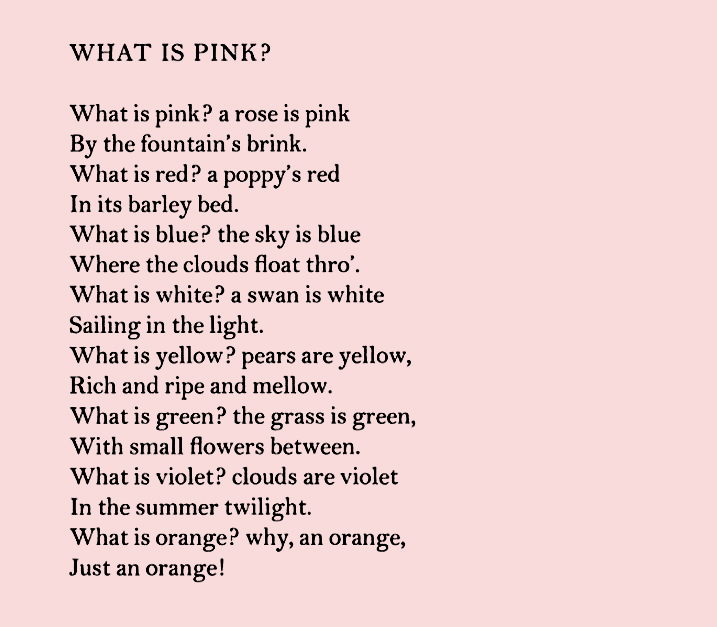
“What Is Pink?” — Christina Rossetti

Capture

“I stole a book” (Clarice Lispector)

The moment her aunt went to pay for her purchases, Joana removed the book and slipped it furtively between the others she was carrying under her arm. Her aunt turned pale.

Once in the street, the woman chose her words carefully:

— Joana.. . Joana, I saw you…

Joana gave her a quick glance. She remained silent.

— But you have nothing to say for yourself? — her aunt could no longer restrain herself, her voice tearful. — Dear God, what is to become of you?

— There’s no need to fuss, Auntie.

— But you’re still a child… Do you realize what you’ve done?

— I know…

— Do you know… do you know what it’s called… ?

— I stole a book, isn’t that what you’re trying to say?

— God help me! I don’t know what I’m going to do, you even have the nerve to own up!

— You forced me to own up.

— Do you think that you can… that you can just go around stealing?

— Well… perhaps not.

— Why do you do it then… ?

— Because I want to.

— You what?

— her aunt exploded.

— That’s right, I stole because I wanted to. I only steal when I feel like it. I’m not doing any harm.

— God help me! So, stealing does no harm, Joana.

— Only if you steal and are frightened. It doesn’t make me feel either happy or sad.

The woman looked at her in despair.

— Look child, you’re growing up, it won’t be long before you’re a young lady… Very soon now you will be wearing your clothes longer… I beg of you: promise me that you won’t do it again, promise me, think of your poor father who is no longer with us.

Joana looked at her inquisitively:

— But I’m telling you I can do what I like, that…

A biblioklept episode from Clarice Lispector’s novel Near to the Wild Heart.


King Lear, Directed by Peter Brook (Full Film)

Dan Brown being humiliated by Herman Melville in a game of crazy golf

Although simply embedding a tweet into a WordPress post and calling that a blog post sets an unfavorable precedent, I cannot not share this.

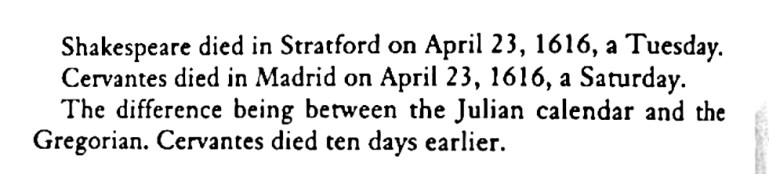
April 23, 1616 (David Markson)

dm


Riff on William Shakespeare

  1. William Shakespeare, the Greatest Living American Author, turns 450 today.
  2. (There may be some, uh, factual, problems with the preceding sentence, but I’ll let it stand).
  3. (After all, to write after Shakespeare requires some gall, a bit of fakery, maybe an outright lie or two).
  4. 450! (Could I even hit 450 points on a riff?)
  5. “Shakespeare invented us,” Harold Bloom repeatedly insists in his big fat book The Western Canon.
  6. (I might be misquoting; the prospect of putting the effort of fact checking into this riff horrifies me).
  7. “Shakespeare—whetting, frustrating, surprising and gratifying,” F. Scott Fitzgerald jotted down in his notebook.
  8. We don’t actually have a record of Shakespeare’s birth, although we do know he was baptized on 26 April 1564.
  9. And died 23 April 1616.
  10. It’s likely that Shakespeare was born on 23 April 1564.
  11. Or, perhaps: There’s something symmetrical, neat, poetic about Shakespeare dying on his birthday.
  12. Ingrid Bergman died on her birthday.
  13. As did Thomas Browne.
  14. As did Yasujrio Ozu.
  15. And, according to tradition: Moses, David, Mohammad.
  16. So why not Shakespeare, born on his deathday?
  17. We want a teleological neatness with Shakespeare: We want his last play to be The Tempest, a tragicomedy that somehow synthesizes all before it; we can claim Prospero a commanding stand-in for Shakespeare.
  18. (These claims overlooking of course that Shakespeare’s last work was likely a forgettable collaboration with John Fletcher, The Two Noble Kinsmen).
  19. The Two Noble Kinsmen was based on Chaucer’s The Knight’s Tale.
  20. (Shakespeare of course “based” his works on other works; the man was not one for original plotting (thank goodness)).
  21. “Chaucer had a deeper knowledge of life than Shakespeare,” claimed Ezra Pound.
  22. “Let the reader contradict that after reading both authors, if he chooses to do so,” he truculently added.
  23. To Coleridge though Shakespeare was “myriad-minded Shakespeare” — Our myriad-minded Shakespeare.
  24. Dryden credited him with “the largest and most comprehensive soul.”
  25. Suggesting also that, “Shakespeare’s magic could not copied be.”
  26. I’m not sure about that.
  27. How many versions of Hamlet have been attempted?
  28. Were not some of these Hamlets magical—magical enough, at least?
  29. Ulysses?
  30. Infinite Jest?
  31. The Lion King?
  32. Oedipus Rex?
  33. David Markson points out somewhere—forgive me for not rising from my fat ass to go verify—that Shakespeare couldn’t possibly have read Sophocles’ Oedipus as there was no English translation yet available.
  34. And how many books did Shakespeare read?
  35. (Chaucer, often credited with a library of sixty).
  36. Speculation, speculation!
  37. Shakespeare Truthers.
  38. Or Anti-Stratfordians—whatever you want to call them.
  39. Walt Whitman was a Shakespeare Truther.
  40. Believing no commoner could write the plays, but “only one of the ‘wolfish earls’ so plenteous in the plays themselves, or some born descendant and knower, might seem to be the true author of those amazing works.”
  41. Amazing that, that Walt Whitman, who could so bombastically conceive himself every man, woman, child, a cosmos, etc.—that he couldn’t credit a commoner with the depth of imagination to produce the plays that Whitman called “greater than anything else in recorded literature.”
  42. David Markson: “Scholars who are convinced that Shakespeare must certainly have been a military man.  Or a lawyer.  Or closely associated with royalty.  Or even a Jew. To which Ellen Terry: Or surely a woman.”
  43. For some Shakespeare Truthers, evidence of his lack of authorship is to be found in the different ways he supposedly signed his name!
  44. Willm Shakp.
  45. William Shakspēr.
  46. Wm Shakspē.
  47. William Shakspere.
  48. Willm Shakspere.
  49. William Shakspeare.
  50. The last of these from his 1616 will, in which he famously bequeathed his second-best bed to his wife Anne Hathaway.
  51. “He was a rich country gentleman, Stephen said, with a coat of arms and landed estate at Stratford and a house in Ireland yard, a capitalist shareholder, a bill promoter, a tithefarmer. Why did he not leave her his best bed if he wished her to snore away the rest of her nights in peace?” Continue reading “Riff on William Shakespeare”

Philosophy of education (Life in Hell)

philosophy of education

Don Quixote — Charles Seliger