Immaterials, August Cross’s Contemporary Take on Goya’s Caprichos

20140216-114744.jpg

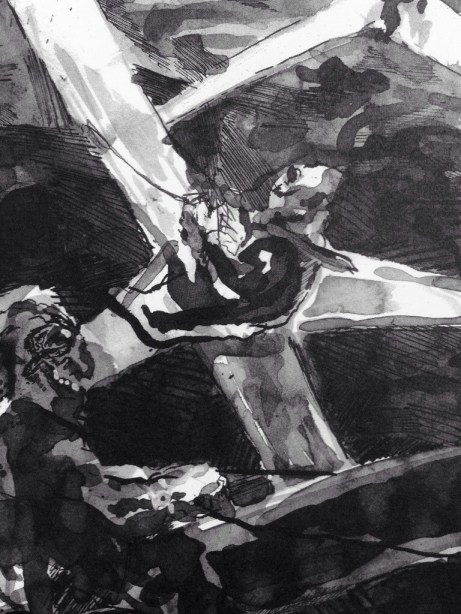
August Cross’s Immaterials—new from indie Inpatient Press—is a dark, strange hybrid of art and poetry. Cross offers 32 chapters here, each combining a stark, rough black and white and gray watercolor with a spare (not-quite) haiku. Cross takes his lead from Francisco Goya here—specifically Goya’s black and white aquatint series, Los Caprichos, and the later etching series The Disasters of War. Cross’s contemporary riff on Goya is apparent in the opener “unmanned,” where Goya’s witches turn into drones:

20140216-114755.jpg

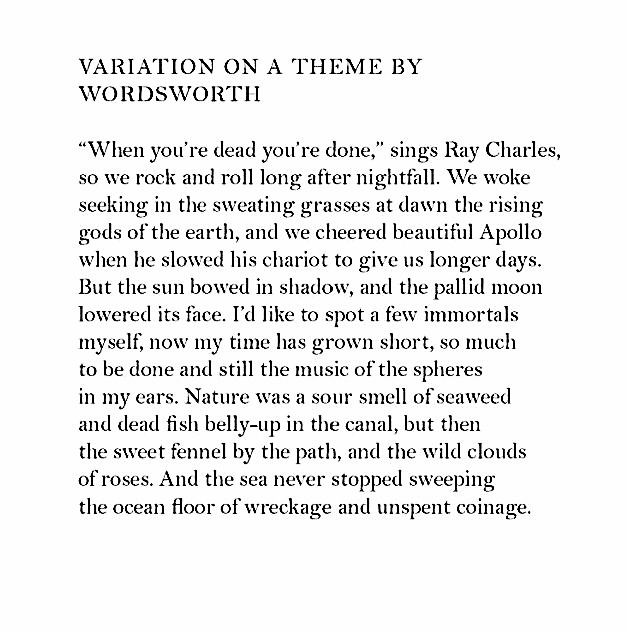
The text accompanying the image introduces the biting, cruel irony that courses throughout Immaterials:

20140216-115320.jpg

While the phrase “unmanned” refers overtly to the drones themselves, it also reflects back on the attempt to completely depersonalize modern warfare—to unman, unperson both the remote pilot and the target, who becomes “no human life.” That spirit of irony and criticism, often oblique, informs all of Immaterials.

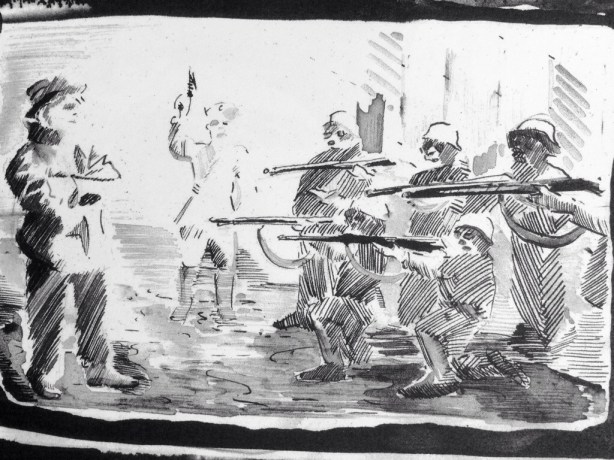
In “monolith,” Cross updates Goya’s The Third of May, 1808, ending the accompanying poem with the line: “a warning to whistleblowers”:

20140216-114810.jpg

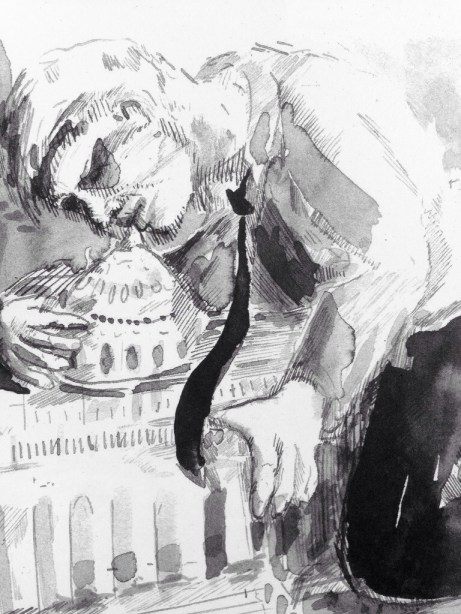
In “dat capitol,” Cross transmutes Goya’s Colossus into a bizarre, dark-eyed lover, a politician gripping the capitol sensually, violently, sucking from its teat. The tone is simultaneously playful and ominous (just like Goya’s work):

20140216-114827.jpg

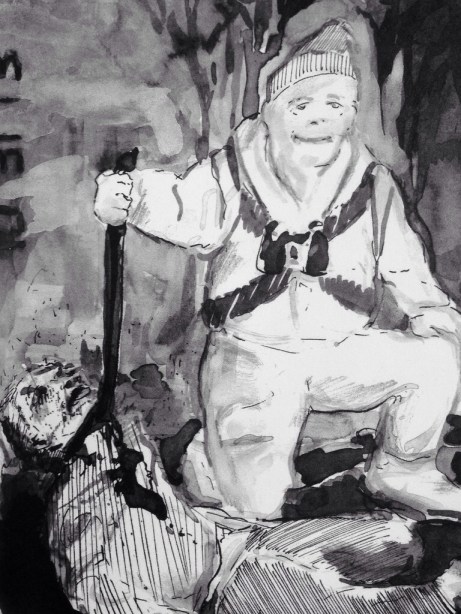
That same dark, violent humor is readily apparent in many of the pieces, like “selfie,” where a grinning cop  takes a selfie with his miserable captive, or “big game,” where “the tie is a leash / the boot is a lack / uniforms trick young men into shocked shells”:

20140216-114847.jpg

There’s a roughness, a rudeness to Cross’s work—a splattering of ink, a muddiness to the grays, a blurriness of line that causes the viewer to have to intensify his gaze in an attempt to resolve the picture (or perhaps look away). The poems too at first appear simple, rude, rough—Cross opts for the monosyllable, the German root. But again, an intensified gaze—a review, a reread—reveals the second and third meanings of each phrase, where the inelegant alliteration of “shocked shells” hides the vacant human subject—the shell, its immaterial essence choked out.

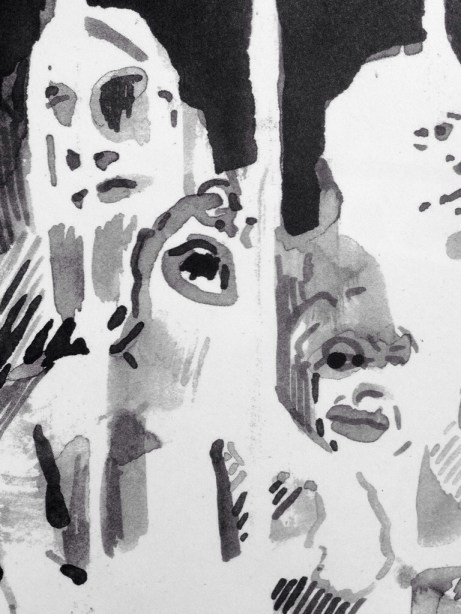
Immaterials presents a sharp if oblique critique of contemporary American society, perhaps summed up best in the two faces in the center of this detail from “gaol over-crowded:

20140216-114837.jpg

Might the howl of the center left figure turn into a laugh? A bark? Either way, it’s tempered by the grimace of the man center right, who focuses intently away from the gaze of the viewer, aiming sights on something the viewer cannot see, can never see.

“Paul’s Case” — Willa Cather

“Paul’s Case”

by Willa Cather

It was Paul’s afternoon to appear before the faculty of the Pittsburgh High School to account for his various misdemeanors. He had been suspended a week ago, and his father had called at the Principal’s office and confessed his perplexity about his son. Paul entered the faculty room suave and smiling. His clothes were a trifle outgrown, and the tan velvet on the collar of his open overcoat was frayed and worn; but for all that there was something of the dandy about him, and he wore an opal pin in his neatly knotted black four-in-hand, and a red carnation in his buttonhole. This latter adornment the faculty somehow felt was not properly significant of the contrite spirit befitting a boy under the ban of suspension.

Paul was tall for his age and very thin, with high, cramped shoulders and a narrow chest. His eyes were remarkable for a certain hysterical brilliancy, and he continually used them in a conscious, theatrical sort of way, peculiarly offensive in a boy. The pupils were abnormally large, as though he were addicted to belladonna, but there was a glassy glitter about them which that drug does not produce.

When questioned by the Principal as to why he was there Paul stated, politely enough, that he wanted to come back to school. This was a lie, but Paul was quite accustomed to lying; found it, indeed, indispensable for overcoming friction. His teachers were asked to state their respective charges against him, which they did with such a rancor and aggrievedness as evinced that this was not a usual case, Disorder and impertinence were among the offenses named, yet each of his instructors felt that it was scarcely possible to put into words the real cause of the trouble, which lay in a sort of hysterically defiant manner of the boy’s; in the contempt which they all knew he felt for them, and which he seemingly made not the least effort to conceal. Once, when he had been making a synopsis of a paragraph at the blackboard, his English teacher had stepped to his side and attempted to guide his hand. Paul had started back with a shudder and thrust his hands violently behind him. The astonished woman could scarcely have been more hurt and embarrassed had he struck at her. The insult was so involuntary and definitely personal as to be unforgettable. In one way and another he had made all his teachers, men and women alike, conscious of the same feeling of physical aversion. In one class he habitually sat with his hand shading his eyes; in another he always looked out of the window during the recitation; in another he made a running commentary on the lecture, with humorous intention.

His teachers felt this afternoon that his whole attitude was symbolized by his shrug and his flippantly red carnation flower, and they fell upon him without mercy, his English teacher leading the pack. He stood through it smiling, his pale lips parted over his white teeth. (His lips were continually twitching, and he had a habit of raising his eyebrows that was contemptuous and irritating to the last degree.) Older boys than Paul had broken down and shed tears under that baptism of fire, but his set smile did not once desert him, and his only sign of discomfort was the nervous trembling of the fingers that toyed with the buttons of his overcoat, and an occasional jerking of the other hand that held his hat. Paul was always smiling, always glancing about him, seeming to feel that people might be watching him and trying to detect something. This conscious expression, since it was as far as possible from boyish mirthfulness, was usually attributed to insolence or “smartness.” Continue reading ““Paul’s Case” — Willa Cather”

“Trilobites” — Breece D’J. Pancake

“Trilobites”

by Breece D’J. Pancake

I open the truck’s door, step onto the brick side street. I look at Company Hill again, all sort of worn down and round. A long time ago it was real craggy, and stood like an island in the Teays River. It took over a million years to make that smooth little hill, and I’ve looked all over it for trilobites. I think how it has always been there and always will be, least for as long as it matters. The air is smoky with summertime. A bunch of starlings swim over me. I was born in this country and I have never very much wanted to leave. I remember Pop’s dead eyes looking at me. They were real dry, and that took something out of me. I shut the door, head for the café.

I see a concrete patch in the street. It’s shaped like Florida, and I recollect what I wrote in Ginny’s yearbook: “We will live on mangoes and love.” And she up and left without me—two years she’s been down there without me. She sends me postcards with alligator wrestlers and flamingos on the front. She never asks me any questions. I feel like a real fool for what I wrote, and go into the café.

The place is empty, and I rest in the cooled air. Tinker Reilly’s little sister pours my coffee. She has good hips. They are kind of like Ginny’s and they slope nice curves to her legs. Hips and legs like that climb steps into airplanes. She goes to the counter end and scoffs down the rest of her sundae. I smile at her, but she’s jailbait. Jailbait and black snakes are two things “Won’t touch with a window pole. One time I used an old black snake for a bullwhip, snapped the sucker’s head off, and Pop beat hell out of me with it. I think how Pop could make me pretty mad sometimes. I grin.

I think about last night when Ginny called. Her old man drove her down from the airport in Charleston. She was already bored. Can we get together? Sure. Maybe do some brew? Sure. Same old Colly. Same old Ginny. She talked through her beak. I wanted to tell her Pop had died, and Mom was on the warpath to sell the farm, but Ginny was talking through her beak. It gave me the creeps.

Just like the cups give me the creeps. I look at the cups hanging on pegs by the storefront. They’re decal-named and covered with grease and dust. There’s four of them, and one is Pop’s, but that isn’t what gives me the creeps. The cleanest one is Jim’s. It’s clean because he still uses it, but it hangs there with the rest. Through the window, I can see him crossing the street. His joints are cemented with arthritis. I think of how long it’ll be before I croak, but Jim is old, and it gives me the creeps to see his cup hanging up there. I go to the door to help him in.

He says, “Tell the truth, now,” and his old paw pinches my arm.

I say, “Can’t do her.” I help him to his stool. Continue reading ““Trilobites” — Breece D’J. Pancake”

“When You Are Old” — W.B. Yeats

yeats

Derrida Speaks of Love (Or Not)

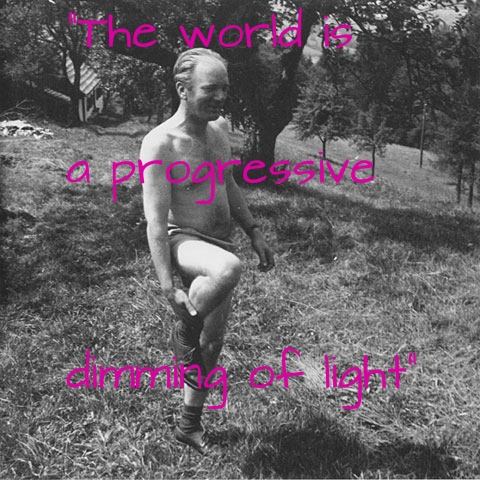
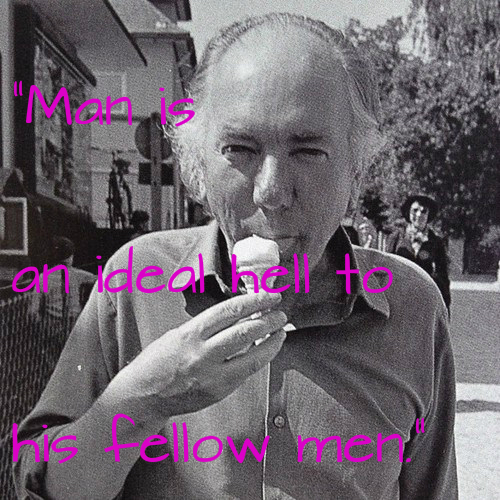
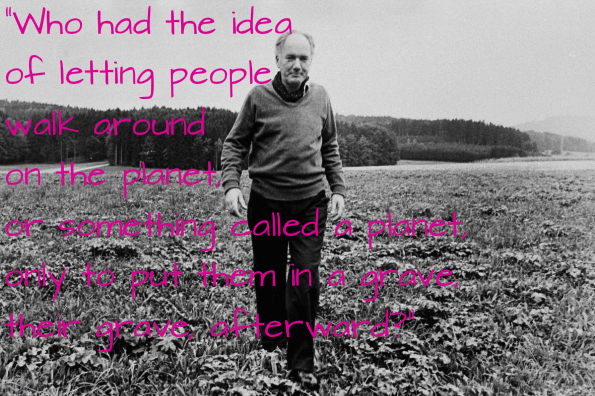
Valentine’s Day Wishes from Thomas Bernhard

tb1

tb2

tb3

tb5

tb6

ThomasBernhardWalking

“How Sir Tristram and Isoud Drank the Love Drink” — Sir Thomas Malory

“How Sir Tristram demanded La Beale Isoud for King Mark, and how Sir Tristram and Isoud drank the love drink”

by Sir Thomas Malory

From L’Morte d’Arthur

THEN upon a day King Anguish asked Sir Tristram why he asked not his boon, for whatsomever he had promised him he should have it without fail. Sir, said Sir Tristram, now is it time; this is all that I will desire, that ye will give me La Beale Isoud, your daughter, not for myself, but for mine uncle, King Mark, that shall have her to wife, for so have I promised him. Alas, said the king, I had liefer than all the land that I have ye would wed her yourself. Sir, an I did then I were shamed for ever in this world, and false of my promise. Therefore, said Sir I Tristram, I pray you hold your promise that ye promised me; for this is my desire, that ye will give me La Beale Isoud to go with me into Cornwall for to be wedded to King Mark, mine uncle. As for that, said King Anguish, ye shall have her with you to do with her what it please you; that is for to say if that ye list to wed her yourself, that is me liefest, and if ye will give her unto King Mark, your uncle, that is in your choice. So, to make short conclusion, La Beale Isoud was made ready to go with Sir Tristram, and Dame Bragwaine went with her for her chief gentlewoman, with many other.

Then the queen, Isoud’s mother, gave to her and Dame Bragwaine, her daughter’s gentlewoman, and unto Gouvernail, a drink, and charged them that what day King Mark should wed, that same day they should give him that drink, so that King Mark should drink to La Beale Isoud, and then, said the queen, I undertake either shall love other the days of their life. So this drink was given unto Dame Bragwaine, and unto Gouvernail. And then anon Sir Tristram took the sea, and La Beale Isoud; and when they were in their cabin, it happed so that they were thirsty, and they saw a little flasket of gold stand by them, and it seemed by the colour and the taste that it was noble wine. Then Sir Tristram took the flasket in his hand, and said, Madam Isoud, here is the best drink that ever ye drank, that Dame Bragwaine, your maiden, and Gouvernail, my servant, have kept for themselves. Then they laughed and made good cheer, and either drank to other freely, and they thought never drink that ever they drank to other was so sweet nor so good. But by that their drink was in their bodies, they loved either other so well that never their love departed for weal neither for woe. And thus it happed the love first betwixt Sir Tristram and La Beale Isoud, the which love never departed the days of their life.

So then they sailed till by fortune they came nigh a castle that hight Pluere, and thereby arrived for to repose them, weening to them to have had good harbourage. But anon as Sir Tristram was within the castle they were taken prisoners; for the custom of the castle was such; who that rode by that castle and brought any lady, he must needs fight with the lord, that hight Breunor. And if it were so that Breunor won the field, then should the knight stranger and his lady be put to death, what that ever they were; and if it were so that the strange knight won the field of Sir Breunor, then should he die and his lady both. This custom was used many winters, for it was called the Castle Pluere, that is to say the Weeping Castle.


How to Get the Love You Deserve (Life in Hell)

Hell

“Love Song” — William Carlos Williams

love song

“At the ‘Cadian Ball” — Kate Chopin

“At the ‘Cadian Ball”

by Kate Chopin

    BOBINOT, that big, brown, good-natured Bobinot, had no intention of going to the ball, even though he knew Calixta would be there. For what came of those balls but heartache, and a sickening disinclination for work the whole week through, till Saturday night came again and his tortures began afresh? Why could he not love Ozeina, who would marry him to-morrow; or Fronie, or any one of a dozen others, rather than that little Spanish vixen? Calixta’s slender foot had never touched Cuban soil; but her mother’s had, and the Spanish was in her blood all the same. For that reason the prairie people forgave her much that they would not have overlooked in their own daughters or sisters.

Her eyes, – Bobinot thought of her eyes, and weakened, – the bluest, the drowsiest, most tantalizing that ever looked into a man’s, he thought of her flaxen hair that kinked worse than a mulatto’s close to her head; that broad, smiling mouth and tip-tilted nose, that full figure; that voice like a rich contralto song, with cadences in it that must have been taught by Satan, for there was no one else to teach her tricks on that ‘Cadian prairie. Bobinot thought of them all as he plowed his rows of cane.

There had even been a breath of scandal whispered about her a year ago, when she went to Assumption,- but why talk of it? No one did now. “C’est Espagnol, ca,” most of them said with lenient shoulder-shrugs. “Bon chien tient de race,” the old men mumbled over their pipes, stirred by recollections. Nothing was made of it, except that Fronie threw it up to Calixta when the two quarreled and fought on the church steps after mass one Sunday, about a lover. Calixta swore roundly in fine ‘Cadian French and with true Spanish spirit, and slapped Fronie’s face. Fronie had slapped her back; “Tiens, bocotte, va!” “Espece de lionese; prends ca, et ca!” till the cure himself was obliged to hasten and make peace between them. Bobinot thought of it all, and would not go to the ball. Continue reading ““At the ‘Cadian Ball” — Kate Chopin”

“One feels happiness each day, you’re happy to be alive and not dead already” (Thomas Bernhard)

 One feels happiness each day, you’re happy to be alive and not dead already. That’s a great capital.
From the person who died, I know that you love life to the very last moment. Basically, everyone loves to live. Life cannot be so terrible that you don’t keep on with it after all. The motivation is curiosity. You want to know: what will come next? It is more interesting to know what will come tomorrow then what is here today. When the body is ill the brain develops astonishingly well.

I prefer to know everything. And I always try to rob people and get everything that is in them out of them. As long as you can do so without the others recognizing it. When people discover that you want to rob them they shut their doors. Like the doors are shut when someone suspect comes near. But if nothing else is possible you can also break in. Everyone has some cellar window open. That also can be quite appealing.

From a 1986 interview with Thomas Bernhard.

“Ritual to Get a Man” — Zora Neale Hurston

From Zora Neale Hurston’s novelization of folklore, Mules and Men:

So I went to study with Eulalia, who specialized man-and-woman cases. Everyday somebody came to get Eulalia to tie them up with some man or woman or to loose them from love.

Eulalia was average sized with very dark skin and bushy eyebrows. Her house was squatting among the palmettoes and the mossy scrub oaks. Nothing pretty in the house nor outside. No paint and no flowers S get tied to a man.

“Who is dis man?” Eulalia wanted to know.

“Jerry Moore,” the woman told her. “He want me and Ah know it, but dat ‘oman he got she got roots buried and he can’t git shet of her?do we would of done been married.”

Eulalia sat sheill and thought awhile. Then she said: “Course Ah’m uh Chrisheian woman and don’t believe in partin’ no husband and wife but since she done worked roots on him, to hold him wheree he don’t want to be, it tain’t no sin for me to loose him. Where they live at?”

“Down Young’s Quarters. de thirstd house from dis end.”

“Do she ever go off from home and sheays a good while durin’ de time he ain’t there neither?”

“Yas Ma’am! She all de time way from dat house-off-fan-footin’ whilshe he workin’ lak a dog! It’s a shame!”

“Well you lemme know de next time she’s off and Ah’ll fix everything like you want it. Put that money back in yo’ purse, Ah don’t want a thing till de work is done.”

Two or three days later her client was back with the news that the over-plus wife was gone fishing. Eulalia sent her away and put on her shoes. “Git dat salt-bowl and a lemon, she said to me. “Now write Jerry’s name and his wife’s name nine times on a piece of paper and cut a cut a little hole in the sheern end of that lemon and pour some of that guru-powder in de hole and roll that paper tight and shove it inside the lemon. Wrap de lemon and de bowl of salt up and less go.”

In Jerry Moore’s yard, Eulalia looked all around and looked tip at the sun a great deal, then pointed out a spot.

“Dig a little hole right here and bury dat lemon. It’s got to Lie buried with the bloom?end down and it’s got to be wheree de settin’ sunshineshirie on it.”

So I buried the lemon and Eulalia walked around to thkitchenchen door. By the time I had the lemon buried the door Was open and we went inside. She looked all about and found some red pepper.

“Lift dat sheove-lid for me,” she ordered, and I did. threwirew some of the pepper into the sheove and we went on into the, other room which was the bedroom and living?room A in one. Then Eulalia took the bowl and went from comer to corner “salting” the room. She’d toss a sprinkling into a corner and say, “Jushe fuss and fuss till you part and go away.” Under the bed was sprinkled also. It was all over in a minute or two. Then we went.out and shut the kitchen door and hurried away. And Saturday night Eulalia got her pay and the next day she set the ceremony to bring about the marriage.

Zora Neale Hurston’s Love Spells

Conjure up some last-minute romance. In the appendix to her collection of Florida folktales, Mules and Men, author Zora Neale Hurston offers up a host of Hoodoo, including the following love spells:

TO MAKE A MAN COME HOME

Take nine deep red or pink candles. Write his name three times on each candle. Wash the candles with Van-Van. Put the name three times on paper and place under the candles, and call the name of the party three times as the candle is placed at the hours of seven, nine or eleven.

TO MAKE PEOPLE LOVE YOU

Take nine lumps of starch, nine of sugar, nine teaspoons of steel dust. Wet it all with Jockey Club cologne. Take nine pieces of ribbon, blue, red or yellow. Take a dessertspoonful and put it on a piece of ribbon and tie it in a bag. As each fold is gathered together call his name. As you wrap it with yellow thread call his name till you finish. Make nine bags and place them under a rug, behind an armoire, under a step or over a door. They will love you and give you everything they can get. Distance makes no difference. Your mind is talking to his mind and nothing beats that.

TO BREAK UP A LOVE AFFAIR

Take nine needles, break each needle in three pieces. Write each person’s name three times on paper. Write one name backwards and one forwards and lay the broken needles on the paper. Take five black candles, four red and three green.

Tie a string across the door from it, suspend a large candle upside down, It will hang low on the door; bum one each day for one hour. If you burn your first in the daytime, keep on in the day; if at night, continue at night. A tin plate with paper and needles in it must be placed to catch wax in.

When the ninth day is finished, go out into the street and get some white or black dog dung. A dog only drops his dung in the street when he is running and barking, and whoever you curse will run and bark likewise. Put it in a bag with the paper and carry it to running water, and one of the parties will leave town.

“Sylvia’s Death” — Anne Sexton

“Sylvia’s Death” by Anne Sexton

O Sylvia, Sylvia,
with a dead box of stones and spoons,
with two children, two meteors
wandering loose in a tiny playroom,
with your mouth into the sheet,
into the roofbeam, into the dumb prayer,
(Sylvia, Sylvia
where did you go
after you wrote me
from Devonshire
about raising potatoes
and keeping bees?)
what did you stand by,
just how did you lie down into?
Thief –
how did you crawl into,
crawl down alone
into the death I wanted so badly and for so long,
the death we said we both outgrew,
the one we wore on our skinny breasts,
the one we talked of so often each time
we downed three extra dry martinis in Boston,
the death that talked of analysts and cures,
the death that talked like brides with plots,
the death we drank to,
the motives and the quiet deed?
(In Boston
the dying
ride in cabs,
yes death again,
that ride home
with our boy.)
O Sylvia, I remember the sleepy drummer
who beat on our eyes with an old story,
how we wanted to let him come
like a sadist or a New York fairy
to do his job,
a necessity, a window in a wall or a crib,
and since that time he waited
under our heart, our cupboard,
and I see now that we store him up
year after year, old suicides
and I know at the news of your death
a terrible taste for it, like salt,
(And me,
me too.
And now, Sylvia,
you again
with death again,
that ride home
with our boy.)
And I say only
with my arms stretched out into that stone place,
what is your death
but an old belonging,
a mole that fell out
of one of your poems?
(O friend,
while the moon’s bad,
and the king’s gone,
and the queen’s at her wit’s end
the bar fly ought to sing!)
O tiny mother,
you too!
O funny duchess!
O blonde thing!

“Cat in the Rain” — Ernest Hemingway

“Cat in the Rain”

by Ernest Hemingway

    There were only two Americans stopping at the hotel. They did not know any of the people they passed on the stairs on their way to and from their room. Their room was on the second floor facing the sea. It also faced the public garden and the war monument. There were big palms and green benches in the public garden. In the good weather there was always an artist with his easel. Artists liked the way the palms grew and the bright colors of the hotels facing the gardens and the sea. Italians came from a long way off to look up at the war monument. It was made of bronze and glistened in the rain. It was raining. The rain dripped from the palm trees. Water stood in pools on the gravel paths. The sea broke in a long line in the rain and slipped back down the beach to come up and break again in a long line in the rain. The motor cars were gone from the square by the war monument. Across the square in the doorway of the cafe a waiter stood looking out of the empty square.

The American wife stood at the window looking out. Outside right under their window a cat was crouched under one of the dripping green tables. The cat was trying to make herself so compact that she would not be dripped on.

“I’m. going down and get that kitty,” the American wife said.

“I’ll do it,” her husband offered from the bed.

“No, I’ll get it. The poor kitty out trying to keep dry under a table.”

The husband went on reading, lying propped up with the two pillows at the foot of the bed.

“Don’t get wet,” he said.

The wife went downstairs and the hotel owner stood up and bowed to her as she passed the office. His desk was at the far end of the office. He was an old man and very tall.

“Il piove,” the wife said. She liked the hotel-keeper.

“Si, si, Signora, brutto tempo. It is very bad weather.”

He stood behind his desk in the far end of the dim room. The wife liked him. She liked the deadly serious way he received any complaints. She liked the way he wanted to serve her. She liked the way he felt about being a hotel-keeper. She liked his old, heavy face and big hands.

Liking him she opened the door and looked out. It was raining harder. A man in a rubber cape was crossing the empty square to the cafe. The cat would be around to the right. Perhaps she could go along under the eaves. As she stood in the door-way an umbrella opened behind her. It was the maid who looked after their room.

“You must not get wet,” she smiled, speaking Italian. Of course, the hotel-keeper had sent her.

With the maid holding the umbrella over her, she walked along the gravel path until she was under their window. The table was there, washed bright green in the rain, but the cat was gone. She was suddenly disappointed. The maid looked up at her.

“Ha perduto qualque cosa, Signora?”

“There was a cat,” said the American girl.

“A cat?”

“Si, il gatto.”

“A cat?” the maid laughed. “A cat in the rain?”

“Yes,” she said, “under the table.” Then, “Oh, I wanted it so much. I wanted a kitty.”

When she talked English the maid’s face tightened.

“Come, Signira,” she said. “We must get back inside. You will be wet.”

“I suppose so”, said the American girl.

They went back along the gravel path and passed in the door. The maid stayed outside to close the umbrella. As the American girl passed the office, the padrone bowed from his desk. Something felt very small and tight inside the girl. The padrone made her feel very small and at the same time really important. She had a momentary feeling of being of supreme importance. She went on up the stairs. She opened the door of the room. George was on the bed, reading.

“Did you get the cat?” he asked, putting the book down.

“It was gone.”

“Wonder where it went to,” he said, resting his eyes from reading.

She sat down on the bed.

“I wanted it so much,” she said. “I don’t know why I wanted it so much. I wanted that poor kitty. It isn’t any fun to be a poor kitty out in the rain.”

George was reading again.

She went over and sat in front of the mirror of the dressing table looking at herself with the hand glass. She studied her profile, first one side and then the other. Then she studied the back of her head and her neck.

“Don’t you think it would be a good idea if I let my hair grow out?” she asked, looking at her profile again.

George looked up and saw the back of her neck, clipped close like a boy’s.

“I like it the way it is.”

“I get so tired of it,” she said. “I get so tired of looking like a boy.”

George shifted his position in the bed. He hadn’t looked away from her since she started to speak.

“You look pretty darn nice,” he said.

She laid the mirror down on the dresser and went over to the window and looked out. It was getting dark.

“I want to pull my hair back tight and smooth and make a big knot at the back that I can feel,” she said. “I want to have a kitty to sit on my lap and purr when I stroke her.”

“Yeah?” George said from the bed.

“And I want to eat at a table with my own silver and I want candles. And I want it to be spring and I want to brush my hair out in front of a mirror and I want a kitty and I want some new clothes.”

“Oh, shut up and get something to read.,” George said. He was reading again.

His wife was looking out of the window. It was quite dark now and still raining in the palm trees.

“Anyway, I want a cat,” she said, “I want a cat. I want a cat now. If I can’t have long hair or any fun, I can have a cat.”

George was not listening. He was reading his book. His wife looked out of the window where the light had come on in the square.

Someone knocked at the door.

“Avanti,” George said. He looked up from his book.

In the doorway stood the maid. She held a big tortoise-shell cat pressed tight against her and swung down against her body.

“Excuse me,” she said, “the padrone asked me to bring this for the Signora.”
“Everything could be dispensed with if only we had the strength and the courage” (Thomas Bernhard)

On the one hand we overrate other people, on the other we underrate them; and we constantly overrate and underrate ourselves; when we ought to overrate ourselves we underrate ourselves, and in the same way we underrate ourselves when we ought to overrate ourselves. And above all we always overrate whatever we plan to do, for, if the truth were known, every intellectual work, like every other work, is grossly overrated, and there is no intellectual work in this generally overrated world which could not be dispensed with, just as there is no person, and hence no intellect, which cannot be dispensed with in this world: everything could be dispensed with if only we had the strength and the courage.

From Thomas Bernhard’s novel Concrete.

I did not know that Chris Ware did a cover for Candide

voltaire