“That Evening Sun” — William Faulkner

“That Evening Sun”

by William Faulkner

I

Monday is no different from any other week day in Jefferson now. The streets are paved now, and the telephone and the electric companies are cutting down more and more of the shade trees – the water oaks, the maples and locusts and elms – to make room for iron poles bearing clusters of bloated and ghostly and bloodless grapes, and we have a city laundry which makes the rounds on Monday morning, gathering the bundles of clothes into bright-colored, specially made motor-cars: the soiled wearing of a whole week now flees apparition-like behind alert and irritable electric horns, with a long diminishing noise of rubber and asphalt like a tearing of silk, and even the Negro women who still take in white peoples’ washing after the old custom, fetch and deliver it in automobiles.

But fifteen years ago, on Monday morning the quiet, dusty, shady streets would be full of Negro women with, balanced on their steady turbaned heads, bundles of clothes tied up in sheets, almost as large as cotton bales, carried so without touch of hand between the kitchen door of the white house and the blackened wash-pot beside a cabin door in Negro Hollow.

Nancy would set her bundle on the top of her head, then upon the bundle in turn she would set the black straw sailor hat which she wore winter and summer. She was tall, with a high, sad face sunken a little where her teeth were missing. Sometimes we would go a part of the way down the lane and across the pasture with her, to watch the balanced bundle and the hat that never bobbed nor wavered, even when she walked down into the ditch and climbed out again and stooped through the fence. She would go down on her hands and knees and crawl through the gap, her head rigid, up-tilted, the bundle steady as a rock or a balloon, and rise to her feet and go on.

Sometimes the husbands of the washing women would fetch and deliver the clothes, but Jubah never did that for Nancy, even before father told him to stay away from our house, even when Dilsey was sick and Nancy would come to cook for us. Continue reading ““That Evening Sun” — William Faulkner”

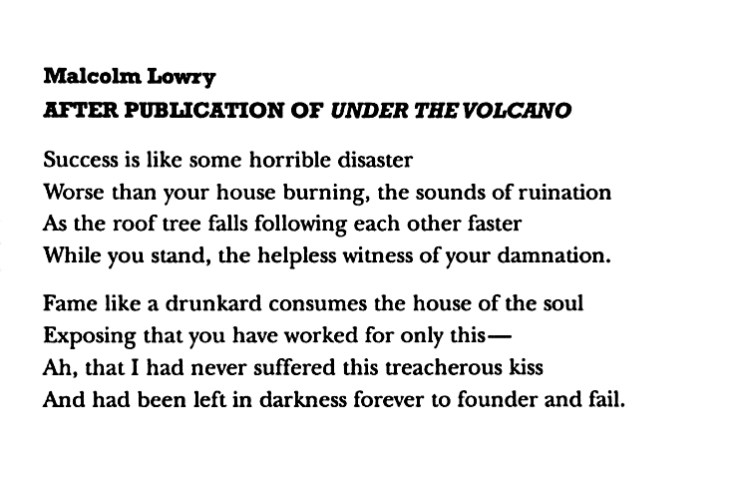
“After Publication of Under the Volcano” — Malcolm Lowry

ml

Seven Plots from Nathaniel Hawthorne’s Note-Books

  1. An article to be made of telling the stories of the tiles of an old-fashioned chimney-piece to a child.
  2. A person conscious that he was soon to die, the humor in which he would pay his last visit to familiar persons and things.
  3. A description of the various classes of hotels and taverns, and the prominent personages in each. There should be some story connected with it,–as of a person commencing with boarding at a great hotel, and gradually, as his means grew less, descending in life, till he got below ground into a cellar.
  4. A person to be in the possession of something as perfect as mortal man has a right to demand; he tries to make it better, and ruins it entirely.
  5. A person to spend all his life and splendid talents in trying to achieve something naturally impossible,–as to make a conquest over Nature.
  6. Meditations about the main gas-pipe of a great city,–if the supply were to be stopped, what would happen? How many different scenes it sheds light on? It might be made emblematical of something.
  7. A fairy tale about chasing Echo to her hiding-place. Echo is the voice of a reflection in a mirror.

from Nathaniel Hawthorne’s American Note-Books.


An Excerpt From The Chapter “Mycobacterium tuberculosis” in Reiner Stach’s Kafka: The Years of Inight

tumblr_my52p06mUb1qzst69o1_1280


They had a difficult time with Kafka. His statements about the dangerous illness seem oddly self-assured, sensory, and at times downright theatrical, even to modern readers who have internalized the paradoxical forms of expression of literary modernity. But when we look over the correspondence of that little circle, it seems equally odd that Brod, Weltsch, and Baum had not developed any real feeling for Kafka’s psychological volatility after more than a decade of close personal contact, or understood his vulnerable, literally exposed life and his sense of reality, maintained in spite of it all. This sense of reality was what told him what to do and what not to do for his illness. But it was a far more basic need, over which he had little control, that compelled him to derive meaning from what had happened.

Continue reading “An Excerpt From The Chapter “Mycobacterium tuberculosis” in Reiner Stach’s Kafka: The Years of Inight”

“A Pair of Silk Stockings” — Kate Chopin

“A Pair of Silk Stockings”

by Kate Chopin

Little Mrs. Sommers one day found herself the unexpected possessor of fifteen dollars. It seemed to her a very large amount of money, and the way in which it stuffed and bulged her worn old porte-monnaie gave her a feeling of importance such as she had not enjoyed for years.

The question of investment was one that occupied her greatly. For a day or two she walked about apparently in a dreamy state, but really absorbed in speculation and calculation. She did not wish to act hastily, to do anything she might afterward regret. But it was during the still hours of the night when she lay awake revolving plans in her mind that she seemed to see her way clearly toward a proper and judicious use of the money.

A dollar or two should be added to the price usually paid for Janie’s shoes, which would insure their lasting an appreciable time longer than they usually did. She would buy so and so many yards of percale for new shirt waists for the boys and Janie and Mag. She had intended to make the old ones do by skilful patching. Mag should have another gown. She had seen some beautiful patterns, veritable bargains in the shop windows. And still there would be left enough for new stockings—two pairs apiece—and what darning that would save for a while! She would get caps for the boys and sailor-hats for the girls. The vision of her little brood looking fresh and dainty and new for once in their lives excited her and made her restless and wakeful with anticipation.

The neighbors sometimes talked of certain “better days” that little Mrs. Sommers had known before she had ever thought of being Mrs. Sommers. She herself indulged in no such morbid retrospection. She had no time—no second of time to devote to the past. The needs of the present absorbed her every faculty. A vision of the future like some dim, gaunt monster sometimes appalled her, but luckily to-morrow never comes.

Mrs. Sommers was one who knew the value of bargains; who could stand for hours making her way inch by inch toward the desired object that was selling below cost. She could elbow her way if need be; she had learned to clutch a piece of goods and hold it and stick to it with persistence and determination till her turn came to be served, no matter when it came.

But that day she was a little faint and tired. She had swallowed a light luncheon—no! when she came to think of it, between getting the children fed and the place righted, and preparing herself for the shopping bout, she had actually forgotten to eat any luncheon at all!

She sat herself upon a revolving stool before a counter that was comparatively deserted, trying to gather strength and courage to charge through an eager multitude that was besieging breastworks of shirting and figured lawn. An all-gone limp feeling had come over her and she rested her hand aimlessly upon the counter. She wore no gloves. By degrees she grew aware that her hand had encountered something very soothing, very pleasant to touch. She looked down to see that her hand lay upon a pile of silk stockings. A placard near by announced that they had been reduced in price from two dollars and fifty cents to one dollar and ninety-eight cents; and a young girl who stood behind the counter asked her if she wished to examine their line of silk hosiery. She smiled, just as if she had been asked to inspect a tiara of diamonds with the ultimate view of purchasing it. But she went on feeling the soft, sheeny luxurious things—with both hands now, holding them up to see them glisten, and to feel them glide serpent-like through her fingers.

Two hectic blotches came suddenly into her pale cheeks. She looked up at the girl.

“Do you think there are any eights-and-a-half among these?”

There were any number of eights-and-a-half. In fact, there were more of that size than any other. Here was a light-blue pair; there were some lavender, some all black and various shades of tan and gray. Mrs. Sommers selected a black pair and looked at them very long and closely. She pretended to be examining their texture, which the clerk assured her was excellent.

“A dollar and ninety-eight cents,” she mused aloud. “Well, I’ll take this pair.” She handed the girl a five-dollar bill and waited for her change and for her parcel. What a very small parcel it was! It seemed lost in the depths of her shabby old shopping-bag.

Mrs. Sommers after that did not move in the direction of the bargain counter. She took the elevator, which carried her to an upper floor into the region of the ladies’ waiting-rooms. Here, in a retired corner, she exchanged her cotton stockings for the new silk ones which she had just bought. She was not going through any acute mental process or reasoning with herself, nor was she striving to explain to her satisfaction the motive of her action. She was not thinking at all. She seemed for the time to be taking a rest from that laborious and fatiguing function and to have abandoned herself to some mechanical impulse that directed her actions and freed her of responsibility.

How good was the touch of the raw silk to her flesh! She felt like lying back in the cushioned chair and reveling for a while in the luxury of it. She did for a little while. Then she replaced her shoes, rolled the cotton stockings together and thrust them into her bag. After doing this she crossed straight over to the shoe department and took her seat to be fitted.

She was fastidious. The clerk could not make her out; he could not reconcile her shoes with her stockings, and she was not too easily pleased. She held back her skirts and turned her feet one way and her head another way as she glanced down at the polished, pointed-tipped boots. Her foot and ankle looked very pretty. She could not realize that they belonged to her and were a part of herself. She wanted an excellent and stylish fit, she told the young fellow who served her, and she did not mind the difference of a dollar or two more in the price so long as she got what she desired.

It was a long time since Mrs. Sommers had been fitted with gloves. On rare occasions when she had bought a pair they were always “bargains,” so cheap that it would have been preposterous and unreasonable to have expected them to be fitted to the hand.

Now she rested her elbow on the cushion of the glove counter, and a pretty, pleasant young creature, delicate and deft of touch, drew a long-wristed “kid” over Mrs. Sommers’s hand. She smoothed it down over the wrist and buttoned it neatly, and both lost themselves for a second or two in admiring contemplation of the little symmetrical gloved hand. But there were other places where money might be spent.

There were books and magazines piled up in the window of a stall a few paces down the street. Mrs. Sommers bought two high-priced magazines such as she had been accustomed to read in the days when she had been accustomed to other pleasant things. She carried them without wrapping. As well as she could she lifted her skirts at the crossings. Her stockings and boots and well fitting gloves had worked marvels in her bearing—had given her a feeling of assurance, a sense of belonging to the well-dressed multitude.

She was very hungry. Another time she would have stilled the cravings for food until reaching her own home, where she would have brewed herself a cup of tea and taken a snack of anything that was available. But the impulse that was guiding her would not suffer her to entertain any such thought.

There was a restaurant at the corner. She had never entered its doors; from the outside she had sometimes caught glimpses of spotless damask and shining crystal, and soft-stepping waiters serving people of fashion.

When she entered her appearance created no surprise, no consternation, as she had half feared it might. She seated herself at a small table alone, and an attentive waiter at once approached to take her order. She did not want a profusion; she craved a nice and tasty bite—a half dozen blue-points, a plump chop with cress, a something sweet—a creme-frappee, for instance; a glass of Rhine wine, and after all a small cup of black coffee.

While waiting to be served she removed her gloves very leisurely and laid them beside her. Then she picked up a magazine and glanced through it, cutting the pages with a blunt edge of her knife. It was all very agreeable. The damask was even more spotless than it had seemed through the window, and the crystal more sparkling. There were quiet ladies and gentlemen, who did not notice her, lunching at the small tables like her own. A soft, pleasing strain of music could be heard, and a gentle breeze, was blowing through the window. She tasted a bite, and she read a word or two, and she sipped the amber wine and wiggled her toes in the silk stockings. The price of it made no difference. She counted the money out to the waiter and left an extra coin on his tray, whereupon he bowed before her as before a princess of royal blood.

There was still money in her purse, and her next temptation presented itself in the shape of a matinee poster.

It was a little later when she entered the theatre, the play had begun and the house seemed to her to be packed. But there were vacant seats here and there, and into one of them she was ushered, between brilliantly dressed women who had gone there to kill time and eat candy and display their gaudy attire. There were many others who were there solely for the play and acting. It is safe to say there was no one present who bore quite the attitude which Mrs. Sommers did to her surroundings. She gathered in the whole—stage and players and people in one wide impression, and absorbed it and enjoyed it. She laughed at the comedy and wept—she and the gaudy woman next to her wept over the tragedy. And they talked a little together over it. And the gaudy woman wiped her eyes and sniffled on a tiny square of filmy, perfumed lace and passed little Mrs. Sommers her box of candy.

The play was over, the music ceased, the crowd filed out. It was like a dream ended. People scattered in all directions. Mrs. Sommers went to the corner and waited for the cable car.

A man with keen eyes, who sat opposite to her, seemed to like the study of her small, pale face. It puzzled him to decipher what he saw there. In truth, he saw nothing-unless he were wizard enough to detect a poignant wish, a powerful longing that the cable car would never stop anywhere, but go on and on with her forever.
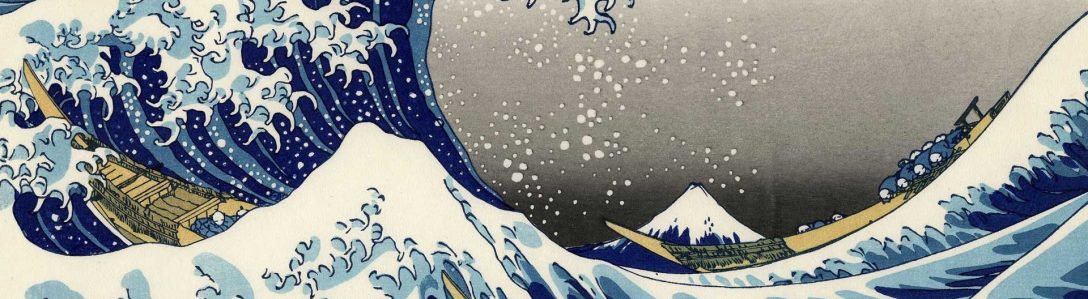
 

Tribute to Jules Verne — Paul Delvaux

“Allegories” — Voltaire

“Allegories”

From Voltaire’s Philosophical Dictionary

Jupiter, Neptune, and Mercury, travelling one day in Thrace, called on a certain king named Hyreus, who entertained them very handsomely. After eating a good dinner, they asked him if they could render him any service. The good man, who was past the age at which it is usual for men to have children, told them he should be very much obliged to them if they would make him a boy. The three gods then urinated on the skin of a new flayed ox; and from these sprang Orion, who became one of the constellations known to the most remote antiquity. This constellation was named Orion by the ancient Chaldæans; it is spoken of in the Book of Job. It would be hard to discover a rational allegory in this pretty story, unless we are to infer from it that nothing was impossible to the gods.

There were in Greece two young rakes, who were told by the oracle to beware of the melampygos or sable posteriors. One day Hercules took them and tied them by the feet to the end of his club, so that they hung down his back with their heads downward, like a couple of rabbits, having a full view of his person. “Ah!” said they; “the oracle is accomplished; this is the melampygos.” Hercules fell alaughing, and let them go. Here again it would be rather difficult to divine the moral sense.

Among the fathers of mythology there were some who had only imagination; but the greater part of them possessed understandings of no mean order. Not all our academies, not all our makers of devices, not even they who compose the legends for the counters of the royal treasury, will ever invent allegories more true, more pleasing, or more ingenious, than those of the Nine Muses, of Venus, the Graces, the God of Love, and so many others, which will be the delight and instruction of all ages.

The ancients, it must be confessed, almost always spoke in allegories. The earlier fathers of the church, the greater part of whom were Platonists, imitated this method of Plato’s. They have, indeed, been reproached with having carried this taste for allegories and allusions a little too far.

St. Justin, in his “Apology,” says that the sign of the cross is marked in the limbs and features of man; that when he extends his arms there is a perfect cross; and that his nose and eyes form a cross upon his face.

According to Origen’s explanation of Leviticus, the fat of the victims signifies the Church, and the tail is a symbol of perseverance.

St. Augustine, in his sermon on the difference and agreement of the two genealogies of Christ, explains to his auditors why St. Matthew, although he reckons forty-two generations, enumerates only forty-one. It is, says he, because Jechonias must be reckoned twice, Jechonias having gone from Jerusalem to Babylon. This journey is to be considered as the corner-stone; and if the corner-stone is the first of one side of a building, it is also the first of the other side; consequently this stone must be reckoned twice; and therefore Jechonias must be reckoned twice. He adds that, in the forty-two generations, we must dwell on the number forty, because that number signifies life. The number ten denotes blessedness, and ten multiplied by four, which represents the four elements and the four seasons, produces forty.

In his fifty-third sermon, the dimensions of matter have astonishing properties. Breadth is the dilation of the heart, length is long-suffering, height is hope, and depth is faith. So that, besides the allegory, we have four dimensions of matter instead of three.

It is clear and indubitable (says he in his sermon on the 6th psalm) that the number four denotes the human body, because of the four elements, and the four qualities of hotcoldmoist, and dry; and as four relates to the body, so three relates to the soul; for we must love God with a triple love—with all our hearts with all our souls, and with all our mindsFour also relates to the Old Testament, and three to the New. Four and threemake up the number of seven days, and the eight is the day of judgment.

One cannot but feel that there is in these allegories an affectation but little compatible with true eloquence. The fathers, who sometimes made use of these figures, wrote in times and countries in which nearly all the arts were degenerating. Their learning and fine genius were warped by the imperfections of the age in which they lived. St. Augustine is not to be respected the less for having paid this tribute to the bad taste of Africa and the fourth century.

The discourses of our modern preachers are not disfigured by similar faults. Not that we dare prefer them to the fathers; but the present age is to be preferred to the ages in which they wrote. Eloquence, which became more and more corrupted, and was not revived until later times, fell, after them, into still greater extravagances; and the languages of all barbarous nations were alike ridiculous until the age of Louis XIV. Look at all the old collections of sermons; they are far below the dramatic pieces of the Passion, which used to be played at the Hôtel de Bourgogne. But the spirit of allegory, which has never been lost, may be traced throughout these barbarous discourses. The celebrated Ménot, who lived in the reign of Francis I., did more honor, perhaps, than any other to the allegorical style. “The worthy administrators of justice,” said he, “are like a cat set to take care of a cheese, lest it should be gnawed by the mice. One bite of the cat does more damage to the cheese than twenty mice can do.”

Here is another very curious passage: “The woodmen, in a forest, cut large and small branches, and bind them in faggots; just so do our ecclesiastics, with dispensations from Rome, heap together great and small benefices. The cardinal’s hat is garnished with bishoprics, the bishoprics are garnished with abbeys and priories, and the whole is garnished with devils. All these church possessions must pass through the three links of the Ave Maria; for benedicta tu stands for fat abbeys of Benedictines, in mulieribus for monsieur and madame, and fructus ventris for banquets and gormandizers.”

The sermons of Barlet and Maillard are all framed after this model, and were delivered half in bad Latin, and half in bad French. The Italian sermons were in the same taste; and the German were still worse. This monstrous medley gave birth to the macaroni style, the very climax of barbarism. The species of oratory, worthy only of the Indians on the banks of the Missouri, prevailed even so lately as the reign of Louis XIII. The Jesuit Garasse, one of the most distinguished enemies of common sense, never preached in any other style. He likened the celebrated Theophile to a calf, because Theophile’s family name was Viaud, something resembling veau (a calf). “But,” said he, “the flesh of a calf is good to roast and to boil, whereas thine is good for nothing but to burn.”

All these allegories, used by our barbarians, fall infinitely short of those employed by Homer, Virgil, and Ovid, which proves that if there be still some Goths and Vandals who despise ancient fable they are not altogether in the right.

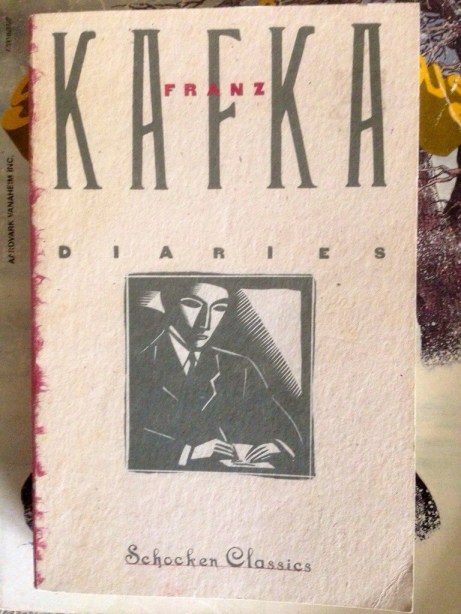
Kafka/Cerebus (Books Acquired, 1.31.2014 + Bonus Circumcision Anecdote)

20140207-154015.jpg

Picked up books last week, not needing them, but hey.

A digest of Kafka’s diaries; good stuff, great random reading.

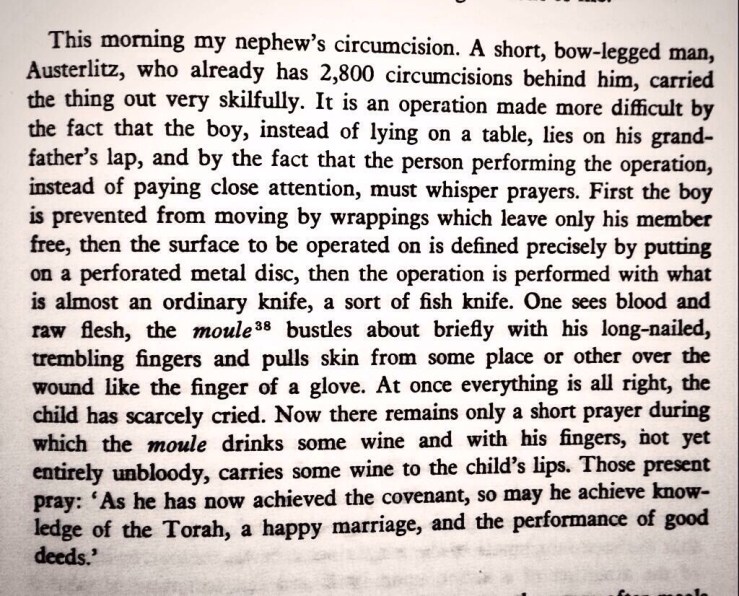
This is a great little anecdote:

20140207-154023.jpg

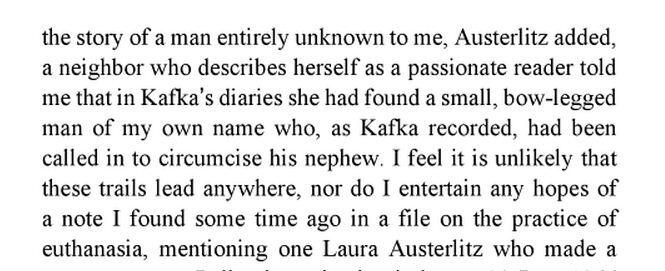
Austerlitz is of course the name of a W.G. Sebald novel. From that novel:

20140207-154029.jpg

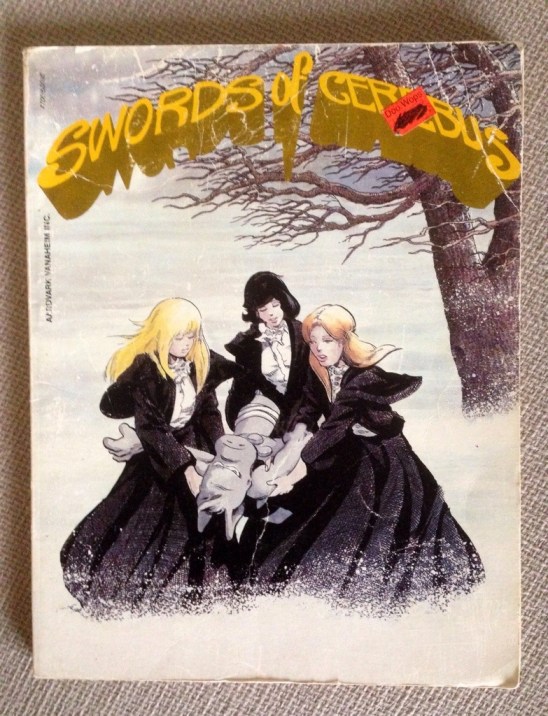
I also picked up the sixth issue of Swords of Cerebus by Dave Sim. It’s a second printing and in terrible shape and I already have the issues in other forms (reprint and graphic novel) but it’s still a pretty rare find. And I am a nerd.

20140207-154036.jpg

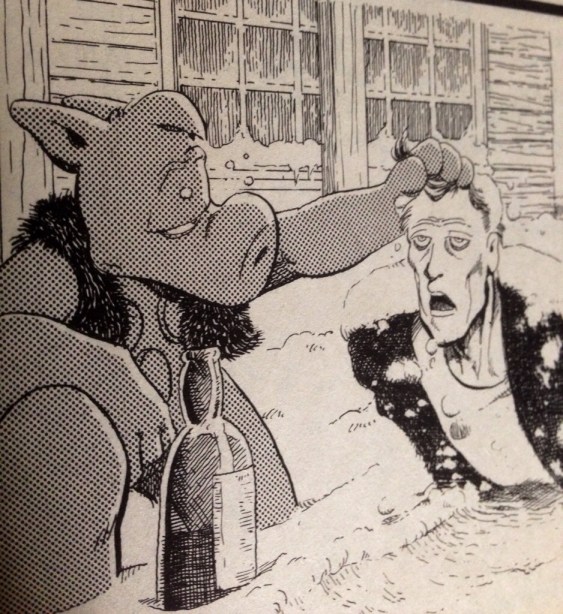
The book also includes a short little excellent wordless comic, “A Night on the Town,” where Cerebus parties with a corpse. I have the reprint somewhere else, but still:

20140207-154043.jpg

“Our Friend Judith” — Doris Lessing

“Our Friend Judith”

by Doris Lessing

I stopped inviting Judith to meet people when a Canadian woman remarked, with the satisfied fervour of one who has at last pinned a label on a rare specimen: “She is, of course, one of your typical English spinsters.”

This was a few weeks after an American sociologist, having elicited from Judith the facts that she was fortyish, unmarried and living alone, had enquired of me: “I suppose she has given up?” “Given up what?” I asked: and the subsequent discussion was unrewarding.

Judith did not easily come to parties. She would come after pressure, not so much-on felt-to do one a favour, but in order to correct what she believed to be a defect in her character. “I really ought to enjoy meeting new people more than I do,” she said once. We reverted to an earlier pattern of our friendship: odd evenings together, an occasional visit to the cinema, or she would telephone to say: “I’m on my way past you to the British Museum . Would you care for a cup of coffee with me? I have twenty minutes to spare.”

It is characteristic of Judith that the word spinster, used of her, provoked fascinated speculation about other people. There are my aunts for instance: aged seventy-odd, both unmarried, one an ex-missionary from China, one a retired matron of a famous London hospital. These two ladies live together under the shadow of the cathedral in a country town. They devote much time to the Church to good causes, to letter writing with friends all over the world, to the grandchildren and the great-grandchildren of relatives. It would be a mistake, however, on entering a house in which nothing has been moved for fifty years, to diagnose a condition of fossilized late-Victorian integrity. They read every book reviewed in the Observer or the Times, so that I recently got a letter from Aunt Rose enquiring whether I did not think that he author of On the Road was not-perhaps?-exaggerating his difficulties. They know a good deal about music, and write letters of encouragement to young composers they feel are being neglected!– “You must understand that anything new and original takes time to be understood.” Well-informed and critical Tories, they are as likely to dispatch telegrams of protest to the Home Secretary as letters of support. These ladies, my aunts Emily and Rose, are surely what is meant by the phrase English spinster. And yet, once the connection has been pointed out, there is no doubt that Judith and they are spiritual cousins, if not sisters. Therefore it follows that one’s pitying admiration for women who have supported manless and uncomforted lives needs a certain modification? Continue reading ““Our Friend Judith” — Doris Lessing”

“Life Is Motion” — Wallace Stevens

life

“William S. Burroughs was a high modernist and a writer of complete trash”

William S. Burroughs was a high modernist and a writer of complete trash; the two are by no means mutually exclusive. He was a genius and a bullshit artist. If his books prove anything, it’s that profundity and inanity can skip along merrily arm in arm. Sometimes his work was heavyweight, sometimes dumb. To borrow a Freudian analogy, sometimes a cigar really is just a cigar and sometimes a man who taught his asshole to talk really is just a man who taught his asshole how to talk (what it’s saying and why is a different story). The paradox of the freest writer being a lifelong junky is really no paradox at all. As a user and pedlar, he understood the mechanics of how it all worked and kindly pointed it out to us, even as he was picking our pockets. He was a stiff morose patrician figure in a suit (so much so his friend Herbert Huncke initially took him for an undercover agent) with books and a history full of debauchery and depravity. If there seems a contradiction there, it’s in the eye of the beholder. What makes Burroughs’ work seem prophetic is that he was perceptive enough to see that people don’t change, the secret to all successful prophecies. We’re still continually re-enacting Greek myths on a daily basis and always will. Psychosis may mirror the zeitgeist (whether it’s paranoia of witches, Jews, communists, drug fiends, Islamists or whoever next) but its essential character doesn’t alter. The bugs and the feds are always with us and there’s only so much one man can do, calling door to door with an extermination kit.

From Darran Anderson’s insightful and thorough essay “The Third Man: William Burroughs at 100.”

“A Still Moment” — Eudora Welty

“A Still Moment”

by Eudora Welty

Lorenzo Dow rode the Old Natchez Trace at top speed upon a race horse, and the cry of the itinerant Man of God, “I must have souls! And souls I must have!” rang in his own windy ears. He rode as if never to stop, toward his night’s appointment.

It was the hour of sunset. All the souls that he had saved and all those he had not took dusky shapes in the mist that hung between the high banks, and seemed by their great number and density to block his way, and showed no signs of melting or changing back into mist, so that he feared his passage was to be difficult forever. The poor souls that were not saved were darker and more pitiful than those that were, and still there was not any of the radiance he would have hoped to see in such a congregation.

“Light up, in God’s name!” he called, in the pain of his disappointment.

Then a whole swarm of fireflies instantly flickered all around him, up and down, back and forth, first one golden light and then another, flashing without any of the weariness that had held back the souls. These were the signs sent from God that he had not seen the accumulated radiance of saved souls because he was not able, and that his eyes were more able to see the fireflies of the Lord than His blessed souls.

“Lord, give me the strength to see the angels when I am in Paradise,” he said. “Do not let my eyes remain in this failing proportion to my – loving heart always.”

He gasped and held on. It was that day’s complexity of horse-trading that had left him in the end with a Spanish race horse for which he was bound to send money in November from Georgia. Riding faster on the beast and still faster until he felt as if he were flying he sent thoughts of i love with matching speed to his wife Peggy in Massachusetts. He found it effortless to love at a distance. He could look at the flowering trees and love Peggy in fullness, just as he could see his visions and love God. And Peggy, to whom he had not spoken until he could speak fateful words (“Would she accept of such an object as him?”), Peggy, the bride, with whom he had spent a few hours of time, showing of herself a small round handwriting, declared all in one letter, her first, that she felt the same as he, and that the fear was never of separation, but only of death.

Lorenzo well knew that it was Death that opened underfoot, that rippled by at night, that was the silence the birds did their singing in. He was close to death, closer than any animal or bird. On the back of one horse after another, winding them all, he was always riding toward it or away from it, and the Lord sent him directions with protection in His mind.

Just then he rode into a thicket of Indians taking aim with their new guns. One stepped out and took the horse by the bridle, it stopped at a touch, and the rest made a closing circle. The guns pointed.

“Incline!” The inner voice spoke sternly and with its customary lightning-quickness. Continue reading ““A Still Moment” — Eudora Welty”

Watch Commissioner of Sewers, A 1991 Documentary About William S. Burroughs

100 Point William Burroughs Riff

1. William Seward Burroughs, born February 5th, 1914, St. Louis, Missouri. Died August 2, 1997, Lawrence, Kansas.

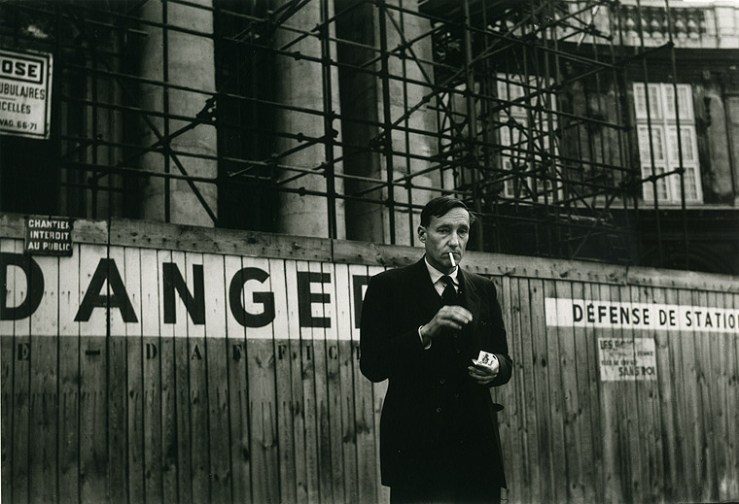
2. Danger.

danger

3. William S. Burroughs, a writer no one reads and everyone references.

4. Point three is not fair: I’m sure you, dearest reader, have read Burroughs, continue to read Burroughs, will read Burroughs, etc.

5. But, points three and four, it’s the idea of Burroughs, Burroughs-as-luminary, Burroughs-as-symbol, that our culture persists in keeping.

6. Re: Points three, four, five: Burroughs the poser who posed for so many photographs, who couldn’t say no to a spoken word CD or a collaboration or a fucking Nike ad.

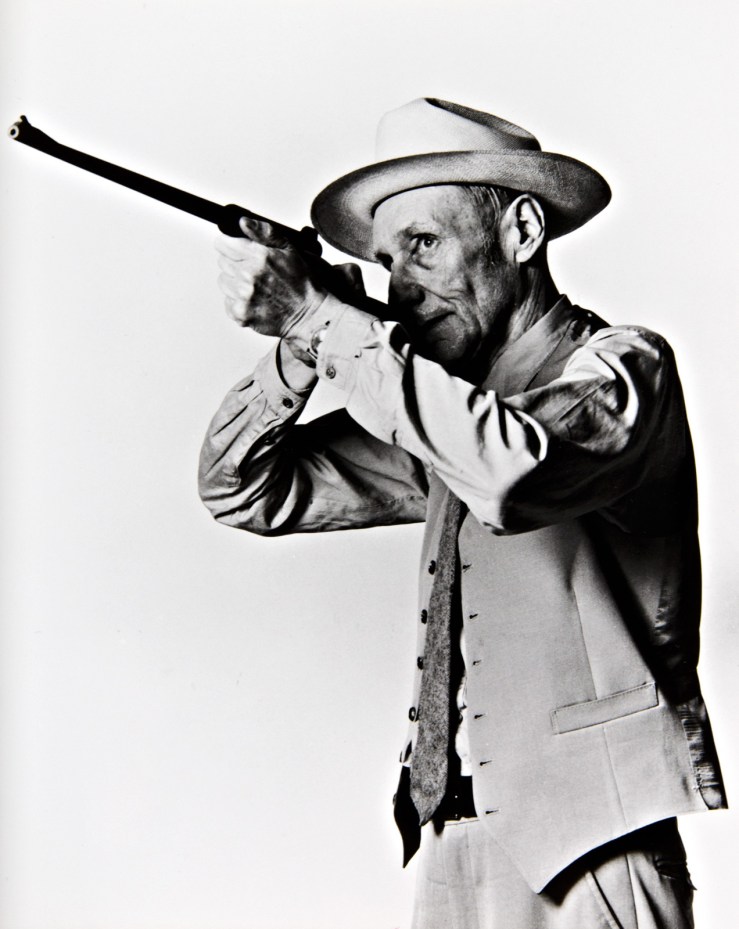
7. And always with the guns.

burroughs_maplethorpe

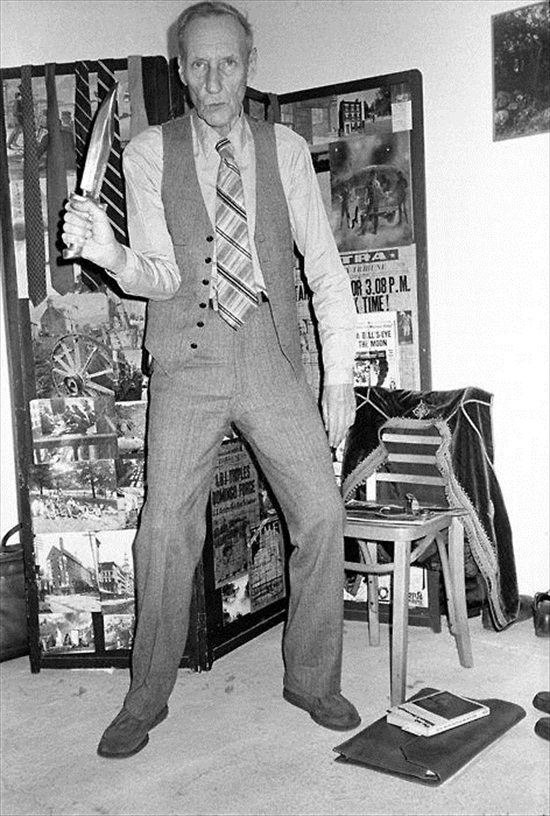
8. And the knives.

william burroughs wielding a knife

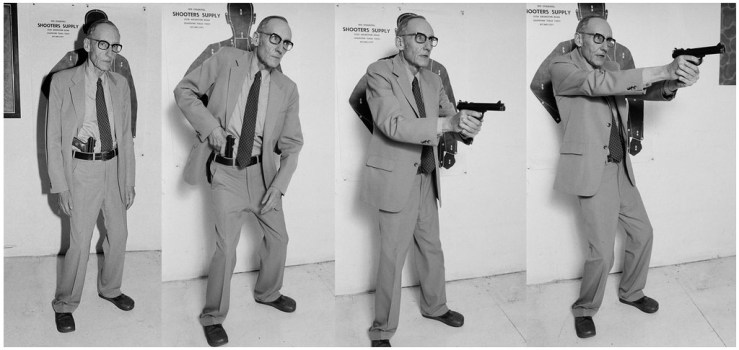
9. And the guns.

william-burroughs-guns1

10. If you want to know what licenses Picasso to break the human form (and other forms) into cubes and lines and colors and figured abstractions, go gander at Aunt Pepa or First Communion.

11. If you want to know what licenses Duchamp to call a urinal a work of art, go gander at Portrait of the Artist’s Father.

12. If you want to know what licenses Burroughs to call Naked Lunch a novel, go read Junkie or Queer.

13. Junkie, the first Burroughs novel I read, is a high modernist classic.

14. Typewriter.

05

15. Shoes.

03

16. The reader is invited, most cordially, to print this riff and cut it into little bits and rearrange it.

17. The reader is invited, most cordially, to cut and paste this riff into a new digital document and rearrange it.

18. William Burroughs, curator.

19. William Burroughs, collaborator. Continue reading “100 Point William Burroughs Riff”

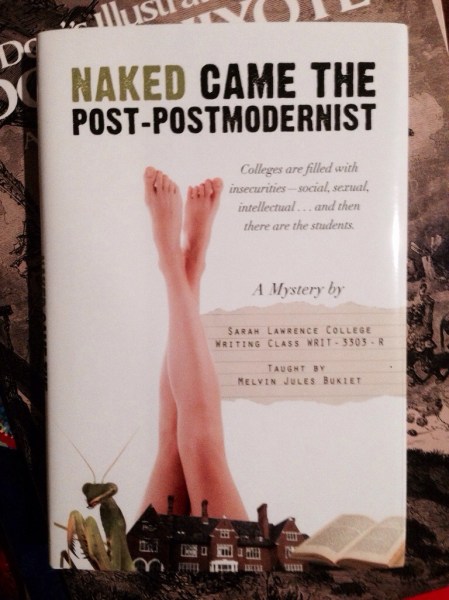
Naked Came the Post-Postmodernist (Book Acquired, Some Time in January)

20140204-155456.jpgNaked Came the Post-Postmodernist showed up some time a few weeks ago and I still haven’t made time for it, despite an interesting premise and its collective authorship. Blurb:

Who killed Eric Davenport? A senior mathematics professor at Underhill College has been found dead in his office, the victim of murder. At Underhill, a small liberal arts college with a pricy tuition and a pampered student body, all of the students are close to their professors. But at least one loved Eric Davenport in a deeply inappropriate fashion. Some hated him. And then there is the faculty at war with itself. And the idiotic administration. And the twin boys who live next to campus. And what’s with all those praying mantises?

The collective work of Sarah Lawrence writing class 3303 – R, taught by novelist Melvin Jules Bukiet, here is a send-up of contemporary campus life that is also the latest installment in an inglorious literary tradition of wacky fun. And the mayhem hasn’t stopped. Soon, a student is found dead in the library, and, from the quad to the dorms, crime scenes and crises begin to multiply. A wealthy alumni donor becomes alarmed. Enter a libidinous medical examiner. Depicting rampant insecurities and raging egos, and with a cast of characters from conflicted faculty to student cliques, from hemp kids to Ugg girls and the J Crew crew, Naked Came the Post-Postmodernist takes us on a journey some may find eerily familiar. . . .

“The Policemen’s Ball” — Donald Barthelme

“The Policemen’s Ball”

by Donald Barthelme

Horace, a policeman, was making Rock Cornish Game Hens for a special supper. The Game Hens are frozen solid, Horace thought. He was wearing his blue uniform pants.

Inside the Game Hens were the giblets in a plastic bag. Using his needlenose pliers Horace extracted the frozen giblets from the interior of the birds. Tonight is the night of the Policemen’s Ball, Horace thought. We will dance the night away. But first, these Game Hens must go into a three-hundred-and-fifty-degree oven.

Horace shined his black dress shoes. Would Margot “put out” tonight? On this night of nights? Well, if she didn’t– Horace regarded the necks of the birds which had been torn asunder by the pliers. No, he reflected, that is not a proper thought. Because I am a member of the force. I must try to keep my hatred under control. I must try to be an example for the rest of the people. Because if they can’t trust us. . .the blue men. . .

In the dark, outside the Policemen’s Ball, the horrors waited for Horace and Margot.

Margot was alone. Her roommates were in Provincetown for the weekend. She put pearl-colored lacquer on her nails to match the pearl of her new-bought gown. Police colonels and generals will be there, she thought. The Pendragon of the Police himself. Whirling past the dais, I will glance upward. The pearl of my eyes meeting the steel gray of high rank.

Margot got into a cab and went over to Horace’s place. The cabdriver was thinking: A nice-looking piece. I could love her.

Horace removed the birds from the oven. He slipped little gold frills, which has been included in the package, over the ends of the drumsticks. Then he uncorked the wine, thinking: This is a town without pity, this town. For those whose voices lack the crack of authority. Luckily the uniform. . . Why won’t she surrender her person? Does she think she can resist the force? The force of the force?

“These birds are delicious.”

Driving Horace and Margot smoothly to the Armory, the new cabdriver thought about basketball.

Why do they always applaud the man who makes the shot?

Why don’t they applaud the ball?

It’s the ball that actually goes into the net.

The man doesn’t go into the net.

Never have I seen a man going into the net.

Twenty thousand policemen of all grades attended the annual fete. The scene was Camelot, with gay colors and burgees. The interior of the Armory had been roofed with lavish tenting. Police colonels and generals looked down on the dark uniforms, white gloves, silvery ball gowns.

“Tonight?”

“Horace, not now. This scene is so brilliant. I want to remember it.”

Horace thought: It? Not me?

The Pendragon spoke. “I ask you to be reasonable with the citizens. They pay our salaries after all. I know they are difficult sometimes, obtuse sometimes, even criminal sometimes, as we often run across in our line of work. But I ask you despite all to be reasonable. I know it is hard. I know it is not easy. I know that for instance when you see a big car, a ’70 Biscayne hardtop, cutting around a corner at a pretty fair clip, with three in the front and three in the back, and they are all mixed up, ages and sexes and colors, your natural impulse is to– I know your first thought is, All those people! Together! And your second thought is, Force! But I must ask you in the name of force itself to be restrained. For force, that great principle, is most honored in the breach and the observance. And that is where you men are, in the breach. You are fine men, the finest. You are Americans. So for the sake of America, be careful. Be reasonable. Be slow. In the name of the Father and the Son and of the Holy Ghost. And now I would like to introduce Vercingetorix, leader of the firemen, who brings us a few words of congratulation from that fine body of men.”

Waves of applause for the Pendragon filled the tented area.

“He is a handsome older man,” Margot said.

“He was born in a Western state and advanced to his present position through raw merit,” Horace told her.

The government of Czechoslovakia sent observers to the Policemen’s Ball. “Our police are not enough happy,” Colonel-General Cepicky explained. “We seek ways to improve them. This is a way. It may not be the best of all possible ways, but. . . Also I like to drink the official whiskey! It makes me gay!”

A bartender thought: Who is that yellow-haired girl in the pearl costume? She is stacked.

The mood of the Ball changed. The dancing was more serious now. Margot’s eyes sparkled from the jorums of champagne she had drunk. She felt Horace’s delicately Game Hen-flavored breath on her cheek. I will give him what he wants, she decided. Tonight. His heroism deserves it. He stands between us and them. He represents what is best in society: decency, order, safety, strength, sirens, smoke. No, he does not represent smoke. Great billowing oily black clouds. That Vercingetorix has a noble look. With whom is Vercingetorix dancing, at present?

The horrors waited outside patiently. Even policemen, the horrors thought. We get even policemen, in the end.

In Horace’s apartment, a gold frill was placed on a pearl toe.

The horrors had moved outside Horace’s apartment. Not even policemen and their ladies are safe, the horrors thought. No one is safe. Safety does not exist. Ha ha ha ha ha ha ha ha ha ha!

“The Volcano Is Dark” — Malcolm Lowry

ml