“Style and Content Must Match” — William Gaddis on Voice and Risk in His Novels

From a brief  1982 interview with William Gaddis

Q: The pervasive and distinctive authorial voice of The Recognitions gives way in J R to a self-effacing voice that seems to serve only functional purposes. Also in J R there is an increased dependence on dialogue. For verisimilitude in Lolita, Nabokov “travelled in school buses to listen to the talk of schoolgirls.” Did you take any special measures to hear and note the speech patterns of any of the wide variety of people who speak in “J R”?

William Gaddis: Style and content must match, must be complementary, accounting in part for a difference between the two books, though the lack of a conventional narrative style had already jarred a good many readers of The Recognitions when it appeared, as its hapless reviews show. J R was started as a story which quickly proved unsatisfactory, inspired- here’s the legitimate gossip—-by the postwar desecration of the Long Island village of Massapequa where my family had had property since around 1910, take a look at it now and you’ll see all the book’s worst hopes realized. In approaching J R as a novel, I was at pains to remove the author’s presence from the start as must be obvious. This was partly by way of what I mentioned earlier, obliging the thing to stand on own, take its own chances. But it was also by way of setting up a problem, a risk, in order to sustain my own interest, especially since the largely uninterrupted dialogue raised the further risk of presenting a convincing sense of real time without the conventional chapter breaks, white spaces, such narrative intrusions as “A week later . . .” How some of the writers I come across get through their books without dying of boredom is beyond me. As for what you call speech patterns, one is always listening and has got an ear or hasn’t, and without one, unless perhaps in dealing with an unfamiliar language and culture, no amount of your special measures like riding around on school buses will get you out of the swamp.

William Blake’s Death Mask

“Finnegans Wake: What It’s All About” — Anthony Burgess

Read Anthony Burgess’s essay on James Joyce’s Finnegans Wake. From said essay—

In his dream HCE, as we shall now call him, tries to make the whole of history swallow up his guilt for him. His initials are made to stand for the generality of sinful man, and they are expanded into slogans like “Here Comes Everybody” and “Haveth Childers Everywhere”. After all, sexual guilt presupposes a certain creative, or procreative, vitality, and a fall only comes to those who are capable of an erection. The unquenchable vitality appears in “our Human Conger Eel” (despite the “down, wantons, down” of the eel-pie-maker in King Lear); the erector of great structures is seen in “Howth Castle and Environs”. From the point of view of the ultimate dreamer of the dream, though (the author himself), “HCE” has a structural task to perform. As a chemical formula (H2CE3) or as a genuine vocable (“hec” or “ech” or even “Hecech”) it holds the dream down to its hero, is sewn to it like a mono­gram-HCE: his dream. But HCE has, so deep is his sleep, sunk to a level of dreaming in which he has become a collective being rehearsing the collective guilt of man. Man falls, man rises so that he can fall again; the sequence of falling and rising goes on till doomsday. The record of this, expressed in the lives of great men, in the systems they make and unmake and remake, is what we call history.

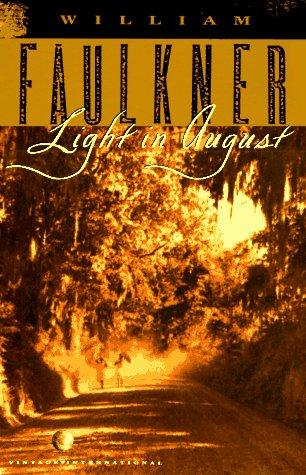
Light in August — William Faulkner

I can’t unpack William Faulkner’s novel Light in August here. There’s too much in it. It’s too thick. Faulkner piles on his sentences in a gelatinous mass, smearing words on top of words into a deep swamp of meaning, motif, and symbol. The novel is archaeological, a deep dig into the South’s abject wounds. It is the most Faulkneresque Faulkner novel I have read, a heady strange brew that tries to suss out racism, misogyny, fear of paternity, the scars of the plantation system, the fallout of the Civil War, the cold comfort of religion, and so much more. Like any good modern text, you could say it’s about a quest for identity, and how the quester must come into conflict with the codes and terms of the dominant social order to find that solid identity. But in Faulkner there is no stable identity, and Light in August dramatizes this problem, even as it points to a possible inherent payoff.

A book review should give some sense of what happens in the book, but as in much of Faulkner’s work, explaining “what happens” in a Light in August would spoil the puzzle, the synthesis, the game, the shock of it all. But some outlines should suffice. The novel is set in the Jim Crow South, mostly in Jefferson, seat of Yoknapatawpha County, the Faulknerverse. It opens with Lena Grove walking “all the way from Alabama” into Mississippi; she’s in her third trimester of pregnancy and still has no ring on her finger, a sign that every Southerner knows how to read. Lena is looking for the father’s child, Lucas Burch; she hears tell that a Burch might work at the planing mill. It’s not Burch though, but Byron Bunch, who falls for Lena right away, plays Joseph to her Mary. Meanwhile, Lucas Burch is around—only the rascal’s taken up the false name Joe Brown. He’s also taken up with the novel’s tragic anti-hero, Joe Christmas, helping that strange man bootleg whiskey out of old servant quarters adjoining a decaying plantation house. Joe Christmas, an abandoned orphan, may have black blood in him. In Jim Crow Mississippi this makes him black, even worse than black—an unknown, unknowable something. Christmas (is there a more overdetermined name in fiction?) is accused of killing the woman who lives the old plantation house, a woman the community of Jefferson shunned for her family’s abolitionist, carpetbaggin’ past, yet now the community must exact the only kind of justice suitable for a black man accused of killing a white woman in Mississippi in the 1920s. JC, always estranged, must now keep on the run to avoid being lynched.

In any other novel, the two protagonists would have to meet, but Faulkner never allows a scene between Christmas and Lena. Yet they are undeniably tied together: somehow he is both the metaphysical father of her child and the child itself, Faulkner’s answer to the inescapable violent fatalism that curses the South. There is no exit from the wounded past, but there might be new possibilities, and we might find them in Lena’s baby. Lena provides a feminine antidote to Christmas’s abject fear of women, his utterly Faulknerian despair of genitalia and menstruation; at the same time, Christmas becomes the sacrificial lamb for the South’s sins, the totem whose ritualistic dismemberment will at once reaffirm the dominant social patriarchal order of the plantation system at the very same time it reveals that system’s deep hypocrisy and radical instability.

In Light in August, Faulkner shows us a world where social codes are rigid, inflexible, immutable, unspoken, and bear absolutely no relation to the concrete reality of the phenomenal, external world they pretend to govern. It’s the primal sin of the plantation system, which paradoxically separated and joined blacks and whites; which said that miscegenation was abomination yet created the optimal circumstances for racial mixing; which proscribed the very concept of a multiracial family while enforcing the Darwinian circumstances that would necessitate such a collective. It is a world where nothing fits together, nothing connects, yet Faulkner finds a place for his misfits, although he must find it by mixing up the system.

Here’s Lena talking to Hightower, the defrocked minister and ersatz medicine man (I will not even begin to discuss Hightower). Lena’s concern is over Christmas’s grandmother, who through a bizarre series of events is present at the baby’s birth—-

“She keeps on talking about—–She is mixed up someway. And sometimes I get mixed up too, listening, having to . . . . . . .” Her eyes, her words, grope, fumble.

“Mixed up?”

“She keeps on talking about him like his pa was that—–that one in jail, that Mr Christmas. She keeps on, and the I get mixed up and it’s like sometimes I can’t——like I am mixed up too and I think that his pa is that Mr—–Mr Christmas too—–” She watches him; it is as though she makes a tremendous effort of some kind. “But I know that aint so. I know that’s foolish. It’s because she keeps on saying it and saying it, and maybe I ain’t strong good yet, and I get mixed up too. But I am afraid . . . . . . .”

“Of what?”

“I don’t like to get mixed up. And I am afraid she might get me mixed up, like they say how you might cross your eyes and then you can’t uncross . . . . . . .”

But the eyes and the I’s (both are ways of seeing, of course) do get crossed in Light. Faulkner mixes up the system, crosses the wires as a way out of the ugly circuit, even as he paradoxically reconfirms the circuit’s contours. This is not a writer who flinches from history and all its despair, even as he tries to find a metaphysical answer outside of religious doctrine and conventional morality.

I feel like I’ve made, at best, some very broad, superficial scratches into the surface of a very dense, thick book; even worse, I’ve barely provided even a hint of Faulkner’s astounding prose. Mea culpa. I’ll take a second, more specific shot at Light in August in an upcoming post. For now: Very highly recommended.

Anthony Burgess Laments the Loss of History

In 1972, Burgess could already see the loss of historical perspective that was happening in institutionalized education. I suppose he would consider 2011 a nightmare that no one is even attempting to wake up from. Also, is there anything like this on TV today? Seriously—is conservatism simply the opposite of intellectualism at this point? Could you imagine a leading conservative pundit having a literary author like Burgess on his or her show to actually, like, talk about history (or anything else for that matter)?
(See also).

Seven Fragmentary Novels That Aren’t The Pale King

I finished David Foster Wallace’s The Pale King the other night (don’t worry—I know that there’s been a terrible shortage of coverage for this obscure book, so I’ll post a review pretty soon review here). The Pale King unfolds as a series of fragments, some short as one page, many the length of long short stories, and one novella length piece. Characters recur, but themes, images, and motifs hold these pieces together rather than any linear plot. The better pieces can stand on their own as short stories, yet are much richer when read with/against the rest of the novel. The Pale King remained unfinished at the time of Wallace’s death, but his notes on the manuscript (published at the end of the book) suggest that fragmentation was always his intentional method.

The fragmentary novel is nothing new, but its particular powers have gained resonance against the backdrop of a world where authority, information, and communication are increasingly decentralized, scattered, and, well, fragmented. Fragmentary novels might have roots in the picaresque (those one-damn-thing-after-the-next novels like Don QuixoteCandide, Huckleberry FinnInvisible Man, Orlando, Blood Meridian . . .), but picaresque novels tend to have a shape, a trajectory, even if they seem to lack traditional plot arcs or characterization. What I’m talking about here are novels made of pieces, segments, or chapters that work fine on their own, and  may even seem self-contained, but when synthesized help reveal the novel’s greater project. So, seven fragmentary novels that aren’t The Pale King—

Steps, Jerzy Kosinski

There’s force and vitality and horror in Steps, all compressed into lucid, compact little scenes. In terms of plot, some scenes connect to others, while most don’t. The book is unified by its themes of repression and alienation, its economy of rhythm, and, most especially, the consistent tone of its narrator. In the end, it doesn’t matter if it’s the same man relating all of these strange experiences because the way he relates them links them and enlarges them. At a remove, Steps is probably about a Polish man’s difficulties under the harsh Soviet regime at home played against his experiences as a new immigrant to the United States and its bizarre codes of capitalism. But this summary is pale against the sinister light of Kosinski’s prose. Here’s David Foster Wallace: “Steps gets called a novel but it is really a collection of unbelievably creepy little allegorical tableaux done in a terse elegant voice that’s like nothing else anywhere ever. Only Kafka’s fragments get anywhere close to where Kosinski goes in this book, which is better than everything else he ever did combined.”

Speedboat, Renata Adler

Telegraphed in bristling, angular prose, Speedboat unwinds as a series of seemingly unrelated vignettes, japes, and jokes all filtered through the narrator’s ironic, faux-journalist sensibility. Adler’s novel eschews plot, conventional characters, and resolution—its contours are its center. Speedboat was published in the early 1970s, but it would seem ahead of its time even if it were published tomorrow.  Adler captures the deep existential alienation of modern life, converting dread into verve and despair into marvel.

2666, Roberto Bolaño

Bolaño’s opus bears considerable superficial comparison to Wallace’s The Pale King: both were published posthumously, both have endured a process of buzz and backlash, both are unfinished, and both are purposefully fragmented. 2666 comprises (at least five) parts, some connected explicitly, others tied loosely together, but all interwoven with themes of violence, darkness, art, and love. The book’s most notorious section, “The Part About the Crimes,” is itself a fragmented beast, a procession of murders and rapes, dead-end investigations, bizarre TV appearances, and other sinister doings. Prominent characters disappear into the violence of Santa Teresa never to return again; the great mystery of the book seems unsolved. But like Ariadne, Bolaño offers his readers a thread through the labyrinth, a layering of motifs, as words and images repeat throughout shifts in space and time.

Naked Lunch, William S. Burroughs

Naked Lunch’s cut-up origins are well-known and probably greatly exaggerated: the book is far more coherent than its reputation insists. Still, Burroughs’s infamous novel is all over the place (quite literally), moving through time and space and even to Interzone. Comic, rambling, lusty, and perverse, Naked Lunch’s satire is often overshadowed by its seedier, more sensational side. Burroughs claimed his novels were part of an antique literary pedigree: “I myself am in a very old tradition, namely, that of the picaresque novel. People complain that my novels have no plot. Well, a picaresque novel has no plot. It is simply a series of incidents.”

Vertigo, W. G.  Sebald

Vertigo blurs the lines between fiction, history, autobiography, and biography. The book comprises four sections. The first section tells the story of the romantic novelist Stendhal (or, more to the point, a version of Stendhal); the second section details two trips Sebald made to Italy, one in 1980, and one in 1987; the third section describes a trip Kakfa took to Italy near the end of his life; the final section describes the narrator hiking from Austria to visit the village where he was born in Bavaria. Underwriting and uniting these separate episodes is the narrator’s attempt to find a common thread between past and present, to find a unity in a Europe fractured by time and war. There’s also a deep, throbbing melancholy mixed with beauty and wisdom here.

Cloud Atlas, David Mitchell

Mitchell constructs Cloud Atlas like a doubled matryoshka doll, nesting narratives inside narratives that work their way to an apocalyptic future; once Cloud Atlas hits its middle mark, it works outward to the past, back to its own edges. With the exception of the middle piece, a nod to Russell Hoban’s Riddley Walker, Mitchell fragments each piece of Cloud Atlas at a key turning point, an old literary trick really, but one that pays off. The tales likely hold up on their own, but their intertextual play is the real delight of the novel, as Mitchell showcases a variety of styles and genres and forms that reflect the content and era of each tale. At its core,  Cloud Atlas explores Nietzschean themes of eternal recurrence and the will to power; its clever fragmented structure emphasizes the loops of history humanity finds itself caught in again and again, even as brave souls seek a new way of seeing, living, doing.

Go Down, Moses, William Faulkner

Faulkner always insisted that Go Down, Moses was a novel, although in its initial publication it was presented as a collection of short stories.  And granted, any of the stories can be read on their own. “Was” is hilarious homosocial hijinks, but read against the sorrow and anger in “The Fire and the Hearth” and “Pantaloon in Black,” or the prolonged majesty of “The Bear,” Faulkner’s project becomes much clearer—he is taking on a century in the lives of the Mississippi McCaslins. Go Down, Moses is strange and sad and funny and truly an achievement, a book that works as a sort of time machine, an attempt to undo or recover the racial and familial (and in Faulkner, these are the same) divides of the past.

“Remember That What We Call The Novel Is a Highly Artificial Form” — William Burroughs on the Picaresque Novel

In a fantastic 1974 interview with noted translator Philippe Mikriammos, William Burroughs discusses the picaresque novel (and much, much more)—-

PM: Have you been influenced by Celine?

WB: Yes, very much so.

PM: Did you ever meet him?

WB: Yes, I did. Allen [Ginsberg] and I went out to meet him in Meudon shortly before his death. Well, it was not shortly before, but two or three years before.

PM: Would you agree to say that he was one of the very rare French novelists who wrote in association blocks?

WB: Only in part. I think that he is in a very old tradition, and I myself am in a very old tradition, namely, that of the picaresque novel. People complain that my novels have no plot. Well, a picaresque novel has no plot. It is simply a series of incidents. And that tradition dates back to the Satyricon of Petronius Arbiter, and to one of the very early novels, The Unfortunate Traveler by Thomas Nashe. And I think Celine belongs to this same tradition. But remember that what we call the “novel” is a highly artificial form, which came in the nineteenth century. It’s quite as arbitrary as the sonnet. And that form had a beginning, a middle, and an end; it has a plot, and it has this chapter structure where you have one chapter, and then you try to leave the person in a state of suspense, and on to the next chapter, and people are wondering what happened to this person, and so forth. That nineteenth-century construction has become stylized as the novel, and anyone who writes anything different from that is accused of being unintelligible. That form has imposed itself to the present time.

“The Empty Room” — Jonathan Lethem

You can read “The Empty Room” by Jonathan Lethem in full at The Paris Review; the piece is part of the new summer issue, which is pretty great so far (Bolaño, William Gibson, poems, art, etc.). From “The Empty Room”—

Earliest memory: father tripping on strewn toys, hopping with toe outraged, mother’s rolling eyes. For my father had toys himself. He once brought a traffic light home to our apartment on the thirty-somethingth floor of the tower on Columbus Avenue. The light, its taxi yellow gone matte from pendulum-years above some polluted intersection and crackled like a Ming vase’s glaze where bolts had been overtightened and then eased, sat to one side of the coffee table it was meant to replace as soon as my father found an ­appropriate top. In fact, the traffic light would follow us up the Hudson, to Darby, to the house with the empty room. There it never escaped the garage.

William Gibson on Blood Meridian

At The GuardianWilliam Gibson says Cormac McCarthy’s Blood Meridian is his most memorable holiday read—

If that’s holiday as in “utterly removed from any sense of immediate surroundings”, my most memorable holiday reading is Cormac McCarthy’s Blood Meridian, which I started in the cab on the way to Vancouver airport, headed for a first trip to Berlin where I was doing something, I wasn’t sure what, with Samuel Delany and Wim Wenders at the Kunsthalle. I am uncertain as to the year, likely it was 1991, before the publication of All the Pretty Horses. I had recently read McCarthy’s astonishing The Orchard Keeper, and on the urging of the friend who had recommended that, I began Blood Meridian. I remember nothing else, door to door, between my home in Vancouver and the hotel room in which I finished the book in Berlin. I awoke from it as from some terribly potent dream, and found myself, quite unexpectedly, in a strange city. Being Berlin, and particularly then, it was a very strange city. A few nights later, over in the east, I continued to experience intense overlays of Blood Meridian. Indeed, I think those overlays helped me better comprehend what I was seeing, and not to panic. The Judge, I knew, would understand all of this.

A Poem for Father’s Day — Robert Hayden’s “Those Winter Sundays”

Robert Hayden’s poem “Those Winter Sundays”–

Sundays too my father got up early
and put his clothes on in the blueblack cold,
then with cracked hands that ached
from labor in the weekday weather made
banked fires blaze. No one ever thanked him.

I’d wake and hear the cold splintering, breaking.
When the rooms were warm, he’d call,
and slowly I would rise and dress,
fearing the chronic angers of that house,

Speaking indifferently to him,
who had driven out the cold
and polished my good shoes as well.
What did I know, what did I know
of love’s austere and lonely offices?

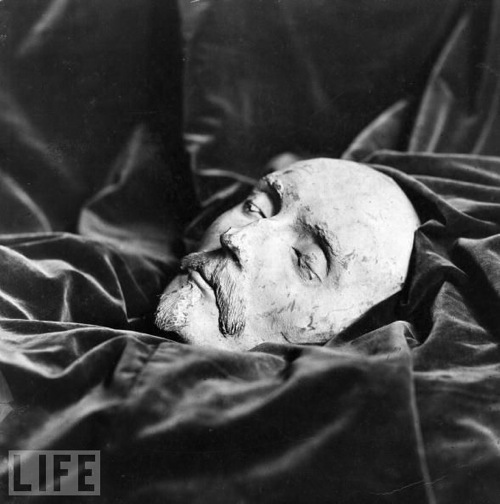
William Shakespeare’s Death Mask

Biblioklept Does Bloomsday

Bloomsday blah blah blah — (all links lead to Biblioklept posts (yeah, we’re solipsists around here))—

How to read Ulysses

James Joyce talks dirty

Filming Finnegans

William Faulkner’s Joyce anxiety

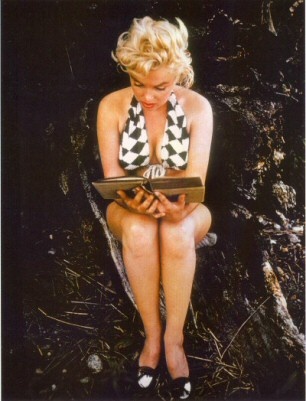
Marilyn Monroe reads Molly 

Biblioklept’s lousy review (the review is lousy, not the book) of Dubliners

Joyce’s entry on the 1901 Irish Census

Biblioklept’s review (not so lousy, the review) of a superior full-cast audio recording of Ulysses

James Joyce explains why Odysseus is the most “complete man’ in literature

Leopold’s Bloom’s recipe for burnt kidney breakfast

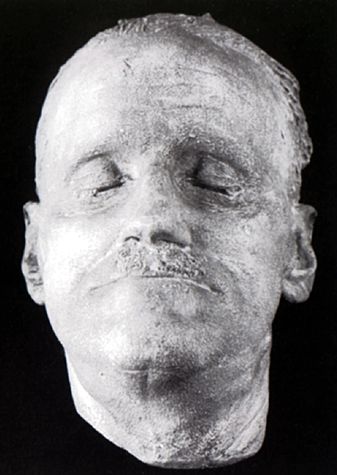
James Joyce’s death mask—


“Don’t Take Any Notice of What I’m Going to Say Because I Don’t Know What I’m Talking About” — Tom Stoppard on the Artist’s Bladder

Is American Psycho Profound, Artistic Nihilism or Stupid, Shallow Nihilism? — Bret Easton Ellis vs David Foster Wallace

Bret Easton Ellis’s controversial novel American Psycho turns 20 this year. The folks at Vintage were kind enough to send me a copy of the book to promote the anniversary, and despite a mounding stack of review copies, I took a few hours to re-read parts of Ellis’s third novel.

I’ve only read two Ellis books and I remember the reading of them distinctly, precisely; I remember how I picked them up and where I was and what I was doing and all that jazz. The first was Ellis’s début Less Than Zero, a slim, ugly little novel that I read in one night. I was fifteen, spending a summer with my aunt and uncle, living in my cousin’s old bedroom. Less Than Zero was part of a cache of books that included Hunter S. Thompson’s Fear and Loathing in Las Vegas, Anthony Scaduto’s Bob Dylan biography, some Hemingway and Fitzgerald novels, One Flew Over the Cuckoo’s Nest, and a Kurt Vonnegut starter kit. In short, a life changing library, and most of it went home with me in my Jansport (somewhat surreptitiously, although I’m sure if I had asked I would have received). Only I didn’t take Less Than Zero, despite reading it all in one sick night, and then reading it again in pieces over the summer. The book hurt my stomach. The drugs were not the Looney Tunes business in HST’s book—they were the symptom of a blank nihilism I simply couldn’t identify with. The scene where the kids casually watch a snuff film horrified me. And the rape scene. Well. It was the first time I read something that genuinely disturbed me in a non-child, non-Grimm’s way — in a way where I felt moral outrage from an adult-psyche-type-position (whatever that means). The book genuinely concerned me; I was afraid such people existed.

I read American Psycho in 2002. I was traveling through Thailand for a month, trading books at guest houses and shops as I went, and the only book I remember being more ubiquitous than American Psycho was Alex Garland’s The Beach (which, yes, I also read there). I had seen and quite enjoyed Mary Harron’s 2000 film adaptation of American Psycho, which had the good sense to treat the whole matter as a piece of cartoonish black comedy. In Harron’s hands, the hyperbolic exploits of Patrick Bateman are considerably less ambiguous than the book’s depiction; Harron  clearly marks the narrative violence as Bateman’s internal fantasies. Of course, one of literature’s greatest tools is ambiguity, and Ellis’s American Psycho revels in it. In a sense, this is the book’s defining nihilism: its total unwillingness to make a definitive judgment about its protagonist’s violence. Instead, American Psycho’s claims to satire rely on the implicit force of the reader’s sense of humanity and morality; like Less Than Zero before it, we have a flat narrative, an utter lack of self-reflection or internal psychology. Ellis gives us only concrete contours, cocaine, hydrochloric acid, chainsaws, and a laundry list of brand names. These are novels without interiors.

American Psycho, utterly concrete, deeply ironic, and occasionally funny, is a strange beach read, but a beach read nonetheless (although all that gristle and blood (and oh the rat!) won’t go down easy for many folks). When I read it in 2002 I found it neither shocking or enlightening, just precise and ugly and grotesque, a numbing progression of concrete descriptions of clothes and restaurants punctuated by ridiculous violence. Its one-note satire would find a better home in a short story. A short short story. I’ve spent the past few days reading through its sections again, trying to reassess it against the backdrop of my current literary estimations of Bret Easton Ellis, which I hate to admit are largely informed not only by his own acerbic personality, but also by (or perhaps more accurately against) his agon with David Foster Wallace.

BEE vs. DFW is not exactly news. Ellis (b. 1964) and Wallace (b. 1962) both published their first novels in the mid-eighties. Less Than Zero made 21-year-old Ellis a star, a likely “voice of his generation.” The Broom of the System didn’t exactly go gangbusters for Wallace, but its voluminous scope, Pynchonian silliness, and its willingness to pick up the postmodern games that Ellis and the other new minimalists seemed to reject announced a major new talent who was willing to both think and feel—to go beyond the surfaces. Indeed, Wallace’s entire project might be defined as setting himself apart from the cool, detached irony that characterizes Ellis’s ethos. In a 1993 interview with Larry McCaffery,Wallace decries fiction that devotes
“a lot of energy to creating expectations and then taking pleasure in disappointing them. You can see this clearly in something like Ellis’s American Psycho: it panders shamelessly to the audience’s sadism for a while, but by the end it’s clear that the sadism’s real object is the reader herself.” I think this is an apt criticism. American Psycho is torture porn encased in a thin veneer of social satire with no interior substance. Here’s Wallace at length—

 I think it’s a kind of black cynicism about today’s world that Ellis and certain others depend on for their readership. Look, if the contemporary condition is hopelessly shitty, insipid, materialistic, emotionally retarded, sadomasochistic, and stupid, then I (or any writer) can get away with slapping together stories with characters who are stupid, vapid, emotionally retarded, which is easy, because these sorts of characters require no development. With descriptions that are simply lists of brand-name consumer products. Where stupid people say insipid stuff to each other. If what’s always distinguished bad writing—flat characters, a narrative world that’s cliched and not recognizably human, etc.—is also a description of today’s world, then bad writing becomes an ingenious mimesis of a bad world. If readers simply believe the world is stupid and shallow and mean, then Ellis can write a mean shallow stupid novel that becomes a mordant deadpan commentary on the badness of everything. Look man, we’d probably most of us agree that these are dark times, and stupid ones, but do we need fiction that does nothing but dramatize how dark and stupid everything is? In dark times, the definition of good art would seem to be art that locates and applies CPR to those elements of what’s human and magical that still live and glow despite the times’ darkness. Really good fiction could have as dark a worldview as it wished, but it’d find a way both to depict this world and to illuminate the possibilities for being alive and human in it. You can defend Psycho as being a sort of performative digest of late-eighties social problems, but it’s no more than that.

Four years before the interview—and two years before the publication of American Psycho—Wallace mocked Ellis’s void, vacuous characters in “Girl with Curious Hair,” a story about a yuppie on LSD at a Keith Jarrett concert.  With no affective life, Sick Puppy (as his low life punk rock friends call him) feels nothing. He cannot enjoy his wealth, his position—not even his acid trip. He can’t even enjoy sex unless he can burn his partner as he’s being fellated. As Marshall Boswell points out in his study Understanding David Foster Wallace, “the story eerily forecasts . . . American Psycho . . . in a grisly and hilarious pastiche of Ellis’ preposterously benumbed prose.”

Perhaps Wallace’s greatest critique of nihilism — greatest in that it escapes the confines of Ellis and his ilk’s literary purview — is Don Gately, erstwhile hero of Infinite Jest, a recovering Demerol addict and small time thief whose painful day-to-day existence figures as the existential struggle against bleak, overwhelming nothingness. Gately is the heart and spirit of IJ, a big sad throbbing heart that, to quote Wallace out of context (from above), is the writer’s way “to depict this [dark] world and to illuminate the possibilities for being alive and human in it.”

Ellis perhaps perceives a character like Gately and his illuminating possibilities as simply too affected. Last summer, at a reading in Hackney, England, Easton offered the following—

Question: David Foster Wallace – as an American writer, what is your opinion now that he has died?

Answer: Is it too soon? It’s too soon right? Well I don’t rate him. The journalism is pedestrian, the stories scattered and full of that Midwestern faux-sentimentality, and Infinite Jest is unreadable. His life story and his battle with depression however is really quite touching . . .

Then there was this cryptic tweet a few months ago—

I’m not sure what Ellis’s tweet meant, and attendees of the Hackney reading claim that he was more considered and measured in his tone than the actual words of his response seem to entail. His end of the agon with Wallace is also rife with its own set of problems—his contemporary is dead, horribly dead, a suicide, (the kind of death that makes an essay like this one, an essay that claims to find affirmation of life in DFW and empty nihilism BEE, particularly hard to swallow, I suppose)—making it all the harder to respond. I read his “too soon” remark from the Hackney reading to be in earnest.

But Ellis’s tweets are not part of his literary corpus (even though they can be entertaining), and Wallace’s suicide is not part of his text. So, I return to those texts—

Wallace’s last effort, The Pale King, contrasts strongly with American Psycho. Wallace’s novel is fractured, heteroglossic, crammed with ideas, and at times purposefully taxing on its reader’s attention. American Psycho is concise (even if its plot is messy and episodic), imagistic, lacks even the pretense of allowing a controlling voice other than Bateman’s into the narrative, and, in its fetishistic, sexualized violence, is a work designed to lock its reader’s attention in a sensationalized vice grip. It’s id-bait par excellence, seductive and stylish. Its greatest achievement may be to fool some readers into believing that its violence is simply part and parcel of its intention of being a scathing satire. The book then relies heavily — too heavily — on an exterior morality system to weigh its flat, static characters, characters who face incredible trauma and yet never process it (or even attempt to process it). And I am not just speaking of Bateman. Consider the dry cleaner who repeatedly removes bloodstains, or the maid  who mops up brain bits without a single question. Then there are the faceless, indistinguishable alpha males who populate Bateman’s yuppie corporate world, and their requisite fiancées and mistresses, weak watery women the narrative repeatedly condemns. These characters lack meaning or depth; they are essentially probable replicants of Bateman, the implication being that psychopathic tendencies lurk everywhere, that the modern condition preempts empathy or human understanding or plain old common decency. The savvy reader is supposed to admire Ellis’s satire of capitalist vacuity, and admittedly, there are some very funny riffs (Bateman’s bits on popular music like Huey Lewis and the News and Whitney Houston, replicated in the film version, still hold up well). But I think Wallace is correct when he asserts that the real violence is ultimately inflicted on the reader. Ellis’s violence is not the same as Flannery O’Connor’s, who used the shock of murder in her stories to explore the possibility of awe, transcendence, and revelation in a desacralized world. Wallace’s The Pale King tries to sanctify the costs of life (death and taxes and the deep existential crisis these costs entail) in a world that has largely abandoned the sacred, in a society where many people are incapable or unwilling to think empathetically about their relation to (via taxes and social institutions) other humans whom they do not personally know. Ellis’s American Psycho is a cartoonish, lopsided distortion of a descralized world. Its affective power is purely externalized, generated from the reader’s moral core. It replaces feeling with violence; it replaces ideas with the illusion of ideas. Its closest claim to art is its satirical power, which is ultimately puddle-shallow (did we really need Ellis to tell us that yuppies are uncaring, shallow and materialistic?) Writers need not be morally instructive, but good books are guided by a vision. Ellis’s vision is pure, bleak nihilism, abyssal and unreflecting, asking little from its reader other than to play voyeur to murder and giving back nothing in return.
Jeremy Bentham’s Death Mask


(More dead Bentham).

The AV Club Interviews Comix Journalist Joe Sacco

The AV Club interviews Biblioklept fave Joe Sacco, whose books Palestine and Safe Area Goražde should be required reading for any thinking person. Sacco explores some of the messiest, ugliest terrains in the world, plumbing disaster and war with heart, wit, and insight (read our post on Sacco for more, including links to shorter works). From the interview—

AVC: You got out of journalism school in 1981, so in addition to the shift in public perception about comics as an adult medium, your career has also spanned a profound shift in the journalism industry. Do you think in some ways you’ve been the beneficiary of that?

JS: As many problems as I have with the mainstream media and the way it goes about its business, I’d say at least journalists were, for the most part, trained in discrimination. I have my problems, mostly with editorial decisions in bigger cities, in editorial offices as opposed to with columnists or reporters. I realize that, as time’s gone by with the new media—I’m talking about the electronic media—you could see a shift to emphasis on visuals and on shorter attention spans. I’m sorry, in a way, if my work is a beneficiary of that. I would hope my work has other attributes that have led to a success. But I can’t know for sure, you know? I think the comics market is the only growing part of the publishing industry, of the book-publishing trade. It’s increasing its share as time goes by. I think it also has to do with the sheer weight of good work that’s out there now—obviously not just my work. There are many other great cartoonists working in fiction and other fields that are just really doing work that has to be looked at, that you cannot ignore.

The Four and Twenty Elders Casting Their Crowns Before the Divine Throne — William Blake