It Is December and Already Dark Forces Are Gathering

Roberto Bolaño’s Brussels sprouts with lemon

In Roberto Bolaño’s sprawling opus 2666 (specifically, in “The Part About Fate”), founding member of the Black Panthers/cookbook author Barry Seaman offers the following recipe during a lecture at a Detroit church–

The name of the recipe is: Brussels Sprouts with Lemon. Take note, please. Four servings calls for: two pounds of brussels sprouts, juice and zest of one lemon, one onion, one sprig of parsley, three tablespoons of butter, black pepper, and salt. You make it like so. One: Clean sprouts well and remove outer leaves. Finely chop onion and parsley. Two: In a pot of salted boiling water, cook sprouts for twenty minutes, or until tender. Then drain well and set aside. Three: Melt butter in frying pan and lightly sauté onion, add zest and juice of lemon and salt and pepper to taste. Four: Add brussels sprouts, toss with sauce, reheat for a few minutes, sprinkle with parsley, and serve with lemon wedges on the side. So good you’ll be licking your fingers, said Seaman. No cholesterol, good for the liver, good for the blood pressure, very healthy.

“Court Rules: Lion Is a Wild Animal” — Charles Portis

November 24, 1960

Court Rules: Lion Is a Wild Animal

A young Brooklyn longshoreman fought a spirited but losing battle in a Brooklyn courtroom yesterday for the right to keep a pet lion at his home.

After the drawn-out, somewhat tongue-in-cheek proceedings at Flatbush Magistrate’s Court, Magistrate Matthew P. Fagan resolved the issue with a concise decision: “I take judicial notice that the lion is a wild animal. I find the defendant guilty.”

The sentence was a $25 fine or ten days in jail. Anthony Ortolano, twenty-six, of 581 Carroll St., Brooklyn, the defendant, asked for ten days in which to raise the $25 and the magistrate granted the request, noting that Mr. Ortolano’s care of the lion had been exemplary.

The specific charge was Section 197 of the city’s Penal Law which makes harboring a wild animal capable of inflicting bodily harm a misdemeanor.

Mr. Ortolano’s troubles with the law began Friday night when Patrolman Thomas Higgins and another officer stopped a car at Union St. and Seventh Ave. to check on the automobile registration. In the car were Mr. Ortolano, three other men and Cleo, a four-month-old male lion, three and a half feet tall and weighing 125 pounds. Mr. Ortolano has since corrected the name to Leo in light of the discovery made over the weekend.

Leo and Mr. Ortolano were hustled off to the Bergan St. police station, where they cooled their heels while a summons was issued. Leo was taken to the Brooklyn shelter of the American Society For the Prevention of Cruelty to Animals.

The trial began yesterday with Mr. Ortolano’s attorney, William Kunstler of Manhattan, asking the judge if the lion could be brought in the courtroom as evidence that he was friendly and tame.

“Oh hell no,” said Magistrate Fagan. “All these people in here would start running. And I wouldn’t blame them.” About 150 persons were in the room.

Then he turned to some officers and asked if they had the
ir guns ready. “Don’t bring him in under any circumstances,” said the judge, “I will conduct this case outside.”

The judge, attorneys, witnesses, defendant and newsmen repaired to an alley outside the court where Leo had been brought in an ASPCA panel truck. The flap was let down to expose the lion, which was beating his head against the wire netting.

The judge opened court in the alley and read the complaint. Mr. Ortolano allowed Leo to lick his fingers through the cage. Then a noisy group of students from nearby Erasmus Hall High School joined the spectators and Magistrate Fagan decided to take the trial back inside. “I’ll take judicial note that I’ve seen the lion,” he said.

The testimony of witnesses followed.

Patrolman Higgins told of the Friday night arrest. He said that Ortolano had told the police that he had bought the lion two weeks ago for $350 from an animal dealer.

Mr. Ortolano said he had a leash on the lion at the time of the arrest and that the windows of the car were up. He said he had a steel cage for Leo in the backyard at his home.

To prove that the animal was tame, said Mr. Kunstler, he would call as witnesses two animal experts.

The first was Mrs. Helen Martini, of 1026 Old Kingsbridge Road, the Bronx, who said she had been an animal trainer for twenty years. Leo was not ferocious, but “very nervous,” she said. But when she was cross-examined by Irving Singer, Assistant District Attorney, she conceded that the animal belonged in a zoo.

Next came Bob Dietc, a zoo-keeper at Fairlawn, N.J., who said that he had trained Leo himself and that he was safe. “He’s only a baby, you could put him in your vest pocket,” he said.

Asked if it wasn’t true that the animal was unpredictable, Mr. Dietc said, “It’s my opinion that all animals are unpredictable, from chickens to birds.”

After the holidays the ASPCA will turn Leo over to Mr. Dietc who will keep him until he can sell him for Mr. Ortolano. Mr. Ortolano, who has been paying $3.15 a day for horsemeat for Leo, is busy getting together $25.


An article by Charles Portis in The New York Tribune. Portis worked for the Tribune for four years in the 1960s before turning to a career as a novelist. The story above is collected in a miscellany of his non-novels, Escape Velocity.

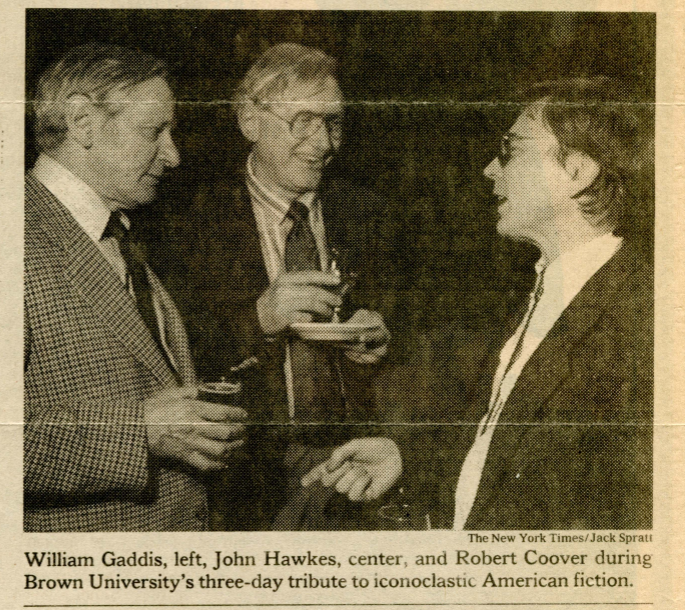
Don was there, as well as William Gass, Stanley Elkin, William Gaddis, and half a dozen others of the postmodernist bent.


The New Yorker: Last week, there was a three-day festival in your honor at Brown University, in Providence—titled, in part, “Celebrating the Unspeakable Practices of Robert Coover”—featuring appearances by many of your colleagues and admirers, including T. C. Boyle, Don DeLillo, Alexandra Kleeman, Marlon James, Edwidge Danticat, Paul Auster, and many others. What was the stimulus for the festival?

Robert Coover: “Unspeakable Practices” was the title of a farewell party I organized for the then retiring professor and great metafictionist John Hawkes, in 1988—a title taken from Donald Barthelme’s book of stories “Unspeakable Practices, Unnatural Acts.” Don was there, as well as William Gass, Stanley Elkin, William Gaddis, and half a dozen others of the postmodernist bent. After that, over the years, we continued with a sequence of vanguard literary ingatherings, calling them all “Unspeakables.” In effect, this was the last one and perhaps the most brilliant of the lot, peopled by old friends and many former students, now celebrated writers in their own right. The readings on the final day by Edwidge Danticat, Rick Powers, Siri Hustvedt, Don DeLillo, and Paul Auster were sensational, some of the best public performances I’ve ever heard. Its whole title was meant to include my creation of the International Writers Project and its freedom-to-write predecessors at Brown, as well as my pioneer digital language workshops in hyperfiction and “cave writing” (writing in immersive 3-D), both programs launched at Brown in 1989. It was a great party, a party that began with the performance of a short sequence from my son Roderick’s radio play based on “Gerald’s Party,” and ending with a reiteration of an old festival favorite, the “Unspeakable Circus.”

From a brief 2018 exchange between the great American novelist Robert Coover and Deborah Treisman (published in The New Yorker). More on Coover’s “Unspeakable Practices” event here.

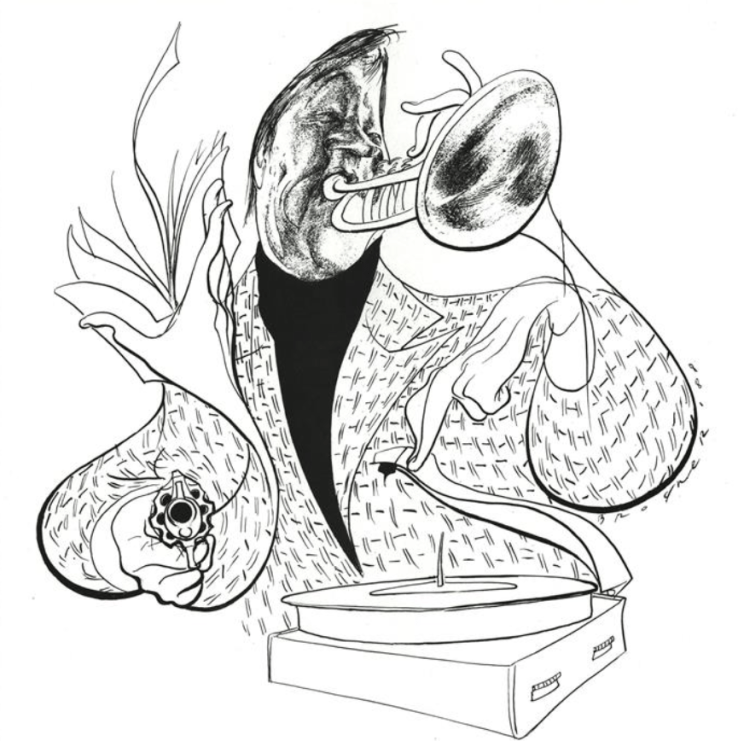
Professor of High Caliber (Portrait of Barry Hannah) — Steve Brodner

Professor of High Caliber, 1988, a portrait of Barry Hannah by Steve Brodner (b. 1954)

The portrait appeared in the 1 July 1988 issue of Esquire, accompanied by the following text:

There he stood, in front of his class at the University of Alabama, tooting on his trumpet: Barry Hannah, gonzo novelist and pseudo-jazz musician, a man possessed by more than the English language. He was playing his own brand of jazz, the kind only a tonedeaf mother could love. Pausing to wipe his brow, Hannah exclaimed, “Whew, this is some good soul!” and began to squawk again. The class grew restive. Several made a break for the door. Hannah pulled a gun out and motioned them back to their seats. “Now this,” he said, waving the gun, “is some bad soul. You guys had better learn the difference.”

Plagiarism

He was born in New York City on August 1, 1819, the third of eight children.

His mother added a final e to the family name after her husband’s death, perhaps to distance herself from his financial problems.

His grandfathers had participated in the Revolutionary War.

At the time of his birth, his father was a fairly prosperous importer of luxury items such as silks and colognes, and his family lived well in a series of houses around New York City, each with comfortable furnishings, refined food and drink, and household servants to keep things in order.

Such lineage and lifestyle notwithstanding, family letters suggest that he was a rather unremarkable child, at least in his father’s eyes.

In 1826, when he was seven years old, his father wrote of him to his brother-in-law : “He is very backward in speech & somewhat slow in comprehension, but you will find him as far as he understands men & things both solid and profound, & of a docile & amiable disposition.”

Instead, the family’s highest praise often went to his older brother

In 1830, after years of increasing debts, his father’s business collapsed, and the family moved—or, some might say, fled—to Albany, New York, to seek sanctuary among his mother’s relatives.

His father died of pneumonia in 1832, entirely bankrupt and raving deliriously from fever.

After his father’s death, he, at 13 years old assumed the responsibilities of a “man” in the family.

With his father’s death and the family’s debt, he was now obliged to seek employment.

He worked as an errand boy at a local bank.  A clerk at his brother’s store. A hand on his uncle’s farm.

After, he enrolled in Albany Classical School in 1835 in order to prepare for a business career, but once there, the young man whom his father had described as inarticulate and “slow” discovered that he had an interest in writing.

He required the requisite knowledge of Latin to obtain a teaching position in the Sikes district of Pittsfield, Massachusetts, in the fall of 1837.

He found teaching in a country school unappealing at best.

His students were, by his own accounts, dull and backward

An early biographer hints at “a rebellion in which some of the bigger boys undertook to ‘lick’ him.”

He left the teaching position after one term, and in 1838 he enrolled in the Lansingburgh Academy, where he was certified as a surveyor and engineer but failed to find the employment he had hoped for as part of the Erie Canal project.

In 1837 he took his first trip to sea.

Several of his uncles were sailors, and he had grown up hearing about their exploits.

He sailed out as a cabin boy on the merchant ship St. Lawrence on June 4, 1839.

He spent four months aboard, including a visit to Liverpool that would provide inspiration and material for scenes of England’s urban poverty in one of his early novels.

None of his letters from this voyage have survived.

When he returned he found his mother and sisters in serious financial trouble, and desperate for extra income, he once again took a teaching job, only to lose it a few months later. He visited an uncle in Galena, Illinois, hoping to find better job prospects there, but failed.

He returned to New York and signed on with the New Bedford whaler Acushnet.

On January 3, 1841, he shipped for the Pacific.

He had signed up for the customary four-year tour aboard the whaler.

Once in the fleet, he quickly grew restless under the conditions imposed by his captain.

Rations were scanty, work and discipline were harsh, and, perhaps most unforgivably, time at sea was continually extended in search of greater hauls.

The Acushnet made one of its few stops in the port of Nuku Hivain the Marquesas in June 1842.

He jumped ship on July 9, 1842.

By the time the Acushnet completed its voyage, fully half the crew had deserted, and several more had died.

He fled into the island’s interior, where he was taken in by the Taipi.

Known as fierce warriors who were actively hostile to neighboring groups, the Taipi were also reputed to practice cannibalism on their conquered enemies.

He lived among the Taipi for four weeks before finding his way back to Nukuheva, where on August 9 he went aboard an Australian whaler named the Lucy-Ann.

Life aboard the Lucy-Ann proved to be even harder than it had been on the Acushnet. The captain of the ship had fallen ill and was taken ashore at Papeete, Tahiti’s largest port, to be treated, and while the ship was anchored, the crew revolted.

Along with most of the crew, he was arrested as a mutineer and handed over to the British authorities, who locked him up in a makeshift outdoor jail.

Conditions at the “calabooza,” as the jail was called, were far better than they had been aboard ship.

Though the inmates did sleep with their feet locked in wooden stocks, they were well fed and were allowed a great deal of leisure and liberty during the day—including being allowed small day-trips across the island. This laxity resulted in the escape of four prisoners. He and his friend were among these escapees.

After touring the Society Islands briefly, they signed up on yet another whaler, the Charles & Henry.

He left that ship on May 2, 1843, in Lahaina, on the island of Maui, Hawaii. He traveled to Honolulu, where he went to work at several odd jobs, including as a clerk in a shop and a pin-setter in a bowling alley.

On August 17 he joined the crew of the USS United States as an ordinary seaman.

He observed flogging routinely used as punishment per existing naval codes of discipline, and he also saw several burials at sea. The United States docked in Boston 14 months later.

Upon his return to Lansingburgh, his tales of the South Pacific made him a minor celebrity.

Friends and family encouraged him to write about his experiences, and he did, transforming his time among the “cannibals” of the Marquesas into a novel published to critical acclaim and financial reward in 1846.

Around this time, he began courting a family friend who lived in Boston, the daughter of the powerful chief justice of the Massachusetts supreme court.

Buoyed by his recent literary success, he married her on August 4, 1847.

Letters suggest a happy, flirtatious union, at least early in the marriage.

They would eventually have four children together.

He made an unsuccessful attempt to gain a government position in Washington, D.C. and had to rely on the support of his father-in-law to supplement his income.

He then wrote two financially-successful novels, which he would later refer to as “two jobs—which I did for money—being forced to it, as other men are to sawing wood. … [M]y only desire for their ‘success’ (as it is called) springs from my pocket, & not from my heart.”

While vacationing in Pittsfield, Massachusetts, in the summer of 1850, he met a successful New England writer, and struck up an immediate and intense, though short-lived, friendship.

The two writers spent a great deal of time together discussing all manner of intellectual and philosophical matters.

In September 1850, he borrowed money from his father-in-law and bought a farm in Pittsfield, a mere six miles from his writer friend.

In 1851, he dedicated his next novel to his friend.

The novel was not a success.

His next novel was even less successful.

An 1853 fire at his publishers warehouse destroyed most of the existing copies of his novels.

He tried unsuccessfully to obtain a consular appointment.

He completed and unsuccessfully attempted to publish two other novels in the 1850s.

One of these was a story about tortoise hunting.

Both manuscripts are lost.

His physical and mental health continued to concern his family.

He suffered severe back problems and recurrent eyestrain; family letters also hint carefully at “ugly attacks” of a more psychological nature.

In 1856, his father-in-law financed a seven-month trip  during which he visited Europe and the Holy Land.

On the trip out, he stopped in Liverpool and spent three days with his successful New England writer friend, who was serving there on a diplomatic appointment. The friend noted in his journal that he appeared “much as he used to (a little paler, and perhaps a little sadder).”

His next novel, the last published in his lifetime, met with critical and popular rejection. 

He failed to earn money on the lecture circuit.

Once again he tried to obtain a consular appointment, but failed.

He continued to meet rejection in his attempts to earn a government position, and his first volume of poetry was rejected for publication in 1860.

He sold his country estate to his brother and bought his brother’s house in New York City.

They visited their cousin on the Virginia battlefields in 1864, leading to a series of poems published in 1866.

He finally won a position as a customs inspector in New York in 1866—which marked the end of his attempts to sustain a living through writing.

He would work there for nineteen years.

Many of his friends died in the 1860s.

His eldest son died of a self-inflicted gunshot wound in 1867. He had argued with his son the night before.

His wife consulted her minister about the possibility of legally separating from him.

He may have also developed alcohol-related emotional problems over time.

She stayed with him until his death.

After his 1889 retirement, he resumed writing as his primary occupation.

Much of his late work was poetry.

He died of heart failure at home in his bed on September 28, 1891, having been largely forgotten by the literary world in the thirty years since his last novel was published.

The New York Times misspelled his name in its obituary.

Virtually all of the letters he wrote were destroyed after his death, as were many of his manuscripts and writing notes.

“Sorokin and the Rest of Us,” an essay by Svetlana Satchkova on the anxiety of Vladimir Sorokin’s influence

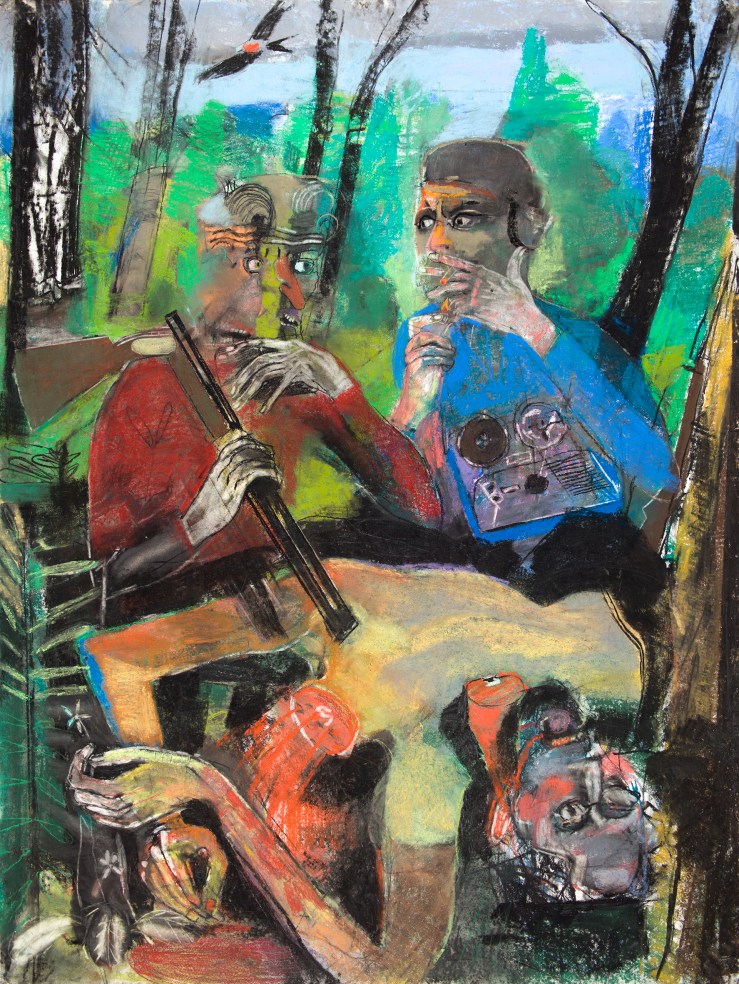
Gregory Klassen, First Day of the Season, 2023

The Fall/Winter 2023 issue of Evergreen Review includes an “Sorokin and the Rest of Us,” an essay by Svetlana Satchkova on Vladimir Sorokin.

The essay includes a number of illustrations by Gregory Klassen, who illustrated Max Lawton’s translation of Sorokin’s shocking novel Their Four Hearts.

From “Sorokin and the Rest of Us”:

Why is Sorokin in a class by himself? Why is he the only contemporary Russian writer who takes these kinds of risks? If we imagine Russian literature as earth with the sky above, Sorokin would be sitting up on a cloud together with Tolstoy and Chekhov, while the rest of us––his Russian contemporaries––would be confined to the earth’s surface, maybe some of us having risen as high as the tenth floor of a building. Present-day Russian literature isn’t very original and is forever ripping off Anglophone fiction. This matter is personal to me, since I’m a Russian writer myself or at least I was before I made the United States my home and started writing in English.

So I don’t mean to praise Sorokin as much as I mean to ask: why are we as a whole not more interesting? There must be reasons for this that have to do with the soul, with imagination, and with courage––and also with history and the current milieu. What has prevented me from being a writer like Sorokin? Would I even want to be?

“Edgy Pleasures” — William T. Vollmann

“Edgy Pleasures”

by

William T. Vollmann


The most significant characteristic of the lovely nineteenth-century Indian daggers I collect is their blunt edges. Their purpose, in short, is to symbolize the power and authority of weapons, much like an officer’s pistol or even a policeman’s uniform. They are talismanic, like a crucifix or a Platonic form. Evidently, beauty was an absolute requirement in their crafting, since any such dagger was metonymic with the official function of a maharaja, whose life had to symbolize perfection to the rest of society. What purpose now? The maharajas are impoverished, and even such distant cousins of these daggers as bayonets are frequently used. For acts of war, we have our bombs, flying machines, crawling machines, swimming machines; for acts of legislation, the truncheon and the gun; for acts of atrocity, again the gun. Thus, these daggers are doubly removed from sharpness. It is emblematic that the little store in Udaipur that sold them (lubricated well with coconut oil, wrapped in bundles of old newspaper) was equally forward in displaying jointed silverfish made up of many small pieces more complex than bones. This made the daggers seem even more beautifully useless, metonymic still of the maharaja but only the Maharaja of Astonishment—for instance, Sawai Madho Singh I, who was reputedly seven feet tall and four feet wide.

In Jaipur, I saw his maharani’s eighteen-pound dress. “That must have been heavy,” I said. The guide smiled. “The Indian women don’t feel the weight when it’s real gold,” he said. The real gold of these daggers is, of course, their craftsmanship. The longer I handle the smooth, yellow ivory of that camel’s head or peer into the checkered gape of that flower-inlaid tiger, the more I perceive this and the more fairylike the pieces become. I have seen the maharaja’s sun emblem: It was composed of muskets raying outward from sacredness. Surely these muskets were never fired. How blasphemous it would have been to wrench off a ray from the sun! I went to another palace, whose wooden gates were forty feet high. I saw the high window where the maharani used to welcome her husband with rose flowers. I passed through green-bordered receding arches like the leaves of artichokes. Now: the Hall of Glory. The ceiling was inlaid with silvered glass in tiny, complex pieces to shimmer a million reflected flames of a single candle. Skeletons dazzled me in the perforated marble screens. But the guide said, “Before, the maharaja had elephants. Now, not a single one!” No utility anywhere. Consider the so-called tiger knife, which is shaped like the letter A with two horizontals. The hand grips one of them: The legs of the A curve inward into parallels to enclose the wrist and lock it. The tiger comes; the point of the A stabs him; he falls dead. Functional, no doubt. But many of these tiger knives—old ones gilded, damascened, tawny-striped like tigers— are for sale. A good one goes for $3,000 (less, of course, if you bargain, cash in hand). A maharaja had placed it on consignment. The maharajas sell things incognito, I heard; the maharajas are ashamed. Sometimes, to decrease the likelihood that the knives will be recognized as theirs, they sell to distant provinces, even though there’s less money that way. This is how it must be. Recently, an art connoisseur came to buy Mogul miniatures. He asked a maharaja if anything was for sale. The maharaja said no, but if the man was serious, he knew another noble who might sell. It had to be understood, however, that the connoisseur would never meet him or learn his name. What is a tiger knife without its maharaja? And, indeed, the matter is worse, much worse, for in Udaipur I saw towers alone and incongruous upon the desert hills. Sentries used to watch there for tigers, but that was when there were still forests. The trees are all burned now. What use, then, a tiger knife? No matter whether any blade is sharp.


From a 1996 Esquire feature called “My Favorite Things.” The feature also included Charles M. Schulz, Francis Ford Coppola, David Lee Roth, Wayne Gretzky, Susan Sontag, John Travolta and many other folks on their favorite thing.

Mass culture reflects the American bewilderment in the face of the world we live in | James Baldwin

What the mass culture really reflects…is the American bewilderment in the face of the world we live in. We do not seem to want to know that we are in the world, that we are subject to the same catastrophes, vices, joys, and follies which have baffled and afflicted mankind for ages. And this has everything to do, of course, with what was expected of America: which expectation, so generally disappointed, reveals something we do not want to know about sad human nature, reveals something we do not want to know about the intricacies and inequities of any social structure, reveals, in sum, something we do not want to know about ourselves. The American way of life has failed—to make people happier or to make them better. We do not want to admit this, and we do not admit it. We persist in believing that the empty and criminal among our children are the result of some miscalculation in the formula (which can be corrected); that the bottomless and aimless hostility which makes our cities among the most dangerous in the world is created, and felt, by a handful of aberrants; that the lack, yawning everywhere in this country, of passionate conviction, of personal authority, proves only our rather appealing tendency to be gregarious and democratic. We are very cruelly trapped between what we would like to be and what we actually are. And we cannot possibly become what we would like to be until we are willing to ask ourselves just why the lives we lead on this continent are mainly so empty, so tame, and so ugly.

This is a job for the creative artist—who does not really have much to do with mass culture, no matter how many of us may be interviewed on TV. Perhaps life is not the black, unutterably beautiful, mysterious, and lonely thing the creative artist tends to think of it as being; but it is certainly not the sunlit playpen in which so many Americans lose first their identities and then their minds.

I feel very strongly, though, that this amorphous people are in desperate search for something which will help them to re-establish their connection with themselves, and with one another. This can only begin to happen as the truth begins to be told. We are in the middle of an immense metamorphosis here, a metamorphosis which will, it is devoutly to be hoped, rob us of our myths and give us our history, which will destroy our attitudes and give us back our personalities. The mass culture, in the meantime, can only reflect our chaos: and perhaps we had better remember that this chaos contains life—and a great transforming energy.

From James Baldwin’s 1959 essay “Mass Culture and the Creative Artist: Some Personal Notes,” collected in The Cross of Redemption.

[Ed. note–the elision in the first sentence of this excerpt is mine; I chose to remove a parenthetical aside that Baldwin makes to Archibald MacLeish’s 1958 play J.B. Here is the first line in full: “What the mass culture really reflects (as is the case with a “serious” play like J.B.) is the American bewilderment in the face of the world we live in.”]

Portrait of James Baldwin — Beauford Delaney

Portrait of James Baldwin, 1965 by Beauford Delaney (1901-79)

“It was a lone tree burning on the desert” | Blood Meridian’s Moral Core

Cormac McCarthy’s Blood Meridian begins as a strange, violent picaresque bildungsroman, detailing the adventures of a teenage runaway known only as “the kid.” When the Kid falls in with John Glanton’s marauders, the narrative lens expands and pulls back; Glanton’s gang essentially envelopes the Kid’s personality. The pronoun “they” dominates the Kid’s own agency, for the most part, and the massive figure of Judge Holden usurps the narrative’s voice. The effect is that the Glanton gang’s killing, raping, and scalping spree becomes essentially de-personalized, and, to a certain extent, amoralized.

The Kid, and perhaps the ex-priest Tobin and the Kid’s erstwhile partner Toadvine, are the only major characters who bear any semblance of conventional morality in the narrative. The Kid exhibits a willingness to help others early on when he agrees to stitch one of Tobin’s wounds; later, he removes an arrowhead from a wounded man when no other member of the company will (Tobin chides him for caring, declaring that the wounded man would have killed the Kid had the Kid’s efforts been unsuccessful). For most of the central narrative though, the Kid’s individual actions are consumed into the gang’s “they.” However, at the beginning of chapter 15 the narrative focuses again on the Kid, who is charged with killing a wounded man named Shelby to “spare” him from the approaching Mexican army (this is a bizarre version of mercy in Blood Meridian). Shelby pleads to live and the Kid allows it, even giving the man some water from his own canteen. After he leaves he catches up with a man named Tate whose horse is wounded. Tate remarks on the boy’s foolishness for helping him, but the Kid does so nonetheless, sharing Tate’s burden as they try to make their way back to the rest of their party. Tate is soon killed by Mexican scouts. In both cases, the outcome of the Kid’s moral actions–the will to help, to save, to preserve life–are negated by the book’s narrative outcomes, but I would argue that his intentions in the face of violence somehow secure his humanity.

His journey alone to rejoin the Glanton gang is figured as a kind of vision quest, a strange echo of Christ in the desert, perhaps. At its core–and perhaps the moral core of the book–is the following strange passage–

It was a lone tree burning on the desert. A herladic tree that the passing storm had left afire. The solitary pilgrim drawn up before it had traveled far to be here and he knelt in the hot sand and held his numbed hands out while all about in that circle attended companies of lesser auxiliaries routed forth into the inordinate day, small owls that crouched silently and stood from foot to foot and tarantulas and solpugas and vinegarroons and the vicious mygale spiders and beaded lizards with mouths black as a chowdog’s, deadly to man, and the little desert basilisks that jet blood from their eyes and the small sandvipers like seemly gods, silent and the same, in Jedda, in Babylon. A constellation of ignited eyes that edged the ring of light all bound in a precarious truce before the torch whose brightness had set back the stars in their sockets.

The burning tree alludes to YHWH’s appearance to Moses as a burning bush, and also the tree of smoke that led the Israelites through the desert. Significantly, all the strange, terrible creatures of the desert come to meet around it in a “precarious truce.” The burning tree inverts the natural, inescapable violence that dominates the novel and turns it into a solitary, singular moment of peace. When the Kid awakes–alone–the tree is merely a “smoldering skeleton of a blackened scrog.” God is not in the permanence of the object but rather in the witnessing of the event–Blood Meridian locates (a version of a) god in the natural violence of burning and consumption. There is a strong contrast here, I believe, with the book’s other version of god, the Judge’s proclamation that “War is god.” The Judge, a cunning, devilish trickster, wants to reduce (or enlarge) war to all contest of wills, to pure violence–to divorce it from any ideological structure. Yet the burning tree episode reveals natural violence divorced from ideology. The animals (and the man, the Kid) suspend their Darwinian animosities in order to witness the sublime. The episode is silent, outside of language, order, ideology. This silence is echoed in the novel’s final confrontation between the Judge and the Kid, who retorts simply “You ain’t nothin'” to the Judge’s barrage of grandiose language. While the rejoinder may not save the Kid, its rejection perhaps saves his soul (if such a thing exists in the novel, which I believe it does). So, while larger-than-life Judge Holden may dominate the novel, Cormac McCarthy has nonetheless given us another moral road to follow, should we choose.

[Ed. note—Biblioklept first published a version of this post in October, 2010.]

“Books are made out of books” | Blood Meridian and Samuel Chamberlain

In his 1992 interview with The New York Times, Cormac McCarthy said, “The ugly fact is books are made out of books. The novel depends for its life on the novels that have been written.” McCarthy’s masterpiece Blood Meridian, as many critics have noted, is made of some of the finest literature out there–the King James Bible, Moby-Dick, Dante’s Inferno, Paradise Lost, Faulkner, and Shakespeare. While Blood Meridian echoes and alludes to these authors and books thematically, structurally, and linguistically, it also owes much of its materiality to Samuel Chamberlain’s My Confession: The Recollections of a Rogue.

Chamberlain, much like the Kid, Blood Meridian’s erstwhile protagonist, ran away from home as a teenager. He joined the Illinois Second Volunteer Regiment and later fought in the Mexican-American War. Confession details Chamberlain’s involvement with John Glanton’s gang of scalp-hunters. The following summary comes from the University of Virginia’s American Studies webpage

According to Chamberlain, John Glanton was born in South Carolina and migrated to Stephen Austin’s settlement in Texas. There he fell in love with an orphan girl and was prepared to marry her. One day while he was gone, Lipan warriors raided the area scalping the elderly and the children and kidnapping the women- including Glanton’s fiancee. Glanton and the other settlers pursued and slaughtered the natives, but during the battle the women were tomahawked and scalped. Legend has it, Glanton began a series of retaliatory raids which always yielded “fresh scalps.” When Texas fought for its independence from Mexico, Glanton fought with Col. Fannin, and was one of the few to escape the slaughter of that regiment at the hands of the Mexican Gen. Urrea- the man who would eventually employ Glanton as a scalp hunter. During the Range Wars, Glanton took no side but simply assassinated individuals who had crossed him. He was banished, to no avail, by Gen. Sam Houston and fought as a “free Ranger” in the war against Mexico. Following the war he took up the Urrea’s offer of $50 per Apache scalp (with a bonus of $1000 for the scalp of the Chief Santana). Local rumor had it that Glanton always “raised the hair” of the Indians he killed and that he had a “mule load of these barbarous trophies, smoke-dried” in his hut even before he turned professional.
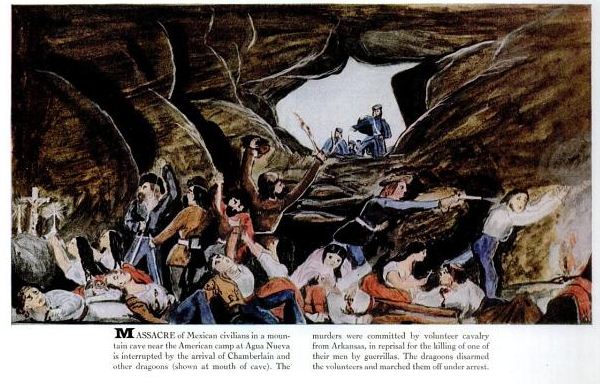
Chamberlain’s Confession also describes a  figure named Judge Holden. Again, from U of V’s summary–

Glanton’s gang consisted of “Sonorans, Cherokee and Delaware Indians, French Canadians, Texans, Irishmen, a Negro and a full-blooded Comanche,” and when Chamberlain joined them they had gathered thirty-seven scalps and considerable losses from two recent raids (Chamberlain implies that they had just begun their careers as scalp hunters but other sources suggest that they had been engaged in the trade for sometime- regardless there is little specific documentation of their prior activities). Second in command to Glanton was a Texan- Judge Holden. In describing him, Chamberlain claimed, “a cooler blooded villain never went unhung;” Holden was well over six feet, “had a fleshy frame, [and] a dull tallow colored face destitute of hair and all expression” and was well educated in geology and mineralogy, fluent in native dialects, a good musician, and “plum centre” with a firearm. Chamberlain saw him also as a coward who would avoid equal combat if possible but would not hesitate to kill Indians or Mexicans if he had the advantage. Rumors also abounded about atrocities committed in Texas and the Cherokee nation by him under a different name. Before the gang left Frontreras, Chamberlain claims that a ten year old girl was found “foully violated and murdered” with “the mark of a large hand on her throat,” but no one ever directly accused Holden.

It’s fascinating to note how much of the Judge is already there–the pedophilia, the marksmanship, the scholarship, and, most interesting of all, the lack of hair. Confession goes on to detail the killing, scalping, raping, and raiding spree that comprises the center of Blood Meridian. Chamberlain even describes the final battle with the Yumas, an event that signals the dissolution of the Glanton gang in McCarthy’s novel.

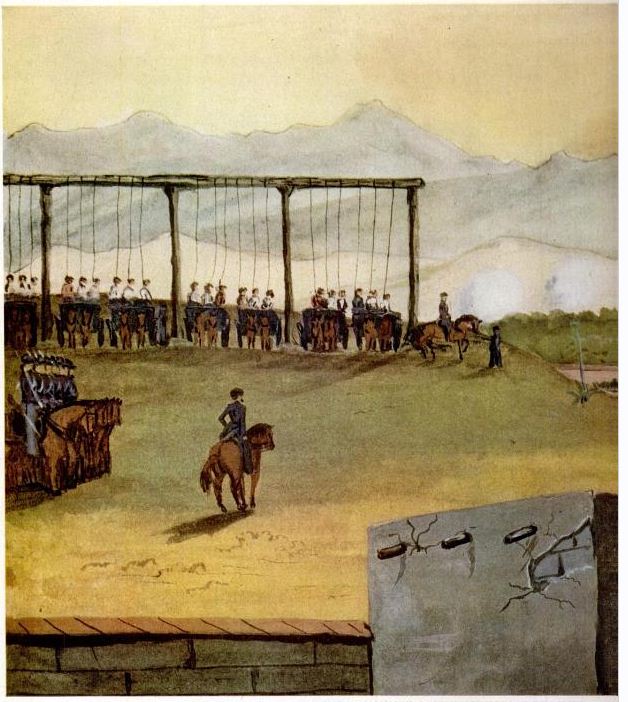
Content aside, Chamberlain’s prose also seems to presage McCarthy’s prose. In his book Different Travelers, Different Eyes, James H. Maguire notes that, “Both venereal and martial, the gore of [Chamberlain’s] prose evokes Gothic revulsion, while his unschooled art, with its stark architectural angles and leaden, keen-edged shadows, can chill with the surreal horrors of the later Greco-Italian painter Giorgio de Chirico.” Yes, Chamberlain was an amateur painter (find his paintings throughout this post), and undoubtedly some of this imagery crept into Blood Meridian.

You can view many of Chamberlain’s paintings and read an edit of his Confession in three editions of Life magazine from 1956, digitally preserved thanks to Google Books–here’s Part I, Part II, and Part III. Many critics have pointed out that Chamberlain’s narrative, beyond its casual racism and sexism, is rife with factual and historical errors. He also apparently indulges in the habit of describing battles and other events in vivid detail, even when there was no way he could have been there. No matter. The ugly fact is that books are made out of books, after all, and if Chamberlain’s Confession traffics in re-appropriating the adventure stories of the day, at least we have Blood Meridian to show for his efforts.
[Ed. note–Biblioklept first ran this post in September of 2010.]

Suttree, Cormac McCarthy’s Grand Synthesis of American Literature

In his 1992 interview with The New York Times, Cormac McCarthy said, “The ugly fact is books are made out of books. The novel depends for its life on the novels that have been written.” McCarthy’s fourth novel, 1979’s Suttree is such a book, a masterful synthesis of the great literature — particularly American literature — that came before it. And like any masterful synthesis, Suttree points to something new, even as it borrows, lifts, and outright steals from the past. But before we plumb its allusions and tropes and patterns, perhaps we should overview the plot, no?

The novel rambles over several years in the life of Cornelius Suttree. It is the early 1950s in Knoxville, Tennessee, and Suttree ekes out a mean existence on the Tennessee River as a fisherman, living in a ramshackle houseboat on the edge of a shantytown. This indigent life is in fact a choice: Suttree is the college-educated son of an established, wealthy family. His choice is a choice for freedom and self-reliance, those virtues we like to think of, in our prejudicial manner, as wholly and intrinsically American. Suttree then is both Emersonian and Huck Finnian, a reflective and insightful man who finds his soul via a claim to agency over his own individuality, an individuality poised in quiet, defiant rebellion against the conforming forces of civilization. These forces manifest most pointedly in the Knoxville police, a brutal, racist organization, but we also see social constraint in the form of familial duty. One thinks of the final lines of Huckleberry Finn: “I reckon I got to light out for the Territory ahead of the rest, because Aunt Sally she’s going to adopt me and sivilize me and I can’t stand it. I been there before.”

Like Huck, Suttree aims to resist all forces that would “sivilize” him. His time on the river and in the low haunts of Tennessee (particularly the vice-ridden borough of McAnally) brings him into close contact with plenty of other outcasts, but also his conscience, which routinely mulls over its place in the world. Suttree is punctuated by–perhaps even organized by–several scenes of hallucination. Some of these psychotrips result from drunkeness, one comes from accidentally ingesting the wrong kind of mushrooms (or, the right kind, if that’s your thing), and the final one, late in the novel, sets in as Suttree suffers from a terrible illness. In his fever dream, a small nun–surely a manifestation of the guilt that would civilize us–accuses him–

Mr. Suttree it is our understanding that at curfew rightly decreed by law in that hour wherein night draws to its proper close and the new day commences and contrary to conduct befitting a person of your station you betook yourself to various low places within the shire of McAnally and there did squander several ensuing years in the company of thieves, derelicts, miscreants, pariahs, poltroons, spalpeens, curmudgeons, clotpolls, murderers, gamblers, bawds, whores, trulls, brigands, topers, tosspots, sots and archsots, lobcocks, smellsmocks, runagates, rakes, and other assorted and felonious debauchees.

The passage is a marvelous example of McCarthy’s stream-of-consciousness technique in Suttree, moving through the various voices that would ventriloquize Suttree, into the edges of madness, strangeness, and the sublimity of language. The tone moves from somber and portentous into bizarre imagery that blends humor and pathos. This is the tone of Suttree, a language that gives voice to transients and miscreants, affirming the dignity of their humanity even as it details the squalor of their circumstance.

It is among these criminals and whores, transvestites and gamblers that Suttree affirms his own freedom and humanity, a process aided by his comic foil, Gene Harrogate. Suttree meets Harrogate on a work farm; the young hillbilly is sent there for screwing watermelons. After his release, Harrogate moves to a shantytown in Knoxville. He’s the country mouse determined to become the city rat, the would-be Tom Sawyer to Suttree’s older and wiser Huck Finn. Through Harrogate’s endless get-rich-quick schemes, McCarthy parodies that most-American of tales, the Horatio Alger story. Simply put, the boy is doomed, on his  “way up to the penitentiary” as Suttree constantly admonishes. In one episode, Harrogate tries to buy arsenic from “a grayhaired and avuncular apothecary” to poison bats he hopes to sell to a hospital (don’t ask)–

May I help you? said the scientist, his hands holding each other.

I need me some strychnine, said Harrogate.

You need some what?

Strychnine. You know what it is dont ye?

Yes, said the chemist.

I need me about a good cupful I reckon.

Are you going to drink it here or take it with you?

Shit fire I aint goin to drink it. It’s poisoner’n hell.

It’s for your grandmother.

No, said Harrogate, craning his neck suspectly. She’s done dead

Suttree, unwilling father-figure, eventually buys the arsenic for the boy against his better judgment. The scene plays out as a wonderful comic inversion of William Faulkner’s “A Rose for Emily,” from which it is so transparently lifted. McCarthy borrows liberally from Faulkner here, of course, most notably in the language and style of the novel, but also in scenes like this one, or a later episode that plays off Faulkner’s comic-romantic story of a man and a woman navigating the aftermath of a flood, “Old Man.” Unpacking the allusions in Suttree surpasses my literary knowledge or skill, but McCarthy is generous, if oblique, with his breadcrumb trail. Take, for example, the following sentence: “Suttree with his miles to go kept his eyes to the ground, maudlin and muttersome in the bitter chill, under the lonely lamplight.” The forced phrase “miles to go” does not immediately present itself as a reference to Robert Frost’s famous poem, yet the direction of the sentence retreats into the history of American poetry; with its dense alliteration and haunted vowels, it leads us into Edgar Allan Poe territory. Only a few dozen pages later, McCarthy boldly begins a chapter with theft: “In just spring the goatman came over the bridge . . .” The reference to e.e. cummings explicitly signifies McCarthy’s intentions to play with literature. Later in the book, while tripping on mushrooms in the mountains, Suttree is haunted by “elves,” the would-be culprits in Frost’s poem “Mending Wall.” The callback is purposeful, but tellingly, McCarthy’s allusions are not nearly as fanciful as their surface rhetoric might suggest: the goatman does not belong in Knoxville–he’s an archaic relic, forced out of town by the police; the elves are not playful spirits but dark manifestations of a tortured psyche.

Once one spots the line-lifting in Suttree it’s hard to not see it. What’s marvelous is McCarthy’s power to convert these lines, these riffs, these stories, into his own tragicomic beast. An early brawl at a roadhouse recalls the “Golden Day” episode of Ralph Ellison’s Invisible Man; a rape victim’s plight echoes Hubert Selby’s “Tralala”; we find the comic hobos of John Steinbeck’s Cannery Row–we even get the road-crossing turtle from The Grapes of Wrath. A later roadhouse chapter replays the “Circe/Nighttown” nightmare in James Joyce’s Ulysses. Ulysses is an easy point of comparison for Suttree, which does for Knoxville what Joyce did for Dublin. Suttree echoes Ulysses’s language, both in its musicality and appropriation of varied voices, as well as its ambulatory structure, its stream-of-consciousness technique, its rude earthiness, and its size (nearly 600 pages). But, as I argued earlier, there’s something uniquely American about Suttree, and its literary appropriations tend to reflect that. Hence, we find Mark Twain, Herman Melville, Ernest Hemingway, Walt Whitman, Emerson and Thoreau, Emily Dickinson, and William Carlos Williams, to name just a few writers whose blood courses through this novel (even elegant F. Scott Fitzgerald is here, in an unexpected Gatsbyish episode late in the novel).

Making a laundry list of writers is weak criticism though, and these sources–all guilty of their own proud plagiarisms–are mentioned only as a means to an end, to an argument that what McCarthy does in Suttree is to synthesize the American literary tradition with grace and humor, while never glossing over its inherent dangers and violence. So, while it appropriates and plays with the tropes of the past, Suttree is still pure McCarthy. Consider the following passage, which arrives at the end of a drunken, awful spree, Suttree locked up for the night–

He closed his eyes. The gray water that dripped from him was rank with caustic. By the side of a dark dream road he’d seen a hawk nailed to a barn door. But what loomed was a flayed man with his brisket tacked open like a cooling beef and his skull peeled, blue and bulbous and palely luminescent, black grots his eyeholes and bloody mouth gaped tonguless. The traveler had seized his fingers in his jaws, but it was not alone this horror that he cried. Beyond the flayed man dimly adumbrate another figure paled, for his surgeons move about the world even as you and I.

Suttree’s dark vision points directly toward the language of McCarthy’s next novel, 1985’s Blood Meridian, roundly considered his masterpiece. Critics who disagree tend to point to Suttree as the pinnacle of McCarthy’s writing. I have no interest at this time in weighing the books against each other, nor do I think that doing so would be especially enlightening. For all of their sameness, they are very different animals: Suttree provides us intense access to its hero’s consciousness, where Blood Meridian always keeps the reader on the outside of its principals’ souls (if those grotesques could be said to have souls). And while Blood Meridian does display some humor, it is the blackest and driest humor I’ve ever read. Suttree is broader and more compassionate; it even has a fart joke. Blood Meridian, at least in my estimation (and many critics will contend this notion) has no flawed episodes; much of this results from the book’s own internal program–it resists love, compassion, and even human dignity. In contrast, Suttree is punctuated by two deaths the audience is meant to read as tragic, yet I found it impossible to do so. The first is the death of Suttree’s child, whom he has abandoned, along with its mother. As such, he is not permitted to take part in the funeral, observing the process rather from its edges. The second tragedy is the death of Suttree’s young lover in a landslide. The book begs us to empathize with Suttree, just as he often empathizes with the marginal figures in the novel, but ultimately these tragedies are a failed ploy. They underwrite a sublime encounter with death for Suttree, an encounter that deepens and enriches his character while paradoxically freeing him from the burdens of social duty and familial order. McCarthy is hardly alone in such a move; indeed, it seems like the signature trope of American masculine literature to me. It’s the move that Huck Finn wishes to make when he promises to light out for the Territory to escape the civilizing body of Aunt Sally; it’s the ending that Hemingway was compelled to give to Frederic Henry at the end of A Farewell to Arms; it’s all of Faulkner, with his mortification of fatherhood and the dramatic responsibility fatherhood entails. It is a cost analysis that neglects any potential benefits.

But these are small criticisms of a large, beautiful, benevolent novel, a book that begs to be reread, a rambling picaresque of comic and tragic proportions. “I learned that there is one Suttree and one Suttree only,” our hero realizes, but this epiphany is set against a larger claim. Near the end of the novel, Suttree goes to check on an old ragman who he keeps a watchful eye on. He finds the man dead, his shack robbed, his body looted. Despairing over the spectacle’s abject lack of humanity, Suttree cries, “You have no right to represent people this way,” for “A man is all men. You have no right to your wretchedness.” Here, Suttree’s painful epiphany is real and true, an Emersonian insight coded in the darkest of Whitman’s language. If there is one Suttree and one Suttree only, he is still beholden to all men; to be anti-social or an outcast is not to be anti-human. Self-hood is ultimately conditional on others and otherness. To experience the other’s wretchedness is harrowing; to understand the other’s wretchedness and thus convert it to dignity is life-affirming and glorious. Suttree is a brilliant, bold, marvelous book. Very highly recommended.

[Ed. note—Biblioklept originally published a version of this review on November 27, 2010].


 “A Note on the Word Gubernatorial” — Lydia Davis

“A Note on the Word Gubernatorial”

by

Lydia Davis


Gubernatorial: Even though I have never used it in a story, and probably never will, this word has always fascinated and pleased me because of its odd divergence from its noun, governor. Why did the noun and the adjective develop in different directions? The adjective is actually closer to the origin of both, which was the Latin gubernator, “governor,” and gubernare, “to steer.” The original, primary meaning of “to govern” was “to steer.” In fact, there is a maritime word in French, gouvernail, that means “rudder,” or “helm”—what we need to steer a boat. The Latin gubernator evolved into the Old French gouverneur and hence, eventually, into our English governor—our governor is one who steers the metaphorical ship of state. (The Latin also evolved into the Spanish gobernador—keeping the b—and the Italian governatore.)

But of course it is all more complicated, as the development of language always is: the English word gubernator, meaning “ruler,” was also in use starting in the 1520s, though it was rare—and so was gubernatrix, meaning a female ruler. Gubernator disappeared from use and governor remained. I do not know why our adjective did not evolve in the same way as our noun. Why did it not turn into governatorial or governorial? Simply because it was not spoken as often?

I have always enjoyed pronouncing gubernatorial, as though its rather crude sound, incorporating two voiced plosives and the word “goober,” is concealing its more elegant, softer, silkier cousin, “govern.” Gubernatorial swings us closer to our Spanish friends, governor to our Italian. During the U.S. presidency of Jimmy Carter, former governor of Georgia, there was much talk of his association with the cultivation of peanuts (colloquially known as “goobers”); thus, goober-natorial, as applied to the office of the governor of the Peanut State, was doubly appropriate.

“Mothers” — William Gaddis

“Mothers”

by

William Gaddis

When Ralph Waldo Emerson informed—or rather, perhaps, warned us—that we are what our mothers made us, we might dismiss it as received opinion and let it go at that, like the broken clock which is right twice a day, like the self-evident answer contained in Freud’s oft-quoted query “What do women want?” when, as nature’s handmaid, she must want what nature wants which is, quite simply, More. But which woman? Whose mother, Emerson’s? A woman so in thrall to religion that we confront another dead end; or Freud’s? or even one’s own, even mine, offering an opportune bit of wisdom to those of us engaged in the creative arts, where paranoia is almost an occupational hazard: “Bill, just try to remember,” she said, “there is much more stupidity than there is malice in the world,” an observation lavish with possibilities recalling Anatole France finding the fool more dangerous than the rogue because “the rogue does at least take a rest sometimes, the fool never.”

This is hardly to see stupidity and malice as mutually exclusive: look at your morning paper, where their combined forces explode exponentially (women and children first) from Bosnia to Belfast, unlike the international “intelligence community” so self-contained in its malice-free exercises that it generally ensnares only its own dubious cast of players. Of further importance is the distinction between stupidity and ignorance, since ignorance is educable, while stupidity’s self-serving mission is the cultivation and exploitation of ignorance, as politicians are keenly aware.

How, then, might Emerson’s mother have seen herself stumbling upon Thomas Carlyle’s vision of her son as a “hoary-headed and toothless baboon”? Or Freud’s, in the gross unlikelihood of her reading the Catholic World’s review of her son’s book Moses and Monotheism as “poorly written, full of repetitions . . . and spoiled by the author’s atheistic bias and his flimsy psychoanalytic fancies”? Goethe’s Wilhelm Meister dismissed as “sheer nonsense” by the Edinburgh Review and, a good century later, the hero of Saul Bellow’s Dangling Man ridiculed as a “pharisaical stinker” in Time magazine, John Barth’s The End of the Road recommended by Kirkus Reviews “for those schooled in the waste matter of the body and the mind,” and William Faulkner’s Absalom, Absalom! shrugged off as the “final blowup of what was once a remarkable, if minor, talent” by The New Yorker magazine where, just forty years later, “a group of avant-garde critics has put forward the idea that books should be made unreadable. This movement has manifest advantages. Being unreadable, the text repels reviewers, critics, anthologists, academic literati, and other parasitical forms of life,” indicting the author of the novel J R wherein “to produce an unreadable text, to sustain this foxy purpose over 726 pages, demands rare powers. Mr. Gaddis has them.” “You’re a fool, a fool!” the distraught mother of Dostoevski’s ill-fated hero Nikolay Stavrogin cries out at the “parasitical forms of life” surrounding her. “You’re all ungrateful fools. Give me my umbrella!”

(“Mothers” is collected in The Rush to Second Place).

Culte de la mayonnaise (Thomas Pynchon)

THE NEXT TIME he saw Pléiade Lafrisée was at a café-restaurant off the Place d’Armes. It would not occur to him until much later to wonder if she had arranged the encounter. She was in pale violet peau de soie, and a hat so beguiling that Kit was only momentarily surprised to find himself with an erection. It was still early in the study of these matters, only a few brave pioneers like the Baron von Krafft-Ebing had dared peep into the strange and weirdly twilit country of hat-fetishism—not that Kit noticed stuff like that ordinarily, but it happened actually to be a gray toque of draped velvet, trimmed with antique guipure, and a tall ostrich plume dyed the same shade of violet as her dress. . . .

“This? One finds them in every other midinette’s haunt, literally for sous.”

“Oh. I must’ve been staring. What happened to you the other night?”

“Come. You can buy me a Lambic.”

The place was like a museum of mayonnaise. This being just at the height of the culte de la mayonnaise then sweeping Belgium, oversize exhibits of the ovoöleaginous emulsion were to be encountered at every hand. Heaps of Mayonnaise Grenache, surrounded by plates of smoked turkey and tongue, glowed redly as if from within, while with less, if any, reference to actual food it might have been there to modify, mountains of Chantilly mayonnaise, swept upward in gravity-impervious peaks insubstantial as cloud, along with towering masses of green mayonnaise, basins of boiled mayonnaise, mayonnaise baked into soufflés, not to mention a number of not entirely successful mayonnaises, under some obscure attainder, or on occasion passing as something else, dominated every corner.

“How much do you know of La Mayonnaise?” she inquired.

He shrugged. “Maybe up to the part that goes ‘Aux armes, citoyens’—”

But she was frowning, earnest as he had seldom seen her. “La Mayonnaise,” Pléiade explained, “has its origins in the moral squalor of the court of Louis XV—here in Belgium the affinity should not be too surprising. The courts of Leopold and Louis are not that different except in time, and what is time? Both monumentally deluded men, maintaining their power through oppression of the innocent. One might usefully compare Cleo de Mérode and the marquise de Pompadour. Neuropathists would recognize in both kings a desire to construct a self-consistent world to live inside, which allows them to continue the great damage they are inflicting on the world the rest of us must live in.

“The sauce was invented as a new sensation for jaded palates at court by the duc de Richelieu, at first known as mahonnaise after Mahon, the chief port of Minorca, the scene of the due’s dubious ‘victory’ in 1756 over the illfated Admiral Byng. Basically Louis’s drug dealer and pimp, Richelieu, known for opium recipes to fit all occasions, is also credited with the introduction into France of the cantharides, or Spanish fly.” She gazed pointedly at Kit’s trousers. “What might this aphrodisiac have in common with the mayonnaise? That the beetles must be gathered and killed by exposing them to vinegar fumes suggests an emphasis on living or recently living creatures—the egg yolk perhaps regarded as a conscious entity—cooks will speak of whipping, beating, binding, penetration, submission, surrender. There is an undoubtedly Sadean aspect to the mayonnaise. No getting past that.”

Kit was a little confused by now. “It always struck me as kind of, I don’t know . . . bland?”

“Until you look within. Mustard, for example, mustard and cantharides, n’estce pas? Both arousing the blood. Blistering the skin. Mustard is the widelyknown key to resurrecting a failed mayonnaise, as is the cantharides to reviving broken desire.”

“You’ve been thinking about mayonnaise a lot, mademoiselle.”

“Meet me tonight,” a sudden fierce whisper, “out at the Mayonnaise Works, and you shall perhaps understand things it is given only to a few to know. There will be a carriage waiting.” She pressed his hand and was gone in a mist of vetiver, abruptly as the other evening.

A passage from Thomas Pynchon’s novel Against the Day; I don’t think you need any context to appreciate this passage.


There is a little tale about man’s fate, and this is the way it is put | Joy Williams

There is a little tale about man’s fate, and this is the way it is put. A man is being pursued by a raging elephant and takes refuge in a tree at the edge of a fearsome abyss. Two mice, one black and one white, are gnawing at the roots of the tree, and at the bottom of the abyss is a dragon with parted jaws. The man looks above and sees a little honey trickling down the tree, and he begins to lick it up and forgets his perilous situ- ation. But the mice gnaw through the tree and the man falls down and the elephant seizes him and hurls him over to the dragon. Now, that elephant is the image of death, which pur- sues men, and the tree is this transitory existence, and the mice are the days and the nights, and the honey is the sweetness of the passing world, and the savor of the passing world diverts mankind. So the days and nights are accomplished and death seizes him and the dragon swallows him down into hell and this is the life of man.

This little tale with its broad and beasty strokes seems to approximate man’s dilemma quite charmingly, with the caveat that it also applies to the ladies (“she” being “he” throughout here, the writer’s woes not limited by gender; like Flannery O’Connor’s Misfit, the writer knows there’s no enjoyment to be had in this life). This is the story, then, pretty much the story, with considerable latitude to be had in describing those mice, those terrifying mice. But it is not for the writer to have any part in providing the honey—the passing world does that. The writer can’t do better than that. What the writer wants to be is the consciousness of the story, he doesn’t want to be part of the distraction; to distract is ignoble, to distract is to admit defeat, to serve a lesser god. The story is not a simple one. It is syncretistic and strange and unhappy, and it all must be told beautifully, even the horrible parts, particularly the horrible parts. The telling of the story can never end, not because the writer doesn’t like the way it must end but because there is no end to the awareness of the story, which the writer has only the dimmest, most fragmentary knowledge of.

From Joy Williams’ essay “Why I Write.” Collected in Ill Nature.