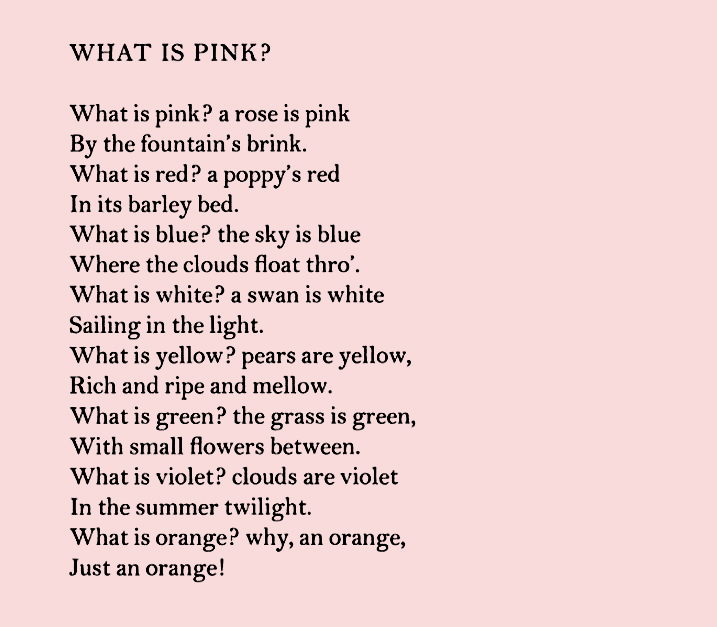
“What Is Pink?” — Christina Rossetti

Capture

“I stole a book” (Clarice Lispector)

The moment her aunt went to pay for her purchases, Joana removed the book and slipped it furtively between the others she was carrying under her arm. Her aunt turned pale.

Once in the street, the woman chose her words carefully:

— Joana.. . Joana, I saw you…

Joana gave her a quick glance. She remained silent.

— But you have nothing to say for yourself? — her aunt could no longer restrain herself, her voice tearful. — Dear God, what is to become of you?

— There’s no need to fuss, Auntie.

— But you’re still a child… Do you realize what you’ve done?

— I know…

— Do you know… do you know what it’s called… ?

— I stole a book, isn’t that what you’re trying to say?

— God help me! I don’t know what I’m going to do, you even have the nerve to own up!

— You forced me to own up.

— Do you think that you can… that you can just go around stealing?

— Well… perhaps not.

— Why do you do it then… ?

— Because I want to.

— You what?

— her aunt exploded.

— That’s right, I stole because I wanted to. I only steal when I feel like it. I’m not doing any harm.

— God help me! So, stealing does no harm, Joana.

— Only if you steal and are frightened. It doesn’t make me feel either happy or sad.

The woman looked at her in despair.

— Look child, you’re growing up, it won’t be long before you’re a young lady… Very soon now you will be wearing your clothes longer… I beg of you: promise me that you won’t do it again, promise me, think of your poor father who is no longer with us.

Joana looked at her inquisitively:

— But I’m telling you I can do what I like, that…

A biblioklept episode from Clarice Lispector’s novel Near to the Wild Heart.


King Lear, Directed by Peter Brook (Full Film)

Dan Brown being humiliated by Herman Melville in a game of crazy golf

Although simply embedding a tweet into a WordPress post and calling that a blog post sets an unfavorable precedent, I cannot not share this.

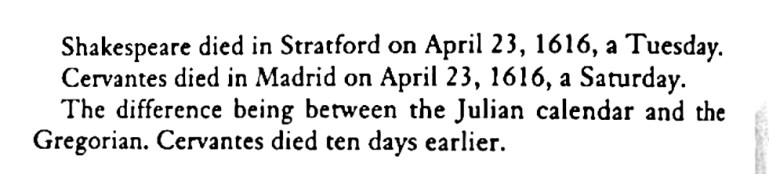
April 23, 1616 (David Markson)

dm


Riff on William Shakespeare

  1. William Shakespeare, the Greatest Living American Author, turns 450 today.
  2. (There may be some, uh, factual, problems with the preceding sentence, but I’ll let it stand).
  3. (After all, to write after Shakespeare requires some gall, a bit of fakery, maybe an outright lie or two).
  4. 450! (Could I even hit 450 points on a riff?)
  5. “Shakespeare invented us,” Harold Bloom repeatedly insists in his big fat book The Western Canon.
  6. (I might be misquoting; the prospect of putting the effort of fact checking into this riff horrifies me).
  7. “Shakespeare—whetting, frustrating, surprising and gratifying,” F. Scott Fitzgerald jotted down in his notebook.
  8. We don’t actually have a record of Shakespeare’s birth, although we do know he was baptized on 26 April 1564.
  9. And died 23 April 1616.
  10. It’s likely that Shakespeare was born on 23 April 1564.
  11. Or, perhaps: There’s something symmetrical, neat, poetic about Shakespeare dying on his birthday.
  12. Ingrid Bergman died on her birthday.
  13. As did Thomas Browne.
  14. As did Yasujrio Ozu.
  15. And, according to tradition: Moses, David, Mohammad.
  16. So why not Shakespeare, born on his deathday?
  17. We want a teleological neatness with Shakespeare: We want his last play to be The Tempest, a tragicomedy that somehow synthesizes all before it; we can claim Prospero a commanding stand-in for Shakespeare.
  18. (These claims overlooking of course that Shakespeare’s last work was likely a forgettable collaboration with John Fletcher, The Two Noble Kinsmen).
  19. The Two Noble Kinsmen was based on Chaucer’s The Knight’s Tale.
  20. (Shakespeare of course “based” his works on other works; the man was not one for original plotting (thank goodness)).
  21. “Chaucer had a deeper knowledge of life than Shakespeare,” claimed Ezra Pound.
  22. “Let the reader contradict that after reading both authors, if he chooses to do so,” he truculently added.
  23. To Coleridge though Shakespeare was “myriad-minded Shakespeare” — Our myriad-minded Shakespeare.
  24. Dryden credited him with “the largest and most comprehensive soul.”
  25. Suggesting also that, “Shakespeare’s magic could not copied be.”
  26. I’m not sure about that.
  27. How many versions of Hamlet have been attempted?
  28. Were not some of these Hamlets magical—magical enough, at least?
  29. Ulysses?
  30. Infinite Jest?
  31. The Lion King?
  32. Oedipus Rex?
  33. David Markson points out somewhere—forgive me for not rising from my fat ass to go verify—that Shakespeare couldn’t possibly have read Sophocles’ Oedipus as there was no English translation yet available.
  34. And how many books did Shakespeare read?
  35. (Chaucer, often credited with a library of sixty).
  36. Speculation, speculation!
  37. Shakespeare Truthers.
  38. Or Anti-Stratfordians—whatever you want to call them.
  39. Walt Whitman was a Shakespeare Truther.
  40. Believing no commoner could write the plays, but “only one of the ‘wolfish earls’ so plenteous in the plays themselves, or some born descendant and knower, might seem to be the true author of those amazing works.”
  41. Amazing that, that Walt Whitman, who could so bombastically conceive himself every man, woman, child, a cosmos, etc.—that he couldn’t credit a commoner with the depth of imagination to produce the plays that Whitman called “greater than anything else in recorded literature.”
  42. David Markson: “Scholars who are convinced that Shakespeare must certainly have been a military man.  Or a lawyer.  Or closely associated with royalty.  Or even a Jew. To which Ellen Terry: Or surely a woman.”
  43. For some Shakespeare Truthers, evidence of his lack of authorship is to be found in the different ways he supposedly signed his name!
  44. Willm Shakp.
  45. William Shakspēr.
  46. Wm Shakspē.
  47. William Shakspere.
  48. Willm Shakspere.
  49. William Shakspeare.
  50. The last of these from his 1616 will, in which he famously bequeathed his second-best bed to his wife Anne Hathaway.
  51. “He was a rich country gentleman, Stephen said, with a coat of arms and landed estate at Stratford and a house in Ireland yard, a capitalist shareholder, a bill promoter, a tithefarmer. Why did he not leave her his best bed if he wished her to snore away the rest of her nights in peace?” Continue reading “Riff on William Shakespeare”

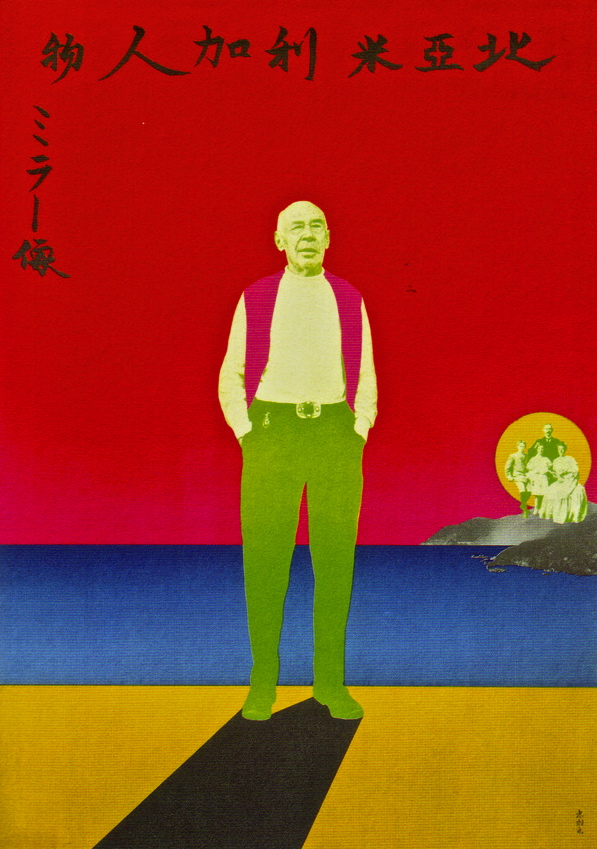
Poster for Exhibition of Art Work by Henry Miller — Tadanori Yokoo

miller

Goodness makes me want to vomit (Clarice Lispector)

Yes, she could feel within herself the presence of a perfect animal. She resisted the idea of unleashing this animal one day. Perhaps for fear of causing some embarrassment or because she was afraid of some revelation… No, no — she repeated to herself- one mustn’t be afraid of being creative. Deep down, the animal probably repelled her because she still felt anxious to please and to be loved by someone as powerful as her dead aunt. Even if only to humiliate her afterwards and disown her without giving it another thought. For the best saying, as well as being the most recent was: goodness makes me want to vomit. Goodness was lukewarm and weak, it stank of raw meat that had been lying around for a long time without, however, becoming completely rotten. It was freshened up from time to time, seasoned sufficiently to preserve it, a lump of lukewarm, stagnating meat.

From Clarice Lispector’s novel Near to the Wild Heart.

I have to move through Near to the Wild Heart very slowly—Lispector’s representation of her narrator’s shifts in consciousness is slippery, abstract, terrifying at times, often beautiful, alienating, complex. As in The Hour of the Star, there’s an intense vein of abjection that unifies the work—its narrator’s navigation of internal and external worlds—that simultaneously attracts and compels me.

“Indian River” — Wallace Stevens

indian river

Easter in Shakespeare

From Thomas Firminger Thiselton-Dyer’s indispensable volume Folk-lore in Shakespeare:

Easter. According to a popular superstition, it is considered unlucky to omit wearing new clothes on Easter Day, to which Shakespeare no doubt alludes in “Romeo and Juliet” (iii. 1), when he makes Mercutio ask Benvolio whether he did “not fall out with a tailor for wearing his new doublet before Easter.” In East Yorkshire, on Easter Eve, young folks go to the nearest market-town to buy some new article of dress or personal adornment to wear for the first time on Easter Day, as otherwise they believe that birds—notably rooks or “crakes”—will spoil their clothes. In “Poor Robin’s Almanac” we are told: “At Easter let your clothes be new, Or else be sure you will it rue.” Some think that the custom of “clacking” at Easter—which is not quite obsolete in some counties—is incidentally alluded to in “Measure for Measure” (iii. 2) by Lucio: “his use was, to put a ducat in her clack-dish.” [649] The clack or clap dish was a wooden dish with a movable cover, formerly carried by beggars, which they clacked and clattered to show that it was empty. In this they received the alms. Lepers and other paupers deemed infectious originally used it, that the sound might give warning not to approach too near, and alms be given without touching the person. A popular name for Easter Monday was Black Monday, so called, says Stow, because “in the 34th of Edward III. (1360), the 14th of April, and the morrow after Easter Day, King Edward, with his host, lay before the city of Paris; which day was full dark of mist and hail, and so bitter cold, that many men died on their horses’ backs with the cold. Wherefore unto this day it hath been call’d the Blacke Monday.” Thus, in the “Merchant of Venice” (ii. 5), Launcelot says, “it was not for nothing that my nose fell a-bleeding on Black Monday last at six o’clock i’ the morning.”

Ben Jonson’s Egg Wine

From Books and my food: with literary quotations and original recipes for every day of the year by Elisabeth Luther Cary and Annie Maria Jones

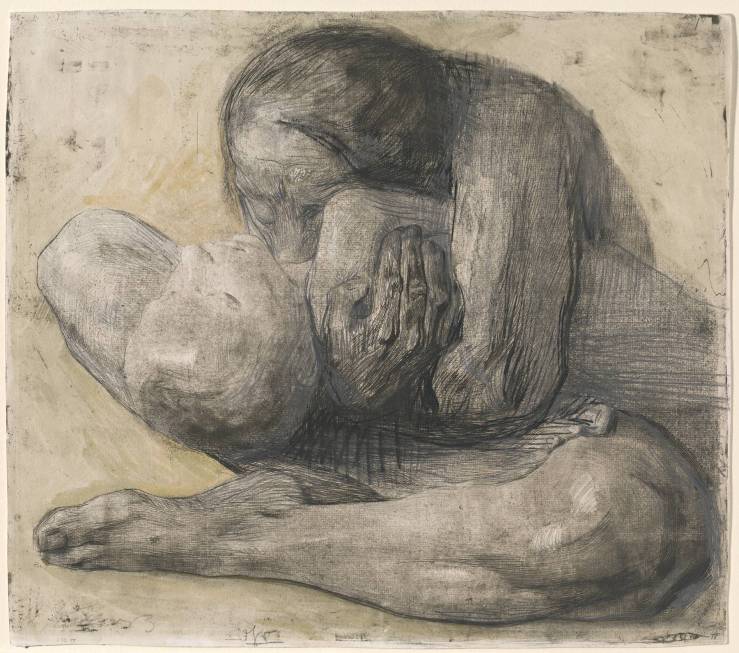
Käthe Kollwitz kept painting poor people (Kollwitz/Vollmann)

kathe-kollwitz4

She worked without reference to the fiery proto-Cubism of those years, the representational, classical past as dead as the Second Reich itself, dead, dead!—as dead as the Tsarist officers who’d now sunk beneath their own weedy mucky parade grounds so that the Party of Lenin and Stalin could march across their moldering faces. Since 1912 she had kept a room on Siegmund-shof for her plastic arts. That was where she would create the mourning woman out of stone. Mostly she carved, etched, and painted in that flat on Weissenbürgerstrasse. Those were the years when the figures in other people’s paintings began to go ever flatter, more garish, more distorted, the colors hurtful to her although she liked some of the galloping calligraphic riders in Kandinsky. Grosz’s desperately angry caricatures, the X-ray bitterness of Otto Dix, not to mention abstract constructivism; she didn’t swim with that tide. Käthe Kollwitz kept painting poor people, starving people (white figures in dark fields, dark chalk on brown Ingres paper), raped women, mothers with dying children, mothers with dead children. In the end she depicted mainly herself, her stricken, simian face thinking and grieving. She too was a mother with a dead child.

From William Vollmann’s Europe Central.

Eggs à la Nabocoque

Vladimir Nabokov’s recipe for eggs (à la Nabocoque, natch)–

Boil water in a saucepan (bubbles mean it is boiling!). Take two eggs (for one person) out of the refrigerator. Hold them under the hot tap water to make them ready for what awaits them.

Place each in a pan, one after the other, and let them slip soundlessly into the (boiling) water. Consult your wristwatch. Stand over them with a spoon preventing them (they are apt to roll) from knocking against the damned side of the pan.

If, however, an egg cracks in the water (now bubbling like mad) and starts to disgorge a cloud of white stuff like a medium in an oldfashioned seance, fish it out and throw it away. Take another and be more careful.

After 200 seconds have passed, or, say, 240 (taking interruptions into account), start scooping the eggs out. Place them, round end up, in two egg cups. With a small spoon tap-tap in a circle and hen pry open the lid of the shell. Have some salt and buttered bread (white) ready. Eat.

V.N.
November 18, 1972

“The Easter Fires” (From Frazer’s The Golden Bough)

A passage Sir James George Frazer’s The  Golden Bough:

The Easter Fires

ANOTHER occasion on which these fire-festivals are held is Easter Eve, the Saturday before Easter Sunday. On that day it has been customary in Catholic countries to extinguish all the lights in the churches, and then to make a new fire, sometimes with flint and steel, sometimes with a burning-glass. At this fire is lit the great Paschal or Easter candle, which is then used to rekindle all the extinguished lights in the church. In many parts of Germany a bonfire is also kindled, by means of the new fire, on some open space near the church. It is consecrated, and the people bring sticks of oak, walnut, and beech, which they char in the fire, and then take home with them. Some of these charred sticks are thereupon burned at home in a newly-kindled fire, with a prayer that God will preserve the homestead from fire, lightning, and hail. Thus every house receives “new fire.” Some of the sticks are kept throughout the year and laid on the hearth-fire during heavy thunder-storms to prevent the house from being struck by lightning, or they are inserted in the roof with the like intention. Others are placed in the fields, gardens, and meadows, with a prayer that God will keep them from blight and hail. Such fields and gardens are thought to thrive more than others; the corn and the plants that grow in them are not beaten down by hail, nor devoured by mice, vermin, and beetles; no witch harms them, and the ears of corn stand close and full. The charred sticks are also applied to the plough. The ashes of the Easter bonfire, together with the ashes of the consecrated palm-branches, are mixed with the seed at sowing. A wooden figure called Judas is sometimes burned in the consecrated bonfire, and even where this custom has been abolished the bonfire itself in some places goes by the name of “the burning of Judas.” The essentially pagan character of the Easter fire festival appears plainly both from the mode in which it is celebrated by the peasants and from the superstitious beliefs which they associate with it. All over Northern and Central Germany, from Altmark and Anhalt on the east, through Brunswick, Hanover, Oldenburg, the Harz district, and Hesse to Westphalia the Easter bonfires still blaze simultaneously on the hill-tops. As many as forty may sometimes be counted within sight at once. Long before Easter the young people have been busy collecting firewood; every farmer contributes, and tar-barrels, petroleum cases, and so forth go to swell the pile. Neighbouring villages vie with each other as to which shall send up the greatest blaze. The fires are always kindled, year after year, on the same hill, which accordingly often takes the name of Easter Mountain. It is a fine spectacle to watch from some eminence the bonfires flaring up one after another on the neighbouring heights. As far as their light reaches, so far, in the belief of the peasants, the fields will be fruitful, and the houses on which they shine will be safe from conflagration or sickness.

At Volkmarsen and other places in Hesse the people used to observe which way the wind blew the flames, and then they sowed flax seed in that direction, confident that it would grow well. Brands taken from the bonfires preserve houses from being struck by lightning; and the ashes increase the fertility of the fields, protect them from mice, and mixed with the drinking-water of cattle make the animals thrive and ensure them against plague. As the flames die down, young and old leap over them, and cattle are sometimes driven through the smouldering embers. In some places tar-barrels or wheels wrapt in straw used to be set on fire, and then sent rolling down the hillside. In others the boys light torches and wisps of straw at the bonfires and rush about brandishing them in their hands. In Munsterland these Easter fires are always kindled upon certain definite hills, which are hence known as Easter or Paschal Mountains. The whole community assembles about the fire. The young men and maidens, singing Easter hymns, march round and round the fire, till the blaze dies down. Then the girls jump over the fire in a line, one after the other, each supported by two young men who hold her hands and run beside her. In the twilight boys with blazing bundles of straw run over the fields to make them fruitful.

At Delmenhorst, in Oldenburg, it used to be the custom to cut down two trees, plant them in the ground side by side, and pile twelve tar-barrels against each. Brush-wood was then heaped about the trees, and on the evening of Easter Saturday the boys, after rushing about with blazing bean-poles in their hands, set fire to the whole. At the end of the ceremony the urchins tried to blacken each other and the clothes of grown-up people. In the Altmark it is believed that as far as the blaze of the Easter bonfire is visible, the corn will grow well throughout the year, and no conflagration will break out. At Braunrude, in the Harz Mountains, it was the custom to burn squirrels in the Easter bonfire. In the Altmark, bones were burned in it. Near Forchheim, in Upper Franken, a straw-man called the Judas used to be burned in the churchyards on Easter Saturday. The whole village contributed wood to the pyre on which he perished, and the charred sticks were afterwards kept and planted in the fields on Walpurgis Day (the first of May) to preserve the wheat from blight and mildew. About a hundred years ago or more the custom at Althenneberg, in Upper Bavaria, used to be as follows. On the afternoon of Easter Saturday the lads collected wood, which they piled in a cornfield, while in the middle of the pile they set up a tall wooden cross all swathed in straw. After the evening service they lighted their lanterns at the consecrated candle in the church, and ran with them at full speed to the pyre, each striving to get there first. The first to arrive set fire to the heap. No woman or girl might come near the bonfire, but they were allowed to watch it from a distance. As the flames rose the men and lads rejoiced and made merry, shouting, “We are burning the Judas!” The man who had been the first to reach the pyre and to kindle it was rewarded on Easter Sunday by the women, who gave him coloured eggs at the church door. The object of the whole ceremony was to keep off the hail.

At other villages of Upper Bavaria the ceremony, which took place between nine and ten at night on Easter Saturday, was called “burning the Easter Man.” On a height about mile from the village the young fellows set up a tall cross enveloped in straw, so that it looked like a man with his arms stretched out. This was the Easter Man. No lad under eighteen years of age might take part in the ceremony. One of the young men stationed himself beside the Easter Man, holding in his hand a consecrated taper which he had brought from the church and lighted. The rest stood at equal intervals in a great circle round the cross. At a given signal they raced thrice round the circle, and then at a second signal ran straight at the cross and at the lad with the lighted taper beside it; the one who reached the goal first had the right of setting fire to the Easter Man. Great was the jubilation while he was burning. When he had been consumed in the flames, three lads were chosen from among the rest, and each of the three drew a circle on the ground with a stick thrice round the ashes. Then they all left the spot. On Easter Monday the villagers gathered the ashes and strewed them on their fields; also they planted in the fields palmbranches which had been consecrated on Palm Sunday, and sticks which had been charred and hallowed on Good Friday, all for the purpose of protecting their fields against showers of hail. In some parts of Swabia the Easter fires might not be kindled with iron or steel or flint, but only by the friction of wood. The custom of the Easter fires appears to have prevailed all over Central and Western Germany from north to south. We find it also in Holland, where the fires were kindled on the highest eminences, and the people danced round them and leaped through the flames or over the glowing embers. Here too, as often in Germany, the materials for the bonfire were collected by the young folk from door to door. In many parts of Sweden firearms are discharged in all directions on Easter Eve, and huge bonfires are lighted on hills and eminences. Some people think that the intention is to keep off the Troll and other evil spirits.
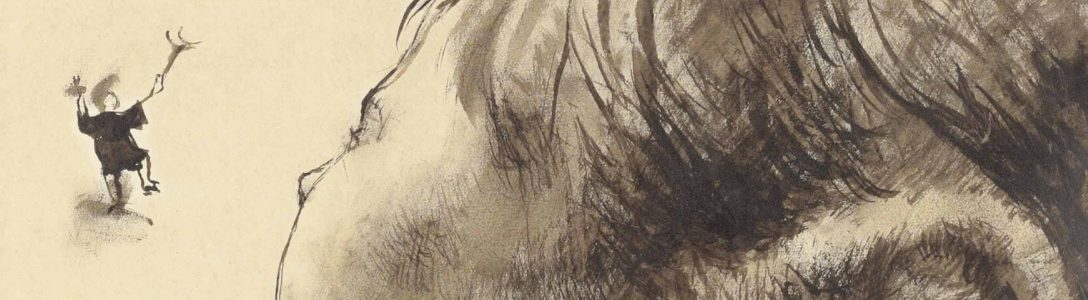
RIP Gabriel García Márquez

RIP Gabriel García Márquez, 1927-2014

Gabo the Giant is dead.

Long live the Giant.

“It’s not just a stream of gibberish” |On Illustrating Finnegans Wake

Wake_in_Progress_31-740x0.jpg

At The Honest Ulsterman, Darran Anderson talks with Stephen Crowe about illustrating James Joyce’s Finnegans Wake in his project Wake in Progress. From the interview:

DA: Do you approach the book as a puzzle or a palette? Do you try to make your artwork close to what Joyce might have meant or do you embrace the possibilities of your own interpretations? Is it possible or even desirable to try to work out what Joyce meant?

SC: Clearly Joyce meant to say something – it’s not just a stream of gibberish. So as an illustrator I think I owe it to the text to try to understand as much of it as I can. I try to figure out at least a couple of different ways to interpret every passage, but I certainly don’t exhaust every avenue. There’s a limit to how much information I can cram into the illustrations anyway. On the other hand, I do think that there are portions of the book where it’s not really important to understand it on a semantic level. Joyce was deeply influenced by music in his writing, and I think it’s fine to appreciate some of the book quite passively, as if it were music. I would agree that there’s no such thing as “understanding” the book entirely. Partial incomprehensibility is part of its design.

“Holy Thursday” — William Blake