Three Books with Stickers on Them (Books Acquired, Sometime Last Month)

My daughter, six, brought home some books from the library a few weeks ago. “These are good,” she reported, showing them to me. “They have medals on them.”

In the last weeks of last month, I got behind three bemedaled or bestickered books (okay, these aren’t really stickers anymore, but I don’t know what to call the stickers—blazons? Emblems? Medals?)—here they are:

20131006-154010.jpg

Jim Crace’s Harvest, beblazoned with a Man Booker Finalist blazon. From The New York Times’s review earlier this year:

In its poetry of the precarious hereafter, “Harvest” calls to mind J. M. Coetzee’s finest and most allegorical novel, “Waiting for the Barbarians.” Like Coetzee, Crace asks large questions: How will ordinary people behave when ripped from their mundane routines, cut adrift from comforting old verities? What suppressed capacity for cruelty may surface? What untested gift for improvised survival?

20131006-154019.jpg

Next: Ayana Mathis’s The Twelve Tribes of Hattie, bemedaled with an Oprah’s Book Club 2.0 medal. I don’t know what 2.0 means here, but the sticker I’ll admit is immediately off-putting. I also originally read the title as The Twelve Tribes of Hottie, also off-putting. The actual premise of the book seems really good though. From The New York Times again:

When the country was too distracted to notice, caught up as it was with two world wars and the Depression, a great movement of people, of some six million African-Americans fleeing the Jim Crow South, was upending the social geography of the country itself. The Great Migration would figure into much of the literature and music of 20th-century urban life — Wright, Ellison, Baldwin and Coltrane — and, decades after it ended, it still lives in myth and shadow, casting a spell upon race relations to this day and captivating the lives and imaginations of its descendants.

Still, there has been no novel like “The Grapes of Wrath” that looks squarely at this migration, which might have been the promise and yet not the purpose of so raw and intimate a book as “The Twelve Tribes of Hattie,” the debut novel of ­Ayana Mathis. The story it tells works at the rough edges of history, residing not so much within the migration itself as within a brutal and poetic allegory of a family beset by tribulations. The narrative opens in 1925, as Hattie Shepherd, a 17-year-old wife and mother newly ­arrived in Philadelphia from Georgia, ­administers mustard poultices and droplets of ipecac to save her infant twins from the pneumonia that has crept into their limp bodies. Because of her desperate circumstances in the cold of the North, she loses her twins “in the order in which they were born.”

20131006-154027.jpg

Finally, Olen Steinhauer’s An American Spy, bestickered with A New York Times Notable Book sticker. You know what? Im just gonna go ahead and borrow from The New York Times review again:

Not since John le Carré has a writer so vividly evoked the multilayered, multifaceted, deeply paranoid world of espionage, in which identities and allegiances are malleable and ever shifting, the mirrors of loyalty and betrayal reflecting one another to infinity. In this intensely clever, sometimes baffling book, it’s never quite clear who is manipulating whom, and which side is up.

So three books, all from major houses, all garnering accolades (in the form of stickers!), and all prominently and favorably reviewed by The New York Times. I’m sure there’s nothing troubling in this at all.


William Burroughs’s Writing Bunker

burroughs desk writing room

“Disagreement” — Lydia Davis

disagreement

The Complete Short Stories of J.G. Ballard (Second Riff: Stories of 1960)

jgb_complete_ss400 PREVIOUSLY:

Introductions + stories 1956-1959

IN THIS RIFF:

Stories published in 1960:

“The Sound-Sweep”

“Zone of Terror”

“Chronopolis”

“The Voices of Time”

“The Last World of Mr. Goddard”

1. “The Sound-Sweep” (1960)

Ballard’s strong suit isn’t characterization. In his later writing, he transcends this apparent weakness, employing a style and rhetoric that dispenses with—or nakedly accepts, in some cases—the flatness of his characters. Ballard works in types: the scientist, the madman, the artist, the detective, the ingenue, the explorer, the has-been. Most of his characters are driven by very basic desires—curiosity, madness, revenge. There’s a thin line though between archetypal placeholders and hackneyed stereotypes, and Ballard occasionally stumbles over it in some of these early stories. “The Sound-Sweep” is one such story, plodding along over too many pages, asking its readers to care about characters that lack emotional or psychological depth. And while I don’t think we read Ballard for emotional depth, necessarily, we do read Ballard’s best work because it plumbs the contours of human psychology colliding into nascent technological changes that affect the most basic human senses.

As its title suggests, “The Sound-Sweep” is another early Ballard tale that takes on the sense of sound. The short version: This is a story about noise pollution, and also about how we might sacrifice an artistic way of listening in favor of apparent convenience. As is often the case in these early stories, Ballard constructs the tale to explore the fallout of one particular idea. In this case, that’s “ultrasonic music”:

Ultrasonic music, employing a vastly greater range of octaves, chords and chromatic scales than are audible by the human ear, provided a direct neural link between the sound stream and the auditory lobes, generating an apparently sourceless sensation of harmony, rhythm, cadence and melody uncontaminated by the noise and vibration of audible music. The re–scoring of the classical repertoire allowed the ultrasonic audience the best of both worlds. The majestic rhythms of Beethoven, the popular melodies of Tchaikovsky, the complex fugal elaborations of Bach, the abstract images of Schoenberg – all these were raised in frequency above the threshold of conscious audibility. Not only did they become inaudible, but the original works were re–scored for the much wider range of the ultrasonic orchestra, became richer in texture, more profound in theme, more sensitive, tender or lyrical as the ultrasonic arranger chose.

To tease out this idea, Ballard employs a washed-up opera singer, Madame Giaconda (a heavy base of Sunset Boulevard’s Norma Desmond with a heavy dash of Miss Havisham and cocaine), and Mangon, a mute orphan, the titular sound-sweep (should I wax on the Blakean undertones here? No? Okay).

“The Sound-Sweep” plods along over far too many pages, even divvying up the plot into chapters, asking us to care about the relationship between Giaconda and Mangon. The story would probably have made an excellent episode of The Twilight Zone, where performers might give life to some of the flat dialogue here and the constraints of television might compress the plot. The most interesting thing about “The Sound-Sweep”: The tale in some ways anticipates the mp3 and the ways in which music will be consumed:

But the final triumph of ultrasonic music had come with a second development – the short–playing record, spinning at 900 r.p.m., which condensed the 45 minutes of a Beethoven symphony to 20 seconds of playing time, the three hours of a Wagner opera to little more than two minutes. Compact and cheap, SP records sacrificed nothing to brevity. One 30–second SP record delivered as much neurophonic pleasure as a natural length recording, but with deeper penetration, greater total impact.

2. “Zone of Terror” (1960)

Edgar Allan Poe’s “William Wilson” is a much better doppelganger story. “Zone of Terror” reads like a very rough sketch for some of the stuff Ballard will do in his 1962 novel The Drowned World. (Both “Chronopolis” and “The Voices of Time” also clearly anticipate The Drowned World, each with much stronger results).

chronopolis

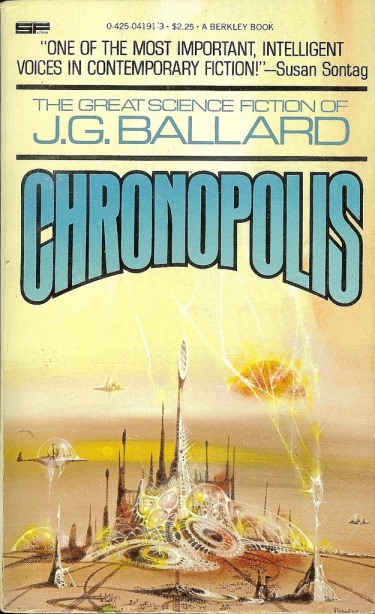
3. “Chronopolis” (1960)

“Chronopolis” offers an interesting central shtick: Clocks and other means of measuring and standardizing time have been banned. But this isn’t what makes the story stick. No, Ballard apparently tips his hand early, revealing why measuring time has been banned—it allows management to control labor:

‘Isn’t it obvious? You can time him, know exactly how long it takes him to do something.’ ‘Well?’ ‘Then you can make him do it faster.’

But our intrepid young protagonist (Conrad, his loaded name is), hardly satisfied with this answer, sneaks off to the city of the past, the titular chronopolis, where he works to restore the timepieces of the past. “Chronopolis” depicts a technologically-regressive world that Ballard will  explore in greater depth with his novel The Drowned World, but the details here are precise and fascinating (if perhaps ultimately unconvincing if we try to apply them as any kind of diagnosis for our own metered age). Ending on a perfect paranoid note, Ballard borrows just a dab of Poe here, synthesizing his influence into something far more original, far more Ballardian. Let’s include it in something I’m calling The Essential Short Stories of J.G. Ballard.

4.  “The Voices of Time” (1960)

“The Voices of Time” is easily the best of the early stories in the collection. Ballard allows himself to dispense almost entirely with plot, or at least the kind of plot he’s been thus-far constrained by. Instead of the neat concision of his nineteenth century forebears (Chekhov and Poe), Ballard moves to something far more Ballardian (excuse the repetition), opening his text to a range of images and phrases that will repeat throughout his career—the word terminal, drained vessels, cryptic designs and sequences, a kind of psychic detritus the reader is left to account for and monitor. The loose threads in “The Voices of Time” are too many to enumerate. There’s a mutant armadillo and a girl named Coma. Mass narcolepsy and cacti that absorb gold from the earth as a shield against radiation. And sleep. And de-evolution:

…thirty years ago people did indeed sleep eight hours, and a century before that they slept six or seven. In Vasari’s Lives one reads of Michelangelo sleeping for only four or five hours, painting all day at the age of eighty and then working through the night over his anatomy table with a candle strapped to his forehead. Now he’s regarded as a prodigy, but it was unremarkable then. How do you think the ancients, from Plato to Shakespeare, Aristotle to Aquinas, were able to cram so much work into their lives? Simply because they had an extra six or seven hours every day. Of course, a second disadvantage under which we labour is a lowered basal metabolic rate – another factor no one will explain. …

… It’s time to re–tool. Just as an individual organism’s life span is finite, or the life of a yeast colony or a given species, so the life of an entire biological kingdom is of fixed duration. It’s always been assumed that the evolutionary slope reaches forever upwards, but in fact the peak has already been reached, and the pathway now leads downward to the common biological grave. It’s a despairing and at present unacceptable vision of the future, but it’s the only one. Five thousand centuries from now our descendants, instead of being multi–brained star–men, will probably be naked prognathous idiots with hair on their foreheads, grunting their way through the remains of this Clinic like Neolithic men caught in a macabre inversion of time. Believe me, I pity them, as I pity myself. My total failure, my absolute lack of any moral or biological right to existence, is implicit in every cell of my body…

I harped on Ballard’s lack of characterization earlier, and “The Voices of Time” makes no strong case for its author’s ability to create deep, full characters. What Ballard does very very well though is harness, express, and communicate the intellect of his smart, smart characters—something many if not most other writers (contemporary or otherwise) can’t do, despite any technical prowess they may possess. “The Voices of Time” doesn’t just tell you that its heroes and antiheroes are brilliant (and/or mad)—it shows you.

Marvelous stuff. Include it in The Essential Short Stories of J.G. Ballard

5. “The Last World of Mr. Goddard” (1960)

More Twilight Zone stuff. God-dard. Lilliput, sort of. Doll’s house. Etc. A one-note exercise that I doubt is worth your time. Skip it.

6. On the horizon:

Ballard anticipates how hollow and stale contemporary writing will become in “Studio Five, The Stars.”

The Orphan Choir (Book Acquired, 9.17.2013)

20130924-200511.jpg

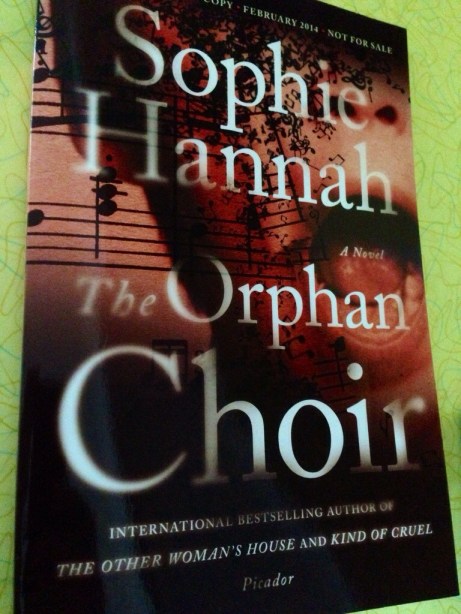
Sophie Hannah’s The Orphan Choir gets a U.S. release from Picador next year, so I grabbed the Australian blurb (Picador’s site doesn’t even list the book yet):

Louise is bereft. Her seven-year-old son Joseph has been sent away to boarding school against her wishes, and she misses him desperately. And the neighbour from hell is keeping her awake at night by playing loud, intrusive music. So when the chance comes to move to the country, she jumps at it as a way of saving her sanity. Only it doesn’t. Because the music seems to have followed her. Except this time it’s choral music, sung by a choir of children that only she can see and hear…

Never read Sophie Hannah but I’ve seen many of the spines of her books at the used bookstore I go to when I’m looking for Barry Hannah books.


“A Lesson for This Sunday” — Derek Walcott

“A Lesson for This Sunday” by Derek Walcott

The growing idleness of summer grass
With its frail kites of furious butterflies
Requests the lemonade of simple praise
In scansion gentler than my hammock swings
And rituals no more upsetting than a
Black maid shaking linen as she sings
The plain notes of some Protestant hosanna—
Since I lie idling from the thought in things—

Or so they should, until I hear the cries
Of two small children hunting yellow wings,
Who break my Sabbath with the thought of sin.
Brother and sister, with a common pin,
Frowning like serious lepidopterists.
The little surgeon pierces the thin eyes.
Crouched on plump haunches, as a mantis prays
She shrieks to eviscerate its abdomen.
The lesson is the same. The maid removes
Both prodigies from their interest in science.
The girl, in lemon frock, begins to scream
As the maimed, teetering thing attempts its flight.
She is herself a thing of summery light,
Frail as a flower in this blue August air,
Not marked for some late grief that cannot speak.

The mind swings inward on itself in fear
Swayed towards nausea from each normal sign.
Heredity of cruelty everywhere,
And everywhere the frocks of summer torn,
The long look back to see where choice is born,
As summer grass sways to the scythe’s design.

Writer’s block (Calvin & Hobbes)

writersblock

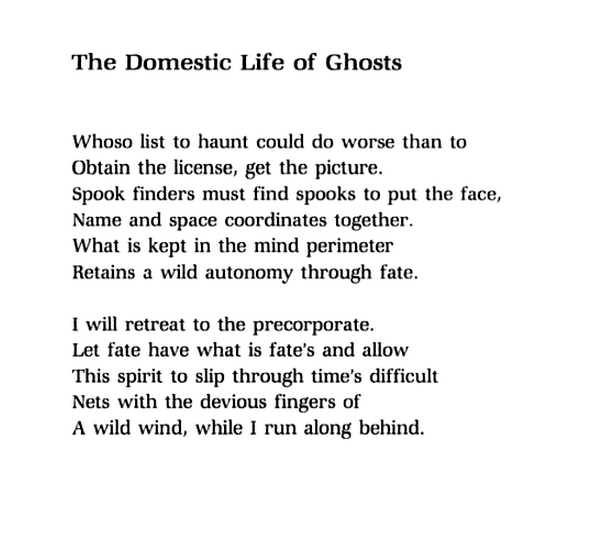
“The Domestic Life of Ghosts” — Tom Clark

tc

Ten Notes from Nathaniel Hawthorne’s Note-Books

  1. Anciently, when long-buried bodies were found undecayed in the grave, a species of sanctity was attributed to them.
  2. Some chimneys of ancient halls used to be swept by having a culverin fired up them.
  3. At Leith, in 1711, a glass bottle was blown of the capacity of two English bushels.
  4. The buff and blue of the Union were adopted by Fox and the Whig party in England. The Prince of Wales wore them.
  5. In 1621, a Mr. Copinger left a certain charity, an almhouse, of which four poor persons were to partake, after the death of his eldest son and his wife. It was a tenement and yard. The parson, headboroughs, and his five other sons were to appoint the persons. At the time specified, however, all but one of his sons were dead; and he was in such poor circumstances that he obtained the benefit of the charity for himself, as one of the four.
  6. A town clerk arranges the publishments that are given in, according to his own judgment.
  7. To make a story from Robert Raikes seeing dirty children at play, in the streets of London, and inquiring of a woman about them. She tells him that on Sundays, when they were not employed, they were a great deal worse, making the streets like hell; playing at church, etc. He was therefore induced to employ women at a shilling to teach them on Sundays, and thus Sunday-schools were established.
  8. To represent the different departments of the United States government by village functionaries. The War Department by watchmen, the law by constables, the merchants by a variety store, etc.
  9. At the accession of Bloody Mary, a man, coming into a house, sounded three times with his mouth, as with a trumpet, and then made proclamation to the family. A bonfire was built, and little children were made to carry wood to it, that they might remember the circumstance in old age. Meat and drink were provided at the bonfires.
  10. To describe a boyish combat with snowballs, and the victorious leader to have a statue of snow erected to him. A satire on ambition and fame to be made out of this idea. It might be a child’s story.

Notations from Nathaniel Hawthorne’s American Note-Books


“Lead us into temptation, and deliver us from no evil” (Thomas Bernhard)

“I used to take sleeping pills,” he said, “and slowly boosted the number of pills I took. In the end, they had absolutely no effect on me, and I could have gulped any number of them, and still not have got to sleep. I repeatedly took such high dosages, I should have died. But I only ever vomited them up. Then I would be unable for days to pursue the least thought, and it was precisely this inability to think that got me through long periods of complete horror … You have to be careful you don’t end up living for longer than your natural lifespan,” he said. “Life is a court case which you lose, whoever you are, and whatever you do. That was decided before any human being was even born. The first man fared no differently from us. Rebellion against this only leads to deeper despair,” he said. “And no more distraction. From the age of thirteen, no more distraction. After the first sexual experience, no distraction. Do you understand?” The only variety was thunderstorms, “and lightning the only poetry.” He said: “Seeing as you’re locked up, locked up in solitary confinement, you’re increasingly thrown back upon yourself.” The questions one asked oneself slowly became one’s death. “But you know, we’re all dead anyway from the outset.” There were simply “no more forms of assistance.” One lay on the floor of one’s cell, along with the shattered limbs of past millennia. “Deceits and subterfuges,” he said. Just as the handling of facts injected insignificance into the brain, whatever question one asked oneself. “Every question is a defeat.” Every question wrought devastation. Disinclination. With questions, the time passed, and the questions passed in time, “so meaningless that everything is just ruins … There, you see,” said the painter, “it’s quite black down there. Last night, I dreamed the workers climbed up the mountain, and flooded the village and the inn and everything. In their thousands and tens of thousands, they swarmed up here, and whatever didn’t belong to them, they trampled underfoot, or it was suffocated in their blackness. How calm it is now! Listen!” The butcher greeted us, and we greeted him back. The houses of Weng seemed jumbled together, as though crushed at the foot of the cliff. “Earlier,” said the painter, “I used to have no pity for human frailty. Any pain seemed to me unnatural! Suddenly I saw myself confronted with an abundance of frailty.” He said: “Will you be playing cards tonight? The knacker is a good cardplayer. The engineer as well. They’re all of them good cardplayers. I don’t know why I’ve always had such an aversion to cardplayers.” He muttered something about cretinism in the mountain valleys, in the high Alps. And then: “Our Father, who art in Hell, unhallowed be Thy name. No Kingdom come. Thy will not be done. On earth, as it is in Hell. Deny us this day our daily bread. And forgive us no trespasses. As we forgive none of those that trespass against us. Lead us into temptation, and deliver us from no evil. Amen. That one works just as well,” he said.

From Thomas Bernhard’s novel Frost.


Biblioklept’s Dictionary of Literary Terms

ALLEGORY

Didactic extended metaphor, best enjoyed amorally.

BIOGRAPHY

The sordid and lurid details of an author’s life; use as a critical rubric if the author’s work seems beyond comprehension.

CATACHRESIS

Mixed or imprecise metaphor. When an author stretches her words like taffy across the loom of meaning.

DEATH OF THE NOVEL

Declare the novel dead every few weeks. Resuscitate as necessary.

EPIC

Originally used to denote lengthy narrative works concerning serious subjects, this term may now be applied freely to modify failure, coffee, tacos, kittens, etc.

FANTASY

An inventive and imaginative style of fiction eschewed and denigrated by serious readers and writers.

GNOMIC POETRY

Poetry composed in the secret language of garden gnomes, inaudible to mortal ears.

HUBRIS

Defining common characteristic of all politicians.

IRONY

Dominant mode of much of 21st century communication (including, lamentably, this list).

JOYCEAN

Hyperbole used to describe lengthy works of contemporary authors. Use to disappoint potential readers.

KENNING

Circumlocution of meaning. E.g. “feed the eagle” for “kill,” “battle-sweat” for “blood,” “tube of garbage” for “internet.”

LEONINE VERSE

Poetry about lions.

MORAL

Each reader’s personal misunderstanding of the meaning of a work of literature.

NONFICTION

What your father reads.

OPEN LETTER

A solipsistic bid for attention delivered under the pretense of reaching out to another entity.

PASTORAL

Use to describe any work of literature set outside of a city.

QUATRAIN

A stanza

or poem

composed of

four lines.

RED HERRING

A false clue employed by an author to distract the reader. A novel where all points of evidence are red herrings (preferable) is a shaggy dog story.

STRUCTURALISM

Grab bag of theories you learned in college.

TRILOGY

Elevate any degraded work of pop culture by repeating it twice. Reboot as necessary.

UNRELIABLE NARRATOR

This narrator cannot be depended upon to pick you up from the airport, water your plants while you’re away, meet you on time for a beer or coffee, return small loans, etc.

VICTORIANISM

Indicative of literature of the prudish, uptight Victorian Era. Famous Victorian works include Venus in FursThe Pearl, and The Lustful Turk.

WITTGENSTEIN

Twentieth-century philosopher. Quote the first and last lines of his book Tractatus Logico-Philosophicus frequently (don’t worry about reading anything in between).

XENOPHOBIA

Fear of warrior princesses.

YELP

The pinnacle of contemporary criticism.

ZEUGMA

The list ended with zeugma and disappointment.

(Previous entries here and here).

Susan Sontag on W.G. Sebald

Susan Sontag on W.G. Sebald:

IS LITERARY GREATNESS still possible? Given the implacable devolution of literary ambition, and the concurrent ascendancy of the tepid, the glib, and the senselessly cruel as normative fictional subjects, what would a noble literary enterprise look like now? One of the few answers available to English-language readers is the work of W. G. Sebald.

Vertigo, the third of Sebald’s books to be translated into English, is how he began. It appeared in German in 1990, when its author was forty-six; three years later came The Emigrants; and two years after that, The Rings of Saturn. When The Emigrants appeared in English in 1996, the acclaim bordered on awe. Here was a masterly writer, mature, autumnal even, in his persona and themes, who had delivered a book as exotic as it was irrefutable. The language was a wonder—delicate, dense, steeped in thinghood; but there were ample precedents for that in English. What seemed foreign as well as most persuasive was the preternatural authority of Sebald’s voice: its gravity, its sinuosity, its precision, its freedom from all-undermining or undignified self-consciousness or irony.

In W. G. Sebald’s books, a narrator who, we are reminded oc­casionally, bears the name W. G. Sebald, travels about registering evidence of the mortality of nature, recoiling from the ravages of modernity, musing over the secrets of obscure lives. On some mission of investigation, triggered by a memory or news from a world irretriev­ably lost, he remembers, evokes, hallucinates, grieves.

Is the narrator Sebald? Or a fictional character to whom the author has lent his name, and selected elements of his biography? Born in 1944, in a village in Germany he calls “W.” in his books (and the dust jacket identifies for us as Wertach im Allgau), settled in England in his early twenties, and a career academic currently teaching modern German literature at the University of East Anglia, the author in­cludes a scattering of allusions to these bare facts and a few others, as well as, among other self-referring documents reproduced in his books, a grainy picture of himself posed in front of a massive Lebanese cedar in The Rings of Saturn and the photo on his new passport in Vertigo. Continue reading “Susan Sontag on W.G. Sebald”

Batrachomyomachia, The Battle of Frogs and Mice

Theodor Severin Kittelsen

Over the next few weeks, I will be tweeting Hugh G. Evelyn-White’s 1914 translation of Batrachomyomachia, of The Battle of Frogs and Mice, a comic epic sometimes attributed to Homer. If the idea of reading a fairly short text over a few weeks seems insanely stupid to you but you want to read this parody, read it here.

“everything has crumbled…everything has dissolved…” (Thomas Bernhard)

Before he retired to his room, “not to sleep, but to howl to myself in the silence of horror,” he said: “How everything has crumbled, how everything has dissolved, how all the reference points have shifted, how all fixity has moved, how nothing exists anymore, how nothing exists, you see, how all the religions and all the irreligions and the protracted absurdities of all forms of worship have turned into nothing, nothing at all, you see, how belief and unbelief no longer exist, how science, modern science, how the stumbling blocks, the millennial courts, have all been thrown out and ushered out and blown out into the air, how all of it is now just so much air … Listen, it’s all air, all concepts are air, all points of reference are air, everything is just air …” And he said: “Frozen air, everything just so much frozen air …”

From Thomas Bernhard’s novel Frost.


Oshidori — Lacfadio Hearn

THERE WAS A FALCONER AND HUNTER, named Sonjô, who lived in the district called Tamura-no-Gô, of the province of Mutsu. One day he went out hunting, and could not find any game. But on his way home, at a place called Akanuma, he perceived a pair of oshidori (mandarin-ducks), swimming together in a river that he was about to cross. To kill oshidori is not good; but Sonjô happened to be very hungry, and he shot at the pair. His arrow pierced the male: the female escaped into the rushes of the farther shore, and disappeared. Sonjô took the dead bird home, and cooked it.

That night he dreamed a dreary dream. It seemed to him that a beautiful woman came into his room, and stood by his pillow, and began to weep. So bitterly did she weep that Sonjô felt as if his heart were being torn out while he listened. And the woman cried to him: “Why–oh! why did you kill him?–of what wrong was he guilty?. . . At Akanuma we were so happy together–and you killed him! What harm did he ever do you? Do you even know what you have done?–oh! do you know what a cruel, what a wicked thing you have done?. . . Me too you have killed–for I will not live without my husband! . . . Only to tell you this I came”. . . . Then again she wept aloud–so bitterly that the voice of her crying pierced into the marrow of the listener’s bones;–and she sobbed out the words of this poem:

Hi kururéba
Sasoëshi mono wo–
Akanuma no
Makomo no kuré no
Hitori-né zo uki!

At the coming of twilight I invited him to return with me–! Now to sleep alone in the shadow of the rushes of Akanuma– ah! what misery unspeakable!

And after having uttered these verses she exclaimed: “Ah, you do not know–you cannot know what you have done! But to-morrow, when you go to Akanuma, you will see–you will see. . . .” So saying, and weeping very piteously, she went away.

When Sonjô awoke in the morning, this dream remained so vivid in his mind that he was greatly troubled. He remembered the words: “But to-morrow, when you go to Akanuma, you will see–you will see.” And he resolved to go there at once, that he might learn whether his dream was anything more than dream.

So he went to Akanuma; and there, when he came to the river bank, he saw the female oshidori swimming alone. In the same moment the bird perceived Sonjô; but, instead of trying to escape, she swam straight toward him, looking at him the while in a strange fixed way. Then, with her beak, she suddenly tore open her own body, and died before the hunter’s eyes. . . .

Sonjô shaved his head, and became a priest.

The Complete Short Stories of J.G. Ballard (First Riff: Introductions + Stories 1956-1959)

jgb_complete_ss400

IN THIS RIFF:

Introductions

Stories published between 1956 and 1959:

“Prima Belladonna”

“Escapement”

“The Concentration City”

“Venus Smiles”

“Manhole 69”

“Track 12”

“The Waiting Grounds”

“Now: Zero”

1. Introduction

I first read J.G. Ballard in high school. I found his work, somehow, after reading Burgess, Burroughs, and Vonnegut. I devoured many of his novels over the next few years, as well as several short story collections. One of these, The Best Short Stories of J.G. Ballard was particularly important to me. That collection—which I loaned to a friend who thought enough of it to never give it back—offers a concise overview of Ballard’s development as a writer, from the pulp sci-fi of his earliest days (“Chronopolis”) to his later evocations of ecological disaster and dystopia (“Billenium,” “The Terminal Beach”) to his more experimental work from The Atrocity Exhibition, stories that pointed toward one of his most famous books, Crash.

I hadn’t returned to Ballard since reading Super-Cannes when it came out a decade ago; at the time I recall being disappointed in the novel and filing it away with William Gibson’s recent efforts, which I found dull.

I’d been reading Donald Barthelme’s wonderful and strange short stories, and, rereading “Glass Mountain,” a story composed in a list, I remembered Ballard’s brilliant story “Answers to a Questionnaire” (from 1990’s War Fever). I tracked the story down in The Complete Short Stories of J.G. Ballard, read it, read a few more at random, and then decided to start at the beginning.

I’ll be reading and riffing on all 98 stories in the collection over the next few months—giving myself breaks for other stuff, of course (although Ballard’s stuff, especially the early stuff is really easy to read).

2. Another introduction

Martin Amis writes the introduction to the 2009 edition and of course manages to bring up his father Kingsley almost immediately. He talks about the times he (Martin) got to spend with Ballard. He points out that Ballard possessed “a revealingly weak ear for dialogue.” He suggests that Ballard could have been the love child of Saki and Jorge Luis Borges. He describes Ballard as “somehow uniquely unique.” He reminds me of why I usually skip introductions.

3. And Ballard’s introduction, from the 2001 first edition of the book

He situates his hero, his contemporary, and his forbear in the first paragraph:

Short stories are the loose change in the treasury of fiction, easily ignored beside the wealth of novels available, an over-valued currency that often turns out to be counterfeit. At its best, in Borges, Ray Bradbury and Edgar Allan Poe, the short story is coined from precious metal, a glint of gold that will glow for ever in the deep purse of your imagination.

He also tells us,

Curiously, there are many perfect short stories, but no perfect novels.

I agree, except for the adverb there.

Did Ballard’s sensibilities gel with the sci-fi fans who read the pulp mags his early stories were published in?

I was interested in the real future that I could see approaching, and less in the invented future that science fiction preferred.

In the final lines of his introduction he describes his oeuvre and addresses criticisms that there’s so much damn analog tech in his stuff:

Vermilion Sands isn’t set in the future at all, but in a kind of visionary present – a description that fits the stories in this book and almost everything else I have written. But oh for a steam-powered computer and a wind-driven television set. Now, there’s an idea for a short story.

Vermilion Sands, the strange resort town where Ballard set over a half-dozen of his tales, is the setting of the first and fourth tales in the collection.

4. “Prima Belladonna” (1956) / “Venus Smiles” (1957)

Ballard already had a distinct setting in mind to play out his future-nowisms. That early stories “Prima Belladonna” and “Venus Smiles” are both in set in Vermilion Sands is maybe the most interesting thing about them. “Prima Belladonna” is never better than its first line:

I first met Jane Ciracylides during the Recess, that world slump of boredom, lethargy and high summer which carried us all so blissfully through ten unforgettable years, and I suppose that may have had a lot to do with what went on between us.

Ballard has the good sense to leave that cryptic reference to “the Recess” unexplained, or at least underexplained throughout the story—exposition is usually the worst aspect of pulp sci-fi. Still, the story is hardly one of his best. I’m guessing Roger Corman must have read it though, as his film Little Shop of Horrors (1960) seems to owe it a certain debt.

vermilion_sands

“Venus Smiles” is also set in Vermilion Sands, and it also takes music—sound—as its major motif (several of Ballard’s early stories do). Ballard strives to do too much in the story—he wants to criticize public attitudes about art, sculpture, music, etc., and also name drop John Cage to bolster his avant garde bona fides. Both stories drag, weighed down by Ballard’s clunky similes and bad dialogue (dear lord I’m agreeing with Amis here!). What’s most frustrating is knowing that Ballard is just a decade away from finding a rhetorical style to match the content of his ideas.

5. “Escapement” (1956)

The story of a man who realizes he is stuck in a time loop, repeating the same actions, “Escapement” is particularly frustrating. The stakes are incredibly low—the domestic scene of a married couple watching TV on a couch begs for darker treatment—and the reader figures out what’s going on way before the narrator. Time is clearly a major motif for Ballard, but his earliest published treatment of it is not especially inspiring. (I realize writing this what an ass I sound like: look, I know this is early work, pulp fiction—my frustration is that I want it to be better—or at least more abbreviated.

6. “The Concentration City” (1957)

“The Concentration City” finally sees Ballard in stronger territory, here exploring one of his favorite dystopic tropes—overpopulation—via one of his favorite conceits—the intrepid and intellectually curious young man. “The Concentration City” also showcases some early experimental touches in its opening paragraphs:

Noon talk on Millionth Street:

‘Sorry, these are the West Millions. You want 9775335th East.’

‘Dollar five a cubic foot? Sell!’

‘Take a westbound express to 495th Avenue, cross over to a Redline elevator and go up a thousand levels to Plaza Terminal. Carry on south from there and you’ll find it between 568th Avenue and 422nd Street.’

‘There’s a cave–in down at KEN County! Fifty blocks by twenty by thirty levels.’

‘Listen to this – “PYROMANIACS STAGE MASS BREAKOUT! FIRE POLICE CORDON BAY COUNTY!”

‘It’s a beautiful counter. Detects up to .005 per cent monoxide. Cost me three hundred dollars.’

‘Have you seen those new intercity sleepers? They take only ten minutes to go up 3,000 levels!’

‘Ninety cents a foot? Buy!’

The story follows up on these early notes, using the initially-estranging material to tell the story of a seemingly-infinite city; our young hero of course wants to bust out. Ballard also gives us an early prototype of what will be one of his major conventions: the green-zone/danger-zone split:

‘City Authority are starting to seal it off,’ the man told him. ‘Huge blocks. It’s the only thing they can do. What happens to the people inside I hate to think.’ He chewed on a sandwich. ‘Strange, but there are a lot of these black areas. You don’t hear about them, but they’re growing. Starts in a back street in some ordinary dollar neighbourhood; a bottleneck in the sewage disposal system, not enough ash cans, and before you know it a million cubic miles have gone back to jungle. They try a relief scheme, pump in a little cyanide, and then – brick it up. Once they do that they’re closed for good.’

No exit!

7. “Manhole 69” (1957)

Despite its unfortunate name, “Manhole 69” is perfect early Ballard. The story follows three men in an experimental group who have undergone a surgery that eliminates their ability to sleep. The story is precise and concise; Ballard seems comfortable here (“comfortable” is not a very Ballardian word, but hey…)—he sets up his experiment and then lets his principals carry it out. The story’s heavy Jungian vibe resurfaces a few years later in Ballard’s early novel The Drowned World

“Manhole 69” is the first of the 98 stories here I’d put in a collection I’ll tentatively call The Essential Short Stories of J.G. Ballard

8. “Track 12” (1958)

While “Track 12” is hardly perfect, its concision and focus do it many favors. Again, we find Ballard playing with sound—particularly something called “microsonics”:

Amplified 100,000 times animal cell division sounds like a lot of girders and steel sheets being ripped apart – how did you put it? – a car smash in slow motion. On the other hand, plant cell division is an electronic poem, all soft chords and bubbling tones. Now there you have a perfect illustration of how microsonics can reveal the distinction between the animal and plant kingdoms.

As is often the case, Ballard has an idea that fascinates him (“microsonics,” here) and simply constructs a story to deliver that idea. Or, rather, rips off a story—and Ballard has the good sense to steal from the best. “Track 12” is a fairly straightforward Edgar Allan Poe ripoff, a revenge tale recalling “The Cask of Amontillado,” and if the reader seems to guess where everything is going before the victim, well, it works here.

9. “The Waiting Grounds” (1959)

Ballard is better at inner space than outer space. “The Waiting Grounds” seems like a bait and switch, or at least I imagine many meat and potatoes SF fans might have felt that way. Ballard has his hero head to some distant planet, only to spend most of that trip in his own mind. And oh what a trip! The story’s central set piece anticipates the final scenes of Kubrick’s 2001: A Space Odyssey as Ballard sends his hero through “deep time”:

Deep Time: 10,000,000,000 mega–years. The ideation–field has now swallowed the cosmos, substituted its own dynamic, its own spatial and temporal dimensions. All primary time and energy fields have been engulfed. Seeking the final extension of itself within its own bounds the mantle has reduced its time period to an almost infinitesimal 0.00000000… n of its previous interval. Time has virtually ceased to exist, the ideation–field is nearly stationary, infinitely slow eddies of sentience undulating outward across its mantles.

The frame Ballard builds to deliver his idea is clunky, but I suppose in those days one could make a sort of living writing stories for magazines, and maybe more words meant more moolah. Again, this story points to the Jungian themes that Ballard would explore in greater depth in The Drowned World.

10. “Now: Zero” (1959)

Here is the first paragraph of “Now: Zero,” the last story of Ballard’s to be published in the 1950s:

You ask: how did I discover this insane and fantastic power? Like Dr Faust, was it bestowed upon me by the Devil himself, in exchange for the deed to my soul? Did I, perhaps, acquire it with some strange talismanic object – idol’s eyepiece or monkey’s paw – unearthed in an ancient chest or bequeathed by a dying mariner? Or, again, did I stumble upon it myself while researching into the obscenities of the Eleusinian Mysteries and the Black Mass, suddenly perceiving its full horror and magnitude through clouds of sulphurous smoke and incense?

No doubt, dear reader, you immediately detect Edgar Allan Poe all over this piece, and you’re not wrong. The story is mostly interesting as a style exercise—namely, Ballard doing Poe—but its cheesiness and predictability drowns out any humor. But again, these are the complete short stories—not just the perfect exercises.

11. On the horizon:

The early 1960s! “Chronopolis”! “The Overloaded Man”! “Billenium”! You are encouraged to play along.

Read Donald Barthelme’s Story “Me and Miss Mandible”

“Me and Miss Mandible” by Donald Barthelme

13 September

Miss Mandible wants to make love to me but she hesitates because I am officially a child; I am, according to the records, according to the gradebook on her desk, according to the card index in the principal’s office, eleven years old. There is a misconception here, one that I haven’t quite managed to get cleared up yet. I am in fact thirty-five, I’ve been in the Army, I am six feet one, I have hair in the appropriate places, my voice is a baritone, I know very well what to do with Miss Mandible if she ever makes up her mind.

In the meantime we are studying common fractions. I could, of course, answer all the questions, or at least most of them (there are things I don’t remember). But I prefer to sit in this too-small seat with the desktop cramping my thighs and examine the life around me. There are thirty-two in the class, which is launched every morning with the pledge of allegiance to the flag. My own allegiance, at the moment, is divided between Miss Mandible and Sue Ann Brownly, who sits across the aisle from me all day long and is, like Miss Mandible, a fool for love. Of the two I prefer, today, Sue Ann; although between eleven and eleven and a half (she refuses to reveal her exact age) she is clearly a woman, with a woman’s disguised aggression and a woman’s peculiar contradictions. Strangely neither she nor any of the other children seem to see any incongruity in my presence here.

15 September

Happily our geography text, which contains maps of all the principal land-masses of the world, is large enough to conceal my clandestine journal-keeping, accomplished in an ordinary black composition book. Every day I must wait until Geography to put down such thoughts as I may have had during the morning about my situation and my fellows. I have tried writing at other times and it does not work. Either the teacher is walking up and down the aisles (during this period, luckily, she sticks close to the map rack in the front of the room) or Bobby Vanderbilt, who sits behind me, is punching me in the kidneys and wanting to know what I am doing. Vanderbilt, I have found out from certain desultory conversations on the playground, is hung up on sports cars, a veteran consumer of Road & Track. This explains the continual roaring sounds which seem to emanate from his desk; he is reproducing a record album called Sounds of Sebring.

19 September

Only I, at times (only at times), understand that somehow a mistake has been made, that I am in a place where I don’t belong. It may be that Miss Mandible also knows this, at some level, but for reasons not fully understood by me she is going along with the game. When I was first assigned to this room I wanted to protest, the error seemed obvious, the stupidest principal could have seen it; but I have come to believe it was deliberate, that I have been betrayed again.

Now it seems to make little difference. This life-role is as interesting as my former life- role, which was that of a claims adjuster for the Great Northern Insurance Company, a position which compelled me to spend my time amid the debris of our civilization: rumpled fenders, roofless sheds, gutted ware houses, smashed arms and legs. After ten years of this one has a tendency to see the world as a vast junkyard, looking at a man and seeing only his (potentially) mangled parts, entering a house only to trace the path of the inevitable fire. Therefore when I was installed here, although I knew an error had been made, I countenanced it, I was shrewd; I was aware that there might well be some kind of advantage to be gained from what seemed a disaster. The role of The Adjuster teaches one much.  Continue reading “Read Donald Barthelme’s Story “Me and Miss Mandible””