“October” — Tom Clark

october

“Recycling one’s own life with books” |Thirteen Notes on Susan Sontag’s Notebook Collection, As Consciousness Is Harnessed to Flesh

20130929-103619.jpg

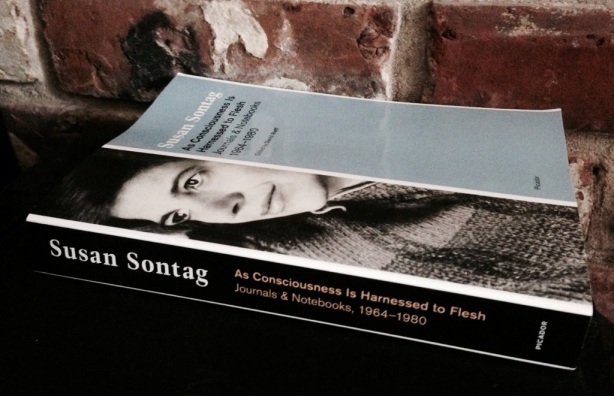
1. “In my more extravagant moments,” writes David Rieff in his introduction to Susan Sontag’s As Consciousness Is Harnessed to Flesh, “I sometimes think that my mother’s journals, of which this is the second of three volumes, are not just the autobiography she never got around to writing…but the great autobiographical novel she never cared to write.”

2. In my review of Reborn, the first of the trilogy Rieff alludes to, I wrote, “Don’t expect, of course, to get a definitive sense of who Sontag was, let alone a narrative account of her life here. Subtitled Journals & Notebooks 1947-1963Reborn veers closer to the “notebook” side of things.”

As Consciousness Is Harnessed to Flesh is far closer to the ‘notebook’ side of things too, which I think most readers (or maybe I just mean me here) will appreciate.

3. I mean, this isn’t the autobiographical novel that Rieff suggests it might be (except of course it is).

Consciousness/Flesh offers something better: access to Sontag’s consciousness in its prime, not quite ripe, but full, heavy, bursting with intellectual energy,  her mind attuned to (and attuning) the tumult of the time the journals cover, 1964 through 1980.

It’s an autobiography stripped of the pretense of presentation; it’s a novel stripped of the pretense of storytelling.

4. Sontag’s intellect and spirit course through the book’s 500 pages, eliding any distinction between lives personal and professional. “What sex is the ‘I’?” she writes, “Who has the right to say ‘I’?” The journals see her working through (if not resolving, thankfully) such issues.

5. An entry from late 1964, clearly background for Sontag’s seminal essay “Notes on Camp” (itself a series of notes), moves through a some thoughts on artists and poets, from Warhol to Breton to Duchamp (“DUCHAMP”) to simply “Style,” which, Rieff’s editorial note tells us, has a box drawn around it. The entry then moves to define

Work of Art

An experiment, a research (solving a “problem”) vs. form of a play

—before turning to a series of notes on the films of Michelangelo Antonioni.

6. A page or two later (1965) delivers the kind of gold vein we wish to discover in author’s notebooks:

PLOTS & SITUATIONS

Redemptive friendship (two women)

Novel in letters: the recluse-artist and his dealer a clairvoyant

A voyage to the underworld (Homer, Vergil [sic]Steppenwolf)

Matricide

An assassination

A collective hallucination (Story)

A theft

A work of art which is really a machine for dominating human beings

The discovery of a lost mss.

Two incestuous sisters

A space ship has landed

An ageing movie actress

A novel about the future. Machines. Each man has his own machine (memory bank, codified decision maker, etc.) You “play the machine. Instant everything.

Smuggling a huge art-work (painting? Sculpture?) out of the country in pieces—called “The Invention of Liberty”

A project: sanctity (based on SW [Simone Weil]—with honesty of Sylvia Plath—only way to solve sex “I” is talk about it

Jealousy

7. The list above—and there’s so much material like it in Consciousness/Flesh—is why I love author’s notebooks, We get to see the raw material here and imagine along with the writer (if we choose), free of the clutter and weight of execution, of prose, of damnable detail.

There’s something joyfully cryptic about Sontag’s notes, like the solitary entry “…Habits of despair” in late July of 1970—or a few months later: “A convention of mutants (Marvel comics).”

If we wish we can puzzle the notes out, treat them as clues or keys that fit to the work she was publishing at the time or to the personal circumstances of her private life. Or (and to be clear, I choose this or) we can let these notes stand as strange figures in an unconventional autobiographical novel.

8. Those looking for more direct material about Sontag’s life (and really, why do you want more and what more do you want?) will likely be disappointed—everything here is oblique (lovely, lovely oblique).

Still, there are moments of intense personal detail, like this 1964 entry where Sontag describes her body:

Body type

  • Tall
  • Low blood pressure
  • Needs lots of sleep
  • Sudden craving for pure sugar (but dislike desserts—not a high enough concentration)
  • Intolerance for liquor
  • Heavy smoking
  • Tendency to anemia
  • Heavy protein craving
  • Asthma
  • Migraines
  • Very good stomach—no heartburn, constipation, etc.
  • Negligible menstrual cramps
  • Easily tired by standing
  • Like heights
  • Enjoy seeing deformed people (voyeuristic)
  • Nailbiting
  • Teeth grinding
  • Nearsighted, astigmatism
  • Frileuse (very sensitive to cold, like hot summers)
  • Not very sensitive to noise (high degree of selective auditory focus)

There’s more autobiographical detail in that list than anyone craving a lurid expose could (should) hope for.

9. For many readers (or maybe I just mean me here) Consciousness/Flesh will be most fascinating as a curatorial project.

Sontag offers her list of best films (not in order),her ideal short story collection, and more. The collection often breaks into lists—like the ones we see above—but also into names—films, authors, books, essays, ideas, etc.

10. At times, Consciousness/Flesh resembles something close to David Markson’s so-called “notecard” novels (Reader’s Block, This Is Not a NovelVanishing Point, The Last Novel):

Napoleon’s wet, chubby back (Tolstoy).

and

Wordsworth’s ‘wise passiveness.’

and

Nabokov talks of minor readers. ‘There must be minor readers because there are minor writers.’

and

Camus (Notebooks, Vol. II): ‘Is there a tragic dilettante-ism?'”

and

‘To think is to exaggerate.’ — Valéry.

and so on…

11. Sometimes, the lists Sontag offers—

(offers is not the right verb at all here—these are Sontag’s personal journals and notebooks, her private ideas, material never intended for public consumption, but yes we are greedy, yes; and some of us (or maybe I just mean me here) are greedier than others, far more interested in her private ideas and notes and lists than the essays and stories and novels she generated from them—and so no, she didn’t offer this, my verb is all wrong)

—sometimes Sontag [creates/notes/generates] very personal lists, like “Movies I saw as a child, when they came out” (composed 11/25/65). There’s something tender here, imagining the child Sontag watching Fantasia or Rebecca or Citizen Kane or The Wizard of Oz in the theater; and then later, the adult Sontag, crafting her own lists, making those connections between past and present.

12. While Reborn showcased the intimate thoughts of a nascent (and at times naïve) intellect, Consciousness/Flesh shows us an assured writer at perhaps her zenith. In September of 1975, Sontag defines herself as a writer:

I am an adversary writer, a polemical writer. I write to support what is attacked, to attack what is acclaimed. But thereby I put myself in an emotionally uncomfortable position. I don’t, secretly, hope to convince, and can’t help being dismayed when my minority taste (ideas) becomes majority taste (ideas): then I want to attack again. I can’t help but be in an adversary relation to my own work.

13. Readers looking for a memoir or biography might be disappointed in Consciousness/Flesh; readers who seek to scrape its contours for “wisdom” (or worse, writing advice) should be castigated.

But As Consciousness Is Harnessed to Flesh will reward those readers who take it on its own terms as an oblique, discursive (and incomplete) record of Sontag’s brilliant mind.

I’ll close this riff with one last note from the book, a fitting encapsulation of the relationship between reader and author—and, most importantly, author-as-reader-and-rereader:

Recycling one’s own life with books.

As Consciousness Is Harnessed to Flesh is new in trade paperback from Picador; you can read excerpts from the book at their site.
“Lines” — William Carlos Williams

lines

“My First Romance” — Lafcadio Hearn

“My First Romance” by Lafcadio Hearn

There has been sent to me, across the world, a little book stamped, on its yellow cover, with names of Scandinavian publishers – names sounding of storm and strand and surge. And the sight of those names, worthy of Frost-Giants, evokes the vision of a face – simply because that face has long been associated, in my imagination, with legends and stories of the North – especially, I think, with the wonderful stories of Björnstjerne Björnson.

It is the face of a Norwegian peasant-girl of nineteen summers – fair and ruddy and strong. She wears her national costume: her eyes are grey like the sea, and her bright braided hair is tied with a blue ribbon. She is tall; and there is an appearance of strong grace about her, for which I can find no word. Her name I never learned, and never shall be able to learn; – and now it does not matter. By this time she may have grandchildren not a few. But for me she will always be the maiden of nineteen summers – fair and fresh from the land of the Hrimthursar – a daughter of gods and Vikings. From the moment of seeing her I wanted die for her; and I dreamed of Valkyrja and of Vala-maids, of Freyja and of Gerda. . . .

She is seated, facing me, in an American railroad-car – a third-class car, full of people whose forms have become indistinguishably dim in memory. She alone remains luminous, vivid: the rest have faded into shadow – all except a man, sitting beside me, whose dark Jewish face, homely and kindly, is still visible in profile. Through the window on our right she watches the strange new world through which we are passing: there is a trembling beneath us, and a rhythm of thunder, while the train sways like a ship in a storm.

An emigrant-train it is; and she, and I, and all those dim people are rushing westward, ever westward – through days and nights that seem preternaturally large – over distances that are monstrous. The light is of a summer day; and shadows slant to the east.

The man beside me says:

“She must leave us tomorrow; – she goes to Redwing, Minnesota. . . . You like her very much? – yes, she’s a fine girl. I think you wish that you were also going to Redwing, Minnesota?”

I do not answer. I am angry that he should know what I wish. And it is very rude of him, I think, to let me know that he knows.

Mischievously, he continues:

“If you like her so much, why don’t you talk to her? Tell me what you would like to say to her; and I’ll interpret for you. . . . Bah! you must not be afraid of the girls!”

Oh! – the idea of telling him what I should like to say to her! . . . Yet it is not possible to see him smile, and to remain vexed with him.

Anyhow, I do not feel inclined to talk. For thirty-eight hours I have not eaten anything; and my romantic dreams, nourished with tobacco-smoke only, are frequently interrupted by a sudden inner aching that makes me wonder how long I shall be able to remain without food. Three more days of railroad travel – and no money! . . . My neighbor yesterday asked me why I did not eat; – how quickly he changed the subject when I told him! Certainly I have no right to complain: there is no reason why he should feed me. And I reflect upon the folly of improvidence.

Then my reflection is interrupted by the apparition of a white hand holding out to me a very, very large slice of brown bread with an inch-thick cut of yellow cheese thereon; and I look up, hesitating, into the face of the Norwegian girl. Smiling, she says to me, in English, with a pretty, childish accent:

“Take it, and eat it.”

I take it, I devour it. Never before nor since did brown bread and cheese seem to me so good. Only after swallowing the very last crumb do I suddenly become aware that, in my surprise and hunger, I forgot to thank her. Impulsively, and at the wrong moment, I try to say some grateful words.

Instantly, and up to the roots of her hair, she flushes crimson: then, bending forward, she puts some question in a clear sharp tone that fills me with fear and shame. I do not understand the question: I understand only that she is angry; and for one cowering moment my instinct divines the power and the depth of Northern anger. My face burns; and her grey eyes, watching it burn, are grey steel; and her smile is the smile of a daughter of men who laugh when they are angry. And I wish myself under the train – under the earth – utterly out of sight forever. But my dark neighbor makes some low-voiced protest – assures her that I had only tried to thank her. Whereat the level brows relax, and she turns away, without a word, to watch the flying landscape; and the splendid flush fades from her cheek as swiftly as it came. But no one speaks: the train rushes into the dusk of five and thirty years ago . . . and that is all!

. . . What can she have imagined that I said? . . . My swarthy comrade would not tell me. Even now my face burns again at the thought of having caused a moment’s anger to the kind heart that pitied me – brought a blush to the cheek of the being for whose sake I would so gladly have given my life . . . But the shadow, the golden shadow of her, is always with me; and, because of her, even the name of the land from which she came is very, very dear to me.

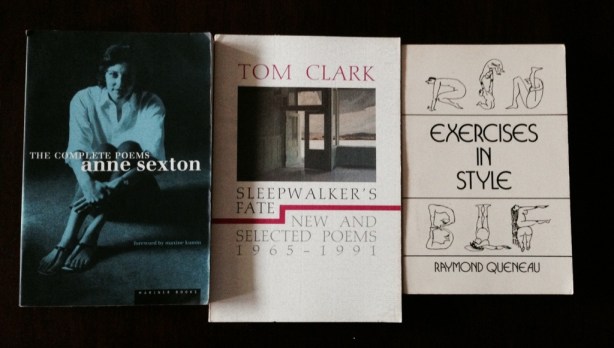
Clark/Queneau/Sexton (Books Acquired, 9.27.2013)

20130928-173447.jpg

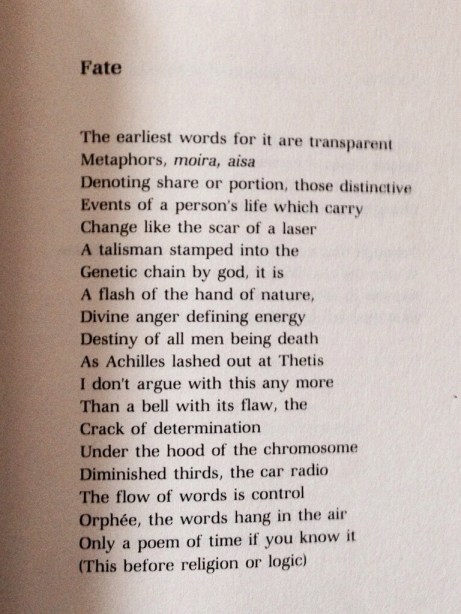
“Fate,” Tom Clark:

20130928-173505.jpg

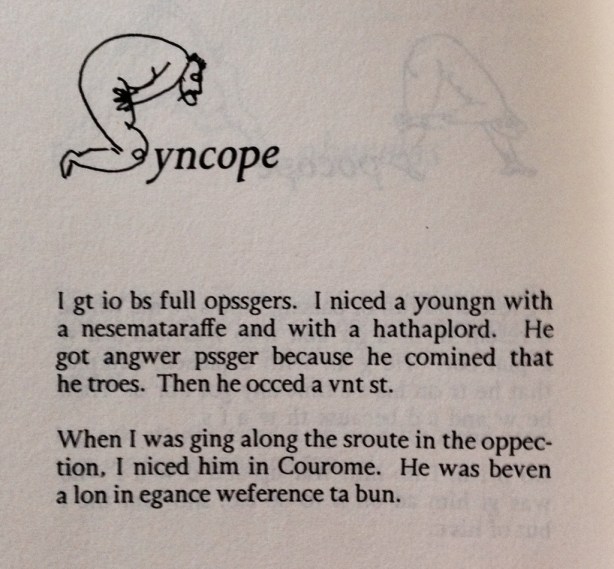
“Syncope,” Raymond Queneau:

20130928-173513.jpg

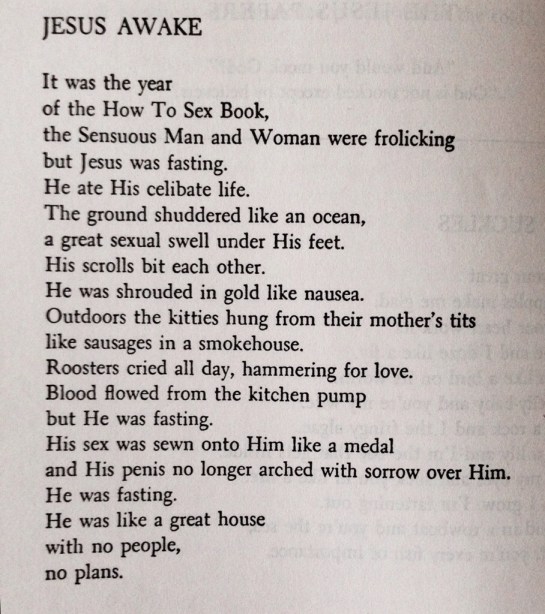
“Jesus Awake,” Anne Sexton:

20130928-173456.jpg

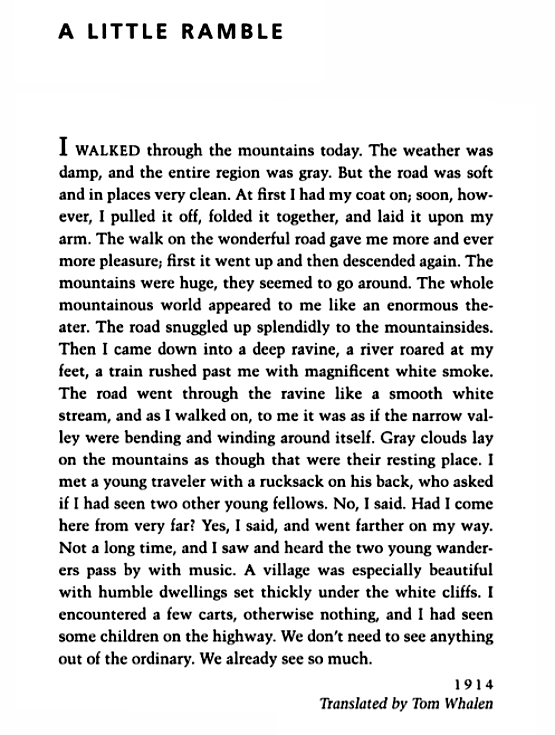
“A Little Ramble” — Robert Walser

alr

“A picnic party in the woods” / September 28, 1841 Journal Entry from Nathaniel Hawthorne

A picnic party in the woods, yesterday, in honor of little Frank Dana’s birthday, he being six years old. I strolled out, after dinner, with Mr. Bradford, and in a lonesome glade we met the apparition of an Indian chief, dressed in appropriate costume of blanket, feathers, and paint, and armed with a musket. Almost at the same time, a young gypsy fortune-teller came from among the trees, and proposed to tell my fortune. While she was doing this, the goddess Diana let fly an arrow, and hit me smartly in the hand. The fortune-teller and goddess were in fine contrast, Diana being a blonde, fair, quiet, with a moderate composure; and the gypsy (O. G.) a bright, vivacious, dark-haired, rich-complexioned damsel,–both of them very pretty, at least pretty enough to make fifteen years enchanting. Accompanied by these denizens of the wild wood, we went onward, and came to a company of fantastic figures, arranged in a ring for a dance or a game. There was a Swiss girl, an Indian squaw, a negro of the Jim Crow order, one or two foresters, and several people in Christian attire, besides children of all ages. Then followed childish games, in which the grown people took part with mirth enough,–while I, whose nature it is to be a mere spectator both of sport and serious business, lay under the trees and looked on. Meanwhile, Mr. Emerson and Miss Fuller, who arrived an hour or two before, came forth into the little glade where we were assembled. Here followed much talk. The ceremonies of the day concluded with a cold collation of cakes and fruit. All was pleasant enough,–an excellent piece of work,–“would’t were done!” It has left a fantastic impression on my memory, this intermingling of wild and fabulous characters with real and homely ones, in the secluded nook of the woods. I remember them, with the sunlight breaking through overshadowing branches, and they appearing and disappearing confusedly,–perhaps starting out of the earth; as if the every-day laws of nature were suspended for this particular occasion. There were the children, too, laughing and sporting about, as if they were at home among such strange shapes,–and anon bursting into loud uproar of lamentation, when the rude gambols of the merry archers chanced to overturn them. And apart, with a shrewd, Yankee observation of the scene, stands our friend Orange, a thick-set, sturdy figure, enjoying the fun well enough, yet, rather laughing with a perception of its nonsensicalness than at all entering into the spirit of the thing.

This morning I have been helping to gather apples. The principal farm labors at this time are ploughing for winter rye, and breaking up the greensward for next year’s crop of potatoes, gathering squashes, and not much else, except such year-round employments as milking. The crop of rye, to be sure, is in process of being threshed, at odd intervals.

I ought to have mentioned among the diverse and incongruous growths of the picnic party our two Spanish boys from Manilla,–Lucas, with his heavy features and almost mulatto complexion; and José, slighter, with rather a feminine face,–not a gay, girlish one, but grave, reserved, eying you sometimes with an earnest but secret expression, and causing you to question what sort of person he is.

From a September 28, 1841 journal entry in Nathaniel Hawthorne’s American Note-Books.

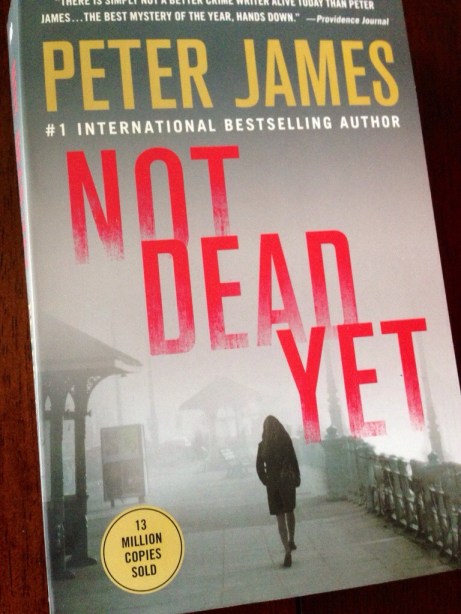
Not Dead Yet (Book Acquired, 9.19.2013)


20130924-200519.jpg

Peter James’s Not Dead Yet. Publisher’s blurb:

For LA producer Larry Brooker, this is the movie that could bring the fortune that has so long eluded him . . .

For rock superstar, Gaia, desperate to be taken seriously as an actor, this is the role that could get her an Oscar nomination…

For the City of Brighton and Hove, the publicity value of a major Hollywood movie being filmed on location, about the city’s greatest love story – between King George IVth and Maria Fitzherbert – is incalculable.

For Detective Superintendent Roy Grace of Sussex CID, it is a nightmare unfolding in front of his eyes. An obsessed stalker is after Gaia. One attempt on her life is made days before she leaves her Bel Air home to fly to Brighton. Now, he has been warned, the stalker may be at large in his city, waiting, watching, planning.


(Not Quite Reviews of) Stuff I Read in September

20130927-141817.jpg

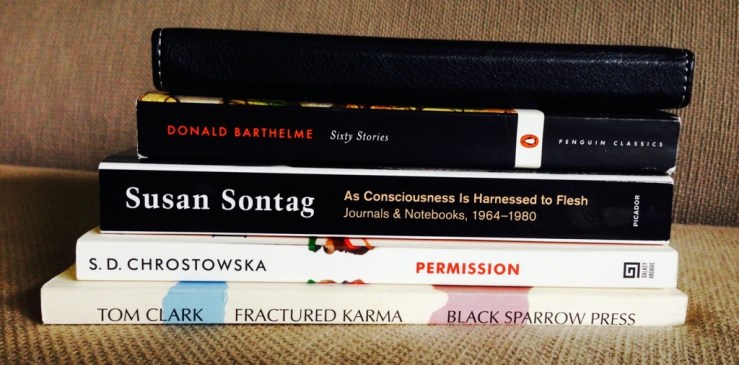
So somehow in September, I neglected to write a single book review—not even a riff!—on this blog. Mea culpa, mea culpa. This oversight (not really an oversight) I mayhap blame on the nascent Fall semester. Or perhaps I should pin it on a certain fatigue after working my way through Pynchon’s mammoth beast Against the Day and Bernhard’s caustic Gargoyles at the end of the summer. But I shouldn’t blame the Thomases. No, I’ve been reading too much at once again. Bad habit.

So, what have I been reading?

Thomas Bernhard’s early novel Frost (on my Kindle, in the dark, often not exactly sober). I posted an excerpt of Ben Marcus’s review of the novel earlier, which I think does a nice job of describing Bernhard’s project. I’m really close to the end, but the novel wears me down—I experienced a similar feeling when I doubled up Correction and The Loser—I should’ve taken a break I think. Still, an excellent, funny read.

Donald Barthelme’s Sixty Stories: I don’t know why anyone wouldn’t own this book. There are a lot of negatives in that sentence; let me reword: Sixty Stories is perfect, a trove, a performance of an author doing stuff that no other author can do. I think I read most of this in college and just sort of went “check” next to it and moved on and I’m certain I didn’t get what he was doing like I do now—just amazing stuff.

I’ve already posted a few excerpts from the latest collection of Susan Sontag’s journals and notebooks, As Consciousness Is Harnessed to Flesh. I like this collection more than the last one—there’s almost a curatorial aspect to Sontag, who is perhaps in her intellectual prime near the end of the journals—or, maybe prime is not the right word; rather, it’s like her mind (which we get to access in some sense via her entries) is so finely attuned (and at times perfectly out of tune) with the intellectual milieu of the day. I’ll be posting a full review sometime in the next two weeks.

S.D. Chrostowska’s novel Permission, new from Dalkey Archive, is lovely stuff—and again, it’ll get its own proper review on here once I can muster the strength. Chrostowska does all sorts of things here that shouldn’t work—cite directly from Blanchot, Derrida, et al—but it does work. The novel is Sebaldian, soaked in history and literature, a book about books, writing about writing. Full review forthcoming. Short review: It’s very very good.

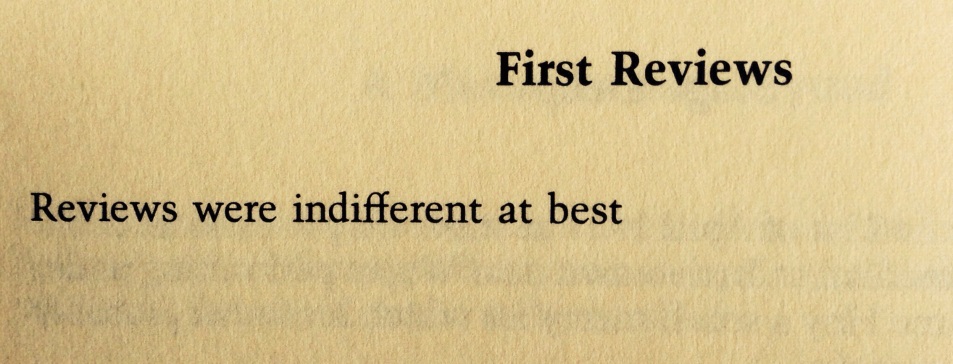
I picked up Tom Clark’s Fractured Karma two weeks ago somewhat randomly. My local bookshop had reorganized some shelves, putting all the Black Sparrow titles together. Fractured Karma must have been on top, because I don’t see how else I would’ve picked up a book with the word “karma” in the title. The book opened to this page:

20130927-141831.jpg

That’s all there is on that page, and something about it—the form, the phrasing—cracked me up. It’s part of a long poem called “He was born blind” about the British comedy actor George Formby. The poem is amazing: I read it there in the store. It reminded me immediately of David Markson’s notecard novels—something about how Clark includes so much reality into his poem. But there’s also this perceptive (if oblique) sense of humor behind it all. I ended up devouring the book, reading the whole thing that weekend. It was one of those holy shit reading moments, frankly. Once I finish typing this I’m going to go pick my kids up and we’re going to go to the bookstore and I’m going to get another Tom Clark book and read it this weekend.

Here’s his poem about The Purple One:

20130927-141838.jpg


“The Gorgon’s Head” by Nathaniel Hawthorne

“The Gorgon’s Head” by Nathaniel Hawthorne

PERSEUS was the son of Danaë, who was the daughter of a king. And when Perseus was a very little boy, some wicked people put his mother and himself into a chest, and set them afloat upon the sea. The wind blew freshly, and drove the chest away from the shore, and the uneasy billows, tossed it up and down; while Danaë clasped her child closely to her bosom, and dreaded that some big wave would dash its foamy crest over them both. The chest sailed on, however, and neither sank nor was upset; until, when night was coming, it floated so near an island that it got entangled in a fisherman’s nets, and was drawn out high and dry upon the sand. The island was called Seriphus, and it was reigned over by King Polydectes, who happened to be the fisherman’s brother.

This fisherman, I am glad to tell you, was an exceedingly humane and upright man. He showed great kindness to Danaë and her little boy; and continued to befriend them, until Perseus had grown to be a handsome youth, very strong and active, and skilful in the use of arms. Long before this time, King Polydectes had seen the two strangers–the mother and her child–who had come to his dominions in a floating chest. As he was not good and kind, like his brother the fisherman, but extremely wicked, he resolved to send Perseus on a dangerous enterprise, in which he would probably he killed, and then to do some great mischief to Danaë herself. So this bad-hearted king spent a long while in considering what was the most dangerous thing that a young man could possibly undertake to perform. At last, having hit upon an enterprise that promised to turn out as fatally as be desired, he sent for the youthful Perseus.

The young man came to the palace, and found the king sitting upon his throne. Continue reading ““The Gorgon’s Head” by Nathaniel Hawthorne”

“I lost a world the other day” — Emily Dickinson

Capture

The Séance Society (Book Acquired, 9.18.2013)

20130924-200501.jpg

Michael Nethercott’s The Séance Society. Blurbish review from Publisher’s Weekly:

Nethercott’s first full-length novel, a classically styled Holmesian whodunit set in 1956, introduces Lee Plunkett, an underemployed PI following reluctantly in his late father’s detective footsteps, and Mr. O’Nelligan, a charmingly low-key and literary-minded Irishman. Together they investigate the death of Trexler Lloyd, a rich eccentric, egomaniac, and patron of the arts of spirit communication, who appears to have been electrocuted at a private demonstration of “the Spectricator,” a device for speaking with the dead, at his home in Braywick, Conn. The plot manages to be twisty while proceeding logically, though the unanalyzed clues are often obvious enough that the reader must assume that Plunkett is none too clever and the smarter O’Nelligan is holding his cards close before the grand gathering and reveal. The household’s collection of psychics, servants, and ghosts are a colorful lot, but in the end are merely quirky where they could have been hilariously bold. Agent: Susan Gleason, Susan Gleason Literary Agency

Seven Jests from Leonardo da Vinci’s Notebooks

1281.

When wine is drunk by a drunkard, that wine is revenged on the drinker.

1283.

An artizan often going to visit a great gentleman without any definite purpose, the gentleman asked him what he did this for. The other said that he came there to have a pleasure which his lordship could not have; since to him it was a satisfaction to see men greater than himself, as is the way with the populace; while the gentleman could only see men of less consequence than himself; and so lords and great men were deprived of that pleasure.

1285.

A JEST.

A man wishing to prove, by the authority of Pythagoras, that he had formerly been in the world, while another would not let him finish his argument, the first speaker said to the second: “It is by this token that I was formerly here, I remember that you were a miller.” The other one, feeling himself stung by these words, agreed that it was true, and that by the same token he remembered that the speaker had been the ass that carried the flour.

A JEST.

It was asked of a painter why, since he made such beautiful figures, which were but dead things, his children were so ugly; to which the painter replied that he made his pictures by day, and his children by night.

1289.

An old man was publicly casting contempt on a young one, and boldly showing that he did not fear him; on which the young man replied that his advanced age served him better as a shield than either his tongue or his strength.

1291.

A JEST.

A man was desired to rise from bed, because the sun was already risen. To which he replied: “If I had as far to go, and as much to do as he has, I should be risen by now; but having but a little way to go, I shall not rise yet.”

1292.

A man, seeing a woman ready to hold up the target for a jousting match, exclaimed, looking at the shield, and considering his spear: “Alack! this is too small a workman for so great a business.”

From the Notebooks of Leonardo da Vinci.


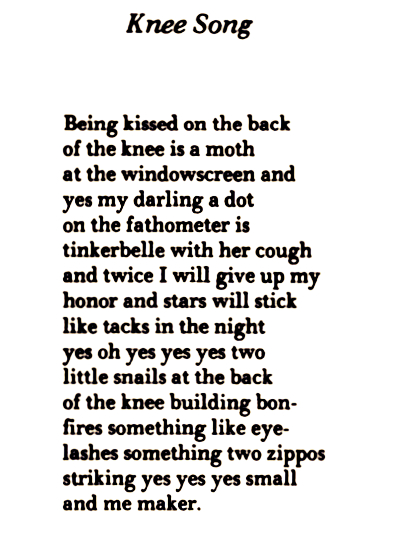
“Knee Song” — Anne Sexton

sexton

The Antagonist (Book Acquired, 9.23.2013)

20130924-200527.jpg

The kind people at Random House sent a copy of Lynn Coady’s The Antagonist, which is new in trade paperback next month. Their blurb:

A piercing epistolary novel, The Antagonist explores, with wit and compassion, how the impressions of others shape, pervert, and flummox both our perceptions of ourselves and our very nature.

Gordon Rankin Jr., aka “Rank,” thinks of himself as “King Midas in reverse”—and indeed misfortune seems to follow him at every turn. Against his will and his nature, he has long been considered—given his enormous size and strength—a goon and enforcer by his classmates, by his hockey coaches, and, not least, by his “tiny, angry” father. He gamely lives up to their expectations, until a vicious twist of fate forces him to flee underground. Now pushing forty, he discovers that an old, trusted friend from his college days has published a novel that borrows freely from the traumatic events of Rank’s own life. Outraged by this betrayal and feeling cruelly misrepresented, he bashes out his own version of his story in a barrage of e-mails to the novelist that range from funny to furious to heartbreaking.

With The Antagonist, Lynn Coady demonstrates all of the gifts that have made her one of Canada’s most respected young writers. Here she gives us an astonishing story of sons and fathers and mothers, of the rewards and betrayals of male friendship, and a large-spirited, hilarious, and exhilarating portrait of a man tearing his life apart in order to put himself back together.

The book got a strange review from Ron Charles in The Washington Post that’s worth reading if your interest is piqued; from that review:

It’s an extraordinarily clever and sympathetic exploration of the cross-currents of male friendship, the intense relationships we make and abandon in school. How ill-fitting those intimacies feel years later whenever a college reunion or some chance encounter forces us to try them on again. Who owns our adolescent memories, our forgotten brutalities, our drunken confessions of affection and dread? (By the way, there are three Lynn Coadys on Facebook, but you were easy to find.)

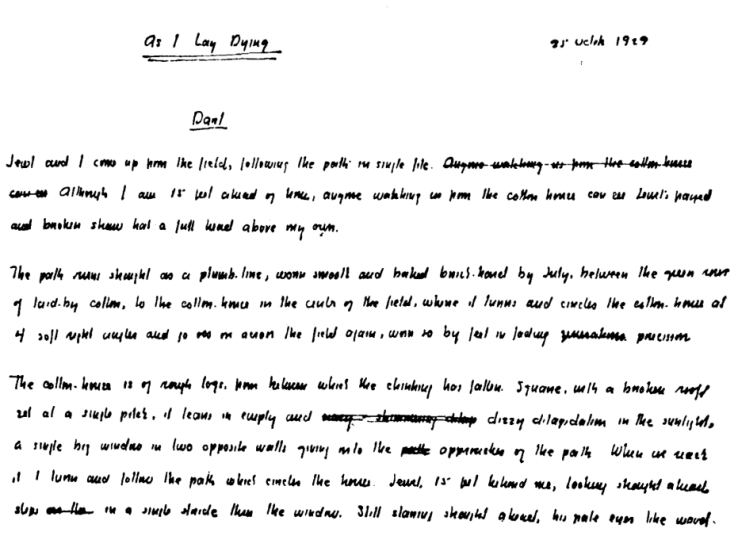
Manuscript Page of Faulkner’s As I Lay Dying

faulkner-w

“Character Is Fate” — Tom Clark

Capture