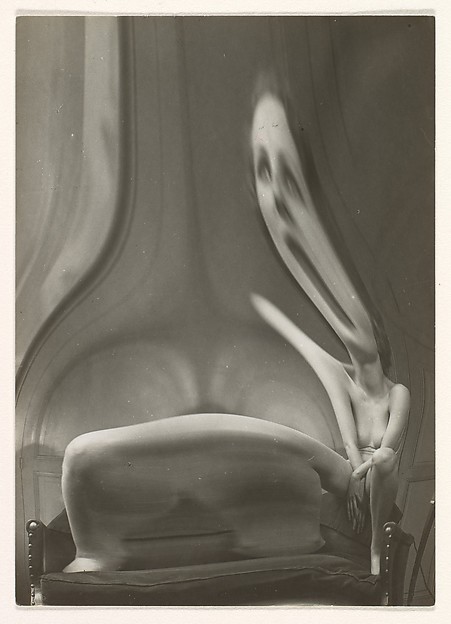
Distortion #51 — André Kertész

André Kertész (American (born Hungary), Budapest 1894–1985 New York) Distortion #51, 1933 Gelatin silver print; Image: 9.6 x 6.9 cm (3 3/4 x 2 11/16 in.) The Metropolitan Museum of Art, New York, Purchase, The Horace W. Goldsmith Foundation Gift, through Joyce and Robert Menschel, 1987 (1987.1180) http://www.metmuseum.org/Collections/search-the-collections/265734

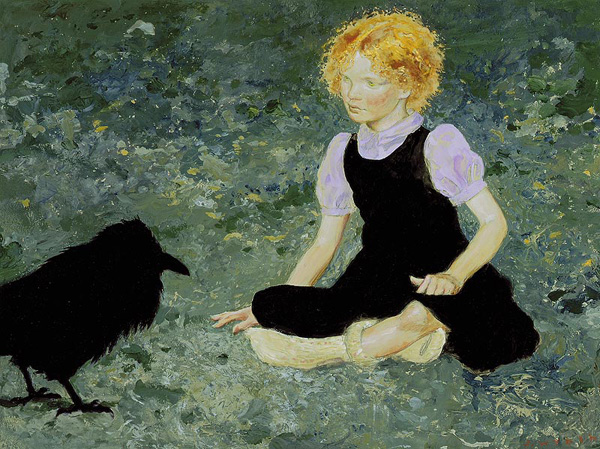
The Raven Girl — Jamie Wyeth

f56d602db302e7b7fc4043de52604d5e

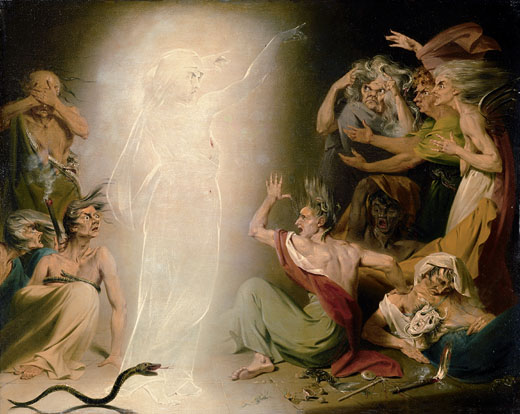
The Ghost of Clytemnestra Awakening the Furies — John Dowman

dowmna_ghost_clytemnestra_0.jpg

Thomas Pynchon sends his regrets to Donald Barthelme for missing the Postmodern Dinner

screenshot-2017-01-18-at-8-36-27-pm

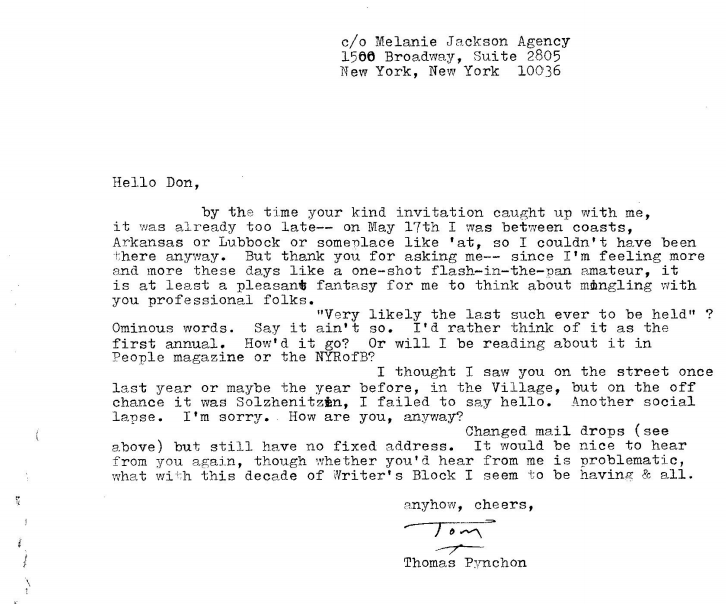
A 1983 letter from Thomas Pynchon to Donald Barthelme.

Superlibrarian Jessamyn West shared Pynchon’s letter to Barthelme on Twitter yesterday and then posted it on her wonderful Donald Barthelme appreciation page.

Pynchon here is ostensibly apologizing for missing Barthelme’s so-called “Postmodern Dinner” in New York.

In his 2009 Barthelme biography Hiding Man, Tracy Daugherty offers the following recollection from novelist Walter Abish:

Around this time — in the spring of 1983 — “Donald had this idea to make a dinner in SoHo,” says Water Abish. “A major dinner for a group of writers, and he planned it very, very carefully. It was a strange event. Amusing and intriguing. He invited…well, that was the thing of it. The list. I was astounded that he consulted me but he called and said, ‘Should we invite so-and-so?’ Naturally, I did the only decent thing and said ‘Absolutely’ to everyone he mentioned. I pushed for Gaddis. Gass was there, and Coover and Hawkes, Vonnegut and his wife, Jill Krementz, who took photographs, I think. Don’s agent, Lynn Nesbit, was there. She was always very friendly. Susan Sontag was the only woman writer invited.

Daugherty continues:

Pynchon couldn’t make it. He wrote Don to apologize. He said he was ‘between coasts, Arkansas or Lubbock or someplace like ‘at.”

Okay.

Abish recollects that the meal was at a very expensive restaurant, prefix, and the writers had to pay their own way. There were about 21 attendees, and Barthelme was “Very, very dour.”

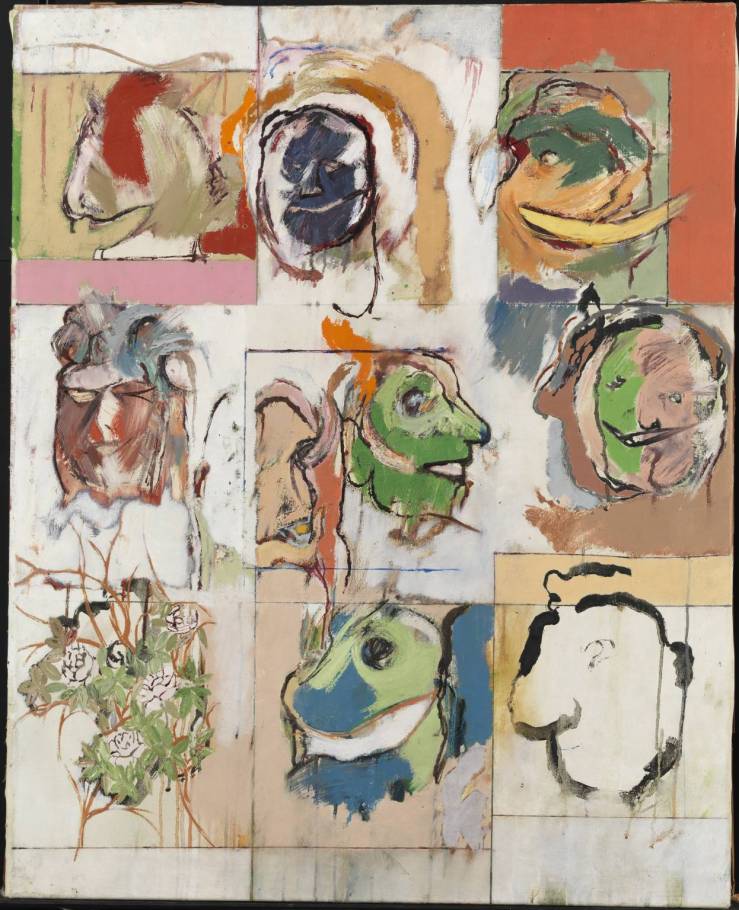
Erasmus Variations — R.B. Kitaj

T12540_10.jpg

“All art constantly aspires to something something music”

“Don’t you know you” –Emily Dickinson

ed0739

Morning Sun — Edward Hopper

26216cf9bad9c5b90cc9d77f8a996bd1

Reading/Have Read/Should Write About (Paul Bowles, Robert Coover, Pierre Senges, Antonio di Benedetto)

img_4908

I’ve had a hard time reading much (let alone writing anything) since November 8th.

A Klimt puzzle has been soothing though.

And I’ve found audiobooks, which I’ve always loved, particularly wonderful lately. They have provided a kind of anti-noise, antidote, anti-?—against the NPR news and punditry I might normally adhere to in the car (and especially potent against my own thoughts at night before I fall asleep).

My pattern with audiobooks has long been to reread at night the chapters or passages I audited that day, or to audit after I had read—or to mix it all up, going back and forth. I like this method because it allows me, essentially, to reread.

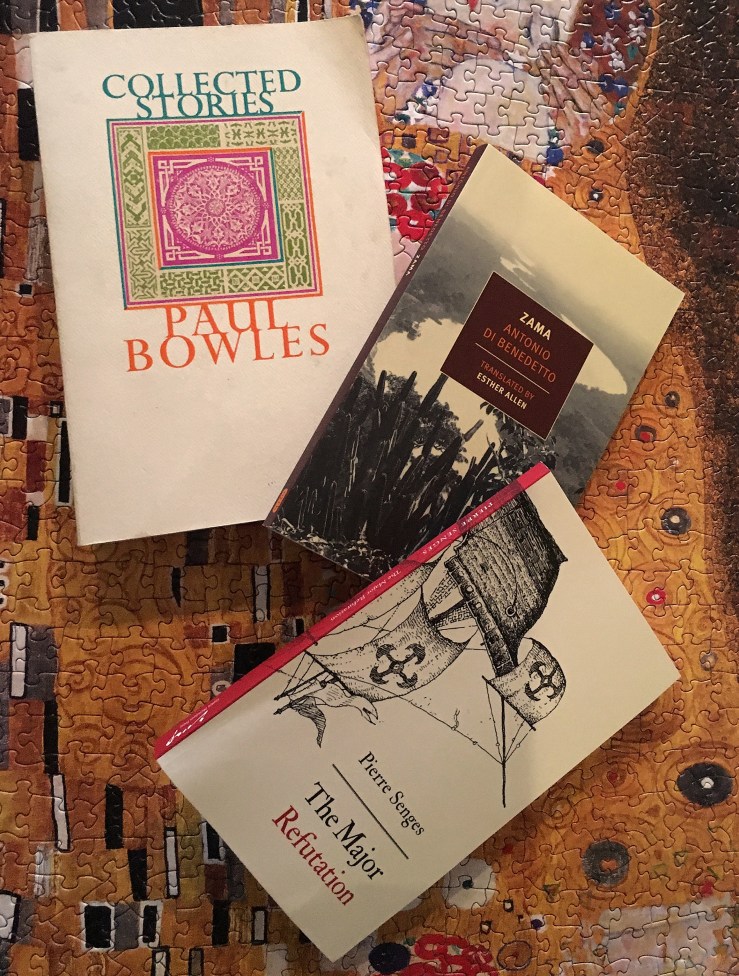
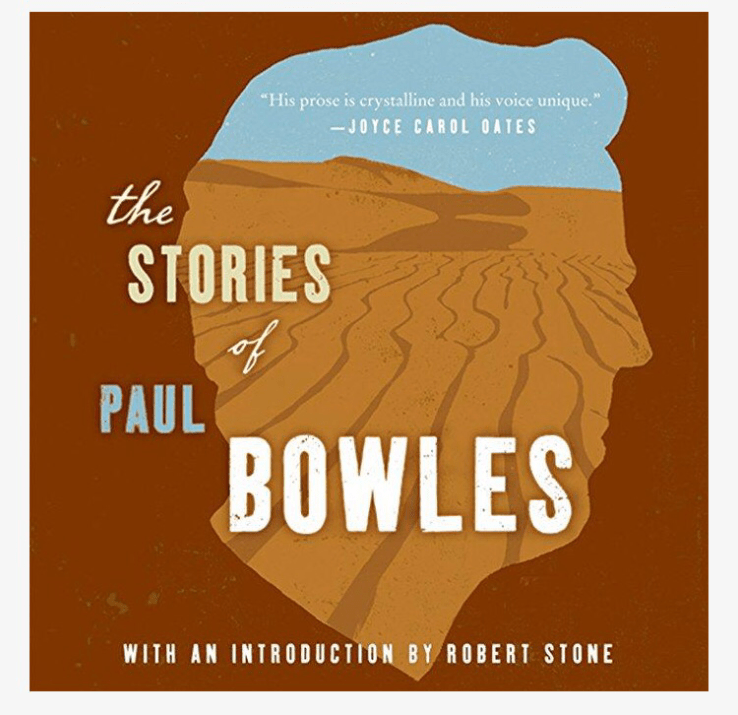
I’ve been listening to The Stories of Paul Bowles, read by like a dozen different performers (not a full-cast group read, but rather different voices for different tales). Then (mostly at night but occasionally very early in the morning), I’ve been rereading some of the stories that are collected in Collected Stories. (My local bookshop had copies of the more-complete The Stories of, but hell, who can pass up a Black Sparrow Press edition? Plus—parenthetically—the BSP edition collects the more essential stories).

Anyway, I’m coming to the end of The Stories of Paul Bowles and I’m almost a bit sad about it. The sadness come partially from the fact that the stories are presented chronologically, and, simply put, the later tales are sadder than the earlier ones. Not in content, but in tone—Bowles’s later stuff grows more bitter, more resentful. The earlier tales are strange, sharp, and driven by weird nightmare alienation and sinister surrealism. But they also open into possibility, exploration, and radical newness. The later tales, composed in the 1980s, seem to me a closing off, not just in themes and tone, but also stylistically. They retreat into formalist modernism. There’s a palpable resistance to postmodernism in the later stories, an elegiac tone that romanticizes (even through multiple ironies) the post-War colonial past.

But my sadness is also the feeling of Oh I want more. (Plus like, the aforereferenced general post-election malaise). This is all easily remedied by my plan to listen to the first two-thirds of these stories again—but probably after I take a crack at his novels.
img_4924

I was too young the first time I took a crack at The Sheltering Sky—16 I think. I was reading a lot of Hemingway, Vonnegut, William Burroughs, et al. But I couldn’t click with Bowles, which makes sense to me two decades later. His stories are spare but sharp, wild but obscure. His fables refuse to square with our expectations. They are menacing, awful, loaded with strangers and travelers and outcasts. The characters do not know what is happening to them; they do not even know that they do not know what is happening to them. Often, the story’s narrator does not seem to know what is happening, and if the narrator does know what is happening, he’s not going to throw anything but the barest bones to the reader to piece together. Anyway, I’ll trek through again, for sure.

A late Bowles story, the epistolary “Unwelcome Words” (many of the later stories are epistolary affairs), offers me a neat transition to the audiobook I’ve been drifting off into unconsciousness the past few evenings with. Here’s Bowles’s narrator (a version of Bowles his-goddamn-self):

I’ve often wished that someone would rewrite the end of Huckleberry Finn, delivering it from the farcical closing scenes which Twain, probably embarrassed by the lyrical sweep of the nearly completed book, decided were necessary if the work were to be appreciated by American readers. It’s the great American novel, damaged beyond repair by its author’s senseless sabotage. I’d be interested to have your opinion, or do you feel that the book isn’t worth having an opinion about, since a botched masterpiece isn’t a masterpiece at all? Yet to counterfeit the style successfully, so that the break would be seamless and the prose following it a convincing continuation of what came before—that seems an impossible task. So I shan’t try it, myself.

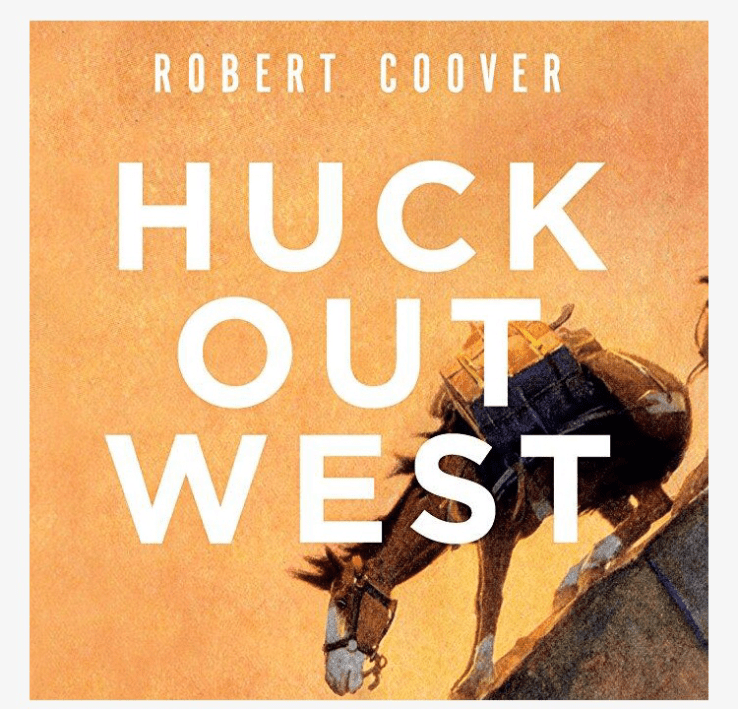
Bowles here licenses my transition to Robert Coover’s latest, Huck Out West, a sorta-sequel to Twain’s problematic American masterpiece. Sure, Coover’s not rewriting the end of Huck Finn so much as he’s carrying out the mission of the novel’s final lines: “…I got to light out for the Territory ahead of the rest, because Aunt Sally she’s going to adopt me and sivilize me, and I can’t stand it. I been there before.” So Coover sets Huck out in the Territory, away from the maternal bodies that would otherwise sivilize him. I’ve gotten maybe two hours into the audiobook (it’s short, fewer than ten hours), but I keep launching in to different points, and only auditing late at night. I need a physical copy.
img_4925

Physical copies report:

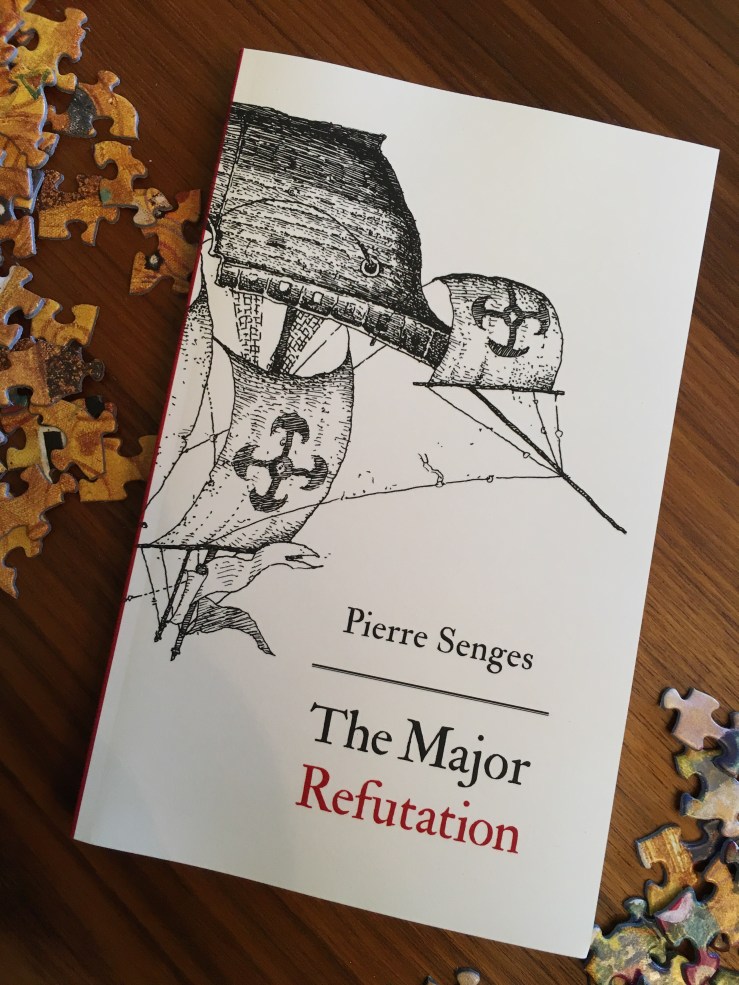
I’m crawling through Pierre Senges’s The Major Refutation (Eng. trans. by Jacob Siefring), mostly because I have to look up names, look for images, get lost in early depictions of “The New World” (and, uh, the refutation of the New World). . So far, it reminds me of the kind of fantasy-based literary criticism that I love: Eco, Borges, Calvino. Excerpt here.

A friend loaned me his copy of Antonio di Benedetto’s first novel Zama (Eng. translation by Esther Allen) last week, insisting I read it, and informing me that Bolaño based the titular figure of his story “Sensini” on di Benedetto. I read the first four chapters this afternoon; they were very short and I want to keep reading. Short chapters are working for me right now.
Appalachian — George Boorujy

2014-appalachian-79-31x48-88

I’ve often wished that someone would rewrite the end of Huckleberry Finn (Paul Bowles)

I’ve often wished that someone would rewrite the end of Huckleberry Finn, delivering it from the farcical closing scenes which Twain, probably embarrassed by the lyrical sweep of the nearly completed book, decided were necessary if the work were to be appreciated by American readers. It’s the great American novel, damaged beyond repair by its author’s senseless sabotage. I’d be interested to have your opinion, or do you feel that the book isn’t worth having an opinion about, since a botched masterpiece isn’t a masterpiece at all? Yet to counterfeit the style successfully, so that the break would be seamless and the prose following it a convincing continuation of what came before—that seems an impossible task. So I shan’t try it, myself.

From Paul Bowles’s short story “Unwelcome Words.”

We have got difficult days ahead

ben-shahn_martin-luther-king-jr-800x1020

Sunday Comics 

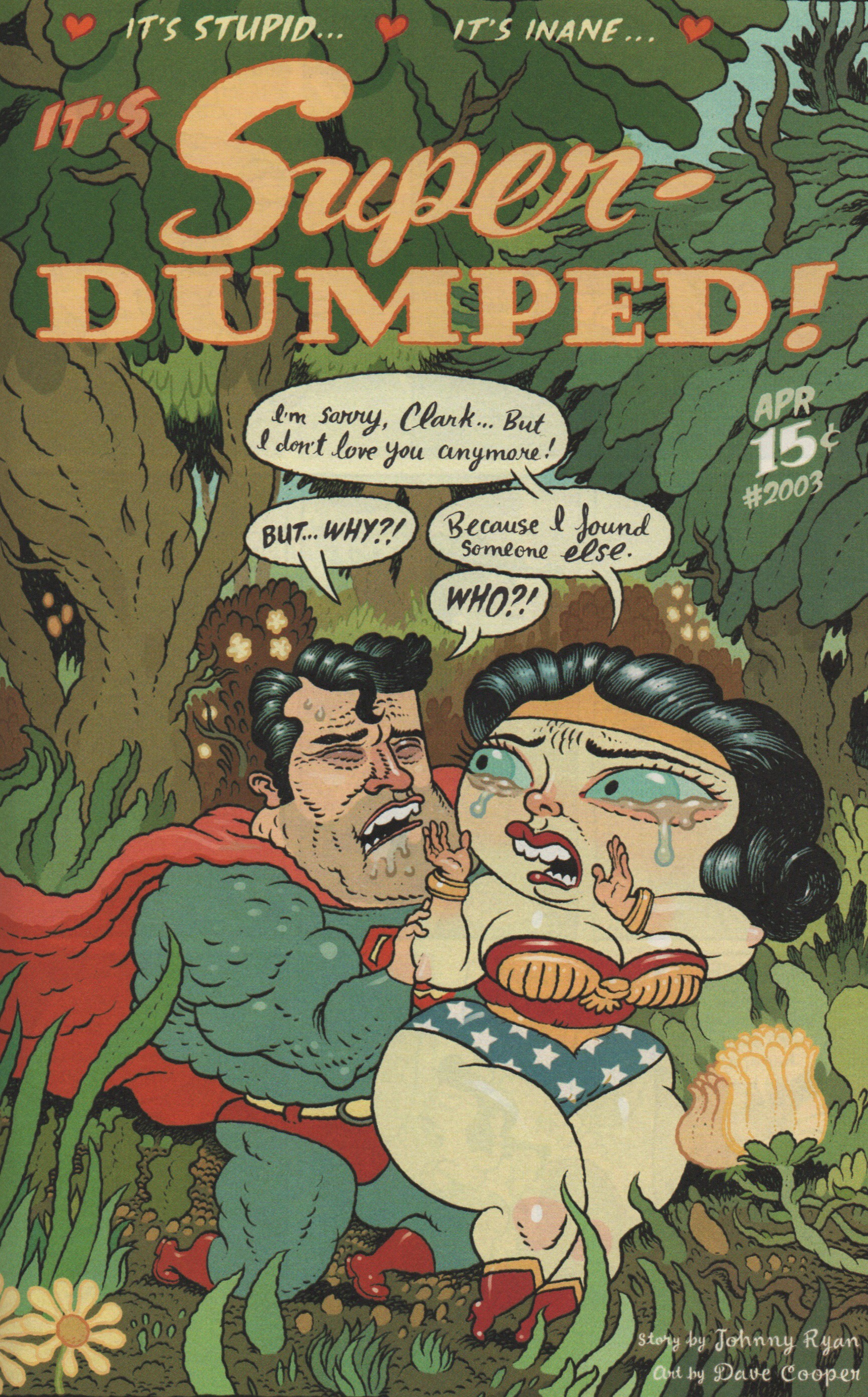
Art by Dave Cooper. From Bizarro World, DC Comics, 2005.

Perseus and Andromeda (detail) — Joachim Wtewael

screenshot-2017-01-07-at-7-03-25-pm

Farce for farce, we could have been just as glad with a book | From Pierre Senges’s The Major Refutation

img_4568

To paint the portrait of this new territory, the mapmakers in their workshops are drawing free-hand sketches of coastlines that are not a whit newfangled, but for their way of appraising our world scornfully, as if from a foreign shore. Bringing islands into existence on paper is a heady game: I have taken it up myself in order to appreciate such intoxication as trumpery procures, that of an adventure on the high seas, at hardly any cost, drawn out in the meticulous outline of gulfs, hills natural harbours, headlands, capes, deltas, swamps, bone-heaps and rocks peopled with grey fowls; it sufficed to set some corsairs gamboling there. But the mapmakers go further: they invent the natives of these territories too, drawing their faces in the manner of the Guanches of the Canaries, or Ukrainians driven by force to Genoa; without inventing much they invent loincloths copied from Madeira, shoes copied from Ceylon, and sticks of incense copied from Bactria but placed in the mouth. As for the amorous rites of the natives, the clerks in Isabella’s workshops only had to leaf through the ledgers of the Old and New Inquisitions, but aslso the works of Tertullian where he denounces the excesses of the Gnostics & their collective mating practices, involving devorations, anthropophagy, child sacrifices, sodomies complicated by the age of the subjects and their numerousness. They plunge into these annals as if into the reservoir of all possible combinations, the imagination being for them but a principle of permutations, and nothing else. The Cathars, before they retracted, addressed their torturers with periphrases we find almost unchanged in the accounts of many impostors returned from the New Indies. We can see that the promoters of these lands under the horizon did not have to look very far for their lying words, which they simply cut from books, sometimes with their images, combining them freely with those old lullabies that our grandmothers recited now and then, no longer believing in them, but transmitting them all the same since one must talk of something if only to fill the day’s idle hours.

By reading these works, by plundering the archives, in other words by resurrecting these long dormant voices, each can see for himself that this world arbitrarily pulled out of the sea is neither a new idea, no an ingenious invention of our admirals, but rehashed legends, dressed up in drama and luxury to appeal to modern appetites, embellished sometimes with the help of parades of passive, nude savages, insinuated by the conquerors—the sole novelty these crude, chronically celibate men are capable of inventing to excite their fantasies, nay, the consummation of these fantasies in a tightly clenched fist, since love, discovery, and imagination are for them matters of force. No one can convince us that the Atlantic islands are an original idea, or that sailors from Lisbon or Genoa are telling for the first time of western archipelagoes adrift on the tenebrous sea. There are in our libraries so many allusions to Atlantis, to the voyages of St. Brendan, to the Seven Cities, to Ante Illa, and to the island of Brazil; so many now tattered books tell of the drifting of the Apostles of God toward the unbelievers and scorpions of the east and of the west, so many tattered books describe the walls of legendary cities and islands in the shape of tortoises: you would swear that the adventure of the new world were naught else than a hardly embellished copy of our old legends, a copy graven on the sea, instead of on paper: farce for farce, we could have been just as glad with a book.

From Pierre Senges’s novel The Major Refutation, new in English translation by Jacob Siefring from Contra Mundum Press.

The narrator is Antonio de Guevara, unsigned author of Refutatio major (c. 1517-25), an argument (?!) against the really real reality of The New World.

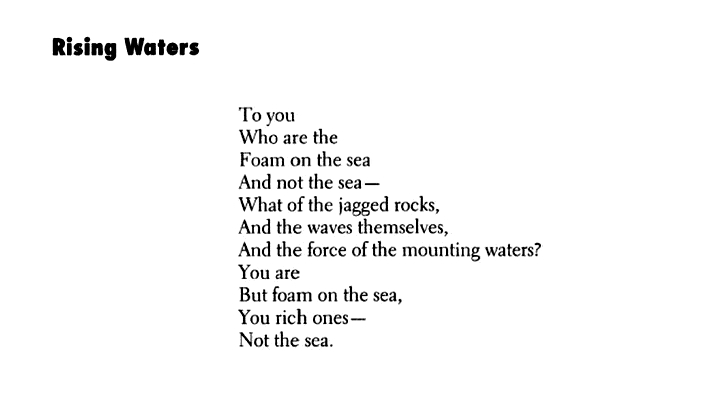
“Rising Waters” — Langston Hughes

lh