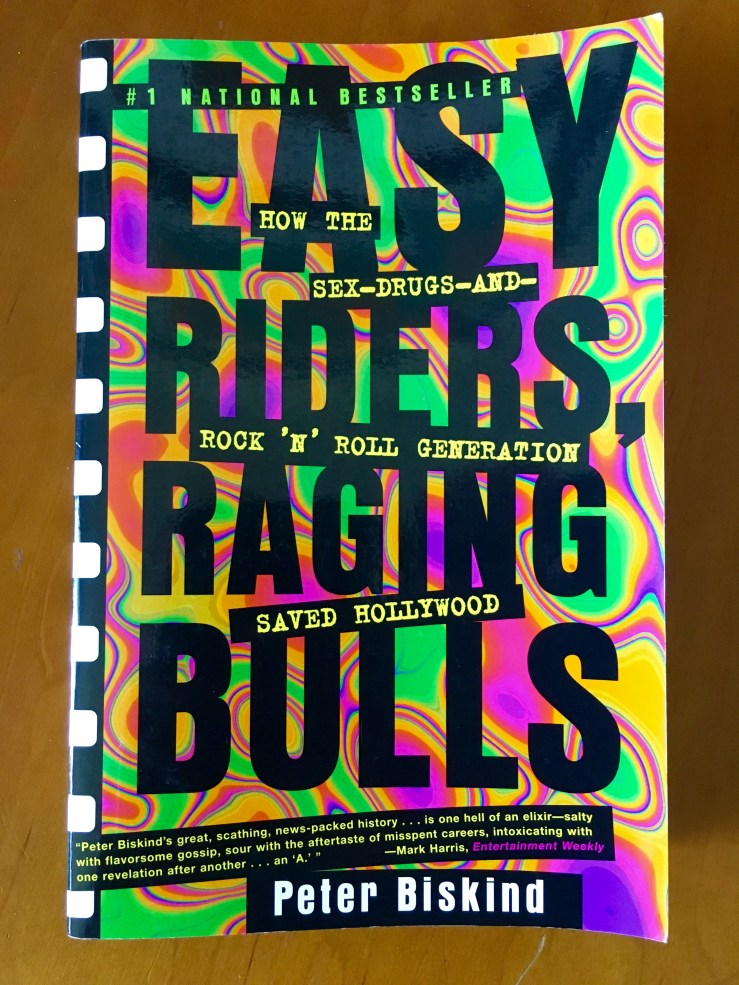
I finally break down and buy Easy Riders, Raging Bulls (Book acquired August 1, 2016)

img_3254

Peter Biskind’s Easy Riders, Raging Bulls has been on my radar forever (or at least since its publication in the late nineties), but I’d resisted picking it up until earlier this week—maybe because of its awful, awful cover (good lord), or maybe because of that off-putting subtitle, which just seems to scream, Boomer mythologies!

But after watching William Friedkin’s Sorcerer a third time, I wanted to read about the film, and Biskind’s book was easy to find used and so well hey. Of course I skipped to the index, and found enough pages on Sorcerer to take the book home. I read those pages at home, right away, with mounting disappointment, or frustration, rather. Biskind’s dishy, bitchy style is annoying, (although I assuaged the bad prose by reading the whole thing, as best as I could, in a Robert Evans accent) and beyond the bad prose is a paucity of information about, like, the actual filmmaking behind Sorcerer. It might be interesting to some people that Friedkin was a total asshole to his girlfriend, but I guess I wanted to know about the work, y’know? At least there’s a whole bunch of stuff on Heaven’s Gate too.

So well anyway, I read the introduction to the book and I can see how it does seem promising, but there’s also something deeply frustrating about Biskind’s approach (from the outset, anyway)—he seems to want to valorize the Baby Boomers at every turn. He introduces the first wave of the heroes of his book at “white men born in the mid- to late ’30s” without a hint of irony, noting that the “second wave was made up of the early boomers.” Of course it’s the names of the heroes that attract the reader: Bogdanovich, Coppola, Nichols, Scorsese, Malick, De Palma, etc. (It’s also sort of fascinating that even in the late ’90s, Biskind, a few paragraphs later, parses the “new group of actors” he lauds (Nicholson, De Niro, Keitel, et al) from “the women,” the “new faces.” Yeesh). My guess is that I’ll pick at this book as I watch and/or re-watch the films of the decade it valorizes—the films of the ’70s—the films that it so boomerishly insists were The Last Great Golden Age of Film Never to Be Replicated Again, Nope, That’s All Folks.

Here’s the trailer for Friedkin’s Sorcerer (the soundtrack is by Tangerine Dream, who also scored Michael Mann’s 1981 film Thief. Mann is not indexed in Easy Riders, Raging Bulls):
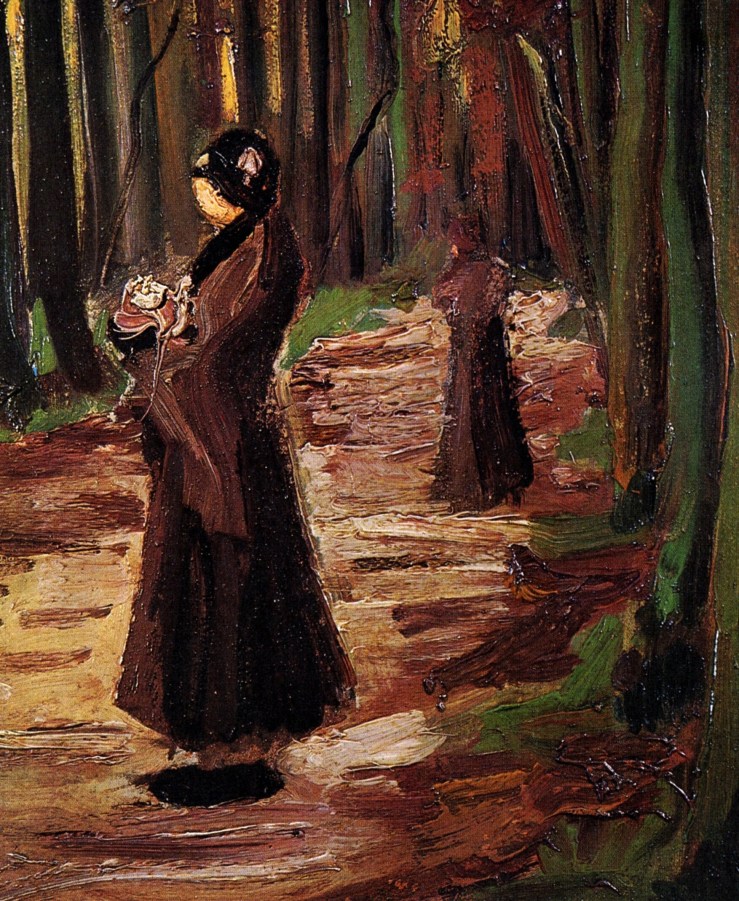


Two Women in the Woods — Vincent van Gogh

two-women-in-the-woods-1882

Mr. Thoreau has twice listened to the music of the spheres, which, for our private convenience, we have packed into a musical-box | Nathaniel Hawthorne’s journal entry for August 5th, 1842

Concord, August 5th.–A rainy day,–a rainy day. I am commanded to take pen in hand, and I am therefore banished to the little ten-foot-square apartment misnamed my study; but perhaps the dismalness of the day and the dulness of my solitude will be the prominent characteristics of what I write. And what is there to write about? Happiness has no succession of events, because it is a part of eternity; and we have been living in eternity ever since we came to this old manse. Like Enoch, we seem to have been translated to the other state of being without having passed through death. Our spirits must have flitted away unconsciously, and we can only perceive that we have cast off our mortal part by the more real and earnest life of our souls. Externally, our Paradise has very much the aspect of a pleasant old domicile on earth. This antique house–for it looks antique, though it was created by Providence expressly for our use, and at the precise time when we wanted it–stands behind a noble avenue of balm-of-Gilead trees; and when we chance to observe a passing traveller through the sunshine and the shadow of this long avenue, his figure appears too dim and remote to disturb the sense of blissful seclusion. Few, indeed, are the mortals who venture within our sacred precincts. George Prescott, who has not yet grown earthly enough, I suppose, to be debarred from occasional visits to Paradise, comes daily to bring three pints of milk from some ambrosial cow; occasionally, also, he makes an offering of mortal flowers. Mr. Emerson comes sometimes, and has been feasted on our nectar and ambrosia. Mr. Thoreau has twice listened to the music of the spheres, which, for our private convenience, we have packed into a musical-box. E—- H—- , who is much more at home among spirits than among fleshly bodies, came hither a few times merely to welcome us to the ethereal world; but latterly she has vanished into some other region of infinite space. One rash mortal, on the second Sunday after our arrival, obtruded himself upon us in a gig. There have since been three or four callers, who preposterously think that the courtesies of the lower world are to be responded to by people whose home is in Paradise. I must not forget to mention that the butcher conies twice or thrice a week; and we have so far improved upon the custom of Adam and Eve, that we generally furnish forth our feasts with portions of some delicate calf or lamb, whose unspotted innocence entitles them to the happiness of becoming our sustenance. Would that I were permitted to record the celestial dainties that kind Heaven provided for us on the first day of our arrival! Never, surely, was such food heard of on earth,–at least, not by me. Well, the above-mentioned persons are nearly all that have entered into the hallowed shade of our avenue; except, indeed, a certain sinner who came to bargain for the grass in our orchard, and another who came with a new cistern. For it is one of the drawbacks upon our Eden that it contains no water fit either to drink or to bathe in; so that the showers have become, in good truth, a godsend. I wonder why Providence does not cause a clear, cold fountain to bubble up at our doorstep; methinks it would not be unreasonable to pray for such a favor. At present we are under the ridiculous necessity of sending to the outer world for water. Only imagine Adam trudging out of Paradise with a bucket in each hand, to get water to drink, or for Eve to bathe in! Intolerable! (though our stout handmaiden really fetches our water.) In other respects Providence has treated us pretty tolerably well; but here I shall expect something further to be done. Also, in the way of future favors, a kitten would be very acceptable. Animals (except, perhaps, a pig) seem never out of place, even in the most paradisiacal spheres. And, by the way, a young colt comes up our avenue, now and then, to crop the seldom-trodden herbage; and so does a company of cows, whose sweet breath well repays us for the food which they obtain. There are likewise a few hens, whose quiet cluck is heard pleasantly about the house. A black dog sometimes stands at the farther extremity of the avenue, and looks wistfully hitherward; but when I whistle to him, he puts his tail between his legs, and trots away. Foolish dog! if he had more faith, he should have bones enough.

Nathaniel Hawthorne’s journal entry for August 5th, 1842. From Passages from the American Note-Books.

Blessed Art Thou among Women — Gertrude Käsebier

dp233037

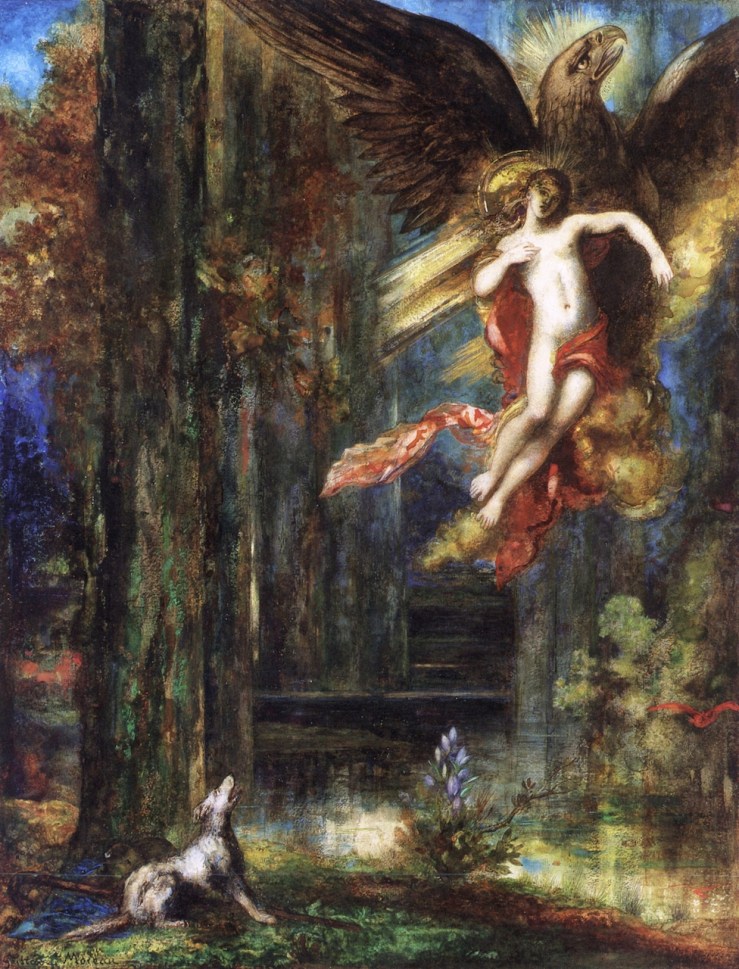
The Abduction of Ganymede — Gustave Moreau

gustave_moreau_-_the_abduction_of_ganymc3a8de2c_1886

In the beginning Dardanus was the son of Jove, and founded Dardania, for Ilius was not yet stablished on the plain for men to dwell in, and her people still abode on the spurs of many-fountained Ida. Dardanus had a son, king Erichthonius, who was wealthiest of all men living; he had three thousand mares that fed by the water-meadows, they and their foals with them. Boreas was enamoured of them as they were feeding, and covered them in the semblance of a dark-maned stallion. Twelve filly foals did they conceive and bear him, and these, as they sped over the rich plain, would go bounding on over the ripe ears of corn and not break them; or again when they would disport themselves on the broad back of Ocean they could gallop on the crest of a breaker. Erichthonius begat Tros, king of the Trojans, and Tros had three noble sons, Ilus, Assaracus, and Ganymede who was comeliest of mortal men; wherefore the gods carried him off to be Jove’s cupbearer, for his beauty’s sake, that he might dwell among the immortals.

From Book XX of The Iliad (translation by Samuel Butler).

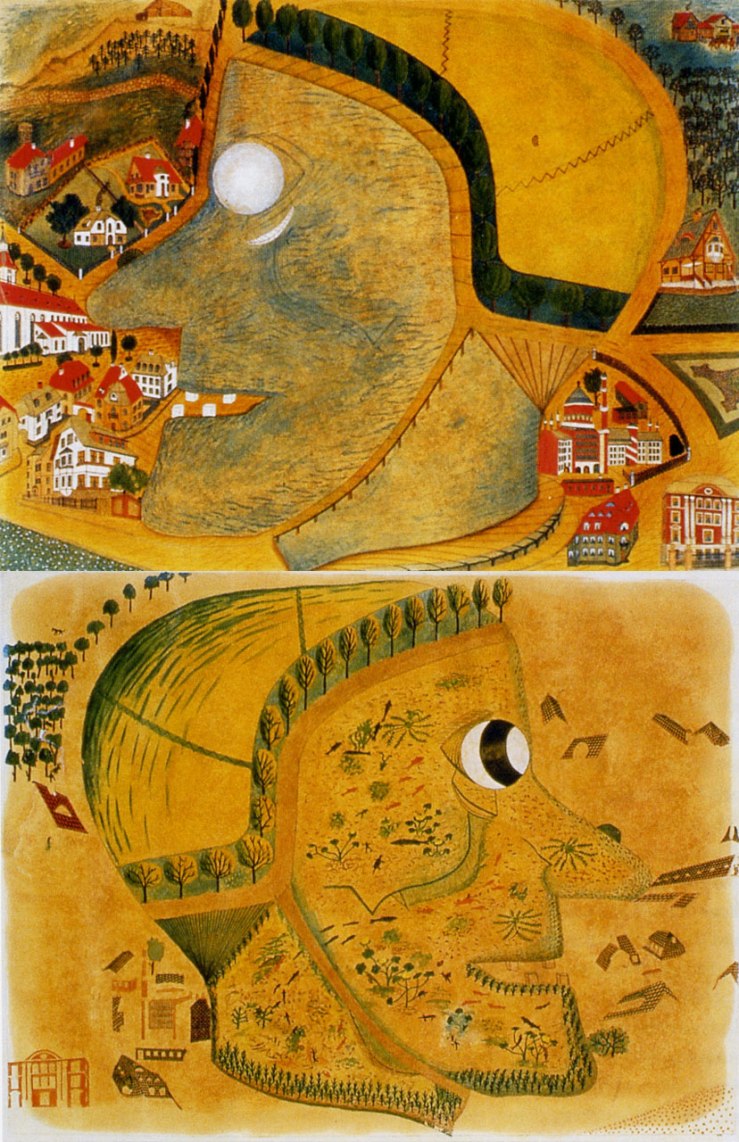
Witch’s Head — August Natterer

witch-s-head-1915

Putney Swope

putney_swope_xlg

Lucia — László Moholy-Nagy

dp111651

Selections from One-Star Amazon Reviews of William Faulkner’s The Sound and the Fury

[Editorial note: The following citations come from one-star Amazon reviews William Faulkner’s novel The Sound and the FuryI’ve preserved the reviewers’ original punctuation and spelling. I reviewed the book (favorably) on this blog seven years ago.  More one-star Amazon reviews].


unreadable

the biggest muddle

a bad ear for dialog

This is a strange book

so-called literary experts

I am an aficionado of classic literature

Faulkner was a Jamnes Joyce wannabe

a bunch of people 100 years ago thought it was good

Symbolism is one of the worst literary techniques of all time

doesn’t even began to tell a good story

It is the worst book I have ever read

Please, don’t insult my intelligence

Morals don’t decaying!

punchless dialogue

overdone prose

non-existent suspense

I have a degree in literature

no longer appropriate to the times

long-winded sentences that go nowhere

Only perverts think as these characters do

characters are poorly-educated, racist and revolting

Eitther he had too much gin or I did not have enpugh

I hate it when characters are given the same name, especially when one is male and the other is female

It has no place in our current American way of life or desire for good reading

Both Dashiell Hammett and Jack Kerouac could write rings around Faulkner

akin to abstract art, in that it is really not art at all

random run-on sentences spewed out on paper

if it weren’t for online Cliff’s Notes

I relish in classical literature

nothing but small talk

adolescent nastiness

signifying nothing

no commas

incest

Dreadful

no periods

people in ivory towers

suggested by a book club

I must be odd or poorly-educated (or both)

the book was a ‘lengthy companion to literary aids’

all of the white characters in this novel are disgusting

The style was so challenging, I found it hard to enjoy the reading process

I fear that William Faulkner and his works, especially this one, have got The South a bad name

Faulkner attempted an experiment with storytelling no one had never done before

a somewhat kinky description of looking up at the girl Caddy’s muddy panties

a novel of stereotypes and pitiful prose

I must need a translator from the South

I choose Hemingway

a despicable trollop

incorrect grammar

No capitalization

So inaccessible

Jackson Pollack

Virginia Wolfe

Cliff’s Notes

unedited

It has no plot

so unsatisfying

I enjoy good books

self-contradictions

borderline suicidal despair

page after page of sheer boredom

He was drunk, as well as over-rated

Like being on a three-week drunken spree

This is not entertainment, this is tediousnes

and what was up with all the words in italics?

nonsensical, grammatically-butchered ramblings

written by either a drug addict or someone with ADHD

it earned bleeding-heart points for having a simpleton for a character

still not completely sure whether or not the male Quentin had sex with his sister Caddy

I wish Faulkner had never “written” it and had instead pursued a career as a lumberjack, or stevedore, and served humanity in some noble fashion

I would like to build a time machine for the sole purpose of traveling back in time to kick Faulkner in the nuts

an endless stream of strangers sneaking up on him and kicking him in the nuts

427 pages of incomprehensible jibberish

NO PUNCTUATION WHATSOEVER

My entire book club scrapped this

undergraduate postmodernism

like an ungreatful girlfriend

I enjoy reading the masters

logical non-sequiturs

supposedly a classic

deliberately bad

Yuck

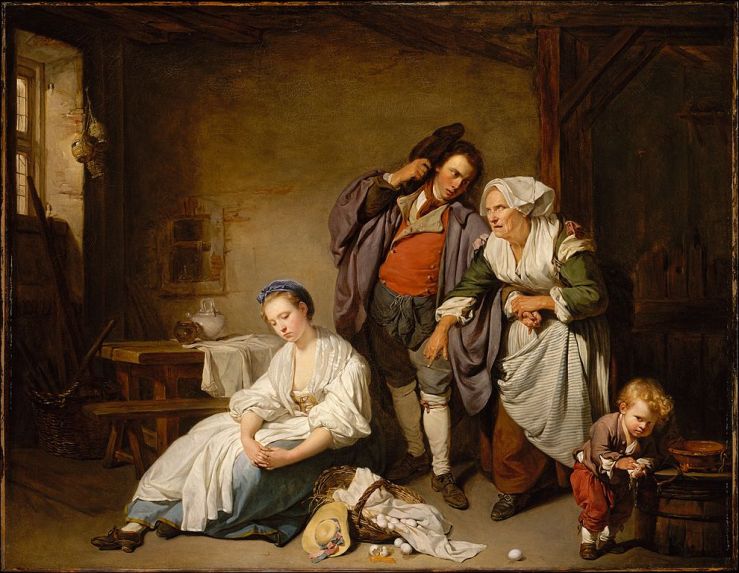
Broken Eggs — Jean-Baptiste Greuze

990px-jean_baptiste_creuze_broken_eggs

“Macadam” — Lucia Berlin

“Macadam” by Lucia Berlin

from A Manual for Cleaning Women


When fresh it looks like caviar, sounds like broken glass, like someone chewing ice.

I’d chew ice when the lemonade was finished, swaying with my grandmother on the porch swing. We gazed down upon the chain gang paving Upson Street. A foreman poured the macadam; the convicts stomped it down with a heavy rhythmic beat. The chains rang; the macadam made the sound of applause.

The three of us said the word often. My mother because she hated where we lived, in squalor, and at least now we would have a macadam street. My grandmother just so wanted things clean — it would hold down the dust. Red Texan dust that blew in with gray tailings from the smelter, sifting into dunes on the polished hall floor, onto her mahogany table.

I used to say macadam out loud, to myself, because it sounded like the name for a friend.

I Will Send Rain (Book acquired, some time at the end of July, 2016)

img_3205

I Will Send Rain by Rae Meadows is new in hardback from Henry Holt & Co. Their blurb:

Annie Bell can’t escape the dust. It’s in her hair, covering the windowsills, coating the animals in the barn, in the corners of her children’s dry, cracked lips. It’s 1934 and the Bell farm in Mulehead, Oklahoma is struggling as the earliest storms of The Dust Bowl descend. All around them the wheat harvests are drying out and people are packing up their belongings as storms lay waste to the Great Plains. As the Bells wait for the rains to come, Annie and each member of her family are pulled in different directions. Annie’s fragile young son, Fred, suffers from dust pneumonia; her headstrong daughter, Birdie, flush with first love, is choosing a dangerous path out of Mulehead; and Samuel, her husband, is plagued by disturbing dreams of rain.

As Annie, desperate for an escape of her own, flirts with the affections of an unlikely admirer, she must choose who she is going to become. With her warm storytelling and beautiful prose, Rae Meadows brings to life an unforgettable family that faces hardship with rare grit and determination. Rich in detail and epic in scope, I Will Send Rain is a powerful novel of upheaval and resilience, filled with hope, morality, and love.

Woman with Three Arms — Jean-Auguste-Dominique Ingres

women-with-three-arms

August — Alex Colville

august-1979large

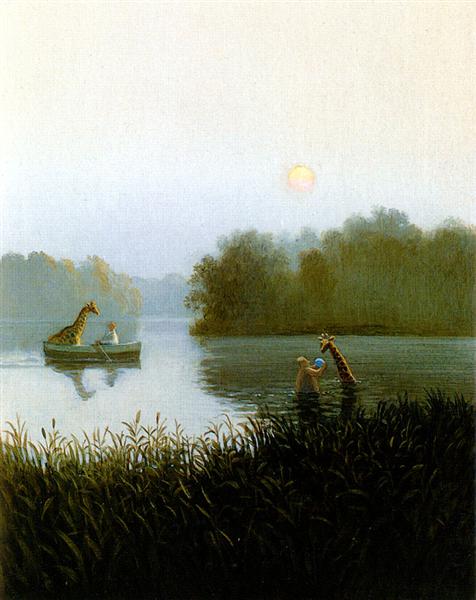
Giraffe — Michael Sowa

giraffelarge

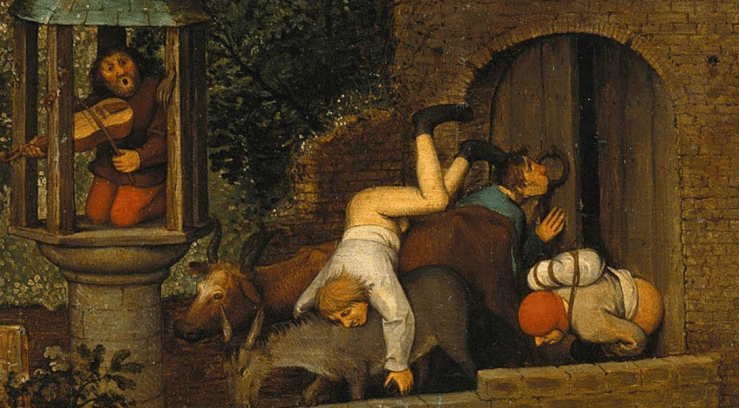
Netherlandish Proverbs (detail) — Pieter Bruegel the Elder

Screenshot 2016-06-26 at 11.59.56 AM

August Morning — Kazuo Nakamura

august-morning-1961large