
The 43 stories that comprise Lucia Berlin’s excellent collection A Manual for Cleaning Women braid together to reveal a rich, dirty, sad, joyous world—a world of emergency rooms and laundromats, fancy hotels and detox centers, jails and Catholic schools. Berlin’s stories jaunt through space and time: rough mining towns in Idaho; country clubs and cotillions in Santiago, Chile; heartbreak in New Mexico and New York; weirdness in Oakland and Berkeley; weirdness in Juarez and El Paso.
The center of this world—I’ll call it the Berlinverse, okay?—the center of the Berlinverse is Lucia Berlin herself. “Her life was rich and full of incident, and the material she took from it for her stories was colorful, dramatic and wide-ranging,” writes Lydia Davis in her foreword to Manual. (You can read Davis’s foreword at The New Yorker; it’s a far more convincing case for Berlin than I can manage here). Yes, Berlin’s life was crammed with incident—-so perhaps the strangest moment in A Manual for Cleaning Women is the three-page biography that appends the volume. The bio is strange in how un-strange it is, how it neatly lays out in a few paragraphs the information of Berlin’s life, information we already know as real, as true, from reading the preceding stories. She’s large, she contains multitudes.
Truth is a central theme in these stories. In “Here It Is Saturday,” a version of Berlin teaches fiction writing to prison inmates. She tells them, “you can lie and still tell the truth.” (As I describe the scenario for “Here It Is Saturday” I realize how hokey it sounds—I suppose there are lots of potentially-hokey moments in Berlin’s stories, yet her cruelty and humor deflate them).
In a crucial moment in the late short story “Silence,” the narrator tells us,
I exaggerate a lot and I get fiction and reality mixed up, but I don’t actually ever lie.
The narrator of “Silence” is, of course, a version of Berlin—fictionalized, sure, a persona, yep, an exaggeration, maybe—but she’s utterly believable.
“Silence” is one of many stories that repeat aspects of Berlin’s biography—we get little Lu’s childhood, a father away at the big war, a drunkenly absent mother, a bad drunk grandfather. A Syrian friend betrayed. Nuns. A good drunk uncle. A hit and run. Am I rushing through it? Sorry. To read Berlin is to read this material again and again, in different ways, through different perspectives and filters. “Silence” is particularly interesting to me because it combines material from two earlier stories not collected in Manual: “Stars and Saints” and “The Musical Vanity Boxes,” both published in Black Sparrow Press’s 1990 collection Homesick. These earlier stories are sharper, rawer, and dirtier; the later story—and Berlin’s later stories in general—strike me as more refined. Wiser, perhaps, sussing grace from abject memory.
Berlin’s recollections of the different figures in her life drive these stories, and it’s fascinating to see how key memories erupt into different tales. Berlin’s narrator’s alcoholic grandfather, a famous Texan dentist, sometimes emerges as a sympathetic if grotesque comedic figure, only to appear elsewhere as an abusive monster. Cousin Bella Lynn is a comedic foil in “Sex Appeal,” but an important confidante in “Tiger Bites” (a story of a visit to an abortion provider in Juarez). Several stories center on sister Sally, dying of cancer.
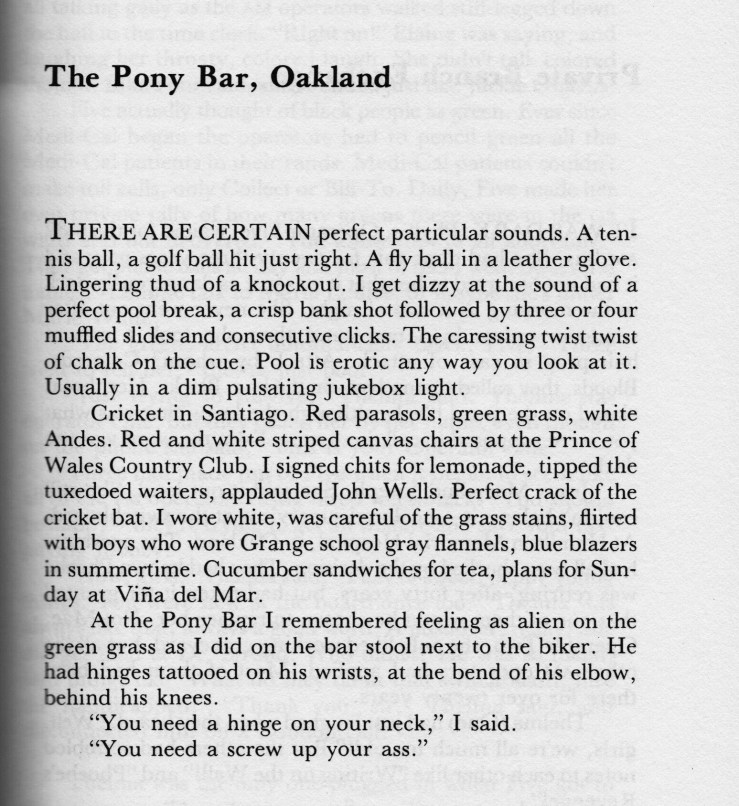
Berlin’s narrator’s four sons (Berlin had four sons) are often in the margins of the stories, but when she mines material from them the results are painful and superb. I note “her sons” in the previous line, but what I really want to note is the friend of one of her sons, a boy she calls Jesse. He shows up in the short “Teenage Punk,” where he’s our narrator’s date to go look at some cranes in a ditch at sunrise. That’s pure Lucia Berlin—weird abject unnatural natural beauty.:
We crossed the log above the slow dark irrigation ditch, over to the clear ditch where we lay on our stomachs, silent as guerrillas. I know, I romanticize everything. It is true though that we lay there freezing for a long time in the fog. It wasn’t fog. Must have been mist from the ditch or maybe just the steam from our mouths.
That brief paragraph showcases much of her technique: Inflation-deflation-resolution-hesitation. The high, low, the in-between. Jesse shows up again in one of the volume’s lengthier (and more painful) tales, “Let Me See You Smile,” a story of police brutality, scandal, and alcoholism.
Most of the stories in Manual are in some way about alcoholism, with the ur-narrator’s mother’s alcoholism haunting the book. In the near-elegy “Panteón de Dolores,” the narrator finds her mother drunk and weeping. When she tries to comfort her mother, she’s rejected; the mother wails, “…the only romance in my life is a midget lamp salesman!” The narrator-daughter reflects, “this sounds funny now, but it wasn’t then when she was sobbing, sobbing, as if her heart would break.” Berlin often punctures her punchlines. In “Mama,” Berlin consoles her dying sister Sally by weaving a fictional ditty about their mother, a paragraph that ends, “She has never before known such happiness.” The story assuages some of her sister’s grief by transmuting it into a realization of love, but the narrator? — “Me…I have no mercy.”
And yet a search for some kind of mercy, some kind of grace propels so many of the stories in A Manual for Cleaning Women. The three-pager “Step,” set in a half-way house, details the residents watching a boxing match between Wilfred Benitez and Sugar Ray Leonard. The recovering (and not-so-recovering) drunks “weren’t asking Benitez to win, just to stay in the fight.” He stays in to the last round before touching his right knee to the canvas. Berlin’s stand-in whispers, “God, please help me.” In “Unmanageable,” the alcoholic narrator finds some measure of grace from others. First from the NyQuil-swilling drunks who share saltine crackers with her in a kind of communion as they wait, shaking, for the liquor store to open at six a.m. And then, from her children. Her oldest son hides her car keys from her.
The same sons are on the narrator’s mind at the end of “Her First Detox,” in which Berlin’s stand-in’s plan for the future takes the form of a shopping list. She’ll cook for her boys when she gets home:
Flour. Milk. Ajax. She only had wine vinegar at home, which, with Antabuse, could throw her into convulsions. She wrote cider vinegar on the list.
Berlin’s various viewpoint characters don’t always do the best job of taking care of themselves, but taking care of other people is nevertheless a preoccupation with the tales in Manual. “Lu” takes care of her dying father in “Phantom Pain”; there’s sick sister Sally; the four sons, of course; a heroin-addicted husband; assorted strays, sure; an old couple in failing health in “Friends”; and the disparate patients who wander in and out of these tales, into doctor’s offices, into emergency rooms, into detox clinics.
And the cleaning women. Caretakers too, of a sort. Laundromats and washing machines are motifs throughout A Manual for Cleaning Women, and it’s no surprise that “Ajax” made the shopping list from “Her First Detox” that I quoted above. An easy point of comparison for Berlin’s writing is the so-called “dirty realism” of Raymond Carver, Denis Johnson, and Carson McCullers. But if Berlin’s realism is dirty, what are we to make of her concern with cleaning, with detox?
As a way of (non-)answering this question, here’s the entirety of the shortest tale in A Manual for Cleaning Women, “Macadam”:
When fresh it looks like caviar, sounds like broken glass, like someone chewing ice.
I’d chew ice when the lemonade was finished, swaying with my grandmother on the porch swing. We gazed down upon the chain gang paving Upson Street. A foreman poured the macadam; the convicts stomped it down with a heavy rhythmic beat. The chains rang; the macadam made the sound of applause.
The three of us said the word often. My mother because she hated where we lived, in squalor, and at least now we would have a macadam street. My grandmother just so wanted things clean — it would hold down the dust. Red Texan dust that blew in with gray tailings from the smelter, sifting into dunes on the polished hall floor, onto her mahogany table.
I used to say macadam out loud, to myself, because it sounded like the name for a friend.
There’s so much in those four paragraphs. Berlin collapses geography and genealogy into ten sentences: daughter, mother, grandmother. Texas, “squalor,” convicts. A road—a new road. Berlin’s narrator converts crushed stone into caviar, then the ice left over after sweet lemonade—and then into the magic of a friend. There’s a lot of beauty in dirt.
I could go on and on about A Manual for Cleaning Women—about how its loose, sharp tales are far more precise than their jagged edges suggest, about its warmth, its depth, its shocking humor, its sadness, its insight. But all I really mean to say is: It’s great, it’s real, it’s true—read it.
A Manual for Cleaning Women is new in trade paperback from Picador. You can read the first story in the collection, “Angel’s Laundromat,” at Picador’s website.















 Biblioklept