A German Picturesque (Book acquired, 1.23.2014)

2015/01/img_4947.jpg

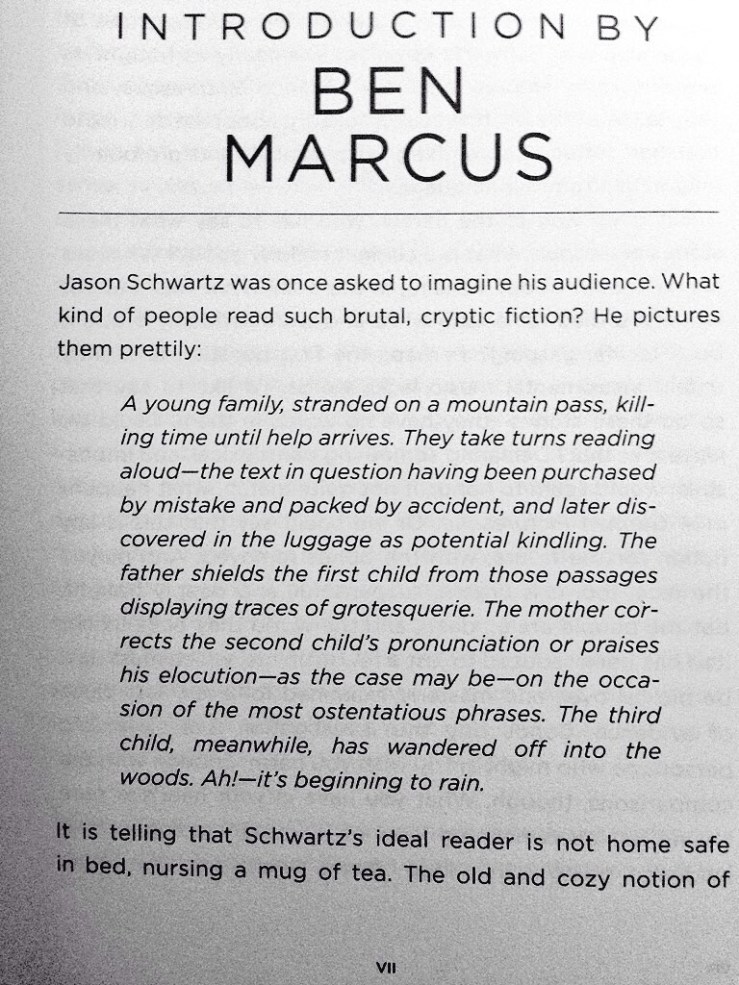
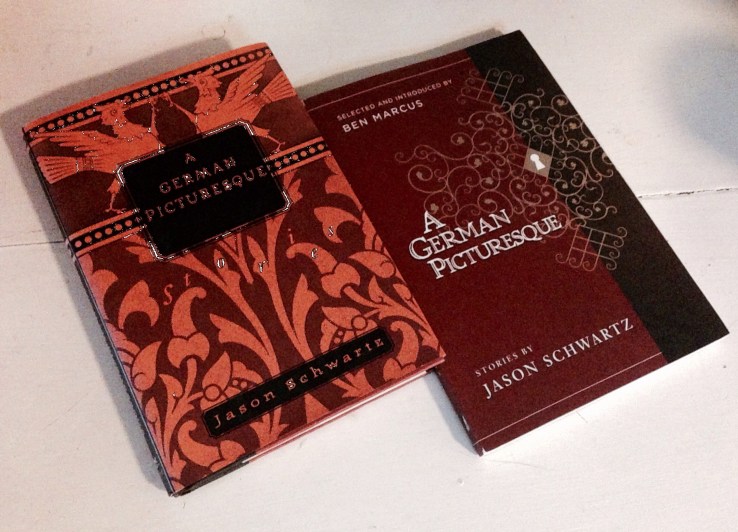
Pharos is reissuing Jason Schwartz’s debut collection A German Picturesque, pictured on the right, above, by the original. The title was selected and introduced by Ben Marcus, who quotes from the interview Schwartz granted me last year—

2015/01/img_4923.jpg

I actually think that it was this review which led to Ben Marcus consenting to talk with me over the phone for an hour in December. I’ve been typing that interview very slowly and swear it’s on the horizon. Painful dreadful anxious work. Interview with Marcus to come. Review of Schwartz to come.

Bertalda, Assailed by Spirits — Theodor von Holst

Theodor_von_Holst_Bertalda_Assailed_Spirits

An article on cemeteries, and other ideas from Nathaniel Hawthorne’s Note-Books

The spells of witches have the power of producing meats and viands that have the appearance of a sumptuous feast, which the Devil furnishes: But a Divine Providence seldom permits the meat to be good, but it has generally some bad taste or smell,–mostly wants salt,–and the feast is often without bread.


An article on cemeteries, with fantastic ideas of monuments; for instance, a sundial;–a large, wide carved stone chair, with some such motto as “Rest and Think,” and others, facetious or serious.


“Mamma, I see a part of your smile,”–a child to her mother, whose mouth was partly covered by her hand.


“The syrup of my bosom,”–an improvisation of a little girl, addressed to an imaginary child.


“The wind-turn,” “the lightning-catch,” a child’s phrases for weathercock and lightning-rod.


“Where’s the man-mountain of these Liliputs?” cried a little boy, as he looked at a small engraving of the Greeks getting into the wooden horse.


When the sun shines brightly on the new snow, we discover ranges of hills, miles away towards the south, which we have never seen before.


To have the North Pole for a fishing-pole, and the Equinoctial Line for a fishing-line.

From Nathaniel Hawthorne’s American Note-Books.

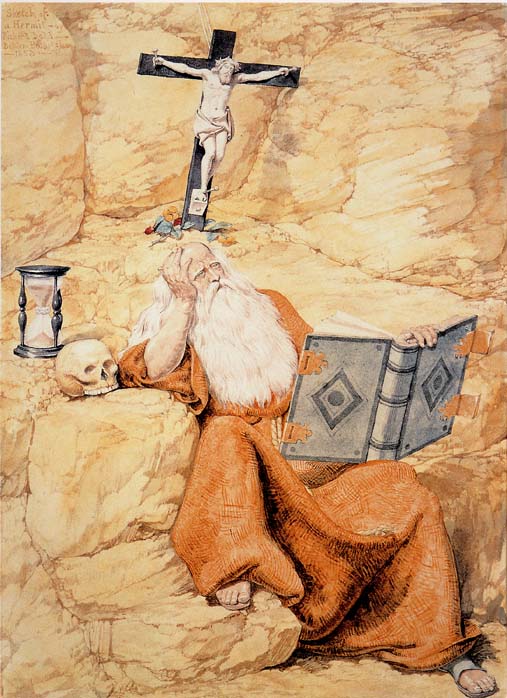
A Hermit — Richard Dadd

a_hermit-large

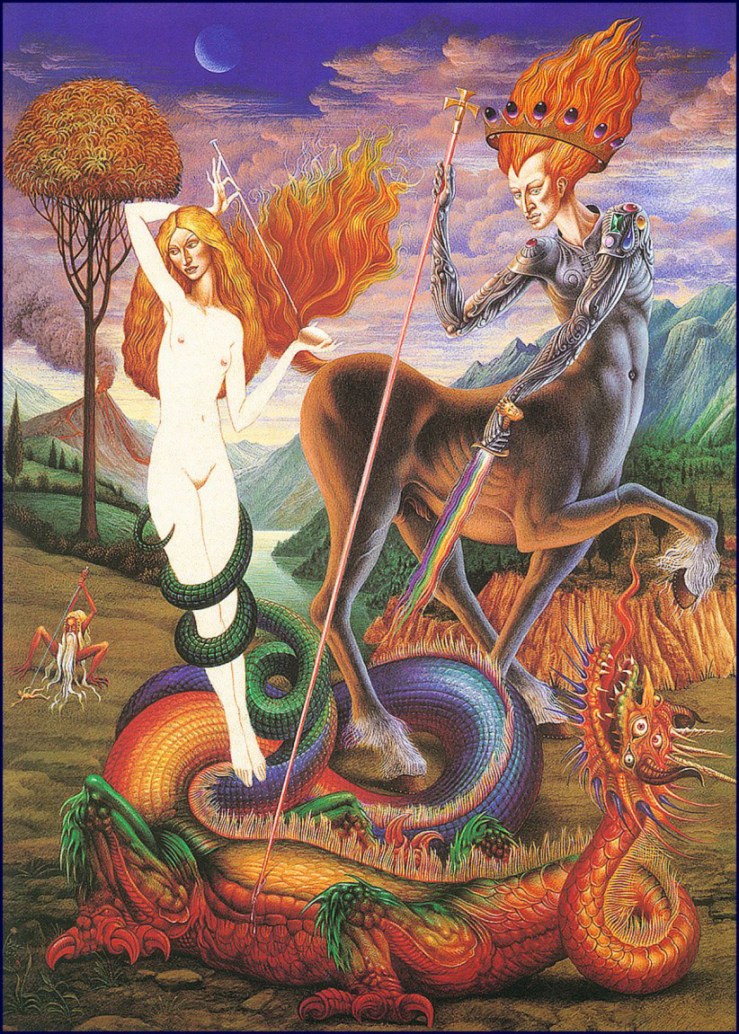
Transformation of St. George — Judson Huss

Judson_Huss_TransformationofStGeorge

The Bus — Paul Kirchner

IfawPYE

A (probably incomplete) list of films mentioned in Thomas Pynchon’s novel Inherent Vice

Below: A (probably incomplete) list of films mentioned in Thomas Pynchon’s novel Inherent Vice.

I’ve listed them in the order in which they show up, and also in the editorial style in which they appear—initially, Pynchon separates the release year with a comma or doesn’t give a year at all, before settling on parenthetical citations—with the one quirk of A Summer Place—its year is indicated in brackets. Obviously this inconsistency is actually some kind of super-meaningful clue, a key that will unlock any unresolved mysteries of Inherent Vice—right?

Black Narcissus, 1947

Caligari

Metropolis

Dr. No, 1962

Now, Voyager (1942)

Fort Apache (1948)

He Ran All the Way (1951)

I Walked with a Zombie (1943)

Ghidrah, the Three-Headed Monster (1964)

Roman Holiday (1953)

The Wizard of Oz (1939)

Vertigo (1958)

The Big Bounce (1969)

Champion (1949)

The Postman Always Rings Twice (1946)

A Summer Place [1959]

The Sea Wolf (1941)

Little Miss Broadway (1938)

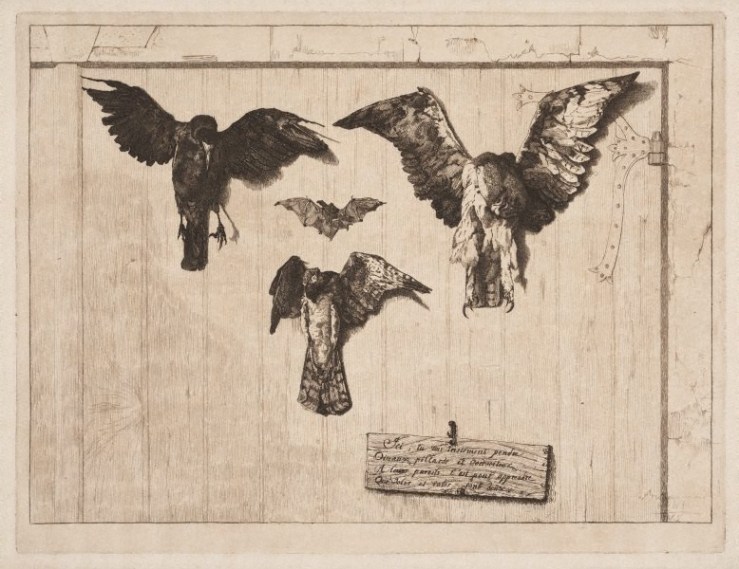
The Winged Door — Félix Bracquemond

6466##S

Paranoia Alert (Inherent Vice)

paranoia alert

Sir Richard Bishop tells a guitar story

No.

B8JlZ-CIQAAIOfZ

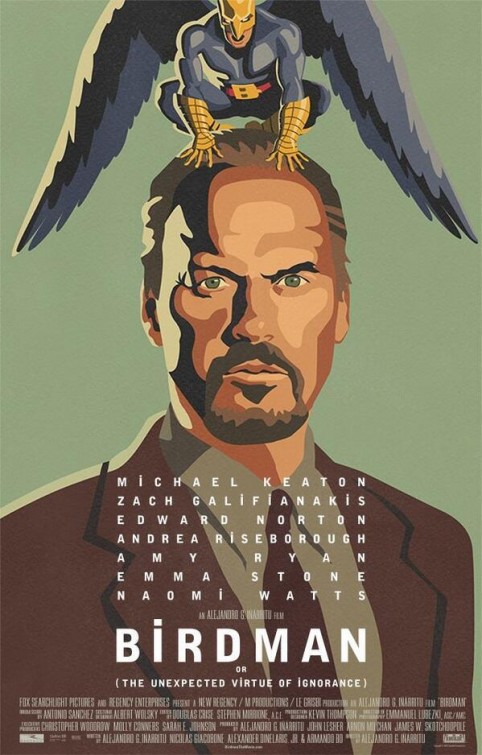
Alejandro González Iñárritu’s Film Birdman Reviewed

YLSqP80

Alejandro González Iñárritu’s film Birdman relies heavily on a central stylistic conceit: The film unfolds as one continuous uninterrupted shot, the camera unblinking, restlessly moving after Riggan Thomson (Michael Keaton), a washed-up actor who has put everything he has—financially, physically, mentally—into a Broadway adaptation of Raymond Carver’s “What We Talk About When We Talk About Love.”

The shot isn’t really continuous (any savvy viewer will spot the cuts), but the effect is powerful and engaging early on, especially when Keaton shares the lens with Edward Norton, who plays Mike, a wild foil to Keaton’s Riggan. Mike is the artist, the theater actor, the method actor, the real deal; Riggan is just a celebrity—or rather was a celebrity, the star of the Birdman franchise. The nod to Keaton’s Batman films is not even a nod, but one of several meta-crutches that Iñárritu rests all the film’s supposed “weight” on. Birdman wants to be heavy, but it feels hollow. Good thing it’s always in motion.

Birdman suffers by comparison to a handful of other films, notably Aleksandr Sokurov’s masterpiece Russian Ark in particular. Sokurov’s film, also filmed in one continuous take, does a finer job plumbing the mysteries of aesthetics (and any of aesthetics’ supposed nemeses) than Birdman. Sokurov’s film also bewilders, where Birdman’s contours are fairly familiar stuff. Another film that stages (and restages) what Birdman would like to be doing with more force is Charlie Kaufman’s deeply flawed and very brilliant film Synecdoche, New York, an alienating study of art, performance, and audience.

Of course I’ve just done exactly what Keaton’s Riggan howls against late in Birdman’s second act. He confronts the theater critic who has promised to kill his play, screaming that she, as a critic, takes no risks, puts nothing on the line. Her words are just labels; all she does is make weak comparisons. Has Iñárritu built a defense into this scene? Are we to empathize with Keaton’s Riggan? Or with Norton’s Mike? Or with the other characters whom Riggan alternately alienates and draws back in, including his ex-wife, his daughter, his girlfriend, his co-star, and his best friend? Or maybe we empathize with Riggan’s Birdman, the voice that haunts him, the voice that haunts itself into existence?

Anchored by fantastic performances—what a joy to see Keaton carry a movie again—great cinematography by Emmanuel Lubezki , and a jazz percussion score, Birdman is an entertaining way to pass two hours, but the profundity it seeks in its final moments simply isn’t there. The film’s formal structuring device, the uninterrupted shot, would like to penetrate its hero’s consciousness, but always seems to fail, necessitating voice-over or dialogue to clumsily underline the main idea. (Should I unfairly contrast this weakness with the far more powerful long-takes in Gaspar Noé’s Enter the Void? No? Okay). Birdman strives to explore the tangle between art and entertainment, but at the end we’re left with yet another Hollywood satire of ego and celebrity. Birdman is amusing when it seeks to be penetrating, clever when it seeks to be profound. And it made Raymond Carver’s story look like lurid dinner theater. But these are just labels.

Chimera — Gustave Moreau

Read “A Chameleon,” a short story by Anton Chekhov

“A Chameleon”

by

Anton Chekhov

The police superintendent Otchumyelov is walking across the market square wearing a new overcoat and carrying a parcel under his arm. A red-haired policeman strides after him with a sieve full of confiscated gooseberries in his hands. There is silence all around. Not a soul in the square. . . . The open doors of the shops and taverns look out upon God’s world disconsolately, like hungry mouths; there is not even a beggar near them.

“So you bite, you damned brute?” Otchumyelov hears suddenly. “Lads, don’t let him go! Biting is prohibited nowadays! Hold him! ah . . . ah!”

There is the sound of a dog yelping. Otchumyelov looks in the direction of the sound and sees a dog, hopping on three legs and looking about her, run out of Pitchugin’s timber-yard. A man in a starched cotton shirt, with his waistcoat unbuttoned, is chasing her. He runs after her, and throwing his body forward falls down and seizes the dog by her hind legs. Once more there is a yelping and a shout of “Don’t let go!” Sleepy countenances are protruded from the shops, and soon a crowd, which seems to have sprung out of the earth, is gathered round the timber-yard.

“It looks like a row, your honour . . .” says the policeman.

Otchumyelov makes a half turn to the left and strides towards the crowd.

He sees the aforementioned man in the unbuttoned waistcoat standing close by the gate of the timber-yard, holding his right hand in the air and displaying a bleeding finger to the crowd. On his half-drunken face there is plainly written: “I’ll pay you out, you rogue!” and indeed the very finger has the look of a flag of victory. In this man Otchumyelov recognises Hryukin, the goldsmith. The culprit who has caused the sensation, a white borzoy puppy with a sharp muzzle and a yellow patch on her back, is sitting on the ground with her fore-paws outstretched in the middle of the crowd, trembling all over. There is an expression of misery and terror in her tearful eyes.

“What’s it all about?” Otchumyelov inquires, pushing his way through the crowd. “What are you here for? Why are you waving your finger . . . ? Who was it shouted?”

“I was walking along here, not interfering with anyone, your honour,” Hryukin begins, coughing into his fist. “I was talking about firewood to Mitry Mitritch, when this low brute for no rhyme or reason bit my finger. . . . You must excuse me, I am a working man. . . . Mine is fine work. I must have damages, for I shan’t be able to use this finger for a week, may be. . . . It’s not even the law, your honour, that one should put up with it from a beast. . . . If everyone is going to be bitten, life won’t be worth living. . . .”

“H’m. Very good,” says Otchumyelov sternly, coughing and raising his eyebrows. “Very good. Whose dog is it? I won’t let this pass! I’ll teach them to let their dogs run all over the place! It’s time these gentry were looked after, if they won’t obey the regulations! When he’s fined, the blackguard, I’ll teach him what it means to keep dogs and such stray cattle! I’ll give him a lesson! . . . Yeldyrin,” cries the superintendent, addressing the policeman, “find out whose dog this is and draw up a report! And the dog must be strangled. Without delay! It’s sure to be mad. . . . Whose dog is it, I ask?”

“I fancy it’s General Zhigalov’s,” says someone in the crowd.

“General Zhigalov’s, h’m. . . . Help me off with my coat, Yeldyrin . . . it’s frightfully hot! It must be a sign of rain. . . . There’s one thing I can’t make out, how it came to bite you?” Otchumyelov turns to Hryukin. “Surely it couldn’t reach your finger. It’s a little dog, and you are a great hulking fellow! You must have scratched your finger with a nail, and then the idea struck you to get damages for it. We all know . . . your sort! I know you devils!”

“He put a cigarette in her face, your honour, for a joke, and she had the sense to snap at him. . . . He is a nonsensical fellow, your honour!”

“That’s a lie, Squinteye! You didn’t see, so why tell lies about it? His honour is a wise gentleman, and will see who is telling lies and who is telling the truth, as in God’s sight. . . . And if I am lying let the court decide. It’s written in the law. . . . We are all equal nowadays. My own brother is in the gendarmes . . . let me tell you. . . .”

“Don’t argue!”

“No, that’s not the General’s dog,” says the policeman, with profound conviction, “the General hasn’t got one like that. His are mostly setters.”

“Do you know that for a fact?”

“Yes, your honour.”

“I know it, too. The General has valuable dogs, thoroughbred, and this is goodness knows what! No coat, no shape. . . . A low creature. And to keep a dog like that! . . . where’s the sense of it. If a dog like that were to turn up in Petersburg or Moscow, do you know what would happen? They would not worry about the law, they would strangle it in a twinkling! You’ve been injured, Hryukin, and we can’t let the matter drop. . . . We must give them a lesson! It is high time . . . . !”

“Yet maybe it is the General’s,” says the policeman, thinking aloud. “It’s not written on its face. . . . I saw one like it the other day in his yard.”

“It is the General’s, that’s certain!” says a voice in the crowd.

“H’m, help me on with my overcoat, Yeldyrin, my lad . . . the wind’s getting up. . . . I am cold. . . . You take it to the General’s, and inquire there. Say I found it and sent it. And tell them not to let it out into the street. . . . It may be a valuable dog, and if every swine goes sticking a cigar in its mouth, it will soon be ruined. A dog is a delicate animal. . . . And you put your hand down, you blockhead. It’s no use your displaying your fool of a finger. It’s your own fault. . . .”

“Here comes the General’s cook, ask him. . . Hi, Prohor! Come here, my dear man! Look at this dog. . . . Is it one of yours?”

“What an idea! We have never had one like that!”

“There’s no need to waste time asking,” says Otchumyelov. “It’s a stray dog! There’s no need to waste time talking about it. . . . Since he says it’s a stray dog, a stray dog it is. . . . It must be destroyed, that’s all about it.”

“It is not our dog,” Prohor goes on. “It belongs to the General’s brother, who arrived the other day. Our master does not care for hounds. But his honour is fond of them. . . .”

“You don’t say his Excellency’s brother is here? Vladimir Ivanitch?” inquires Otchumyelov, and his whole face beams with an ecstatic smile. “‘Well, I never! And I didn’t know! Has he come on a visit?

“Yes.”

“Well, I never. . . . He couldn’t stay away from his brother. . . . And there I didn’t know! So this is his honour’s dog? Delighted to hear it. . . . Take it. It’s not a bad pup. . . . A lively creature. . . . Snapped at this fellow’s finger! Ha-ha-ha. . . . Come, why are you shivering? Rrr . . . Rrrr. . . . The rogue’s angry . . . a nice little pup.”

Prohor calls the dog, and walks away from the timber-yard with her.
The crowd laughs at Hryukin.

“I’ll make you smart yet!” Otchumyelov threatens him, and wrapping himself in his greatcoat, goes on his way across the square.

DFW’s Brief Interviews with Hideous Men, books as memory objects, etc.

2015/01/img_4925.jpg

On our short walk home from her school yesterday, my darling daughter inquires if we can go to the bookstore. She needs some new Junie B. Jones, she reports. I assent.

This particular bookstore is about a mile away, a big labyrinth of shelves and stacks and strange little closets crammed with books. The owner once kindly estimated to me that the place houses somewhere between one million and two million books, but probably not more than three million books. The place is a hive, or better yet a brain. An archive.

On this warmish January afternoon, a coverless paperback wedged and warped keeps the front door propped open. My daughter doesn’t dally, fetching up a bevy of Ms. Jones’ adventures (and the third volume of Ivy + Bean to boot: “It’s Ivy “plus” Bean, not Ivy “and” Bean, her graceful correction).

We have a few minutes before we need to pick up my son, so I do a fairly regular patrol about the premises, looking for a copy of Jane Bowles’s Two Serious Ladies for a colleague. No dice. And, out of weird old habits, go past the last shelf, where Vollmann’s underattended tomes rest near David Foster Wallace novels, always depleted. I like to look at the new covers, I guess.

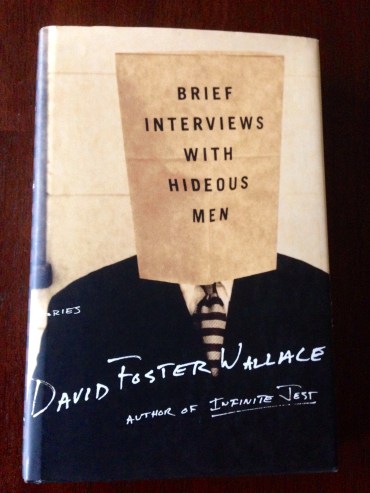
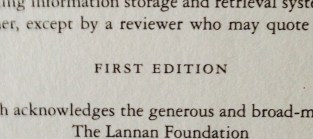
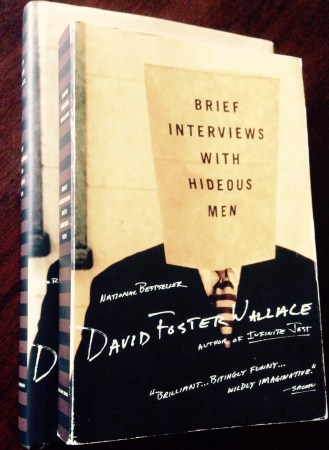
Well so and anyway, I spied a pristine hardcover copy of Brief Interviews with Hideous Men, clearly never read, and thought, Oh hey, this must be a first edition. Which it was and Oh hey you don’t need this book.

2015/01/img_4926.jpg

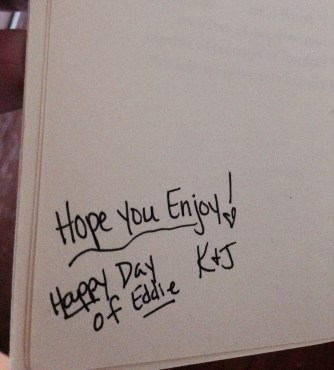
There is nothing rare or especially valuable about a first hardback U.S. edition of Hideous Men. The store is selling it for half of the publisher’s recommended price, but I have more than enough credit (thanks unsolicited review copies!) to pick it up. Which I do. Despite of course already owning it in the far more flexible trade paperback edition (first edition!) inscribed by some of the dearest damn friends who gave it to me for a birthday, an edition I reread memorably over a few weeks in Italy, an edition warped by strange moistures (I’d love to pretend the warping arose from the salty splash of the ancient Mediterranean but my own body sweat is a far more likely culprit).

2015/01/img_4927.jpg

Brief Interviews is my favorite collection of David Foster Wallace stories. The stories here are much better than those in his first collection, Girl with Curious Hair (which, the first DFW I read, has a special place in my gizzards), and though there’s nothing here that can touch the best moments of Oblivion (“The Suffering Channel” and “Good Old Neon”), the collection is cohesive, propulsive, engaging, its longer pieces punctuated by blips and vignettes. Here is the first selection, “A Radically Condensed History of Postindustrial Life”:

When they were introduced, he made a witticism, hoping to be liked. She laughed very hard, hoping to be liked. Then each drove home alone, staring straight ahead, with the very same twist to their faces.

The man who’d introduced them didn’t much like either of them, though he acted as if he did, anxious as he was to preserve good relations at all times. One never knew, after all, now did one now did one now did one.

So I picked up the hardback first edition, realizing that what I really wanted (in addition to this edition that I didn’t and don’t really need) was the copy that I read in college, the copy I borrowed from UF’s Library West (I’ll pay you $10,000 if you can think of a better library name, which you can’t), a flat brown squashed brick—-I must’ve been one of the first to read it, this was in ’99 or early ’00—I checked it out three times and then I had to return it. I ripped off “Adult World (I)” and “Adult World (II)” (these are actually the same story, but…) for a project in some bullshit class I was taking at the time, some class called Post-Historical Visual Culture or some other such nonsense—I didn’t rip off the plot, but the structure, the whole narrative/outline thing that Wallace did there. (My story was about a geneticist trying to clone a son or maybe someone to love, I can’t recall, shudder to recall…And why was I turning in a story and not an essay?!).

Why do I want the very edition that I first read, Dewey’s decimals imprinted on its drab jacketless spine? Why do I want an object that proclaims first, first, first, even though I don’t need it—why the compulsion? And then the sentimental compulsion to keep a less sturdy paperback version just because my name is incribed in itjust because I recall so vividly shaving my beard in Minori in Amalfi after reading “Tri-Stan: I Sold Sissee Nar to Ecko” and realizing that Oh my god this story is fucking terrible, DFW, I get what you’re doing, but my god. 

A book is a memory object, a placeholder, a bookmark for the memory of the reading experience, because we don’t remember what we read, not really. I have a few novels committed to memory (more or less) through yearly rereading, through teaching, but on the whole the details fade, the misremembering opens to misreading. My dream is to disband all of my books, march them out into the world, my memory secure, transcendent, stable, eternal, etc.—the objects gone, their dusty physicality imprinted in some psychic library of the soul. But I don’t believe in my dream, and even though I dig e-books, they don’t shock my memory in the same way that old pressed leaves do. So I live with these guys, nestled together unnecessarily, necessarily so.

2015/01/img_4928.jpg

How to avoid mathematics (Glen Baxter)

Capture