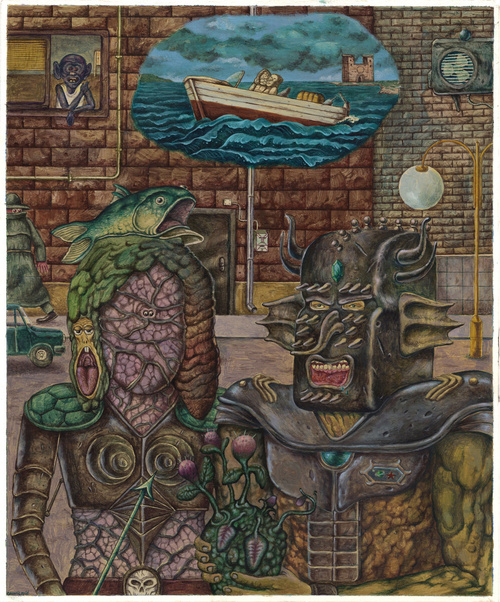
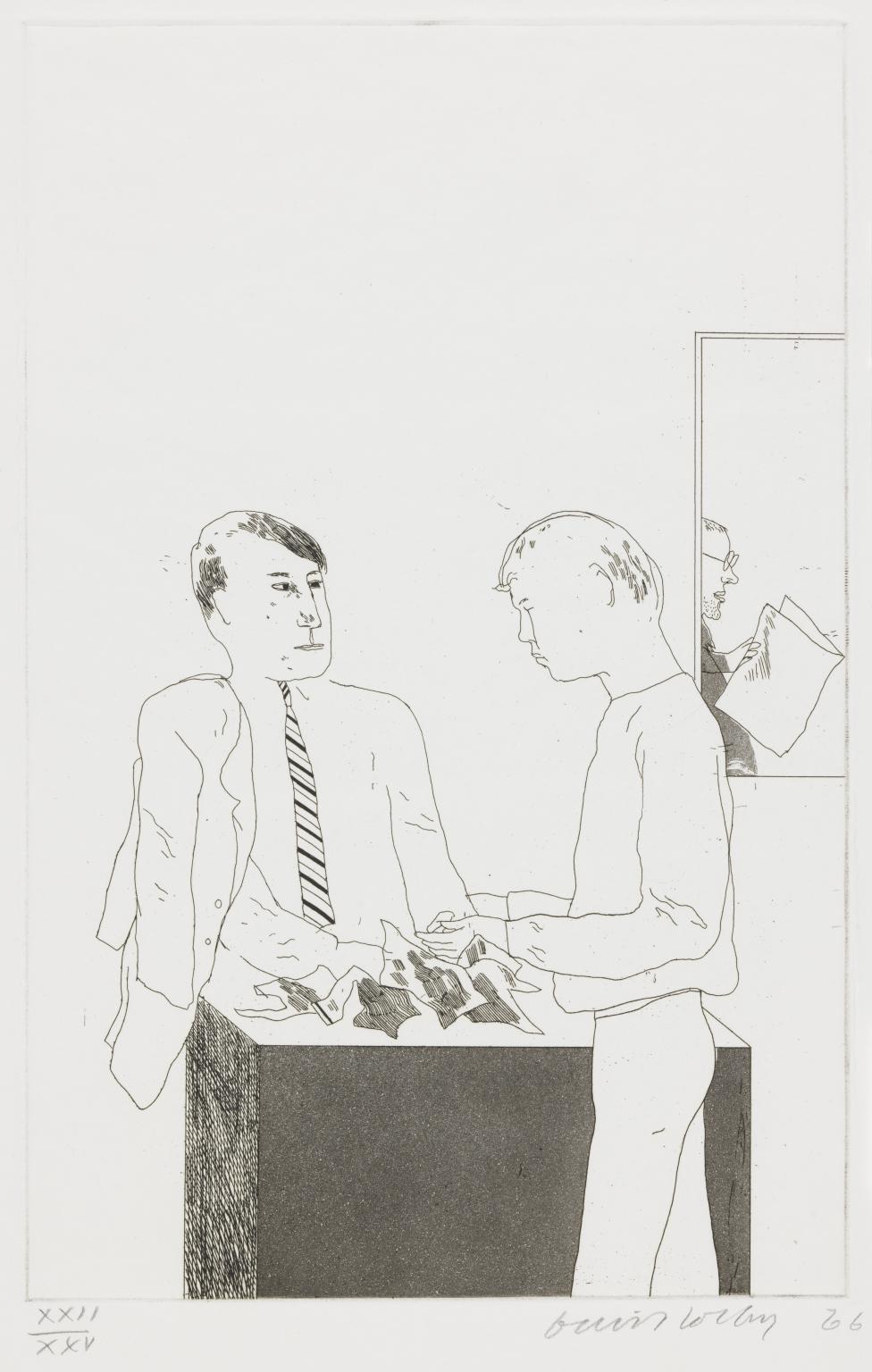
He Enquired after the Quality — David Hockney

He Enquired after the Quality, 1966 by David Hockney (b. 1937)

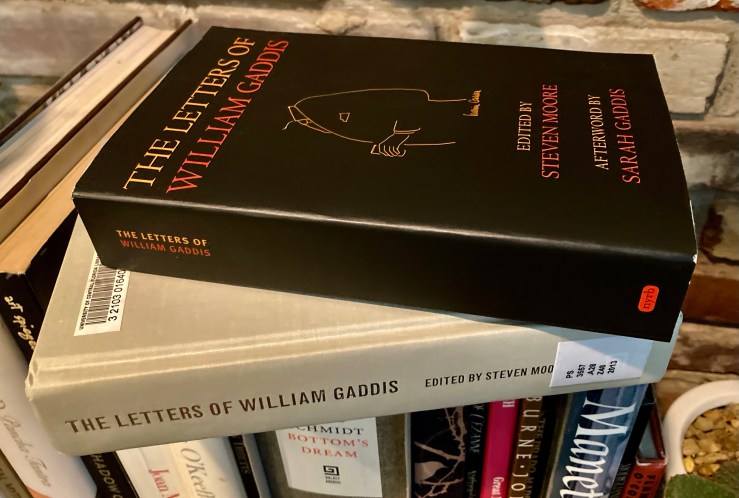
Letter to Oppenheimer | William Gaddis

New York City
4 January 1955
Dear Doctor Oppenheimer.

I have already taken a greater liberty than this, asking your attention to my letter, in having called Harcourt, Brace & Co., who are publishing a long novel I have written, to ask that they send you a copy. You must receive mail of all sorts, crank notes and fan letters of every description, but few I should think of half a million words. And since I can also well imagine that you seldom if ever read novels, if only for not having the time, it is an added imposition to have sent you such a bulky one.

But for having read your recent address at Columbia’s anniversary, I should never have presumed to do so. But I was so stricken by the succinctness, and the use of the language, with which you stated the problems which it has taken me seven years to assemble and almost a thousand pages to present, that my first thought was to send you a copy. And I do submit this book to you with deepest respect. Because I believe that The Recognitions was written about “the massive character of the dissolution and corruption of authority, in belief, in ritual and in temporal order, . . .” about our histories and traditions as “both bonds and barriers among us,” and our art which “brings us together and sets us apart.” And if I may go on presuming to use your words, it is a novel in which I tried my prolonged best to show “the integrity of the intimate, the detailed, the true art, the integrity of craftsmanship and preservation of the familiar, of the humorous and the beautiful” standing in “massive contrast to the vastness of life, the greatness of the globe, the otherness of people, the otherness of ways, and the all-encompassing dark.”

The book is a novel about forgery. I know that if you do get into it, you will find boring passages, offensive incidents, and some pretty painful sophomorics, all these in my attempts to present “the evils of superficiality and the terrors of fatigue” as I have seen them: I tried to present the shadowy struggle of a man surrounded by those who have “dissolved in a universal confusion,” those who “know nothing and love nothing.”

However you feel about the book, please allow my most humble congratulations on your address which provoked my taking the liberty of sending it to you, and in expression of my deepest admiration for men like yourself in the world you described.

From The Letters of William Gaddis; ed. Steve Moore. Moore adds the following note: [American physicist (1904–67), known for his work on the atomic bomb. On 26 December 1954 he gave a lecture entitled “Prospects in the Arts and Sciences” at Columbia University’s bicentennial anniversary celebration, reprinted in his book The Open Mind (1955). The following letter is a corrected draft.]

You can read a version of “Prospects in the Arts and Sciences” here.

There Is Something about a Man in a Uniform — Sanam Khatibi


There Is Something about a Man in a Uniform, 2016 by Sanam Khatibi (b. 1979)

“A Continuity of Parks” — Julio Cortázar

“A Continuity of Parks”

by

Julio Cortázar

translated by Paul Blackburn


He had begun to read the novel a few days before. He had put it down because of some urgent business conferences, opened it again on his way back to the estate by train; he permitted himself a slowly growing interest in the plot, in the characterizations. That afternoon, after writing a letter giving his power of attorney and discussing a matter of joint ownership with the manager of his estate, he returned to the book in the tranquility of his study which looked out upon the park with its oaks. Sprawled in his favorite armchair, its back toward the door—even the possibility of an intrusion would have irritated him, had he thought of it—he let his left hand caress repeatedly the green velvet upholstery and set to reading the final chapters. He remembered effortlessly the names and his mental image of the characters; the novel spread its glamour over him almost at once. He tasted the almost perverse pleasure of disengaging himself line by line from the things around him, and at the same time feeling his head rest comfortably on the green velvet of the chair with its high back, sensing that the cigarettes rested within reach of his hand, that beyond the great windows the air of afternoon danced under the oak trees in the park. Word by word, caught up in the sordid dilemma of the hero and heroine, letting himself be absorbed to the point where the images settled down and took on color and movement, he was witness to the final encounter in the mountain cabin. The woman arrived first, apprehensive; now the lover came in, his face cut by the backlash of a branch. Admirably, she stanched the blood with her kisses, but he rebuffed her caresses, he had not come to perform again the ceremonies of a secret passion, protected by a world of dry leaves and furtive paths through the forest. The dagger warmed itself against his chest, and underneath liberty pounded, hidden close. A lustful, panting dialogue raced down the pages like a rivulet of snakes, and one felt it had all been decided from eternity. Even to those caresses which writhed about the lovers body, as though wishing to keep him there, to disuade him from it; they sketched abominably the frame of that other body it was necessary to destroy. Nothing had been forgotten: alibis, unforeseen hazards, possible mistakes. From this hour on, each instant had its use minutely assigned. The cold-blooded, twice-gone-over reexamination of the details was barely broken off so that a hand could caress a cheek. It was beginning to get dark.

Not looking at one another now, rigidly fixed upon the task which awaited them, they separated at the cabin door. She was to follow the trail that led north. On the path leading in the opposite direction, he turned for a moment to watch her running, her hair loosened and flying. He ran in turn, crouching among the trees and hedges until, in the yellowish fog of dusk, he could distinguish the avenue of trees which led up to the house. The dogs were not supposed to bark, they did not bark. The estate manager would not be there at this hour, and he was not there. He went up the three porch steps and entered. The woman’s words reached him over the thudding of blood in his ears, first a blue chamber, then a hall, then a carpeted stairway. At the top, two doors. No one in the first room, no one in the second. The door of the salon, and then, the knife in hand, the light from the great windows, the high back of an armchair covered in green velvet, the head of the man in the chair reading a novel.

Three books (Books acquired, 8 June 2023)

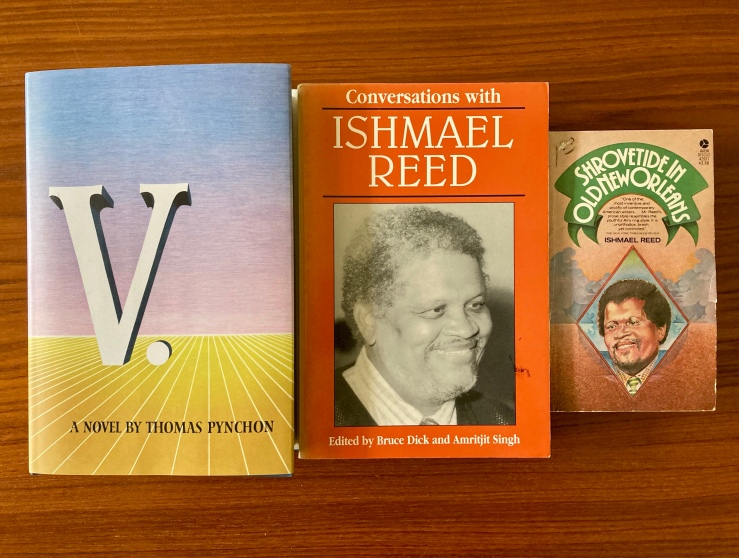
I got a facsimile hardback sixtieth anniversary edition of Thomas Pynchon’s novel V. for my birthday. I also picked up two Ishmael Reed books: Conversations with Ishmael Reed and an Avon Bard edition of Shrovetide in Old New Orleans. Before I even physically picked up these last two, I knew that they formerly belonged to a guy from Perry, Florida and that a stamp with his name and address would be on the inside of the cover or first page. I was correct in this intimation. I now have probably thirty to forty books once owned by this person. I wrote about some Reeds, formerly his, here.

Maybe I should compare my shelf with the checklist he made in the inside cover of Conversations with Ishmael Reed—


There’s Only Love & Dreams — Davor Gromilovic

There’s Only Love & Dreams, 2022 by Davor Gromilovic (b. 1985)

Study for The Tennis Players — Pavel Tchelitchew

Study for The Tennis Players, 1934 by Pavel Tchelitchew (1898-1957)

Baltimore — Miles Cleveland Goodwin

Baltimore, 2022 by Miles Cleveland Goodwin (b. 1980)

Still Life with Mug, Pipe and Book — John Frederick Peto

Still Life with Mug, Pipe and Book,1899 by John Frederick Peto (1854-1907)

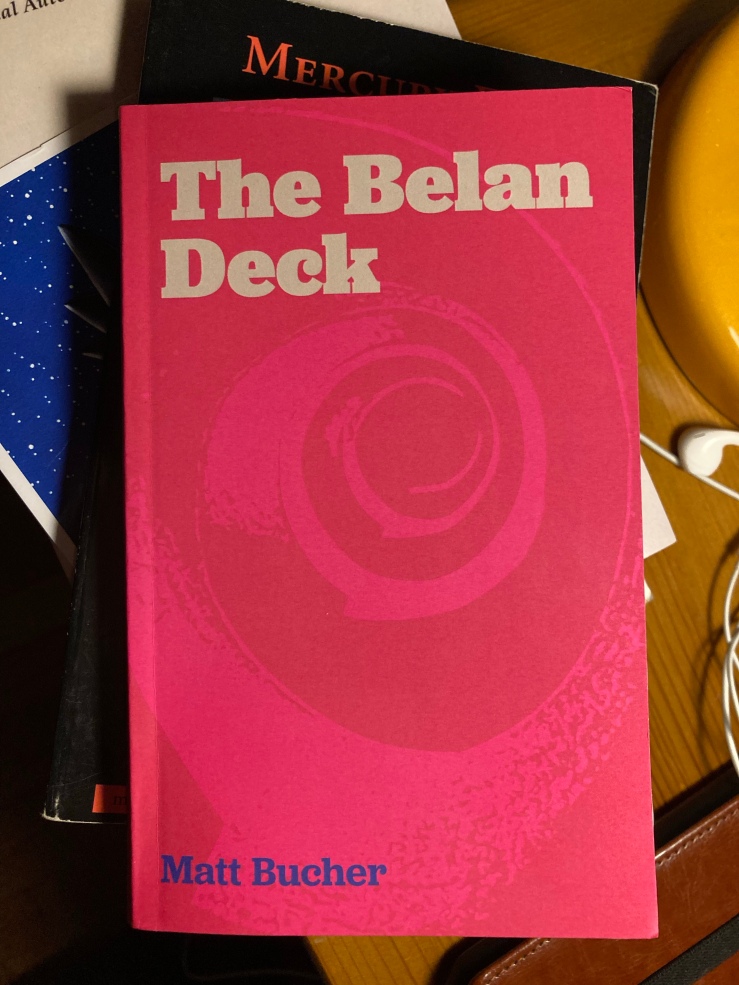
Matt Bucher’s The Belan Deck is an unexpectedly moving argument for humanity and serious triviality

I stayed up later than I meant to the other night reading all of Matt Bucher’s new book The Belan Deck in one cover-to-cover go. On his website, Bucher describes The Belan Deck as “a little book…set mostly during a layover at SFO” that “centers around a person who maybe doesn’t really fit in at their AI tech job but still needs to produce one final PowerPoint deck.” This description approximates the plot, in the barest sense, but doesn’t touch on the spirit or form of The Belan Deck.

Let’s talk about the spirit and form of The Belan Deck. Bucher borrows the epigraphic, anecdotal, fractured, discontinuous style that David Markson practiced (perfected?) in his so-called Notecard Quartet (1996-2007: Reader’s Block, This Is Not A NovelVanishing Point, and The Last Novel). “An assemblage…nonlinear, discontinuous, collage-like,” wrote Markson, to which Bucher’s narrator replies, “Bricolage. DIY culture. Amateurism. Fandom. Blackout poems.”

Bucher’s bricolage picks up Markson’s style and spirit, but also moves it forward. Although Markson’s late quartet is arguably (I would say, by definition) formally postmodernist, the object of the Notecard Novels’ obsession is essentially Modernism. Bucher’s book is necessarily post-postmodern, taking as its objects the detritus and tools of postmodern communication: PowerPoint, Google Street View, Wikipedia, social media, artificial intelligence.

At the same time, Bucher continues Markson’s obsessions with artists and death, adding to the mortality lists that wormed through DM’s quartet. Bucher’s updates are odd though, in that they seem to, in their print form, contextualize anew coincidences that were so raw and immediate when they popped up on Twitter and other social media:

Nicanor Parra died the day after Ursula K. LeGuin died.

Larry McMurty and Beverly Cleary died the same day.

(In my memory, William H. Gass died the day before LeGuin, but this is not true. He died almost two months before LeGuin. But I recall teaching selections from both of their work in a literature class in the spring semester of 2018, and pointing out to my students that the empty spaces behind the dashes after their birth years might now be filled in. “An encyclopedia entry demands at least a birth or a death,” notes Bucher’s narrator.)

The encyclopedia, by which I mean Wikipedia, becomes a heroic motif in The Belan Deck. “Wikipedia is the number one result for over 50% of Google searches,” Bucher’s narrator points out, following it up with,

Wikipedia, made by humans, for free, is a better search engine than Google, the most expensive and sophisticated algorithm in the world.

Earlier in The Belan Deck, the narrator points to the “mindless pleasure of going down a deep Wikipedia rabbit hole,” a pleasure that an artificial intelligence, no matter how developed, could never feel. About three dozen pages later, Bucher’s narrator throws a slant rhyme to his previous note on the “mindless pleasures” of Wikipedia rabbit holes, pointing out that Thomas Pynchon had used Mindless Pleasures as a working title for Gravity’s Rainbow. That’s how this book operates: Disparate fragments of information are “Clues rather than trivia.”

The goal is to find the sublime in these connections; Bucher’s narrator repeatedly and succinctly argues that finding the beautiful, much less the sublime, is impossible for an artificial intelligence. The Belan Deck plays out as a discursive, looping, and unexpectedly moving argument for humanity, in all its serious triviality, against the backdrop of capital’s rapid encroachment into the human position in the arts.

“Capitalism is incompatible with being an artist, for most people,” avers our narrator. “Yet you participate!” might come the retort, and it’s true—not only does Bucher’s narrator work in a soulless medium, the deck (trying to inject some soul, some sublime, some humanity into it), he also works for the soulless Belan, a money guy who would love to replace artists with machines. (In what I think has to be a great intentional gag, Bucher’s narrator’s point of contact for Belan is a middleman named  Jimmy Chen. I just have to believe that the character’s a take on the Jimmy Chen who wrote and designed on HTMLGIANT for all those years.)

The narrator participates because there aren’t that many other options, as we all know. “Do you understand what I am saying? Does it also feel this way to you?” the narrator plaintively asks. I mean, for me, that’s a Yes, all the time. 

There’s much more in The Belan Deck than I can get to here—more on art, artists, baseball, airports—it’s voluminous for a “little book.” (“When we buy a book, we think we are buying time to read” is a line I underlined but could not otherwise work into this review, so I’ll include it here parenthetically. (A lot of this review has happened in parentheses.))

I’ll end with two bits of personal trivia, two coincidences.

First: The day The Belan Deck arrived in my mail, which is the day that I read The Belan Deck, some AI-cheerleading dork went viral on Twitter for posting a series of unasked-for renderings of “what the backgrounds of the most famous paintings in the world look like with AI.” He was roundly and rightly mocked for his endeavors, and I found the general antipathy heartening, but still a small cadre of people who know absolutely nothing about art congratulated his vapidity.

Second: Earlier that same day, I read a passage from Walter Tevis’s 1980 dystopian novel Mockingbird, and found its sentiment largely heartening as well. The hero of the novel, staring at a “dumb parody of humanity” declares it “nothing, nothing at all.” He continues, pointing out that the forces of capital “had given robots to the world with the lie that they would save us from labor or relieve us from drudgery so that we could grow and develop inwardly.” But underneath this false promise was a deep “contempt for the ordinary life of men and women,”  a deep hatred of human life itself. The sentiment I find heartening here is in the hero’s recognition and resistance to this contempt.

The Belan Deck isn’t a straightforward guidebook or manifesto or map, but it nevertheless, in its elliptical, poetic approach, offers a winding, thinking, feeling path of opposition to not only the machines themselves, but also the hollow men who would gladly replace artists and creators and thinkers with those machines. It’s also really fun to read. Great stuff.

Mockingbird — Aron Wiesenfeld 

Mockingbird, 2023 by Aron Wiesenfeld (b. 1972)

They had given robots to the world with the lie that they would save us from labor or relieve us from drudgery so that we could grow and develop inwardly | From Walter Tevis’s Mockingbird

I had never looked at a robot that closely before, having been brought up to fear and respect them. And I became aware, looking at his stupid, manufactured face, that I was seeing for the first time what the significance of this dumb parody of humanity really was: nothing, nothing at all. Robots were something invented once out a blind love for the technology that could allow them to be invented. They had been made and given to the world of men as the weapons that nearly destroyed the world had once been given, as a “necessity.” And, deeper still, underneath that blank and empty face, identical to all the thousands of faces of its make, I could sense contempt—contempt for the ordinary life of men and women that the human technicians who had fashioned it had felt. They had given robots to the world with the lie that they would save us from labor or relieve us from drudgery so that we could grow and develop inwardly. Someone must have hated human life to have made such a thing—such an abomination in the sight of the Lord.

From Walter Tevis’s 1980 novel Mockingbird.

 “A Note on the Word Gubernatorial” — Lydia Davis

“A Note on the Word Gubernatorial”

by

Lydia Davis


Gubernatorial: Even though I have never used it in a story, and probably never will, this word has always fascinated and pleased me because of its odd divergence from its noun, governor. Why did the noun and the adjective develop in different directions? The adjective is actually closer to the origin of both, which was the Latin gubernator, “governor,” and gubernare, “to steer.” The original, primary meaning of “to govern” was “to steer.” In fact, there is a maritime word in French, gouvernail, that means “rudder,” or “helm”—what we need to steer a boat. The Latin gubernator evolved into the Old French gouverneur and hence, eventually, into our English governor—our governor is one who steers the metaphorical ship of state. (The Latin also evolved into the Spanish gobernador—keeping the b—and the Italian governatore.)

But of course it is all more complicated, as the development of language always is: the English word gubernator, meaning “ruler,” was also in use starting in the 1520s, though it was rare—and so was gubernatrix, meaning a female ruler. Gubernator disappeared from use and governor remained. I do not know why our adjective did not evolve in the same way as our noun. Why did it not turn into governatorial or governorial? Simply because it was not spoken as often?

I have always enjoyed pronouncing gubernatorial, as though its rather crude sound, incorporating two voiced plosives and the word “goober,” is concealing its more elegant, softer, silkier cousin, “govern.” Gubernatorial swings us closer to our Spanish friends, governor to our Italian. During the U.S. presidency of Jimmy Carter, former governor of Georgia, there was much talk of his association with the cultivation of peanuts (colloquially known as “goobers”); thus, goober-natorial, as applied to the office of the governor of the Peanut State, was doubly appropriate.

Skin Graft — Otto Dix

Skin Graft (Transplantation), from The War series, 1924 by Otto Dix (1891–1969)

“A Way You’ll Never Be” — Ernest Hemingway

“A Way You’ll Never Be”

by

Ernest Hemingway


The attack had gone across the field, been held up by machine-gun fire from the sunken road and from the group of farm houses, encountered no resistance in the town, and reached the bank of the river. Coming along the road on a bicycle, getting off to push the machine when the surface of the road became too broken, Nicholas Adams saw what had happened by the position of the dead.

They lay alone or in clumps in the high grass of the field and along the road, their pockets out, and over them were flies and around each body or group of bodies were the scattered papers. Continue reading ““A Way You’ll Never Be” — Ernest Hemingway”

Books acquired, 26 May 2023

I brought a box of old books to my spot; I did not intend to pick up any books but then I picked up six:

I’d been looking for a handsome and/or cheap copy of Aldous Huxley’s The Devils of Loudon for a few years ago; success.

I posted something on Twitter a few days ago about how much I’ve been enjoying Steve Erickson’s Days Between Stations; one of the replies put James Crumley in his company (along with McCarthy and Joy Williams), so I picked up Dancing Bear and The Last Good Kiss:

I’ve long loved Peter Mendelsund’s cover designs, so I didn’t pass up on a used copy of What We See When We Read. It has a lot of pictures and diagrams and such.

I saw a very interesting looking person reading an actor’s edition of Philip Ridley’s play Mercury Fur on the train a few weeks ago. I had never heard of the play, but looked it up, thought it sounded pretty cool, and then looked for it in the drama section of this same book store the last time I was there. I didn’t find it. I found it yesterday mixed in with the novels. (I wasn’t actually looking for it.)

I don’t own physical copies of The Last Novel and Vanishing Point, two of the three novels collected in David Markson’s This Is Not a Novel and Other Novels, so I couldn’t pass on this omnibus. I do own a copy of Reader’s Block, which is not collected in This Is Not a Novel and Other Novels.

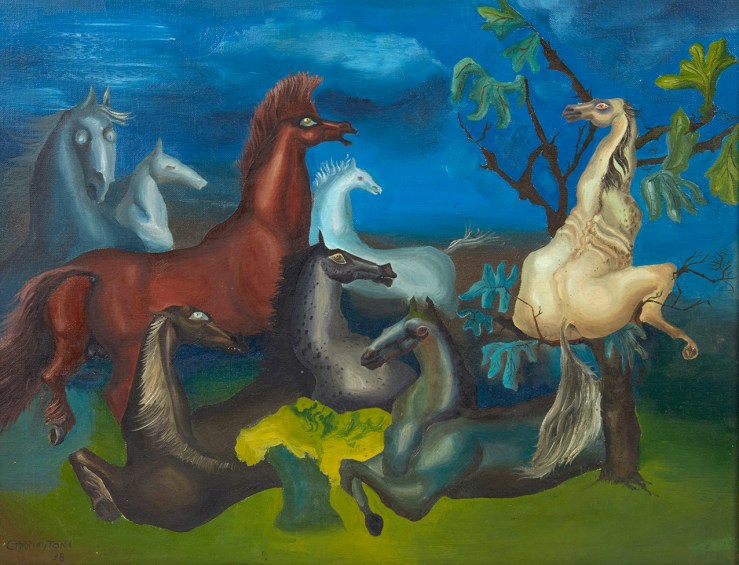
Lord Candlestick’s Horses — Leonora Carrington

Lord Candlestick’s Horses, 1938 by Leonora Carrington (1917-2011)