Une après-midi — Xiao Guo Hui

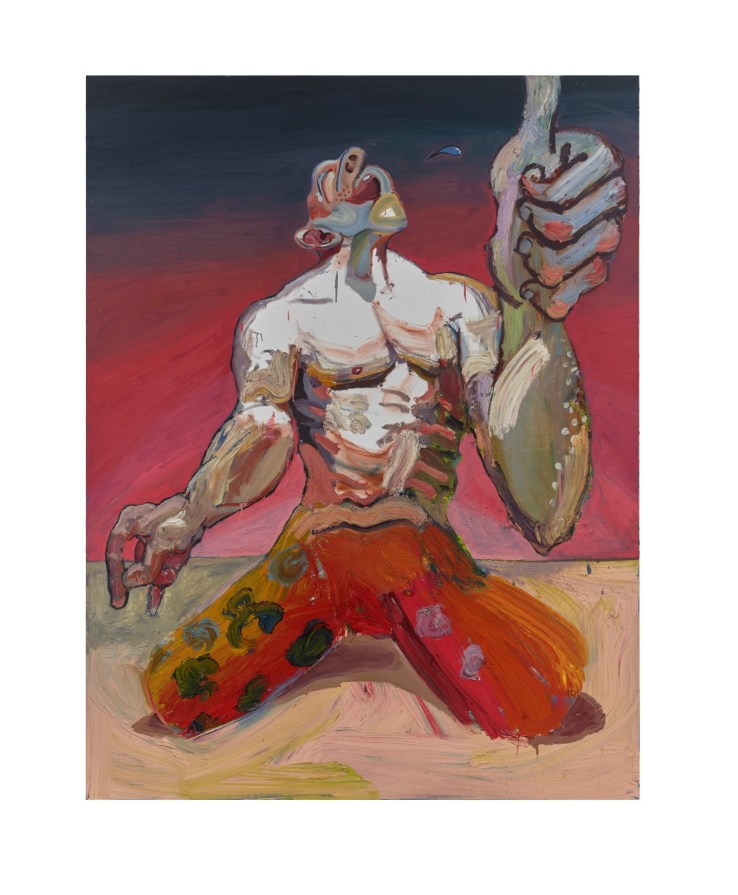
Une après-midi, 2022 by Xiao Guo Hui (b. 1969)

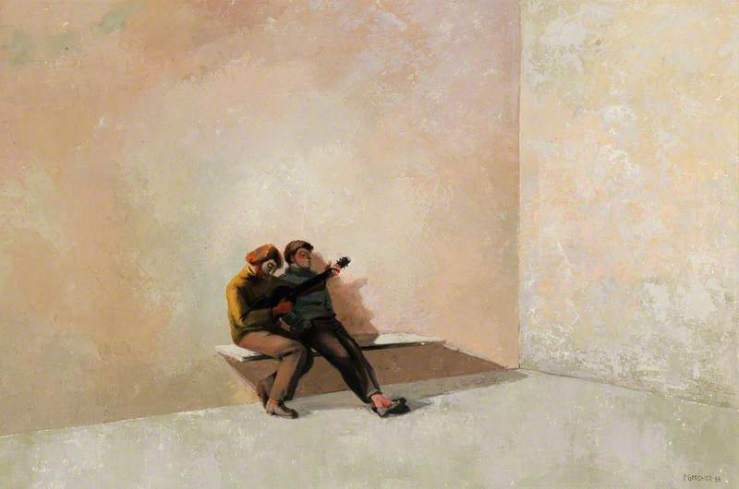
Penelope — Glyn Philpot

Penelope, 1923 by Glyn Philpot (1884-1937)

You know, I’ve never been entirely clear what “postmodern” means | Steve Erickson

Q. It’s interesting that you say your new book is surreal but not magical realism. You’ve said that you don’t consider your earlier books to be surrealistic. Why not?

A. Surrealism was born out of a preoccupation with the irrationality and illogic of the subconscious, and a view that human relationships are fundamentally absurd. Whatever else my books may be about, they don’t express an absurd view of existence. The form of the books, and the strange juxtapositions of their narratives, may strike people as surreal, but the central concerns that drive the stories are traditional ones. I don’t think any true surrealist would consider me a surrealist, in the same way no hard-core science-fiction fan would consider me a science-fiction writer, since the basic concern of most classic science fiction is the relationship between man and technology. Philip K. Dick and Theodore Sturgeon and a few others are exceptions. Technology is a completely valid and important topic to write about, but it just doesn’t happen to interest me. And my books aren’t “experimental” because my priorities don’t involve reinventing literary forms, and they’re not fantastic because they’re not characterized by the sense of wonder that fantasy evokes. I think it’s been hard for my novels to find a niche.

Q. Do you see your books as being postmodern?

A. You know, I’ve never been entirely clear what “postmodern” means. But to at least some extent postmodernism seems to involve a cultural or aesthetic self-awareness, and an insistence on art recognizing and tweaking its own artifice. My aim isn’t to call attention to the artifice of my books but to make readers forget the artifice, to persuade them to exchange their reality for the one I’ve created. I’m aware that trying to get readers to give themselves over to another reality is always doomed to failure. On the other hand, that’s the job of the novelist, to fail and fail again. The great hope isn’t to succeed-I’m not sure what success would really mean-but to risk everything, and perhaps to fail by narrower  margins, until there’s nothing left to fail with.

From a 1997 interview with novelist Steve Erickson. Larry McCaffery and Takayuki Tatsumi conducted the interview, which published in Contemporary Literature, Autumn, 1997, Vol. 38, No. 3.

“Wet” — Joy Williams

“Wet”

by

Joy Williams

from 99 Stories of God


The Lord was drinking some water out of a glass. There was nothing wrong with the glass, but the water tasted terrible.

This was in a white building on a vast wasteland. The engineers within wore white uniforms and booties on their shoes and gloves on their hands. The water had traveled many hundreds of miles through wide pipes to be here.

What have you done to my water? the Lord asked. My living water…

Oh, they said, we thought that was just a metaphor.

WET

This is not a review of Fernanda Melchor’s This Is Not Miami

  1. This is not a review of Fernanda Melchor’s collection This Is Not Miami.
  2. First published in 2013, This Is Not Miami is now available in English translation by Sophie Hughes.
  3. Hughes previously translated Melchor’s two novels, the recent shorty Paradais and the superb 2017 novel Hurricane Season.
  4. Melchor composed the twelve pieces collected in This Is Not Miami between 2002 and 2011.
  5. In her introduction to the collection, Melchor declares that the pieces in This Is Not Miami are not properly tales or stories or works of journalism, but rather relatos—reports “based on events that really happened.”
  6. Melchor crafts her relatos from eyewitness accounts.
  7. (There’s also some journalistic research in there.)
  8. Like Paradais and Hurricane Season, the relatos of This Is Not Miami all take place in Melchor’s native Veracruz.
  9. Like Paradais and Hurricane Season, the relatos of This Is Not Miami describe and explore violent crime.
  10. Some characters: narcos, corrupt cops, crackheads, corrupt judges, petty drug dealers, petty drug users, an infanticidal beauty queen, a child rapist, a ufologist, a lynch mob, starving stowaways, scared cadets, a demon-possessed teen, a healer, a priest, an older couple clinging to the floor of their apartment as bullets fly through the walls, etc.
  11. (And Melchor’s “I” of course.)
  12. (Oh, and there’s a brief appearance by Mel Gibson.)
  13. Most of Melchor’s relatos are short. There are two significantly longer pieces: “Queen, Slave, Woman” and “The House on El Estero.”
  14. “Queen, Slave, Woman” tells the story of Evangelina Tejera Bosada, queen of the 1983 Veracruz Carnival who killed her children and cut them into pieces.
  15. In the previous sentence, the phrase “tells the story” is imprecise. In “Queen” and in most of the relatos in the collection, Melchor is telling the story of the witnesses who are telling the story.
  16. “The House on El Estero,” the longest piece, is a haunted house/exorcism riff that ends up being a kind of love story, a story about falling in love with a storyteller.
  17. “The House on El Estero” began to to wear thin for me, its premise stretched farther than my interest.
  18. However, William T. Vollmann singled out “The House on El Estero” as a favorite in his New York Times review of This Is Not Miami, a review I read a few minutes before I decided not to write a review of This Is Not Miami.
  19. While I don’t think “El Estero” is one of the better pieces in the collection, I generally agree with Vollmann’s assessment of the book’s trajectory.
  20. Vollmann points out that “because the relatos are arranged mostly in order between 2002 and 2011, during which time the author was obviously working hard at her craft, the style rapidly improves, in Sophie Hughes’s translation, into something natural, careful and smooth.”
  21. And, I’d add, rough when necessary.
  22. I hate to say that I was disappointed in This Is Not MiamiI mean, I was, disappointed, but also deeply interested.
  23. The sketches here are not sketchy; they are ballast, the raw and vivid material that points to the Hurricane Season’s masterful hallucinatory language explosion.
  24. As such, This Is Not Miami reads like a minor work, but one nonetheless vital to its creator’s artistic maturation.
  25. For me, This Is Not Miami is most appreciable as an apprenticeship work that points toward the Bigger Thing to come.
  26. And of course I want more.

The War Crime — Ben Quilty

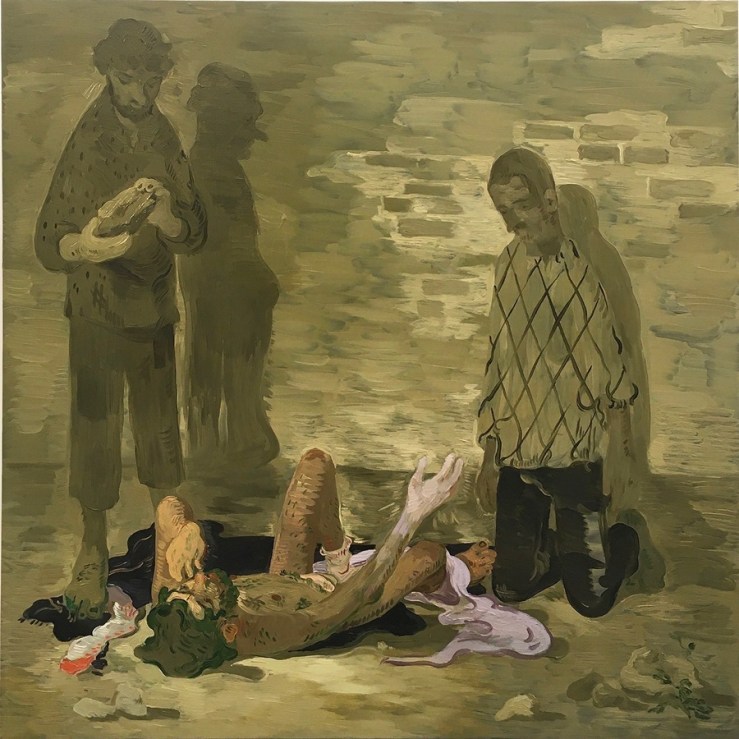
The War Crime, 2022 by Ben Quilty (b. 1973)

“The Dreadful Has Already Happened” — Mark Strand

“The Dreadful Has Already Happened”

by

Mark Strand


The relatives are leaning over, staring expectantly.
They moisten their lips with their tongues. I can feel
them urging me on. I hold the baby in the air.
Heaps of broken bottles glitter in the sun.

A small band is playing old fashioned marches.
My mother is keeping time by stamping her foot.
My father is kissing a woman who keeps waving
to somebody else. There are palm trees.

The hills are spotted with orange flamboyants and tall
billowy clouds move behind them. “Go on, Boy,”
I hear somebody say, “Go on.”
I keep wondering if it will rain.

The sky darkens. There is thunder.
“Break his legs,” says one of my aunts,
“Now give him a kiss.” I do what I’m told.
The trees bend in the bleak tropical wind.

The baby did not scream, but I remember that sigh
when I reached inside for his tiny lungs and shook them
out in the air for the flies. The relatives cheered.
It was about that time I gave up.

Now, when I answer the phone, his lips
are in the receiver; when I sleep, his hair is gathered
around a familiar face on the pillow; wherever I search
I find his feet. He is what is left of my life.

Thanatopsis — Ed Emshwiller

Mystery box (Books acquired, 17 May 2023)

One of my oldest friends (by which I mean friend I’ve had for a long time, not, like, old, although we’re both getting up there, although by no means old, but I suppose certainly definitely no longer youngmiddleaged, I guess, although when we were young we would have thought ourselves now (middleaged) old)

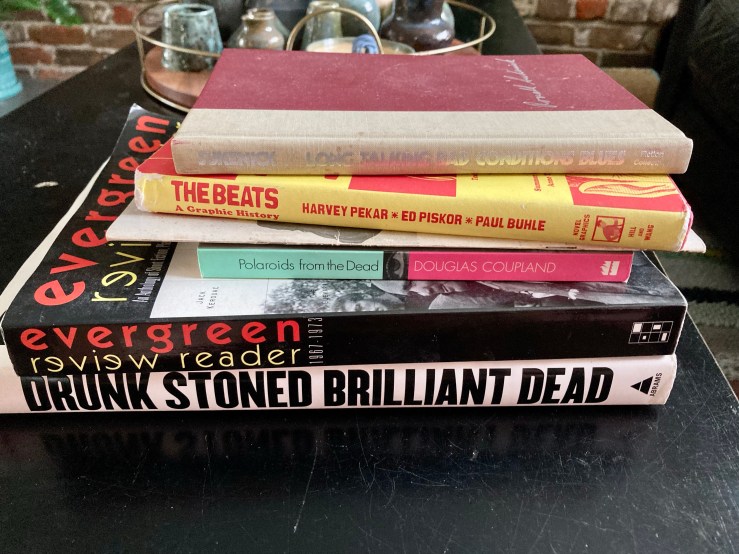
—one of my oldest friends Patrick sent me a mystery box of books earlier this week. Highlights include The Evergreen Review Reader (begins with William S. Burroughs and ends with Kathy Acker, two writers Patrick introduced me to way back in seventh or eighth grade), a graphic history of the Beats by Harvey Pekar et al, and a signed copy of Ronald Sukenick’s Long Talking Bad Condition Blues. Thanks PT!

Morning — Norman Stevens

Morning, 1974 by Norman Stevens (1937-1988)

Nightmare — Salman Toor 

Nightmare, 2020 by Salman Toor (b. 1983)

Gary Amdahl’s Across My Big Brass Bed (Book acquired, early May 2023)

Gary Amdahl’s 2014 novel Across My Big Brass Bed is getting a new printing from corona\samizdat. A review copy arrived at Biblioklept World Headquarters a day or two before a short vacation, and I almost tucked it into my backpack for the plane, but I knew that the novel’s paragraphless flow would not work for me if I were around other humans, let alone in a big metal plastic carbon fiber thing forty thousand feet in the etc.

So I set it aside, and then picked it up this afternoon.

The novel (subtitled “An Intellectual Autobiography in Twenty-four Hours”) begins: “I drove, aimlessly but alertly, fighting traffic.” It’s the early 1960s in the Twin Cities, and our narrator seems to be coming into consciousness, by which I might mean earliest memories, or really just new language-and-concept acquisition: “President John Fitzgerald Kennedy had just been—new word—assassinated.” A few sentences later, our narrator cracked me up with this mordant zinger:

“Whatever it meant to be human, President Kennedy could no longer manage it.”

Yikes! The first chapter ends with our hero successfully assisting a group of pedestrians in their crossing of the street in his new professional capacity of an elected Crossing Guard of Madison Elementary. I loved the pages I read today.

Girl Reading — George Clausen

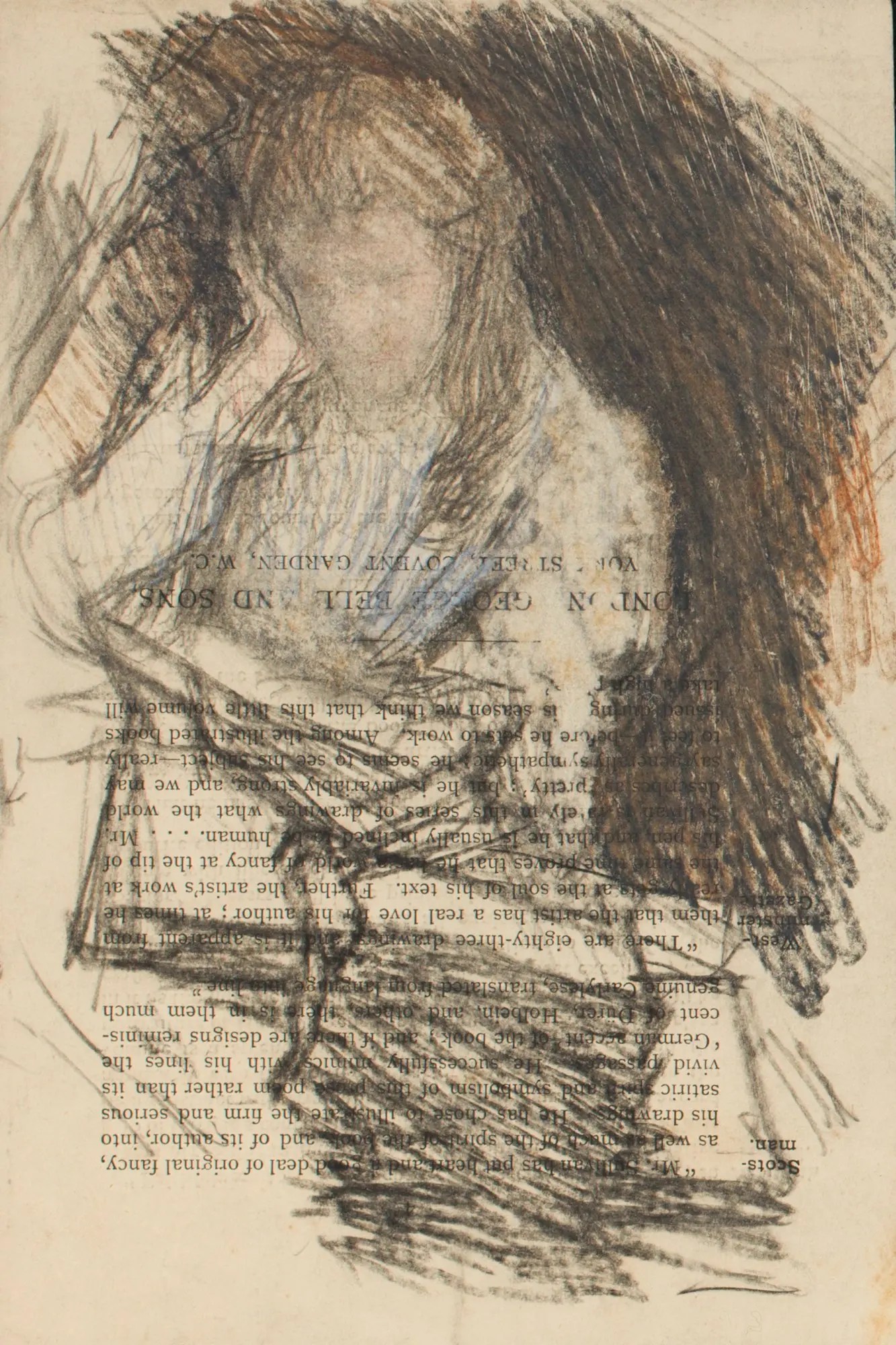
Girl Reading, George Clausen (1852 – 1944)

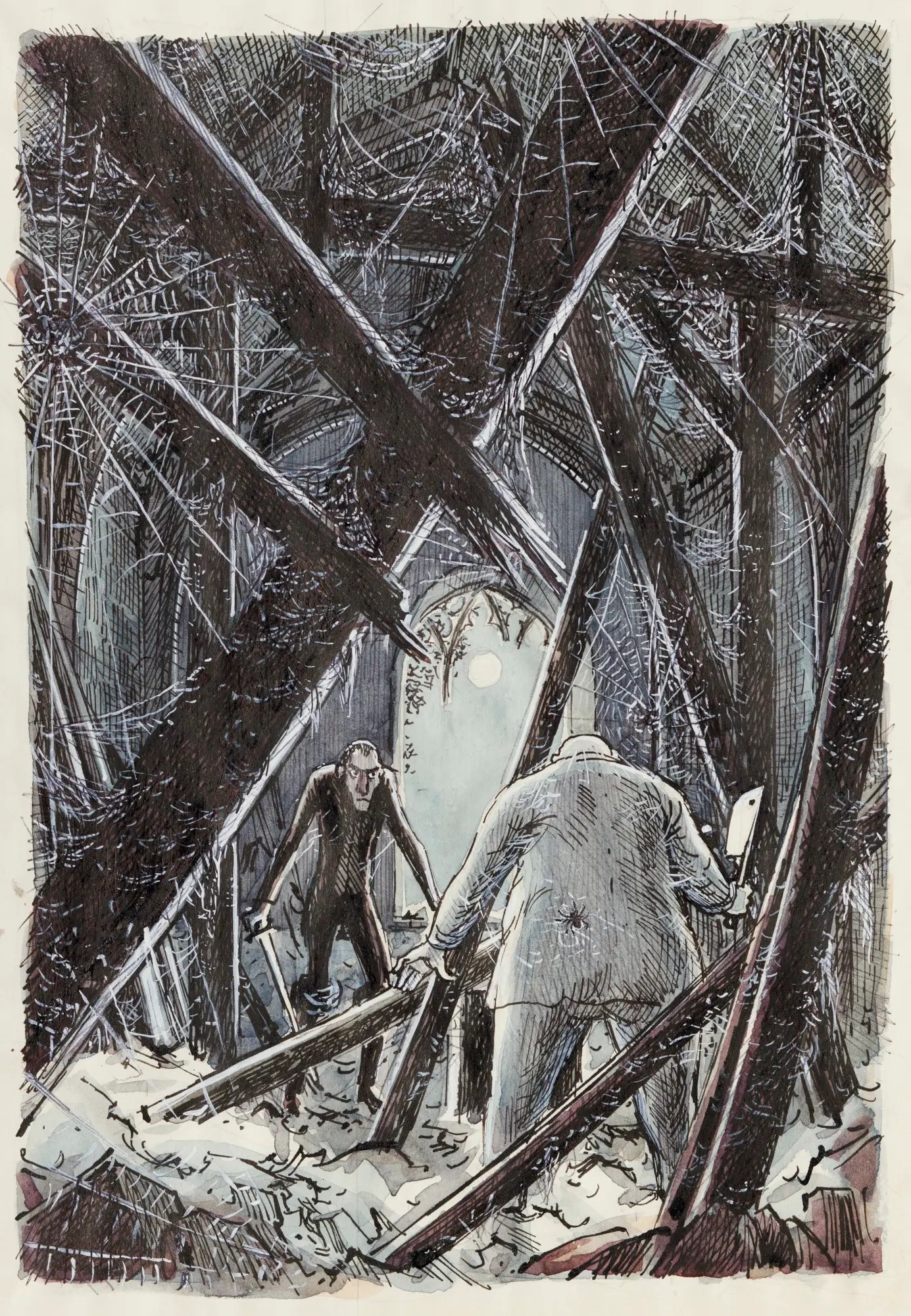
The Hall of Spiders (An Illustration for Mervyn Peake’s Gormenghast) — Charles W. Stewart

On the Way to the Doctor, 1974 by Charles W. Stewart (1915 – 2001).

Part of a series of unpublished illustrations that were to illustrate Mervyn Peake’s 1950 novel, Gormenghast. (More here.)

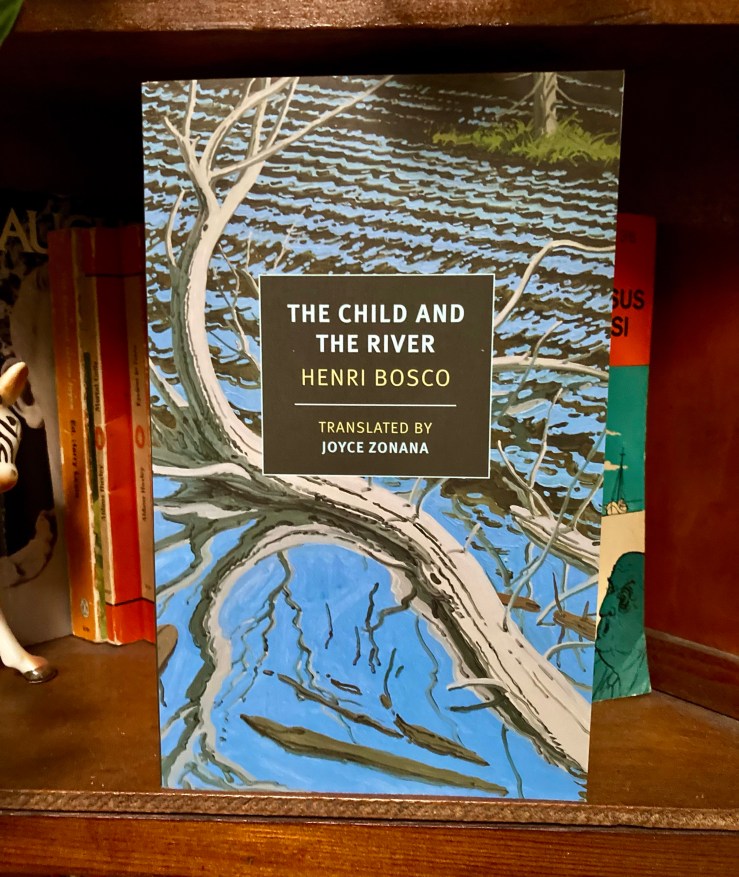
On Henri Bosco’s lovely brief novel, The Child and the River

Last week or maybe the week before last, I received in the mail a review copy of Henri Bosco’s slim 1945 novel The Child and The River. This new translation by Joyce Zonana is available now from publisher NYRB. I picked up The Child and the River this week twice: once before bed, and then again immediately upon waking the next morning, where I finished it before rising.

Set some years before either of the Big Wars, The River and the Child takes place in the countryside somewhere in the south of France (likely Bosco’s native Provence). Narrator Pascalet, now an older man, looks back on a transformational episode in his youth. He relates how as a young boy, he was free to roam the countryside wherever he pleased, excepting the river, where, according to his parents, “there are black holes where you can drown; there are snakes in the reeds and Gypsies on the banks.”

When his parents go on a trip, leaving him in the care of sweet Tante Martine, young Pascalet makes his way to the forbidden river posthaste, blaming any mischief on newly-arrived Spring:

…one fine April morning, temptation caught me unawares. It knew how to speak to me. It was a springtime temptation, one of the sweetest there is, I think, for anyone who is open to clear skies, tender leaves, and newly-blossomed flowers.

That is why I succumbed.

Pascalet’s adventure quickly goes awry, or improves in intensity, depending on how you like to think of it. He falls asleep in an old rowboat, drifts downriver, and ends up on an island inhabited by Gypsies. Hungry, he spies them from behind the brush. Near their cauldron they keep a dog and a bear—and a bound prisoner: “He was a handsome child, sturdy, taller than me and stronger, most likely a Gypsy.” The men in the group beat the young prisoner with a whip, but he endures it. Late in the night, under cover of darkness, Pascalet frees this boy, Gatzo; they then steal a boat and escape to live out a boyhood fantasy of utter freedom—for a few days, at least.

The Child and the River brims with lovely nostalgic pleasures. The boys playact their boyish fantasies, forging crude bows and arrows of reed and pretending that they might have to fend off monsters or “headhunters, cannibals.” Pascalet describes the wonderful sensation of escalating these fantasies:

Then I would feel a mock terror. I enjoyed it. Because when you scare yourself through make-believe, you know well enough that you are not in any danger, but still you are afraid. It is one of the most delicious pleasures.

And yet the boys are not merely playacting—they are surviving: fishing, foraging, strategically moving and mooring their boat to avoid detection. They make fire; they cook. In a lovely little scene, they dig a spring to enjoy fresh water:

We made a hole near a bulge in the clay. Water was seeping through. We continued to dig and fashioned a little basin. Through a breach in the clay, the water moistened a bed of sand. We flattened one side of our hole and stuck in a hollow reed. At first the reed stayed dry. We were aching with impatience, even more than for the fire. At long last, a droplet formed and grew round; for a long time, it hung, uncertain. Suddenly it fell. Another drop came, and slowly, at the tip of the green reed, the spring was born.

This passage exemplifies the simple precision of Bosco’s prose via Zonana’s clean, clear translation. The joy of The Child and the River comes from Pascalet’s gentle, limpid observations of his time on the river, which are generally free of intrusive, muddy “adult” meditations. Instead, we experience what the boys experience:

Everywhere, plants and waters, shorelines and trees, came alive at nightfall with a confused, mysterious life. A duck would flap its wings in the reeds; an owl would screech on a black poplar; a brutal badger would rummage in a bush; a weasel, gliding from branch to branch, would cause two or three leaves to tremble lightly; a roving fox would yelp in the distance.

“It is a sad animal,” Gatzo told me. “It is thinking

The adventures of Pascalet and Gatzo culminate in a strange, dreamlike encounter with “the Puppeteer of Souls.” I won’t remark on the episode at any length, only add that it provides a nearly-mystical, memorable climax to the book. I’ll also add that the novel’s last two sentences are some of the sweetest I’ve read in a while.

I loved reading The Child and the River; I loved the feeling of reading it. It took me back to books I’d loved as a child: Arthur Ransome’s Swallows and Amazons, abridged and bowdlerized versions of Moby-Dick and Huckleberry Finn, and countless Robinsades. In a letter to a friend, Bosco suggested that The Child and the River was “a novel very good, I think, for children, adolescents, and poets.” Is there a better audience?

The Child and the River is one of two Bosco books in publication now from NYRB; they released Zonana’s translation of his 1948 novel Malicroix in early March of 2020. I have it on my shelf, still unread, but not for long. I hope NYRB and Zonana will do a few more Bosco titles. Recommended.

King Cheetah — Angela Gram

King Cheetah, 2022 by Angela Gram (b. 1985)

Playground No.6 — Peter Colville Horridge Gardner

Playground No.6, 1968 by Peter Colville Horridge Gardner (b. 1921)