“We Need Cruel Comedy” | A Lars Iyer Interview

I first interviewed Lars Iyer in 2011, after the publication of his novel Spurious, the beginning of a trilogy that concluded with Exodus (my favorite of the three). I asked Lars to talk with me about his trilogy for an email interview, and we ended up discussing failure, comedy, optimism, academia, American writing, Britain in the mid-eighties, and his forthcoming novel Wittgenstein Jr.

You can get Lars Iyer’s trilogy from publisher Melville House, check out his blog, and find him on Twitter.

Biblioklept: Why a trilogy? Was that by design? Is it a trilogy?

Lars Iyer: Spurious was only a beginning. I wanted to historicise my characters, to present their friendship as part of a larger social, economic and political context. Otherwise, I risked merely contributing belatedly to the literature of the absurd.

Biblioklept: I want to talk about the end of Exodus but that seems like bad form for an interview. Spoilers, etc. Can you comment on where you leave your protagonists, or how you leave them, or why you leave them?

LI: I leave my protagonists roughly where they were at the beginning of the trilogy: rudderless, rather lost, full of a sense of their failure, but with their friendship, such as it is, intact. ‘No hugs, no lessons’: my characters haven’t learned anything…
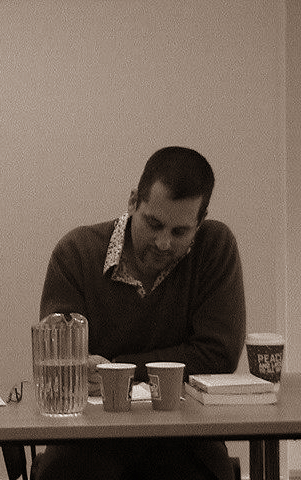
larsBiblioklept: Why can’t they learn? Why the repetition? Why not a heroic arc? Why not a saving grace?

LI: Perhaps because learning implies a kind of resolution that I think is inappropriate for the characters. Kundera says something apposite about Don Quixote. Cervantes makes his would-be knight-errant set off in search of battles, ready to sacrifice his life for a noble cause, ‘but tragedy doesn’t want him’. Kundera goes on:

since its birth, the novel is suspicious of tragedy: of its cult of grandeur; of its theatrical origins; of its blindness to the prose of life. Poor Alonzo Quijada. In the vicinity of his mournful countenance, everything turns into comedy.

So it is with my trilogy. No tragedy! No heroism! No tragic catharsis, that would see the tragic hero being dragged back into line. And no comic catharsis either, in which the older norms of a traditional societal system are reaffirmed. So much comedy is self-congratulatory, self-reassuring: the humour of good cheer, of port and cigars. It shores up things as they are. This is why I can never bear to watch comedy on television. It’s so rare to see comedians turn the joke on themselves. We need cruel comedy. Black comedy, which laughs at itself laughing…

Why the use of repetition in my novels? Because I want to portray the breakdown of things as they are, not once, but again and again. Failure, without amelioration. Serio-comic breakdown, without restitution. Anomie. Helplessness. Crushed hope. How else to acknowledge the prose of our lives?

Much of the humour of Don Quixote, depends on the contrast between lofty ideals and the concrete, everyday, corporeal life. The humour of my trilogy is analogous – but, of course, our everyday is utterly changed! A generalised precarity, un- and under-employment, free-floating anxiety, consumerism, the emphasis on self-representation, the sense that history is over, that politics is all played out, that financial and climatic catastrophe loom…

The tragedy of everyday life is that it’s not even tragic. It never reaches the lofty heights of tragic grandeur. Well, nor do my characters. When W. is at his most wretched, he cannot even die – that’s the end of Dogma. When W. is at his most revolutionary, participating in his own version of the Occupy movement, as at the end of Exodus … well, I won’t spoil the story, but it won’t surprise readers of previous books in the trilogy that there is neither a heroic arc nor a saving grace. Continue reading ““We Need Cruel Comedy” | A Lars Iyer Interview”

Sitting Woman in a Green Blouse — Egon Schiele

“Certain Cheeses are converted into Stones, and many Wicked Men are drowned” (St. Patrick assassination attempt)

“Certain Cheeses are converted into Stones, and many Wicked Men are drowned”

(From The Life and Acts of St. Patrick by Jocelin).

And certain wicked and envious men, who lived in the country of Ferros, contriving to destroy the life of the saint, offered unto him poisoned cheeses, as if for his benediction; the which he blessed, and immediately converted into stones, to the admiration of many, the honor of God, the veneration of himself, and the confusion of the poisoners. And unto this day remain these stones in the place where the miracle was done, and show the virtue of Patrick, though mute, because they underwent mutation. Then did these poisoners, seeing that their machinations redounded to the glory of the saint and to the shame of themselves, gather together fifty armed men to spill the blood of this just one. And they, being assembled against him, entered the ford of a certain river, journeying along the bank whereof the man of God met them; and when he beheld their countenances, he understood their thoughts, and raising against them his left hand, with a clear voice he cried out, “Ye shall not come unto us, nor shall ye return unto your own people, but in this river shall your bodies remain, even to the day of judgment.” Then, according to the word of the man of God, immediately they sank as lead in the mighty waters; nor even to this day were their bodies found, though long and often sought. Thus, at the divine mandate, did the water punish them who conspired the death of Saint Patrick, as erewhile the fire from heaven punished them which were sent by King Achab to the prophet. And the place wherein they sank in the waters is called even to this day the Ford of the Drowned Men.

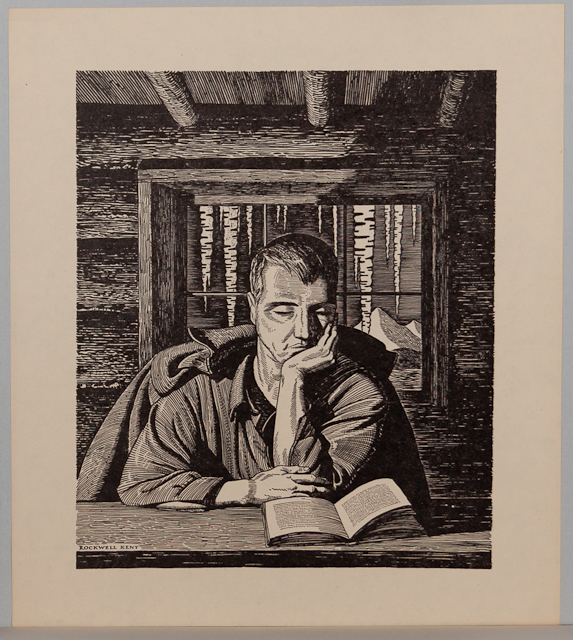
Books Make the Home — Rockwell Kent

1990-213

Man Tied to a Tree and a Figure Resting — Jusepe de Ribera

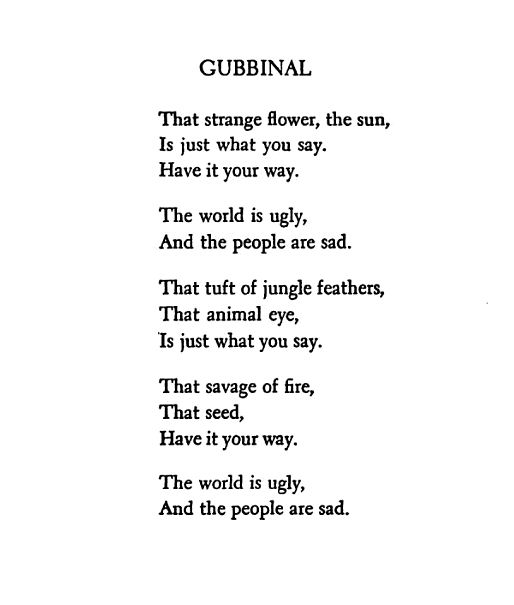
“Gubbinal” — Wallace Stevens

Capture

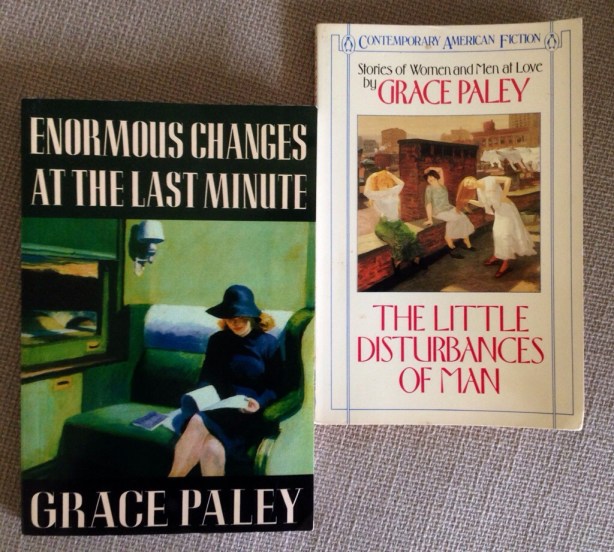
Two by Grace Paley (Books Acquired, 3.07.2014)

20140316-144125.jpg

I’d been wanting to pick up a collection of Grace Paley’s stories for awhile now. I wasn’t sure whether or not to pick up Enormous Changes at the Last Minute or The Little Disturbances of Man, so I just got both. The covers helped convince me, I’ll admit—I’m a sucker for Hopper, and John French Sloan is no slouch either. (I’m tempted here to launch into some vague critique of the covers that books by women get but nah).

I’ve already read most of Enormous Change, ingesting most of the tales while sitting in my car, waiting to pick my kids up after school, which seems like a perfect place to read it. Smart, odd, often sharp, scathing, precise, etc.—great stuff. I’ll try to do a full review but I’ve got a huge backlog. In the meantime, check out “Wants.”

Pool of Tears 2 (After Lewis Carroll) — Kiki Smith

The Essential Short Stories of J.G. Ballard

jgb_complete_ss4003111

I. “Manhole 69” (1957)

II. “Chronopolis” (1960)

III.  “The Voices of Time” (1960)

IV. “The Overloaded Man” (1961)

V. “Billennium” (1961)

VI. “Thirteen to Centaurus” (1962)

VII. “The Subliminal Man” (1963)

VIII. “End-Game” (1963)

IX. “Time of Passage” (1964)

X. “The Lost Leonardo” (1964)

XI. “The Terminal Beach” (1964)

XII. “The Drowned Giant” (1964)

XIII. “The Beach Murders” (1966)

XIV.  “The Assassination of John Fitzgerald Kennedy Considered as a Downhill Motor Race” (1966)

XV. “Why I Want to Fuck Ronald Reagan” (1968)

XVI. “Notes Towards a Mental Breakdown” (1976)

XVII. “The Index” (1977)

XVIII. “The Dead Time” (1977)

XIX. “News from the Sun” (1981)

XX. “Myths of the Near Future” (1982)

XXI. “Memories of the Space Age” (1982)

XXII. “Answers to a Questionnaire” (1985)

XXIII. “A Guide to Virtual Death” (1992)

At 1200 pages and just under 100 stories, The Complete Short Stories is frankly too complete—but I read them all anyway. The list above is my suggestion for a volume I’d call The Essential Short Stories of J.G. Ballard. Each selection on the list is linked to a riff I wrote; in several cases, links to the full text of the story can be found at the riff.

All Are but Stories (The Rubaiyat of Omar Khayyam) — Edmund Dulac

“A Nice Gathering, Isn’t It?” (Orson Welles, Robert Bresson, and Andrei Tarkovsky in Fancy Dress)

“Toys” — Roland Barthes

“Toys”

by

Roland Barthes

(From Mythologies. Translation by Annette Lavers)

French toys: one could not find a better illustration of the fact that the adult Frenchman sees the child as another self. All the toys one commonly sees are essentially a microcosm of the adult world; they are all reduced copies of human objects, as if in the eyes of the public the child was, all told, nothing but a smaller man, a homunculus to whom must be supplied objects of his own size.

Invented forms are very rare: a few sets of blocks, which appeal to the spirit of do-it-yourself, are the only ones which offer dynamic forms. As for the others, French toys always mean something, and this something is always entirely socialized, constituted by the myths or the techniques of modern adult life: the Army, Broadcasting, the Post Office, Medicine (miniature instrument-cases, operating theaters for dolls), School, Hair-Styling (driers for permanent-waving), the Air Force (Parachutists), Transport (trains, Citroens, Vedettes, Vespas, petrol-stations), Science (Martian toys).

The fact that French toys literally prefigure the world of adult functions obviously cannot but prepare the child to accept them all, by constituting for him, even before he can think about it, the alibi of a Nature which has at all times created soldiers, postmen and Vespas. Toys here reveal the list of all the things the adult does not find unusual: war, bureaucracy, ugliness, Martians, etc. It is not so much, in fact, the imitation which is the sign of an abdication, as its literalness: French toys are like a Jivaro head, in which one recognizes, shrunken to the size of an apple, the wrinkles and hair of an adult. There exist, for instance, dolls which urinate; they have an oesophagus, one gives them a bottle, they wet their nappies; soon, no doubt, milk will turn to water in their stomachs. This is meant to prepare the little girl for the causality of house-keeping, to ‘condition’ her to her future role as mother. However, faced with this world of faithful and complicated objects, the child can only identify himself as owner, as user, never as creator; he does not invent the world, he uses it: there are, prepared for him, actions without adventure, without wonder, without joy. He is turned into a little stay-at-home householder who does not even have to invent the mainsprings of adult causality; they are supplied to him ready-made: he has only to help himself, he is never allowed to discover anything from start to finish. The merest set of blocks, provided it is not too refined, implies a very different learning of the world: then, the child does not in any way create meaningful objects, it matters little to him whether they have an adult name; the actions he performs are not those of a user but those of a demiurge. He creates forms which walk, which roll, he creates life, not property: objects now act by themselves, they are no longer an inert and complicated material in the palm of his hand. But such toys are rather rare: French toys are usually based on imitation, they are meant to produce children who are users, not creators.

The bourgeois status of toys can be recognized not only in their forms, which are all functional, but also in their substances. Current toys are made of a graceless material, the product of chemistry, not of nature. Many are now moulded from complicated mixtures; the plastic material of which they are made has an appearance at once gross and hygienic, it destroys all the pleasure, the sweetness, the humanity of touch. A sign which fills one with consternation is the gradual disappearance of wood, in spite of its being an ideal material because of its firmness and its softness, and the natural warmth of its touch. Wood removes, from all the forms which it supports, the wounding quality of angles which are too sharp, the chemical coldness of metal. When the child handles it and knocks it, it neither vibrates nor grates, it has a sound at once muffled and sharp. It is a familiar and poetic substance, which does not sever the child from close contact with the tree, the table, the floor. Wood does not wound or break down; it does not shatter, it wears out, it can last a long time, live with the child, alter little by little the relations between the object and the hand. If it dies, it is in dwindling, not in swelling out like those mechanical toys which disappear behind the hernia of a broken spring. Wood makes essential objects, objects for all time. Yet there hardly remain any of these wooden toys from the Vosges, these fretwork farms with their animals, which were only possible, it is true, in the days of the craftsman. Henceforth, toys are chemical in substance and color; their very material introduces one to a coenaesthesis of use, not pleasure. These toys die in fact very quickly, and once dead, they have no posthumous life for the child.

The Death of Caesar — Jean-Leon Gerome

Ides of March — Cy Twombly

Beware

beware

An Idle Afternoon — Julius LeBlanc Stewart