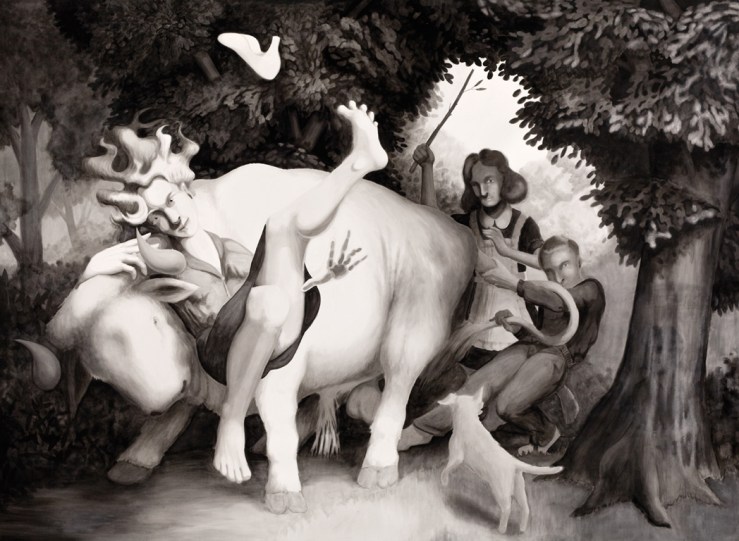
Tribute to Jules Verne — Paul Delvaux

“Allegories” — Voltaire

“Allegories”

From Voltaire’s Philosophical Dictionary

Jupiter, Neptune, and Mercury, travelling one day in Thrace, called on a certain king named Hyreus, who entertained them very handsomely. After eating a good dinner, they asked him if they could render him any service. The good man, who was past the age at which it is usual for men to have children, told them he should be very much obliged to them if they would make him a boy. The three gods then urinated on the skin of a new flayed ox; and from these sprang Orion, who became one of the constellations known to the most remote antiquity. This constellation was named Orion by the ancient Chaldæans; it is spoken of in the Book of Job. It would be hard to discover a rational allegory in this pretty story, unless we are to infer from it that nothing was impossible to the gods.

There were in Greece two young rakes, who were told by the oracle to beware of the melampygos or sable posteriors. One day Hercules took them and tied them by the feet to the end of his club, so that they hung down his back with their heads downward, like a couple of rabbits, having a full view of his person. “Ah!” said they; “the oracle is accomplished; this is the melampygos.” Hercules fell alaughing, and let them go. Here again it would be rather difficult to divine the moral sense.

Among the fathers of mythology there were some who had only imagination; but the greater part of them possessed understandings of no mean order. Not all our academies, not all our makers of devices, not even they who compose the legends for the counters of the royal treasury, will ever invent allegories more true, more pleasing, or more ingenious, than those of the Nine Muses, of Venus, the Graces, the God of Love, and so many others, which will be the delight and instruction of all ages.

The ancients, it must be confessed, almost always spoke in allegories. The earlier fathers of the church, the greater part of whom were Platonists, imitated this method of Plato’s. They have, indeed, been reproached with having carried this taste for allegories and allusions a little too far.

St. Justin, in his “Apology,” says that the sign of the cross is marked in the limbs and features of man; that when he extends his arms there is a perfect cross; and that his nose and eyes form a cross upon his face.

According to Origen’s explanation of Leviticus, the fat of the victims signifies the Church, and the tail is a symbol of perseverance.

St. Augustine, in his sermon on the difference and agreement of the two genealogies of Christ, explains to his auditors why St. Matthew, although he reckons forty-two generations, enumerates only forty-one. It is, says he, because Jechonias must be reckoned twice, Jechonias having gone from Jerusalem to Babylon. This journey is to be considered as the corner-stone; and if the corner-stone is the first of one side of a building, it is also the first of the other side; consequently this stone must be reckoned twice; and therefore Jechonias must be reckoned twice. He adds that, in the forty-two generations, we must dwell on the number forty, because that number signifies life. The number ten denotes blessedness, and ten multiplied by four, which represents the four elements and the four seasons, produces forty.

In his fifty-third sermon, the dimensions of matter have astonishing properties. Breadth is the dilation of the heart, length is long-suffering, height is hope, and depth is faith. So that, besides the allegory, we have four dimensions of matter instead of three.

It is clear and indubitable (says he in his sermon on the 6th psalm) that the number four denotes the human body, because of the four elements, and the four qualities of hotcoldmoist, and dry; and as four relates to the body, so three relates to the soul; for we must love God with a triple love—with all our hearts with all our souls, and with all our mindsFour also relates to the Old Testament, and three to the New. Four and threemake up the number of seven days, and the eight is the day of judgment.

One cannot but feel that there is in these allegories an affectation but little compatible with true eloquence. The fathers, who sometimes made use of these figures, wrote in times and countries in which nearly all the arts were degenerating. Their learning and fine genius were warped by the imperfections of the age in which they lived. St. Augustine is not to be respected the less for having paid this tribute to the bad taste of Africa and the fourth century.

The discourses of our modern preachers are not disfigured by similar faults. Not that we dare prefer them to the fathers; but the present age is to be preferred to the ages in which they wrote. Eloquence, which became more and more corrupted, and was not revived until later times, fell, after them, into still greater extravagances; and the languages of all barbarous nations were alike ridiculous until the age of Louis XIV. Look at all the old collections of sermons; they are far below the dramatic pieces of the Passion, which used to be played at the Hôtel de Bourgogne. But the spirit of allegory, which has never been lost, may be traced throughout these barbarous discourses. The celebrated Ménot, who lived in the reign of Francis I., did more honor, perhaps, than any other to the allegorical style. “The worthy administrators of justice,” said he, “are like a cat set to take care of a cheese, lest it should be gnawed by the mice. One bite of the cat does more damage to the cheese than twenty mice can do.”

Here is another very curious passage: “The woodmen, in a forest, cut large and small branches, and bind them in faggots; just so do our ecclesiastics, with dispensations from Rome, heap together great and small benefices. The cardinal’s hat is garnished with bishoprics, the bishoprics are garnished with abbeys and priories, and the whole is garnished with devils. All these church possessions must pass through the three links of the Ave Maria; for benedicta tu stands for fat abbeys of Benedictines, in mulieribus for monsieur and madame, and fructus ventris for banquets and gormandizers.”

The sermons of Barlet and Maillard are all framed after this model, and were delivered half in bad Latin, and half in bad French. The Italian sermons were in the same taste; and the German were still worse. This monstrous medley gave birth to the macaroni style, the very climax of barbarism. The species of oratory, worthy only of the Indians on the banks of the Missouri, prevailed even so lately as the reign of Louis XIII. The Jesuit Garasse, one of the most distinguished enemies of common sense, never preached in any other style. He likened the celebrated Theophile to a calf, because Theophile’s family name was Viaud, something resembling veau (a calf). “But,” said he, “the flesh of a calf is good to roast and to boil, whereas thine is good for nothing but to burn.”

All these allegories, used by our barbarians, fall infinitely short of those employed by Homer, Virgil, and Ovid, which proves that if there be still some Goths and Vandals who despise ancient fable they are not altogether in the right.

The Library — Elizabeth Shippen Green

Elizabeth Shippen Green

The Voice — Edvard Munch

bem_aic_09_10

“All art constantly aspires towards the condition of music”

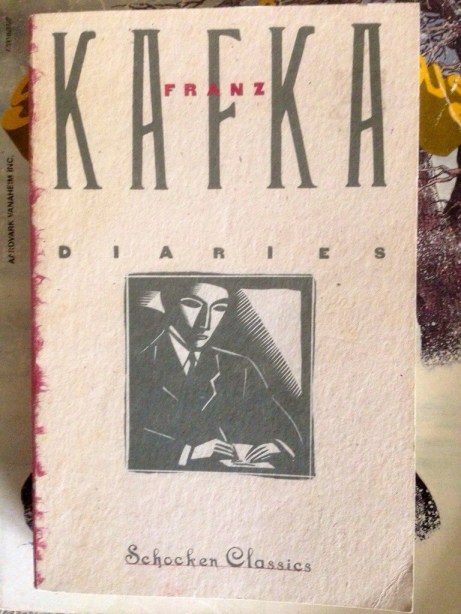
Kafka/Cerebus (Books Acquired, 1.31.2014 + Bonus Circumcision Anecdote)

20140207-154015.jpg

Picked up books last week, not needing them, but hey.

A digest of Kafka’s diaries; good stuff, great random reading.

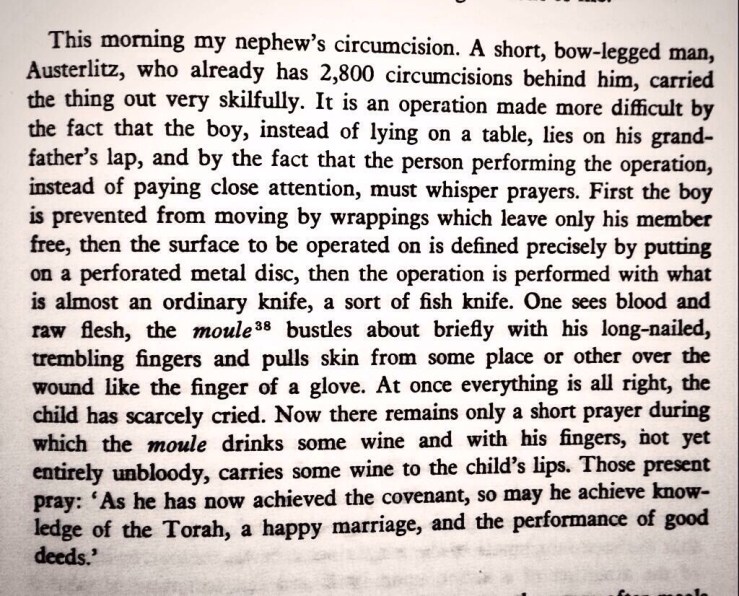
This is a great little anecdote:

20140207-154023.jpg

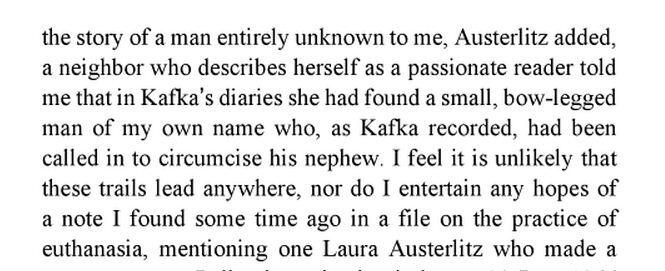
Austerlitz is of course the name of a W.G. Sebald novel. From that novel:

20140207-154029.jpg

I also picked up the sixth issue of Swords of Cerebus by Dave Sim. It’s a second printing and in terrible shape and I already have the issues in other forms (reprint and graphic novel) but it’s still a pretty rare find. And I am a nerd.

20140207-154036.jpg

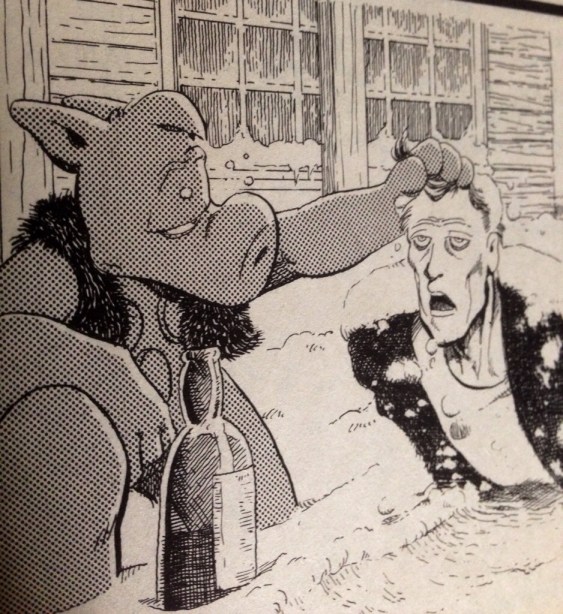
The book also includes a short little excellent wordless comic, “A Night on the Town,” where Cerebus parties with a corpse. I have the reprint somewhere else, but still:

20140207-154043.jpg

The Future Is Old — Marijn Akkermans

000130image

“Our Friend Judith” — Doris Lessing

“Our Friend Judith”

by Doris Lessing

I stopped inviting Judith to meet people when a Canadian woman remarked, with the satisfied fervour of one who has at last pinned a label on a rare specimen: “She is, of course, one of your typical English spinsters.”

This was a few weeks after an American sociologist, having elicited from Judith the facts that she was fortyish, unmarried and living alone, had enquired of me: “I suppose she has given up?” “Given up what?” I asked: and the subsequent discussion was unrewarding.

Judith did not easily come to parties. She would come after pressure, not so much-on felt-to do one a favour, but in order to correct what she believed to be a defect in her character. “I really ought to enjoy meeting new people more than I do,” she said once. We reverted to an earlier pattern of our friendship: odd evenings together, an occasional visit to the cinema, or she would telephone to say: “I’m on my way past you to the British Museum . Would you care for a cup of coffee with me? I have twenty minutes to spare.”

It is characteristic of Judith that the word spinster, used of her, provoked fascinated speculation about other people. There are my aunts for instance: aged seventy-odd, both unmarried, one an ex-missionary from China, one a retired matron of a famous London hospital. These two ladies live together under the shadow of the cathedral in a country town. They devote much time to the Church to good causes, to letter writing with friends all over the world, to the grandchildren and the great-grandchildren of relatives. It would be a mistake, however, on entering a house in which nothing has been moved for fifty years, to diagnose a condition of fossilized late-Victorian integrity. They read every book reviewed in the Observer or the Times, so that I recently got a letter from Aunt Rose enquiring whether I did not think that he author of On the Road was not-perhaps?-exaggerating his difficulties. They know a good deal about music, and write letters of encouragement to young composers they feel are being neglected!– “You must understand that anything new and original takes time to be understood.” Well-informed and critical Tories, they are as likely to dispatch telegrams of protest to the Home Secretary as letters of support. These ladies, my aunts Emily and Rose, are surely what is meant by the phrase English spinster. And yet, once the connection has been pointed out, there is no doubt that Judith and they are spiritual cousins, if not sisters. Therefore it follows that one’s pitying admiration for women who have supported manless and uncomforted lives needs a certain modification? Continue reading ““Our Friend Judith” — Doris Lessing”

A Quiet Hour — John White Alexander

0de9999a173984efb74e8e6e7af22848

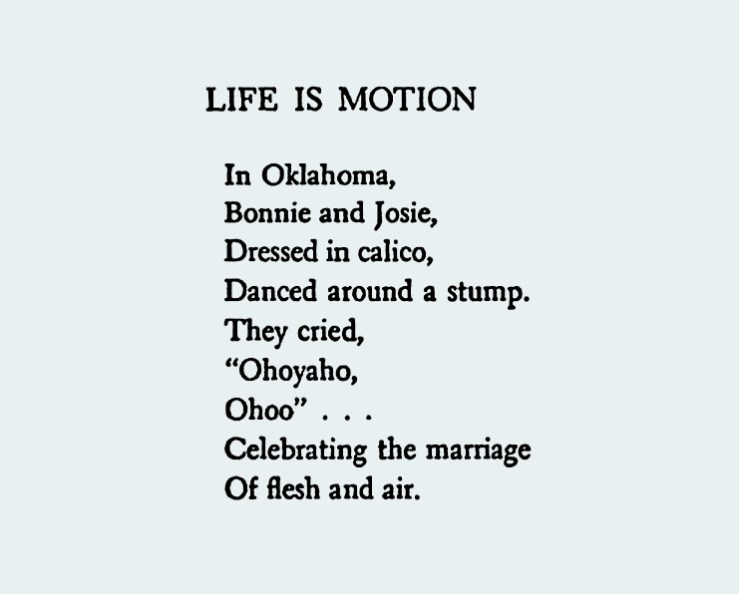
“Life Is Motion” — Wallace Stevens

life

Small Talk — Hans-Georg Rauch

159

Fear (Life in Hell)

fear

“William S. Burroughs was a high modernist and a writer of complete trash”

William S. Burroughs was a high modernist and a writer of complete trash; the two are by no means mutually exclusive. He was a genius and a bullshit artist. If his books prove anything, it’s that profundity and inanity can skip along merrily arm in arm. Sometimes his work was heavyweight, sometimes dumb. To borrow a Freudian analogy, sometimes a cigar really is just a cigar and sometimes a man who taught his asshole to talk really is just a man who taught his asshole how to talk (what it’s saying and why is a different story). The paradox of the freest writer being a lifelong junky is really no paradox at all. As a user and pedlar, he understood the mechanics of how it all worked and kindly pointed it out to us, even as he was picking our pockets. He was a stiff morose patrician figure in a suit (so much so his friend Herbert Huncke initially took him for an undercover agent) with books and a history full of debauchery and depravity. If there seems a contradiction there, it’s in the eye of the beholder. What makes Burroughs’ work seem prophetic is that he was perceptive enough to see that people don’t change, the secret to all successful prophecies. We’re still continually re-enacting Greek myths on a daily basis and always will. Psychosis may mirror the zeitgeist (whether it’s paranoia of witches, Jews, communists, drug fiends, Islamists or whoever next) but its essential character doesn’t alter. The bugs and the feds are always with us and there’s only so much one man can do, calling door to door with an extermination kit.

From Darran Anderson’s insightful and thorough essay “The Third Man: William Burroughs at 100.”

Nitrogen Cycle/10 Reds — Leslie Shows

“A Still Moment” — Eudora Welty

“A Still Moment”

by Eudora Welty

Lorenzo Dow rode the Old Natchez Trace at top speed upon a race horse, and the cry of the itinerant Man of God, “I must have souls! And souls I must have!” rang in his own windy ears. He rode as if never to stop, toward his night’s appointment.

It was the hour of sunset. All the souls that he had saved and all those he had not took dusky shapes in the mist that hung between the high banks, and seemed by their great number and density to block his way, and showed no signs of melting or changing back into mist, so that he feared his passage was to be difficult forever. The poor souls that were not saved were darker and more pitiful than those that were, and still there was not any of the radiance he would have hoped to see in such a congregation.

“Light up, in God’s name!” he called, in the pain of his disappointment.

Then a whole swarm of fireflies instantly flickered all around him, up and down, back and forth, first one golden light and then another, flashing without any of the weariness that had held back the souls. These were the signs sent from God that he had not seen the accumulated radiance of saved souls because he was not able, and that his eyes were more able to see the fireflies of the Lord than His blessed souls.

“Lord, give me the strength to see the angels when I am in Paradise,” he said. “Do not let my eyes remain in this failing proportion to my – loving heart always.”

He gasped and held on. It was that day’s complexity of horse-trading that had left him in the end with a Spanish race horse for which he was bound to send money in November from Georgia. Riding faster on the beast and still faster until he felt as if he were flying he sent thoughts of i love with matching speed to his wife Peggy in Massachusetts. He found it effortless to love at a distance. He could look at the flowering trees and love Peggy in fullness, just as he could see his visions and love God. And Peggy, to whom he had not spoken until he could speak fateful words (“Would she accept of such an object as him?”), Peggy, the bride, with whom he had spent a few hours of time, showing of herself a small round handwriting, declared all in one letter, her first, that she felt the same as he, and that the fear was never of separation, but only of death.

Lorenzo well knew that it was Death that opened underfoot, that rippled by at night, that was the silence the birds did their singing in. He was close to death, closer than any animal or bird. On the back of one horse after another, winding them all, he was always riding toward it or away from it, and the Lord sent him directions with protection in His mind.

Just then he rode into a thicket of Indians taking aim with their new guns. One stepped out and took the horse by the bridle, it stopped at a touch, and the rest made a closing circle. The guns pointed.

“Incline!” The inner voice spoke sternly and with its customary lightning-quickness. Continue reading ““A Still Moment” — Eudora Welty”

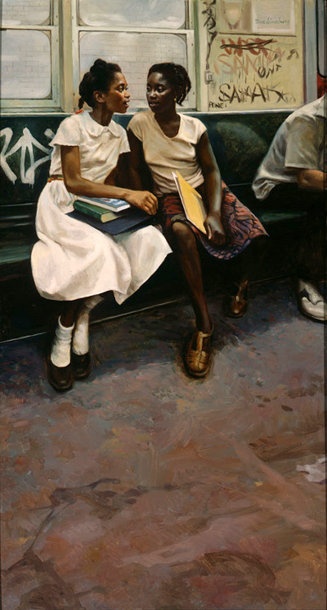
Girls with Books — Max Ginsburg

mg

Still Life With Fruit, Pie, and Drinking Vessels — Jan Davidsz de Heem