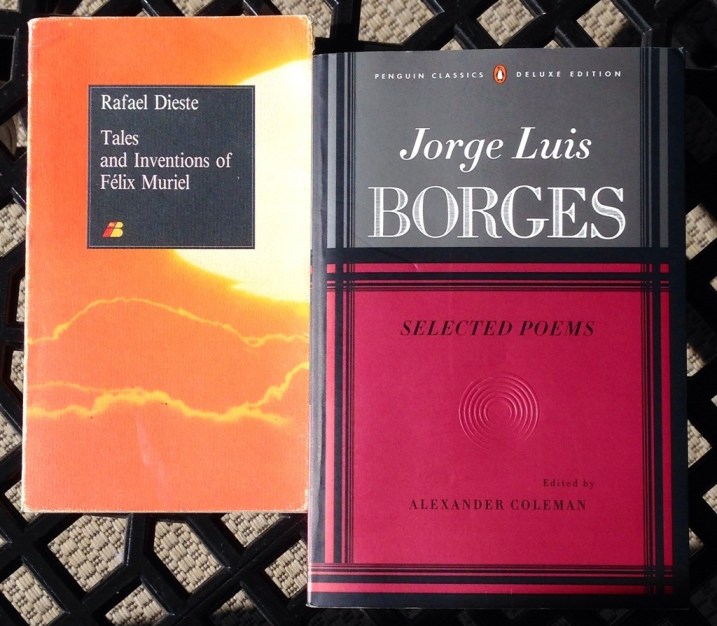
Haven’t read Rafael Dieste (one of his books shows up in Bolaño’s novel 2666—Amalfitano hangs it in his backyard).
The Borges poetry collection matches nicely with these.
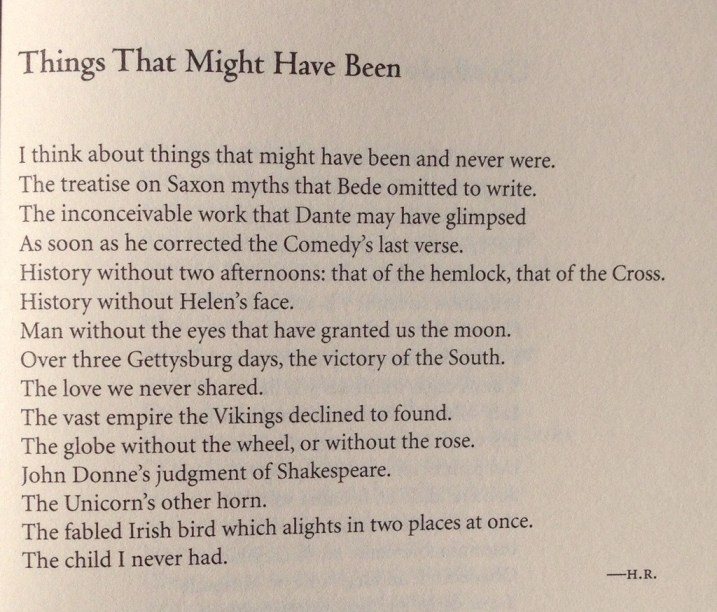
A poem by JLB:
Haven’t read Rafael Dieste (one of his books shows up in Bolaño’s novel 2666—Amalfitano hangs it in his backyard).
The Borges poetry collection matches nicely with these.
A poem by JLB:

“Child’s Play” by Robert Louis Stevenson
The regret we have for our childhood is not wholly justifiable: so much a man may lay down without fear of public ribaldry; for although we shake our heads over the change, we are not unconscious of the manifold advantages of our new state. What we lose in generous impulse, we more than gain in the habit of generously watching others; and the capacity to enjoy Shakespeare may balance a lost aptitude for playing at soldiers. Terror is gone out of our lives, moreover; we no longer see the devil in the bed-curtains nor lie awake to listen to the wind. We go to school no more; and if we have only exchanged one drudgery for another (which is by no means sure), we are set free for ever from the daily fear of chastisement. And yet a great change has overtaken us; and although we do not enjoy ourselves less, at least we take our pleasure differently. We need pickles nowadays to make Wednesday’s cold mutton please our Friday’s appetite; and I can remember the time when to call it red venison, and tell myself a hunter’s story, would have made it more palatable than the best of sauces. To the grown person, cold mutton is cold mutton all the world over; not all the mythology ever invented by man will make it better or worse to him; the broad fact, the clamant reality, of the mutton carries away before it such seductive figments. But for the child it is still possible to weave an enchantment over eatables; and if he has but read of a dish in a story-book, it will be heavenly manna to him for a week.
If a grown man does not like eating and drinking and exercise, if he is not something positive in his tastes, it means he has a feeble body and should have some medicine; but children may be pure spirits, if they will, and take their enjoyment in a world of moon-shine. Sensation does not count for so much in our first years as afterwards; something of the swaddling numbness of infancy clings about us; we see and touch and hear through a sort of golden mist. Children, for instance, are able enough to see, but they have no great faculty for looking; they do not use their eyes for the pleasure of using them, but for by-ends of their own; and the things I call to mind seeing most vividly, were not beautiful in themselves, but merely interesting or enviable to me as I thought they might be turned to practical account in play. Nor is the sense of touch so clean and poignant in children as it is in a man. If you will turn over your old memories, I think the sensations of this sort you remember will be somewhat vague, and come to not much more than a blunt, general sense of heat on summer days, or a blunt, general sense of wellbeing in bed. And here, of course, you will understand pleasurable sensations; for overmastering pain—the most deadly and tragical element in life, and the true commander of man’s soul and body—alas! pain has its own way with all of us; it breaks in, a rude visitant, upon the fairy garden where the child wanders in a dream, no less surely than it rules upon the field of battle, or sends the immortal war-god whimpering to his father; and innocence, no more than philosophy, can protect us from this sting. As for taste, when we bear in mind the excesses of unmitigated sugar which delight a youthful palate, “it is surely no very cynical asperity” to think taste a character of the maturer growth. Smell and hearing are perhaps more developed; I remember many scents, many voices, and a great deal of spring singing in the woods. But hearing is capable of vast improvement as a means of pleasure; and there is all the world between gaping wonderment at the jargon of birds, and the emotion with which a man listens to articulate music. Continue reading ““Child’s Play” — Robert Louis Stevenson”


The most general survey shows us that the two foes of human happiness are pain and boredom. We may go further, and say that in the degree in which we are fortunate enough to get away from the one, we approach the other. Life presents, in fact, a more or less violent oscillation between the two. The reason of this is that each of these two poles stands in a double antagonism to the other, external or objective, and inner or subjective. Needy surroundings and poverty produce pain; while, if a man is more than well off, he is bored. Accordingly, while the lower classes are engaged in a ceaseless struggle with need, in other words, with pain, the upper carry on a constant and often desperate battle with boredom. The inner or subjective antagonism arises from the fact that, in the individual, susceptibility to pain varies inversely with susceptibility to boredom, because susceptibility is directly proportionate to mental power. Let me explain. A dull mind is, as a rule, associated with dull sensibilities, nerves which no stimulus can affect, a temperament, in short, which does not feel pain or anxiety very much, however great or terrible it may be. Now, intellectual dullness is at the bottom of that vacuity of soul which is stamped on so many faces, a state of mind which betrays itself by a constant and lively attention to all the trivial circumstances in the external world. This is the true source of boredom—a continual panting after excitement, in order to have a pretext for giving the mind and spirits something to occupy them. The kind of things people choose for this purpose shows that they are not very particular, as witness the miserable pastimes they have recourse to, and their ideas of social pleasure and conversation: or again, the number of people who gossip on the doorstep or gape out of the window. It is mainly because of this inner vacuity of soul that people go in quest of society, diversion, amusement, luxury of every sort, which lead many to extravagance and misery. Nothing is so good a protection against such misery as inward wealth, the wealth of the mind, because the greater it grows, the less room it leaves for boredom. The inexhaustible activity of thought! Finding ever new material to work upon in the multifarious phenomena of self and nature, and able and ready to form new combinations of them,—there you have something that invigorates the mind, and apart from moments of relaxation, sets it far above the reach of boredom.
From Arthur Schopenhauer’s The Wisdom of Life (trans. T. Bailey Saunders).




A Philosophy of Walking by Frederic Gros is new in English translation from Verso Books. Their blurb:
In A Philosophy of Walking, Frédéric Gros charts the many different ways we get from A to B—the pilgrimage, the promenade, the protest march, the nature ramble—and shows what it tells us about ourselves.
He draws attention to other thinkers who also saw walking as a central part of their practice, and ponders over things like why Henry David Thoreau entered Walden Woods in pursuit of the wilderness; the reason Rimbaud walked in a fury while Nerval rambled to cure his melancholy. We learn how Rousseau had to walk to think, Nietzsche in order to write, while Kant walked to distract himself from contemplation. Brilliant, erudite and always entertaining, Gros is certain to make you reconsider this everyday activity.
I had hoped to crack into this a bit more over the holidays, but got wrapped up in another Verso book, Balestrini’s Tristano—and also like four other books. More to come.
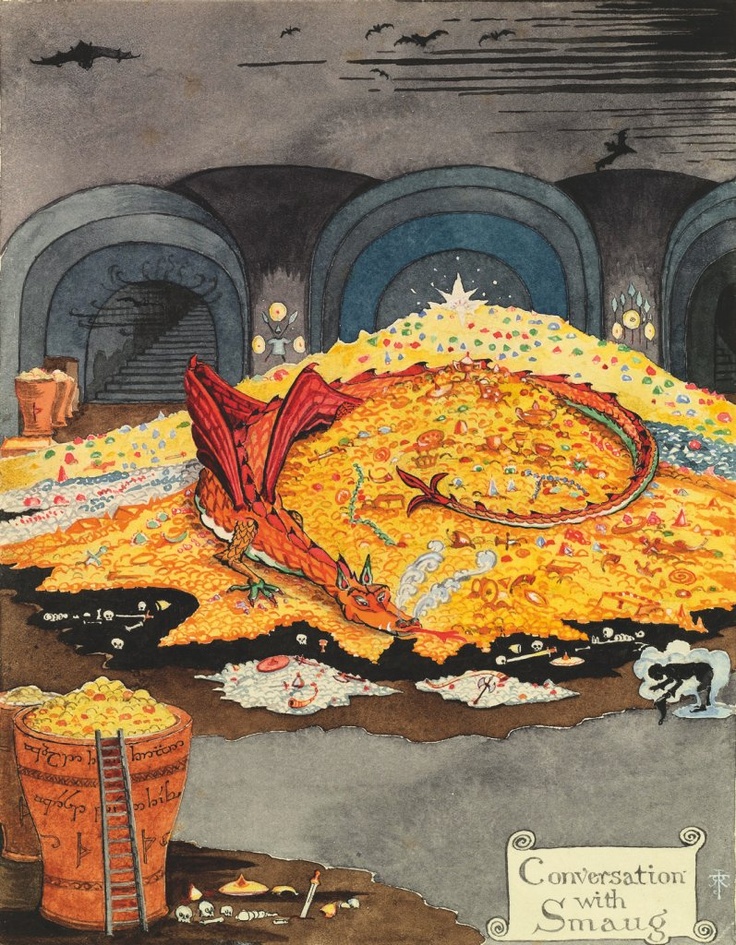
The Hobbit Is a Picaresque Novel

“I Have a Very Vivid Child’s View” — A 1967 Interview with J.R.R. Tolkien

J.R.R. Tolkien, In His Own Words (1968 BBC Documentary)

 Biblioklept