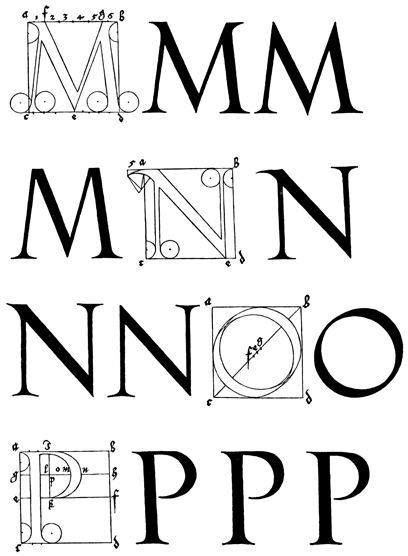
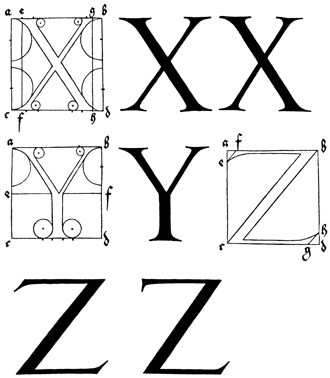
THE letters which are usually called “text,” or quadrate, it was formerly customary so to write, although they are now imitated by the new art, as presently I shall show below. Although the alphabet begins with the writing of A, yet shall I (not needlessly) in the first place undertake to draw an I; because almost all the other letters are formed after this letter, although always something has to be added to it or taken away.
First make your I of equal squares, of which three are properly set one over the other; and the top of the top one, and the bottom of the bottom one, divide in two points, that is to say, into three equal parts: then set a square equal to the others in an oblique manner, so that its diagonal be vertical, and its angle on the first point of the top square. In this way, this oblique square shall extend with its angles more to the left than the right. Then produce upwards on either side, after the width of the superposed squares, right lines to meet the sides of the oblique set square. Next do below precisely as you did above, except that you must set the angle of the oblique square on the second point, that is, the one farthest to the right in the bottom of the lowest square; and let fall your lines on either side upon the transposed square: so will I be perfect; only above it draw with a fine pen a tiny in-crescent. Continue reading ““Directions for the Construction of the Text” — Albrecht Dürer”→
I’ve used Tim O’Brien’s short story “The Things They Carried” in the classroom for so many years now that I’ve perhaps become immune to any of the tale’s rhetorical force.Trekking through the story again with a new group of students can occasionally turn up new insights—mostly these days from veterans going back to school after tours in Iraq and Afghanistan—but for the most part, the story “The Things They Carried” is too blunt in its symbols, too programmatic in its oppositions of the physical and metaphysical, too rigid in its maturation plot. There’s no mystery to it, unlike other oft-anthologized stories which can withstand scores of rereadings (I think of Hawthorne or O’Connor here; when I reread “A Good Man Is Hard to Find,” for example, I always understand it or misunderstand it in a new, different way).
But my students invariably love “The Things They Carried,” and I love reading it with them.
Despite reading the story “The Things They Carried” semester after semester, I hadn’t gone back to the novel The Things They Carried in years, until the kind people at Audible sent me a new audiobook version read by character actor Bryan Cranston (Malcolm in the Middle; Seinfeld). I enjoyed the audiobook over a week of commutes.
The Things They Carried is a loose collection of stories that centers on a character named Tim O’Brien and his time with Alpha Company during the Vietnam War. The book also focuses on O’Brien’s experiences, as well as the experiences of some of his fellow soldiers, before and after Vietnam. O’Brien ties the book around a few major stories, fleshing it out with fragments, and telling tales from different viewpoints and even different chronologies. If a character dies in one story, he’s welcome to show up in a later story or vignette. That’s how memory works. And when memory fails, there are stories:
Forty-three years old, and the war occurred half a lifetime ago, and yet the remembering makes it now. And sometimes remembering will lead to a story, which makes it forever. That’s what stories are for. Stories are for joining the past to the future. Stories are for those late hours in the night when you can’t remember how you got from where you were to where you are. Stories are for eternity, when memory is erased, when there is nothing to remember except the story.
O’Brien’s major concern in The Things They Carried isn’t just the experiences of regular soldiers in the Vietnam War. He’s also deeply concerned with how to frame, recall, tell, and retell those experiences. In this sense, the formal aspects of the novel—its fragmentary, decentered structure—carry out its themes. The result is a strange beast, a novel that is simultaneously postmodern metafiction and dirty realism. Almost every single story in The Things They Carried attempts to suss out its own telling; indeed, how to tell, how to witness to (horror, violence, war) is probably the book’s real aim. Nowhere is this more evident than in “How to Tell a True Story”:
A true war story is never moral. It does not instruct, nor encourage virtue, nor suggest models of proper human behavior, nor restrain men from doing the things men have always done. If a story seems moral, do not believe it. If at the end of a war story you feel uplifted, or if you feel that some small bit of rectitude has been salvaged from the larger waste, then you have been made the victim of a very old and terrible lie. There is no rectitude whatsoever. There is no virtue. As a first rule of thumb, therefore, you can tell a true war story by its absolute and uncompromising allegiance to obscenity and evil.
The notation of a “rule of thumb” there is a dark little sick joke, a thread that O’Brien picks up from the opening title story. Moments like these, little threads, little images, help the work to cohere as a novel, even as O’Brien does his damnedest to fracture the whole business. His hand-wringing about truth and fiction and reality begins to wear on the reader. It’s not that O’Brien isn’t right to be concerned about these issues, but The Things They Carried spends a bit too much time dithering over its own right to imagine a truth.
O’Brien is better at the dirty realism, I think, which we can see in the brutal vivid details in “Sweetheart of the Song Tra Bong,” a story about a guy who brings his teenage girlfriend to Vietnam. “Vietnam was full of strange stories, some improbable, some well beyond that,” O’Brien writes at the beginning, “but the stories that will last forever are those that swirl back and forth across the border between trivia and bedlam, the mad and the mundane.” In “Sweetheart,” O’Brien toes that line to great effect. The story culminates in imagery that seems borrowed from Cormac McCarthy’s Blood Meridian. I’m tempted to share the story’s strongest image but won’t. No spoilers.
“Sweetheart” is less concerned with the frames and edges of its own telling than some of the other stories in The Things They Carried, but O’Brien still highlights the essential problem of witnessing:
“Patience, man. Up to now, everything I told you is from personal experience, the exact truth, but there’s a few other things I heard secondhand. Thirdhand, actually. From here on it gets to be … I don’t know what the word is.”
“Speculation.”
I think it helped me to hear The Things They Carried in a different voice, a different tone or mode or mood than my own. Bryan Cranston does a wonderful job here. I’ve written before about how a good reader makes all the difference in an audiobook. Cranston, surely most famous for his iconic performance as hapless father Hal in Malcolm in the Middle, telegraphs O’Brien’s tales in a straightforward but sonorous voice, injecting pathos and wry humor at the appropriate moments. Cranston inhabits each voice in The Things They Carried, imbuing every character with his own tone and rhythm. The result is a compelling and moving interpretation of The Things They Carried. Cranston opens up what I had thought to be a more-or-less closed book.
This new audiobook features a bonus essay called “The Vietnam in Me” which recounts O’Brien’s 1994 return to Vietnam with his young girlfriend. The essay reads as a condensation, repetition, and extension of the book that precedes it, with O’Brien repeatedly admitting as much—reminding us again and again of the relationship between memory and story. O’Brien reads the essay himself in a reedy, often shaky voice. The recording quality seems to depart from the clean studio perfection of the book proper—there’s more hiss, more crackly, longer gaps. More dirty realism. Strangely, O’Brien’s quaver suggests a man less in control of the story than alter-ego Cranston’s confidence suggested. The divergence in the two readers underscores the book’s core theme, reminding us that it’s not just the story that matters, but the storyteller
You can see/hear Cranston read bits of the book in this video:










 I’ve used Tim O’Brien’s short story “The Things They Carried” in the classroom for so many years now that I’ve perhaps become immune to any of the tale’s rhetorical force.Trekking through the story again with a new group of students can occasionally turn up new insights—mostly these days from veterans going back to school after tours in Iraq and Afghanistan—but for the most part, the story “The Things They Carried” is too blunt in its symbols, too programmatic in its oppositions of the physical and metaphysical, too rigid in its maturation plot. There’s no mystery to it, unlike other oft-anthologized stories which can withstand scores of rereadings (I think of Hawthorne or O’Connor here; when I reread “A Good Man Is Hard to Find,” for example, I always understand it or misunderstand it in a new, different way).
 Biblioklept