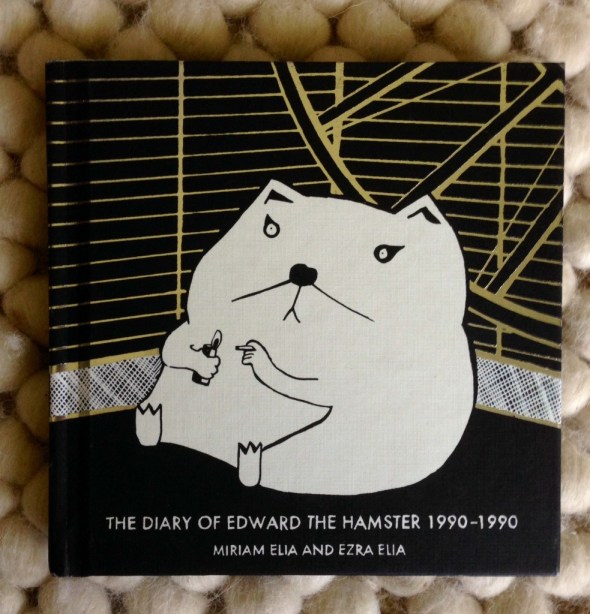
The Diary of Edward the Hamster 1990-1990 (Book Acquired, Some Time Last Month)

20131006-154358.jpg

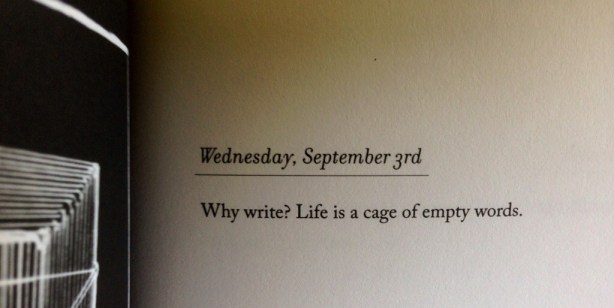
“What’s this cute little book?” my wife asked, picking up Miriam Elia and Ezra Elia’s short hardback novelty The Diary of Edward the Hamster 1990-1990. I’m sure this is the hoped-for reaction from the publishers and producers: the reader, attracted to the aesthetics of this small, square (and shiny!) picture book will pick it up and then laugh at its content—see, this hamster thinks, he feels, he writes. And he experiences ennui, existential boredom. Here is the book neatly summed up:

20131006-154406.jpg

The Diary of Edward the Hamster 1990-1990 is a one-note affair that delivers the same joke over 80 pages. The art is nice and the packaging is lovely, but the premise isn’t really that funny—certainly not funny enough to sustain over the book’s length (which is already pamphlet-short).

“On Visiting Bookshops” — Christopher Morley

“On Visiting Bookshops” by Christopher Morley

It is a curious thing that so many people only go into a bookshop when they happen to need some particular book. Do they never drop in for a little innocent carouse and refreshment? There are some knightly souls who even go so far as to make their visits to bookshops a kind of chivalrous errantry at large. They go in not because they need any certain volume, but because they feel that there may be some book that needs them. Some wistful, little forgotten sheaf of loveliness, long pining away on an upper shelf—why not ride up, fling her across your charger (or your charge account), and gallop away. Be a little knightly, you book-lovers!

The lack of intelligence with which people use bookshops is, one supposes, no more flagrant than the lack of intelligence with which we use all the rest of the machinery of civilization. In this age, and particularly in this city, we haven’t time to be intelligent.

A queer thing about books, if you open your heart to them, is the instant and irresistible way they follow you with their appeal. You know at once, if you are clairvoyant in these matters (libre-voyant, one might say), when you have met your book. You may dally and evade, you may go on about your affairs, but the paragraph of prose your eye fell upon, or the snatch of verses, or perhaps only the spirit and flavour of the volume, more divined than reasonably noted, will follow you. A few lines glimpsed on a page may alter your whole trend of thought for the day, reverse the currents of the mind, change the profile of the city. The other evening, on a subway car, we were reading Walter de la Mare’s interesting little essay about Rupert Brooke. His discussion of children, their dreaming ways, their exalted simplicity and absorption, changed the whole tenor of our voyage by some magical chemistry of thought. It was no longer a wild, barbaric struggle with our fellowmen, but a venture of faith and recompense, taking us home to the bedtime of a child.

The moment when one meets a book and knows, beyond shadow of doubt, that that book must be his—not necessarily now, but some time—is among the happiest excitements of the spirit. An indescribable virtue effuses from some books. One can feel the radiations of an honest book long before one sees it, if one has a sensitive pulse for such affairs. Its honour and truth will speak through the advertising. Its mind and heart will cry out even underneath the extravagance of jacket-blurbings. Some shrewd soul, who understands books, remarked some time ago on the editorial page of the Sun’s book review that no superlative on a jacket had ever done the book an atom of good. He was right, as far as the true bookster is concerned. We choose our dinner not by the wrappers, but by the veining and gristle of the meat within. The other day, prowling about a bookshop, we came upon two paper-bound copies of a little book of poems by Alice Meynell. They had been there for at least two years. We had seen them before, a year or more ago, but had not looked into them fearing to be tempted. This time we ventured. We came upon two poems—“To O, Of Her Dark Eyes,” and “A Wind of Clear Weather in England.” The book was ours—or rather, we were its, though we did not yield at once. We came back the next day and got it. We are still wondering how a book like that could stay in the shop so long. Once we had it, the day was different. The sky was sluiced with a clearer blue, air and sunlight blended for a keener intake of the lungs, faces seen along the street moved us with a livelier shock of interest and surprise. The wind that moved over Sussex and blew Mrs. Meynell’s heart into her lines was still flowing across the ribs and ledges of our distant scene.

There is no mistaking a real book when one meets it. It is like falling in love, and like that colossal adventure it is an experience of great social import. Even as the tranced swain, the book-lover yearns to tell others of his bliss. He writes letters about it, adds it to the postscript of all manner of communications, intrudes it into telephone messages, and insists on his friends writing down the title of the find. Like the simple-hearted betrothed, once certain of his conquest, “I want you to love her, too!” It is a jealous passion also. He feels a little indignant if he finds that any one else has discovered the book, too. He sees an enthusiastic review—very likely in The New Republic—and says, with great scorn, “I read the book three months ago.” There are even some perversions of passion by which a book-lover loses much of his affection for his pet if he sees it too highly commended by some rival critic.
This sharp ecstasy of discovering books for one’s self is not always widespread. There are many who, for one reason or another, prefer to have their books found out for them. But for the complete zealot nothing transcends the zest of pioneering for himself. And therefore working for a publisher is, to a certain type of mind, a never-failing fascination. As H. M. Tomlinson says in “Old Junk,” that fascinating collection of sensitive and beautifully poised sketches which came to us recently with a shock of thrilling delight:

To come upon a craft rigged so, though at her moorings and with sails furled, her slender poles upspringing from the bright plane of a brimming harbour, is to me as rare and sensational a delight as the rediscovery, when idling with a book, of a favourite lyric.

To read just that passage, and the phrase the bright plane of a brimming harbour, is one of those “rare and sensational delights” that set the mind moving on lovely journeys of its own, and mark off visits to a bookshop not as casual errands of reason, but as necessary acts of devotion. We visit bookshops not so often to buy any one special book, but rather to rediscover, in the happier and more expressive words of others, our own encumbered soul.

Reading Centaur — Odilon Redon

Cowboy Henk Practices Good Oral Hygiene (Kama & Seele)

henk1

“Everything human is pathetic” (Mark Twain)

human

Whistler in His Studio — James McNeill Whistler

“eavesdropping on my own thoughts” | Passage from + One-Sentence Riff on Evan Dara’s Novel The Lost Scrapbook

. . . In fact, this happens often—when I feel as if words, others’ words, have crowded mine out, and have left me no place; I do not know why, through what mechanism, this occurs, but when it does, and it is often, I find that I developed a need, an earnest yearning, for words that have not become sour and strange—that is, for words that are my own, words that are uniquely mine amid this foreign wash; and yet I find, when I look for such words—my words—none seem to be there: all of my words, upon the slightest inspection, seem so foreign to me, so much the work of others; and so I wonder how I can claim that anything that occurs in my consciousness is mine, and not the product of some othernesses; often I feel that I am not thinking so much as eavesdropping on my own thoughts, listening in on the narrative being told between othernesses—that it is the otherness thinking me; because none of it, in truth, seems to issue from me; even my unplanned cries, my most heartfelt exclamations, have been determined by others: I have noticed that it is precisely at times of highest emotion—when I am going to the deepest regions of my responses, to the deepest particularity of me—that my words, which would then seem to be at their most personal and spontaneous, are in fact at their most derivative, just pure banal cliché: oh my God!, Will you look at that!, I don’t believe it!; but where are my words, I wonder, my own thoughts?; it seems, sometimes, that I am a conduit and not a content—a transfer point, a capacitor, a pattern in waves; or, at most, I am a bricklayer, combining chunks of accepted solidity to wall out fresh perception; is this adolescent thinking?—

From Evan Dara’s novel The Lost Scrapbook.

I am really loving this book so far, this novel that moves through consciousnesses in a (yes, I’ll use that cliché that book reviewers so often grab for) dazzling performance, shifting through minds, monologues, dialogues, always a few steps (or more) ahead of its reader, beckoning though, inviting, calling its reader to participate in discussions (or performances) of art, science, politics, psychology, education, loneliness, ecology, family, fireflies, radio plays, alienation, voting trends, Chomskyian linguistics, Eisensteinian montage, theft, Walkman Personal Stereos, semiotics, one-man shows, drum sets, being ventriloquized—a novel that takes ventriloquism as not just a theme (as we can see in the citation above) but also as a rhetorical device, a novel that ventriloquizes its reader, throws its reader into a metaphorical deep end and then dramatically shifts the currents as soon as the reader has learned to swim, a novel of othernesses, a novel that offers content through conduits, patterns that coalesce through waves, a novel composed in transfer points, each transfer point announcing the limitations of first-person perspective, the perspective that the reader is logically and spiritually and psychologically beholden to—and then, perhaps, transcending (or at least producing the affective illusion of transcendence of) first-person perspective, and this (illusion of) transcendence, oh my, what a gift, what a gift . . .

Grasshopper in Front of a House of Cards — Heorhiy Narbut

“Thoreau” — Charles Ives

“Thoreau” — Charles Ives

Thoreau was a great musician, not because he played the flute but because he did not have to go to Boston to hear “the Symphony.” The rhythm of his prose, were there nothing else, would determine his value as a composer. He was divinely conscious of the enthusiasm of Nature, the emotion of her rhythms and the harmony of her solitude. In this consciousness he sang of the submission to Nature, the religion of contemplation, and the freedom of simplicity—a philosophy distinguishing between the complexity of Nature which teaches freedom, and the complexity of materialism which teaches slavery. In music, in poetry, in all art, the truth as one sees it must be given in terms which bear some proportion to the inspiration. In their greatest moments the inspiration of both Beethoven and Thoreau express profound truths and deep sentiment, but the intimate passion of it, the storm and stress of it, affected Beethoven in such a way that he could not but be ever showing it and Thoreau that he could not easily expose it. They were equally imbued with it, but with different results. A difference in temperament had something to do with this, together with a difference in the quality of expression between the two arts. “Who that has heard a strain of music feared lest he would speak extravagantly forever,” says Thoreau. Perhaps music is the art of speaking extravagantly. Herbert Spencer says that some men, as for instance Mozart, are so peculiarly sensitive to emotion … that music is to them but a continuation not only of the expression but of the actual emotion, though the theory of some more modern thinkers in the philosophy of art doesn’t always bear this out. However, there is no doubt that in its nature music is predominantly subjective and tends to subjective expression, and poetry more objective tending to objective expression. Hence the poet when his muse calls for a deeper feeling must invert this order, and he may be reluctant to do so as these depths often call for an intimate expression which the physical looks of the words may repel. They tend to reveal the nakedness of his soul rather than its warmth. It is not a matter of the relative value of the aspiration, or a difference between subconsciousness and consciousness but a difference in the arts themselves; for example, a composer may not shrink from having the public hear his “love letter in tones,” while a poet may feel sensitive about having everyone read his “letter in words.” When the object of the love is mankind the sensitiveness is changed only in degree.

But the message of Thoreau, though his fervency may be inconstant and his human appeal not always direct, is, both in thought and spirit, as universal as that of any man who ever wrote or sang—as universal as it is nontemporaneous—as universal as it is free from the measure of history, as “solitude is free from the measure of the miles of space that intervene between man and his fellows.” In spite of the fact that Henry James (who knows almost everything) says that “Thoreau is more than provincial—that he is parochial,” let us repeat that Henry Thoreau, in respect to thought, sentiment, imagination, and soul, in respect to every element except that of place of physical being—a thing that means so much to some—is as universal as any personality in literature. That he said upon being shown a specimen grass from Iceland that the same species could be found in Concord is evidence of his universality, not of his parochialism. He was so universal that he did not need to travel around the world to PROVE it. “I have more of God, they more of the road.” “It is not worth while to go around the world to count the cats in Zanzibar.” With Marcus Aurelius, if he had seen the present he had seen all, from eternity and all time forever. Continue reading ““Thoreau” — Charles Ives”

Ann — Antonio Santin

“The Yellow Chimney” — William Carlos Williams

wcw

Creation Myth (The Far Side)

larson

Some content on this page was disabled on May 26, 2021 as a result of a DMCA takedown notice from Gary Larson. You can learn more about the DMCA here:

https://wordpress.com/support/copyright-and-the-dmca/

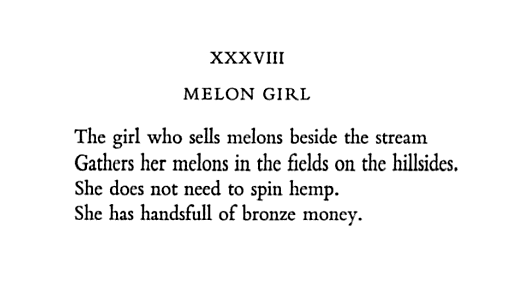
“Melon Girl” – Mei Yao Ch’en

MelonGirl

Translated by Kenneth Rexroth.

Anxiety — Edvard Munch

“Memory” — Two Notes from Samuel Butler’s Note-Books

Memory

i

Memory is a kind of way (or weight – whichever it should be) that the mind has got upon it, in virtue of which the sensation excited endures a little longer than the cause which excited it.  There is thus induced a state of things in which mental images, and even physical sensations (if there can be such a thing as a physical sensation) exist by virtue of association, though the conditions which originally called them into existence no longer continue.

This is as the echo continuing to reverberate after the sound has ceased.

ii

To be is to think and to be thinkable.  To live is to continue thinking and to remember having done so.  Memory is to mind as viscosity is to protoplasm, it gives a tenacity to thought – a kind of pied à terrefrom which it can, and without which it could not, advance.

Thought, in fact, and memory seem inseparable; no thought, no memory; and no memory, no thought.  And, as conscious thought and conscious memory are functions one of another, so also are unconscious thought and unconscious memory.  Memory is, as it were, the body of thought, and it is through memory that body and mind are linked together in rhythm or vibration; for body is such as it is by reason of the characteristics of the vibrations that are going on in it, and memory is only due to the fact that the vibrations are of such characteristics as to catch on to and be caught on to by other vibrations that flow into them from without – no catch, no memory.

—From Samuel Butler’s Note-Books.

Portrait of a Woman — Constantin Daniel Rosenthal

“The Story of the Tramp” — Thomas Bernhard

The STORY OF THE TRAMP

In the larch wood he ran into a tramp. His first thought had been that it might be the escaped showman, but the tramp was nothing to do with that. Not at all. The painter had been startled, because he had failed to see the tramp, and tripped over him. “Like a corpse lying in the middle of the road,” says the painter. A hypothermia victim, he had thought, and taken a step back. From the man’s clothes, he could tell he wasn’t from here. Where is he from? “Striped pants, you know, the sort that circus people wear, particularly circus directors.” Assuming the man was dead, he had tried to flip him over with his stick so that he could see his face, “because the fellow was lying facedown. It’s natural to want to see someone’s face,” said the painter. But no sooner had he applied the stick to the “dead man,” than he had emitted a scream and leaped to his feet. “Oh,” the tramp is said to have said, “I was just playing dead, I wanted to see what happened when someone comes across somebody else, lying flat on his front like a dead man, in the road, in the middle of the forest and the middle of winter.” With those words, the tramp had got up, and brushed down his pants. “If you think I’m the escaped showman, you’re mistaken, I have nothing to do with those showmen. You don’t have to worry about that. Let’s shake!” He held his hand out to the painter, and introduced himself. “He gave me such a complicated name that I was unable to remember it,” said the painter. “Then he buttoned up his coat, which must have come undone. A dignified but completely reduced appearance,” said the painter. “It could just as easily have been a trap, I mean, God knows whom I could have encountered.” That was no one’s idea of a joke, the painter had said, one did not simply play dead, that was a prank, a silly prank of the sort teenagers might indulge in, to give their parents a fright. “Just imagine if the shock had given me a heart attack!”—“Then I would have run off,” the tramp is said to have replied. Anyone could have a heart attack at any time. “Yes. Of course.”—“No involvement from any other party would have been suspected,” the tramp is supposed to have said. “Of course not,” the painter. In any case the road was full of tracks, who would have taken the trouble to trace all the different footwear. “No, of course not. If you should happen to be in financial straits,” the painter is supposed to have said, “then I must point out to you that I have no money. I am a poor man, and my situation is miserable.”—“Oh,” the tramp is supposed to have replied, “I’ve got enough money.” He was amazed that the painter should take him for a robber, was it perhaps the fault of the circus pants he was wearing. “Oh, no,” the painter is supposed to have said, “I’m an artist myself.”—“It’s remarkable how little understanding is displayed by people one would expect to have a lot of understanding,” the tramp is supposed to have said. Besides, he did not dislike the painter. “When I heard someone approaching, I lay down in the road. It was just an experiment.”—“An experiment,” the painter is supposed to have said again. “Yes, an experiment. And what happened is exactly what I thought would happen. I listened to every step you took. The way you walk, it’s as though you were on deer hooves,” the tramp said. “I had a fantastic image of you in my head as you approached. A completely fantastic image of you!” His pronunciation was a little northern, it might be that he was from Holstein or Hamburg. “A deer is coming to present itself to me,” he said, and: “That was pure poetry.” The painter: “I understand.” What profession did the tramp pursue, inquired the painter. “I am the owner of a movable theater,” he is supposed to have replied. “The way you’re dressed, one would have thought you’d just come from some rather dubious society piece,” the painter is supposed to have said. “You’re not a million miles out there,” the tramp: “I appeared in this costume three hundred times in Frankfurt am Main. Till I could stand it no longer, and ran away. You should try playing the same part in a play three hundred times, and a pretty boring play at that, a so-called George Bernard Shaw play, and you’ll go crazy too.” But he was surely a man who could live by his jokes. “Oh, I should say so too. I have always lived by my jokes.”—“And how do you propose to continue now? Since, as I am forced to assume, you are pretty much at loose ends, drifting here and there? How do you mean to continue?”—“I never asked myself that,” the tramp is said to have answered. Since he, the tramp, the theater manager, the director of a so-called movable theater, had no children, it wasn’t so very difficult to live “unto the day.” But was that entirely realistic, said the painter. Men of his (the tramp’s) type had freedom, disrepute, and humor written in their faces. “I am said to have picked up a few magic tricks from my father,” the tramp is supposed to have said, “that everyone likes. For instance how to make my head disappear. It’s very easy.” He could do a demonstration, “if the gentleman cared to see,” and the painter did care, and the tramp duly made his head disappear. “The man only extended as far as his Adam’s apple. What I say is true. It may strike you as thoroughly implausible, but it’s as true as the fact that I’m standing in front of you now. The whole appearance of that tramp … And just imagine this whole scene taking place in the middle of the larch wood, where we take the fork down into the ravine …” Then, in a trice, the tramp’s head was back in its original place. “That’s just a simple trick, making my head disappear,” said the tramp, “what’s harder is playing ball with your own legs.” Of course the painter wanted to see that magic trick as well. And suddenly the tramp’s legs came down from the sky, and he hunkered down on the ground and played ball with them, kids’ ball games. While he was playing, he said: “I’ll stop right away if you feel scared.” The painter could feel a shiver, but he still said: “No, no, I’m not scared.” He was, as you say, astounded by what was put on for him. “I have never seen such consummate magic tricks,” he said. “Now I’m too bored to go on,” the tramp is supposed to have said, and he stopped. “The thing with the head was as baffling to me as the other one, with the legs,” the painter said, “can you imagine it? Of course, as with everything, there must be some sort of knack to it!” All Paris had lain at the tramp’s feet, and if he felt like it, it would lie at his feet again, only he didn’t feel like having Paris lying at his feet again. “I’m bored.” In London he had been presented to the queen. If the gentleman would like it, he would be happy to give him the address of his movable theater. “It’s small, but exquisite,” he is supposed to have said, “and it can go into action anywhere you require.” It was the most exquisite of theaters. The most exquisite theater in the world. But one day he was fed up with magic tricks—“it’s so easy to get fed up with magic tricks”—and had turned instead to pure, true art, the sort of art that isn’t dependent on magic tricks. Now, he was sure the gentleman would love to know which was harder, to perform magic tricks of the sort he had just performed, and which were unquestionably among the best in the world, or else to act in straight theater, to put over a true art form, then, as exemplified by the theater, an art without tricks, as for instance, “playing King Lear.” They were both equally difficult, one was harder than the other, but it was a better thing to act in a play than to perform tricks, he personally found acting far more satisfying, and for that reason he had magicked up his movable theater “out of thin air,” as he said. “Though, of course that too was a stunt, a sort of trick,” said the tramp. Acting, moreover, was highly intellectual, whereas performing magic tricks wasn’t intellectual at all. Only the trick itself was. “Of course it always comes down to the audience.” And he said, supposedly: “The audiences for my magic tricks are a thousand times dearer to me than the audiences who watch me acting.” The audiences for his tricks would know right away what it was that was so astounding to them, whereas the audiences for his acting never seemed to know. “Theater audiences are invariably disappointing. Audiences for magic tricks never are.” And yet he would rather act, even though he was better suited to doing tricks. “Theater audiences don’t make me any happier than magic-trick audiences,” he said. “Audiences for magic tricks are as they are. Theater audiences are never as they are, they are always as they ought not to be, they want to be as they are not …” The audiences for magic tricks were never so stupid that they failed to realize how stupid they were, but theater audiences were, if anything, more stupid. “Most actors are so stupid they don’t even notice how stupid the audiences are. Because in general actors are even more stupid than audiences, even though an audience is infinitely stupid.” Why did he not demonstrate any more magic tricks, the painter wanted to know. “Magic tricks of themselves are not satisfying,” the tramp is supposed to have said, “but a play can be satisfying in itself.” He didn’t know, anyway, why he now preferred acting to demonstrating magic tricks. Right at the moment, he wasn’t doing one thing or the other. “But I will demonstrate my magic tricks again!” he is supposed to have said, “and Paris will lie at my feet again!” Then he supposedly asked what the quickest way down to the station was. “Go down the ravine,” the painter told him. Then: “I’d like to know at what age magic tricks of themselves are no longer satisfying.” The tramp reflected briefly and said: “That’s different in each performer’s individual case. But often the magic tricks are no longer satisfying, even before they have been mastered,” he is supposed to have said. The painter offered to accompany the tramp part of the way down the ravine. “I know my way around here,” he is supposed to have said. “You lose your footing somewhere, and you’ll break a leg. Come with me!” Before they parted, the painter asked him: “What was it that prompted you to try that silly nonsense out on me?”—“Silly nonsense?” the tramp is supposed to have answered. “You mean, playing dead in front of you? That’s a passion of mine, that’s all.” And then he suddenly disappeared. “He was as supple as you’d expect a performer of magic tricks to be,” the painter said. “I’ve never met anyone like that, who claims to be the proprietor of a ‘movable theater.’ Or do you think I’ve made up the whole story?” I think it’s true myself.

–From Thomas Bernhard’s novel Frost.