Girl Reading — Francisc Sirato

Bergman’s Dreams, A Video Essay from Criterion Collection

The Complete Short Stories of J.G. Ballard (Second Riff: Stories of 1960)

jgb_complete_ss400 PREVIOUSLY:

Introductions + stories 1956-1959

IN THIS RIFF:

Stories published in 1960:

“The Sound-Sweep”

“Zone of Terror”

“Chronopolis”

“The Voices of Time”

“The Last World of Mr. Goddard”

1. “The Sound-Sweep” (1960)

Ballard’s strong suit isn’t characterization. In his later writing, he transcends this apparent weakness, employing a style and rhetoric that dispenses with—or nakedly accepts, in some cases—the flatness of his characters. Ballard works in types: the scientist, the madman, the artist, the detective, the ingenue, the explorer, the has-been. Most of his characters are driven by very basic desires—curiosity, madness, revenge. There’s a thin line though between archetypal placeholders and hackneyed stereotypes, and Ballard occasionally stumbles over it in some of these early stories. “The Sound-Sweep” is one such story, plodding along over too many pages, asking its readers to care about characters that lack emotional or psychological depth. And while I don’t think we read Ballard for emotional depth, necessarily, we do read Ballard’s best work because it plumbs the contours of human psychology colliding into nascent technological changes that affect the most basic human senses.

As its title suggests, “The Sound-Sweep” is another early Ballard tale that takes on the sense of sound. The short version: This is a story about noise pollution, and also about how we might sacrifice an artistic way of listening in favor of apparent convenience. As is often the case in these early stories, Ballard constructs the tale to explore the fallout of one particular idea. In this case, that’s “ultrasonic music”:

Ultrasonic music, employing a vastly greater range of octaves, chords and chromatic scales than are audible by the human ear, provided a direct neural link between the sound stream and the auditory lobes, generating an apparently sourceless sensation of harmony, rhythm, cadence and melody uncontaminated by the noise and vibration of audible music. The re–scoring of the classical repertoire allowed the ultrasonic audience the best of both worlds. The majestic rhythms of Beethoven, the popular melodies of Tchaikovsky, the complex fugal elaborations of Bach, the abstract images of Schoenberg – all these were raised in frequency above the threshold of conscious audibility. Not only did they become inaudible, but the original works were re–scored for the much wider range of the ultrasonic orchestra, became richer in texture, more profound in theme, more sensitive, tender or lyrical as the ultrasonic arranger chose.

To tease out this idea, Ballard employs a washed-up opera singer, Madame Giaconda (a heavy base of Sunset Boulevard’s Norma Desmond with a heavy dash of Miss Havisham and cocaine), and Mangon, a mute orphan, the titular sound-sweep (should I wax on the Blakean undertones here? No? Okay).

“The Sound-Sweep” plods along over far too many pages, even divvying up the plot into chapters, asking us to care about the relationship between Giaconda and Mangon. The story would probably have made an excellent episode of The Twilight Zone, where performers might give life to some of the flat dialogue here and the constraints of television might compress the plot. The most interesting thing about “The Sound-Sweep”: The tale in some ways anticipates the mp3 and the ways in which music will be consumed:

But the final triumph of ultrasonic music had come with a second development – the short–playing record, spinning at 900 r.p.m., which condensed the 45 minutes of a Beethoven symphony to 20 seconds of playing time, the three hours of a Wagner opera to little more than two minutes. Compact and cheap, SP records sacrificed nothing to brevity. One 30–second SP record delivered as much neurophonic pleasure as a natural length recording, but with deeper penetration, greater total impact.

2. “Zone of Terror” (1960)

Edgar Allan Poe’s “William Wilson” is a much better doppelganger story. “Zone of Terror” reads like a very rough sketch for some of the stuff Ballard will do in his 1962 novel The Drowned World. (Both “Chronopolis” and “The Voices of Time” also clearly anticipate The Drowned World, each with much stronger results).
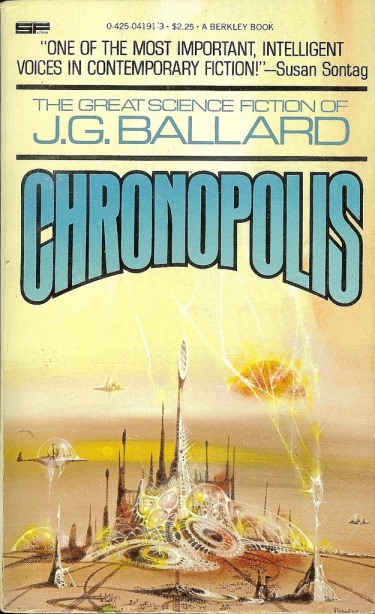
chronopolis

3. “Chronopolis” (1960)

“Chronopolis” offers an interesting central shtick: Clocks and other means of measuring and standardizing time have been banned. But this isn’t what makes the story stick. No, Ballard apparently tips his hand early, revealing why measuring time has been banned—it allows management to control labor:

‘Isn’t it obvious? You can time him, know exactly how long it takes him to do something.’ ‘Well?’ ‘Then you can make him do it faster.’

But our intrepid young protagonist (Conrad, his loaded name is), hardly satisfied with this answer, sneaks off to the city of the past, the titular chronopolis, where he works to restore the timepieces of the past. “Chronopolis” depicts a technologically-regressive world that Ballard will  explore in greater depth with his novel The Drowned World, but the details here are precise and fascinating (if perhaps ultimately unconvincing if we try to apply them as any kind of diagnosis for our own metered age). Ending on a perfect paranoid note, Ballard borrows just a dab of Poe here, synthesizing his influence into something far more original, far more Ballardian. Let’s include it in something I’m calling The Essential Short Stories of J.G. Ballard.

4.  “The Voices of Time” (1960)

“The Voices of Time” is easily the best of the early stories in the collection. Ballard allows himself to dispense almost entirely with plot, or at least the kind of plot he’s been thus-far constrained by. Instead of the neat concision of his nineteenth century forebears (Chekhov and Poe), Ballard moves to something far more Ballardian (excuse the repetition), opening his text to a range of images and phrases that will repeat throughout his career—the word terminal, drained vessels, cryptic designs and sequences, a kind of psychic detritus the reader is left to account for and monitor. The loose threads in “The Voices of Time” are too many to enumerate. There’s a mutant armadillo and a girl named Coma. Mass narcolepsy and cacti that absorb gold from the earth as a shield against radiation. And sleep. And de-evolution:

…thirty years ago people did indeed sleep eight hours, and a century before that they slept six or seven. In Vasari’s Lives one reads of Michelangelo sleeping for only four or five hours, painting all day at the age of eighty and then working through the night over his anatomy table with a candle strapped to his forehead. Now he’s regarded as a prodigy, but it was unremarkable then. How do you think the ancients, from Plato to Shakespeare, Aristotle to Aquinas, were able to cram so much work into their lives? Simply because they had an extra six or seven hours every day. Of course, a second disadvantage under which we labour is a lowered basal metabolic rate – another factor no one will explain. …

… It’s time to re–tool. Just as an individual organism’s life span is finite, or the life of a yeast colony or a given species, so the life of an entire biological kingdom is of fixed duration. It’s always been assumed that the evolutionary slope reaches forever upwards, but in fact the peak has already been reached, and the pathway now leads downward to the common biological grave. It’s a despairing and at present unacceptable vision of the future, but it’s the only one. Five thousand centuries from now our descendants, instead of being multi–brained star–men, will probably be naked prognathous idiots with hair on their foreheads, grunting their way through the remains of this Clinic like Neolithic men caught in a macabre inversion of time. Believe me, I pity them, as I pity myself. My total failure, my absolute lack of any moral or biological right to existence, is implicit in every cell of my body…

I harped on Ballard’s lack of characterization earlier, and “The Voices of Time” makes no strong case for its author’s ability to create deep, full characters. What Ballard does very very well though is harness, express, and communicate the intellect of his smart, smart characters—something many if not most other writers (contemporary or otherwise) can’t do, despite any technical prowess they may possess. “The Voices of Time” doesn’t just tell you that its heroes and antiheroes are brilliant (and/or mad)—it shows you.

Marvelous stuff. Include it in The Essential Short Stories of J.G. Ballard

5. “The Last World of Mr. Goddard” (1960)

More Twilight Zone stuff. God-dard. Lilliput, sort of. Doll’s house. Etc. A one-note exercise that I doubt is worth your time. Skip it.

6. On the horizon:

Ballard anticipates how hollow and stale contemporary writing will become in “Studio Five, The Stars.”

Alfonso Cuarón Picks DVDs from the Criterion Collection Closet

Levitation — Egon Schiele

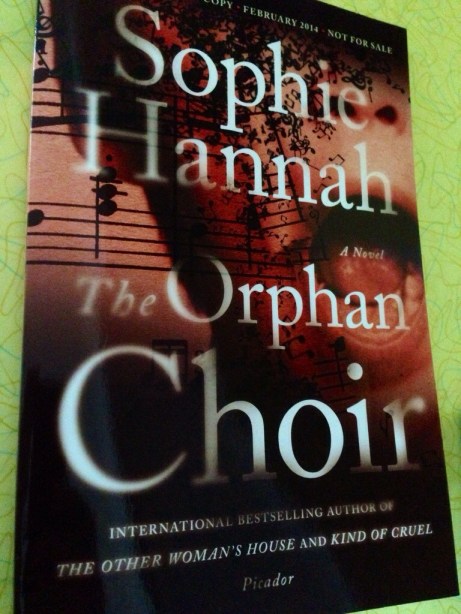
The Orphan Choir (Book Acquired, 9.17.2013)

20130924-200511.jpg

Sophie Hannah’s The Orphan Choir gets a U.S. release from Picador next year, so I grabbed the Australian blurb (Picador’s site doesn’t even list the book yet):

Louise is bereft. Her seven-year-old son Joseph has been sent away to boarding school against her wishes, and she misses him desperately. And the neighbour from hell is keeping her awake at night by playing loud, intrusive music. So when the chance comes to move to the country, she jumps at it as a way of saving her sanity. Only it doesn’t. Because the music seems to have followed her. Except this time it’s choral music, sung by a choir of children that only she can see and hear…

Never read Sophie Hannah but I’ve seen many of the spines of her books at the used bookstore I go to when I’m looking for Barry Hannah books.


“A Lesson for This Sunday” — Derek Walcott

“A Lesson for This Sunday” by Derek Walcott

The growing idleness of summer grass
With its frail kites of furious butterflies
Requests the lemonade of simple praise
In scansion gentler than my hammock swings
And rituals no more upsetting than a
Black maid shaking linen as she sings
The plain notes of some Protestant hosanna—
Since I lie idling from the thought in things—

Or so they should, until I hear the cries
Of two small children hunting yellow wings,
Who break my Sabbath with the thought of sin.
Brother and sister, with a common pin,
Frowning like serious lepidopterists.
The little surgeon pierces the thin eyes.
Crouched on plump haunches, as a mantis prays
She shrieks to eviscerate its abdomen.
The lesson is the same. The maid removes
Both prodigies from their interest in science.
The girl, in lemon frock, begins to scream
As the maimed, teetering thing attempts its flight.
She is herself a thing of summery light,
Frail as a flower in this blue August air,
Not marked for some late grief that cannot speak.

The mind swings inward on itself in fear
Swayed towards nausea from each normal sign.
Heredity of cruelty everywhere,
And everywhere the frocks of summer torn,
The long look back to see where choice is born,
As summer grass sways to the scythe’s design.

John Brown Reading His Bible — Horace Pippin

Writer’s block (Calvin & Hobbes)

writersblock

To Have the Apprentice in the Sun — Marcel Duchamp

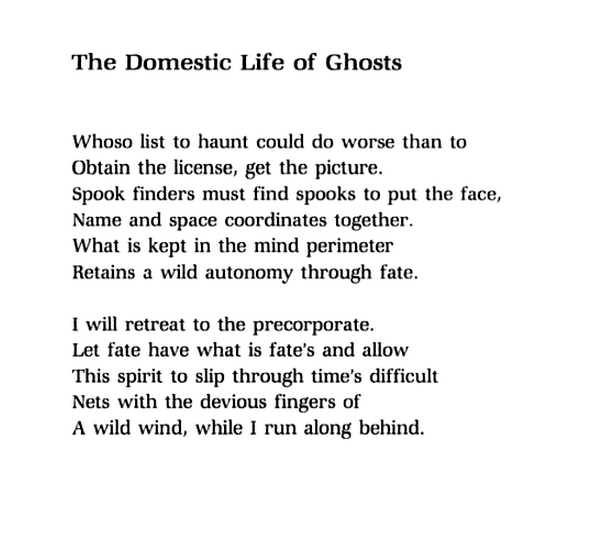
“The Domestic Life of Ghosts” — Tom Clark

tc

October (The Pumpkins) — Carl Larsson

Ten Notes from Nathaniel Hawthorne’s Note-Books

  1. Anciently, when long-buried bodies were found undecayed in the grave, a species of sanctity was attributed to them.
  2. Some chimneys of ancient halls used to be swept by having a culverin fired up them.
  3. At Leith, in 1711, a glass bottle was blown of the capacity of two English bushels.
  4. The buff and blue of the Union were adopted by Fox and the Whig party in England. The Prince of Wales wore them.
  5. In 1621, a Mr. Copinger left a certain charity, an almhouse, of which four poor persons were to partake, after the death of his eldest son and his wife. It was a tenement and yard. The parson, headboroughs, and his five other sons were to appoint the persons. At the time specified, however, all but one of his sons were dead; and he was in such poor circumstances that he obtained the benefit of the charity for himself, as one of the four.
  6. A town clerk arranges the publishments that are given in, according to his own judgment.
  7. To make a story from Robert Raikes seeing dirty children at play, in the streets of London, and inquiring of a woman about them. She tells him that on Sundays, when they were not employed, they were a great deal worse, making the streets like hell; playing at church, etc. He was therefore induced to employ women at a shilling to teach them on Sundays, and thus Sunday-schools were established.
  8. To represent the different departments of the United States government by village functionaries. The War Department by watchmen, the law by constables, the merchants by a variety store, etc.
  9. At the accession of Bloody Mary, a man, coming into a house, sounded three times with his mouth, as with a trumpet, and then made proclamation to the family. A bonfire was built, and little children were made to carry wood to it, that they might remember the circumstance in old age. Meat and drink were provided at the bonfires.
  10. To describe a boyish combat with snowballs, and the victorious leader to have a statue of snow erected to him. A satire on ambition and fame to be made out of this idea. It might be a child’s story.

Notations from Nathaniel Hawthorne’s American Note-Books


Reading Woman — Rik Wouters

Trompe l’oeil with Studio Wall and Vanitas Still Life — Cornelis Norbertus Gysbrechts

“Lead us into temptation, and deliver us from no evil” (Thomas Bernhard)

“I used to take sleeping pills,” he said, “and slowly boosted the number of pills I took. In the end, they had absolutely no effect on me, and I could have gulped any number of them, and still not have got to sleep. I repeatedly took such high dosages, I should have died. But I only ever vomited them up. Then I would be unable for days to pursue the least thought, and it was precisely this inability to think that got me through long periods of complete horror … You have to be careful you don’t end up living for longer than your natural lifespan,” he said. “Life is a court case which you lose, whoever you are, and whatever you do. That was decided before any human being was even born. The first man fared no differently from us. Rebellion against this only leads to deeper despair,” he said. “And no more distraction. From the age of thirteen, no more distraction. After the first sexual experience, no distraction. Do you understand?” The only variety was thunderstorms, “and lightning the only poetry.” He said: “Seeing as you’re locked up, locked up in solitary confinement, you’re increasingly thrown back upon yourself.” The questions one asked oneself slowly became one’s death. “But you know, we’re all dead anyway from the outset.” There were simply “no more forms of assistance.” One lay on the floor of one’s cell, along with the shattered limbs of past millennia. “Deceits and subterfuges,” he said. Just as the handling of facts injected insignificance into the brain, whatever question one asked oneself. “Every question is a defeat.” Every question wrought devastation. Disinclination. With questions, the time passed, and the questions passed in time, “so meaningless that everything is just ruins … There, you see,” said the painter, “it’s quite black down there. Last night, I dreamed the workers climbed up the mountain, and flooded the village and the inn and everything. In their thousands and tens of thousands, they swarmed up here, and whatever didn’t belong to them, they trampled underfoot, or it was suffocated in their blackness. How calm it is now! Listen!” The butcher greeted us, and we greeted him back. The houses of Weng seemed jumbled together, as though crushed at the foot of the cliff. “Earlier,” said the painter, “I used to have no pity for human frailty. Any pain seemed to me unnatural! Suddenly I saw myself confronted with an abundance of frailty.” He said: “Will you be playing cards tonight? The knacker is a good cardplayer. The engineer as well. They’re all of them good cardplayers. I don’t know why I’ve always had such an aversion to cardplayers.” He muttered something about cretinism in the mountain valleys, in the high Alps. And then: “Our Father, who art in Hell, unhallowed be Thy name. No Kingdom come. Thy will not be done. On earth, as it is in Hell. Deny us this day our daily bread. And forgive us no trespasses. As we forgive none of those that trespass against us. Lead us into temptation, and deliver us from no evil. Amen. That one works just as well,” he said.

From Thomas Bernhard’s novel Frost.


Biblioklept’s Dictionary of Literary Terms

ALLEGORY

Didactic extended metaphor, best enjoyed amorally.

BIOGRAPHY

The sordid and lurid details of an author’s life; use as a critical rubric if the author’s work seems beyond comprehension.

CATACHRESIS

Mixed or imprecise metaphor. When an author stretches her words like taffy across the loom of meaning.

DEATH OF THE NOVEL

Declare the novel dead every few weeks. Resuscitate as necessary.

EPIC

Originally used to denote lengthy narrative works concerning serious subjects, this term may now be applied freely to modify failure, coffee, tacos, kittens, etc.

FANTASY

An inventive and imaginative style of fiction eschewed and denigrated by serious readers and writers.

GNOMIC POETRY

Poetry composed in the secret language of garden gnomes, inaudible to mortal ears.

HUBRIS

Defining common characteristic of all politicians.

IRONY

Dominant mode of much of 21st century communication (including, lamentably, this list).

JOYCEAN

Hyperbole used to describe lengthy works of contemporary authors. Use to disappoint potential readers.

KENNING

Circumlocution of meaning. E.g. “feed the eagle” for “kill,” “battle-sweat” for “blood,” “tube of garbage” for “internet.”

LEONINE VERSE

Poetry about lions.

MORAL

Each reader’s personal misunderstanding of the meaning of a work of literature.

NONFICTION

What your father reads.

OPEN LETTER

A solipsistic bid for attention delivered under the pretense of reaching out to another entity.

PASTORAL

Use to describe any work of literature set outside of a city.

QUATRAIN

A stanza

or poem

composed of

four lines.

RED HERRING

A false clue employed by an author to distract the reader. A novel where all points of evidence are red herrings (preferable) is a shaggy dog story.

STRUCTURALISM

Grab bag of theories you learned in college.

TRILOGY

Elevate any degraded work of pop culture by repeating it twice. Reboot as necessary.

UNRELIABLE NARRATOR

This narrator cannot be depended upon to pick you up from the airport, water your plants while you’re away, meet you on time for a beer or coffee, return small loans, etc.

VICTORIANISM

Indicative of literature of the prudish, uptight Victorian Era. Famous Victorian works include Venus in FursThe Pearl, and The Lustful Turk.

WITTGENSTEIN

Twentieth-century philosopher. Quote the first and last lines of his book Tractatus Logico-Philosophicus frequently (don’t worry about reading anything in between).

XENOPHOBIA

Fear of warrior princesses.

YELP

The pinnacle of contemporary criticism.

ZEUGMA

The list ended with zeugma and disappointment.

(Previous entries here and here).