The Fabulous World of Jules Verne — Karel Zeman (Full Film)

Batrachomyomachia, The Battle of Frogs and Mice

Theodor Severin Kittelsen

Over the next few weeks, I will be tweeting Hugh G. Evelyn-White’s 1914 translation of Batrachomyomachia, of The Battle of Frogs and Mice, a comic epic sometimes attributed to Homer. If the idea of reading a fairly short text over a few weeks seems insanely stupid to you but you want to read this parody, read it here.

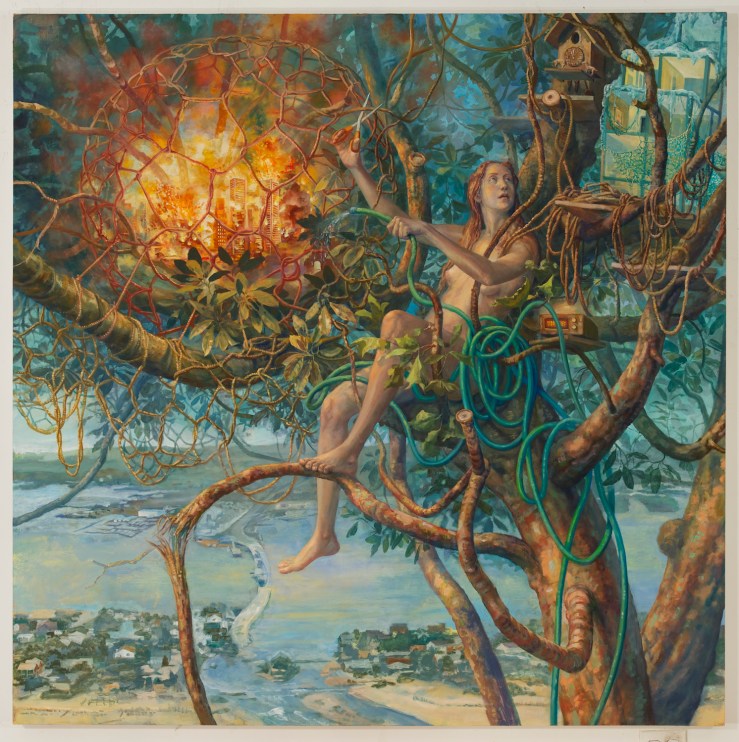
Self-Portrait as Catastrophic Failure — Julie Heffernan

Girl in Tree with Exploding City_2013_68x68

“everything has crumbled…everything has dissolved…” (Thomas Bernhard)

Before he retired to his room, “not to sleep, but to howl to myself in the silence of horror,” he said: “How everything has crumbled, how everything has dissolved, how all the reference points have shifted, how all fixity has moved, how nothing exists anymore, how nothing exists, you see, how all the religions and all the irreligions and the protracted absurdities of all forms of worship have turned into nothing, nothing at all, you see, how belief and unbelief no longer exist, how science, modern science, how the stumbling blocks, the millennial courts, have all been thrown out and ushered out and blown out into the air, how all of it is now just so much air … Listen, it’s all air, all concepts are air, all points of reference are air, everything is just air …” And he said: “Frozen air, everything just so much frozen air …”

From Thomas Bernhard’s novel Frost.


Venus and Cupid — Lorenzo Lotto

Oshidori — Lacfadio Hearn

THERE WAS A FALCONER AND HUNTER, named Sonjô, who lived in the district called Tamura-no-Gô, of the province of Mutsu. One day he went out hunting, and could not find any game. But on his way home, at a place called Akanuma, he perceived a pair of oshidori (mandarin-ducks), swimming together in a river that he was about to cross. To kill oshidori is not good; but Sonjô happened to be very hungry, and he shot at the pair. His arrow pierced the male: the female escaped into the rushes of the farther shore, and disappeared. Sonjô took the dead bird home, and cooked it.

That night he dreamed a dreary dream. It seemed to him that a beautiful woman came into his room, and stood by his pillow, and began to weep. So bitterly did she weep that Sonjô felt as if his heart were being torn out while he listened. And the woman cried to him: “Why–oh! why did you kill him?–of what wrong was he guilty?. . . At Akanuma we were so happy together–and you killed him! What harm did he ever do you? Do you even know what you have done?–oh! do you know what a cruel, what a wicked thing you have done?. . . Me too you have killed–for I will not live without my husband! . . . Only to tell you this I came”. . . . Then again she wept aloud–so bitterly that the voice of her crying pierced into the marrow of the listener’s bones;–and she sobbed out the words of this poem:

Hi kururéba
Sasoëshi mono wo–
Akanuma no
Makomo no kuré no
Hitori-né zo uki!

At the coming of twilight I invited him to return with me–! Now to sleep alone in the shadow of the rushes of Akanuma– ah! what misery unspeakable!

And after having uttered these verses she exclaimed: “Ah, you do not know–you cannot know what you have done! But to-morrow, when you go to Akanuma, you will see–you will see. . . .” So saying, and weeping very piteously, she went away.

When Sonjô awoke in the morning, this dream remained so vivid in his mind that he was greatly troubled. He remembered the words: “But to-morrow, when you go to Akanuma, you will see–you will see.” And he resolved to go there at once, that he might learn whether his dream was anything more than dream.

So he went to Akanuma; and there, when he came to the river bank, he saw the female oshidori swimming alone. In the same moment the bird perceived Sonjô; but, instead of trying to escape, she swam straight toward him, looking at him the while in a strange fixed way. Then, with her beak, she suddenly tore open her own body, and died before the hunter’s eyes. . . .

Sonjô shaved his head, and became a priest.

October — James Tissot

Riff on Thomas Bernhard’s Old Masters

Out of the four or five Bernhard works I’ve read, Old Masters is so far the least enjoyable, at least in terms of “heart.” Concrete and The Loser were both concerned with acceptance of one’s limits, his/her incapacity to be great in the face of their insistence on trying to get there. Here, it is mainly the folly of aesthetic representation, and how achievement and authority in an “old master” is false and arbitrary and patronizing. It seems like it is the most obvious excuse for Bernhard to rage against the art world, and of art making in general. On a formal level, though, it might be the clearest example of what Bernhard repeatedly performs: it is a “staged fiction,” insofar that techniques of theater are implemented through the mode of the “novel.” Bernhard, as always, beautifully writes paradox, ambivalence, and futility in this seamless meshing of form and content. This is the structural dipole–its largest–that is mirrored within the text on levels of theme, syntax, and joke.

Continue reading “Riff on Thomas Bernhard’s Old Masters”

First Novel (Glen Baxter)

first novel

A Pair of Shoes — Vincent van Gogh

The Complete Short Stories of J.G. Ballard (First Riff: Introductions + Stories 1956-1959)

jgb_complete_ss400

IN THIS RIFF:

Introductions

Stories published between 1956 and 1959:

“Prima Belladonna”

“Escapement”

“The Concentration City”

“Venus Smiles”

“Manhole 69”

“Track 12”

“The Waiting Grounds”

“Now: Zero”

1. Introduction

I first read J.G. Ballard in high school. I found his work, somehow, after reading Burgess, Burroughs, and Vonnegut. I devoured many of his novels over the next few years, as well as several short story collections. One of these, The Best Short Stories of J.G. Ballard was particularly important to me. That collection—which I loaned to a friend who thought enough of it to never give it back—offers a concise overview of Ballard’s development as a writer, from the pulp sci-fi of his earliest days (“Chronopolis”) to his later evocations of ecological disaster and dystopia (“Billenium,” “The Terminal Beach”) to his more experimental work from The Atrocity Exhibition, stories that pointed toward one of his most famous books, Crash.

I hadn’t returned to Ballard since reading Super-Cannes when it came out a decade ago; at the time I recall being disappointed in the novel and filing it away with William Gibson’s recent efforts, which I found dull.

I’d been reading Donald Barthelme’s wonderful and strange short stories, and, rereading “Glass Mountain,” a story composed in a list, I remembered Ballard’s brilliant story “Answers to a Questionnaire” (from 1990’s War Fever). I tracked the story down in The Complete Short Stories of J.G. Ballard, read it, read a few more at random, and then decided to start at the beginning.

I’ll be reading and riffing on all 98 stories in the collection over the next few months—giving myself breaks for other stuff, of course (although Ballard’s stuff, especially the early stuff is really easy to read).

2. Another introduction

Martin Amis writes the introduction to the 2009 edition and of course manages to bring up his father Kingsley almost immediately. He talks about the times he (Martin) got to spend with Ballard. He points out that Ballard possessed “a revealingly weak ear for dialogue.” He suggests that Ballard could have been the love child of Saki and Jorge Luis Borges. He describes Ballard as “somehow uniquely unique.” He reminds me of why I usually skip introductions.

3. And Ballard’s introduction, from the 2001 first edition of the book

He situates his hero, his contemporary, and his forbear in the first paragraph:

Short stories are the loose change in the treasury of fiction, easily ignored beside the wealth of novels available, an over-valued currency that often turns out to be counterfeit. At its best, in Borges, Ray Bradbury and Edgar Allan Poe, the short story is coined from precious metal, a glint of gold that will glow for ever in the deep purse of your imagination.

He also tells us,

Curiously, there are many perfect short stories, but no perfect novels.

I agree, except for the adverb there.

Did Ballard’s sensibilities gel with the sci-fi fans who read the pulp mags his early stories were published in?

I was interested in the real future that I could see approaching, and less in the invented future that science fiction preferred.

In the final lines of his introduction he describes his oeuvre and addresses criticisms that there’s so much damn analog tech in his stuff:

Vermilion Sands isn’t set in the future at all, but in a kind of visionary present – a description that fits the stories in this book and almost everything else I have written. But oh for a steam-powered computer and a wind-driven television set. Now, there’s an idea for a short story.

Vermilion Sands, the strange resort town where Ballard set over a half-dozen of his tales, is the setting of the first and fourth tales in the collection.

4. “Prima Belladonna” (1956) / “Venus Smiles” (1957)

Ballard already had a distinct setting in mind to play out his future-nowisms. That early stories “Prima Belladonna” and “Venus Smiles” are both in set in Vermilion Sands is maybe the most interesting thing about them. “Prima Belladonna” is never better than its first line:

I first met Jane Ciracylides during the Recess, that world slump of boredom, lethargy and high summer which carried us all so blissfully through ten unforgettable years, and I suppose that may have had a lot to do with what went on between us.

Ballard has the good sense to leave that cryptic reference to “the Recess” unexplained, or at least underexplained throughout the story—exposition is usually the worst aspect of pulp sci-fi. Still, the story is hardly one of his best. I’m guessing Roger Corman must have read it though, as his film Little Shop of Horrors (1960) seems to owe it a certain debt.

vermilion_sands

“Venus Smiles” is also set in Vermilion Sands, and it also takes music—sound—as its major motif (several of Ballard’s early stories do). Ballard strives to do too much in the story—he wants to criticize public attitudes about art, sculpture, music, etc., and also name drop John Cage to bolster his avant garde bona fides. Both stories drag, weighed down by Ballard’s clunky similes and bad dialogue (dear lord I’m agreeing with Amis here!). What’s most frustrating is knowing that Ballard is just a decade away from finding a rhetorical style to match the content of his ideas.

5. “Escapement” (1956)

The story of a man who realizes he is stuck in a time loop, repeating the same actions, “Escapement” is particularly frustrating. The stakes are incredibly low—the domestic scene of a married couple watching TV on a couch begs for darker treatment—and the reader figures out what’s going on way before the narrator. Time is clearly a major motif for Ballard, but his earliest published treatment of it is not especially inspiring. (I realize writing this what an ass I sound like: look, I know this is early work, pulp fiction—my frustration is that I want it to be better—or at least more abbreviated.

6. “The Concentration City” (1957)

“The Concentration City” finally sees Ballard in stronger territory, here exploring one of his favorite dystopic tropes—overpopulation—via one of his favorite conceits—the intrepid and intellectually curious young man. “The Concentration City” also showcases some early experimental touches in its opening paragraphs:

Noon talk on Millionth Street:

‘Sorry, these are the West Millions. You want 9775335th East.’

‘Dollar five a cubic foot? Sell!’

‘Take a westbound express to 495th Avenue, cross over to a Redline elevator and go up a thousand levels to Plaza Terminal. Carry on south from there and you’ll find it between 568th Avenue and 422nd Street.’

‘There’s a cave–in down at KEN County! Fifty blocks by twenty by thirty levels.’

‘Listen to this – “PYROMANIACS STAGE MASS BREAKOUT! FIRE POLICE CORDON BAY COUNTY!”

‘It’s a beautiful counter. Detects up to .005 per cent monoxide. Cost me three hundred dollars.’

‘Have you seen those new intercity sleepers? They take only ten minutes to go up 3,000 levels!’

‘Ninety cents a foot? Buy!’

The story follows up on these early notes, using the initially-estranging material to tell the story of a seemingly-infinite city; our young hero of course wants to bust out. Ballard also gives us an early prototype of what will be one of his major conventions: the green-zone/danger-zone split:

‘City Authority are starting to seal it off,’ the man told him. ‘Huge blocks. It’s the only thing they can do. What happens to the people inside I hate to think.’ He chewed on a sandwich. ‘Strange, but there are a lot of these black areas. You don’t hear about them, but they’re growing. Starts in a back street in some ordinary dollar neighbourhood; a bottleneck in the sewage disposal system, not enough ash cans, and before you know it a million cubic miles have gone back to jungle. They try a relief scheme, pump in a little cyanide, and then – brick it up. Once they do that they’re closed for good.’

No exit!

7. “Manhole 69” (1957)

Despite its unfortunate name, “Manhole 69” is perfect early Ballard. The story follows three men in an experimental group who have undergone a surgery that eliminates their ability to sleep. The story is precise and concise; Ballard seems comfortable here (“comfortable” is not a very Ballardian word, but hey…)—he sets up his experiment and then lets his principals carry it out. The story’s heavy Jungian vibe resurfaces a few years later in Ballard’s early novel The Drowned World

“Manhole 69” is the first of the 98 stories here I’d put in a collection I’ll tentatively call The Essential Short Stories of J.G. Ballard

8. “Track 12” (1958)

While “Track 12” is hardly perfect, its concision and focus do it many favors. Again, we find Ballard playing with sound—particularly something called “microsonics”:

Amplified 100,000 times animal cell division sounds like a lot of girders and steel sheets being ripped apart – how did you put it? – a car smash in slow motion. On the other hand, plant cell division is an electronic poem, all soft chords and bubbling tones. Now there you have a perfect illustration of how microsonics can reveal the distinction between the animal and plant kingdoms.

As is often the case, Ballard has an idea that fascinates him (“microsonics,” here) and simply constructs a story to deliver that idea. Or, rather, rips off a story—and Ballard has the good sense to steal from the best. “Track 12” is a fairly straightforward Edgar Allan Poe ripoff, a revenge tale recalling “The Cask of Amontillado,” and if the reader seems to guess where everything is going before the victim, well, it works here.

9. “The Waiting Grounds” (1959)

Ballard is better at inner space than outer space. “The Waiting Grounds” seems like a bait and switch, or at least I imagine many meat and potatoes SF fans might have felt that way. Ballard has his hero head to some distant planet, only to spend most of that trip in his own mind. And oh what a trip! The story’s central set piece anticipates the final scenes of Kubrick’s 2001: A Space Odyssey as Ballard sends his hero through “deep time”:

Deep Time: 10,000,000,000 mega–years. The ideation–field has now swallowed the cosmos, substituted its own dynamic, its own spatial and temporal dimensions. All primary time and energy fields have been engulfed. Seeking the final extension of itself within its own bounds the mantle has reduced its time period to an almost infinitesimal 0.00000000… n of its previous interval. Time has virtually ceased to exist, the ideation–field is nearly stationary, infinitely slow eddies of sentience undulating outward across its mantles.

The frame Ballard builds to deliver his idea is clunky, but I suppose in those days one could make a sort of living writing stories for magazines, and maybe more words meant more moolah. Again, this story points to the Jungian themes that Ballard would explore in greater depth in The Drowned World.

10. “Now: Zero” (1959)

Here is the first paragraph of “Now: Zero,” the last story of Ballard’s to be published in the 1950s:

You ask: how did I discover this insane and fantastic power? Like Dr Faust, was it bestowed upon me by the Devil himself, in exchange for the deed to my soul? Did I, perhaps, acquire it with some strange talismanic object – idol’s eyepiece or monkey’s paw – unearthed in an ancient chest or bequeathed by a dying mariner? Or, again, did I stumble upon it myself while researching into the obscenities of the Eleusinian Mysteries and the Black Mass, suddenly perceiving its full horror and magnitude through clouds of sulphurous smoke and incense?

No doubt, dear reader, you immediately detect Edgar Allan Poe all over this piece, and you’re not wrong. The story is mostly interesting as a style exercise—namely, Ballard doing Poe—but its cheesiness and predictability drowns out any humor. But again, these are the complete short stories—not just the perfect exercises.

11. On the horizon:

The early 1960s! “Chronopolis”! “The Overloaded Man”! “Billenium”! You are encouraged to play along.

Fairy Tale Illustration — Heorhiy Narbut

Read Donald Barthelme’s Story “Me and Miss Mandible”

“Me and Miss Mandible” by Donald Barthelme

13 September

Miss Mandible wants to make love to me but she hesitates because I am officially a child; I am, according to the records, according to the gradebook on her desk, according to the card index in the principal’s office, eleven years old. There is a misconception here, one that I haven’t quite managed to get cleared up yet. I am in fact thirty-five, I’ve been in the Army, I am six feet one, I have hair in the appropriate places, my voice is a baritone, I know very well what to do with Miss Mandible if she ever makes up her mind.

In the meantime we are studying common fractions. I could, of course, answer all the questions, or at least most of them (there are things I don’t remember). But I prefer to sit in this too-small seat with the desktop cramping my thighs and examine the life around me. There are thirty-two in the class, which is launched every morning with the pledge of allegiance to the flag. My own allegiance, at the moment, is divided between Miss Mandible and Sue Ann Brownly, who sits across the aisle from me all day long and is, like Miss Mandible, a fool for love. Of the two I prefer, today, Sue Ann; although between eleven and eleven and a half (she refuses to reveal her exact age) she is clearly a woman, with a woman’s disguised aggression and a woman’s peculiar contradictions. Strangely neither she nor any of the other children seem to see any incongruity in my presence here.

15 September

Happily our geography text, which contains maps of all the principal land-masses of the world, is large enough to conceal my clandestine journal-keeping, accomplished in an ordinary black composition book. Every day I must wait until Geography to put down such thoughts as I may have had during the morning about my situation and my fellows. I have tried writing at other times and it does not work. Either the teacher is walking up and down the aisles (during this period, luckily, she sticks close to the map rack in the front of the room) or Bobby Vanderbilt, who sits behind me, is punching me in the kidneys and wanting to know what I am doing. Vanderbilt, I have found out from certain desultory conversations on the playground, is hung up on sports cars, a veteran consumer of Road & Track. This explains the continual roaring sounds which seem to emanate from his desk; he is reproducing a record album called Sounds of Sebring.

19 September

Only I, at times (only at times), understand that somehow a mistake has been made, that I am in a place where I don’t belong. It may be that Miss Mandible also knows this, at some level, but for reasons not fully understood by me she is going along with the game. When I was first assigned to this room I wanted to protest, the error seemed obvious, the stupidest principal could have seen it; but I have come to believe it was deliberate, that I have been betrayed again.

Now it seems to make little difference. This life-role is as interesting as my former life- role, which was that of a claims adjuster for the Great Northern Insurance Company, a position which compelled me to spend my time amid the debris of our civilization: rumpled fenders, roofless sheds, gutted ware houses, smashed arms and legs. After ten years of this one has a tendency to see the world as a vast junkyard, looking at a man and seeing only his (potentially) mangled parts, entering a house only to trace the path of the inevitable fire. Therefore when I was installed here, although I knew an error had been made, I countenanced it, I was shrewd; I was aware that there might well be some kind of advantage to be gained from what seemed a disaster. The role of The Adjuster teaches one much.  Continue reading “Read Donald Barthelme’s Story “Me and Miss Mandible””

Resting in Bed — James McNeill Whistler

Almond Tree in Blossom — Vincent van Gogh

David Bowie’s Top 100 Must Read Books

David Bowie’s Top 100 Must Read Books:

The Age of American Unreason, Susan Jacoby, 2008

The Brief Wondrous Life of Oscar Wao, Junot Díaz, 2007

The Coast of Utopia (trilogy), Tom Stoppard, 2007

Teenage: The Creation of Youth 1875-1945, Jon Savage, 2007

Fingersmith, Sarah Waters, 2002

The Trial of Henry Kissinger, Christopher Hitchens, 2001

Mr. Wilson’s Cabinet of Wonder, Lawrence Weschler, 1997

A People’s Tragedy: The Russian Revolution 1890-1924, Orlando Figes, 1997

The Insult, Rupert Thomson, 1996

Wonder Boys, Michael Chabon, 1995

The Bird Artist, Howard Norman, 1994

Kafka Was The Rage: A Greenwich Village Memoir, Anatole Broyard, 1993

Beyond the Brillo Box: The Visual Arts in Post-Historical Perspective, Arthur C. Danto, 1992

Sexual Personae: Art and Decadence from Nefertiti to Emily Dickinson, Camille Paglia, 1990

David Bomberg, Richard Cork, 1988

Sweet Soul Music: Rhythm and Blues and the Southern Dream of Freedom, Peter Guralnick, 1986

The Songlines, Bruce Chatwin, 1986

Hawksmoor, Peter Ackroyd, 1985

Nowhere To Run: The Story of Soul Music, Gerri Hirshey, 1984

Nights at the Circus, Angela Carter, 1984

Money, Martin Amis, 1984

White Noise, Don DeLillo, 1984

Flaubert’s Parrot, Julian Barnes, 1984

The Life and Times of Little Richard, Charles White, 1984

A People’s History of the United States, Howard Zinn, 1980

A Confederacy of Dunces, John Kennedy Toole, 1980

Interviews with Francis Bacon, David Sylvester, 1980

Darkness at Noon, Arthur Koestler, 1980

Earthly Powers, Anthony Burgess, 1980

Raw (a ‘graphix magazine’) 1980-91

Viz (magazine) 1979 –

The Gnostic Gospels, Elaine Pagels, 1979

Metropolitan Life, Fran Lebowitz, 1978

In Between the Sheets, Ian McEwan, 1978

Writers at Work: The Paris Review Interviews, ed. Malcolm Cowley, 1977

The Origin of Consciousness in the Breakdown of the Bicameral Mind, Julian Jaynes, 1976

Tales of Beatnik Glory, Ed Saunders, 1975

Mystery Train, Greil Marcus, 1975

Selected Poems, Frank O’Hara, 1974

Before the Deluge: A Portrait of Berlin in the 1920s, Otto Friedrich, 1972

In Bluebeard’s Castle: Some Notes Towards the Re-definition of Culture, George Steiner, 1971

Octobriana and the Russian Underground, Peter Sadecky, 1971

The Sound of the City: The Rise of Rock and Roll, Charlie Gillete, 1970

The Quest For Christa T, Christa Wolf, 1968

Awopbopaloobop Alopbamboom: The Golden Age of Rock, Nik Cohn, 1968

The Master and Margarita, Mikhail Bulgakov, 1967

Journey into the Whirlwind, Eugenia Ginzburg, 1967

Last Exit to Brooklyn, Hubert Selby Jr., 1966

In Cold Blood, Truman Capote, 1965

City of Night, John Rechy, 1965

Herzog, Saul Bellow, 1964

Puckoon, Spike Milligan, 1963

The American Way of Death, Jessica Mitford, 1963

The Sailor Who Fell From Grace With The Sea, Yukio Mishima, 1963

The Fire Next Time, James Baldwin, 1963

A Clockwork Orange, Anthony Burgess, 1962

Inside the Whale and Other Essays, George Orwell, 1962

The Prime of Miss Jean Brodie, Muriel Spark, 1961

Private Eye (magazine) 1961 –

On Having No Head: Zen and the Rediscovery of the Obvious, Douglas Harding, 1961

Silence: Lectures and Writing, John Cage, 1961

Strange People, Frank Edwards, 1961

The Divided Self, R. D. Laing, 1960

All The Emperor’s Horses, David Kidd, 1960

Billy Liar, Keith Waterhouse, 1959

The Leopard, Giuseppe Di Lampedusa, 1958

On The Road, Jack Kerouac, 1957

The Hidden Persuaders, Vance Packard, 1957

Room at the Top, John Braine, 1957

A Grave for a Dolphin, Alberto Denti di Pirajno, 1956

The Outsider, Colin Wilson, 1956

Lolita, Vladimir Nabokov, 1955

Nineteen Eighty-Four, George Orwell, 1949

The Street, Ann Petry, 1946

Black Boy, Richard Wright, 1945
(Via).