Portrait of the Artist’s Father — Rembrandt

Bloomsday

Portrait of James Joyce by Djuna Barnes

How to read Ulysses

Ulysses art by Roman Muradov

Selections from one-star Amazon reviews of Ulysses

joyce_ulysses-p2
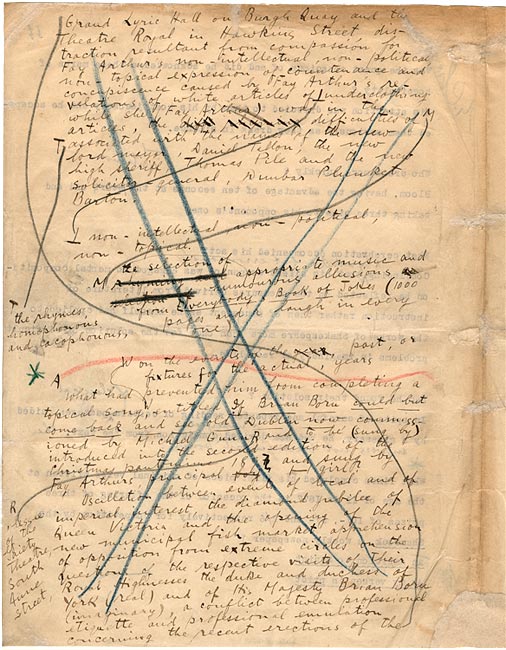
Ulysses manuscript page

A list of Irish heroes (from “The Cyclops” episode of Ulysses)

“Words,” a page from one of Joyce’s notebooks for Ulysses

Another page of Joyce’s notes, plus links to more

James Joyce talks dirty

Filming Finnegans

James Joyce’s eye glasses prescription

William Faulkner’s Joyce anxiety

Ezra Pound on James Joyce

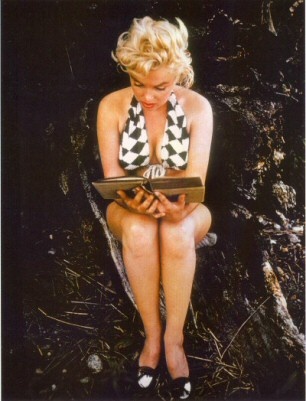
Marilyn Monroe reads Molly 

Biblioklept’s lousy review (the review is lousy, not the book) of Dubliners

Joyce’s entry on the 1901 Irish Census

Joyce’s caricature of Leopold Bloom

Biblioklept’s review (not so lousy, the review) of a superior full-cast audio recording of Ulysses

James Joyce explains why Odysseus is the most “complete man’ in literature

James Joyce’s passport

Leopold’s Bloom’s recipe for burnt kidney breakfast

“What in water did Bloom, waterlover, drawer of water, watercarrier, returning to the range, admire?”

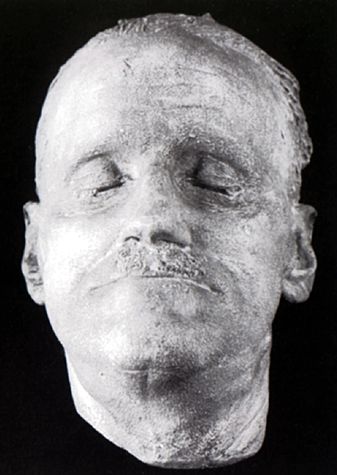
James Joyce’s death mask


Jerry (Nude Reclining with Ulysses) — Paul Cadmus

jerry cadmus

Harry Nilsson’s Unfinished Documentary, Did Somebody Drop His Mouse?

(About).

“Despair” — Leonardo da Vinci

Capture

Proserpina Turning Ascalaphus into an Owl — Antonio Tempesta

forvandlingskonst_gb0988_100

“All I Think About Is You” — Harry Nilsson

Best Feeling (Tony Millionaire)

Capture

Eight Ideas from Nathaniel Hawthorne’s Note-Books

  1. A man, perhaps with a persuasion that he shall make his fortune by some singular means, and with an eager longing so to do, while digging or boring for water, to strike upon a salt-spring.
  2. To have one event operate in several places,–as, for example, if a man’s head were to be cut off in one town, men’s heads to drop off in several towns.
  3. Follow out the fantasy of a man taking his life by instalments, instead of at one payment,–say ten years of life alternately with ten years of suspended animation.
  4. Sentiments in a foreign language, which merely convey the sentiment without retaining to the reader any graces of style or harmony of sound, have somewhat of the charm of thoughts in one’s own mind that have not yet been put into words. No possible words that we might adapt to them could realize the unshaped beauty that they appear to possess. This is the reason that translations are never satisfactory,–and less so, I should think, to one who cannot than to one who can pronounce the language.
  5. A person to be writing a tale, and to find that it shapes itself against his intentions; that the characters act otherwise than he thought; that unforeseen events occur; and a catastrophe comes which he strives in vain to avert. It might shadow forth his own fate,–he having made himself one of the personages.
  6. It is a singular thing, that, at the distance, say, of five feet, the work of the greatest dunce looks just as well as that of the greatest genius,–that little space being all the distance between genius and stupidity.
  7. Mrs. Sigourney says, after Coleridge, that “poetry has been its own exceeding great reward.” For the writing, perhaps; but would it be so for the reading?
  8. Four precepts: To break off customs; to shake off spirits ill-disposed; to meditate on youth; to do nothing against one’s genius.

—Notations from Nathaniel Hawthorne’s American Note-Books(See also: Ten ideas and then Twenty ideas from Nathaniel Hawthorne’s Note-Books).

Oscar Wilde at Work — Aubrey Beardsley

Meet the Feebles — Peter Jackson

Hold Still — Hayv Kahraman

Hayv-Kahraman_Hold-Still_2010_Oil-on-linen_106.6x172cm

(Artist’s site).

Five from Félix Fénéon

ff

Snoods, Gnomes, Loupes, Coffee (A Passage from Pynchon’s Novel Against the Day)

Electrical arcs stabbed through the violet dusk. Heated solutions groaned toward their boiling points. Bubbles rose helically through luminous green liquids. Miniature explosions occurred in distant corners of the facility, sending up showers of glass as nearby workers cowered beneath seaside umbrellas set up for just such protection. Gauge needles oscillated feverishly. Sensitive flames sang at different pitches. Amid a gleaming clutter of burners and spectroscopes, funnels and flasks, centrifugal and Soxhlet extractors, and distillation columns in both the Glynsky and Le BelHenninger formats, serious girls with their hair in snoods entered numbers into logbooks, and pale gnomes, patient as lockpickers, squinted through loupes, adjusting tremblers and timers with tiny screwdrivers and forceps. Best of all, somebody in here somewhere was making coffee.

Another passage from Thomas Pynchon’s great big book Against the Day.


The Hammock — Gustave Courbet

“Rapunzel” — Anne Sexton

“Rapunzel” by Anne Sexton

A woman
who loves a woman
is forever young.
The mentor
and the student
feed off each other.
Many a girl
had an old aunt
who locked her in the study
to keep the boys away.
They would play rummy
or lie on the couch
and touch and touch.
Old breast against young breast…


Let your dress fall down your shoulder,
come touch a copy of you
for I am at the mercy of rain,
for I have left the three Christs of Ypsilanti
for I have left the long naps of Ann Arbor
and the church spires have turned to stumps.
The sea bangs into my cloister
for the politicians are dying,
and dying so hold me, my young dear,
hold me…

Continue reading ““Rapunzel” — Anne Sexton”