The Chums of Chance vs The Legion of Gnomes (Citation from + Riff on Thomas Pynchon’s Against the Day)

At first the “noise” seemed no more than the ensemble of magnetoatmospheric disturbances which the boys had long grown used to, perhaps here intensified by the vastly resonant space into which they were moving ever deeper. But presently the emission began to coalesce into human timbres and rhythms—not speech so much as music, as if the twilit leagues passing below were linked by means of song.

Lindsay, who was Communications Officer, had his ear close to the Tesla device, squinting attentively, but at last withdrew, shaking his head. “Gibberish.”

“They are calling for help,” ~delared Miles, “clear as day and quite desperately, too. They claim to be under attack by a horde of hostile gnomes, and have set out red signal lamps, arranged in concentric circles.”

“There they are!” called Chick Counterfly, pointing over the starboard quarter.

“Then there is nothing to discuss,” declared Randolph St. Cosmo. “We must put down and render aid.”

They descended over a battlefield swarming with diminutive combatants wearing pointed hats and carrying what proved to be electric crossbows, from which they periodically discharged bolts of intense greenish light, intermittently revealing the scene with a morbidity like that of a guttering star.

“We cannot attack these fellows,” protested Lindsay, “for they are shorter than we, and the Rules of Engagement clearly state—”

“In an emergency, that choice lies at the Commander’s discretion,” replied Randolph.

They were soaring now close above the metallic turrets and parapets of a sort of castle, where burned the crimson lights of distress. Figures could be discerned below gazing up at the Inconvenience. Peering at them through a nightglass, Miles stood at the conning station, transfixed by the sight of a woman poised upon a high balcony. “My word, she’s lovely!” he exclaimed at last.

Their fateful decision to land would immediately embroil them in the byzantine politics of the region, and eventually they would find themselves creeping perilously close to outright violation of the Directives relating to Noninterference and Height Discrepancy, which might easily have brought an official hearing, and perhaps even disfellowshipment from the National Organization. For a detailed account of their subsequent narrow escapes from the increasingly deranged attentions of the Legion of Gnomes, the unconscionable connivings of a certain international mining cartel, the sensual wickedness pervading the royal court of Chthonica, Princess of Plutonia, and the all-but-irresistible fascination that subterranean monarch would come to exert, Circelike, upon the minds of the crew of Inconvenience (Miles, as we have seen, in particular), readers are referred to The Chums of Chance in the Bowels of the Earth—for some reason one of the less appealing of this series, letters having come in from as far away as Tunbridge Wells, England, expressing displeasure, often quite intense, with my harmless little intraterrestrial scherzo.

After their precipitate escape from the ill-disposed hordes of thickset indigenous, over another night and day, as time is reckoned on the surface, the Chums swept through the interior of the Earth and at last out her Northern portal, which they beheld as a tiny circle of brightness far ahead. As before, all remarked the diminished size of the planetary exit. It was a tricky bit of steering, as they emerged, to locate the exact spot, on the swiftly dilating luminous circumference, where they might with least expenditure of time find themselves in the vicinity of the schooner Etienne-Louis Malus, carrying the Vormance Expedition toward a fate few of its members would willingly have chosen.

1.The above citation comprises the final paragraphs of The Light Over the Ranges, the first book in Thomas Pynchon’s massive, byzantine novel Against the Day, which is perhaps too massive and too byzantine for me to approach in any way other way than the occasional riff and citation as I read it.

2. The Light Over the Ranges both begins and ends by focusing on The Chums of Chance, an intrepid band of adventurers who sail their skyship Inconvenience into every manner of trouble. The passage above—which, hey, don’t worry, there are no real spoilers there—-the passage above showcases a jocular, jaunty voice that Pynchon employs frequently throughout the book, a voice appropriate to pulp fiction, to serialized “boy’s novels,” to speculative fiction narratives, etc. The voice is somehow simultaneously engaged and detached, urging its listener to care about the heroes in peril, but also acknowledging its own formal artificiality, the flatness of its characters, their position as placeholders or checkerboard pieces in Pynchon’s big project.

3. The voice that relates the Chums of Chance episodes is wonderfully didactic, its earnest, moral tone buoying the narrative into adventure (and fun!); at the same time, everything else in the novel—its violence, its class warfare, its analysis of exploitation—-ensures that this voice is to be read and interpreted with dark irony.

4. And yet the spirit of adventure, of fun—of imagination—inheres (and not just in the episodes with the Chums).

5. The Chums of Chance: Miles Blundell, Chick Counterfly, Lindsay Noseworth,  Darby Suckling, and commander Randolph St. Cosmo. The names are Pynchonian, tautologies be damned! (They also remind me of porn aliases). I am remiss: Let me include Pugnax, a dog of discerning literary taste, his ability to read just one of many seemingly-metaphysical powers Pynchon grants his characters in Against the Day.

6. My favorite paragraph in the above citation is the penultimate one, where we find our heroes “creeping perilously close to outright violation of the Directives relating to Noninterference and Height Discrepancy” by diving into a strange underworld adventure and battling The Legion of Gnomes. Pynchon (or Pynchon’s adventure-voice, if’n ya’ll permit me) offers us a too-brief peek at “the royal court of Chthonica, Princess of Plutonia, and the all-but-irresistible fascination that subterranean monarch would come to exert, Circelike, upon the minds of the crew of Inconvenience” and then refers us to The Chums of Chance in the Bowels of the Earth, a book we cannot read because it doesn’t exist.

7. But what am I saying? Of course The Chums of Chance in the Bowels of the Earth exists!—we just have to imagine it.

Untitled — Zdzisław Beksiński

“Was” by William Faulkner

“Was” by William Faulkner

Isaac McCaslin, ‘Uncle Ike’, past seventy and nearer eighty than he ever corroborated any more, a widower now and uncle to half a county and father to no one

this was not something participated in or even seen by himself, but by his elder cousin, McCaslin Edmonds, grandson of Isaac’s father’s sister and so descended by the distaff, yet notwithstanding the inheritor, and in his time the bequestor, of that which some had thought then and some still thought should have been Isaac’s, since his was the name in which the title to the land had first been granted from the Indian patent and which some of the descendants of his father’s slaves still bore in the land. But Isaac was not one of these:-a widower these twenty years, who in all his life had owned but one object more than he could wear and carry in his pockets and his hands at one time, and this was the narrow iron cot and the stained lean mattress which he used camping in the woods for deer and bear or for fishing or simply because he loved the woods; who owned no property and never desired te since the earth was no man’s but all men’s, as light and air and weather were; who lived still in the cheap frame bungalow in Jefferson which his wife’s father gave them on their marriage and which his wife had willed to him at her death and which he had pretended to accept, acquiesce to, to humor her, ease her going but which was not his, will or not, chancery dying wishes mortmain possession or whatever, himself merely holding it for his wife’s sister and her children who had lived in it with him since his wife’s death, holding himself welcome to live in one room of it as he had during his wife’s time or she during her time or the sister-in-law and her children during the rest of his and after not something he had participated in or even remembered except from the hearing, the listening, come to him through and from his cousin McCaslin born in 1850 and sixteen years his senior and hence, his own father being near seventy when Isaac, an only child, was born. rather his brother than cousin and rather his father than either, out of the old time, the old days.

When he and Uncle Buck ran back to the house from discovering that Tomey’s Turl had run again, they heard Uncle Buddy cursing and bellowing in the kitchen, then the fox and the dogs came out of the kitchen and crossed the hall into the dogs’ room and they heard them run through the dogs’ room into his and Uncle Buck’s room then they saw them cross the hall again into Uncle Buddy’s room and heard them run through Uncle Buddy’s room into the kitchen. Where Uncle Buddy was picking the breakfast up out of the ashes and wiping it off with his apron. “What in damn’s hell do you mean,” he said “turning that damn fox out with the dogs all loose in the house?”

“Damn the fox” Uncle Buck said. “Tomey’s Turl has broke out again. Give me and Cass some breakfast quick we might just barely catch him before he gets there.” Continue reading ““Was” by William Faulkner”

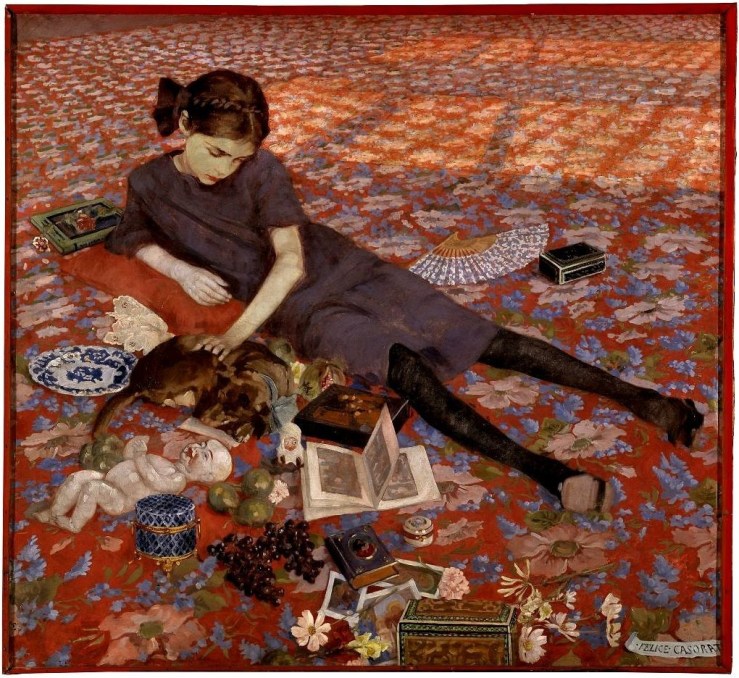
Girl On a Red Carpet — Felice Casorati

girl

Beach House, Live at the Interface in 2010

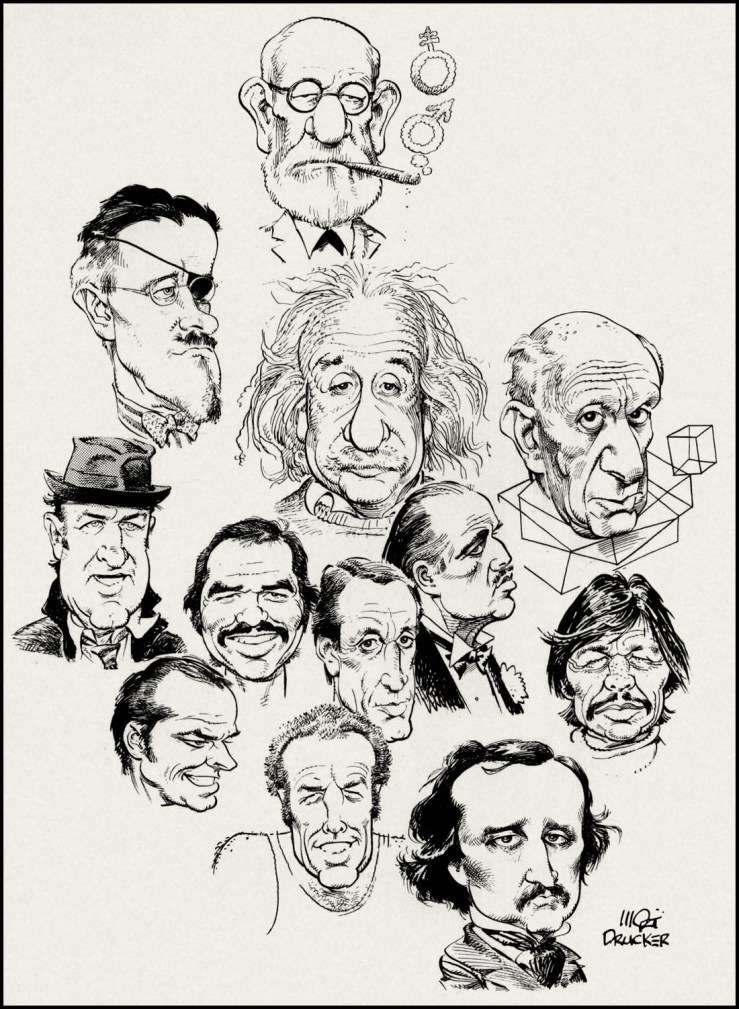
Mort Drucker Portraits of Freud, Joyce, Poe, Einstein, Charles Bronson, Etc.

mort drucker

Interrogation II — Leon Golub

golub

Recording the humiliation with a camera, with the perpetrators, a stupid grin on their faces, included in the picture, side by side with the twisted naked bodies of their prisoners, is an integral part of the process…The very positions and costumes of the prisoners suggest a theatrical staging, a kind of tableau vivant, which cannot but bring to mind the whole spectrum of American performance art and ‘theatre of cruelty’ the photos of Mapplethorpe, the weird scenes in David Lynch, to name but two” — Slavoj Žižek on Abu Ghraib (Violence)

A Ballad of the Captains — Harry Clarke

0068 The Year's At The Spring - Harry Clarke - A Ballad of the Captains 2

(Via/more).

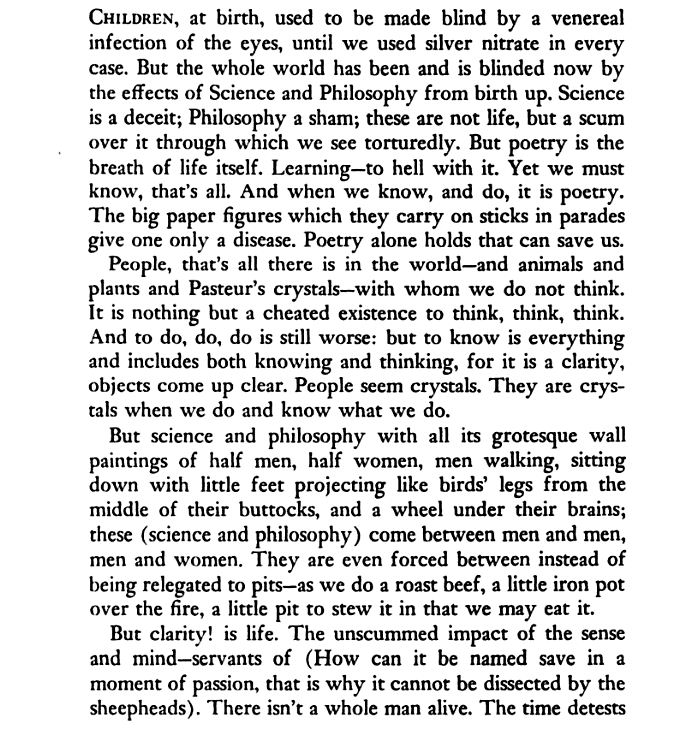
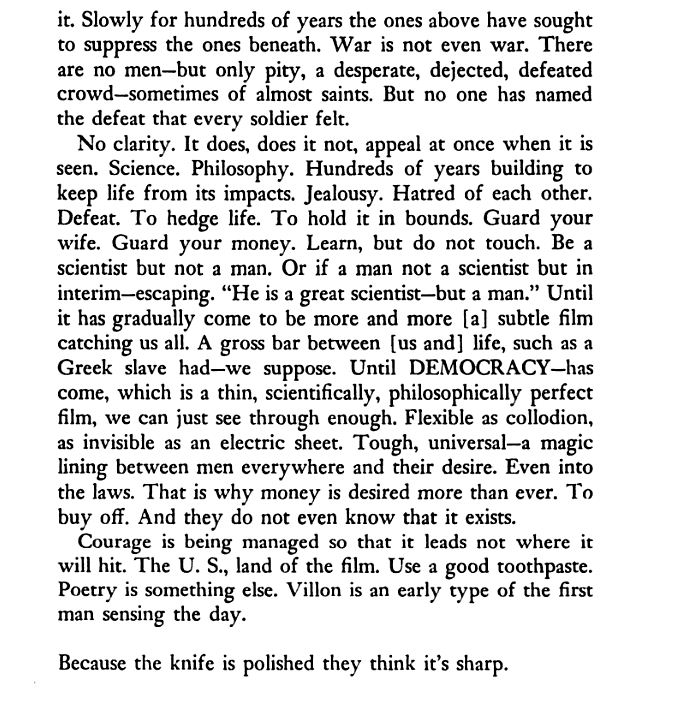
“Science and Philosophy” — William Carlos Williams

1

            2

“Science and Philosophy” by William Carlos Williams is collected in The Embodiment of Knowledge (New Directions).

Huxley vs. Orwell: The Webcomic

Stuart McMillen’s webcomic adapts (and updates) Postman’s famous book-length essay, Amusing Ourselves to Death, which argues that Aldous Huxley’s vision of the future in Brave New World was ultimately more accurate than the one proposed by George Orwell in 1984. (Via).

“The Bible as Poetry” — Walt Whitman

“The Bible as Poetry” by Walt Whitman

I suppose one cannot at this day say anything new, from a literary point of view, about those autochthonic bequests of Asia—the Hebrew Bible, the mighty Hindu epics, and a hundred lesser but typical works; (not now definitely including the Iliad—though that work was certainly of Asiatic genesis, as Homer himself was—considerations which seem curiously ignored.) But will there ever be a time or place—ever a student, however modern, of the grand art, to whom those compositions will not afford profounder lessons than all else of their kind in the garnerage of the past? Could there be any more opportune suggestion, to the current popular writer and reader of verse, what the office of poet was in primeval times—and is yet capable of being, anew, adjusted entirely to the modern?

All the poems of Orientalism, with the Old and New Testaments at the centre, tend to deep and wide, (I don’t know but the deepest and widest,) psychological development—with little, or nothing at all, of the mere esthetic, the principal verse-requirement of our day. Very late, but unerringly, comes to every capable student the perception that it is not in beauty, it is not in art, it is not even in science, that the profoundest laws of the case have their eternal sway and outcropping.

In his discourse on “Hebrew Poets” De Sola Mendes said: “The fundamental feature of Judaism, of the Hebrew nationality, was religion; its poetry was naturally religious. Its subjects, God and Providence, the covenants with Israel, God in Nature, and as reveal’d, God the Creator and Governor, Nature in her majesty and beauty, inspired hymns and odes to Nature’s God. And then the checker’d history of the nation furnish’d allusions, illustrations, and subjects for epic display—the glory of the sanctuary, the offerings, the splendid ritual, the Holy City, and lov’d Palestine with its pleasant valleys and wild tracts.” Dr. Mendes said “that rhyming was not a characteristic of Hebrew poetry at all. Metre was not a necessary mark of poetry. Great poets discarded it; the early Jewish poets knew it not.” Compared with the famed epics of Greece, and lesser ones since, the spinal supports of the Bible are simple and meagre. All its history, biography, narratives, &c., are as beads, strung on and indicating the eternal thread of the Deific purpose and power. Yet with only deepest faith for impetus, and such Deific purpose for palpable or impalpable theme, it often transcends the masterpieces of Hellas, and all masterpieces.

The metaphors daring beyond account, the lawless soul, extravagant by our standards, the glow of love and friendship, the fervent kiss—nothing in argument or logic, but unsurpass’d in proverbs, in religious ecstasy, in suggestions of common mortality and death, man’s great equalizers—the spirit everything, the ceremonies and forms of the churches nothing, faith limitless, its immense sensuousness immensely spiritual—an incredible, all-inclusive non-worldliness and dew-scented illiteracy (the antipodes of our Nineteenth Century business absorption and morbid refinement)—no hair-splitting doubts, no sickly sulking and sniffling, no “Hamlet,” no “Adonais,” no “Thanatopsis,” no “In Memoriam.”

The culminated proof of the poetry of a country is the quality of its personnel, which, in any race, can never be really superior without superior poems. The finest blending of individuality with universality (in my opinion nothing out of the galaxies of the “Iliad,” or Shakspere’s heroes, or from the Tennysonian “Idylls,” so lofty, devoted and starlike,) typified in the songs of those old Asiatic lands. Men and women as great columnar trees. Nowhere else the abnegation of self towering in such quaint sublimity; nowhere else the simplest human emotions conquering the gods of heaven, and fate itself. (The episode, for instance, toward the close of the “Mahabharata”—the journey of the wife Savitri with the god of death, Yama,

“One terrible to see—blood-red his garb,

His body huge and dark, bloodshot his eyes,

Which flamed like suns beneath his turban cloth,

Arm’d was he with a noose,”

who carries off the soul of the dead husband, the wife tenaciously following, and—by the resistless charm of perfect poetic recitation!—eventually redeeming her captive mate.)

I remember how enthusiastically William H. Seward, in his last days, once expatiated on these themes, from his travels in Turkey, Egypt, and Asia Minor, finding the oldest Biblical narratives exactly illustrated there to-day with apparently no break or change along three thousand years—the veil’d women, the costumes, the gravity and simplicity, all the manners just the same. The veteran Trelawney said he found the only real nobleman of the world in a good average specimen of the mid-aged or elderly Oriental. In the East the grand figure, always leading, is the old man, majestic, with flowing beard, paternal, &c. In Europe and America, it is, as we know, the young fellow—in novels, a handsome and interesting hero, more or less juvenile—in operas, a tenor with blooming cheeks, black mustache, superficial animation, and perhaps good lungs, but no more depth than skim-milk. But reading folks probably get their information of those Bible areas and current peoples, as depicted in print by English and French cads, the most shallow, impudent, supercilious brood on earth.

I have said nothing yet of the cumulus of associations (perfectly legitimate parts of its influence, and finally in many respects the dominant parts,) of the Bible as a poetic entity, and of every portion of it. Not the old edifice only—the congeries also of events and struggles and surroundings, of which it has been the scene and motive—even the horrors, dreads, deaths. How many ages and generations have brooded and wept and agonized over this book! What untellable joys and ecstasies—what support to martyrs at the stake—from it. (No really great song can ever attain full purport till long after the death of its singer—till it has accrued and incorporated the many passions, many joys and sorrows, it has itself arous’d.) To what myriads has it been the shore and rock of safety—the refuge from driving tempest and wreck! Translated in all languages, how it has united this diverse world! Of civilized lands to-day, whose of our retrospects has it not interwoven and link’d and permeated? Not only does it bring us what is clasp’d within its covers; nay, that is the least of what it brings. Of its thousands, there is not a verse, not a word, but is thick-studded with human emotions, successions of fathers and sons, mothers and daughters, of our own antecedents, inseparable from that background of us, on which, phantasmal as it is, all that we are to-day inevitably depends—our ancestry, our past.

Strange, but true, that the principal factor in cohering the nations, eras and paradoxes of the globe, by giving them a common platform of two or three great ideas, a commonalty of origin, and projecting kosmic brotherhood, the dream of all hope, all time—that the long trains gestations, attempts and failures, resulting in the New World, and in modern solidarity and politics—are to be identified and resolv’d back into a collection of old poetic lore, which, more than any one thing else, has been the axis of civilization and history through thousands of years—and except for which this America of ours, with its polity and essentials, could not now be existing.

No true bard will ever contravene the Bible. If the time ever comes when iconoclasm does its extremest in one direction against the Books of the Bible in its present form, the collection must still survive in another, and dominate just as much as hitherto, or more than hitherto, through its divine and primal poetic structure. To me, that is the living and definite element-principle of the work, evolving everything else. Then the continuity; the oldest and newest Asiatic utterance and character, and all between, holding together, like the apparition of the sky, and coming to us the same. Even to our Nineteenth Century here are the fountain heads of song.


Untitled — Bridget Tichenor

el_maravilloso_surrealismo_de_bridget_tichenor_3948_641x427

The Draughtsman’s Contract — Peter Greenaway

The Resurrectionist (Book Acquired, 6.04.2013)

20130607-155808.jpg

20130607-155816.jpg

Matthew Guinn’s The Resurrectionist showed up in the mail a few days ago. Haven’t really had time to get into it, but the premise seems promising, and Guinn’s Southern lit bona fides also intrigue me.

Publisher W.W. Norton’s blurb:

A young doctor wrestles with the legacy of a slave “resurrectionist” owned by his South Carolina medical school.

“Dog days and the fresh bodies are arriving once again.” So begins the fall term at South Carolina Medical College, where Dr. Jacob Thacker is on probation for Xanax abuse. His interim career—working public relations for the dean—takes an unnerving detour into the past when the bones of African American slaves, over a century old, are unearthed on campus. Out of the college’s dark past, these bones threaten to rise and condemn the present.

In the middle of the nineteenth century, Dr. Frederick Augustus Johnston, one of the school’s founders, had purchased a slave for his unusual knife skills. This slave, Nemo (“no man”) would become an unacknowledged member of the surgical faculty by day—and by night, a “resurrectionist,” responsible for procuring bodies for medical study. An unforgettable character, by turns apparently insouciant, tormented, and brilliant, and seen by some as almost supernatural, Nemo will seize his self-respect in ways no reader can anticipate.

With exceptional storytelling pacing and skill, Matthew Guinn weaves together past and present to relate a Southern Gothic tale of shocking crimes and exquisite revenge, a riveting and satisfying moral parable of the South.


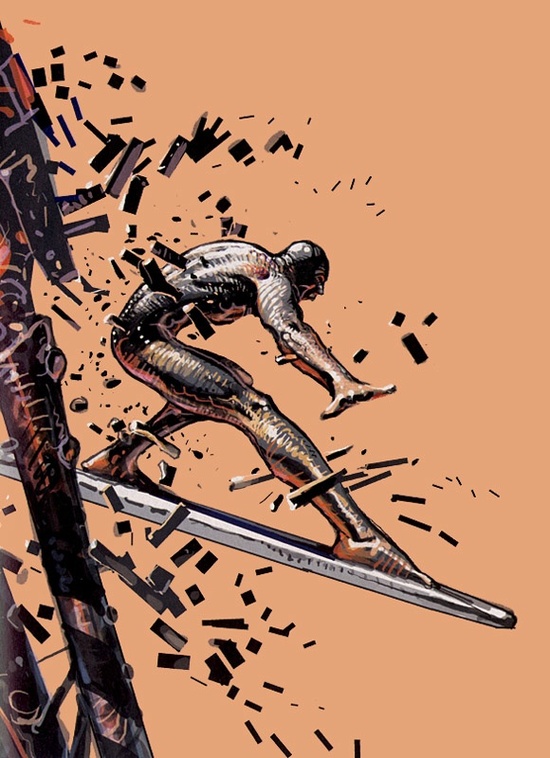
Silver Surfer — Moebius

surfer

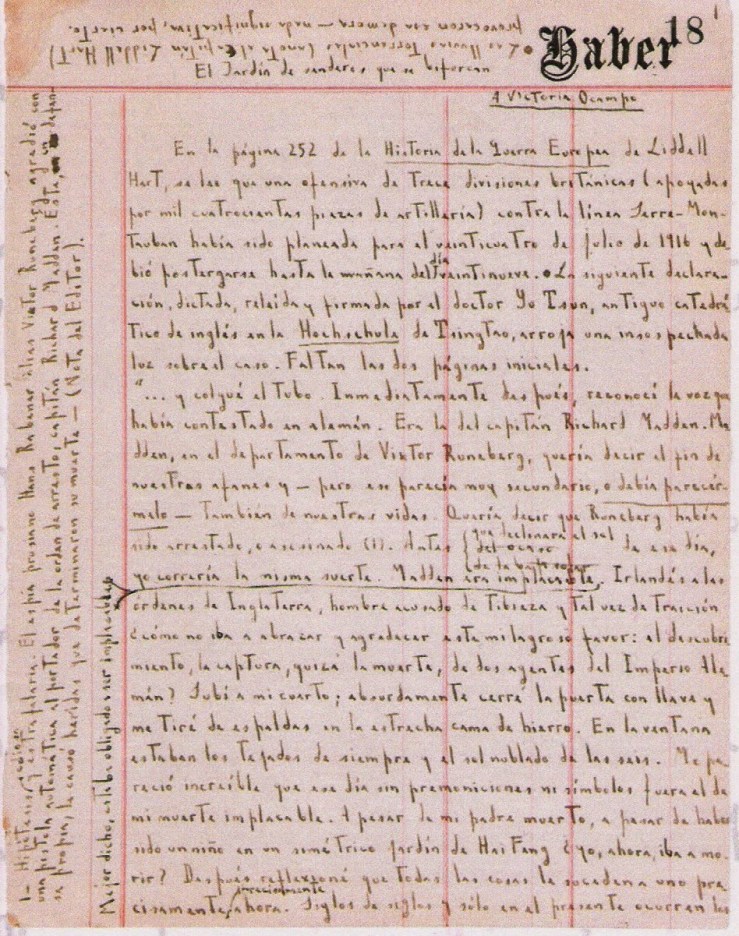
Handwritten Manuscript Page for Jorge Luis Borges’s “The Garden of Forking Paths”

borges manuscript

(Via).

List with No Name #29

  1. V., mostly on a beach in Ko Lanta.
  2. The Road, in the maternity ward after my daughter was born.
  3. Infinite Jest, late at night after I first moved to Tokyo. And then lugging it onto the train.
  4. Un Bel Morir, in the emergency room all night, my mother’s fever so high.
  5. As I Lay Dying, another hospital.
  6. 2666. On a plane leaving San Francisco. And then compulsively every night for a month.
  7. Angels, on a Florida beach.
  8. Cat’s Cradle, on a houseboat, on a river.
  9. The Once and Future King, in the back of a rented car that was zooming across the South Island of NZ, my parents repeatedly imploring me to just look up please.
  10.  Ulysses, on the old gold velour couch I sometimes still miss, on my roommate’s Ritalin, comprehending next to nothing. And then a decade later, with real joy.