Storm Kings (Book Acquired Some Time Last Month)

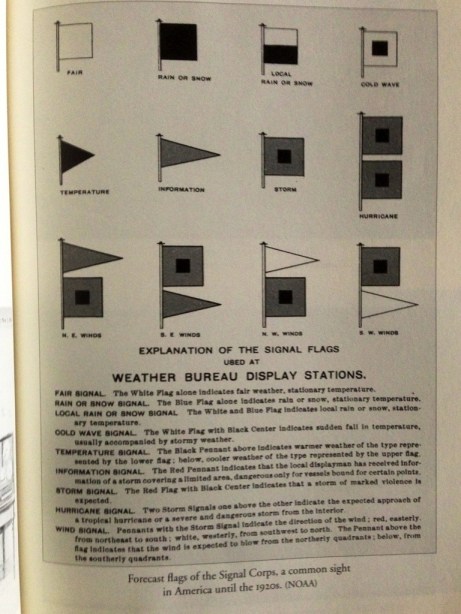
20130414-153718.jpg

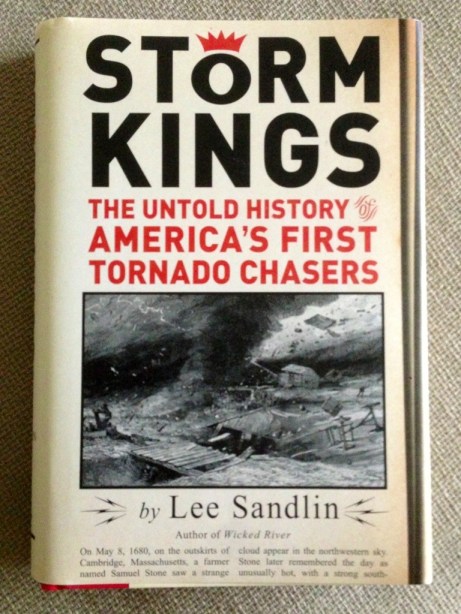
I liked Lee Sandlin’s last book Wicked River, so I took interest when a reader copy of his  new book Storm Kings: The Untold History of America’s First Tornado Chasers showed up at Biblioklept World Headquarters a few months ago. I have no special interest in tornadoes or meteorology, but so far Storm Kings has intrigued me into reading more.

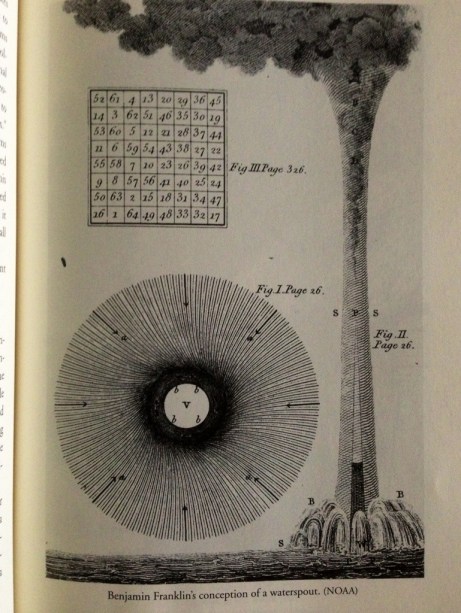
20130414-153724.jpg

Publisher Random House’s blurb:

From the acclaimed author of Wicked River comes Storm Kings, a riveting tale of supercell tornadoes and the quirky, pioneering, weather-obsessed scientists whose discoveries created the science of modern meteorology.

While tornadoes have occasionally been spotted elsewhere, only the central plains of North America have the perfect conditions for their creation. For the early settlers the sight of a funnel cloud was an unearthly event. They called it the “Storm King,” and their descriptions bordered on the supernatural: it glowed green or red, it whistled or moaned or sang. In Storm Kings, Lee Sandlin explores America’s fascination with and unique relationship to tornadoes. From Ben Franklin’s early experiments to the “great storm war” of the nineteenth century to heartland life in the early twentieth century, Sandlin re-creates with vivid descriptions some of the most devastating storms in America’s history, including the Tri-state Tornado of 1925 and the Peshtigo “fire tornado,” whose deadly path of destruction was left encased in glass.

Drawing on memoirs, letters, eyewitness testimonies, and archives, Sandlin brings to life the forgotten characters and scientists who changed a nation—including James Espy, America’s first meteorologist, and Colonel John Park Finley, who helped place a network of weather “spotters” across the country. Along the way, Sandlin details the little-known but fascinating history of the National Weather Service, paints a vivid picture of the early Midwest, and shows how successive generations came to understand, and finally coexist with, the spiraling menace that could erase lives and whole towns in an instant.

20130414-153731.jpg

Twenty Ideas from Nathaniel Hawthorne’s Note-Books

1. A hint of a story,–some incident which should bring on a general war; and the chief actor in the incident to have something corresponding to the mischief he had caused.

2. A sketch to be given of a modern reformer,–a type of the extreme doctrines on the subject of slaves, cold water, and other such topics. He goes about the streets haranguing most eloquently, and is on the point of making many converts, when his labors are suddenly interrupted by the appearance of the keeper of a mad-house, whence he has escaped. Much may be made of this idea.

3. A change from a gay young girl to an old woman; the melancholy events, the effects of which have clustered around her character, and gradually imbued it with their influence, till she becomes a lover of sick-chambers, taking pleasure in receiving dying breaths and in laying out the dead; also having her mind full of funeral reminiscences, and possessing more acquaintances beneath the burial turf than above it.

4. A well-concerted train of events to be thrown into confusion by some misplaced circumstance, unsuspected till the catastrophe, yet exerting its influence from beginning to end.

5. On the common, at dusk, after a salute from two field-pieces, the smoke lay long and heavily on the ground, without much spreading beyond the original space over which it had gushed from the guns. It was about the height of a man. The evening clear, but with an autumnal chill.

6. The world is so sad and solemn, that things meant in jest are liable, by an overpowering influence, to become dreadful earnest,–gayly dressed fantasies turning to ghostly and black-clad images of themselves.

7. A story, the hero of which is to be represented as naturally capable of deep and strong passion, and looking forward to the time when he shall feel passionate love, which is to be the great event of his existence. But it so chances that he never falls in love, and although he gives up the expectation of so doing, and marries calmly, yet it is somewhat sadly, with sentiments merely of esteem for his bride. The lady might be one who had loved him early in life, but whom then, in his expectation of passionate love, he had scorned.

8. The scene of a story or sketch to be laid within the light of a street-lantern; the time, when the lamp is near going out; and the catastrophe to be simultaneous with the last flickering gleam.

9. The peculiar weariness and depression of spirits which is felt after a day wasted in turning over a magazine or other light miscellany, different from the state of the mind after severe study; because there has been no excitement, no difficulties to be overcome, but the spirits have evaporated insensibly.

10. To represent the process by which sober truth gradually strips off all the beautiful draperies with which imagination has enveloped a beloved object, till from an angel she turns out to be a merely ordinary woman. This to be done without caricature, perhaps with a quiet humor interfused, but the prevailing impression to be a sad one. The story might consist of the various alterations in the feelings of the absent lover, caused by successive events that display the true character of his mistress; and the catastrophe should take place at their meeting, when he finds himself equally disappointed in her person; or the whole spirit of the thing may here be reproduced.

11. Two persons might be bitter enemies through life, and mutually cause the ruin of one another, and of all that were dear to them. Finally, meeting at the funeral of a grandchild, the offspring of a son and daughter married without their consent,–and who, as well as the child, had been the victims of their hatred,–they might discover that the supposed ground of the quarrel was altogether a mistake, and then be wofully reconciled.

12. Two persons, by mutual agreement, to make their wills in each other’s favor, then to wait impatiently for one another’s death, and both to be informed of the desired event at the same time. Both, in most joyous sorrow, hasten to be present at the funeral, meet, and find themselves both hoaxed.

13. The story of a man, cold and hard-hearted, and acknowledging no brotherhood with mankind. At his death they might try to dig him a grave, but, at a little space beneath the ground, strike upon a rock, as if the earth refused to receive the unnatural son into her bosom. Then they would put him into an old sepulchre, where the coffins and corpses were all turned to dust, and so he would be alone. Then the body would petrify; and he having died in some characteristic act and expression, he would seem, through endless ages of death, to repel society as in life, and no one would be buried in that tomb forever.

14. Canon transformed to church-bells.

15. A person, even before middle age, may become musty and faded among the people with whom he has grown up from childhood; but, by migrating to a new place, he appears fresh with the effect of youth, which may be communicated from the impressions of others to his own feelings.

16. In an old house, a mysterious knocking might be heard on the wall, where had formerly been a door-way, now bricked up.

17. It might be stated, as the closing circumstance of a tale, that the body of one of the characters had been petrified, and still existed in that state.

18. A young man to win the love of a girl, without any serious intentions, and to find that in that love, which might have been the greatest blessing of his life, he had conjured up a spirit of mischief which pursued him throughout his whole career,–and this without any revengeful purposes on the part of the deserted girl.

19. Two lovers, or other persons, on the most private business, to appoint a meeting in what they supposed to be a place of the utmost solitude, and to find it thronged with people.

20. Some treasure or other thing to be buried, and a tree planted directly over the spot, so as to embrace it with its roots.
From Nathaniel Hawthorne’s American Note-Books.

Watch Kashtanka, A 1952 Animated Adaptation of Anton Chekhov’s Short Story

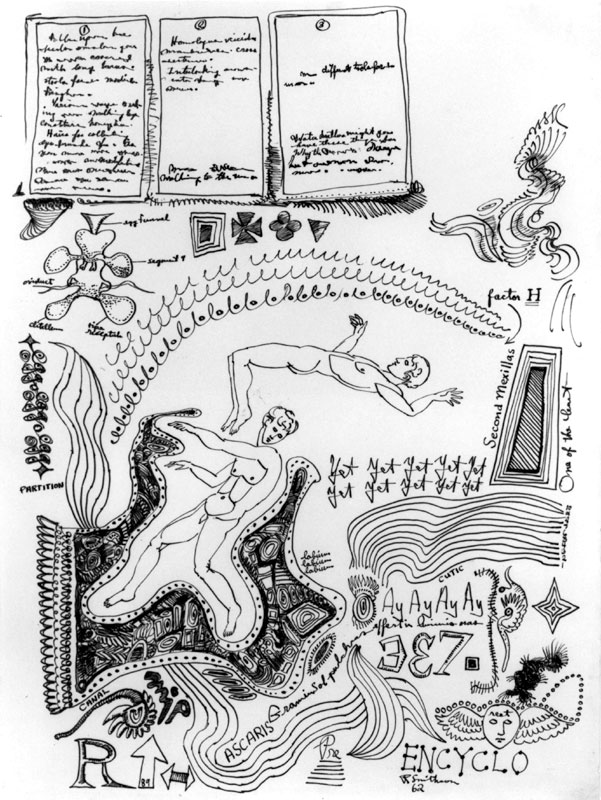
Encyclo — Robert Smithson

encyclo_800

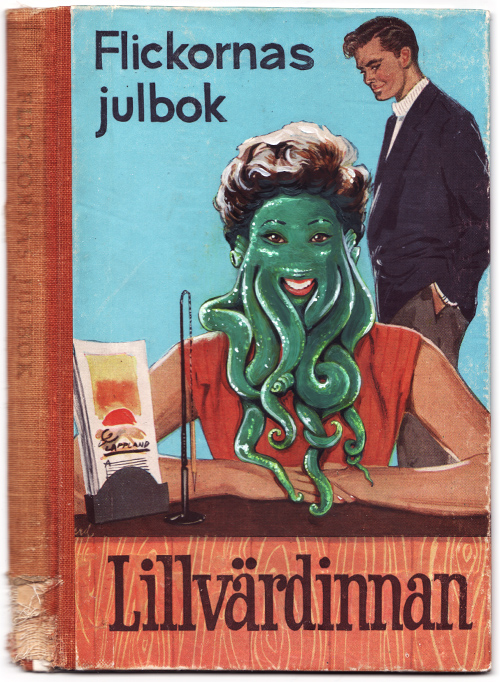
Little Hostess — Emmy Lincoln

Lillvardinnan_EmmyLincoln1

(More/via).

“The Threat” — Saki

“The Threat” by Saki

Sir Lulworth Quayne sat in the lounge of his favourite restaurant, the Gallus Bankiva, discussing the weaknesses of the world with his nephew, who had lately returned from a much-enlivened exile in the wilds of Mexico.  It was that blessed season of the year when the asparagus and the plover’s egg are abroad in the land, and the oyster has not yet withdrawn into it’s summer entrenchments, and Sir Lulworth and his nephew were in that enlightened after-dinner mood when politics are seen in their right perspective, even the politics of Mexico.

“Most of the revolutions that take place in this country nowadays,” said Sir Lulworth, “are the product of moments of legislative panic.  Take, for instance, one of the most dramatic reforms that has been carried through Parliament in the lifetime of this generation.  It happened shortly after the coal strike, of unblessed memory.  To you, who have been plunged up to the neck in events of a more tangled and tumbled description, the things I am going to tell you of may seem of secondary interest, but after all we had to live in the midst of them.”

Sir Lulworth interrupted himself for a moment to say a few kind words to the liqueur brandy he had just tasted, and them resumed his narrative.

“Whether one sympathises with the agitation for female suffrage or not one has to admit that its promoters showed tireless energy and considerable enterprise in devising and putting into action new methods for accomplishing their ends.  As a rule they were a nuisance and a weariness to the flesh, but there were times when they verged on the picturesque.  There was the famous occasion when they enlivened and diversified the customary pageantry of the Royal progress to open Parliament by letting loose thousands of parrots, which had been carefully trained to scream ‘Votes for women,’ and which circled round his Majesty’s coach in a clamorous cloud of green, and grey and scarlet.  It was really rather a striking episode from the spectacular point of view; unfortunately, however, for its devisers, the secret of their intentions had not been well kept, and their opponents let loose at the same moment a rival swarm of parrots, which screeched ‘I don’t think’ and other hostile cries, thereby robbing the demonstration of the unanimity which alone could have made it politically impressive.  In the process of recapture the birds learned a quantity of additional language which unfitted them for further service in the Suffragette cause; some of the green ones were secured by ardent Home Rule propagandists and trained to disturb the serenity of Orange meetings by pessimistic reflections on Sir Edward Carson’s destination in the life to come.  In fact, the bird in politics is a factor that seems to have come to stay; quite recently, at a political gathering held in a dimly-lighted place of worship, the congregation gave a respectful hearing for nearly ten minutes to a jackdaw from Wapping, under the impression that they were listening to the Chancellor of the Exchequer, who was late in arriving.” Continue reading ““The Threat” — Saki”

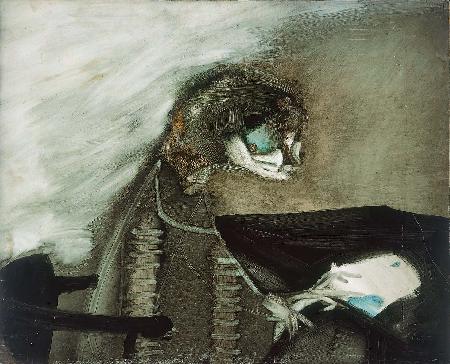
Man Reading — Paul Wunderlich

man-reading-1959

Lake Bride — Vangel Naumovski

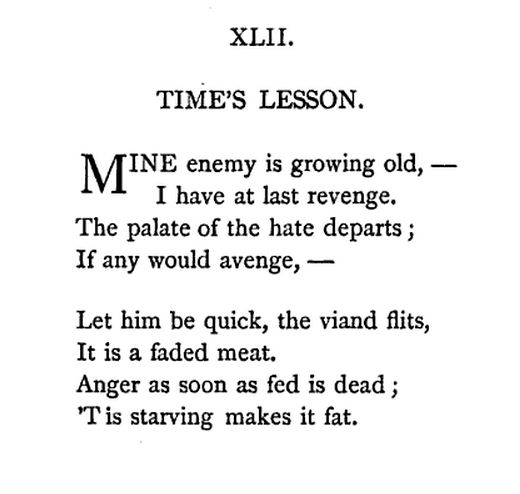
“Mine enemy is growing old” — Emily Dickinson

Capture

See the Trailer for Slavoj Žižek’s New Film, The Pervert’s Guide to Ideology

Poster

Raymond Pettibon: “I read as I write, write as I read”

Read a 1999 interview with Raymond Pettibon in BOMB. Excerpt:

I read as I write, write as I read. If it used to take me five minutes to read the whole newspaper, now, my mind wanders, and then five minutes later I wonder, Gee, did I read that? I used to take notes, and I have notebooks full of drawings and notes that were partly quotations, and I’ve done a lot of marginalia, writing in books. I’m usually reading a number of books at a time, and whether I get through an individual one is probably unlikely. I’ve lost interest in narrative. (sigh) At least in the sense of seeing how a story comes out at the end. There’s a type of reading where you get lost in the narrative and you become part of the story and you’re compelled to finish. I don’t really have any interest in that. For me, reading has become more microscopic, more about dissecting the work. It may start on the level of the novel, then go down to theme or style, then to a paragraph, and finally a sentence. Or the sentence itself becomes about structure, or the words in it. Probably the most obvious example of that kind of reading is James Joyce. It becomes a kind of disease. Every text becomes related to another one, even in a different language, down to each individual word, which then becomes a clue into the etymology of the word, and then that etymological tree. A different context, a different language…you’re just making these associations from one thing to another. I used to start out with a simple drawing that would begin as an idea, and then my writing would make some associations with something else. And then, you know, a day later, or a year later, or whenever, the whole page would be covered with small, finely written text. And it would become a lot of things that were meant to be just in one drawing, expanded into this while still part of my notes. Voluminous notes. You do actually get lost in that morass of associations.


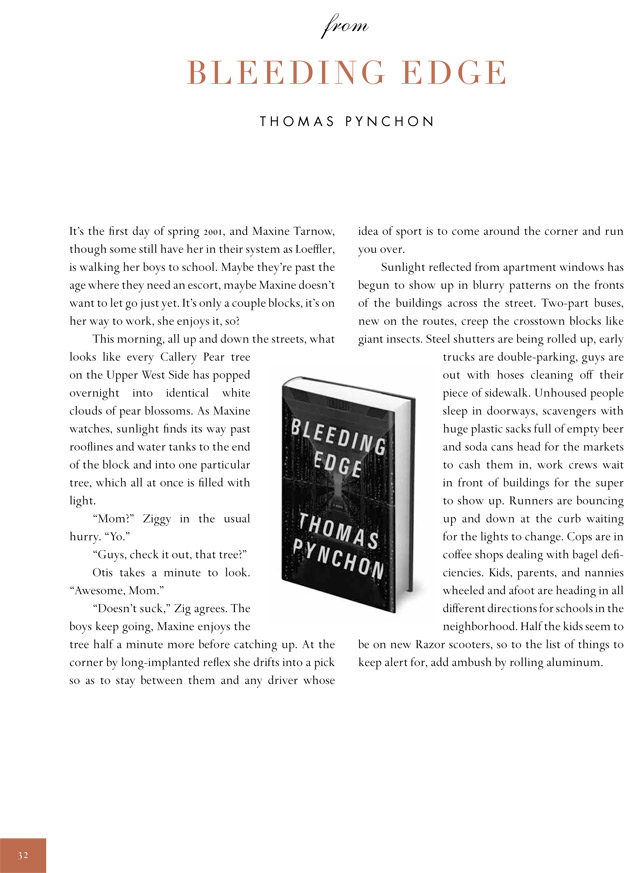
Read the First Page of Thomas Pynchon’s Forthcoming Novel, Bleeding Edge

41313pynchon1

(Via; via).


Tree of Hope, Remain Strong — Frida Kahlo

Adam Johnson Wins the 2013 Pulitzer Prize for Fiction

Adam Johnson won the 2013 Pulitzer Prize for fiction yesterday. He won for his 2012 novel The Orphan Master’s Son, which the jury notes is

an exquisitely crafted novel that carries the reader on an adventuresome journey into the depths of totalitarian North Korea and into the most intimate spaces of the human heart.

I gave the novel a somewhat mixed review—Johnson is a powerful prose-slinger and a fantastic storyteller, but The Orphan Master’s Son is overtly beholden to a standard of realism that the novel’s tone shifts cannot bear. I wrote—

The biggest problem though is the overwhelming suspicion that Johnson is simply out of his element in trying to inhabit the North Korean imagination. Although he’s clearly done his research, North Korea is essentially closed to the rest of the world. And Johnson is a U.S. American. I mean, there’s this whole other impossible-to-digest ball of wax here that makes Johnson’s admirable intent to write a novel about “propaganda” just way too complicated to suss out in a review, and I’ll admit that I tend to read like a reviewer, and that these notions just bugged the hell out of me as the novel progressed.

“A Transgression” — Anton Chekhov

“A Transgression” by Anton Chekhov

A COLLEGIATE assessor called Miguev stopped at a telegraph-post in the course of his evening walk and heaved a deep sigh. A week before, as he was returning home from his evening walk, he had been overtaken at that very spot by his former housemaid, Agnia, who said to him viciously:

“Wait a bit! I’ll cook you such a crab that’ll teach you to ruin innocent girls! I’ll leave the baby at your door, and I’ll have the law of you, and I’ll tell your wife, too….”

And she demanded that he should put five thousand roubles into the bank in her name. Miguev remembered it, heaved a sigh, and once more reproached himself with heartfelt repentance for the momentary infatuation which had caused him so much worry and misery.

When he reached his bungalow, he sat down to rest on the doorstep. It was just ten o’clock, and a bit of the moon peeped out from behind the clouds. There was not a soul in the street nor near the bungalows; elderly summer visitors were already going to bed, while young ones were walking in the wood. Feeling in both his pockets for a match to light his cigarette, Miguev brought his elbow into contact with something soft. He looked idly at his right elbow, and his face was instantly contorted by a look of as much horror as though he had seen a snake beside him. On the step at the very door lay a bundle. Something oblong in shape was wrapped up in something—judging by the feel of it, a wadded quilt. One end of the bundle was a little open, and the collegiate assessor, putting in his hand, felt something damp and warm. He leaped on to his feet in horror, and looked about him like a criminal trying to escape from his warders….

“She has left it!” he muttered wrathfully through his teeth, clenching his fists. “Here it lies…. Here lies my transgression! O Lord!”

He was numb with terror, anger, and shame… What was he to do now? What would his wife say if she found out? What would his colleagues at the office say? His Excellency would be sure to dig him in the ribs, guffaw, and say: “I congratulate you!… He-he-he! Though your beard is gray, your heart is gay…. You are a rogue, Semyon Erastovitch!” The whole colony of summer visitors would know his secret now, and probably the respectable mothers of families would shut their doors to him. Such incidents always get into the papers, and the humble name of Miguev would be published all over Russia….

The middle window of the bungalow was open and he could distinctly hear his wife, Anna Filippovna, laying the table for supper; in the yard close to the gate Yermolay, the porter, was plaintively strumming on the balalaika. The baby had only to wake up and begin to cry, and the secret would be discovered. Miguev was conscious of an overwhelming desire to make haste. Continue reading ““A Transgression” — Anton Chekhov”

Reader in Green — Pierre-Auguste Renoir

Evening and Sorrow — Gustave Moreau