The Fall — Dmitry Samarov

File0096

(Read my interview with Dmitry Samarov)

Onibaba — Kaneto Shindô (Full Film)

“The drama’s done” (Moby-Dick)

The drama’s done. Why then here does any one step forth?—Because one did survive the wreck.

It so chanced, that after the Parsee’s disappearance, I was he whom the Fates ordained to take the place of Ahab’s bowsman, when that bowsman assumed the vacant post; the same, who, when on the last day the three men were tossed from out of the rocking boat, was dropped astern. So, floating on the margin of the ensuing scene, and in full sight of it, when the halfspent suction of the sunk ship reached me, I was then, but slowly, drawn towards the closing vortex. When I reached it, it had subsided to a creamy pool. Round and round, then, and ever contracting towards the button-like black bubble at the axis of that slowly wheeling circle, like another Ixion I did revolve. Till, gaining that vital centre, the black bubble upward burst; and now, liberated by reason of its cunning spring, and, owing to its great buoyancy, rising with great force, the coffin life-buoy shot lengthwise from the sea, fell over, and floated by my side. Buoyed up by that coffin, for almost one whole day and night, I floated on a soft and dirgelike main. The unharming sharks, they glided by as if with padlocks on their mouths; the savage sea-hawks sailed with sheathed beaks. On the second day, a sail drew near, nearer, and picked me up at last. It was the devious-cruising Rachel, that in her retracing search after her missing children, only found another orphan.

The untitled epilogue to Melville’s Moby-Dick, which I’ve always thought of by its epigraph from Job, “And I Only Am Escaped Alone to Tell Thee.”

I’ve enjoyed citing these extracts through this reading of Moby-Dick.


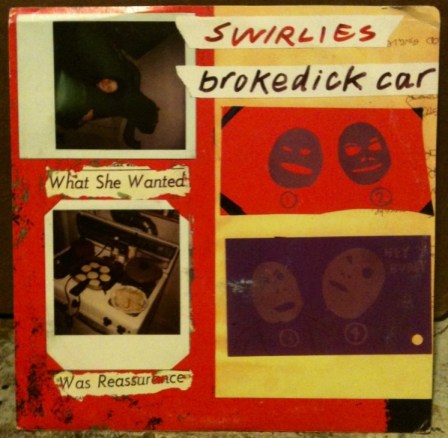
Seven-Inch Sundays #2 // The Swirlies — “Wrong Tube”

20130224-130231.jpg

In my estimation, The Swirlies were the greatest indie rock band of the 1990s to never really make it big—and by “make it big” I mean indie rock big—Sebadoh big, Superchunk big. They made two stellar albums of shoegazed-influenced dream pop, Blonder Tongue Audio Baton (1993), and They Spent Their Wild Youthful Days in the Glittering World of the Salons (1996). These albums are crammed with fuzzy four-track recorder experiments, folky half-songs, and a handful of truly stellar, muscular, dream pop songs that would fit nicely on any mixtape between jams from My Bloody Valentine and Stereolab. One such song is “Wrong Tube,” the a-side to this Taang! Records 7″ purporting to be the Brokedick Car EP (it’s not the full EP, which has two other songs).

20130224-130239.jpg

“Wrong Tube” was a staple in my ’86 Camry’s tape deck for years, and I still love it today. I haven’t listened to this 7″ in years—I almost certainly bought it because of the blue vinyl (and, ashamedly, certain completist tendencies). The guitars are crunchy, swerving, swirly, guitarists Seana Carmody and Damon Tutunjian attacking their tremolo bars with abandon and trading verses as the band crashed through in a high tempo. I still find the final moments of the song exhilarating, as one of the guitars hammers out a  sweet melody in the highest register as Carmody harmonizes along. Somehow the entire version of the song doesn’t fit on the 7″, which is a shame I guess. B-sides “Labrea Tarpit” and “You’re Just Jealous” are a forgettable experiment followed by a forgettable ditty.

Profane Love — Titian

“On Some Technical Elements of Style in Literature” — Robert Louis Stevenson

There is nothing more disenchanting to man than to be shown the springs and mechanism of any art.  All our arts and occupations lie wholly on the surface; it is on the surface that we perceive their beauty, fitness, and significance; and to pry below is to be appalled by their emptiness and shocked by the coarseness of the strings and pulleys.  In a similar way, psychology itself, when pushed to any nicety, discovers an abhorrent baldness, but rather from the fault of our analysis than from any poverty native to the mind.  And perhaps in æsthetics the reason is the same: those disclosures which seem fatal to the dignity of art seem so perhaps only in the proportion of our ignorance; and those conscious and unconscious artifices which it seems unworthy of the serious artist to employ were yet, if we had the power to trace them to their springs, indications of a delicacy of the sense finer than we conceive, and hints of ancient harmonies in nature.  This ignorance at least is largely irremediable.  We shall never learn the affinities of beauty, for they lie too deep in nature and too far back in the mysterious history of man.  The amateur, in consequence, will always grudgingly receive details of method, which can be stated but never can wholly be explained; nay, on the principle laid down in Hudibras, that

‘Still the less they understand,
The more they admire the sleight-of-hand,’

many are conscious at each new disclosure of a diminution in the ardour of their pleasure.  I must therefore warn that well-known character, the general reader, that I am here embarked upon a most distasteful business: taking down the picture from the wall and looking on the back; and, like the inquiring child, pulling the musical cart to pieces.

1.  Choice of Words.—The art of literature stands apart from among its sisters, because the material in which the literary artist works is the dialect of life; hence, on the one hand, a strange freshness and immediacy of address to the public mind, which is ready prepared to understand it; but hence, on the other, a singular limitation.  The sister arts enjoy the use of a plastic and ductile material, like the modeller’s clay; literature alone is condemned to work in mosaic with finite and quite rigid words.  You have seen these blocks, dear to the nursery: this one a pillar, that a pediment, a third a window or a vase.  It is with blocks of just such arbitrary size and figure that the literary architect is condemned to design the palace of his art.  Nor is this all; for since these blocks, or words, are the acknowledged currency of our daily affairs, there are here possible none of those suppressions by which other arts obtain relief, continuity, and vigour: no hieroglyphic touch, no smoothed impasto, no inscrutable shadow, as in painting; no blank wall, as in architecture; but every word, phrase, sentence, and paragraph must move in a logical progression, and convey a definite conventional import.

Now the first merit which attracts in the pages of a good writer, or the talk of a brilliant conversationalist, is the apt choice and contrast of the words employed.  It is, indeed, a strange art to take these blocks, rudely conceived for the purpose of the market or the bar, and by tact of application touch them to the finest meanings and distinctions, restore to them their primal energy, wittily shift them to another issue, or make of them a drum to rouse the passions.  But though this form of merit is without doubt the most sensible and seizing, it is far from being equally present in all writers.  The effect of words in Shakespeare, their singular justice, significance, and poetic charm, is different, indeed, from the effect of words in Addison or Fielding.  Or, to take an example nearer home, the words in Carlyle seem electrified into an energy of lineament, like the faces of men furiously moved; whilst the words in Macaulay, apt enough to convey his meaning, harmonious enough in sound, yet glide from the memory like undistinguished elements in a general effect.  But the first class of writers have no monopoly of literary merit.  There is a sense in which Addison is superior to Carlyle; a sense in which Cicero is better than Tacitus, in which Voltaire excels Montaigne: it certainly lies not in the choice of words; it lies not in the interest or value of the matter; it lies not in force of intellect, of poetry, or of humour.  The three first are but infants to the three second; and yet each, in a particular point of literary art, excels his superior in the whole.  What is that point? Continue reading ““On Some Technical Elements of Style in Literature” — Robert Louis Stevenson”

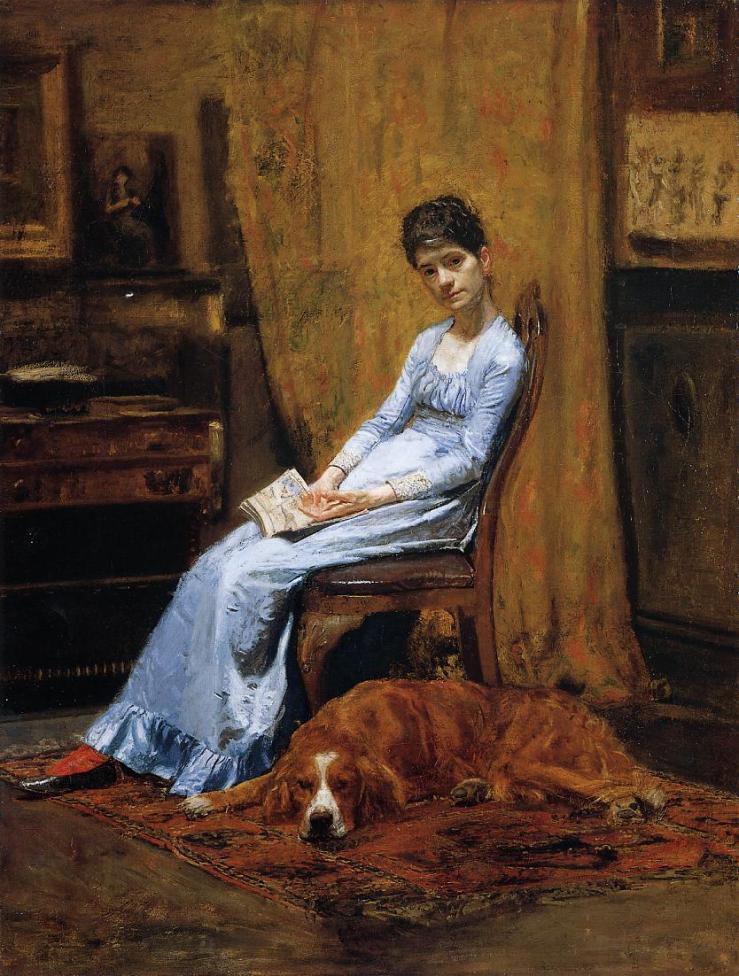
The Artist’s Wife and His Setter Dog — Thomas Eakins

the-artist-s-wife-and-his-setter-dog-1889

Alfred Hitchcock’s Secret Agent (Full Film)

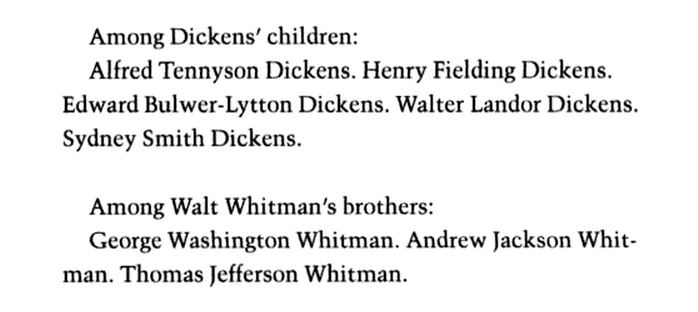
Dickens’ Children // Whitman’s Brothers — David Markson

Capture

“I turn my body from the sun” (Moby-Dick)

“I turn my body from the sun. What ho, Tashtego! let me hear thy hammer. Oh! ye three unsurrendered spires of mine; thou uncracked keel; and only god-bullied hull; thou firm deck, and haughty helm, and Pole-pointed prow,—death-glorious ship! must ye then perish, and without me? Am I cut off from the last fond pride of meanest shipwrecked captains? Oh, lonely death on lonely life! Oh, now I feel my topmost greatness lies in my topmost grief. Ho, ho! from all your furthest bounds, pour ye now in, ye bold billows of my whole foregone life, and top this one piled comber of my death! Towards thee I roll, thou all-destroying but unconquering whale; to the last I grapple with thee; from hell’s heart I stab at thee; for hate’s sake I spit my last breath at thee. Sink all coffins and all hearses to one common pool! and since neither can be mine, let me then tow to pieces, while still chasing thee, though tied to thee, thou damned whale! THUS, I give up the spear!”

From “The Chase—The Third Day,” Chapter 135 of Melville’s Moby-Dick. Ahab’s final monologue.


Wonder Woman — Jaime Hernandez

JaimeHernandez_WonderWoman–100

“The Queen of Spades” — Alexander Pushkin

“The Queen of Spades” by Alexander Pushkin

I

There was a card party at the rooms of Narumov of the Horse Guards. The long winter night passed away imperceptibly, and it was five o’clock in the morning before the company sat down to supper. Those who had won, ate with a good appetite; the others sat staring absently at their empty plates. When the champagne appeared, however, the conversation became more animated, and all took a part in it.

“And how did you fare, Surin?” asked the host.

“Oh, I lost, as usual. I must confess that I am unlucky: I play mirandole, I always keep cool, I never allow anything to put me out, and yet I always lose!”

“And you did not once allow yourself to be tempted to back the red?…
Your firmness astonishes me.”

“But what do you think of Hermann?” said one of the guests, pointing to a young Engineer: “he has never had a card in his hand in his life, he has never in, his life laid a wager, and yet he sits here till five o’clock in the morning watching our play.”

“Play interests me very much,” said Hermann: “but I am not in the position to sacrifice the necessary in the hope of winning the superfluous.”

“Hermann is a German: he is economical—that is all!” observed Tomsky. “But if there is one person that I cannot understand, it is my grandmother, the Countess Anna Fedotovna.”

“How so?” inquired the guests.

“I cannot understand,” continued Tomsky, “how it is that my grandmother does not punt.”

“What is there remarkable about an old lady of eighty not punting?” said Narumov.

“Then you do not know the reason why?”

“No, really; haven’t the faintest idea.” Continue reading ““The Queen of Spades” — Alexander Pushkin”

Convalescent (Note in Opal) — James McNeill Whistler

convalescent-aka-petit-dejeuner-note-in-opal-1884

Valerie and Her Week of Wonders (Full Film)

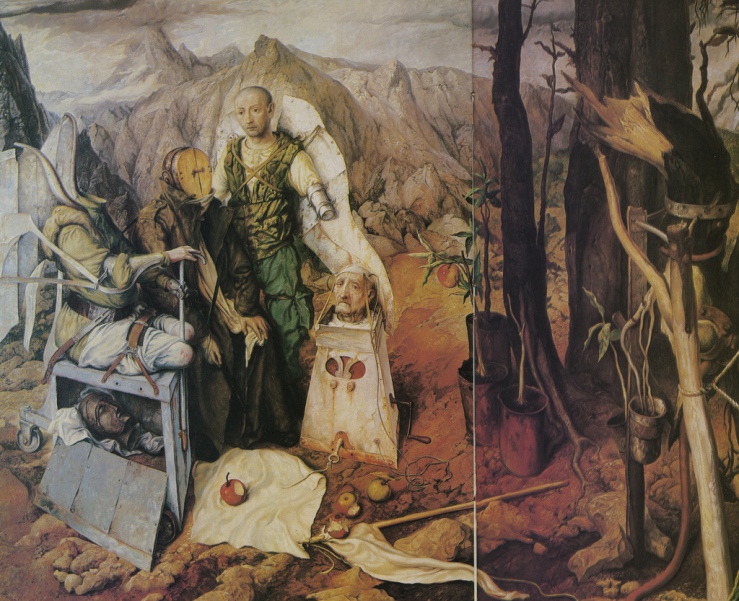
Eternal Return — Samuel Bak

3371402293_4e45d342dd_b

“ESP” (Live) — Matmos Covers The Buzzcocks