“Ahab never thinks; he only feels, feels, feels” (Moby-Dick)

“D’ye see him?” cried Ahab; but the whale was not yet in sight.

“In his infallible wake, though; but follow that wake, that’s all. Helm there; steady, as thou goest, and hast been going. What a lovely day again! were it a new-made world, and made for a summer-house to the angels, and this morning the first of its throwing open to them, a fairer day could not dawn upon that world. Here’s food for thought, had Ahab time to think; but Ahab never thinks; he only feels, feels, feels; THAT’S tingling enough for mortal man! to think’s audacity. God only has that right and privilege. Thinking is, or ought to be, a coolness and a calmness; and our poor hearts throb, and our poor brains beat too much for that. And yet, I’ve sometimes thought my brain was very calm—frozen calm, this old skull cracks so, like a glass in which the contents turned to ice, and shiver it. And still this hair is growing now; this moment growing, and heat must breed it; but no, it’s like that sort of common grass that will grow anywhere, between the earthy clefts of Greenland ice or in Vesuvius lava. How the wild winds blow it; they whip it about me as the torn shreds of split sails lash the tossed ship they cling to. A vile wind that has no doubt blown ere this through prison corridors and cells, and wards of hospitals, and ventilated them, and now comes blowing hither as innocent as fleeces. Out upon it!—it’s tainted. Were I the wind, I’d blow no more on such a wicked, miserable world. I’d crawl somewhere to a cave, and slink there. And yet, ’tis a noble and heroic thing, the wind! who ever conquered it? In every fight it has the last and bitterest blow. Run tilting at it, and you but run through it. Ha! a coward wind that strikes stark naked men, but will not stand to receive a single blow. Even Ahab is a braver thing—a nobler thing than THAT. Would now the wind but had a body; but all the things that most exasperate and outrage mortal man, all these things are bodiless, but only bodiless as objects, not as agents. There’s a most special, a most cunning, oh, a most malicious difference! And yet, I say again, and swear it now, that there’s something all glorious and gracious in the wind. These warm Trade Winds, at least, that in the clear heavens blow straight on, in strong and steadfast, vigorous mildness; and veer not from their mark, however the baser currents of the sea may turn and tack, and mightiest Mississippies of the land swift and swerve about, uncertain where to go at last. And by the eternal Poles! these same Trades that so directly blow my good ship on; these Trades, or something like them—something so unchangeable, and full as strong, blow my keeled soul along! To it! Aloft there! What d’ye see?”

“Nothing, sir.”

From “The Chase—The Third Day,” Chapter 135 of Melville’s Moby-Dick.
 

“Bluebeard” — Edna St. Vincent Millay

“Bluebeard” by Edna St. Vincent Millay—

This door you might not open, and you did;
So enter now, and see for what slight thing
You are betrayed… Here is no treasure hid,
No cauldron, no clear crystal mirroring
The sought-for truth, no heads of women slain
For greed like yours, no writhings of distress,
But only what you see… Look yet again—
An empty room, cobwebbed and comfortless.
Yet this alone out of my life I kept
Unto myself, lest any know me quite;
And you did so profane me when you crept
Unto the threshold of this room to-night
That I must never more behold your face.
This now is yours. I seek another place.

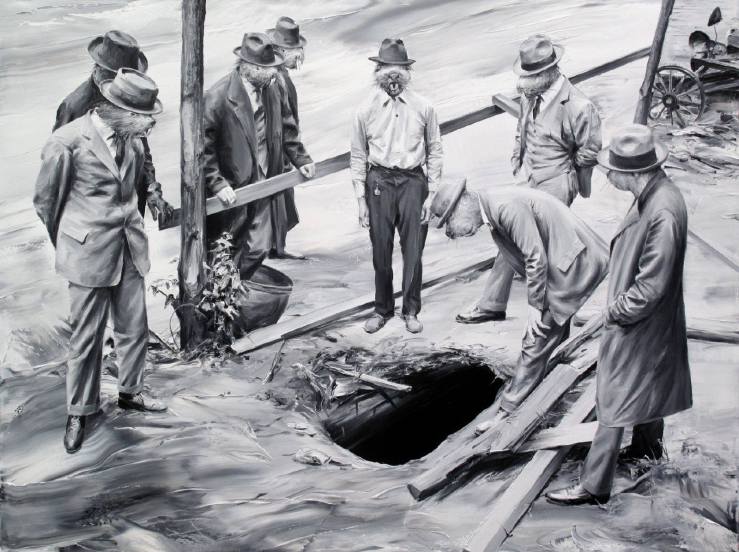
Nostalgia — Paco Pomet

Paco_Pomet_Nostalgia_2011_1938_412

(More/via)

“The Blind Man” — Guy de Maupassant

“The Blind Man” by Guy de Maupassant

How is it that the sunlight gives us such joy? Why does this radiance when it falls on the earth fill us with the joy of living? The whole sky is blue, the fields are green, the houses all white, and our enchanted eyes drink in those bright colors which bring delight to our souls. And then there springs up in our hearts a desire to dance, to run, to sing, a happy lightness of thought, a sort of enlarged tenderness; we feel a longing to embrace the sun.

The blind, as they sit in the doorways, impassive in their eternal darkness, remain as calm as ever in the midst of this fresh gaiety, and, not understanding what is taking place around them, they continually check their dogs as they attempt to play.

When, at the close of the day, they are returning home on the arm of a young brother or a little sister, if the child says: “It was a very fine day!” the other answers: “I could notice that it was fine. Loulou wouldn’t keep quiet.”

I knew one of these men whose life was one of the most cruel martyrdoms that could possibly be conceived.

He was a peasant, the son of a Norman farmer. As long as his father and mother lived, he was more or less taken care of; he suffered little save from his horrible infirmity; but as soon as the old people were gone, an atrocious life of misery commenced for him. Dependent on a sister of his, everybody in the farmhouse treated him as a beggar who is eating the bread of strangers. At every meal the very food he swallowed was made a subject of reproach against him; he was called a drone, a clown, and although his brother-in-law had taken possession of his portion of the inheritance, he was helped grudgingly to soup, getting just enough to save him from starving. Continue reading ““The Blind Man” — Guy de Maupassant”

Bibliothèque — Maria Helena Vieira da Silva

biblioth-que-1949

Alice — Jan Švankmajer (Full Film)

Archduke Leopold’s Gallery — David Teniers the Younger

“The golden age of rock was cut short by the success of the Beatles” — Henry Flynt

For me, the golden age of rock was cut short by the success of the Beatles, which could be dated either 1964 or 1966.  UK artists had contributed important hits to the pop field—but the triumph of the Beatles formula shifted pop away from the breakthrough of the late Fifties.  The Beatles were essentially a music-hall “kid” act, limited to a four-square, discrete-pitch vocabulary.  (They knew American ethnic music only by rumor.)  They found and crystallized the segment with the best numbers—early teens who wanted something more bland than actual rock.  At this point, the regime of maximum sales backfired, as one might well have expected it to.

The “youth” craze of the Sixties became increasingly dubious (from flower power to Altamont), and the Beatles and their imitators morphed, leading their fans to a mystique of consumerist dissipation.  (Carnaby Street and “Yellow Submarine.”)  For me, the Beatles’ consummate song was “Revolution,” which begins “If you wanna make a revolution, count me out.”  It served as the anthem for all the mediocrities who responsed to the stresses of the late twentieth century by embracing institutional co-optation.

After the Beatles seized the market, white pop ceased to interest me except for the flukes.  When Bob Dylan added electric instruments and blues chops to his act for “Subterranean Homesick Blues,” that impelled me to my initial rock efforts of 1966 (with Walter De Maria on traps).  Given my political engagement, I had been waiting for an impetus to try songs with “revolution” lyrics.

In general, the ascendancy of the Beatles, and the assassination of Martin Luther King, Jr., ended ethnic-rock—the ethnic impulses reverted to the segmented R&B and C&W markets.  After the mid-Sixties, rock-pop no longer had ethnic chops—could I have been the only one who was musicological enough to realize that?  Rock-pop became uniformly loud in a way which was vulgar, mechanical, and bloated.  (There was no more of the profundity, and I mean profundity, of a Chuck Berry or of “Be-Bop-A-Lula.”)

From Henry Flynt’s essay “The Meaning of My Avant-Garde Hillbilly and Blues Music.”


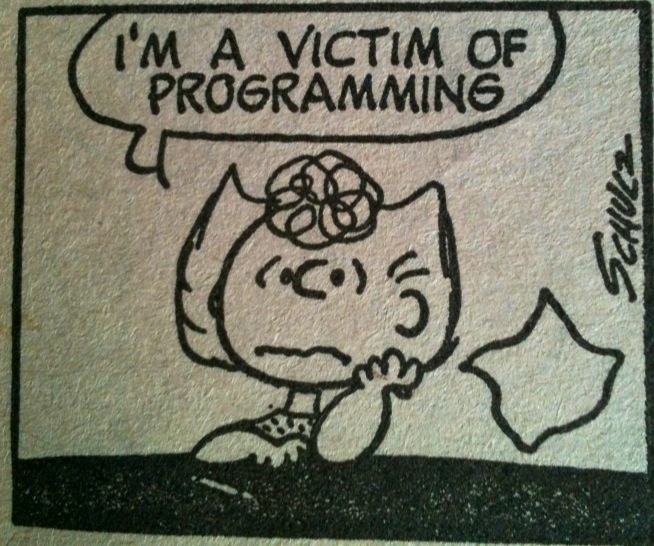
Victim

20130120-102118.jpg

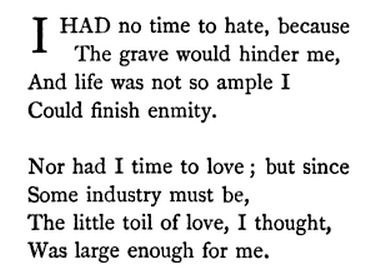
“I had not time to hate, because” — Emily Dickinson

ed

“Markheim” — Robert Louis Stevenson

“Markheim” by Robert Louis Stevenson

“Yes,” said the dealer, “our windfalls are of various kinds. Some customers are ignorant, and then I touch a dividend on my superior knowledge. Some are dishonest,” and here he held up the candle, so that the light fell strongly on his visitor, “and in that case,” he continued, “I profit by my virtue.”

Markheim had but just entered from the daylight streets, and his eyes had not yet grown familiar with the mingled shine and darkness in the shop. At these pointed words, and before the near presence of the flame, he blinked painfully and looked aside.

The dealer chuckled. “You come to me on Christmas Day,” he resumed, “when you know that I am alone in my house, put up my shutters, and make a point of refusing business. Well, you will have to pay for that; you will have to pay for my loss of time, when I should be balancing my books; you will have to pay, besides, for a kind of manner that I remark in you to-day very strongly. I am the essence of discretion, and ask no awkward questions; but when a customer cannot look me in the eye, he has to pay for it.” The dealer once more chuckled; and then, changing to his usual business voice, though still with a note of irony, “You can give, as usual, a clear account of how you came into the possession of the object?” he continued. “Still your uncle’s cabinet? A remarkable collector, sir!”

And the little pale, round-shouldered dealer stood almost on tip- toe, looking over the top of his gold spectacles, and nodding his head with every mark of disbelief. Markheim returned his gaze with one of infinite pity, and a touch of horror.

“This time,” said he, “you are in error. I have not come to sell, but to buy. I have no curios to dispose of; my uncle’s cabinet is bare to the wainscot; even were it still intact, I have done well on the Stock Exchange, and should more likely add to it than otherwise, and my errand to-day is simplicity itself. I seek a Christmas present for a lady,” he continued, waxing more fluent as he struck into the speech he had prepared; “and certainly I owe you every excuse for thus disturbing you upon so small a matter. But the thing was neglected yesterday; I must produce my little compliment at dinner; and, as you very well know, a rich marriage is not a thing to be neglected.”

There followed a pause, during which the dealer seemed to weigh this statement incredulously. The ticking of many clocks among the curious lumber of the shop, and the faint rushing of the cabs in a near thoroughfare, filled up the interval of silence.

“Well, sir,” said the dealer, “be it so. You are an old customer after all; and if, as you say, you have the chance of a good marriage, far be it from me to be an obstacle. Here is a nice thing for a lady now,” he went on, “this hand glass—fifteenth century, warranted; comes from a good collection, too; but I reserve the name, in the interests of my customer, who was just like yourself, my dear sir, the nephew and sole heir of a remarkable collector.” Continue reading ““Markheim” — Robert Louis Stevenson”

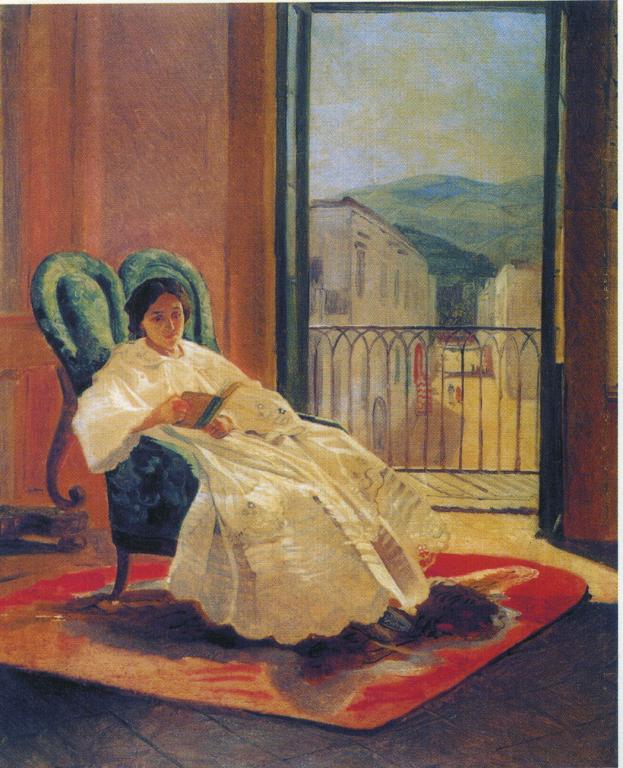
Portrait of the Artist’s Wife, Anna Ge — Nikolai Ge

portrait-of-the-artist-s-wife-anna-ge

Barfly (Full Film)

Letter to Ernest Hemingway — F.Scott Fitzgerald

Dear Ernest:

It’s a fine novel [For Whom the Bell Tolls], better than anybody else writing could do. Thanks for thinking of me and for your dedication. I read it with intense interest, participating in a lot of the writing problems as they came along and often quite unable to discover how you brought off some of the effects, but you always did. The massacre was magnificent and also the fight on the mountain and the actual dynamiting scene. Of the sideshows I particularly liked the vignette of Karkov and Pilar’s Sonata to death—and I had a personal interest in the Moseby guerilla stuff because of my own father. The scene in which the. father says goodbye to his son is very powerful. I’m going to read the whole thing again.

I never got to tell you how I like To Have and to Have Not either. There is observation and writing in that that the boys will be imitating with a vengeance—paragraphs and pages that are right up with Dostoiefski in their undeflected intensity.

Congratulations too on your new book’s great success. I envy you like hell and there is no irony in this. I always liked Dostoiefski with his wide appeal more than any other European—and I envy you the time it will give you to do what you want.

With Old Affection,

P.S. I came across an old article by John Bishop about how you lay four days under dead bodies at Caporetto and how I flunked out of Princeton (I left on a stretcher in November—you can’t flunk out in November) … What I started to say was that I do know something about you on the Italian front, from a man who was in your unit—how you crawled some hellish distance pulling a wounded man with you and how the doctors stood over you wondering why you were alive with so many perforations. Don’t worry—I won’t tell anybody. Not even Allan Campbell who called me up and gave me news of you the other day.

P.S. (2) I hear you are marrying one of the most beautiful people I have ever seen. Give her my best remembrance.

(November 8, 1940; republished in New Directions’ edition of The Crack Up).


“Is Ahab, Ahab? Is it I, God, or who, that lifts this arm?” (Moby-Dick)

“What is it, what nameless, inscrutable, unearthly thing is it; what cozening, hidden lord and master, and cruel, remorseless emperor commands me; that against all natural lovings and longings, I so keep pushing, and crowding, and jamming myself on all the time; recklessly making me ready to do what in my own proper, natural heart, I durst not so much as dare? Is Ahab, Ahab? Is it I, God, or who, that lifts this arm? But if the great sun move not of himself; but is as an errand-boy in heaven; nor one single star can revolve, but by some invisible power; how then can this one small heart beat; this one small brain think thoughts; unless God does that beating, does that thinking, does that living, and not I. By heaven, man, we are turned round and round in this world, like yonder windlass, and Fate is the handspike. And all the time, lo! that smiling sky, and this unsounded sea! Look! see yon Albicore! who put it into him to chase and fang that flying-fish? Where do murderers go, man! Who’s to doom, when the judge himself is dragged to the bar? But it is a mild, mild wind, and a mild looking sky; and the air smells now, as if it blew from a far-away meadow; they have been making hay somewhere under the slopes of the Andes, Starbuck, and the mowers are sleeping among the new-mown hay. Sleeping? Aye, toil we how we may, we all sleep at last on the field. Sleep? Aye, and rust amid greenness; as last year’s scythes flung down, and left in the half-cut swaths—Starbuck!”

But blanched to a corpse’s hue with despair, the Mate had stolen away.

From “The Symphony,” Chapter 132 of Melville’s Moby-Dick. The speaker is, of course, Ahab.


Ben Marcus Doing His David Markson Impression

In his early writings, Thoreau called the alphabet the saddest song. Later in life he would renounce this position and say it produced only dissonant music.

Letters, Montaigne said, are a necessary evil.

But are they? asked Blake, years later. I shall write of the world without them.

I would grow mold on the language, said Pasteur. Except nothing can grow on that cold, dead surface.

Of words Teresa of Avila said, I did not live to erase them all.

They make me sick, said Luther. Yours and yours and yours. Even sometimes my own.

If it can be said, then I am not interested, wrote Schopenhauer.

When told to explain himself, a criminal in Arthur’s court simply pointed at the large embroidered alphabet that hung above the king.

Poets need a new instrument, said Shelley.

If I could take something from the world, said Nietzsche, and take with it even the memory of that thing, so that the world might carry on ever forward with not even the possibility that thing could exist again, it would be the language that sits rotting inside my mouth.

I am a writer, said Picasso. I make my own letters.

Shall I destroy this now, or shall I wait for you to leave the room, said his patron to Kadmos, the reputed inventor of the alphabet.

Kadmos is a fraud, said Wheaton. Said Nestor. Said William James.

Do not read this, warned Plutarch.

Do not read this, warned Cicero.

Do not read this, begged Ovid.

If you value your life. Bleed a man, and with that vile release spell out his name in the sand, prescribed Hippocrates.

No alphabet but in things, said Williams.

Correction. No alphabet at all.

The entirety of Chapter 35 of Ben Marcus’s novel The Flame Alphabet. It’s a departure of style from the novel that seems to owe more than a passing nod to David Markson’s notecard novels.


List with No Name #17

  1. Gordon Lish
  2. Ed Sanders
  3. Nadine Gordimer
  4. Harry Matthews
  5. Doris Lessing
  6. Cynthia Ozick
  7. Philip Roth
  8. Derek Walcott
  9. William H. Gass
  10. John Ashberry
  11. E.L. Doctorow
  12. Lawrence Ferlinghetti
  13. Harold Bloom
  14. Gabriel García Márquez
  15. Joyce Johnson
  16. Milan Kundera
  17. Amiri Baraka
  18. Gary Snyder
  19. Joyce Carol Oates
  20. Mario Vargas Llosa
  21. Joan Didion
  22. Harper Lee
  23. John Barth
  24. Don DeLillo
  25. Cormac McCarthy
  26. Chinua Achebe
  27. Umberto Eco
  28. Günter Grass