“Winter Now” (Live) — Broadcast

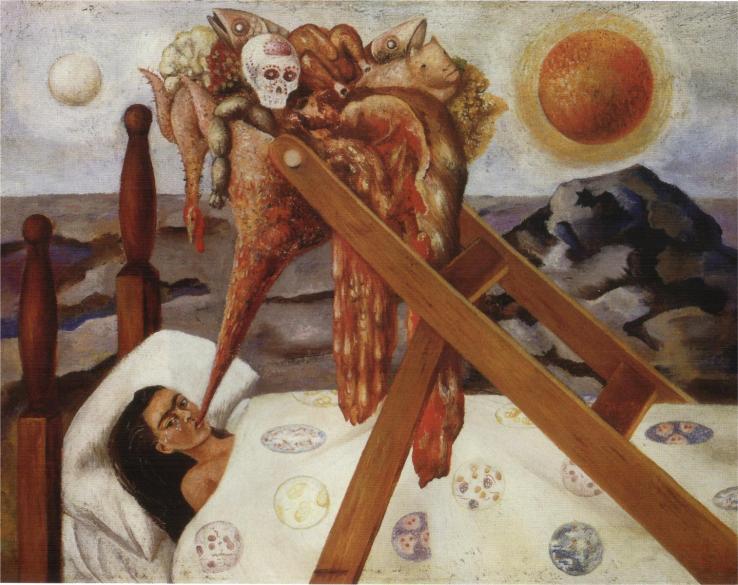
Without Hope — Frida Kahlo

without-hope-1945.jpg!HD

“The Gilded Six-Bits” — Zora Neale Hurston

“The Gilded Six-Bits” by Zora Neale Hurston

It was a Negro yard around a Negro house in a Negro settlement that looked to the payroll of the G. and G. Fertilizer works for its support.
But there was something happy about the place. The front yard was parted in the middle by a sidewalk from gate to doorstep, a sidewalk edged on either side by quart bottles driven neck down into the ground on a slant. A mess of homey flowers planted without a plan but blooming cheerily from their helter-skelter places. The fence and house were whitewashed. The porch and steps scrubbed white.
The front door stood open to the sunshine so that the floor of the front room could finish drying after its weekly scouring. It was Saturday. Everything clean from the front gate to the privy house. Yard raked so that the strokes of the rake would make a pattern. Fresh newspaper cut in fancy edge on the kitchen shelves.
Missie May was bathing herself in the galvanized washtub in the bedroom. Her dark-brown skin glistened under the soapsuds that skittered down from her washrag. Her stiff young breasts thrust forward aggressively, like broad-based cones with the tips lacquered in black.
She heard men’s voices in the distance and glanced at the dollar clock on the dresser.
“Humph! Ah’m way behind time t’day! Joe gointer be heah ‘fore Ah git mah clothes on if Ah don’t make haste.”
She grabbed the clean mealsack at hand and dried herself hurriedly and began to dress. But before she could tie her slippers, there came the ring of singing metal on wood. Nine times.
Missie May grinned with delight. She had not seen the big tall man come stealing in the gate and creep up the walk grinning happily at the joyful mischief he was about to commit. But she knew that it was her husband throwing silver dollars in the door for her to pick up and pile beside her plate at dinner. It was this way every Saturday afternoon. The nine dollars hurled into the open door, he scurried to a hiding place behind the Cape jasmine bush and waited.  Continue reading ““The Gilded Six-Bits” — Zora Neale Hurston”

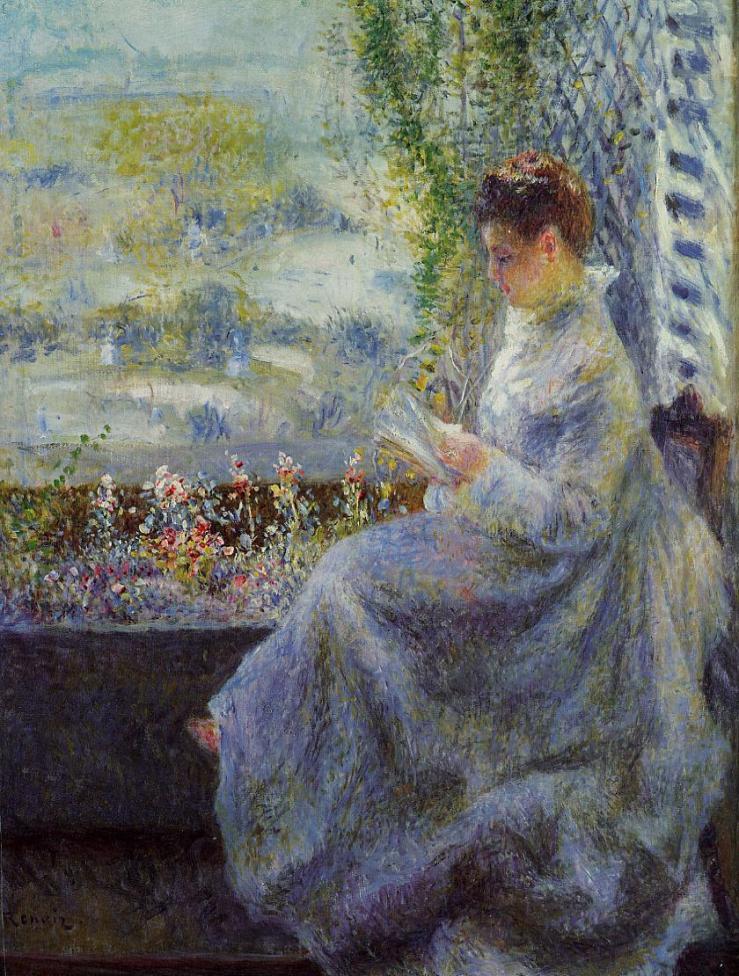
Madame Chocquet Reading — Pierre-Auguste Renoir

madame-chocquet-reading-1876

Sunrise — F.W. Murnau (Full Film)

Hunting Birds at Night — Jean-Francois Millet

hunting-birds-at-night-1874

Average Blurb / Excellent Blurb

20130201-173414.jpg

“And there is a Catskill eagle in some souls that can alike dive down into the blackest gorges…” (Moby-Dick)

Look not too long in the face of the fire, O man! Never dream with thy hand on the helm! Turn not thy back to the compass; accept the first hint of the hitching tiller; believe not the artificial fire, when its redness makes all things look ghastly. To-morrow, in the natural sun, the skies will be bright; those who glared like devils in the forking flames, the morn will show in far other, at least gentler, relief; the glorious, golden, glad sun, the only true lamp—all others but liars!

Nevertheless the sun hides not Virginia’s Dismal Swamp, nor Rome’s accursed Campagna, nor wide Sahara, nor all the millions of miles of deserts and of griefs beneath the moon. The sun hides not the ocean, which is the dark side of this earth, and which is two thirds of this earth. So, therefore, that mortal man who hath more of joy than sorrow in him, that mortal man cannot be true—not true, or undeveloped. With books the same. The truest of all men was the Man of Sorrows, and the truest of all books is Solomon’s, and Ecclesiastes is the fine hammered steel of woe. “All is vanity.” ALL. This wilful world hath not got hold of unchristian Solomon’s wisdom yet. But he who dodges hospitals and jails, and walks fast crossing graveyards, and would rather talk of operas than hell; calls Cowper, Young, Pascal, Rousseau, poor devils all of sick men; and throughout a care-free lifetime swears by Rabelais as passing wise, and therefore jolly;—not that man is fitted to sit down on tomb-stones, and break the green damp mould with unfathomably wondrous Solomon.

But even Solomon, he says, “the man that wandereth out of the way of understanding shall remain” (I.E., even while living) “in the congregation of the dead.” Give not thyself up, then, to fire, lest it invert thee, deaden thee; as for the time it did me. There is a wisdom that is woe; but there is a woe that is madness. And there is a Catskill eagle in some souls that can alike dive down into the blackest gorges, and soar out of them again and become invisible in the sunny spaces. And even if he for ever flies within the gorge, that gorge is in the mountains; so that even in his lowest swoop the mountain eagle is still higher than other birds upon the plain, even though they soar.

From “The Try-Works,” Chapter 96 of Melville’s Moby-Dick.


Lydia Davis Reads “Once a Very Stupid Man”

“Two Queens” — Lydia Cabrera

Capture

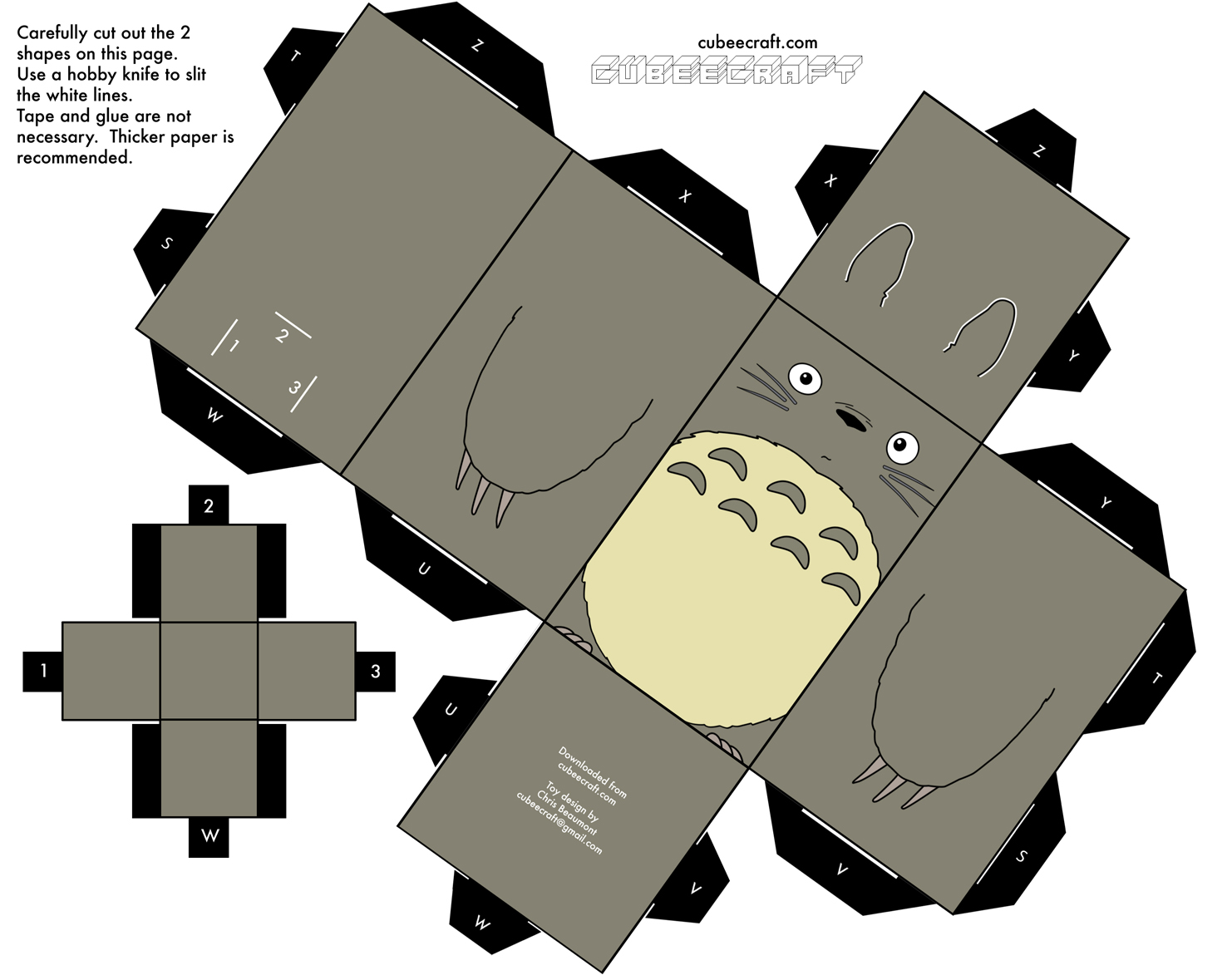
Make Your Own Totoro

totoro(Via).


“The Idiots” — Joseph Conrad

“The Idiots” by Joseph Conrad

We were driving along the road from Treguier to Kervanda. We passed at a smart trot between the hedges topping an earth wall on each side of the road; then at the foot of the steep ascent before Ploumar the horse dropped into a walk, and the driver jumped down heavily from the box. He flicked his whip and climbed the incline, stepping clumsily uphill by the side of the carriage, one hand on the footboard, his eyes on the ground. After a while he lifted his head, pointed up the road with the end of the whip, and said–

“The idiot!”

The sun was shining violently upon the undulating surface of the land. The rises were topped by clumps of meagre trees, with their branches showing high on the sky as if they had been perched upon stilts. The small fields, cut up by hedges and stone walls that zig-zagged over the slopes, lay in rectangular patches of vivid greens and yellows, resembling the unskilful daubs of a naive picture. And the landscape was divided in two by the white streak of a road stretching in long loops far away, like a river of dust crawling out of the hills on its way to the sea.

“Here he is,” said the driver, again. Continue reading ““The Idiots” — Joseph Conrad”

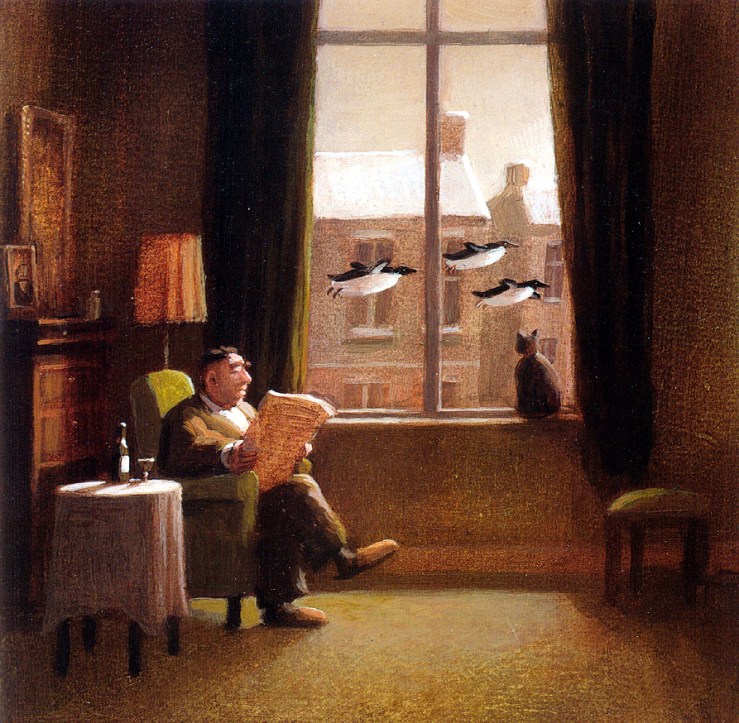
February — Michael Sowa

february

“I squeezed that sperm till a strange sort of insanity came over me” (Moby-Dick)

Squeeze! squeeze! squeeze! all the morning long; I squeezed that sperm till I myself almost melted into it; I squeezed that sperm till a strange sort of insanity came over me; and I found myself unwittingly squeezing my co-laborers’ hands in it, mistaking their hands for the gentle globules. Such an abounding, affectionate, friendly, loving feeling did this avocation beget; that at last I was continually squeezing their hands, and looking up into their eyes sentimentally; as much as to say,—Oh! my dear fellow beings, why should we longer cherish any social acerbities, or know the slightest ill-humor or envy! Come; let us squeeze hands all round; nay, let us all squeeze ourselves into each other; let us squeeze ourselves universally into the very milk and sperm of kindness.

Would that I could keep squeezing that sperm for ever! For now, since by many prolonged, repeated experiences, I have perceived that in all cases man must eventually lower, or at least shift, his conceit of attainable felicity; not placing it anywhere in the intellect or the fancy; but in the wife, the heart, the bed, the table, the saddle, the fireside, the country; now that I have perceived all this, I am ready to squeeze case eternally. In thoughts of the visions of the night, I saw long rows of angels in paradise, each with his hands in a jar of spermaceti.

From “A Squeeze of the Hand,” Chapter 94 of Herman Melville’s novel Moby-Dick.

Galaxie 500 Playing “Tugboat” Under a Basketball Hoop in 1989

Anecdote on W.H. Auden’s Hygiene, Via David Markson

Capture

The Unborn Fetus: Who Will Play Sancho Panza to Its Don Quixote? — Mahendra Singh

singh

An image from Mahendra Singh’s strange and wonderful and as-yet-unfinished volume The Dream Book of Mr Pyridine,

See more of Singh’s work at his site; read his interview with Biblioklept.