Charles Burns’s The Hive (Book Acquired 10.15.2012)

20121030-155650.jpg

For some reason—some reason founded on no reason at all but rather superstitious suspicion—I didn’t believe Charles Burns would follow up X’ed Out, the first chapter of a proposed trilogy. I suppose X’ed Out had unresolved cult classic written all over it (written metaphorically, of course).

X’ed Out was one of my favorite books of 2010. From my review:

In Black Hole, Burns established himself as a master illustrator and a gifted storyteller, using severe black and white contrast to evoke that tale’s terrible pain and pathos. X’ed Out appropriately brings rich, complex color to Burns’s method, and the book’s oversized dimensions showcase the art beautifully. This is a gorgeous book, both attractive and repulsive (much like Freud’s concept of “the uncanny,” which is very much at work in Burns’s plot). Like I said at the top, fans of Burns’s comix likely already know they want to read X’ed Out; weirdos who love Burroughs and Ballard and other great ghastly fiction will also wish to take note. Highly recommended.

20121030-155702.jpg

So, of course I was stoked when Burns’s sequel The Hive showed up a few weeks ago—in fact, the only thing that got in the way of me reading it immediately was that it showed up in a package along with Chris Ware’s Building Stories (this is, without question, the best package I’ve received in six years of doing the blog).

20121030-155714.jpg

Anyway, I’ll be revisiting X’ed Out and then reviewing The Hive in the next week or so. For now, a few pics. Two from the interior above. And our hero Doug, in his alter-ego/costume Nitnit (inverse Tintin):

20121030-155722.jpg

I dig this panel in particular: A take on Roy Lichtenstein via Raymond Pettibon via the romance comics those pop artists were riffing on:

20121030-155729.jpg


Mischief Night — Jamie Wyeth

“Where for aught any man knows lies the locality of hell” (A Passage from Blood Meridian)

The malpais. It was a maze. Ye’d run out upon a little promontory and ye’d be balked about by the steep crevasses, you wouldnt dare to jump them. Sharp black glass the edges and sharp the flinty rocks below. We led the horses with every care and still they were bleedin about their hooves. Our boots was cut to pieces. Clamberin over those old caved and rimpled plates you could see well enough how things had gone in that place, rocks melted and set up all wrinkled like a pudding, the earth stove through to the molten core of her. Where for aught any man knows lies the locality of hell. For the earth is a globe in the void and truth there’s no up nor down to it and there’s men in this company besides myself seen little cloven hoof-prints in the stone clever as a little doe in her going but what little doe ever trod melted rock? I’d not go behind scripture but it may be that there has been sinners so notorious evil that the fires coughed em up again and I could well see in the long ago how it was little devils with their pitchforks had traversed that fiery vomit for to salvage back those souls that had by misadventure been spewed up from their damnation onto the outer shelves of the world. Aye. It’s a notion, no more. But someplace in the scheme of things this world must touch the other. And somethin put them little hooflet markings in the lava flow for I seen them there myself.

From Cormac McCarthy’s novel Blood Meridian.


Adoration of the Moon — Max Weber

Martin Scorsese’s The King of Comedy, Example #1 on the Horror/Comedy Axis

Werewolf — Andre Masson

The Cabinet of Dr. Caligari (Full Film)

To Repel Ghosts — Jean-Michel Basquiat

Watch The Secret Adventures of Tom Thumb, A Disturbing and Moving Stop Motion Fairy Tale

“My life closed twice before its close” — Emily Dickinson

My life closed twice before its close—
It yet remains to see
If Immortality unveil
A third event to me

So huge, so hopeless to conceive
As these that twice befell.
Parting is all we know of heaven,
And all we need of hell.

—Emily Dickinson.

The Phantom of Kohada Koheiji — Katsushika Hokusai

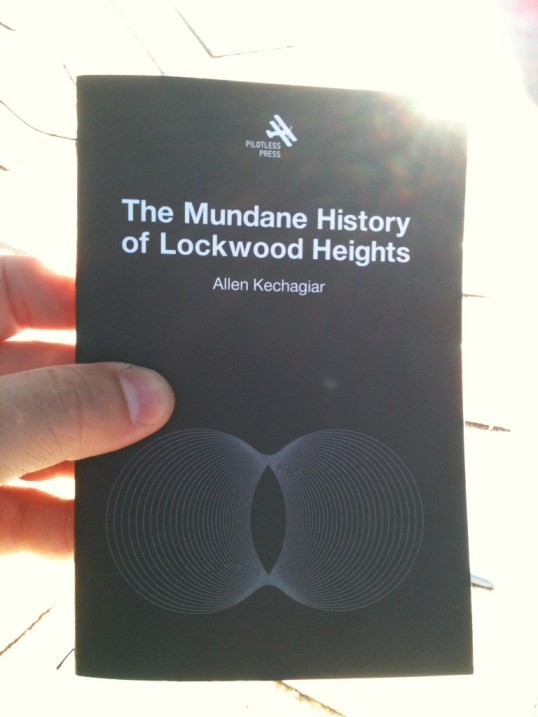
I Review The Mundane History of Lockwood Heights, a Chapbook by Allen Kechagiar

20121029-143421.jpg

“The Mundane History of Lockwood Heights” is a lovely little chapbook, new from Pilotless Press, an Athenian  outfit (uh, Greek, not Georgian) that  knows how to put together an aesthetically-pleasing text. “Lockwood Heights” is their first release. It’s by Allen Kechagiar, who, full disclosure, I’ve been email-friendly with for a several years now.

What’s “Lockwood Heights” about?

An unnamed narrator, a young man, returns to his hometown in California, the titular Lockwood Heights, “another far station, another dead end valley prone to fire, another far suburb with no other cause than the profit it would generate for its contractors.” With little going for it in a depressed economy, the citizens of Lockwood Heights allow porn production to become their town’s raison d’etre. Studios move in and the girls of Lockwood Heights soon find they can essentially auction off their virginity on camera:

They struggle to keep their virginity intact (or at any rate their parents struggle to keep it so) and hope that they will be chosen as the royal heir’s queen consort. Here, at Lockwood Heights, we had our very own race: at its finish line there was no prince to greet the winners, but a whole menagerie, or more accurately a bestiary, comprising of artificially tanned Californian would-have-beens, barely legal girls with gigantic strap-ons, transvestites and hermaphrodites, midgets and giants, obese, anorexic, effeminate, silicon-enhanced or not, all of them with a ticket to her body, standing in a metaphorical queue. A body that wasn’t hers to control anymore. The studio owned it from then on, through the unwritten contracts of promised fame that is rarely delivered.

They were also called the Treasurers or The Knights Who Say No. Their motto was non numquam. Their herald was a locked gate.

The various histories of these girls fill most of “The Mundane History of Lockwood Heights,” and as the narrator often uses the first-person plural “we” (that is, the high school boys), the story sometimes takes on a melancholy and wistful tone similar to Eugenides’s The Virgin Suicides. These are the finest moments of “Heights,” compact and precise narratives that relate the sad (and sometimes not-so-sad) lives of these girls who make porn (or, in some cases, refuse to).

It’s not just the girls of Lockwood Heights who sell their bodies on film—our protagonist comes home to sell all he has left, his “twin virginity” to be lost for a director who is sometimes called the Stanley Kubrick of porn. Scenes of the narrator meeting the casting director, his costar, and other workers on the film’s production are interspersed with the girl stories, as well as the backdrop of the narrator’s homecoming. His father has died, his mother is absent, and a strange little ersatz closet has been constructed in one of the house’s corridors. The interrelationship between these three elements is not as fully developed as it could be; I found myself wanting more. I also wanted more of the strange, aphoristic asides the narrator occasionally offers, like this one:

When we sleep we do not live in the full sense of the word. We rehearse death. Our dreams, the fallout of our daily lives, can only be remembered. They cannot be lived.

When they happen, we do not exist.

In its best moments (and there are plenty of those), “Heights” commands the reader’s attention with its bizarre mix of pathos and the pathetic, with sharp humor that threatens to tip into something more sinister. The southern California exurb Kechagiar crafts recalls the slightly off dystopias of George Saunders—the kind of place we wish were more removed from our immediate reality. “The Mundane History of Lockwood Heights” feels like the starting point of something bigger, more expansive, more detailed—and I’d want to read that something. Recommended.

Girl Reading — Pierre-Auguste Renoir

Mummified Frog — M.C. Escher

Warm Halloween — Jamie Wyeth

Types of Fear (A Passage from Roberto Bolaño’s Novel 2666)

There are odder things than sacraphobia, said Elvira Campos, especially if you consider that we’re in Mexico and religion has always been a problem here. In fact, I’d say all Mexicans are essentially sacraphobes. Or take gephyrophobia, a classic fear. Eots of people suffer from it. What’s gephyrophobia? asked Juan de Dios Martinez. The fear of crossing bridges. That’s right, I knew someone once, well, it was a boy, really, who was afraid that when he crossed a bridge it would collapse, so he’d run across it, which was much more dangerous. A classic, said Elvira Campos. Another classic: claustrophobia. Fear of confined spaces. And another: agoraphobia. Fear of open spaces. I’ve heard of those, said Juan de Dios Martinez. And one more: necrophobia. Fear of the dead, said Juan de Dios Martinez, I’ve known people like that. It’s a handicap for a policeman. Then there’s hemophobia, fear of blood. That’s right, said Juan de Dios Martinez. And peccatophobia, fear of comitting sins. But there are other, rarer, fears. For instance, clinophobia. Do you know what that is? No idea, said Juan de Dios Martinez. Fear of beds. Can anyone really fear beds, or hate them? Actually, yes, there are people who do. But they can deal with the problem by sleeping on the floor and never going into a bedroom. And then there’s tricophobia, or fear of hair. That’s a little more complicated, isn’t it? Yes, very much so. There are cases of tricophobia that end in suicide. And there’s verbophobia, fear of words. Which must mean it’s best not to speak, said Juan de Dios Martinez. There’s more to it than that, because words are everywhere, even in silence, which is never complete silence, is it? And then we have vestiphobia, which is fear of clothes. It sounds strange but it’s much more widespread than you’d expect. And this one is relatively common: iatrophobia, or fear of doctors. Or gynophobia, which is fear of women, and naturally afflicts only men. Very widespread in Mexico, although it manifests itself in different ways. Isn’t that a slight exaggeration? Not a bit: almost all Mexican men are afraid of women. I don’t know what to say to that, said Juan de DiosMartinez. Then there are two fears that are really very romantic: ombrophobia and thalassophobia, or fear of rain and fear of the sea. And two others with a touch of the romantic: anthophobia, or fear of flowers, and dendrophobia, fear of trees. Some Mexican men may be gynophobes, said Juan de DiosMartinez, but not all of them, it can’t be that bad. What do you think optophobia is? asked the director. Opto, opto, something to do with the eyes, my God, fear of the eyes? Even worse: fear of opening the eyes. In a figurative sense, that’s an answer to what you just said about gynophobia. In a literal sense, it leads to violent attacks, loss of consciousness, visual and auditory hallucinations, and generally aggressive behavior. I know, though not personally, of course, of two cases in which the patient went so far as to mutilate himself. He put his eyes out? With his fingers, the nails, said the director. Good God, said Juan de Dios Martinez. Then we have pedophobia, of course, which is fear of children, and ballistophobia, fear of bullets. That’s my phobia, said Juan de Dios Martinez. Yes, I suppose it’s only common sense, said the director. And another phobia, this one on the rise: tropophobia, or the fear of making changes or moving. Which can be aggravated if it becomes agyrophobia, fear of streets or crossing the street. Not to forget chromophobia, which is fear of certain colors, or nyctophobia, fear of night, or ergophobia, fear of work. A common complaint is decidophobia, the fear of making decisions. And there’s a fear that’s just beginning to spread, which is anthrophobia, or fear of people. Some Indians suffer from a heightened form of astrophobia, which is fear of meteorological phenomena like thunder and lightning. But the worst phobias, in my opinion, are pantophobia, which is fear of everything, and phobophobia, fear of fear itself. If you had to suffer from one of the two, which would you choose? Phobophobia, said Juan de Dios Martinez. Think carefully, it has its drawbacks, said the director. Between being afraid of everything and being afraid of my own fear, I’d take the latter. Don’t forget I’m a policeman and if I was scared of everything I couldn’t work. But if you’re afraid of your own fears, you’re forced to live in constant contemplation of them, and if they materialize, what you have is a system that feeds on itself, a vicious cycle, said the director.
From “The Part About the Crimes,” 2666 by Roberto Bolaño.


Ghostly Gourds — Norman Rockwell