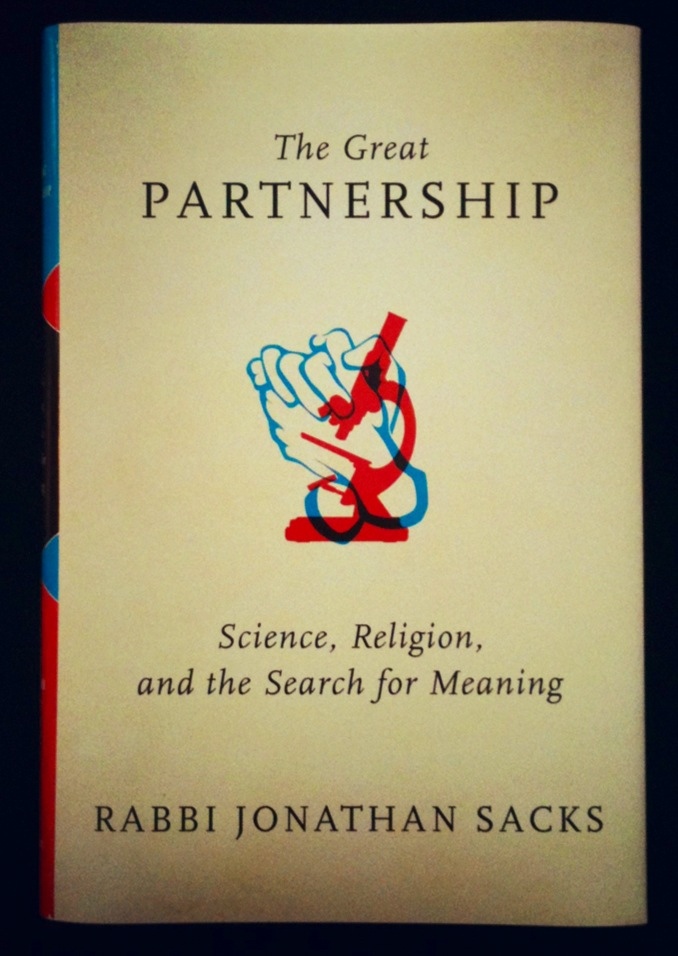
Jonathan Sacks’s The Great Partnership: Science, Religion, and the Search for Meaning is getting a hardback release in the US from Random House (it’s been out in the UK for a while now). RH’s blurb:
An impassioned, erudite, thoroughly researched, and beautifully reasoned book from one of the most admired religious thinkers of our time that argues not only that science and religion are compatible, but that they complement each other—and that the world needs both.
“Atheism deserves better than the new atheists,” states Rabbi Jonathan Sacks, “whose methodology consists of criticizing religion without understanding it, quoting texts without contexts, taking exceptions as the rule, confusing folk belief with reflective theology, abusing, mocking, ridiculing, caricaturing, and demonizing religious faith and holding it responsible for the great crimes against humanity. Religion has done harm; I acknowledge that. But the cure for bad religion is good religion, not no religion, just as the cure for bad science is good science, not the abandonment of science.”
Rabbi Sacks’s counterargument is that religion and science are the two essential perspectives that allow us to see the universe in its three-dimensional depth. Science teaches us where we come from. Religion explains to us why we are here. Science is the search for explanation. Religion is the search for meaning. We need scientific explanation to understand nature. We need meaning to understand human behavior. There have been times when religion tried to dominate science. And there have been times, including our own, when it is believed that we can learn all we need to know about meaning and relationships through biochemistry, neuroscience, and evolutionary psychology. In this fascinating look at the interdependence of religion and science, Rabbi Sacks explains why both views are tragically wrong.
Look, I’ll be frank—I’m hardly a fan of the so-called “new atheists,” but that’s not what this book is really about. It’s really about trying to restore an anchoring metaphysical center—a god, namely, Sacks’s god—despite the progress made by science and philosophy. What I find repellent about Sacks’s book is the idea that only religion can provide a logical, meaningful answer to “why we are here.” I have no problem with the coexistence of religion and science, but that’s not what Sacks wants. He wants religion to dominate. Anyway, clearly I’m not enthusiastic, but if you’re interested, here’s a proper review.
















 Biblioklept